The Wolf King Summary, Characters and Themes
The Wolf King by Lauren Palphreyman is a fantasy novel that explores themes of power, loyalty, and survival in a world filled with violence and manipulation. The story follows Princess Aurora, a woman trapped in a political marriage to a cruel noble, Lord Sebastian, while her life becomes entwined with the dangerous and mysterious Wolves—humans who can transform into wolves.
As Aurora finds herself caught between the oppressive world of her father’s court and the unpredictable, brutal forces of the Wolves, she must navigate betrayal, shifting alliances, and growing feelings for Callum, a powerful Alpha wolf. The novel combines political intrigue, complex relationships, and intense action, creating a captivating tale of survival, love, and vengeance.
Summary
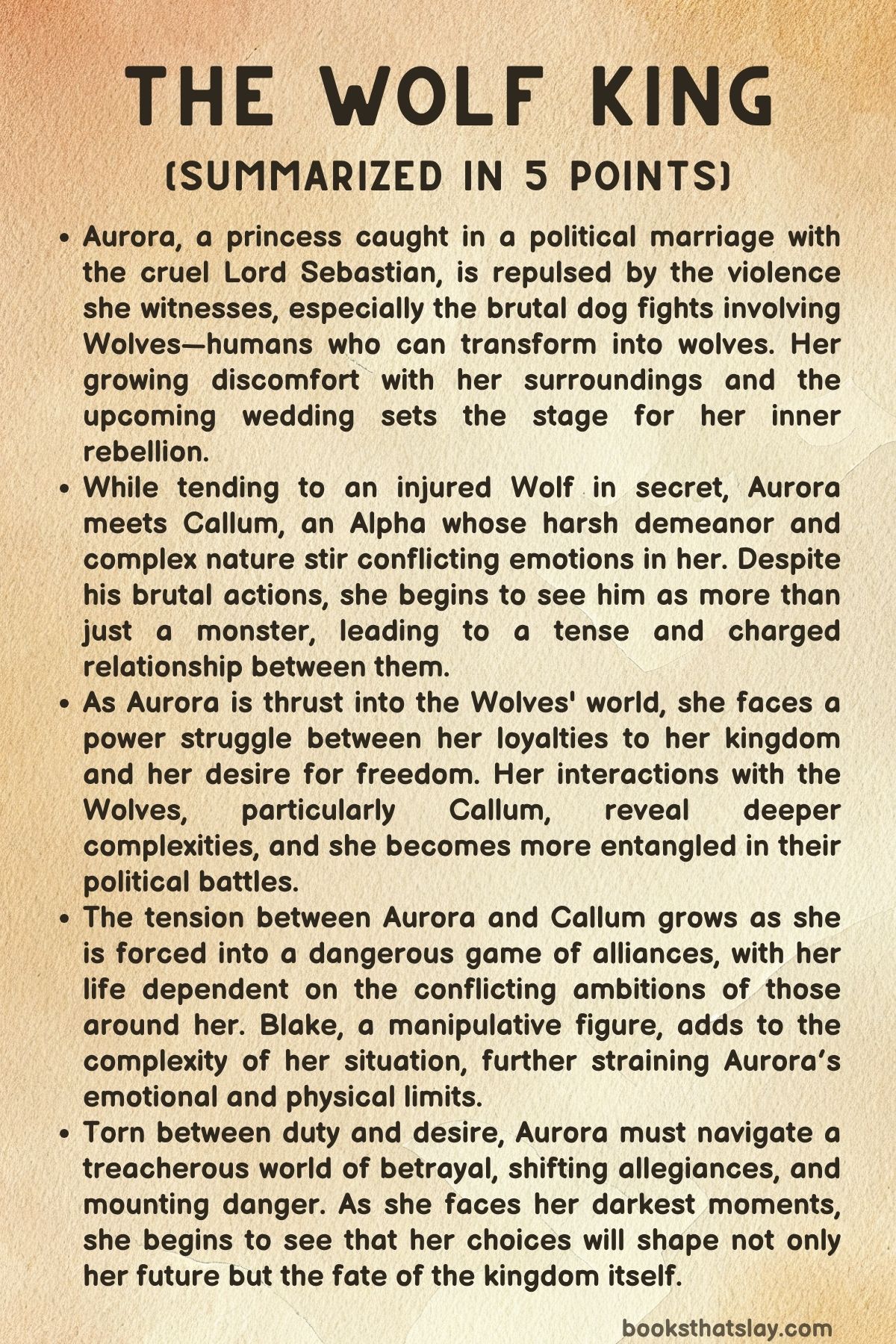
Aurora, the daughter of a powerful king, finds herself in a dangerous marriage arrangement with Lord Sebastian, a cruel noble who seeks to use her for political gain. Her life is further complicated when she is forced to witness brutal dog fights, where the Wolves—humans who can shift into wolves—fight each other for sport.
Aurora is disturbed by the violence, and despite her beauty and status, she is trained to be obedient and silent. However, the cruel reality of her upcoming marriage and the violence around her stir a sense of rebellion in her.
The pivotal moment occurs when Aurora encounters an Alpha male during a dog fight. Despite the Alpha’s brutal nature, she is inexplicably drawn to him.
He radiates a raw hatred, which stirs something deep within her. This meeting sets off a series of events that will change the course of Aurora’s life.
Later, she sneaks into the kennels where the Wolves are kept, hoping to help a young, injured Wolf. As she tends to the wounded animal, she encounters the Alpha again, who warns her to stay away, yet there is an undeniable tension between them.
Despite his rough demeanor, Aurora starts to see him as more than just a monster.
As time passes, Aurora’s sense of entrapment grows. She is nothing more than a pawn in the power struggles between her father, Lord Sebastian, and the Wolves.
Still, Aurora shows moments of defiance, risking her safety to help the Wolves and challenge the oppressive expectations placed upon her. In a pivotal act of rebellion, she intervenes during a fight, sparing the life of a young Wolf, defying both her father and Sebastian.
This action sets the stage for a dramatic confrontation, where Aurora’s world begins to spiral out of control.
Sebastian, angered by her defiance, lashes out violently, and the situation escalates with Aurora being taken by the Alpha. Though forcibly captured, Aurora recognizes that her fate may no longer be in her hands, and a deeper sense of longing begins to grow within her.
The Alpha, who has now become her captor, reveals his plan to take her to the Wolf King—a figure who holds a significant role in the conflict between her father and the Wolves. As they journey toward the Northlands, Aurora is torn between her loyalty to her kingdom and her growing bond with the Alpha, who has become a more complex figure in her life.
As the journey progresses, Aurora comes to learn more about the Wolves and their motives. The Alpha, named Callum, explains the legend of the Elderwolf—a tale that reveals the history of the Wolves’ connection to the Moon and the curse they bear.
This story adds a layer of depth to the Wolves’ world and their struggle for freedom, with the Heart of the Moon being the key to their transformation. Aurora also learns that Sebastian possesses this powerful relic, and the Wolves believe that retrieving it will help them win the war.
Tensions rise as Aurora’s feelings for Callum grow more complicated. She begins to see him as more than just a ruthless captor.
Yet, she is still trapped between the power struggles of the Wolves and her loyalty to her family. Their journey takes them to a castle where Callum’s past relationships and the political intrigues of the Wolves further complicate Aurora’s situation.
She grows increasingly uncomfortable with her role in the Wolves’ plans and starts to question her place in the world.
In the Wolves’ territory, Aurora faces increasing hostility from the pack, especially from Blake, a dangerous and manipulative figure. Blake seems to have a deep interest in Aurora, which only adds to her growing sense of helplessness.
Callum, though protective, is caught in a power struggle within the Wolves, torn between loyalty to his pack and his connection to Aurora. As Blake continues to undermine Callum’s authority, Aurora is forced to confront the complexities of her situation and the uncertain future ahead.
Aurora’s relationship with Callum deepens, and she begins to see the vulnerability beneath his fierce exterior. However, the power dynamics between the Wolves make her position increasingly precarious.
Blake’s manipulative behavior and the political games within the pack further complicate Aurora’s already tangled emotions. She is caught between her duty to her kingdom, her growing feelings for Callum, and the manipulation of those around her.
Things take a darker turn when Aurora is imprisoned by Blake and forced into a dangerous position. She must choose between marrying James, the Wolf King, or being handed over to Sebastian.
As she navigates these treacherous waters, she learns of Blake’s true intentions—to use her as a pawn in his own game for power. His betrayal cuts deep, especially as Aurora begins to realize that she has a deeper connection with Callum than she initially thought.
In a desperate act of self-preservation, Aurora makes a choice that shocks everyone—she kills Sebastian. This marks a turning point in her journey as she grapples with the consequences of her actions and the growing conflict within the Wolves’ pack.
During a chaotic battle, Aurora is gravely injured by James, but Callum arrives just in time to save her. However, their reunion is complicated when Blake reveals that he has bonded his life force with Aurora’s, making her life dependent on his.
As Aurora’s fate becomes intertwined with both Blake and Callum, she must navigate the dangerous political landscape and the shifting alliances that surround her. Blake’s manipulation becomes increasingly evident as he seeks to control both Aurora and Callum.
Yet, Aurora is determined to take control of her own destiny, recognizing that she can use Blake’s treachery to her advantage.
The story ends with Aurora standing at the crossroads of her future, ready to face the challenges ahead. She must choose between loyalty, freedom, and the love she shares with Callum, knowing that the power struggles within the Wolves and the kingdom will determine not only her fate but the future of the entire realm.
Characters
Aurora
Aurora is the protagonist of The Wolf King and the daughter of a king who finds herself caught in a brutal world of power, violence, and manipulation. Initially presented as a beautiful, obedient princess, her character evolves throughout the story as she begins to defy the constraints placed on her.
Aurora is forced into a marriage with Lord Sebastian, a cruel and ambitious nobleman who seeks to use her to strengthen his political position. Her engagement symbolizes her powerless existence in a world dominated by men, but her growing awareness of the violence surrounding her prompts her to question her place.
The cruelty she witnesses, particularly during the dog fights where Wolves—humans who can transform into wolves—fight for sport, disturbs her deeply and sets the stage for her eventual rebellion.
As Aurora becomes more involved with the Wolves, especially the Alpha, Callum, her emotions and loyalties are torn. She is caught between her loyalty to her family and her growing bond with Callum, who represents a path that contrasts with everything she has known.
Aurora’s inner conflict is one of the central themes of the story, as she grapples with the power dynamics of her kingdom, her duty, and her desires for freedom and autonomy. Despite her circumstances, she shows moments of strength, such as when she saves a young Wolf from execution, marking her first act of defiance.
Over time, Aurora becomes a more determined and complex character, one who is forced to make difficult choices and navigate the treacherous political and personal dynamics of her world.
Callum
Callum, the Alpha of the Wolves, plays a pivotal role in The Wolf King as both a captor and a potential love interest for Aurora. Initially seen as a brutal and dangerous figure, Callum is revealed to be more than just a savage warrior.
He is deeply connected to the Wolves’ struggle for survival and their search for the Heart of the Moon, a powerful relic believed to enable the Wolves to shift freely. Callum’s relationship with Aurora is fraught with tension, as he is tasked with capturing her and taking her to the Wolf King, but he is not entirely unaffected by her presence.
Despite his rough exterior and intimidating demeanor, Callum shows moments of vulnerability and care, especially when he tends to Aurora’s injuries and protects her from other members of his pack.
His character is complex, as he is torn between his loyalty to the Wolves and his growing feelings for Aurora. Callum’s internal struggle is evident as he grapples with the political intrigue within the pack, particularly his interactions with Blake, another powerful figure among the Wolves.
While he is protective of Aurora, he also faces the pressure of his position as Alpha and the responsibilities that come with it. Callum is a character defined by his intense emotions and the weight of the choices he must make for the sake of his people and his growing relationship with Aurora.
Blake
Blake is a cunning and manipulative figure within the Wolf pack, serving as both a political player and a source of tension for the other characters. His motivations are shrouded in mystery, and he plays a dangerous game of power, constantly maneuvering to achieve his own goals.
Blake’s interactions with Aurora are fraught with manipulation and subtle threats, as he seeks to use her as a pawn in his quest for control. His ultimate objective is to seize power within the Wolves and undermine Callum’s position as Alpha, eventually challenging him for the throne.
Blake’s relationship with Aurora is one of constant manipulation. He preys on her vulnerabilities, reminding her of the loss of her mother and using her emotions to control her.
Despite this, Aurora begins to see through his schemes and realizes the extent of his treachery. Blake’s manipulations create a complex web of power dynamics, as he tries to ensure that Aurora’s fate is tied to his own, using her to ensure Callum’s downfall.
His character is a driving force of conflict in the narrative, as his hidden motives and actions challenge both Aurora and Callum, forcing them to confront their own desires and choices in the face of his plotting.
Lord Sebastian
Lord Sebastian is Aurora’s betrothed and one of the main antagonists in The Wolf King. He is a power-hungry and cruel nobleman who sees Aurora as nothing more than a tool to solidify his political standing.
His marriage proposal to Aurora is not driven by love but by ambition, as he believes that marrying her will strengthen his position in the kingdom. Sebastian’s arrogance and disdain for Aurora are evident throughout the story, especially when he taunts her about the brutal dog fights and tries to dominate her both emotionally and physically.
As the story progresses, Sebastian’s cruelty becomes more apparent, especially in his interactions with Aurora, who begins to defy him. His reaction to her defiance is violent, and he tries to assert his control over her, making him one of the primary forces driving Aurora’s desire to escape.
Although he represents a traditional form of oppression in the story, Sebastian is a character who also highlights Aurora’s growth, as she begins to stand up for herself and make choices that go against his wishes. His presence in the narrative adds to the sense of entrapment Aurora feels, and his eventual fate plays a significant role in her journey towards self-determination.
Fiona
Fiona is a minor yet significant character in The Wolf King, who serves as a potential rival to Aurora within the Wolf pack. She is presented as an old friend of Callum, and her interactions with him create a sense of tension and jealousy for Aurora.
Fiona’s role is that of a possible love interest for Callum, which further complicates Aurora’s emotional journey as she begins to form a bond with the Alpha. Though Fiona is not an overt antagonist, her presence in the story creates a subtle but important conflict, highlighting Aurora’s insecurity and the complexities of her evolving relationship with Callum.
Fiona’s role in the plot is largely one of contrast to Aurora, as she represents a life Callum might have had before Aurora’s arrival. Her relationship with Callum is marked by familiarity and history, but it also symbolizes the internal conflicts Aurora faces as she navigates her feelings for him.
Fiona’s presence serves as a reminder to Aurora of the delicate balance she must maintain in her relationship with Callum, while also dealing with her own feelings of jealousy and uncertainty. Though not a primary antagonist, Fiona’s role in the story underscores the emotional challenges Aurora faces in her journey towards self-realization and freedom.
Themes
Power and Control
In The Wolf King, power and control are at the heart of many of the conflicts, both personal and political. The protagonist, Aurora, is ensnared in a complex web of power dynamics that threaten to consume her.
Initially, her father and Lord Sebastian use her as a pawn to secure political alliances, which diminishes her autonomy and positions her as an object of control. Her marriage to Sebastian is arranged solely to strengthen her father’s political stance, stripping Aurora of her freedom and personal agency.
This lack of control over her own life leads to a deep internal struggle, as she grapples with the realization that her choices are constrained by the manipulative forces around her.
Simultaneously, Aurora’s capture by the Wolves, particularly Callum, further complicates her relationship with power. As she is transported deeper into the Northlands, Aurora’s position becomes one of forced submission.
Callum, although protective at times, also holds power over her, but the dynamics between them are more nuanced. His power comes from being the Alpha, while Aurora is not merely a victim of circumstance—she begins to understand that her emotions and decisions also carry weight.
The theme of power and control is not just external; it reflects Aurora’s internal battle as she tries to navigate between the oppressive world of her father, her soon-to-be husband, and the Wolves, whose politics are just as brutal as the royal court.
The Wolves themselves are embroiled in their own power struggles, with Blake scheming to take control of the pack, while Callum remains caught in his own moral dilemmas. The shifting allegiances and constant betrayals show that control is never absolute, and even the most powerful figures must negotiate the complex politics of survival.
Aurora, who once felt powerless, begins to learn that control is not always about dominance but can also come from understanding and leveraging one’s own strengths in a world full of treachery and betrayal.
Loyalty and Betrayal
Loyalty and betrayal are recurring themes in The Wolf King, with characters constantly wrestling with where their allegiances lie. Aurora’s journey is marked by the tension between her loyalty to her family and her growing emotional bond with Callum, the Alpha.
At the start of the story, she is loyal to her kingdom and her father, even though they treat her as a mere political tool. However, as her circumstances evolve and she becomes entangled with the Wolves, her loyalties begin to shift.
Callum, despite being her captor, shows her a side of the Wolves that is more complex than she initially believed. She starts to feel conflicted, torn between the loyalty she feels toward her father and her deepening connection with the Alpha.
Betrayal is equally central to the narrative. The political intrigue between the Wolves and the kingdom leads to numerous instances of betrayal.
Blake’s manipulation of Aurora is a prime example. He lures her into a false sense of trust, only to later use her as a pawn in his own game for power.
His duplicity makes Aurora realize that even those she thought she could trust are capable of betrayal. Her relationship with James, the Wolf King, is another example of betrayal.
Once, Aurora trusted him, but she learns that his motivations are not as noble as she believed. This realization forces her to take matters into her own hands, even making drastic decisions to protect herself.
As the plot unfolds, Aurora finds herself in a situation where her very survival depends on navigating these shifting alliances. She learns that loyalty is not always about blind allegiance, but about recognizing who genuinely has her best interests at heart.
Betrayal, while painful, becomes a tool for Aurora to shape her destiny. The theme of loyalty and betrayal forces her to confront not only the deceptive nature of those around her but also the complexities of her own beliefs and decisions.
Survival and Autonomy
Survival and autonomy are pivotal themes in The Wolf King, as Aurora is forced to fight not just for her physical survival but also for her sense of self. At the start of the novel, Aurora is depicted as a woman with limited agency.
She is a political pawn, trapped in a system that values her only for her beauty and her ability to secure alliances. The marriage arrangement with Sebastian epitomizes her lack of autonomy, as she has no say in her future.
However, her journey is marked by a gradual but significant transformation as she begins to reclaim control over her fate.
Aurora’s relationship with Callum is crucial to her evolution. Though she is initially captured and forced to follow his orders, she starts to see him as a complex individual who does not simply define her existence.
Her autonomy becomes more of a struggle than ever before as she is pulled between the loyalties and expectations of her kingdom and her growing feelings for Callum. Despite being in a precarious position, Aurora refuses to simply submit to the whims of the powerful men around her.
Instead, she tries to navigate her own path, finding ways to help the Wolves while still holding on to her personal values.
The struggle for survival in the harsh environment of the Northlands is another key aspect of the theme. Aurora faces constant threats to her safety, both from external dangers and from the complex political landscape.
She learns that survival is not just about physical strength, but about making smart decisions, forging alliances, and, at times, choosing when to act decisively. Aurora’s fight for autonomy is not just a battle against the men who seek to control her but a deeper, internal battle to find her place in a world that seems to deny her the freedom to choose her own destiny.
Love and Desire
Love and desire play a significant role in the emotional and narrative development of The Wolf King. Aurora’s emotional journey is driven by the growing complexities of her feelings for Callum, the Alpha of the Wolves.
Though initially, Callum represents a threat to her, her feelings toward him evolve as she learns more about his character. The raw intensity of their interactions speaks to a deeper connection, one that transcends the initial circumstances of her capture.
The tension between them is palpable, and despite the clear power imbalance, their chemistry is undeniable.
Aurora’s relationship with Callum is contrasted with her engagement to Sebastian, who is portrayed as cruel and power-hungry. Her marriage to Sebastian represents the forced nature of her existence, while her growing feelings for Callum signify her desire for something more genuine and self-determined.
The push and pull between these two men—one representing duty and the other passion—create a rich emotional landscape for Aurora. She is torn between the obligations of her position and her growing attraction to Callum, which complicates her feelings of love and desire.
The theme of love is further explored through the relationships within the Wolves. Callum’s protective nature toward Aurora, despite their complex dynamics, shows that love within this pack is not about domination, but rather about understanding and connection.
However, the power struggles within the pack, particularly with Blake’s manipulative actions, make it clear that love can be easily distorted when used for political gain. Aurora’s journey with Callum reveals that love is a force both powerful and dangerous, capable of both healing and destroying in equal measure.
Love and desire, as explored in the book, illustrate the deep conflicts within Aurora’s heart. She must reconcile her feelings for Callum with her duty to her kingdom, all while navigating the treacherous politics and power plays surrounding her.
Love, in this context, becomes a force of both liberation and entrapment, driving Aurora’s decisions as she fights for her survival and autonomy.