The Wondrous Life and Loves of Nella Carter Summary, Characters and Themes
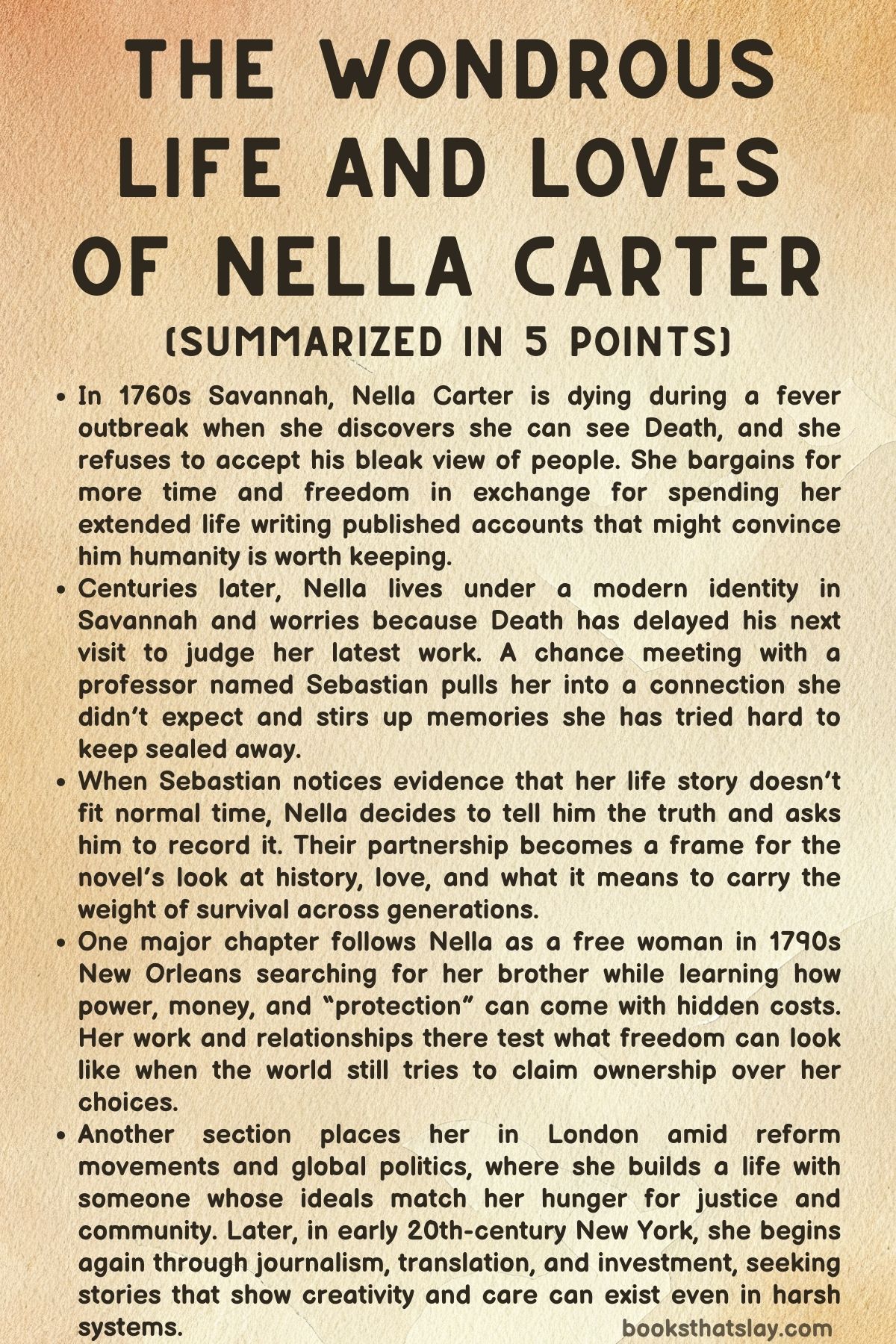
The Wondrous Life and Loves of Nella Carter by Brionni Nwosu is a sweeping speculative historical novel about a woman who refuses to let the world be reduced to its worst people. In 1760s Savannah, enslaved and dying from fever, Nella Carter makes an impossible bargain with Death: she will be spared and set free across centuries, but she must spend her long life writing proof that humanity deserves to continue.
Gifted with an ear for languages and a body that will not age, Nella moves through eras as a witness, a journalist, and a lover, carrying both wonder and grief as her evidence.
Summary
Nella Carter first meets Death on a plantation outside Savannah during a season of disease and panic. Typhoid and yellow fever are tearing through the enslaved quarters and the main house alike.
Death, moving from body to body as he works, is worn down by the endless routine of collecting souls. He is not simply tired of his job; he is losing patience with people themselves.
Every harvest of the dead feels like another confirmation that cruelty spreads faster than kindness. As he approaches Nella’s cabin to take her, he realizes she is watching him clearly.
Unlike everyone around her, she can see what he is.
Nella is barely alive, burning with fever, coughing blood, and marked by a rash. Still, she speaks to Death as if he is a visitor she recognizes.
She tells him she has always been able to see him, and that her mother could too. She is frightened, but she is also curious, and her mind keeps reaching beyond the cabin walls.
She holds tight to a small book she taught herself to read, a rare object that represents a life she was never meant to have. Death expects pleading.
Instead, he finds a young woman who wants to talk about the world.
Death tells her he will return for her when her body gives out. Before he leaves, he asks what she would have done if she had been free.
Nella answers without hesitation: she would have gone everywhere. She would have crossed oceans, walked cities she has only heard named, and found places tied to her family’s origins.
She believes there must be people unlike the ones who own her, people capable of decency even if she has not been allowed to meet them. Death argues that human beings are the same wherever they live, that pain travels well, that the world repeats itself.
Nella refuses to surrender that idea. She insists that even in a life shaped by violence, there can be love, memory, and the will to keep going.
She calls it holding on to dawn: the choice to believe that morning can still matter.
When Death admits he is considering ending humanity entirely, Nella is horrified. His plan is not just to collect souls but to release a final plague, erase people, and let the earth begin again without them.
Nella thinks of those she has loved and lost, and of her brother Silas, sold away years earlier. She cannot accept that Silas, wherever he is, will simply be counted as one more reason for the world to be destroyed.
She proposes a bargain: give her freedom and time, and she will show Death proof that human goodness is real.
Death agrees, but he sets terms designed to make the deal heavy. He restores her health and grants her many lifetimes with an unchanging body, plus an unusual gift: she will be understood wherever she goes, able to speak and be heard across languages.
In exchange, Nella must spend her long life writing and publishing accounts meant for Death’s judgment, records of what she sees and whom she meets. She can never tell anyone about the bargain.
She can never have descendants. If she fails to convince him, Death will take her and then carry out his plan for the world.
Nella accepts, and with a touch to her forehead, Death pulls her back from the edge of dying.
Nearly two and a half centuries later, Nella lives in Savannah again under the name Vivian Edwards. She has cycled through identities for generations, producing travel writing, journalism, and testimony shaped by everything she has witnessed.
She has loved, lost, reinvented herself, and tried to keep moving because stopping makes the losses louder. Recently, she has slowed.
After the death of Winston Reynolds, the last person she truly allowed close, she abandoned her constant travel and reduced her writing to a small local column for The Savannah Tribune. Worse, Death has not appeared for three years.
The silence terrifies her because it suggests a verdict is coming.
One afternoon in a café, Vivian realizes she has forgotten her wallet. A charming stranger offers to pay for her coffee.
The gesture is small, but it hits her like a crack of light in a room she has kept dim for a long time. She feels attraction, a spark she has denied herself because love has always come with a countdown.
Then she spots Death outside, recognizable only to her by the sense of shadow around him, and she panics. She flees, certain that the meeting she has dreaded is close.
That night she attends a university lecture honoring Winston. A major donation is announced, money Vivian herself has built and distributed anonymously across lifetimes.
The featured speaker is a new professor, Dr. Sebastian Moore, and he turns out to be the same man from the café. The coincidence unsettles her, and the lecture makes it worse.
Sebastian’s research focuses on missing voices in Black journalism, including one of Vivian’s former identities, Jimi Ireland. He criticizes that writer for polishing suffering into something easier to consume.
Vivian, unable to stay quiet, challenges him publicly. The exchange is sharp, but it pulls them toward each other rather than pushing them apart.
Afterward, Vivian and Sebastian talk. He invites her into his office, where he shows her an archive of historic Black writing, including clippings of work she created under names he treats as long-dead.
Vivian is overwhelmed by the feeling of being both known and misunderstood. Intimacy arrives fast, mixed with anger and fascination.
She kisses him, and they sleep together, crossing a line she has avoided for years.
The next day becomes a long, charged date. They move through Savannah together: an art gallery, lunch, wandering streets.
Vivian slips between languages at a West African restaurant without thinking, and Sebastian’s interest deepens. At the Telfair Museum, exhibits tied to slavery-era Savannah force Vivian to endure the past in a public space, surrounded by people who see history as objects behind glass rather than something that still lives in her body.
In a small collection room, she notices eighteenth-century hand-painted tin figurines and recognizes them instantly as the work of William, one of her earliest and most dangerous loves. The sight jolts her with grief and fear.
She buys them for an enormous sum, as if she can protect the memory by owning it, then abruptly cuts Sebastian off, telling him to leave her alone for his own good.
Back home, Vivian places the figurines in a trunk filled with objects from her many lives: photos, letters, textiles, clippings, and her battered copy of Robinson Crusoe. The trunk is not just a collection; it is a map of everything she has tried not to lose.
Seeing the figurines among those relics makes her feel as if a circle is closing. A knock comes at the door, and she braces herself, expecting Death.
Instead, it is Sebastian, determined to make sure she is safe.
Vivian tries to send him away, claiming the problem is her past and that no one can help. Sebastian stays, steady and gentle, until she breaks.
When she finally lets him in, he notices the open trunk and the photo albums. He asks if the people are her ancestors.
Vivian answers with the truth: they are all her. She tells him her real name is Nella May Carter, born in 1760, and explains the bargain with Death.
She shows him the photographs across centuries, including identities Sebastian recognizes from his scholarship. Instead of rejecting her, Sebastian is stunned and exhilarated by the living proof in front of him.
Vivian asks him to record her story so it will exist beyond her private burden, and he rushes to fetch a recorder. She decides to begin where love first changed the shape of her freedom: New Orleans.
In 1795, Nella arrives in La Nouvelle-Orléans as Noelle Carbonnier, searching for Silas after learning he was traded to Louisiana. She rents a room from Miss Hortense, who teaches her how free women of color must dress and move to survive public scrutiny.
Noelle runs low on money and meets rejection while seeking work, until a marchande points her toward Miss Eulalie de Mandéville, a formidable free woman of color who runs a warehouse. Noelle refuses to be dismissed.
Eulalie, amused by her nerve, gives her a chance. Noelle becomes one of Eulalie’s strongest workers, using her language skills and learning business in a city that offers limited space but still more than the plantation ever did.
Through Eulalie, Noelle enters social circles and meets Jacques Boudreaux, a charming broker who courts her with books and attention. He offers a secure arrangement and provides a grand home staffed by enslaved workers, a comfort that sits beside exploitation.
Noelle writes under a male pen name, trying to build the evidence Death demands, while continuing to search for Silas through letters and inquiries that go unanswered. Jacques wants a version of her that fits neatly into his plans.
His affection is real in its way, but it carries ownership.
In the household, Noelle grows close to William, Jacques’s Black driver and farrier. William is skilled, observant, and quietly creative, making tin figurines that hold memory in metal.
He helps her search for Silas through the Black community. During Mardi Gras, William brings news that Silas is in town with the Cormack family.
The same day, Jacques announces he has been assigned to Paris and expects Noelle to travel with him. That night, Noelle slips out to meet William and confirm Silas’s presence.
She is attacked by drunken white sailors, and William fights them off, earning threats of retaliation. In the aftermath, fear and tenderness collapse into a kiss that changes what both of them have been trying not to name.
Silas does not appear the next day. Noelle’s frustration grows as Jacques speaks of her future as if it is already decided.
William urges her to choose a life that belongs to her. When Jacques unexpectedly offers William a position in France, William accepts, a choice shaped by survival and by the tight walls closing around them.
Noelle is left facing what she wants, what she risks, and what it means to love people who can be taken from her. As the pressure peaks, Death returns, reminding her that every attachment she forms will be tested, and that her writing, her witness, and her choices are all still part of the bargain that holds the world in the balance.
Characters
Death
Death is not a distant abstraction in The Wondrous Life and Loves of Nella Carter but a weary, self-questioning worker who has become so overburdened by constant reaping that he starts imagining an end to the entire human project. He moves through history by inhabiting bodies, which makes him both intimate with human suffering and strangely detached from individual lives, as if people blur into an endless queue of endings.
His central conflict is not whether he can destroy humanity—he can—but whether he should, and that conflict makes him unusually susceptible to argument, especially from someone who can truly see him. He is fascinated by Nella because she disrupts the rules of his invisibility and because her mind insists on meaning where he sees repetition and rot.
The bargain he offers reveals his personality as much as his power: he imposes constraints that isolate her (no descendants, no confession, no shared burden), turning her into a solitary witness whose proof must be literary and public but whose true stakes must remain private. Even when he appears almost administrative—coming to “evaluate” her writing—his presence carries the emotional force of an ultimatum, and his relationship with Nella becomes a long, uneasy companionship where she is both petitioner and prosecutor, compelled to keep showing him what he refuses to notice on his own.
Nella May Carter
Nella is the moral engine of The Wondrous Life and Loves of Nella Carter, a woman whose earliest life is shaped by enslavement, disease, and the sharp contradiction of being denied personhood while possessing a fiercely expansive inner world. Her ability to see Death makes her exceptional, but the deeper exceptionalism is her insistence that goodness can exist alongside horror without being meaningless; she refuses the easy clarity of despair.
The yellow-covered copy of Robinson Crusoe becomes more than a cherished object—it symbolizes literacy as survival, narrative as evidence, and travel as imagined freedom long before it becomes literal freedom. After the bargain, her immortality is not romanticized as endless possibility; it is portrayed as a prolonged experiment conducted on her heart, because her task requires engagement with people, while her rules and lived experience teach her that attachment invites catastrophe.
Across her many identities—Vivian Edwards, Jimi Ireland, Noelle Carbonnier, Arden Bell, Tessa Thorpe—she adapts not just names but postures: journalist, traveler, scholar, lover, benefactor, archivist of “missing voices.” What stays constant is her dual hunger: to prove that humanity is not disposable and to believe that she herself is allowed joy without it becoming a death sentence for someone else. Her character is defined by endurance that does not harden into numbness; even after centuries, she still flinches at reminders of slavery, still longs for connection, still bargains emotionally with a cosmic force by creating work that might outlast her.
Vivian Edwards
Vivian Edwards is the contemporary mask through which Nella’s long life becomes visible as loneliness, wealth, and vigilance. In the present-day Savannah storyline, Vivian’s charm and competence—her café routine, her local history column, her quiet philanthropy—function as camouflage, but the disguise is also an ethical strategy: she lives as someone who contributes without drawing attention that could expose her impossibility.
Vivian’s fear of Death returning is not just fear of personal annihilation; it is the terror of failing the responsibility she once chose, because the stakes include the world. Her avoidance of attraction after Winston’s death shows how immortality can turn grief into policy: she limits desire to reduce future loss, yet desire still finds her, catching her off guard with how immediate it feels when Sebastian appears.
Vivian’s trunk of artifacts reveals another dimension of her identity: she is not only a traveler and writer but also a curator of her own evidence, building a private museum of love, language, and history that compensates for the fact that she cannot create a lineage. The “Vivian” persona therefore becomes the point where emotional fatigue, moral duty, and the craving for ordinary intimacy collide most sharply.
Sebastian Moore
Sebastian is introduced as charismatic and intellectually ambitious, but his real narrative function is to become the first person in a long time who can hold Nella’s truth without collapsing under it. As a scholar of Black journalism and “missing voices,” he represents a modern institutional gaze that can be both preserving and invasive; his critique of Vivian’s past work as sanitizing suffering immediately positions him as someone who believes he can interpret history correctly from the outside.
What makes him compelling is that he is willing to be wrong in real time—he can argue, but he can also listen, and his curiosity becomes care rather than extraction. When he sees the archive in her home and realizes the photos are all her, his response is not fear but awe, which reorients him from academic distance to personal responsibility.
He becomes a witness and a recorder, but importantly, he is not simply a stenographer for her legend; his presence forces Nella to confront what it means to be believed and what it costs to let someone into the bargain’s shadow. His tenderness during her breakdown shows a different kind of courage than the adventurous kind: the willingness to stay when the story turns unmanageable, and to accept that loving her may mean living with cosmic stakes he did not choose.
Winston Reynolds
Winston is less a fully dramatized on-page partner in the portion and more an emotional hinge: the last great loss that persuades Nella to stop moving. His death marks a shift from the outward rhythm of travel-and-testimony to the inward rhythm of waiting-and-dreading, where the absence of Death’s visits becomes its own form of haunting.
Winston’s memorial lecture and the donation connected to Vivian’s hidden wealth suggest he occupied a space where love, community legacy, and public memory overlapped, making him a rare relationship that did not require her to erase herself completely. In that sense, Winston functions as proof of what Nella is trying to defend to Death: that people can create meaning that outlives them through mentorship, institutions, and the quiet accumulation of care.
Murray
Murray appears briefly near the plantation at the opening, yet his characterization serves a specific purpose: he is a moving reminder that death is not only intimate but also logistical, traveling by wagon and routine. Death’s observation of Murray’s infection underscores Death’s omniscience about bodies while also showing his fatigue—Murray becomes one more imminent end in a landscape overflowing with them.
Murray’s presence also sharpens the setting’s cruelty, because even those who participate in the plantation system are not protected from the epidemics it endures, reinforcing the theme that suffering radiates outward beyond neat moral categories.
Scipio
Scipio’s wounded, captive body in the wagon establishes the story’s opening moral weather: human beings reduced to cargo, injury layered upon imprisonment, and death approaching as both relief and theft. Even with limited detail, Scipio functions as an early mirror for Nella’s later experiences—proof that the world is built to grind certain people down, and that Death has been made complicit through sheer repetition.
The fact that Death notices him with the same tired precision he gives to anyone else is part of the critique; it suggests that atrocity can become routine even to forces that are supposed to be “natural,” which is why Nella’s insistence on individual value matters.
Silas Carter
Silas is Nella’s brother, but more importantly he is her original reason to believe in a future larger than survival. Silas operates as both a personal ache and a moral anchor: the idea of him being sold away becomes a wound that time cannot naturally heal, because the separation was structural and intentional.
When Nella argues with Death about redeemable people, she names Silas as evidence that goodness and love exist within the enslaved community despite constant violation. Her search for him in New Orleans reveals how hope can be both sustaining and tormenting; every inquiry that yields nothing forces her to confront the scale of the system that can erase a person’s trace.
Silas’s near-appearance during Mardi Gras becomes agonizing precisely because it is plausible—close enough to imagine reunion—yet still controlled by the permissions of owners, which turns familial love into something that must petition power to exist.
Miss Hortense
Miss Hortense embodies the practical wisdom of a free woman of color navigating a city built on layered hierarchies. She is a guide to survival in New Orleans, teaching Noelle how freedom is still policed through clothing, behavior, and constant vigilance.
Her role highlights that “free” is not the same as safe; she helps Nella understand that social codes like the tignon are not mere fashion but enforced markers intended to discipline visibility and desire. Miss Hortense’s characterization also adds emotional texture to the world: she is not a grand revolutionary figure but someone who has learned how to keep herself and others alive by reading the city correctly.
Sylvie
Sylvie appears as a small but important node of community knowledge: the marchande who offers direction when Noelle is repeatedly refused work. In the economy, where opportunity is often gated by race and gender, Sylvie represents the informal networks that keep people from falling through the cracks.
Her advice to seek Eulalie shows how women create alternate routes around exclusion, and her brief presence suggests a broader world of free Black women whose labor and intelligence sustain the city’s daily life.
Eulalie de Mandéville
Eulalie is portrayed as a force of competence and controlled audacity: a young, powerful free woman of color who has built a warehouse operation in a society designed to limit her. She initially dismisses Noelle, not out of cruelty but as a test of seriousness, and when Noelle refuses to leave, Eulalie recognizes a kind of will she respects.
Eulalie’s mentorship is not sentimental; it is transactional, demanding results, yet it becomes transformative because it gives Nella a vision of Black womanhood linked to power, strategy, and public presence rather than mere endurance. Eulalie also complicates easy narratives of purity: her wealth and social life exist within a slave society, and her relationship structures reflect the constrained choices available.
Through her, the story shows that agency under oppression often involves compromises that still leave a person impressive, admirable, and morally complex.
Eugène
Eugène functions as a bridge between social worlds, introduced as Eulalie’s lover and a figure who helps anchor her public legitimacy within certain circles. His presence emphasizes that affection and partnership in this society are shaped by negotiation, reputation, and the need for protection, not only by romance.
While he is not explored as deeply as others in the summary, he contributes to the portrayal of New Orleans as a place where intimacy is often entangled with survival, and where relationships can serve as both refuge and constraint.
Jacques Boudreaux
Jacques is a portrait of charm fused with entitlement, a man who can genuinely enjoy Noelle’s company and still fundamentally treat her as a curated possession. His courtship—books, Sunday walks, flattering attention—creates the illusion of tenderness, but his proposal of plaçage reveals the structure underneath: an arrangement designed to secure pleasure and status for him while limiting her autonomy.
Jacques’s claim to “dislike” slavery while benefiting from it is central to his characterization; he represents the kind of moral self-exoneration that allows exploitation to persist without disrupting self-image. In domestic life, his hurried lovemaking and assumptions about children and feminine duty show that even when he provides material comfort, he is uninterested in her interior ambitions, especially her writing, which is the very labor tied to her bargain and identity.
Jacques therefore becomes a seductive trap: a life that looks like security but functions as another gilded cage, and his shadow stretches forward through the later appearance of the Boudreaux name, suggesting how family power and predation reproduce across generations.
Sarah
Sarah, a household worker in Jacques’s home, is a quiet embodiment of the moral discomfort Noelle cannot escape. Her presence forces Noelle to confront the fact that her relative comfort is sustained by a system that mirrors the one she fled, and that living as Jacques’s kept partner does not exempt her from complicity in the household’s enslaving structure.
Sarah’s characterization gains weight through what she symbolizes: the labor that makes luxury possible and the proximity between Noelle and the people who serve her, a proximity that undermines the fantasy that she has simply crossed into a different class without cost.
Jenny
Jenny, Sarah’s daughter, carries a sharper edge of insight than her position should allow in the social order, and that is precisely why she matters. When she tells Noelle the household has noticed and that Noelle must choose the life she wants, Jenny becomes a moral mirror and a narrative truth-teller: someone whose vulnerability does not prevent her from seeing the adult world clearly.
She represents the way oppressed people often become expert readers of power and desire because their safety depends on it, and her brief intervention pushes Noelle toward agency by naming what Noelle is trying not to admit.
William
William is one of the most emotionally charged figures because he offers Nella a form of intimacy that is rooted in recognition rather than arrangement. As Jacques’s Black driver and farrier, he occupies a position of skilled labor that still exists inside bondage, and his gentleness—coaxing the cockatiel back while singing—immediately contrasts with the violence surrounding Noelle’s life.
Their bond grows through shared attention to craft: her writing and his forging, both acts of making something that can outlast the maker. His tin figurines, including one painted to resemble her, are not just romantic tokens; they are proof that he sees her as an individual worthy of being rendered, remembered, and held.
When he promises to search for Silas through the Black community, he becomes a conduit of solidarity that Jacques’s world cannot provide. His rescue of Noelle during the sailors’ assault crystallizes his courage, but the scene also exposes how perilous their connection is: care becomes a liability under white violence.
William’s acceptance of the offered position in France complicates him further; it is not simply betrayal or ambition, but a survival calculus in a world where opportunities are rare and often come through the very people who control you. He stands at the crossroads of love, danger, and possibility, making him one of Nella’s loves that is also a lesson about how quickly the world punishes Black tenderness.
René
René appears mainly as an absence—“René’s shadow”—but that phrasing gives him a specific emotional shape: he is a past entanglement powerful enough that Nella flees not only a place but the gravitational pull of what he represents. In the logic of the novel, a “shadow” is not merely a memory; it is a threat, a pattern, or a form of control that can persist beyond physical proximity.
René’s limited presence in the summary suggests a relationship marked by danger or coercion, and the fact that she must escape him underscores how immortality does not guarantee safety—only more time in which harm can follow.
Barbara Hale
Barbara is portrayed as energetic and politically engaged, a suffragist organizer who opens a door for Nella into the world of women’s rights activism in London. Her significance lies in the limitations she unintentionally reveals: the movement space she invites Nella into is passionate but often framed around the experiences of wealthy, middle-class white women.
Barbara therefore becomes a lens through which Nella can observe how liberation movements can reproduce exclusions even while speaking the language of justice. She is not depicted as malicious; rather, she represents a kind of sincere partiality, the tendency of people to universalize their own needs, which Nella, with her long and wide perspective, cannot ignore.
Rohan Naoroji
Rohan is one of Nella’s great loves because he offers a blend of intellect, ethical clarity, and tenderness that aligns with her deepest longing: to believe that human beings can choose solidarity over exploitation. As a speaker for the East India Association, he insists that justice must be expansive, challenging people who seek rights for themselves to acknowledge others across background and empire.
That insistence resonates with Nella’s mission to gather “evidence” of goodness, because it frames goodness not as isolated kindness but as principled attention to systems. Their relationship grows through conversation, shared observation, and mutual respect, and it becomes a partnership that is both political and intimate—supporting immigrant communities, recording stories of lascars and ayahs, building a home that is also a site of care.
Rohan’s vulnerability appears when he confesses he wants something beyond duty, and Nella’s vulnerability appears when she agrees to time without promises, revealing how immortality forces her to negotiate love as temporary by default. His death at sea, followed by her miscarriage, turns their story into a meditation on how war and empire swallow individuals, and how even impossible miracles—her pregnancy—can be brutally revoked.
Rohan’s memory becomes an argument she wages against Death: proof that beauty is real even when it is brief, and that a life can matter without being long.
Dadabhai Naoroji
Dadabhai is portrayed as both patriarch and strategist, raising Rohan after his father’s death and steering the family business and political engagement. He represents a generation balancing pragmatism with national and communal aspiration, investing in economic infrastructure while participating in advocacy.
His planned decision to shut down the trading house and return to Bombay as war escalates frames him as someone who understands when survival requires retreat, and his presence grounds Rohan’s sense of duty. He also functions as a stabilizing contrast to the predatory capitalism embodied by the Boudreaux men: Dadabhai’s business aims toward self-determination rather than extraction, even as it must operate within imperial constraints.
Benjamin Boudreaux
Benjamin’s appearance in London is brief but ominous, defined by entitlement and the casual dehumanization of others. His interest in cotton investment and his boastful talk of a “plan” signal that he inherits both wealth and the moral rot that often accompanies it, and his resemblance to Jacques works like a narrative echo, suggesting how patterns of exploitation repeat across time and bloodlines.
Benjamin’s role is to trigger Nella’s memory and alarm, forcing her to recognize that history does not stay buried; it returns in new suits and new markets, carrying the same contempt underneath.
Bartholomew Boudreaux
Bartholomew embodies intergenerational power sharpened into predation: a man negotiating deals while hiding a scheme to ruin partners and seize land, treating finance as another form of conquest. His reaction to Nella—claiming his grandfather kept a miniature portrait of a woman who looks like her—adds a chilling dimension: Nella is not only a witness to history but a haunting to the families who profited from the old order.
His quick shift from confrontation to polite smoothing also reveals how practiced he is at controlling rooms and narratives. Bartholomew’s presence emphasizes that capitalism’s “respectable” face can coexist with the same instincts that once supported slavery, and that Nella’s long life forces her to encounter those instincts again and again under different names.
Gopal
Gopal functions as the messenger of catastrophe, but his role carries emotional and cultural weight: as Rohan’s assistant, he stands close enough to duty to deliver truth when truth destroys someone. When he arrives with news of the steamer fire, he becomes part of the machinery of war and distance that severs lives, and his presence underscores how immigrant communities depend on networks of information and care even in grief.
He is not dramatized as a villain or savior; he is simply the person who must carry unbearable news, which makes him a quiet emblem of how ordinary people are forced into extraordinary emotional labor during crisis.
Willa
Willa is a Harlem neighbor who represents the texture of communal life Nella keeps trying to deny herself. Her involvement in mutual aid positions her as a practical idealist, someone who responds to hardship with organization rather than despair, and her dinners with Nathan create a domestic warmth that tempts Nella back toward belonging.
Willa’s astonishment at Adam’s dress and her easy presence in Nella’s home show how intimacy can be built through everyday rituals, not just grand romance. In the context of Nella’s fear of loss, Willa embodies a different model of courage: attachment as a choice worth making despite risk.
Nathan
Nathan, as Willa’s husband, contributes to the sense of stable partnership and community that Nella has rarely been able to sustain. His presence at dinners and social outings like the dance offers Nella a glimpse of ordinary continuity, the kind of life that proceeds without cosmic bargaining in the background.
Nathan’s role is subtle but important because he helps normalize the idea that Nella could be part of a circle rather than always the isolated observer, and that proof of human goodness can live in marriages, friendships, and shared meals as much as in dramatic heroism.
Adam Herriman
Adam arrives in Nella’s Harlem life like a spark of reinvention: charming, ambitious, and strategic about navigating a racist society by “passing” when it serves his goal of learning elite tailoring and building something “for the race.” He fascinates Nella because he feels genuinely new to her exhausted perspective—someone using disguise not to escape responsibility but to acquire tools for collective advancement. His craftsmanship, culminating in the ivory silk dress he makes for her, is both aesthetic and symbolic: it is the creation of beauty as defiance, an argument that Black artistry can be luxurious and world-class even when the world denies it.
Adam’s character also challenges Nella’s caution, because he invites her to be seen, to step out, to participate in life rather than only document it for Death. If Nella has spent centuries turning experience into evidence, Adam tempts her into experience as possibility, and that tension makes him feel like the kind of “inspired” story Death demanded—one that could serve as proof not only of goodness, but of imaginative agency under constraint.
Themes
Mortality as a Moral Accounting
Death arriving at Hampstead House during epidemics sets a relentless baseline: lives can end without fairness, pattern, or warning, and the sheer volume of suffering can make existence look like a mistake. What makes this premise more than grim atmosphere is how Death’s fatigue becomes an argument.
He is not just an inevitable force; he is a judge who believes his own evidence: cruelty repeats, so the logical conclusion is to erase the species. The bargain with Nella turns mortality into a moral audit of humankind, where the continuation of the world depends on whether human beings can be shown to produce goodness that is not merely accidental or self-serving.
That framing forces every later episode—romance, work, activism, even art collecting—to carry the pressure of proof. Nella’s writing is not only expression or career; it is testimony submitted under threat.
This theme gains depth because the standard comfort people take in death—“it comes for everyone”—is denied to Nella. Immortality becomes an unnatural punishment disguised as mercy.
Death’s insistence that everyone ends except her, as long as the bargain holds, creates a quiet psychological horror: she cannot step out of the courtroom. Even grief is complicated, because grief usually ends in acceptance; for Nella it turns into a repeating trial where she must keep living among losses and still argue for life.
Death’s plan to reset the world also turns the idea of “starting over” into a critique of human fantasy: wiping the slate clean does not remove the capacity for harm, it only removes the people who might have learned, repented, protected each other, or loved. Nella’s refusal to accept annihilation is not sentimental optimism; it is a claim that moral worth can be cumulative, carried by memory, recorded truth, and the stubborn choice to keep believing in dawn even when history gives every reason not to.
Love as Risk, Shelter, and Evidence
Nella’s romantic life is never simply a subplot; it is a repeated test of whether closeness can exist without possession and whether tenderness can survive inside violent structures. The early scenes establish why she resists attachment: everyone she loves remains vulnerable to Death, and she alone must continue.
That imbalance turns love into a wager where the likely outcome is grief, and her impulse to withdraw becomes a survival strategy rather than coldness. The museum moment with William’s figurines is devastating because it shows how love can be preserved in objects while the person is gone, and because it reminds her that love is also a trail Death can follow.
When she pushes Sebastian away “for his own good,” it is not melodrama; it is the logic of someone who has learned that affection creates targets.
The New Orleans arc presents two contrasting models of intimacy. Jacques offers security and status but treats Noelle as a curated part of his life plan, assuming children, domestic focus, and compliance.
His desire is frequent yet emotionally thin, which leaves her “hollow” because being wanted is not the same as being seen. With William, connection grows through shared work, listening, craft, and mutual protection.
His intervention during the assault ties love to safety in the most literal way: he uses his body to defend her, then carries the consequences. That relationship also reveals how love can be politically dangerous when it crosses lines of race, status, and power in a slave society.
The danger is not abstract; it is immediate violence.
Rohan in London adds another layer: love paired with shared purpose. Their relationship grows through conversation about solidarity, exploitation, and community, and it becomes a home built from chosen commitments rather than ownership.
The pregnancy and miscarriage—impossible under Death’s terms—turn love into a direct challenge to the bargain itself, as if the human capacity to create new life and new bonds refuses to obey the rules imposed by a cosmic authority. When Nella forces Death to read her diary after the loss, love becomes evidence in the trial: not proof that humans are perfect, but proof that humans can build meaning that is not reducible to harm.
In The Wondrous Life and Loves of Nella Carter, love is the strongest argument against extinction precisely because it is costly; it asks for vulnerability in a world that punishes it, and it persists anyway.
Race, Empire, and the Economics of Human Worth
The book places racial violence and economic exploitation at the center of its moral argument, making it impossible to “prove humanity” without confronting the systems that profit from dehumanization. The plantation epidemics that open the story show bodies treated as expendable labor units, and Death’s work tally becomes an indictment of how routine suffering is made under slavery.
In New Orleans, the supposedly more fluid social world still depends on coerced labor and racial hierarchy, and even romantic arrangements can mirror market logic: who can offer security, who must trade autonomy for survival, who is deemed respectable or disposable. Noelle’s discomfort with slavery tied to Jacques’s family, despite his claims to dislike it, exposes a familiar pattern: individuals can perform moral discomfort while still accepting the benefits.
London’s sections extend the critique from slavery to empire and industrial capitalism. Rohan’s speeches and the East India Association meetings frame exploitation through policy, trade, and bureaucratic exclusion: Indians kept from civil service power, laborers trapped in poor conditions, and an economy engineered so India sells raw cotton cheaply and buys finished cloth at higher cost.
The cotton thread is especially pointed because it links continents and centuries: the wealth of empires and the comforts of cities rely on the same plant that structured the slave economy Nella fled. The American investors’ plan to manipulate shares and seize land shows exploitation evolving into financial strategy, where harm is done through contracts and markets rather than whips, but the underlying logic—profit through another’s vulnerability—remains.
Nella’s presence in immigrant neighborhoods and her documentation of lascars, ayahs, and Black domestic workers show that the “modern” world’s diversity is often built on unequal movement: people cross oceans because empires and markets have already crossed into their homes. Death’s criticism of progress as displacement and greed forces a philosophical question: if a civilization grows by harming many to benefit few, can it be defended as “worth saving”?
The novel’s answer is complex. It does not excuse the systems; it searches for human acts inside them—solidarity work, mutual aid, warnings that prevent theft, community building—that resist the dominant logic.
In The Wondrous Life and Loves of Nella Carter, the value of humanity is not measured by its monuments or inventions, but by whether people can recognize the trap of exploitation and still choose ethical responsibility within, and against, it.
Memory, Objects, and the Burden of an Unending Life
Nella’s trunk of keepsakes—letters, textiles, clippings, photographs, the worn book—functions like a private museum built to hold what time keeps taking from her. Objects become substitutes for the ordinary continuity other people get through family lines and aging: the continuity of seeing one’s features change, having children, passing down stories openly.
Because the bargain forbids descendants, she cannot rely on inheritance as a pathway for memory. Instead, she becomes her own lineage, and the archive of objects is the closest thing she has to family continuity.
Each item is a proof that a love happened, a city was survived, a name was once worn, a version of her existed. The cost is that memory does not fade gently; it accumulates, and accumulation can become crushing.
The museum encounter with William’s figurines is a turning point because it demonstrates how the past can ambush the present. It is not simply nostalgia; it is the sudden return of vulnerability.
The figurines are art, but they are also a message from a life she could not keep, reminding her that people become artifacts while she remains living. When she buys them for an enormous sum, it reads as grief expressed through transaction: she cannot rescue the person, so she rescues the trace.
That impulse continues with her anonymous donation at Winston’s lecture and her habit of giving money quietly. Wealth across lifetimes becomes another object-like tool: a way to shape the world without being seen, and a way to honor the dead by supporting the living.
The “completion” of the collection in the trunk signals dread because it suggests a story reaching its final evidence. If the trunk feels full, then perhaps her submission to Death is nearly complete, and with it the world’s verdict.
This theme also ties to her fear of intimacy with Sebastian: letting someone witness the trunk means letting someone witness the scale of her loss. When Sebastian sees the albums and she admits “they are all me,” memory turns from private burden into shared reality.
That sharing is both relief and danger, because secrecy was part of her survival contract. The Wondrous Life and Loves of Nella Carter portrays memory as a duty that keeps love from disappearing, but also as weight that can make living feel like carrying a century on each breath—especially when time refuses to carry you toward an ending.