The Wrong Sister Summary, Characters and Themes | Claire Douglas
The Wrong Sister by Claire Douglas is a twist-filled domestic thriller that explores the fragile ties between family, guilt, and buried secrets. The story follows two sisters, Tasha and Alice, whose reunion after years apart leads to tragedy and shocking revelations.
What begins as a simple house swap for a relaxing vacation spirals into a web of lies, murder, and long-hidden trauma linked to their childhood. Douglas crafts an intense mystery that alternates between multiple perspectives and timelines, revealing how the ghosts of the past never truly fade—and how one family’s history of loss resurfaces with devastating consequences.
Summary
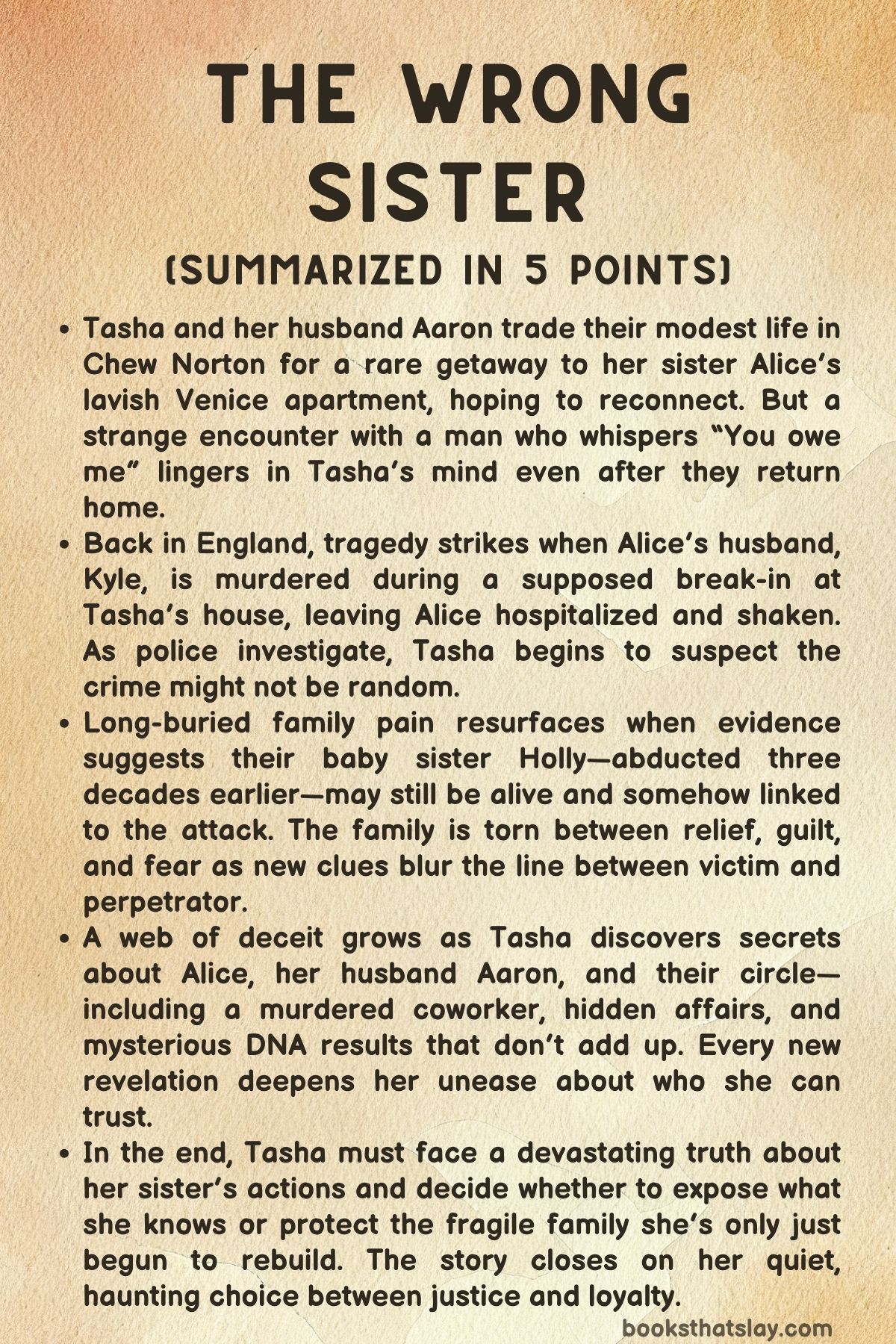
Tasha and her husband Aaron live modestly in Chew Norton with their young twins, Elsie and Flossie. When Tasha’s wealthy sister Alice visits with her husband Kyle, their contrasting lifestyles spark quiet tension.
Alice offers Tasha and Aaron a week’s stay in her luxurious Venice apartment while she and Kyle watch the twins. Tasha accepts, hoping the trip will rekindle her marriage.
Before leaving, she notices a blue chalk asterisk on the pavement outside their house—something she dismisses at the time.
In Venice, Tasha and Aaron are amazed by Alice’s opulent apartment. The romantic getaway briefly restores their intimacy until a disturbing encounter unsettles them.
A strange man follows them through narrow alleys, muttering “Tu mi devi” (“You owe me”) and brandishing a knife. They escape unharmed but remain shaken.
Meanwhile, Alice, staying at Tasha’s house, begins feeling uneasy, sensing she is being watched at night.
Their idyllic trip ends abruptly when Tasha and Aaron learn that there has been a break-in at their home. Kyle is dead, and Alice is critically injured.
They rush back to England in shock. The twins are safe with Aaron’s mother, Viv, but the tragedy devastates the family.
At the hospital, Alice recalls hearing a noise, Kyle going downstairs, and then being struck from behind. She is heartbroken and frightened, clinging to Tasha for comfort.
Tasha, already haunted by memories of their baby sister Holly’s abduction thirty years earlier, fears that history is repeating itself.
The police suspect a burglary gone wrong since there was no forced entry, but Tasha recalls the blue chalk mark outside her house, possibly a burglar’s symbol. Aaron mentions Kyle’s financial troubles involving a tech startup, adding another layer of mystery.
When Tasha and Aaron return home, they find a note pushed through the door: “IT WAS SUPPOSED TO BE YOU. ” Unknown to them, someone has been watching Tasha for months and attacked Alice by mistake.
Their mother Jeanette arrives from France, still burdened by guilt over Holly’s disappearance decades earlier. The family reunites amid grief and suspicion.
Tasha’s unease deepens when she sees Aaron outside at night talking secretly to a woman. He claims it was Zoë, his coworker, walking home, but Tasha doesn’t believe him.
Soon, their elderly neighbor mentions seeing a tall blonde woman near their home after the attack—the same night the threatening note appeared.
The investigation takes a shocking turn when detectives reveal that DNA found at the crime scene matches Holly Harper, the sister abducted thirty years ago. The family reels at the revelation that Holly might be alive and connected to the murder.
Alice confesses that she recently received letters from a woman claiming to be Holly, who said she was watching them but needed proof before revealing herself. The realization that Holly may be both victim and culprit shatters the family’s fragile peace.
In a separate thread set in 2019, a young woman named Bonnie grieves her adoptive mother, Clarissa. Sorting through her things, she discovers newspaper clippings about Holly’s abduction and a sealed box labeled “Final Resting Place,” containing baby clothes and a photo of a garden.
Her father then confesses that she was adopted—and that the grave in their garden holds the remains of “the real Bonnie. ” Bonnie begins to suspect her parents were involved in Holly’s disappearance.
Back in the present, Tasha’s jealousy and distrust toward Zoë grow after seeing her flirt with Aaron at the pub. The next morning, Zoë’s body is found in the pond behind Tasha’s house.
Police quickly turn their attention to Aaron, who had argued with Zoë the night before. Tasha lies to give him an alibi, though doubts fester.
Jeanette admits she confronted Zoë that night but insists she didn’t harm her. Viv also begins acting secretive, and tensions mount as the truth unravels.
Viv eventually confesses that after a heated argument, she pushed Zoë, who hit her head but walked away. Terrified, Viv kept silent.
Meanwhile, Viv reveals an even deeper secret: her late sister Clarissa had stolen Holly decades ago and raised her as her own daughter—Bonnie. When Clarissa died, Viv recognized Bonnie as Holly but delayed telling anyone.
DNA tests confirm that Bonnie is indeed Holly Harper, bringing bittersweet closure to the family’s decades-long mystery.
Still, unanswered questions remain. The blood found in Tasha’s home doesn’t match Zoë or Holly.
When Tasha investigates further, she discovers that Alice is a chimera—she has two sets of DNA because she absorbed a twin in the womb. This explains the DNA discrepancy.
Tasha realizes that Alice used this secret to manipulate the investigation. The final revelation comes when Tasha confronts Alice, piecing together the truth: Alice killed Kyle.
Facing exposure over Kyle’s failing business and desperate to protect her reputation, Alice struck him with Aaron’s wrench, staged the scene to look like a break-in, and injured herself to sell the story. She then let suspicion fall on Zoë.
In the last confrontation on Hampstead Heath, Alice neither denies nor confesses, leaving Tasha in moral turmoil. Tasha knows the truth but cannot bear to destroy her sister—or shatter their mother’s fragile joy after finding Holly alive.
Remembering their shared trauma and lifelong bond, Tasha chooses silence. She takes Alice’s hand, deciding to protect her despite everything, aware that the truth will haunt them both.
Through its intricate twists, The Wrong Sister reveals how family love can blur the line between right and wrong. It’s a story of guilt, deception, and the lasting scars of loss, showing how the past can resurface in the most unexpected—and devastating—ways.
Characters
Tasha
Tasha is the emotional core of The Wrong Sister, a woman torn between familial devotion, moral conscience, and the haunting traumas of her past. Living modestly with her husband Aaron and their twin daughters, she is portrayed as compassionate yet deeply anxious, shaped by the abduction of her baby sister Holly three decades earlier.
Her protectiveness toward her own children reflects her lifelong fear of loss. When tragedy strikes—her sister Alice’s husband murdered and Alice herself attacked—Tasha’s instinct to protect reawakens.
Yet beneath her empathy runs a powerful current of guilt and self-doubt; she constantly measures her ordinary life against Alice’s wealth and success.
Throughout the novel, Tasha’s psychological unraveling parallels the gradual unearthing of family secrets.
She becomes the moral observer in a landscape of deceit, realizing that love and loyalty often blur with complicity. Her decision to conceal Alice’s guilt at the end underscores her conflicted nature—she acts out of love, but it is a love shadowed by moral compromise.
Tasha’s evolution from passive bystander to quiet moral agent gives the story its emotional depth, as she embodies both the victim and the reluctant protector of truth.
Alice
Alice emerges as the novel’s most enigmatic and morally ambiguous figure. Outwardly successful, intelligent, and elegant, she embodies the life Tasha envies.
Yet beneath this polished exterior lies a woman capable of deep deception. Her duality—nurturer and manipulator—mirrors the scientific phenomenon at the story’s heart: her being a chimera, possessing two sets of DNA.
This biological anomaly becomes a metaphor for her fractured identity and moral duplicity.
Alice’s marriage to Kyle reveals both her vulnerability and ambition.
Initially the grieving widow, she gradually transforms into a suspect whose calmness masks dark intentions. Her decision to kill Kyle—driven by desperation to preserve her reputation and distance herself from his corrupt business dealings—exposes her as both a victim of circumstance and a calculated perpetrator.
Yet her tenderness toward her family and her ultimate connection with her rediscovered sister Holly (Bonnie) suggest that she is not entirely devoid of humanity. In Alice, the novel explores how intelligence and love, when corrupted by fear, can become instruments of destruction.
Aaron
Aaron serves as Tasha’s grounding presence, a steady, working-class man whose straightforward decency contrasts with the duplicity of others. His affection for Tasha and the twins reveals him as a loving husband and father, but his occasional secrecy—especially regarding Zoë and his dealings with the Knight brothers—introduces shades of moral complexity.
He represents the ordinary man caught in extraordinary turmoil, struggling to uphold honesty in a world steeped in deceit.
Aaron’s loyalty is often tested, yet he remains a symbol of endurance and compassion.
His decision to protect Tasha, even when confronted by suspicion, underscores his integrity. Still, his naivety makes him vulnerable to manipulation, especially by Alice and Zoë.
By the end, Aaron’s quiet forgiveness of Tasha’s silence regarding Alice’s crime suggests a deep understanding of familial loyalty, even when it borders on moral blindness.
Jeanette
Jeanette, the matriarch of the Harper family, carries the generational weight of tragedy. The abduction of her baby Holly in 1989 becomes the central trauma defining her life, driving her into self-exile in France and fueling her dependence on alcohol.
Yet, beneath her guilt and emotional instability lies a resilient mother desperate for closure. Her reunion with Holly—now Bonnie—represents both redemption and punishment, as she must face the decades of silence that shaped her family’s pain.
Jeanette’s character reflects the novel’s theme of maternal loss and flawed protection. Her strained relationship with Tasha and Alice softens over time, revealing a woman who has suffered too long to judge harshly.
She becomes the emotional bridge between the past and present, embodying both the fragility and endurance of motherhood. Her journey from despair to acceptance provides a haunting echo of how unresolved grief can warp generations.
Kyle
Kyle is introduced as the successful and charming husband of Alice, but his death becomes the catalyst for the story’s unravelling. His involvement in a failing tech startup and dealings with dubious investors hint at greed and moral compromise beneath his polished surface.
Through flashbacks and revelations, he evolves from victim to symbol of the deceit that infects both marriage and business.
Kyle’s arrogance and secrecy make him partly responsible for his own downfall, yet his murder exposes the destructive power of ambition and betrayal.
His relationship with Alice is marked by emotional distance, illustrating how success can corrode intimacy. Ultimately, Kyle’s death forces the characters to confront their own capacity for deceit and self-preservation.
Viv
Viv, Aaron’s mother, is a complex figure who intertwines the threads of two families’ histories. Once seemingly peripheral, she emerges as a keeper of devastating secrets, having concealed the truth about her sister Clarissa’s abduction of Holly for decades.
Her actions—driven by misguided protection—reflect the moral ambiguity that defines the novel. Viv’s confession about accidentally causing Zoë’s death deepens her tragic complexity; she becomes both sinner and confessor, burdened by guilt but seeking redemption.
Her pragmatic, sometimes cold demeanor masks deep maternal instinct and remorse. By the end, Viv’s acceptance of her punishment contrasts with the moral silence of others, highlighting her as one of the few characters willing to face the consequences of her actions.
She represents the painful truth that concealment, even for love, can destroy lives.
Zoë
Zoë serves as a catalyst for conflict and revelation. At first a peripheral character—the flirtatious coworker at Aaron’s garage—she evolves into a tragic figure consumed by obsession and loneliness.
Her fixation on Aaron and resentment toward Tasha expose her vulnerability, while her entanglement with the Knight brothers’ criminal operations places her in real danger.
Zoë’s death functions as both narrative misdirection and moral commentary.
Initially framed as the villain responsible for Kyle’s murder, she is later revealed to be another casualty of lies and concealment. Her desperation for attention and belonging mirrors the themes of mistaken identity and moral corruption that run throughout the story.
In Zoë, Claire Douglas crafts a character both pitiable and destructive—a woman undone by her desires and the deceit of others.
Bonnie / Holly
Bonnie, later revealed as Holly, embodies the novel’s emotional climax—a living ghost of the past whose reappearance shatters decades of guilt and silence. Raised under a false identity by Clarissa, she grows up believing in a life built on lies.
Her discovery of the truth through her mother’s death and the relics hidden in the attic leads her to confront the horrifying reality of her stolen childhood.
Holly’s dual identity bridges the generational and moral themes of the story: the loss of innocence, the enduring scars of family secrets, and the search for belonging.
Her reunion with Jeanette, Tasha, and Alice is both redemptive and tragic, for she has inherited not only their blood but also their pain. Her presence serves as a mirror to each character’s guilt, reminding them that truth, once buried, never stays silent.
Themes
Family Secrets and Hidden Pasts
In The Wrong Sister, family secrets form the backbone of the narrative, shaping every character’s present reality through the weight of past deceit. The novel shows how lies, omissions, and concealed truths ripple across generations, creating emotional fractures that no one can fully mend.
The disappearance of Holly Harper thirty years earlier functions as the first buried truth, setting off a chain reaction of guilt, grief, and secrecy that lingers in each family member’s psyche. Jeanette’s silence about that day, Viv’s concealed knowledge of her sister Clarissa’s possible involvement, and Bonnie’s (later revealed as Holly) false upbringing under a stolen identity all contribute to a web of hidden truths that redefine what family means.
Each secret, once exposed, corrodes trust further rather than healing old wounds. Claire Douglas emphasizes that secrets within families often stem not only from malice but from misguided attempts to protect loved ones or maintain emotional order.
Yet, these attempts only deepen the damage. The revelation that Alice’s genetic chimerism allows her to manipulate forensic evidence underscores the theme’s final turn — even science, truth’s supposed servant, becomes another tool for deception.
Ultimately, the novel suggests that the destruction caused by secrecy far outweighs the comfort it temporarily provides. The characters’ reconciliation at the end feels uneasy because the truth, even when partly known, can never undo decades of hidden pain.
Sisterhood and Loyalty
The relationship between Tasha and Alice serves as the emotional core of The Wrong Sister, examining how love between siblings can oscillate between fierce devotion and moral blindness. Their dynamic captures the contradictions of sisterhood — affection and rivalry, protection and resentment, admiration and suspicion.
Tasha’s instinctive loyalty to Alice remains unbroken despite mounting evidence of her sister’s guilt. This loyalty, rooted in shared trauma and their missing sibling’s absence, transforms into both a moral test and a survival mechanism.
The sisters’ bond, strained by differences in wealth, temperament, and life choices, ultimately survives betrayal because of Tasha’s decision to protect Alice rather than expose her. Douglas presents this as both a triumph and a tragedy: the triumph of unconditional familial love, but the tragedy of its capacity to suppress justice.
Even Alice’s calculated choices — hiding her involvement in Kyle’s death and exploiting her chimerism — reveal a desperate need for control within a family scarred by powerlessness. Through this portrayal, the novel questions whether loyalty is inherently virtuous or if, under certain circumstances, it becomes complicity.
The closing image of Tasha and Alice walking together encapsulates this tension: the bond remains intact, but the cost of preserving it is moral silence.
Identity and the Search for Self
Identity, both personal and biological, is constantly under siege in The Wrong Sister. From the stolen childhood of Holly/Bonnie to Alice’s dual DNA and Tasha’s struggle to define herself outside of her sister’s shadow, the book explores how identity can be fragmented, stolen, or reshaped by circumstance.
Holly’s rediscovery as Bonnie destabilizes everyone’s understanding of who she truly is — both victim and survivor, daughter and stranger. Her existence challenges the notion that blood alone defines belonging.
Meanwhile, Alice’s chimerism literalizes the idea of divided identity: two genetic selves within one body, mirroring her moral duplicity. Tasha’s emotional journey revolves around locating her own sense of self amidst these unstable identities.
Her modest lifestyle and grounded nature contrast sharply with Alice’s wealth and glamour, yet by the end, Tasha becomes the moral center — the one who must decide whether truth or familial unity defines who she is. Douglas uses identity as a lens to examine how individuals are shaped not only by family and memory but also by secrets that others impose on them.
The discovery that biological identity can be manipulated — through DNA, deception, or misplaced loyalty — leaves readers questioning whether authenticity is ever truly knowable when families build themselves upon half-truths.
Guilt, Grief, and the Weight of the Past
The emotional current of The Wrong Sister runs through guilt and grief — feelings that haunt every generation in the Harper family. Jeanette’s enduring remorse for losing baby Holly defines her entire life; her self-imposed exile in France is both punishment and avoidance.
Tasha’s protective instincts stem from inheriting that unresolved guilt, while Alice’s moral unraveling hints at the psychological toll of growing up in a family built around unspoken trauma. The novel captures how grief never remains confined to one event but spreads through time, transforming into guilt and self-destruction.
When past crimes resurface through DNA evidence and long-buried secrets, characters are forced to confront not just what happened but how it has shaped their moral compass. Kyle’s death, Zoë’s obsession, and even Viv’s accidental role in another’s demise reinforce how grief distorts judgment, leading to impulsive acts of concealment.
Douglas portrays guilt not merely as emotional residue but as a living force — one that drives people to lie, protect, or destroy. The past’s shadow looms so heavily that no one escapes unscathed, illustrating how tragedy becomes a cyclical inheritance in families that never confront their pain honestly.
Deception and Moral Ambiguity
Deception operates on every level in The Wrong Sister, not just as a plot device but as a moral landscape where truth and lies coexist uneasily. From minor omissions to deliberate manipulation, deceit defines how characters relate to one another.
Alice deceives the police, her sister, and even herself; Viv hides her knowledge of Clarissa’s role in Holly’s abduction; and Aaron conceals his involvement in criminal activity at the garage. Each act of deceit begins as an attempt to protect — reputation, family, or love — but each eventually corrodes moral integrity.
What makes Douglas’s portrayal compelling is that deception is rarely malicious; it is born of fear, loyalty, and desperation. The blurred boundary between right and wrong creates a world where every decision carries ethical compromise.
By the end, Tasha’s silence — her choice to protect her sister despite knowing the truth — stands as the most morally ambiguous act of all. It forces readers to consider whether maintaining peace within a family justifies betraying justice.
In this way, Douglas transforms deception from a mere plot catalyst into an exploration of human frailty and the limits of moral courage.