The Xmas Day Butcher Summary, Characters and Themes
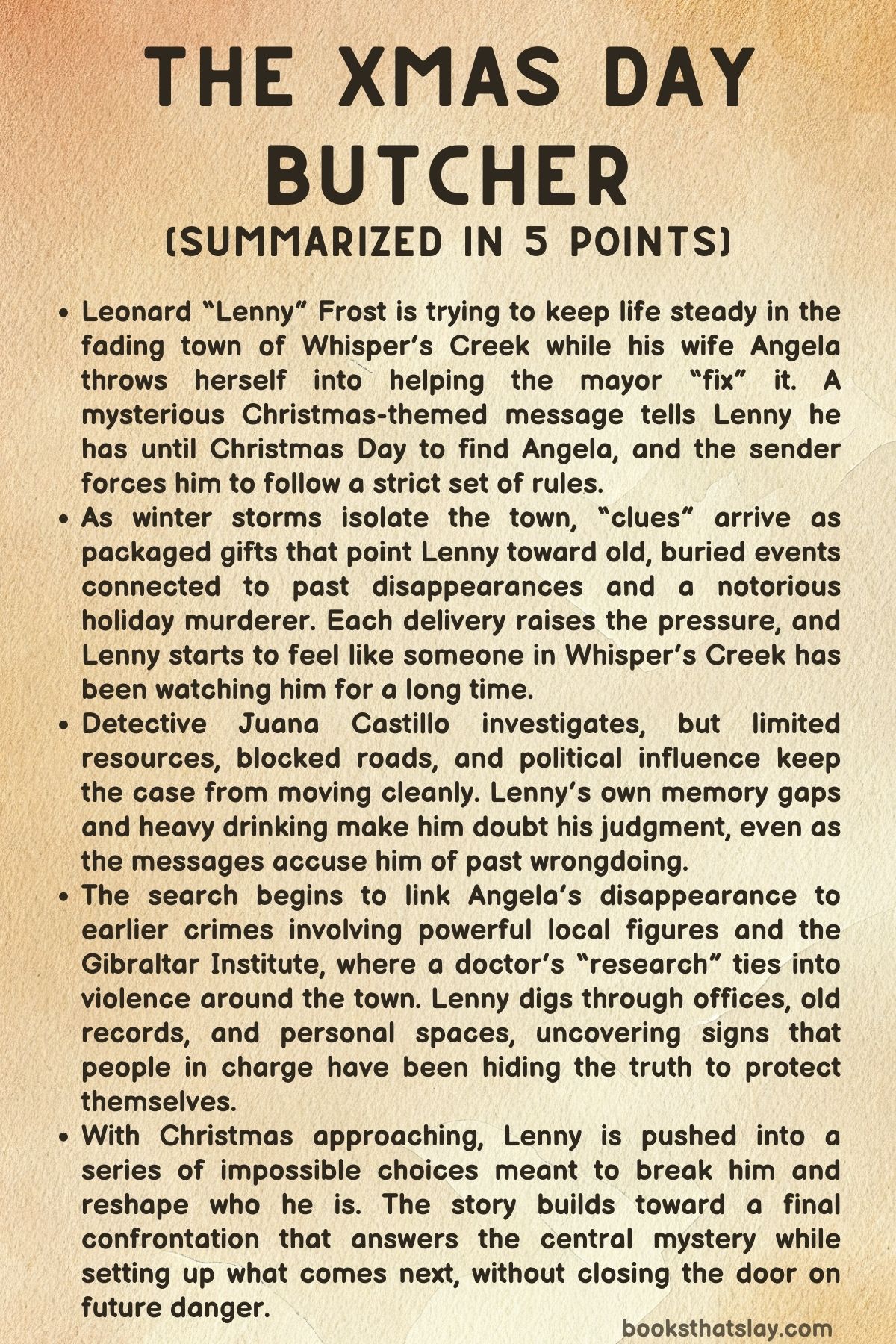
The Xmas Day Butcher by Spencer Guerrero is a Christmas-set thriller about Leonard “Lenny” Frost, a man who already carries the scars of a childhood massacre in the dying town of Whisper’s Creek. When his wife, Angela, vanishes and a series of “gift boxes” arrive with numbered clues, Lenny is forced into a timed game that ends on Christmas Day.
Each clue pushes him deeper into the town’s buried crimes—missing people, corrupt officials, and a notorious killer tied to a secretive institute. As the days tick down, Lenny’s fear, guilt, and blackouts blur what’s real, until the truth behind the “Xmas Day Butcher” reshapes everything he believes about himself and his past.
Summary
On December 1, Leonard “Lenny” Frost walks through Whisper’s Creek to shop for Christmas and pick out an anniversary gift for his wife, Angela. The town feels run-down and strangely quiet, and Lenny can’t shake the thought that they should leave.
Angela, however, believes Whisper’s Creek can be repaired and supports Mayor Carl Hamonte’s efforts to “revive” it. Lenny stops at a Christmas-themed shop, determined to buy Angela a silver bracelet decorated with five small gold rings for their five years of marriage.
Inside, he runs into Joseph Candela, a maintenance worker connected to the mayor’s office. Joseph makes crude remarks about Angela and hints that other men notice her.
Lenny leaves irritated, and the encounter sticks with him as the snow thickens.
When Lenny gets home, he finds a small gift box on his porch. He opens it and discovers a red envelope marked “CLUE #1.” The note tells him he has 24 days to find Angela, with Christmas Day as the deadline, and orders him to play a game.
It’s signed by “The Xmas Day Butcher.” Inside the box is a bloodstained pair of reindeer earrings that Lenny recognizes as Angela’s. Panic hits immediately.
He rushes through the house and finds signs she was taken abruptly: slippers left in the kitchen, her sweater on the couch, the back door unlocked. He runs outside shouting her name, but the town remains silent.
In the wind, the clue letter slips away and vanishes into the snowfall.
The next day, December 2, Lenny wakes from a nightmare tied to his childhood: a Santa-masked intruder attacking a family with a sharp Christmas-tree star, throats cut and blood everywhere. The dream isn’t just horror—it feels like memory.
He snaps fully awake, remembering Angela is missing. He tries to rebuild the timeline: she left for work at the mayor’s office on December 1 and never replied to his text.
A pounding at the door raises false hope, but it’s Detective Juana Castillo. She brings another taped box labeled “CLUE #2,” delivered to the police station for Lenny.
Inside is a blood-streaked white ornament and a message: “Remember what you’ve done. There’s nowhere for you to run.”
On December 3, Lenny realizes his coping has shifted into something dangerous. He has been drinking heavily and losing time, waking unsure of what he did the night before.
He admits he delayed calling police because Whisper’s Creek has a history of failing victims. George St. Nicklaus—his employer—lost his daughter Clara the previous Christmas, and she was never found.
Castillo questions Lenny hard, unsettled by the clue’s accusation that Lenny has done something. Lenny finally tells her Angela has been missing since December 1 and shows the boxes.
Castillo begins a missing-persons response but warns the weather and blocked roads will slow everything. When she leaves, Lenny’s mind spirals back to orphanages and foster homes.
Outside, he briefly sees a dark figure near the forest and gives chase, only to fall and lose them.
Lenny visits George’s farmhouse to fix cabinets and tell him the truth. George is shaken and immediately compares Angela’s disappearance to Clara’s.
When Lenny mentions the name “Xmas Day Butcher,” George reacts as if that name shouldn’t exist anymore. He suggests the original butcher is dead, raising the possibility of a copycat.
On December 5, Castillo takes Lenny into town to question residents. Joseph Candela reappears, acting concerned, but keeps suggesting Angela may have left Lenny voluntarily.
Lenny’s anger flares. Inside a shop, an older woman shares the town’s rumors: Clara’s case, the old Xmas Day Butcher story, and whispers that George might have harmed his own daughter.
A scream interrupts the conversation. A Christmas stocking has been hung from a streetlight.
Lenny reaches in and pulls out a severed, frozen foot with red-and-green painted nails. He recognizes Angela’s manicure.
On December 6, another box appears on Lenny’s porch. Inside is a rotting ham with a metallic Christmas star embedded in it and “CLUE #3”: Lenny must learn who the Butcher is, or Angela will become a “Christmas ham.” Castillo ties the symbolism to an older case and tells Lenny the original Xmas Day Butcher was Colton Kilhouser, the man who murdered the Frost family twenty years earlier.
Lenny admits he is the surviving child from that massacre. Digging through the ham, Castillo finds a newspaper clipping dated December 25 describing the killings and revealing Kilhouser was transferred to the Gibraltar Institute under Doctor Thomas T. Tuttle, with approval from then-councilman Carl Hamonte.
The photo attached includes Lenny’s foster parents and George St. Nicklaus standing beside a Christmas tree, linking George to Lenny’s past.
Lenny grows suspicious that Angela’s disappearance is tied to Clara’s. On December 7 he visits George, bringing ornaments as an excuse.
George’s home is filthy and neglected, filled with reminders of Clara. While decorating a crooked tree, Lenny notices an unlocked metal lockbox containing jewelry, including reindeer earrings like Angela’s.
George claims he bought them for Clara, hoping she would return. When pressed, George warns that Whisper’s Creek hides protected secrets and names Doctor Tuttle and Mayor Hamonte as people with power.
He implies that the Frost murders, Clara’s disappearance, and Angela’s kidnapping are connected by the same cover-up.
On December 8, Lenny receives “CLUE #4,” claiming proof about Clara is hidden in George’s house—specifically Clara’s room—and warning Angela will suffer if Lenny fails. Lenny calls Castillo, but she dismisses the idea that George is involved and argues they have to keep moving carefully because they have no clear suspect.
Lenny resolves to search George’s house himself. Before he can leave, he hears a threatening voice outside ordering him to come along.
He panics, runs inside, and blacks out.
On December 9, Lenny wakes late at night and uses a key to enter George’s house. Clara’s bedroom is neat, unlike the rest of the house, and he finds an opened lockbox under the bed.
Inside are photos of Clara with Henry Hamonte, the mayor’s son, including intimate pictures. Lenny remembers Henry died soon after Clara disappeared, officially blamed on alcohol poisoning.
As Lenny hides the box, George catches him and attacks with an axe. George stops just short of killing him, shaken and paranoid, saying someone has been moving through his house at night.
Lenny explains the Butcher’s clue. George insists he has no proof in the house, then admits he was strict with Clara and hated Henry.
He claims he believed Henry killed Clara and suggests Henry’s death looked like guilt. George also hints Angela might be involved because she worked for the mayor and attended the same Town Hall Christmas party where Clara vanished.
A knock comes at the door. Another gift box has been left.
Inside is a bloody Christmas gnome and a severed finger wearing Angela’s ring. “CLUE #5” warns Lenny not to trust George and orders Lenny to check George’s basement the next night at a specific time.
It threatens Lenny directly, claiming the Butcher is always watching.
On December 10, Lenny’s paranoia worsens. He decides to follow the clue.
After another blackout, he wakes, sneaks to George’s house, and unlocks the padlocked basement. The smell hits him first, then the sight: a decayed body hanging from the ceiling wrapped in Christmas lights.
It is Clara, still wearing a pink sweater and a name tag. Beneath her is another gift box.
“CLUE #6” says that if Lenny wants to see Angela again, George must bleed. The note includes a photo of Angela bound and duct-taped and sets the deadline: Christmas Day.
Lenny hears footsteps. George comes down with an axe, sees Clara, and accuses Lenny of killing her.
In the chaos, George blurts that he killed Henry Hamonte himself because he thought Henry murdered Clara—meaning he killed the wrong person. George attacks.
Lenny fights back and, in a frantic struggle, drives the axe into George’s chest, killing him. Terrified, he flees, realizing the Butcher may have accessed the basement through an ajar window.
On December 12, Castillo brings Lenny back to George’s house. She finds Clara hanging and George dead.
She notices bruises on Lenny and evidence of a fight but doesn’t accuse him openly. Officers take over the scene.
Lenny’s mind fractures further, with visions of a shadow at his window and a voice urging him toward an old white church.
On December 13, Lenny receives “CLUE #7” along with Angela’s red Christmas underwear, promising they will now learn about “my doctor.” Joseph Candela visits, claiming Lenny called him about George and Clara—something Lenny doesn’t remember. Lenny goes to Joseph’s house and sees a wall of unsettling holiday masks Joseph collects.
Driven by whispers and fear, Lenny attacks Joseph, accusing him of being the Butcher, then realizes he may be wrong and leaves humiliated.
On December 14, Castillo reports that George’s safe held cash and a note accusing Mayor Hamonte and Doctor Tuttle of corruption. George confessed to killing Henry but not Clara.
Clara’s body is being transferred to the Gibraltar Institute under a special procedure ordered through the mayor. The mayor then demands to see Lenny and pushes for a narrative: George murdered Henry and Clara, and the town should move on.
After the meeting, Lenny sneaks into Angela’s office and opens her safe using her birthday code. Inside is a letter to the Ethics Commission dated December 1, accusing Hamonte of siphoning public funds and diverting money to the Gibraltar Institute.
Outside, a crowd gathers around a headless body hanging in a doctor’s white coat, signaling the Butcher has escalated.
On December 15, Lenny wakes with “CLUE #8” already in his lap. The box contains a dirty Santa hat, a bloodied tree-top star, and Gibraltar Institute documents tied to Doctor Tuttle.
The papers describe research that treats Colton Kilhouser as a subject in a project about serial killers, implying he was used and directed to commit murders. A note from Tuttle to Colton reads like instructions with a schedule and targets.
Castillo calls with urgent news: someone has escaped from the Gibraltar Institute and is believed armed and dangerous. Lenny becomes convinced the escapee is Colton and that Colton killed Tuttle.
On December 16, Joseph tries to reconcile by bringing alcohol. They drink heavily.
Joseph admits he was attracted to Angela, claims she flirted, and suggests she may have left Lenny or even participated in the situation. Rage takes over.
Lenny attacks Joseph and strangles him to death. He panics, drags the body into the woods, and buries it.
He searches Joseph’s home for evidence linking him to Angela but finds nothing. The killing sinks into Lenny as a second irreversible act, and he realizes the game is turning him into what he fears.
On December 17, “CLUE #9” arrives: a dollhouse and a rhyme directing Lenny to “kill the name that rhymes with Sam” and have “dinner with some Ham.” Lenny understands it points to Mayor Hamonte. He feels trapped, believing Angela will die if he refuses.
Castillo is still focused on the Gibraltar escapee, and Lenny hides the clue.
On December 18, Lenny shows Castillo the dollhouse, trying to keep her engaged without revealing the order to kill the mayor. Castillo also asks about Joseph, who is now missing, and notes Joseph’s home was torn apart.
Before Lenny can respond, a window explodes and Doctor Tuttle’s severed head lands inside wearing a Santa hat with “CLUE #10,” which threatens Castillo and mocks her investigation. Castillo rushes outside and finds nothing.
On December 19, Lenny’s memories and headlines blur together—stories of older doll-linked murders and hints that the Gibraltar Institute has been involved for years. He checks on Castillo’s mother, then another attack occurs: an axe wrapped in Christmas lights is launched through a window with another taunting message.
The killer stays invisible, always a step ahead.
On December 21, “CLUE #11” arrives with a pig ornament, calling the target a “pig” and ordering Lenny to kill him. It includes a Town Hall address and a key.
Lenny finally acts. On December 22, he breaks into Town Hall at night and reaches the mayor’s office.
The safe contains planted evidence suggesting the mayor tried to assault Clara, including texts and photos staged to paint him as her predator. Mayor Hamonte arrives, confronts Lenny, denies involvement, and insists George was the true monster.
Lenny demands answers about Angela and the money trail to the Gibraltar Institute. Hamonte tries to bargain, but Lenny stabs him through the eye, killing him, and escapes into the forest.
On December 23, “CLUE #12” reveals the real structure behind everything: records showing “Colton Kilhouser” was publicly declared dead, but Doctor Tuttle and Hamonte faked it to keep using Colton as a controlled killer linked to dollhouse-themed crimes. Castillo’s signature appears in the paperwork, implicating her.
A message on the dollhouse warns Lenny he will become the same kind of killer. Exhausted, Lenny dreams he might be Colton, and his blackouts feel like proof.
On Christmas Eve, Lenny finds Castillo searching his house. He overpowers her, takes her gun, and forces a confession.
Castillo admits she helped cover up crimes under Hamonte’s orders and went along because she needed medical support for her mother. Lenny insists he is Colton, but Castillo says he is not.
A voice in Lenny’s head urges him to kill her, and he shoots Castillo. Another gift instructs him to go to the abandoned white church at midnight.
At midnight on Christmas Day, Lenny enters the church and meets a man who looks like him: his twin brother, Lincoln, alive. Lincoln reveals he orchestrated the entire 25-day game as revenge, furious that Lenny “abandoned” him after their foster family died long ago.
Lincoln explains that Doctor Tuttle faked Lincoln’s death and renamed him Colton Kilhouser, shaping him into the Dollhouse Killer and aiming him at targets to benefit the institute’s allies. Lincoln killed Tuttle, abducted Angela, and forced Lenny to murder people so Lenny would carry the same stain.
Lincoln brings Angela out alive, then loops a rope around her neck and offers Lenny a final choice: kill Lincoln or save Angela. Lincoln disappears into the darkness, leaving Angela hanging.
Lenny hacks her down and holds her. Angela, traumatized and now aware of the murders Lenny committed, rejects him.
Lincoln left her a gun; she fires at Lenny but misses, then collapses, unable to kill him and begging Lenny to end her suffering. Lenny refuses and swears he will hunt Lincoln down.
In the epilogue, Lincoln disappears for years under new identities, drifting through harsh living and small jobs, then returns to Whisper’s Creek as “Lonnie Jacobs,” still drawn to kill again—unaware that Lenny, shaped into the very thing he feared, is closing in.
Characters
Leonard “Lenny” Frost
Leonard “Lenny” Frost is the emotional center of The Xmas Day Butcher—a man who begins as an anxious but ordinary husband and ends as someone terrifyingly reshaped by grief, manipulation, and his own unaddressed trauma. From the first day, his private wish to leave Whisper’s Creek reveals a deep instinct for self-preservation, but it’s paired with passivity: he stays because Angela believes in the town and because he has learned, through a life of instability, to endure rather than confront.
Once Angela disappears, Lenny’s need to control the uncontrollable becomes the lever Lincoln uses against him. The “game” weaponizes Lenny’s love into a chain, and Lenny repeatedly mistakes violence for agency—each killing becomes, in his mind, a terrible proof that he is still “doing something” to save her.
His blackouts and fragmented memories are not just plot devices; they reflect a psyche splitting under pressure, where guilt, fear, and buried childhood horror blur into hallucination and false certainty. By the end, Lenny’s identity is shattered so completely that he is vulnerable to believing he might be Colton, which shows how easily he can be pushed into accepting a monster narrative if it explains his missing time and his mounting brutality.
Even after saving Angela, he cannot return to who he was, because the cost of survival has become part of him; his final vow of vengeance signals that the transformation Lincoln wanted is already underway—Lenny has been dragged across a moral line and now stands on the other side, capable of hunting the way he was once hunted.
Angela Frost
Angela Frost functions as both the story’s moral anchor and its most devastating casualty, not because she is powerless, but because she is brave in a way the town cannot tolerate. Angela’s commitment to staying in Whisper’s Creek and “helping restore it” initially reads as optimism, but it gradually reveals itself as integrity: she believes in civic responsibility, and she’s willing to confront corruption directly, even when it’s dangerous.
Her letter to the Ethics Commission shows she was acting on principle and gathering evidence, which reframes her abduction as a targeted silencing rather than random cruelty. Angela also becomes the mirror that exposes what Lenny turns into; her disappearance drives him, but her reappearance punctures his self-justification.
She survives Lincoln’s captivity, yet the real rupture happens when she learns what Lenny did in her name—her rejection is not coldness but trauma colliding with betrayal. Even when Lincoln hands her a gun and the scene seems to demand vengeance, she cannot carry it through, not because she lacks strength, but because she has been psychologically broken by the ordeal and morally repulsed by the world she’s been forced into.
Angela’s final state—begging to be ended—underscores the book’s bleak insistence that survival is not the same as rescue, and that love can be weaponized so thoroughly it leaves nothing intact, not even the desire to keep living.
Detective Juana Castillo
Detective Juana Castillo is presented as the blunt, competent investigator who might be the town’s last functional institution, but The Xmas Day Butcher gradually reveals her as a compromised figure trapped inside a corrupt system she both resents and serves. She pressures Lenny with suspicion early on, and that harshness initially feels like professionalism, yet it also hints at her awareness that in Whisper’s Creek the official story rarely matches the truth.
Castillo’s investigation is constantly obstructed—by weather, limited resources, and political interference—but the deeper obstruction is her own complicity, which turns her from pursuer into participant. Her admission that she helped cover up crimes because she was promised medical care for her mother makes her a character built around coercion and rationalization: she is not purely evil, but she has accepted a bargain where personal desperation overrides public duty.
That compromise is exactly what makes her tragic, because she continues to act as if she can manage the damage—contain it, solve it, steer it—until Lincoln’s campaign escalates and her control collapses. Her death is not just a shocking beat; it is the consequence of a world where everyone is leveraged—by power, by fear, by love—and where someone like Castillo, who tried to be both protector and accomplice, becomes impossible to save once the truth is dragged into the open.
Lincoln Frost
Lincoln Frost is the architect of the story’s cruelty and the embodiment of calculated revenge, but what makes him especially unsettling is how methodical and intimate his evil is. He doesn’t simply kill; he designs an experience meant to reshape another person from the inside, turning Lenny into a mirror of himself through forced choices and escalating moral injury.
Lincoln’s grievance—being “abandoned” after the foster-family massacre—may be rooted in real loss, yet he transforms that wound into a philosophy: suffering must be passed on, and love must be turned into a weapon. His manipulation is sophisticated because it uses symbols (dolls, gifts, Christmas imagery) to keep Lenny psychologically trapped in childhood terror while also staging the town as a theater of punishment.
Lincoln’s identity as “Colton Kilhouser” is not only a disguise; it is proof of how thoroughly he has been engineered by Doctor Tuttle and enabled by the town’s leadership, which makes him both monster and product. Even so, the narrative refuses to let that excuse him—Lincoln makes conscious, theatrical choices to maximize anguish, especially in the final church confrontation where he forces Lenny into an impossible decision and then vanishes, satisfied that the damage is permanent.
His epilogue return under a new name shows his defining trait: he is not driven by a single revenge that ends, but by a continuing appetite for reinvention and predation, suggesting that what he truly wants is not justice, but a world where he can keep creating victims the way he was created.
George St. Nicklaus
George St. Nicklaus is introduced as a bitter, abrasive old man obsessed with Christmas ham and poisoned by the unresolved disappearance of his daughter, and he becomes the story’s most claustrophobic portrait of grief curdling into obsession. His home—filthy, neglected, packed with reminders of Clara—externalizes his inner state: he lives in a mausoleum of memory, unable to move forward, yet unable to truly face what happened.
George’s suspicion of others and his quickness to rage make him an easy target for town gossip and for Lincoln’s manipulation; the narrative uses him as a pressure point where fear, rumor, and resentment converge. The discovery of Clara’s corpse in his basement forces the most brutal irony: George was not the murderer of his daughter, but he is still guilty—guilty of violence, guilt of fixation, and guilt of having killed Henry Hamonte in misguided certainty.
That admission, that he “got the wrong guy,” reveals George as a man destroyed by the need for a simple answer, someone who chose certainty over truth because uncertainty was unbearable. His death at Lenny’s hands is therefore doubly tragic: he is a victim of Lincoln’s staging and a casualty of Lenny’s forced descent, but he is also a man whose own brutality helped make him killable.
George is a warning about what happens when grief becomes identity—when a person stops seeking meaning and starts seeking someone to punish.
Joseph Candela
Joseph Candela initially reads as crude comic menace—a burly maintenance worker with vulgar jokes and an invasive interest in Angela—but the storyline uses him to explore how paranoia and guilt can distort perception. His early harassment of Lenny plants insecurity and resentment that later makes him an easy suspect in Lenny’s mind, especially once Lenny’s hallucinations intensify and the “always watching” motif primes him to interpret any discomfort as danger.
Joseph’s house full of holiday masks is a brilliant misdirection because it visually aligns him with the story’s festive horror aesthetics, but it ultimately exposes how shallow evidence can feel “convincing” when someone is desperate for answers. Joseph’s attempt to make peace—arriving with alcohol—becomes the fatal moment where Lenny’s rage and fear merge into violence; Joseph’s drunken admissions about attraction to Angela and insinuations that she might be “in on it” are not proof of guilt, but they are perfectly tailored to detonate Lenny’s insecurity.
His death is one of the most morally damning turns because it is not a forced ultimatum like George’s; it is a choice made in emotional excess, followed by frantic rationalization and a desperate search for justification that isn’t there. Joseph therefore represents the point where Lenny stops being only a manipulated pawn and starts becoming accountable as a killer, showing how the Butcher’s “game” doesn’t just coerce actions—it erodes the ability to distinguish threat from provocation.
Mayor Carl Hamonte
Mayor Carl Hamonte is the polished face of Whisper’s Creek’s rot, a figure who speaks in sympathy while operating in concealment and self-preservation. His role is not that of the masked slasher but of the administrator of horror—the person who makes violence sustainable by burying evidence, redirecting narratives, and turning institutions into tools.
Hamonte’s connection to the Gibraltar Institute and his history of signing off on Colton’s transfer point to a long-standing pattern: when faced with scandal, he chooses containment over accountability, and he treats people as expendable assets in service of the town’s power structure. His attempt to frame George as the sole villain shows how he crafts convenient endings, and his request that Lenny provide a statement is a chilling example of coercion dressed as civic procedure.
When Lenny confronts and kills him, the act carries the ugly ambiguity the book thrives on—Hamonate is corrupt and implicated, yet Lenny’s murder is not clean justice; it is the result of prolonged psychological captivity and escalating bloodshed. Hamonte’s true menace lies in how ordinary his evil is: he does not need to swing the axe himself because he knows how to make others do the dirty work, and that bureaucratic cruelty is what allowed Tuttle’s project and Lincoln’s transformation to exist in the first place.
Clara St. Nicklaus
Clara St. Nicklaus is physically absent for most of the time, yet she is everywhere in the story’s emotional architecture, acting as the unresolved wound that keeps Whisper’s Creek unstable. Through photos, rumors, and the haunting state of George’s home, Clara becomes a symbol people project onto—innocent victim, rebellious secret-keeper, scandal threat—depending on what they need to believe.
The intimate photos with Henry Hamonte suggest she had a private life the town would rather sensationalize than understand, and the lack of witnesses or camera footage from the Town Hall party implies a coordinated cover-up that treated her disappearance as a problem to be managed. The most horrifying revelation—that her body has been hanging in George’s basement—turns Clara from mystery to evidence, from rumor to undeniable truth, which is exactly what the conspirators feared.
Yet even in death, Clara remains instrumentalized: her story is repeatedly used to accuse George, justify violence against Henry, and later to construct a narrative that absolves the powerful. Clara’s tragedy is that she is denied personhood by nearly everyone—reduced to an emblem of grief for her father, a political liability for the mayor, and a tool in Lincoln’s coercion of Lenny.
In that sense, Clara is the book’s clearest proof that the town doesn’t just produce monsters; it produces silences, and those silences are what let monsters thrive.
Henry Hamonte
Henry Hamonte operates as a catalyst figure—someone whose relationship with Clara and sudden death deepen the sense that Whisper’s Creek runs on buried scandal. The photos of Henry and Clara introduce intimacy and secrecy, implying a romance that may have crossed class, reputation, or political boundaries, which would explain why the town quickly sealed the narrative around her disappearance.
Henry’s death, officially ruled alcohol poisoning, reads less like closure and more like convenient disposal, especially once George admits he killed Henry out of misguided vengeance. Henry’s characterization is intentionally filtered through others’ hatred and suspicion—George’s contempt, the planted evidence that makes the mayor look predatory, and Lenny’s growing belief that everyone is lying—so Henry becomes less a fully seen person and more a contested story.
That ambiguity is the point: Henry shows how easily truth can be replaced by what serves someone’s need, whether that need is grief, reputation management, or revenge. Even if Henry was flawed, his fate demonstrates that in this town, guilt is often assigned after the fact, and death becomes just another way to simplify a messy reality.
Doctor Thomas T. Tuttle
Doctor Thomas T. Tuttle is the story’s most overt emblem of institutional monstrosity the kind of villain who doesn’t wear a mask because he believes his credentials are a mask. His research framing serial violence as genetic destiny turns murder into methodology, reducing human lives to data points and using Colton—later revealed to be Lincoln—as a programmable instrument.
The document describing a project about the genetics of serial killers suggests a worldview where morality is irrelevant compared to results, and where control is the ultimate scientific achievement. Tuttle’s relationship with his subject is chillingly paternal and transactional, treating Lincoln as both “son” and weapon, which helps explain why Lincoln’s identity becomes so fluid—Colton is not just a false name, but a manufactured role enforced by authority.
Tuttle’s death and the grotesque display of his severed head are ironic not because they redeem anyone, but because they show what happens when a creator loses control of his creation; the violence he cultivated returns as spectacle. Even in death, Tuttle’s influence lingers through the records, the cover-ups, and the psychological framing that pushes Lenny to doubt his own identity, proving that the most lasting horror is not a single killer, but a system that teaches people they are only what someone powerful says they are.
Colton Kilhouser
Colton Kilhouser exists as both historical trauma and weaponized mythology, a name that functions like a curse placed over the town and over Lenny’s mind. The original massacre of the Frost family brands Colton as the archetypal boogeyman, and the copycat fear that follows becomes a tool the powerful can manipulate—point suspicion outward, keep the public chasing a monster story instead of institutional wrongdoing.
As the narrative unfolds, “Colton” shifts from person to label, ultimately revealed as an identity forced onto Lincoln through Tuttle’s machinations. That transformation is crucial: Colton is less a singular villain than a manufactured persona designed to make violence predictable and usable.
The story also exploits Colton’s mythic weight to destabilize Lenny, nudging him into believing he might be Colton, which demonstrates how trauma can be exploited until a victim begins to accept the identity of the threat. In the end, Colton Kilhouser is the book’s clearest example of how names can be weapons: the town fears the label, the conspirators deploy the label, and Lenny nearly collapses under the label, while the real killer benefits from the confusion it creates.
Mildred
Mildred appears through Lenny’s memories of Mercy’s Light as the authoritarian force who shaped his earliest understanding of power. She represents institutional cruelty at its most intimate—an adult in charge of vulnerable children who enforces order not through care but through fear, creating an environment where hiding, dissociation, and emotional numbness become survival skills.
Those skills later resurface in Lenny’s adult life as avoidance, suppressed memory, and a tendency to endure rather than seek help, which makes him especially susceptible to Lincoln’s psychological tactics. Mildred’s importance is therefore structural: she is part of the origin story of how the brothers learned that the world is unsafe and that authority rarely protects.
By placing Mercy’s Light in the background of the doll motif and the boys’ secretive behavior, the narrative suggests that the seeds of the “game”—the hiding, the watching, the punishment—were planted long before Whisper’s Creek became the stage for them.
Corita
Corita functions as a voice of remembered warning from Lenny’s past, someone tied to the foster system era who told him the truth—at least as it was understood then—about Colton killing the Frost foster family. Even when she is not present in current events, her words carry weight because they serve as one of the few guiding threads Lenny has while his mind fractures.
Corita’s role highlights how fragmented knowledge travels among powerless people: half-truths, rumors, and traumatic accounts become the only available “history” when official institutions bury facts. That makes her memory both helpful and harmful—helpful because it points to the underlying horror connected to the brothers’ childhood, and harmful because it anchors Lenny to a narrative of Colton-as-monster that Lincoln later exploits.
Corita’s significance is that she represents the kind of witness society forgets, yet whose small acts of truth-telling can echo for decades, shaping how a survivor interprets danger when the past comes roaring back.
Themes
Guilt that won’t stay buried
From the first day Angela disappears, Lenny’s mind reacts as if the crime scene is not only in his house but inside him. His nightmares don’t function like random fear; they behave like a returning sentence, replaying a childhood Christmas trauma where a Santa-masked attacker turned celebration into slaughter.
That memory keeps asserting itself at the exact moments Lenny tries to act “normally,” and the story treats it as evidence that the past is still making demands in the present. Lenny’s guilt is complicated because it is both real and manipulated.
He feels responsible for not protecting Angela, for delaying the police, and later for the deaths he causes while following the “game.” Yet the guilt is also engineered by the person controlling him, who uses reminders, timed deliveries, and staged discoveries to trap Lenny in a cycle of confession without relief. Each “gift” is designed to make guilt physical: jewelry that proves intimacy, body parts that convert love into evidence, and objects that echo old violence.
Even when Lenny tries to redirect blame outward—toward George, Joseph, the mayor, or the supposed escaped killer—his blackouts keep dragging suspicion back onto himself. The story makes guilt feel less like an emotion and more like a habitat: Lenny lives inside it, thinks inside it, and makes decisions inside it.
By the end, guilt becomes the mechanism that turns him from a frantic husband into someone capable of murder, because he starts believing pain must be “paid” in blood. That shift is not presented as a heroic transformation; it is a corrosion.
The final cruelty is that even after Angela is alive, guilt remains undefeated: the truth of what Lenny has done makes reunion impossible, and the remaining purpose he can grasp is revenge. In The Xmas Day Butcher, guilt is not only consequence—it is the tool used to manufacture a new monster.
How institutions protect the powerful and punish the expendable
Whisper’s Creek is not merely a gloomy setting; it behaves like a small ecosystem built to absorb harm without changing. People vanish, investigations stall, and explanations are delivered like official paperwork rather than moral reckoning.
The narrative repeatedly shows authority figures shaping reality through procedure: the slow missing-person response justified by weather, the convenient conclusion that George will be blamed for multiple deaths, and the transfer of Clara’s body under a “special procedure” that bypasses ordinary oversight. The effect is a town where the truth is treated as optional if it threatens the right names.
Mayor Hamonte represents civic power that looks charitable on the surface—restoring the town, rallying people to stay—while privately using access, money, and influence to manage outcomes. Doctor Tuttle represents professional power, the kind that can make cruelty sound like research and make a person’s life resemble a file number.
When Lenny finds Angela’s letter to the Ethics Commission, the theme sharpens: Angela is not taken at random. She is targeted because she tried to use a system intended for accountability, and that same system becomes part of the cover-up.
Even Detective Castillo is pulled into this structure, not as a cartoon villain but as someone cornered by need, bargaining morality for her mother’s care. The story’s institutional corruption is therefore not simply “bad people in power,” but a network of incentives that makes the vulnerable pay the price while the powerful retain plausible deniability.
The killer’s “game” thrives because institutions have already taught everyone that truth can be edited, delayed, or buried. Lenny’s isolation is not only emotional; it is structural.
He keeps discovering that official help is either incompetent, compromised, or actively hostile to disclosure. By the time the mayor is dead, the story has shown how easy it is for an institution to offer a narrative that the public will accept, especially when fear is high and roads are blocked.
In The Xmas Day Butcher, the scariest force is not a single murderer—it is the machinery that decides whose suffering counts and whose can be rewritten.
Identity fractured by trauma and manipulated perception
Lenny’s blackouts are not a simple plot trick; they are the story’s way of showing identity as unstable under stress and exploitation. He experiences gaps in time, waking up with actions already taken, and those gaps become a psychological battleground where memory, suggestion, and fear compete to define who he is.
Because he cannot reliably account for his own behavior, he becomes easy to steer. The killer exploits this by creating evidence that pushes Lenny toward certain conclusions—Joseph must be guilty, George must be guilty, Colton must be back—while Lenny’s mind fills in missing pieces with whatever explanation will reduce uncertainty.
The narrative also builds identity confusion through mirroring. Lenny is a survivor of a massacre associated with a named killer, and later he begins to suspect he might actually be that killer.
That suspicion is not irrational in context: he finds documents linking murders to the Gibraltar Institute, sees notes that sound like psychological conditioning, and learns that records were falsified. The town’s history is already one where names can be changed and deaths can be faked, so the idea that identity can be reassigned is believable inside the world.
The ultimate reveal—that the orchestrator is Lincoln, his twin—turns identity into a weapon. A twin is the perfect embodiment of stolen selfhood: someone who can look like you, claim your life’s meaning, and argue that your choices created him.
Lincoln’s plan is explicitly about converting Lenny into a copy, forcing him to act until the label “Butcher” fits. The message “You will become me” captures a central fear: that under pressure, a person’s self-concept can be rewritten by another’s narrative.
The tragedy is that Lenny cooperates with that rewriting because he craves coherence. He wants the chaos to make sense, even if the explanation damns him.
In The Xmas Day Butcher, identity is shown as something that can be worn down through trauma, redirected by suggestion, and finally remade through coercion—until a person is no longer sure whether he is choosing violence or merely fulfilling the role designed for him.
Love turned into leverage and the violence of control
Angela’s abduction transforms marriage from a private bond into a public instrument of torture. Lenny’s love is the one predictable force in him, and that predictability makes it exploitable.
The killer does not only threaten Angela’s life; he weaponizes intimacy, sending personal items that prove access to her body and thus access to Lenny’s mind. The gifts are cruelly domestic: earrings, underwear, a ringed finger.
They are not random gore—they are symbols of relationship turned into receipts. The story also highlights how controlling dynamics often depend on forcing a person to “participate.” Lenny is not simply told that Angela will die; he is told he must perform tasks, interpret rhymes, arrive at specific times, and accept the killer’s framing of events.
The structure resembles an abusive relationship scaled up to a town-wide game, where rules are arbitrary but punishment is consistent. Lenny’s increasing obedience shows how love can trap someone into moral collapse, especially when the alternative is imagining the loved one suffering.
Even his violence begins to wear the mask of devotion: he tells himself he is doing what he must to save Angela, while the acts themselves steadily destroy the possibility of any healthy reunion. That is the theme’s bitter logic: the more Lenny “proves” his love through obedience, the more he becomes someone Angela cannot safely love back.
The final scene makes this explicit. Angela is alive, but she is also forced into a decision shaped by what Lenny has done.
Her rejection is not cruelty; it is the psychological reality of learning that the person who came to save you killed others to do it, and may continue killing. The story refuses to let love erase consequences.
It shows that love can motivate courage, but it can also be used to manufacture compliance and justify brutality. In The Xmas Day Butcher, control is not maintained by physical captivity alone; it is maintained by turning affection into a chain, making the victim of the game believe that harming others is the only remaining form of care.
Cycles of violence and the manufacture of a successor
The narrative treats violence like a contagious inheritance rather than an isolated act. Lenny survives a childhood massacre, grows into adulthood with that scar beneath his daily life, and then is forced into a repeating pattern that echoes the original horror.
The killer’s method is educational: each clue is a lesson, each “gift” a curriculum, each deadline a test. The aim is not merely to punish Lenny; it is to train him into a particular identity.
That is why the killings are staged with holiday props and repeated motifs—stars, lights, stockings, dolls—because the killer is building a signature and trying to transfer it. When Lenny kills George, it is framed as demanded sacrifice.
When he kills Joseph, it happens in a blur of rage and fear, and the story emphasizes the aftermath: he searches for justification, finds none, and realizes he has crossed into killing without certainty. That step matters because it shows the shift from coerced violence to internalized violence.
The game also targets the town’s previous wounds, reopening old disappearances and corrupt cover-ups, so that fresh killings feel like continuations rather than ruptures. Lincoln’s revenge plan is the most direct expression of this theme.
He does not just want Lenny to suffer; he wants Lenny to become the thing that once destroyed them, turning victimhood into authorship of harm. His own history under Tuttle’s conditioning demonstrates another version of the same cycle: institutional manipulation creating a killer, then that killer creating another.
The ending implies that the cycle is not over. Lincoln survives under new identities and returns to killing, and Lenny’s remaining purpose becomes hunting him with the same single-mindedness that once hunted Angela’s rescue.
The story closes with the sense that violence has rewritten their lives into roles that persist even when the immediate crisis ends. In The Xmas Day Butcher, the horror is not only the body count; it is the idea that violence reproduces itself through trauma, coercion, and revenge, shaping people into successors who continue the pattern because it is the only language left that feels powerful enough to answer what was done to them.