The Younger Gods Summary, Characters and Themes
The Younger Gods by Katie Shepard is a mythic fantasy set in a world where divine politics and mortal survival collide. Iona Night-Singer, trained to serve Wesha the Maiden, has lived through a brutal rebellion against Napeth, the god of Death, and watched faith become a liability in the new order that follows.
When grief and rage strip away her last reason to endure, she chooses an impossible journey across the Sea of Dreams to demand an answer from the gods themselves. What she finds is not comfort or clarity, but a bargain with consequences that reach far beyond one life.
Summary
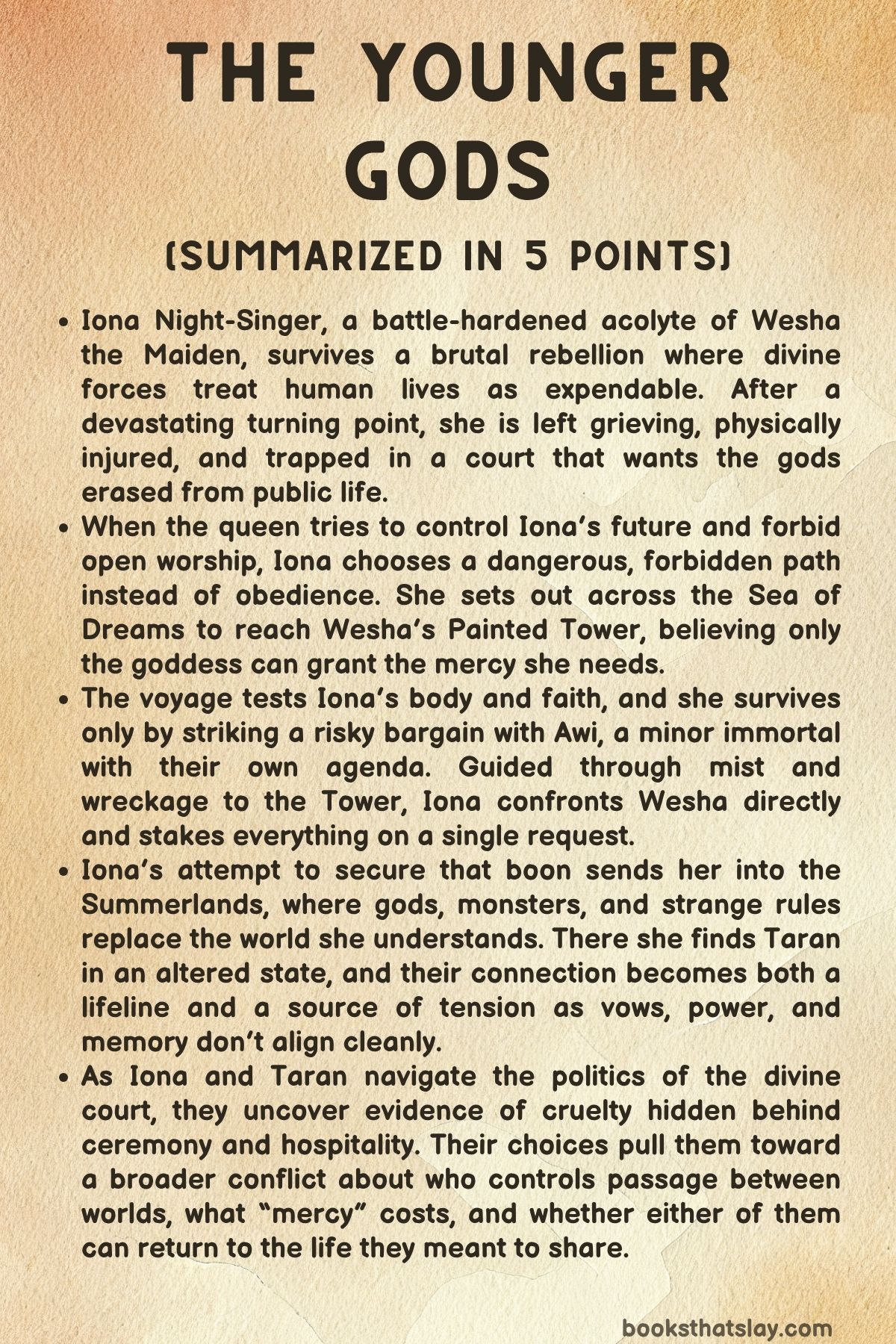
Iona Night-Singer has spent years learning devotion, discipline, and the precise rules of prayer, but war teaches her different rules: keep moving, stay alive, and accept that the gods can be enemies. During a desperate battle on coastal cliffs, Death’s priests call down divine fire to destroy rebels and trap the queen’s forces.
Iona and other acolytes answer with their own songs, shaping firebreaks and trying to carve a path for retreat. The plan nearly holds—until wind shifts and panic spreads.
As soldiers scramble down narrow paths, Iona falls and badly breaks her ankle. Her betrothed, Taran ab Genna, catches her and gets her to the beach, where chaos deepens: the queen is trapped above, hemmed in by flame, and Death himself is on the ridge, hurling fire as if the land is kindling.
Iona refuses to accept helplessness. She orders the acolytes back up to sing for rain and open a corridor through the blaze, even though she knows she is trying to outmatch a god.
Her own role is clear: once Taran heals her ankle, she will use Wesha’s blessing of night to distract Death long enough for the queen’s army to escape. But Taran examines her injury and refuses to do what she asks.
The break is severe; forcing it to heal instantly would be dangerous and uncertain. Instead, Taran makes a choice that shocks everyone.
He kisses Iona with the weight of a farewell, takes her scarf to shield his face, arms himself with a stolen stone knife, and walks toward Death alone. Iona fights to follow.
She even knocks out the man carrying her and deadens pain in her leg to run—but before she reaches the cliff path, an enormous blast throws her into the sand.
Death is ripped screaming out of the world. The cliffs collapse as the Mountain—the Allmother—reacts with an earthquake-like grief.
Survivors find only ash and broken stone where Death stood. The next day the sea returns Taran’s body, still wrapped in Iona’s scarf.
Months pass, and Iona exists in a kind of hollow endurance. The rebellion may have won, but the victory has a bitter taste.
The queen’s court grows hostile toward open prayer, as if the only way to be safe is to pretend the gods no longer matter. Iona still helps where she can—spotting a baby’s malnourishment, pressing coins into a mother’s hand—but she can’t sing blessings freely without risking punishment.
When Iona asks permission to rebuild the ruined barracks at Ereban so the surviving acolytes can serve under strict limits, the queen refuses and declares she wants the gods forgotten. Then, to solve Iona’s “future,” the queen proposes marrying her to a cousin, Lord Fentos, to secure an heir.
The suggestion lands like a final humiliation: grief used as leverage, love erased for politics.
Iona breaks and flees to the shore with one clear thought: she will not live like this. If the world won’t allow her faith, and if it can’t return Taran, she will go where mortals aren’t supposed to go.
She decides to sail across the Sea of Dreams to Wesha’s Painted Tower and beg the goddess to open the Gates so she can bring Taran back from the Underworld.
With the court against her, Iona survives by singing bawdy market songs for coins, hiding her priestly identity in plain sight. Drutalos, an acolyte of Smenos the Shipwright, returns from Ereban with relics recovered from Wesha’s wrecked chapel—vestments, tools, scrolls, and sacred pieces that smell like the life she lost.
Iona takes them, covers herself in the old symbols, and goes to the harbor to steal a small boat. Drutalos tries to stop her, terrified she’s sailing toward death.
Iona proves the gods still answer in strange ways by calling up a small flame using Death’s old blessing—an unsettling reminder that power outlasts its owner. Drutalos relents and helps her cast off.
The sea is punishing. Mist steals direction.
Food and water run out. Iona drifts toward death until a seagull lands on her boat.
When she attacks, the bird swears and reveals herself as Awi, a minor immortal who shifts forms. Awi knows the route and offers guidance in exchange for a promise: when the Gates open, Iona must help Awi escape back to the mortal world.
Iona agrees, binding herself to the bargain. With Awi’s help, the Painted Tower appears near the Mountain and the cavern-mouth of the Underworld, surrounded by wrecked ships and funeral silence.
Iona walks among dusk-souls shuffling toward the cave and enters the tower alone.
At the top sits Wesha, vast and unmoving, like mercy made stone. Iona lays out relics, takes up her kithara, and sings for hours—prayers, epics, lullabies—until Wesha finally turns her head and speaks.
Iona claims she is the last living priest of Wesha, that Death slaughtered the clergy, and that she helped end Death’s tyranny. Wesha refuses the simple story.
She says mortals misunderstand her, and she warns that Death is Stoneborn and cannot remain dead; the Allmother will rebuild him. Still, Iona asks for what she came for: open the Gates of Dawn so she can bring Taran home.
She offers herself in exchange if a life must be paid.
Wesha’s reaction is strange: she laughs at Taran’s small, tender promises—like a stone house and a plum tree—and then agrees. But she says a sacrifice is required, and without living priests, her power is thin.
She directs Iona to prepare an altar. When Iona fears the demand will be unbearable, Wesha chooses the kithara, and Iona throws it into the fire.
The offering vanishes, accepted. Then Wesha reveals the true cost.
She cuts Iona’s throat and pushes her into the burning altar.
Iona wakes alive in a storeroom of offerings, not in the Underworld but in the Summerlands beyond the Gates. Death’s monstrous offspring—the Fallen—find her and call her a priestess.
Iona sings them into sleep and runs into a lantern-lit garden beneath a sky without the Moon. She hides in a villa and collides with two drunken immortals.
One is Marit, a sea god. The other is Taran—present, solid, and unscarred.
Iona grabs him in shock, but he doesn’t recognize her. When the Fallen arrive demanding the “maiden-priest,” Taran bluffs that Iona is his priestess as part of a costume party, and with Marit’s pressure, forces the Fallen to retreat.
Iona soon understands what’s wrong: Taran is immortal now. Awi confirms it—Taran has mortal blood but serves Genna’s purposes, and Stoneborn rebirth can erase memory and reshape power.
When Iona tells Taran she came to reclaim her dead betrothed and promised to bring him to Wesha, Taran refuses. He calls it a trap and keeps her close as “his” priestess, using the weight of vows to bind her movements.
He threatens Awi into silence.
In the City of the Gods, Iona witnesses a gathering of mortal priests who fled the war and now exist under divine suspicion. At a banquet in Smenos’s palace, Death has returned—calm, blue-eyed, and frighteningly assured.
Taran proposes a new arrangement among the Stoneborn: release old grudges, reopen travel between worlds, and rebuild a mortal realm worth ruling. Death rejects it.
He wants his old dominion, Wesha as bride, and obedience. Taran attacks him, and the fight turns ugly.
Sensing Death gathering something worse than fists, Iona grabs Wirrea the Huntress and threatens her with a stone knife to stop the escalation. Instead of supporting her, Taran forces her to drop it, exposing Iona to retaliation.
Smenos and Wirrea demand punishment. Death proposes taking Iona for himself to “correct” her.
Cornered, Taran offers himself instead. Wirrea chooses Taran, humiliates him, and marks him in front of the court while Death watches.
Iona and Taran escape into the palace, and Iona discovers the feast has included butchered human-like remains. She sets fire to Smenos’s workshops as a distraction and finds Taran later, injured and bleeding gold, cut open and burned to keep him quiet.
She heals him with song, even as anger and fear twist between them.
Following Awi’s trail, they uncover a locked door inside the Mountain and a hidden atrocity beyond it: a lava-fed altar built from bones, cells filled with living prisoners, and evidence of immortal blood used like fuel. Taran tries to retreat, sure Death will kill witnesses, but Iona refuses to leave people behind.
Under pressure, Taran calls the Allmother. The Mountain manifests and answers the cruelty with a catastrophic scream that blows open prison doors and throws the palace into chaos.
Death’s priests begin slaughtering witnesses with fire. Iona and Taran fight through smoke and panic, forcing Marit—broken by what he’s seen—to flee with them.
Outside, gods clash in vast forms, sea and stone and predation colliding, until the Allmother drags Marit and Death underground in violent upheaval.
Afterward, Taran turns on Iona, pinning her with her own knife and demanding truth. Iona admits she led the mortal rebellion against Death, and that Taran fought beside her and helped kill Death—an act Taran insists should be impossible and dangerous for him as he is now.
He tries to force silence, demanding she vow never to speak of it and to abandon her pursuit. Yet the bond between them is still real, tugging against fear and control.
In a quieter moment, Taran talks as if marriage is inevitable, as if the future can be rebuilt by insisting hard enough. Iona admits the truth he can’t hold: they already pledged themselves long ago, and she crossed the sea because he died.
She loves him, but she still intends to return to the mortal world and finish what the war began.
They ride to the Painted Tower together. At the top, Wesha waits with a banquet for three, and Iona learns the final twist: Wesha is Taran’s mother, and Death is his father.
Wesha tells the history the court hides—love that became captivity, vows turned into chains, and Genna’s role in binding Wesha to hold the Gates shut inside the tower. Taran confronts Wesha for abandoning him and recoils from being made responsible for her freedom.
Iona refuses to force Wesha into another bargain and argues that mercy only matters when it is chosen, not extracted.
That choice arrives through fire. Awi appears, announces the tower is burning, and Iona struggles down smoke-filled stairs as floors heat beneath her.
She collapses and calls for Taran. She wakes on the beach as rain falls and the tower burns behind them.
The boats are destroyed. Awi is revealed as Wesha in bird form, escaped at last—and Wesha has left the Gates wide open, sending dusk-souls into confusion and opening the way for disaster to follow.
In the aftermath, Taran calls Iona “nightingale” and says he remembers. He carries her back up the Mountain, memory returning in fragments that include how he first met her years earlier: not in battle, but in a field hospital, where her voice and her work as a healer first drew him into her orbit, and into a love strong enough to challenge gods.
Characters
Iona Night-Singer (Iona ter Wesha)
Iona is the emotional and moral center of The Younger Gods, defined first by endurance and then by the cost of that endurance. She begins as a war-trained acolyte whose faith is practical rather than ornamental: she knows prayers as tactics, blessings as logistics, and devotion as something you do while terrified and injured.
Her identity as “last living priest” is both a badge and a wound—she carries survival guilt for the massacre at Ereban, and that guilt hardens into a fierce insistence that her life must still be useful. What makes Iona compelling is that she is never simply brave; she is brave in ways that are messy and sometimes reckless, especially when grief becomes her engine.
After Taran’s death, her love turns into a single-minded project—crossing the Sea of Dreams, bargaining with divinity, and accepting almost any price—because living without him feels like a betrayal of what they built. Yet that same obsession also reveals her strongest trait: refusal to let institutions (a queen’s court, a god’s vow, a culture’s fear of prayer) dictate what is “allowed” to matter.
Even when she is numb, she still sees suffering clearly and acts to relieve it, which shows that compassion is not a mood for her but a discipline. In the Summerlands, Iona’s arc shifts from fighting Death to fighting the subtler tyranny of dependence: vows that bind the body, gods who treat mortals as props, and a resurrected Taran who is both beloved and unfamiliar.
She keeps choosing agency—sometimes at great personal risk—because she recognizes that love without freedom becomes another kind of captivity. By the end, Iona’s power is not only her voice but her insistence that mercy must be chosen, not coerced, and that devotion is hollow if it demands the annihilation of the self.
Taran ab Genna (Taran, son of Genna)
Taran initially appears as the gentlest kind of strength—an acolyte of peace who heals, steadies panic, and tries to keep Iona alive when the world is burning. His defining early trait is devotion that expresses itself through restraint: he refuses to “fix” Iona’s broken ankle instantly, not out of cruelty, but because he understands the limits and consequences of power better than she wants to accept in that moment.
That refusal is the pivot into his first great act of love and tragedy: he goes to face Death himself, not as a hero chasing glory, but as someone choosing a clean sacrifice over prolonged collapse. After his death and rebirth, Taran becomes a different kind of character—still intensely protective, but sharpened by immortality’s distortions.
The Summerlands version of him is unsettling because the tenderness is still there, yet it is surrounded by control: he keeps Iona close as “his priestess,” uses her vows as leverage, and reacts to uncertainty with dominance rather than comfort. This isn’t presented as simple villainy; it reads like trauma filtered through divine politics—rebirth wipes memory and rearranges loyalties, and he is forced to survive in a court where affection is weaponized.
His contradictions make him tragic: he genuinely wants peace and connection, but he has learned that safety in the gods’ world often looks like ownership. His anger at Iona’s secrets is also fear—fear of being manipulated, fear of being pulled toward Death and Wesha’s gravitational family tragedy, fear that love will again end in loss.
When memory returns near the end, it doesn’t magically erase the harm; instead, it clarifies what was always true: Taran’s love is real, but he must choose what kind of love it will be—protective partnership or beautiful imprisonment. His best moments are when he reaches for partnership, even while confessing the darker fantasies he’s capable of, because that honesty is the first step away from repeating the gods’ cycle of possession.
Wesha the Maiden (goddess of mercy)
Wesha embodies the novel’s most provocative idea about “mercy”: that it can be used as a mask for power, and that divine tenderness can coexist with divine indifference. When Iona finally reaches her, Wesha is not a warm answer to prayer but a monumental, exhausted presence—motionless, bridal, and ruined—suggesting a deity trapped in a role she did not fully choose.
Her conversations are cutting because they puncture Iona’s moral narrative; she refuses to celebrate Death’s fall, questions what “priesthood” even means, and exposes the fragility of mortal interpretations of the gods. Yet Wesha is not simply cold.
Her laughter at Taran’s domestic promise hints at a buried humanity: the idea of a stone house and a plum tree moves her in a way cosmic politics does not. The brutality of her “sacrifice” reveals her at her worst—she takes what she needs, even if it means killing the petitioner—and it forces the reader to confront a deity whose mercy is conditional and self-serving.
Later, her revealed history reframes everything: she was once treated as disposable, fell into love that became captivity, and then was bound by Genna into keeping the Gates shut. In that light, Wesha becomes a study in how victimhood can curdle into harm—how someone trapped for long enough may start treating others as acceptable offerings.
Her escape in bird form is both liberation and catastrophe; she chooses freedom, but the cost is chaos spilling into the mortal world. Wesha’s complexity lies in that moral tension: she is genuinely wronged, genuinely dangerous, and genuinely capable of change—yet change only matters if it includes accountability, not just flight.
Napeth (Death)
Death is introduced as an apocalypse wearing golden armor—an overwhelming force that makes human courage feel tiny. His role in the rebellion years is not merely antagonistic; he represents the perversion of sacred order into extortion, where worship becomes taxation and sacrifice becomes political control.
That backdrop makes the rebellion feel less like blasphemy and more like self-defense. What is chilling about Death is how absolute he is: he collapses temples, slaughters clergy, weaponizes disaster, and turns the landscape itself into a battlefield.
After his violent death and Stoneborn rebuilding, his second presence is even more unnerving because it is calm. The blue-eyed composure at the banquet signals a different threat: not rage, but entitlement.
He does not argue like someone seeking compromise; he speaks like someone retrieving property—dominion, respect, and Wesha as bride. His hints about “tactics” like charm show that Death can adapt, which makes him more frightening than a straightforward destroyer.
He also functions as a mirror to Taran: both are tied to Wesha, both are shaped by the Allmother’s laws, and both reveal how divine lineage becomes a trap. Death’s core motivation remains consistent across forms—possession dressed up as cosmic necessity—and his menace is that he can make that possession sound like a rightful order of things.
Genna the Peace-Queen
Genna’s presence is mostly indirect, which is fitting for a goddess of peace in a story where “peace” often means control. Through Taran and her priesthood, Genna appears as an architect of outcomes rather than a comforting sanctuary.
She sends Taran on an “errand” to influence a mortal rebellion, suggesting that even peace deities play politics and use human conflict as a lever. Her most morally loaded action is the binding of Wesha—turning the Gates into a prison and forcing Wesha to uphold a vow that reshapes both worlds.
That act complicates Genna’s symbolism: peace is not necessarily kindness; it can be enforced stability, an order maintained by constraints that deny consent. Genna’s power also echoes in Taran’s instincts: his healing, his desire to stop harm, but also his impulse to restrain and manage people “for their own good.” In that way, Genna operates like an inherited philosophy—peace as structure—whose shadow the characters must confront if they want a peace that is chosen rather than imposed.
The Queen
The queen embodies the post-war turn from survival to governance, where trauma becomes policy and policy becomes cruelty. She is not portrayed as a mustache-twirling tyrant; her choices read like someone who has watched gods burn a country and decided that the only safety is erasure.
That makes her campaign against prayer and divine names psychologically understandable, but ethically brutal—she strips survivors of the very tools that once helped them endure and heal. Her refusal to let acolytes rebuild at Ereban, and her desire to make the gods forgotten, signals a new regime built on fear of dependence.
The proposal to marry Iona off to Lord Fentos is the queen at her most dehumanizing: she reduces Iona’s grief and identity to a “future” problem to be solved through reproductive politics. In doing so, she becomes a symbol of how states often treat war heroines—useful until they are inconvenient, celebrated until they refuse to be domesticated.
The queen pushes Iona toward the sea not by direct violence, but by making ordinary life intolerable.
Drutalos (acolyte of Smenos the Shipwright)
Drutalos is the story’s clearest portrait of loyalty without romance—steadfast, pragmatic, and quietly brave in ways that don’t demand recognition. He is introduced as someone who obeys Taran’s last command to carry Iona away, and that moment defines him: he chooses the painful duty of restraint over the easier heroism of fighting beside them.
Later, he becomes a bridge between ruin and continuity by retrieving relics from Ereban’s chapel—an act that is part archaeology, part devotion, and part refusal to let annihilation be the final word. His attempts to stop Iona from sailing are not about controlling her; they come from an intimate understanding of what grief makes people do, and a desire to keep her alive even if she hates him for it.
Drutalos also highlights one of The Younger Gods’ key ideas: that “craft” can be sacred. As an acolyte of the Shipwright, his faith is tied to making and maintaining, and his role is often to enable Iona’s movement through the world, even when that movement terrifies him.
Hiwa (young peace-acolyte)
Hiwa represents caretaking as a form of resistance. In the months after Taran’s death, Iona’s grief becomes a kind of paralysis, and Hiwa stays close—dressing her, accompanying her, quietly keeping her functional in a court that demands usefulness while denying spiritual expression.
Hiwa’s presence underscores how survival after catastrophe often depends on small, unglamorous acts done repeatedly. As a peace-acolyte, Hiwa also hints at a generational shift: younger clergy trying to preserve gentleness in a world that punishes softness.
Hiwa is not a catalyst for plot so much as a witness to Iona’s hollowing-out, which makes the later decision to abandon court life feel less impulsive and more inevitable.
Awi (minor immortal, bird-shifter)
Awi begins as comic misdirection—a seagull that swears—then quickly becomes one of the most consequential moral forces in the story. Awi’s bargain with Iona is transactional, but it is not empty; it is a compact rooted in shared desperation.
Awi wants escape back to the mortal world, and Iona wants passage to Wesha, and their promises create a chain of obligation that follows Iona into the Summerlands. Awi is also a narrative test for Iona’s integrity: once bound, Iona must decide whether her oaths are tools or truths.
As the story progresses, Awi becomes an observer of divine hypocrisy, casually revealing lore about rebirth and memory that mortals are never meant to understand. The eventual twist—that Awi is actually Wesha in bird form—recasts earlier scenes with startling intensity: what looked like minor immortality was a goddess testing, guiding, and ultimately engineering her own escape.
In that light, Awi functions as a mask for divinity’s manipulative agility: gods can hide, lie by omission, and still claim they never broke a vow.
Marit (sea god)
Marit is a portrait of divine instability and enforced role-playing. He appears as a drunken companion to the reborn Taran, which at first reads like decadence, but quickly reveals a being shaped by confinement and trauma—someone who “went mad” after being trapped and later had to be killed so the Allmother could restore him “saner.” That detail makes Marit haunting: immortality doesn’t prevent damage; it just changes how damage is managed.
At the banquet, Marit’s emotional volatility—hesitation, intrigue, then collapse into sobbing—shows a god caught between appetites, loyalties, and shame. Yet when crisis hits, he becomes essential: he floods the valley, saves fleeing priests, and fights because the Allmother’s laws demand it.
Marit’s power is vast, but his agency is limited, which makes him one of the clearest examples of how the divine world can be both privileged and imprisoned. He is what happens when a god’s nature—the sea’s force—collides with a court’s politics: obedience, spectacle, and cruelty.
Smenos the Shipwright
Smenos represents creation corrupted into consumption. As a Shipwright, he should be aligned with building, craft, and routes between worlds; instead, he is obsessed with possession—ships, domain, status—and furious about any barrier that limits his reach.
His palace and banquet are a showcase of entitlement, where mortals are ornaments at best and resources at worst. The revelation of butchered human-like bones turns Smenos into an image of divine parasitism: gods who literally feed on those beneath them.
His rage at Iona for threatening Wirrea is not only personal; it is outrage that a mortal dared to disrupt hierarchy inside his house. Later, the hidden atrocity—cells of living prisoners, an altar built from priests and fueled with immortal blood—cements Smenos as a villain of infrastructure: not chaotic destruction like Death on a cliff, but systematized cruelty hidden behind walls and rituals.
He is terrifying because he is organized, and because his godhood lets him treat violence as an administrative choice.
Wirrea (the Huntress)
Wirrea embodies predation as culture. She is not simply violent; she frames harm as sport, dominance as flirtation, and humiliation as ceremony.
Her choice to take Taran as “payment,” and the forced kiss delivered under Death’s watching satisfaction, makes her a symbol of how consent is erased in the gods’ court—desire becomes a weapon, and bodies become bargaining chips. Wirrea’s threats toward Iona are intimate and theatrical, suggesting she enjoys the performance of fear as much as the result.
Yet she is not portrayed as stupid or impulsive; she understands leverage, social optics, and how to make cruelty feel sanctioned. In the broader mythic structure, Wirrea is what happens when “nature” is interpreted as permission: hunting is her domain, so everything becomes prey if she can justify it.
Teuta (Genna’s high priestess)
Teuta functions as a window into the clerical diaspora—mortal priests trapped in the Summerlands because the gods fear mortals after the burning of Death’s temple. She recognizes Iona immediately, which signals the scale of Iona’s reputation and the way mortal resistance echoes even in divine spaces.
Teuta’s role is largely informational, but the emotional subtext matters: she is one of the few characters who understands both sides of the threshold—mortal devotion and divine suspicion—and her presence shows what priesthood becomes when severed from its community. Her recounting of Marit’s madness and restoration also emphasizes how normalized divine violence is among those who serve the gods; she speaks of killing a god like an unpleasant necessity, which hints at how faith can recalibrate moral boundaries.
Lord Fentos
Fentos is less a fully realized person in the summary and more a symbol of dynastic coercion. His importance lies in what he represents to Iona: the court’s attempt to overwrite her grief and agency with a political marriage that produces an heir and tidies up an inconvenient heroine.
The proposal’s cruelty is not in anything Fentos does directly, but in the way his existence is used as a tool—proof that the queen sees Iona as a resource to be allocated, not a survivor whose life and vows matter.
The Allmother (the Mountain)
The Allmother is the story’s closest thing to cosmic law—a force that does not feel like a comforting parent so much as an ancient regulator of balance. She rebuilds Stoneborn like Death, which strips mortal victories of permanence and turns rebellion into an ongoing negotiation rather than a final triumph.
Yet she is not indifferent to atrocity; when confronted with the bone altar and imprisoned victims, her response is catastrophic and immediate, suggesting that the Allmother’s morality is less about kindness and more about the integrity of the world’s structure. Her scream that shatters doors and triggers chaos feels like a natural disaster with purpose—an enforcement mechanism.
She also becomes the only power capable of checking the other gods when their cruelty becomes too blatant, which positions her as both terrifying and necessary: justice delivered as geological force.
Themes
Grief as a Force That Shapes Choice
Loss arrives first as shock and then as a kind of operating system for Iona’s decisions in The Younger Gods. Taran’s death does not simply leave an absence; it reorganizes what she believes is worth doing, what she thinks she is allowed to want, and how much pain she is willing to carry in her body to act.
The story places her grief in physical terms—numbness, exhaustion, the refusal of a broken ankle to cooperate—and then shows how she keeps overriding the limits of flesh through blessing, stubbornness, and raw will. That pairing matters: mourning is not presented as private sadness but as something that changes the shape of risk.
When Iona is pushed toward a politically convenient marriage, the humiliation is not only social; it is also the moment she realizes that the living world is beginning to rewrite her story for her, turning her into a tool for succession and stability. Her response is not a speech about love or a tidy vow to “move on.” She chooses motion, danger, and the thin hope of the impossible, because stasis reads like surrender.
The sea journey makes grief look less like emotion and more like endurance. She is not traveling toward comfort; she is traveling toward a god who may punish her, toward a realm where truth is negotiable and vows have teeth.
Even before the Painted Tower, the court’s intolerance for prayer turns grief into something socially policed—she can still help a malnourished child quietly, but she cannot openly sing blessings without drawing hostility. In that environment, mourning becomes isolating, and isolation becomes combustible.
Iona’s turn to bawdy market songs is especially sharp because it shows a woman forced to perform a different self just to stay fed, even while her inner life is fixed on one purpose. Later, the bargain with Wesha weaponizes grief by offering it a target and a transaction: bring Taran back, pay the cost.
The cruelty is that Iona’s longing is sincere while the divine system treats sincerity as leverage. By the time she reaches the Summerlands and meets a living, unrecognizing Taran, grief evolves again—now it is not only about death but about the death of shared memory, the death of certainty, and the death of the simple story that love plus courage equals reunion.
The theme keeps tightening: grief does not end; it changes forms, and each form demands a new kind of bravery.
Faith Under Pressure When Institutions Collapse
Prayer in the story is not treated as decorative tradition; it is infrastructure—medical care, weather control, fire management, morale, and meaning. The rebellion scenes make that plain: blessings are tools that shape tactics, and song is a technology of survival.
Then the story fractures the relationship between faith and public life by showing what happens when a new regime decides the divine is the problem. Iona can still diagnose and help, but she is expected to do it without the language and rituals that once made that help socially legible.
The queen’s insistence that the gods’ names be forgotten is not framed as simple villainy; it is presented as a political response to devastation and manipulation. Yet the cost is clear: erasing the gods also erases the people trained to mediate crises, and it erases the community bonds built around shared rites.
The result is a society that wants the benefits of priestly service while resenting the source of that service.
Iona’s position becomes a test case for what faith looks like when it loses official shelter. She tries to negotiate limits—restore barracks, serve under strict boundaries—suggesting a pragmatic, modern arrangement where belief is constrained for public safety.
The refusal exposes how fear of the gods becomes fear of anyone marked by the gods, even when that person is demonstrably helpful. This tension is sharpened by the fact that the gods in the story do not behave like distant ideals; they are political actors with grudges, appetites, and systems of punishment.
That reality gives the queen’s policy an emotional logic, but it also turns faith into a risky form of speech. Singing a blessing is no longer only devotion; it is an act that can get you targeted, mocked, or erased.
The Painted Tower sequence then flips the theme in a harsher direction: faith is not automatically rewarded. Iona arrives with relics, music, and history, expecting that devotion and sacrifice will purchase mercy.
Wesha’s coldness interrupts the fantasy that belief guarantees care, and the demanded “sacrifice” reveals how easily sacred language can hide predation. Even so, the story refuses to make faith synonymous with naivety.
Iona’s prayers work. Her songs put monsters to sleep.
Her blessings open locks and close wounds. The conflict is not whether the divine exists; it is whether divine power can be trusted, and who gets to define what “mercy” means.
By showing a world where institutions fall, courts ban prayer, and gods treat mortals as bargaining chips, the theme asks a harder question: if faith remains, what is it made of—obedience, usefulness, love, habit, defiance, or the refusal to let the sacred be monopolized by either throne or temple?
Power, Consent, and the Violence Hidden Inside “Mercy”
The story constantly stages encounters where someone with overwhelming power offers a choice that is not truly a choice. That dynamic begins with Death’s domination of the mortal world through tithes, sacrifices, and terror, but it does not end when Death is torn out of the world.
The same pattern repeats in quieter forms: the queen’s attempt to “solve” Iona’s future through marriage is presented as governance, yet it strips Iona of agency at the exact moment she is most vulnerable. Later, Wesha frames her help as conditional and her mercy as a boon to be earned, then reveals how easily “mercy” can be used to justify violation.
The altar scene is a brutal statement that the language of holiness can be a mask for control. Iona arrives ready to give up her instrument, her status, even her life if it means saving the person she loves, and the divine system responds by exploiting that readiness.
The shock is not only the act itself but the way it redefines the moral landscape: a goddess of mercy becomes someone who can cut a throat with calm authority, leaving the reader to sit with the discomfort that titles and domains do not guarantee ethics.
In the Summerlands, coercion grows more intimate. Taran, newly immortal and stripped of memory, becomes a man who can protect Iona from immediate threats while also claiming her as his priestess through oath logic and physical containment.
The story refuses to let his tenderness erase his capacity for domination. When he locks her in rooms, demands vows, and threatens her life to control what she can say, it shows how fear and love can coexist in one relationship when power is uneven.
Iona’s vows are especially important here: the book treats sacred promises as binding forces that can trap as effectively as chains. Vows are meant to establish truth and safety, yet they can be drafted into captivity when someone else controls the terms.
The gods’ banquet intensifies the theme by turning sexual humiliation and bodily threat into political currency. Death’s proposal to take Iona “as compensation” is not merely personal menace; it is a demonstration of how the powerful normalize cruelty as etiquette.
Wirrea’s choice and the forced kiss function in the same register: punishment performed as ceremony. Even the eating of human-like bones in a divine setting underscores that exploitation is not an accident in this world; it is a habit of the ruling class.
Against that, Iona’s resistance is complicated. Her knife to Wirrea’s throat is desperation, but it is also a glimpse of how quickly survival can force someone into harming others.
The theme does not sort characters into pure victims and pure predators; it shows a ladder of power where the oppressed sometimes grab for leverage in ways that can injure bystanders. What emerges is a portrait of consent as something that requires not only personal will but structural safety—without it, “mercy” becomes a slogan, “choice” becomes performance, and love can be turned into a contract enforced by threat.
Identity, Memory, and the Self That Survives Transformation
The book treats identity as something that can be stolen without killing the body. Taran’s return is the clearest example: he is alive, solid, and present, yet the person Iona knew is missing from behind his eyes.
This is not amnesia as a convenient plot twist; it is an existential injury that forces both characters to confront what their bond was built on. For Iona, love becomes a problem of proof.
If he cannot remember vows, private jokes, shared plans, and the ordinary tenderness of a life together, then what remains of “Taran” is contested territory. For Taran, identity is weaponized against him.
Others define him through lineage, function, and court politics—“son of Genna,” connected to Wesha and Death—while he tries to establish authority through control, suspicion, and the insistence that he cannot be trapped again. The story suggests that when memory is stripped, the vacuum is filled quickly by fear and by the expectations of those around you.
The Stoneborn cycle—death, rebuilding, return—turns personal continuity into a political mechanism. If rebirth wipes memory and alters temperament, then immortality is not simply a gift; it is a system that keeps powerful beings useful and manageable, because their past selves can be erased when inconvenient.
That makes Taran’s struggle more than romantic tragedy; it becomes a commentary on how institutions prefer people who can be reset. Iona’s refusal to accept the reset as final is not only devotion; it is also rebellion against the idea that identity is owned by the Allmother or any divine process.
Her insistence on telling the truth of who he was, even when it endangers her, functions like witness testimony in a world that benefits from forgetting.
At the same time, the theme complicates Iona’s own identity. In the mortal world, she is a healer, a rebel leader, a surviving priest, and later a performer singing for coins.
In the Summerlands, she is labeled “priestess,” “souvenir,” “trap,” and “property,” identities assigned by others for their convenience. Her struggle is not to discover who she is in a spiritual sense; it is to keep her selfhood intact under constant redefinition.
The lock blessing scene highlights this: her competence and sacred knowledge mark her as dangerous, and danger becomes another label that invites containment.
The revelations at the Painted Tower push identity into the realm of origin stories. Learning that Wesha is Taran’s mother and that Death is his father reframes him as the product of divine conflict rather than a man who chose a life beside Iona.
Yet the theme does not let lineage override lived experience. The final movement—Taran’s memory returning as the tower burns and rain falls—does not restore the past in a neat way; it reopens responsibility.
If he remembers, then he must face what he did while he did not remember, and Iona must face the fact that reunion does not erase what happened in between. Identity here is not a single stable core.
It is a series of states shaped by memory, power, vows, and survival, and the story’s tension comes from watching characters fight to claim a self that the world keeps trying to rewrite.