There’s Always Next Year Summary, Characters and Themes
There’s Always Next Year by Leah Johnson and George M. Johnson is a contemporary YA novel about coming home to a town that no longer feels the same, and realizing that visibility can be both power and a trap. Dominique Cole returns to Oakrun after chasing internet fame in New York, only to find his family’s hardware store on the brink of closing and his image being leveraged for a redevelopment plan.
Alongside Dominique, his cousin Andy investigates what the town’s leaders are really doing. The story centers community, accountability, first love, and the choice to stop running.
Summary
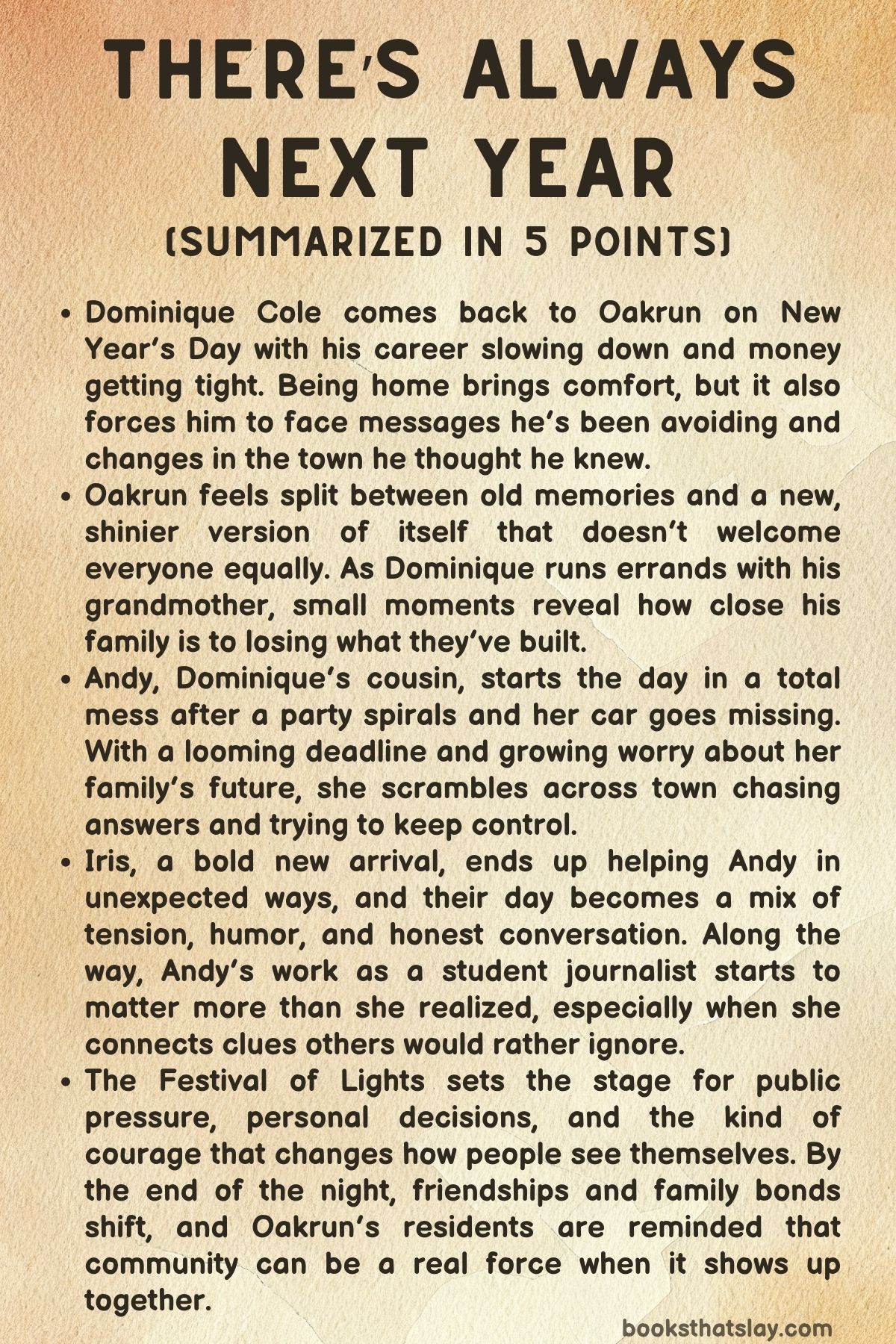
Dominique Cole comes back to Oakrun on New Year’s Day after almost two years away. In New York, he rode a viral runway challenge into a brief surge of modeling work and online attention, but the jobs have slowed and his money is nearly gone.
He tells himself this trip is practical: a paid promotional gig connected to a new hotel development might steady his finances and revive his career. Still, the return also carries old guilt.
He has ignored months of messages from his cousin Andy because he can’t bring himself to admit how badly things have been going.
His grandmother, GiMa, picks him up in her red truck, and the drive through snowy fields brings back memories of being raised by her after his mother died when he was eight. Oakrun looks familiar and strange at once: some places are boarded up, other blocks look newly polished, and the town feels like it’s being redesigned for someone else.
Dominique tries to hold on to the comfort of old traditions as GiMa insists on their New Year’s ritual in the apartment above the family store.
That comfort cracks when he sees the sign in the hardware store window: GOING OUT OF BUSINESS. GiMa doesn’t want to talk yet, but Dominique can tell the situation is serious.
While unpacking, he receives an unexpected “Happy New Year” text from Tyler, his former best friend, which hits harder than he expects. He can’t decide whether to reply, because their friendship didn’t fade gently.
It broke, and Dominique knows he played a major role in that.
GiMa sends him out for New Year’s ingredients and errands. In the grocery store, Dominique gets a blunt look at what has changed in Oakrun.
There are more wealthy newcomers, more trendy storefronts, and an undercurrent of gossip about who is thriving and who is being pushed out. Miss Angie, a town busybody, corners him with questions, and Dominique escapes only to run straight into Tyler, now working as a cashier.
Their reunion is awkward and sharp. Tyler makes it clear that Dominique’s silence was a choice, not an accident.
The snow worsens, and Dominique ends up riding with Tyler to the laundromat. In the small space of the car, old history comes up in sideways comments: Tyler’s scholarship, Dominique leaving college, the different paths they took.
At the laundromat, Dominique is handed a past-due bill for GiMa. He tries to pay by card, but it declines.
He covers it with cash and a lie, and the panic he has been avoiding becomes real. He didn’t just come home broke.
He came home to a family that is struggling in ways he never let himself see.
While Dominique is being jolted back into reality, Andy is having the worst possible New Year’s morning. She wakes up at the Holloways’ house after a rich-kid party, hungover and mortified, dressed in borrowed clothes.
The glamorous drag performer Alotta Bang Bang, who is also connected to the library, finds her and forces her to face the mess she made. Andy’s phone is gone, her plans to meet Dominique at the airport are ruined, and then she discovers her car has disappeared.
A flash drive she keeps in the glove compartment matters to her more than anyone realizes, and losing the car feels like losing control of everything at once.
A new girl in town, Iris Chapman, helps Andy in the blizzard. Iris has money, confidence, a classic car, and the kind of boldness that makes Andy nervous.
Iris offers a ride, but not for free. She wants a favor later, and Andy agrees because she has no other option.
Their partnership starts as necessity, but Iris’s teasing warmth and steady presence quickly complicate Andy’s feelings.
Andy returns to the hardware store building, trying to slip upstairs without confronting her furious mother, Michelle. Outside, a social-media interviewer ambushes her with questions about Dominique’s return.
The scene spirals until Iris creates a distraction and they bolt. A post online suggests Andy’s Corolla has been spotted, and the chase begins.
At the library, Andy runs into Alotta again, who is frantic because her audition video has been wiped. Andy’s own crisis pauses long enough for her to help: she changes into a ridiculous outfit and performs a dance with Alotta so they can record a new video.
For a moment, Andy remembers what it feels like to be capable and present instead of terrified and cornered. But the relief doesn’t last.
The car keeps vanishing, and every lead seems to turn into another prank.
The deeper problem sits underneath all of it. Earlier in December, Andy recorded a private conversation at city hall: Mayor Gavin Youngblood V talked about redevelopment as if it were a cleansing project.
He spoke with contempt about “minorities,” bragged about displacing Black-owned businesses, and laid out a plan to use Dominique as a friendly face so people wouldn’t fight back. Andy’s flash drive contains proof, and she is desperate to keep it safe long enough to publish the truth.
Dominique’s situation tightens when his agent, Kim, arrives at GiMa’s apartment with news: the hotel campaign wants him immediately, starting the next day, and he is expected to appear with the mayor at the Festival of Lights that night. Dominique tries to be excited, but GiMa is disappointed he might leave so soon, and Tyler is furious.
The distance between Dominique and Tyler isn’t just about missed texts; it’s about Dominique choosing a life that made Tyler feel replaceable.
Dominique finally asks Tyler to meet at their old spot, hoping to say what he has never said out loud. When they sit together, Dominique admits his feelings and kisses Tyler.
Tyler doesn’t deny the connection, but he doesn’t accept the apology as a reset button either. He explains how it felt to watch Dominique share everything online while shutting out the people who loved him most.
Tyler tells him a relationship can’t be built on Tyler always waiting and Dominique always leaving.
Andy, meanwhile, pieces together the car mystery and realizes Brooklyn, her crush, treated the theft like a joke. The betrayal lands hard, especially because Andy has softened Brooklyn’s behavior in her writing and in her own mind.
Worse, Andy discovers Iris knew more than she admitted, including Dominique being Andy’s cousin. Andy feels played and exposed, and it drives her toward a reckless plan to confront the mayor directly.
That plan collapses when Alotta’s dog crushes the flash drive on the sidewalk. Andy is devastated, but Alotta doesn’t let her spiral into silence.
She pushes Andy toward the only strategy that can’t be taken from her: tell the story publicly, clearly, and without trying to control every outcome.
At the Festival of Lights, Oakrun gathers under glowing decorations and staged spectacle. Andy’s mother chooses to back her instead of punishing her, and together they post Andy’s message to the town.
Phones buzz. People read about the mayor’s intentions and the pattern of displacement.
The crowd shifts from festive to tense, and the mayor’s confident script begins to crack.
Dominique sees Andy’s post right before he is pushed onstage. He is handed remarks meant to keep him compliant, and he learns the mayor won’t even respect the assistant’s name.
Then Dominique finds something that changes the entire night: evidence that Cole’s Hardware is historically significant, listed as a safe site in the Green Book, meaning the building has legal protections. The “progress” plan isn’t just cruel.
It may be unlawful.
When Dominique steps up to speak, he refuses to play the role. He tells the truth about getting lost chasing fame, about being used, and about what Oakrun and Cole’s mean.
He announces he won’t endorse a project that destroys his community, and he reveals the historic status that blocks demolition. The crowd reacts instantly, and the mayor’s control slips away.
In the chaos, Andy and Iris finally speak honestly. Iris admits she sought Andy out because she likes her, not because of Dominique.
Andy recognizes that her own fear of being seen has kept her half-hidden for too long. Nearby, Dominique publicly credits Tyler and declares his love, choosing home and a real life over a fragile career.
Tyler answers by running to him, and they leave together with GiMa, finally aligned.
Back at Cole’s, Alotta turns the store into a fundraiser party to cover back rent and keep the doors open. The community shows up with cash, music, glitter, and determination.
Kim, seeing the viral momentum of Dominique’s stand, pivots and offers to work with him from Oakrun. Dominique posts a clip and calls for donations, using the same internet that once pulled him away to support the people who raised him.
As the celebration grows, Andy finds Iris in the middle of the noise and chooses clarity over panic. She tells Iris she likes who she is when they’re together and asks for something real.
Iris kisses her, and Andy lets herself accept it. Around them, the party becomes more than a fix for a bill.
It becomes a statement: Oakrun’s future will not be decided only by money and power, and the new year will be shaped by the people who refuse to be erased.
Characters
Dominique Cole
Dominique is introduced as someone who built his identity around visibility: a viral runway challenge turned him into a New York–adjacent fashion figure, but the story makes it clear that his confidence is brittle because it depends on external attention. His return to Oakrun is powered by equal parts need and denial—he needs money, stability, and a “win,” yet he avoids Andy’s messages because acknowledging them would force him to admit how far he has slipped from the version of himself he performs online.
Oakrun becomes a mirror that refuses to flatter him: the shuttered shops, the “GOING OUT OF BUSINESS” sign, and the unchanged apartment above the store all confront him with what he tried to outrun. Dominique’s most important internal conflict is not fame versus home, but performance versus truth; he has learned to narrate himself for an audience, and the book steadily pressures him to speak as a person again.
That shift peaks when he realizes the hotel deal doesn’t just offer him relevance, it weaponizes his image as cover for displacement, and his integrity finally outweighs his desperation. His romance with Tyler is written as the emotional core of that transformation: Dominique’s attraction is sincere, but his habit is self-protection through distance, and Tyler forces him to confront what love costs if it is going to be real.
By the end, Dominique’s choice to stay is not framed as settling; it is framed as maturity—he stops confusing mobility with freedom and chooses rootedness, accountability, and community as the place where his voice actually matters.
Andy Cole
Andy operates as a tightly coiled mix of ambition, anxiety, and moral clarity, and the book’s energy often comes from how quickly her brain turns pressure into motion. She is a high school journalist with sharp instincts and a real sense of duty, but she also carries the classic burden of being “the responsible one” in a family crisis—working at Cole’s, trying to plan a future, and feeling like she has to hold everyone together while still being a teenager.
Her New Year’s Day chaos is not just comic misfortune; it exposes how little margin she has emotionally, so one missing car or dead phone becomes catastrophic because she is already stretched to the limit. Andy’s defining trait is that she wants control, and the story repeatedly breaks that illusion to push her toward trust: she cannot force Dominique to listen, cannot physically stop redevelopment, cannot keep her mother calm with half-truths, and cannot solve everything alone.
The recording of the mayor is her turning point because it validates her instincts while also challenging her approach—she initially wants a direct confrontation that will “fix” it, but she learns that writing the truth publicly can be more powerful than cornering one man privately. Her emotional arc runs alongside her political one: she is learning to be brave in public, but also to stop hiding in private, especially with her mother and with Iris.
By the end, Andy’s courage becomes more grounded—less frantic, less fueled by panic—and she begins choosing relationships that make her feel seen rather than judged.
Tyler Anderson
Tyler functions as both the story’s emotional conscience and its most consistent standard for what accountability looks like. He is not written as cruel when he is cold to Dominique; he is written as someone who has already grieved being abandoned and refuses to reopen that wound without proof that things will be different.
Tyler’s scholarship references and his steady work life create an important contrast to Dominique’s influencer volatility, but the book avoids making him merely “responsible” and instead makes him deeply tender beneath the restraint. His pain is specific: Dominique didn’t just leave Oakrun, he left without explanation and then turned his life into content, which makes Tyler feel replaced by an audience.
Tyler’s boundaries are the most emotionally mature thing in the narrative; when Dominique offers long-distance as if that automatically fixes the past, Tyler names the imbalance and insists a relationship cannot be built on one person always adjusting. That insistence is not a rejection of love, it is a demand that love be mutual.
Tyler’s final acceptance of Dominique comes only after Dominique shows the town—and himself—that he is willing to choose something that costs him status. When Tyler runs to hug and kiss him after the speech, it lands as earned because Tyler is responding to action, not promises, and the romance becomes a public affirmation of partnership rather than a private fantasy.
GiMa
GiMa is the anchor, embodying a love that is both nurturing and uncompromising. Her traditions—like insisting Dominique be the first man to walk through every room—aren’t quaint details, they are her way of insisting on continuity, protection, and belonging in a world that keeps trying to erase Black family spaces.
She raised Dominique after his mother died, and the story treats that history as the emotional foundation beneath everything Dominique does; his shame, his avoidance, and even his hunger for applause all read as coping strategies that grew from grief and displacement. GiMa also represents a type of pride that can become a barrier: she refuses to discuss the store’s finances and dislikes Dominique paying bills because accepting help feels like admitting failure.
Yet her love is not passive—she pushes Dominique to stop running, calls out what he feels for Tyler, and insists that home is something you choose and maintain. In the climax, GiMa’s presence in the escape and the later dancing is more than warmth; it symbolizes community protection, the idea that survival is collective, and that joy itself can be resistance when the town is under threat.
Iris Chapman
Iris enters as disruption: stylish, confident, wealthy, and seemingly unbothered by the social rules that keep everyone else in their lanes. At first she feels like a wildcard with a transactional edge—she helps Andy but demands a favor to be named later, which introduces an unsettling power dynamic because Iris’s privilege allows her to treat risk like a game.
Over time, though, the book complicates her into someone who is not simply “rich and reckless,” but a person trying to reinvent herself in a place where she also feels out of place. Her teasing, her speed, and her bravado read as armor; the quiet moment in the supply closet hints that she carries loneliness and a desire to belong that she doesn’t know how to ask for cleanly.
Iris’s growth is tied to empathy: she learns that what looks like harmless prank culture around Brooklyn has real consequences for Andy, and she begins to take Andy’s fear seriously instead of treating it as entertainment. Most importantly, Iris becomes a romantic counterpart who invites Andy into softness rather than chaos; by confessing that her interest was never really Dominique but the possibility of a future with Andy, Iris shifts from manipulator to vulnerable participant.
Their final kiss lands as a choice Andy makes from calm rather than panic, which signals that Iris is no longer just adrenaline—she becomes genuine connection.
Kim
Kim represents the machinery of image, and she is written with enough practicality to feel real rather than villainous. She is blunt about the industry moving on because her job depends on results, and she keeps Dominique tethered to the logic of branding even when he wants to think emotionally.
At the same time, her actions show that she is not indifferent to Dominique as a person; she finds opportunities for him, travels to Oakrun, and understands how to turn moments into momentum. Kim’s role becomes morally sharp when the mayor’s team tries to script Dominique, because it forces the question of where representation ends and exploitation begins.
Her eventual decision to keep working with Dominique after his speech shows her adaptability and hints at a subtle respect: she recognizes that authenticity is now the brand, but she also sees that Dominique has finally become someone worth betting on because he is not just chasing clout—he is leading something. Kim therefore functions as a bridge between two worlds, and the book uses her to show that staying in Oakrun doesn’t mean abandoning ambition, it means redefining what ambition is for.
Mayor Gavin Youngblood V
Mayor Youngblood is the clearest embodiment of systemic threat, but what makes him effective is that he is not framed as cartoonishly evil; he is framed as familiar. He speaks the language of “revitalization” while privately describing the town in terms of demographics and “big money,” revealing that the development plan is not neutral progress but targeted reshaping meant to displace existing Black businesses and communities.
His decision to use Dominique as the face of the project is central to the story’s critique: he understands that optics can neutralize resistance, especially when the person providing the optics is a local Black success story. Even his refusal to learn N’Darius’s name signals the everyday contempt beneath his public performance.
In the climax, Youngblood loses control not because someone outmaneuvers him in a private meeting, but because the community refuses his narrative in public. He becomes a symbol of power that depends on silence, and once the town speaks, he collapses into rage and flight.
N’Darius
N’Darius appears briefly, but he carries disproportionate thematic weight because he represents the quiet violence of being erased while standing in the room. The small moment where he corrects Dominique on his name—because the mayor refuses to learn it—captures the story’s broader concern with who is allowed to be fully human and who is treated as interchangeable labor.
N’Darius is also the conduit through which Dominique receives evidence that transforms the public narrative, suggesting that people on the margins of power often hold the most dangerous truths. Even without extensive page time, he operates as proof that exploitation is not abstract; it happens in the daily disrespect that powerful people normalize, and it is maintained by expecting others to swallow it.
Alotta Bang Bang
Alotta brings flamboyance, comedy, and sharp wisdom, but the book uses her to do something deeper than comic relief. She moves through Oakrun as someone who sees everything—social hypocrisy, small-town gossip, and the quiet panic under everyone’s public faces—and she refuses to pretend that “objectivity” is always virtuous.
Her advice to Andy is pivotal because it reframes journalism as moral clarity rather than polite neutrality, pushing Andy to publish the truth instead of trying to engineer a private solution. Alotta’s life in the library, her Drag On!
audition pressure, and her ability to pivot from crisis to performance underline a theme of chosen family and survival through artistry. Most significantly, Alotta turns the hardware store into a rent party, transforming threatened space into communal celebration and material support.
She embodies the idea that joy, spectacle, and queerness are not distractions from political struggle—they are tools for building solidarity.
Michelle
Michelle is written as the parent who has been forced into hardness by constant stress, and the story gradually reveals how much love is underneath her anger. Her fury at Andy’s disappearance is not about control for its own sake; it is about fear, exhaustion, and the terror of losing more than she can bear—her daughter, her home, her family business, the stability she has fought for.
Michelle’s presence also grounds Andy’s storyline in real stakes: the store is not just a symbol, it is rent, medicine, food, and dignity. When Michelle finally confronts Andy and demands honesty, the moment lands as a lifeline rather than punishment; she offers partnership, but only if Andy stops shutting her out.
Her generosity with Lady Nelson, giving away parts they can barely afford, also shows that Michelle’s values are communal even when she is scared. She is therefore a portrait of a caregiver at the edge of burnout, and her arc moves from reactive anger toward active alliance with her daughter.
Connie Holloway
Connie Holloway functions as a satirical lens on privilege and content culture. Her hunger for “podcast content” and her casual presentation of Andy’s humiliating video reveal a social environment where embarrassment becomes entertainment and other people’s crises become material.
Connie is not the central antagonist, but she represents a softer kind of harm: the thoughtless exploitation that wealthy spaces can enable, where consequences are a joke because they rarely land on the people laughing. Her household setting also contrasts with the Cole family’s precariousness, emphasizing how differently disaster plays out depending on whose safety net is real.
Rico Glaswell
Rico operates as a messenger of the town’s social media ecosystem, the person whose posts and sightings turn rumor into action. By circulating the image that helps Andy track her car, Rico demonstrates how visibility can be used for support rather than vanity, which parallels Dominique’s larger arc of reclaiming his platform for community.
Rico also highlights how quickly narratives spread in Oakrun—sometimes helpfully, sometimes harmfully—and the story uses that to show that the battle over the town is also a battle over what people believe and repeat.
Miss Angie
Miss Angie embodies the social surveillance of Oakrun, the kind of gossip that feels small until you realize how powerfully it shapes reputations and shame. Her prying questions and rumor-spreading about GiMa’s finances expose a community reflex to turn hardship into spectacle, which directly feeds Dominique’s embarrassment and secrecy.
She is not a mastermind, but she represents how judgment can become another form of pressure on people already struggling, and how public humiliation can discourage asking for help. Later, when she notes people talking about raising money online, she also shows that the same social currents that spread harm can pivot toward support, depending on what story the town decides to tell.
Brooklyn Townsend
Brooklyn represents the danger of treating other people’s lives as games, especially when you are insulated from consequences. The stolen car “prank” is framed as a scavenger-hunt joke, but it lands on Andy as panic and real risk, exposing a mismatch between intent and impact.
Brooklyn also acts as a catalyst for Andy’s self-reflection as a journalist: Andy realizes she has been too gentle in her writing, smoothing over harm by describing it as harmless fun. Brooklyn therefore becomes less a romantic crush figure and more an object lesson in how charisma and social status can normalize disrespect, and how growing up sometimes means naming that clearly.
Lady Nelson
Lady Nelson’s brief presence is a reminder that community struggle is not abstract—it’s prescriptions, broken trucks, and impossible choices. Her blown head gasket and rush to reach the pharmacy highlight how precarious life can be for older residents, and her interaction with Michelle and Andy shows the quiet ethics that hold the town together.
She also mirrors the hardware store’s purpose: Cole’s is not just retail, it is a practical lifeline, a place where neighbors solve problems together when the official systems do not.
Mrs. Vernie
Mrs. Vernie appears as the laundromat owner who hands over the past-due bill, and her role is small but sharp: she introduces financial reality with no softness, because small businesses cannot survive on sentiment. That moment forces Dominique to confront a truth he has been avoiding—that the family’s hardship is not theoretical, it is immediate, and it comes with public exposure and humiliation.
Mrs. Vernie’s presence helps the story translate “money is tight” into concrete consequence, which intensifies Dominique’s shame and accelerates his shift from denial to responsibility.
Dr. Thompson
Dr. Thompson’s appearance mainly supports Andy’s identity as a serious young reporter. The budget cut interview and the school breakfast issue show that Andy’s journalism is not just drama-chasing; she is attentive to policy and its everyday impacts.
Dr. Thompson therefore helps establish Andy’s credibility and reinforces a theme that public decisions reshape private lives, preparing the ground for the larger redevelopment fight.
Themes
Homecoming, Memory, and Reclaiming a Self Beyond the Persona
There’s Always Next Year treats Dominique’s return to Oakrun as more than a change of location; it becomes the moment where the person he has been performing begins to crack under the weight of what he has been avoiding. The humiliation at the airport, the ignored messages from Andy, and the awkward encounters with people who remember him before the runway-walk challenge all push him into an uncomfortable truth: his public image has been loud, but his private life has been quiet in the worst way.
Oakrun holds the versions of him that existed before follower counts and brand deals, and the town forces him to compare what he gained with what he left behind. The apartment above Cole’s, the familiar photographs, and the New Year’s traditions with GiMa are not sentimental decoration; they’re evidence that he still belongs to a story that can’t be reduced to content.
At the same time, home is not frozen in time. The boarded-up storefronts, the glossy new businesses, and the “GOING OUT OF BUSINESS” sign reveal that returning does not automatically restore what was lost.
That tension—between the comfort of memory and the shock of change—creates a pressure that makes Dominique finally confront his shame about money, his fear of being seen as a failure, and his instinct to disappear when life gets hard. The theme culminates when he chooses to speak publicly without a script, not as an influencer or a hired face, but as a son, a neighbor, and someone who wants his life to mean more than an algorithmic spike.
The story insists that identity is not a brand refresh; it is a moral stance shaped by where you come from, who raised you, and what you’re willing to protect when applause fades.
Gentrification, Displacement, and the Politics of Respectability
Oakrun’s redevelopment plan is presented as a shiny promise, but There’s Always Next Year exposes how these projects often function: they rename removal as “progress” and call erasure “revitalization.” The town’s transformation is visible in its new storefronts and wealthy arrivals, yet the real conflict appears in the way power speaks about people. The mayor’s private comments show that the plan is not simply economic development; it is demographic engineering, where Black-owned businesses and long-standing community spaces become obstacles rather than assets.
Cole’s Hardware stands at the center of this theme because it represents multi-generational survival, mutual aid, and local memory. When the mayor frames Dominique as “that Cole boy from the internet,” the book highlights a blunt strategy—using a recognizable Black figure to soften public resistance and give a moral cover to policies that harm Black residents.
This is not subtle prejudice; it is tactical racism paired with media savvy. Dominique’s opportunity is real, and so is his desperation for stability, which makes the temptation credible.
The theme becomes especially sharp because it refuses an easy villain-and-victim split: the community is not only battling a mayor but also battling the internal pressures that make someone accept a harmful deal just to breathe financially. Andy’s role as a student journalist adds another dimension, showing how truth-telling can challenge respectability politics.
She is pressured to be “objective,” to keep the tone polite, and to treat injustice as a debate topic rather than a lived emergency. The book argues that when institutions are designed to displace you, being presentable is not protection, and being quiet is not safety.
What matters is collective clarity—naming what is happening, refusing the performance of agreement, and insisting that history, law, and community ties carry authority that money should not override.
Social Media, Fame Cycles, and the Cost of Living as Content
Dominique’s influencer career is not romanticized as a dream job or mocked as shallow; There’s Always Next Year treats it as labor that is volatile, extractive, and emotionally destabilizing. His success begins with a viral moment, but the story shows how quickly the platform economy replaces people and moves on, leaving those who built their identity around visibility scrambling for the next booking.
Dominique’s routines—filming “Get Ready with Me” videos, counting commissions, and staying “engaged” even while anxious—illustrate how the work requires constant self-surveillance. He can’t simply feel disappointment after a failed audition; he has to package himself as resilient, desirable, and trending.
That pressure makes his shame deepen when bookings slow, because he feels he has to embody success even when his bank balance says otherwise. The theme also extends to Oakrun, where public life is increasingly mediated through phones: street interviews ambush Andy, posts go viral in seconds, and the Festival of Lights becomes a stage for competing narratives.
The same system that can humiliate and exploit also becomes a tool for resistance. Andy’s message spreads faster than any formal meeting could.
Dominique’s unscripted speech, clipped and shared, becomes fuel for fundraising and collective action. The book refuses a simple “social media is bad” conclusion; instead, it points to the real issue—who controls the story, who profits from it, and what happens when people are treated as marketing.
Dominique’s turning point comes when he chooses not to be a prop. The story suggests that technology amplifies whatever values are already present: if the goal is personal branding, it will reward performance; if the goal is community defense, it can help mobilize.
The cost is that nothing stays private for long, and the courage required is not only to speak, but to accept being seen without the protective filter of a curated persona.
Friendship, Rupture, and the Difficulty of Repair
The broken triangle between Dominique, Andy, and Tyler demonstrates how absence can be its own kind of betrayal, even when it isn’t meant to be cruel. Dominique’s silence is driven by shame and fear, but the impact on Andy and Tyler is still real: months of ignored messages, holidays that came and went, and the sense that Dominique chose an audience over his people.
Tyler’s coldness at the grocery store and in the car is not just pettiness; it is self-protection from someone who once mattered deeply. The book captures a specific kind of pain common in childhood bonds—when the person you shared everything with grows into someone who cannot be reached anymore.
Repair, in There’s Always Next Year, is not framed as a single apology that fixes the past. Tyler demands a “fifty-fifty” relationship, meaning Dominique’s dreams cannot automatically outrank Tyler’s needs.
That insistence changes the power dynamic: Dominique can’t simply return, confess feelings, and expect a reset. He has to accept accountability for how his choices shaped Tyler’s loneliness and mistrust.
Andy’s relationships show repair in a different form: she learns that her “fine, I’ve got it” posture pushes away the people who want to help. When she finally asks her mother for help, it becomes a turning point that is just as brave as confronting the mayor.
The theme also includes how community figures like Alotta function as corrective forces, calling out Andy’s flawed plan and pushing her toward action that can actually protect people. Friendship and support networks are portrayed as imperfect but essential systems where honesty is the price of belonging.
By the end, the story suggests that repair is possible when people stop performing strength and start communicating needs, boundaries, and commitments in plain terms—even if the conversation is messy and late.
Queer Love, Visibility, and Choosing a Life That Fits
Romance in There’s Always Next Year is not treated as a side plot; it becomes a lens for how the characters learn to be honest. Dominique and Tyler’s relationship carries years of unspoken longing and suppressed conversation, made harder by the ways small towns can police difference and by the ways ambition can pull someone away from intimacy.
Their kiss is not presented as a magical solution; it immediately triggers the harder discussion about trust, effort, and what it means to build a relationship that is not one-sided. Tyler’s refusal to accept a relationship where he is always waiting challenges a common pattern—especially for someone dating a person chasing public validation.
Dominique’s eventual public declaration is risky, not because it is dramatic, but because it stakes his future on authenticity rather than marketability. The story frames that moment as a choice to stop living split in two: one self for the crowd and another self hidden in private.
Andy and Iris offer a parallel, younger version of queer discovery that includes flirtation, confusion, and the fear of being played. Iris’s initial secrecy and the “favor” bargain create distrust, yet their connection grows through small scenes of shared laughter, cramped closeness, and the relief Andy feels when she can be herself without strategizing.
Iris admitting she wanted an excuse to connect with Andy reframes her actions as awkward desire rather than manipulation, and Andy’s willingness to move toward her without panic shows emotional growth. The book also places queer joy inside community, not outside it: drag queens become organizers, the party becomes a fundraiser, and celebration becomes a way of building safety.
Visibility here is not only personal pride; it is also political power. By choosing love openly, the characters challenge the town’s old silences and demonstrate that belonging does not require shrinking.
The theme ultimately argues that a life that fits is not one where desire is hidden until convenient; it is one where relationships are allowed to be real, public, and supported—especially in the very place that taught you to hide.