These Immortal Truths Summary, Characters and Themes
These Immortal Truths by R. Raeta, is a historical fantasy about immortality, compassion, suffering, and the difficult work of creating goodness in an unjust world.
The story follows Anna, a persecuted woman who receives eternal life from the mysterious god Khiran after showing kindness when she has almost nothing to give. As centuries pass, Anna becomes a healer, mother, rescuer, witness, and protector across many periods of human history. Her endless life brings freedom and purpose, but it also forces her to endure repeated loss, separation, violence, and loneliness.
Summary
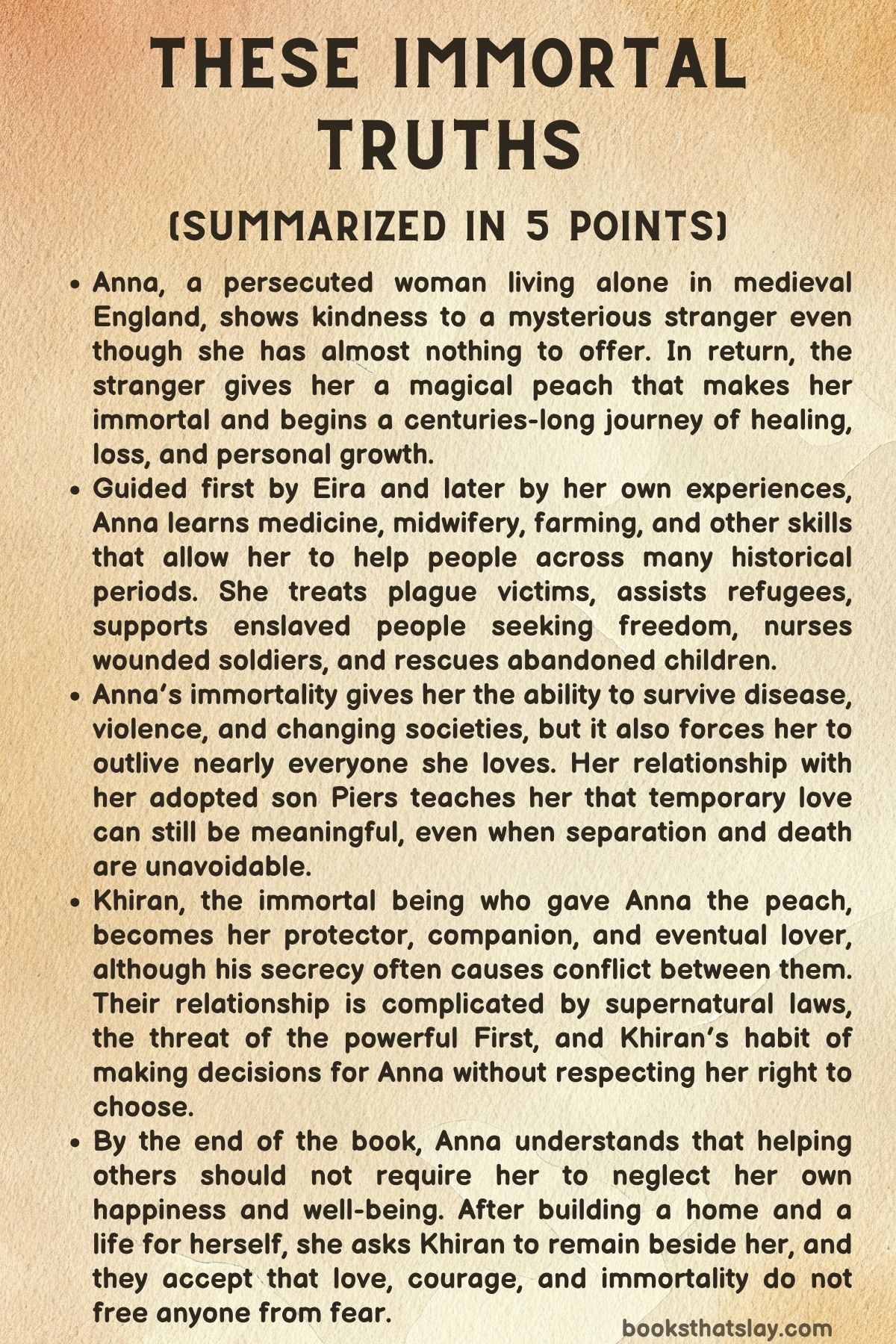
In England in 1185, Anna lives alone in a forest after years of enslavement, exile, and rejection. Pale markings across her skin have caused frightened villagers to treat her as diseased, leaving her with little food, safety, or human companionship.
While gathering berries, Anna encounters a richly dressed stranger fleeing soldiers. Although helping the stranger could cost Anna her life, she hides the woman in her cabin and shares her scarce food without demanding anything in return.
The stranger gives Anna a strange fruit called a táo, or Persian apple. Soon afterward, soldiers arrest Anna, and a priest condemns her as a witch before ordering her to be burned alive.
The flames destroy her clothing and restraints, but Anna’s body remains unharmed. When the villagers leave, the stranger returns and explains that death will no longer claim her.
The mysterious figure changes appearance and introduces himself as Khiran, one of his many names. With nowhere else to go, Anna follows him to the hidden home of Eira, an elderly healer who immediately understands that the fruit has made Anna immortal.
Eira warns that an endless life will become unbearable unless Anna learns to use it well. Under Eira’s guidance, Anna studies medicine, childbirth, literacy, agriculture, cooking, and the careful use of natural resources.
She learns to treat illness, assist women during pregnancy, and provide care regardless of a patient’s wealth. Eira also teaches her that the markings on her skin are harmless and that other people’s fear does not define her value.
Anna gradually becomes stronger, more confident, and highly skilled. She also discovers that immortality has made her unable to bear children, a loss that hurts even though Eira explains that Anna would otherwise be forced to outlive every child she raised.
Khiran visits in changing forms and gives Anna a carved bone ring that permanently attaches itself to her finger. He warns her never to remove it but refuses to explain its full purpose.
After Eira leaves, Anna remains in the cottage until security turns into stagnation. Khiran encourages her to enter the world, and Anna begins working as a midwife while moving from place to place before anyone can notice that she does not age.
In Norwich, Anna befriends Marco, an Italian merchant, and his son Giovanni. Giovanni offers her genuine friendship, and Anna slowly permits herself to enjoy his quiet companionship.
When violence erupts in the city, Giovanni attempts to help Anna escape. After seeing the pale markings on her arm, however, he assumes she carries a contagious disease and abandons her.
Anna is deeply wounded by his rejection but refuses to let it decide her future. Remembering Marco’s descriptions of Venice, she resolves to travel toward the city and witness its beauty for herself.
During the Great Famine, Anna finds a five-year-old boy named Piers waiting for a mother who has abandoned him. She takes him into an empty cabin, feeds him from her limited supplies, and promises that she will not leave him through death.
Khiran warns that loving a mortal child will eventually cause Anna terrible pain. She accepts that future loss and raises Piers anyway, becoming the mother she believed immortality had prevented her from being.
Years later, Piers marries Maria and discovers that Anna intends to leave. Anna reveals the truth about her immortality, but she refuses his request to remain because she cannot bear to watch him age and die.
Piers accuses her of taking away his right to choose, and their separation leaves both of them devastated. Khiran stays with Anna through her grief and asks her to remember one question: should immortality ever stop feeling entirely like a curse, she must ask why he chose her.
Anna later treats victims of the Black Death in Venice. Although Khiran urges her to leave, she remains because even saving a few people seems worth the pain and risk.
Anna contracts the disease and suffers severely, though death cannot keep her. Khiran takes her to an isolated cottage and cares for her, allowing Anna to see his concern, limitations, and loneliness more clearly.
In Rouen, Anna witnesses Joan of Arc’s execution and begs Khiran to intervene. He refuses, explaining that laws governing immortal beings prevent him from directly changing mortal lives.
Their disagreement grows as Anna watches innocent people suffer while Khiran claims he cannot act. After villagers burn another home she has created, centuries of anger and grief finally overwhelm her.
Instead of asking Anna to control herself, Khiran holds her while she screams and mourns. He reminds her that terrible periods may return, but they do not erase the possibility of another morning.
Anna eventually returns to Genoa and learns that Piers died during the plague while protecting his family. His grandson Franco recognizes Anna from family stories and welcomes her as the immortal mother Piers always believed would return.
Piers’s descendants accept Anna without fear and share the history of the family he created. Their love teaches her that relationships can remain valuable even when they end in death.
As centuries pass, Anna and Khiran repeatedly support one another. When Khiran is overcome by the destruction of Indigenous communities during European conquest, Anna repeats his own lesson and asks him to look beyond immediate cruelty toward whatever beauty still survives.
In London, Khiran finally explains why he selected Anna. He creates a situation involving abandoned children and shows that, even when others notice suffering, Anna is the person who immediately acts.
Khiran chose her because persecution and deprivation had not destroyed her compassion. When she sheltered him and shared her food in 1185, she proved that she would protect another person even when kindness offered no reward.
Anna continues living under different names and identities. In a Puritan settlement, she survives another accusation of witchcraft when Khiran turns her escape into a frightening supernatural performance.
During the American Revolution, Anna works as a military nurse and earns the respect of surgeon Frederick Thompson. Their affection grows, but Anna ends the relationship because she cannot offer the mortal future of marriage, children, and shared old age that he imagines.
Anna later lives among the fleet of Ching Shih and experiences unusual freedom at sea. Although she admires Ching Shih’s authority and protections for women, violence against civilians and the exposure of Anna’s skin eventually force her to leave.
In Louisiana, Anna operates a safe house connected to the Underground Railroad. She treats people escaping slavery and works beside Silas, a gentle guide who is later revealed to be another immortal being.
When slave catcher Gerald Abel threatens Anna, Khiran discovers that he can defend her because her immortality is connected to his magic. Anna also learns that Silas gained immortality through a different agreement and now serves a power beyond himself.
In London in 1888, Anna cares for Seth Hastings, a sensitive child living under a cruel father. Her affection for Seth reminds her of Piers, but the memory now brings gratitude instead of unbearable sorrow.
During the First World War, Anna works in a military hospital and witnesses injuries created by modern weapons. After repeated bombings, Khiran admits that even he no longer knows whether the protection of the magical fruit has limits.
In New York in 1920, Anna and Khiran finally confront the love that has grown between them. After centuries of friendship, arguments, separations, and shared experiences, they become lovers.
Khiran reveals that Anna’s bone ring was made from part of his own body. It allows him to sense her danger and hides her from other immortals who might harm her in order to punish him.
Their happiness is interrupted when Eira summons Anna back to the magical cottage. Eira explains that abandoned and starving children are guided to her home, and she asks Anna to travel through magical pathways to bring them to safety.
Khiran attempts to prevent Anna from accepting the responsibility, causing a serious conflict between them. Anna wants to be treated as his equal, while Khiran’s fear causes him to speak as though she remains under his authority.
Anna works with Eira and Silas to rescue hundreds of children from famine. She struggles with the knowledge that millions remain beyond their reach, but Eira reminds her that the inability to save everyone does not make individual lives less important.
In Germany, Anna assists people targeted by Nazi persecution and guides refugees toward escape routes. When soldiers capture her, Khiran directly kills one of them to save her, violating the laws that restrict immortal interference.
Another immortal punishes Khiran severely for his actions. He eventually reveals that this being is known as the First, the earliest person to consume fruit from the world tree and claim the status of a god.
The First controls the distribution of immortality and forbids the other gods from freely interfering in human affairs. Khiran stole Anna’s peach both as an act of rebellion and as a way to place compassion in the world through someone who remained free.
Fearing that the First will discover Anna’s importance to him, Khiran takes her to a well-supplied cottage in California and leaves without her consent. Anna spends years waiting, grieving, and angrily pulling at the ring that connects them.
Over time, she creates a life that is not based entirely on rescuing others. She paints, keeps bees, raises a donkey, builds gardens, shares food with nearby communities, and establishes the first home she has chosen for herself.
Thirteen years later, Khiran returns and offers an ordinary peach as an apology. Anna refuses to excuse his decision, but she understands that fear and love, rather than indifference, caused him to leave.
Anna tells him that ignoring her own needs while constantly serving others is another form of destruction. She asks Khiran to stay and face whatever the First may do instead of making choices for her.
Khiran admits that he loves her but remains afraid of losing her. When Anna repeats his old claim that fear belongs to mortals, he places her hand over his racing heart and tells her that fear belongs to everyone.
Characters
Anna
Anna is the moral and emotional center of These Immortal Truths. She begins the book as a woman who has experienced enslavement, isolation, religious persecution, hunger, and public rejection, yet these experiences have not eliminated her ability to recognize another person’s need.
Her decision to protect Khiran is significant because it is made before she knows that he possesses power or can reward her. Anna helps because helping is her instinct, even though the world has given her many reasons to become suspicious, selfish, or cruel.
Immortality does not instantly transform Anna into a confident hero. She must learn basic skills, receive education, overcome internalized shame, and understand that survival alone is not the same as living.
Eira’s teaching gives Anna practical power through medicine, literacy, farming, and midwifery. These abilities allow her to create change without depending entirely on supernatural force.
Anna’s compassion is active rather than sentimental. She feeds Piers when she is hungry, cares for plague victims despite the danger, assists people escaping slavery, guides refugees away from persecution, and rescues children from famine.
Her actions are not based on the belief that she can save everyone. She repeatedly confronts the painful difference between doing meaningful good and possessing enough power to end widespread suffering.
Her relationship with Piers reveals both her capacity for love and her fear of loss. Anna accepts the risk of raising him, but when he becomes an adult, she tries to control the terms of their separation because she cannot tolerate the thought of watching him die.
Piers’s anger forces Anna to recognize that protection can become controlling when it denies another person the right to choose. This lesson later shapes her conflict with Khiran, who also attempts to make decisions for her in the name of safety.
Anna’s shame about her skin remains one of her longest internal struggles. Even after centuries of healing others, she still fears exposure because her earliest experiences taught her that visible difference could lead to abandonment, violence, or execution.
Khiran’s acceptance helps her, but Anna’s eventual growth requires more than receiving reassurance from someone who loves her. She must build a life in California where her identity is not entirely determined by service, concealment, or the expectations of others.
Her greatest development lies in learning that compassion must include herself. By the conclusion, Anna does not stop helping people, but she rejects the belief that her worth depends on endless sacrifice.
Anna becomes powerful without losing the qualities that caused Khiran to choose her. Her immortality enlarges the reach of her kindness, but it is her repeated decision to act, love, learn, and begin again that makes her extraordinary.
Khiran
Khiran is a god associated with numerous myths, names, cultures, and identities, but These Immortal Truths presents him most clearly as a being trapped between great power and strict limitation. He can change appearances, travel across vast distances, influence decisions, create illusions, and protect Anna, yet he is forbidden from directly solving many of the human tragedies he witnesses.
His many forms initially make him difficult to understand. Shapeshifting allows Khiran to enter different societies, escape recognition, challenge expectations, and hide the face he considers his own.
The mystery surrounding him is partly playful, but it is also defensive. Khiran has lived under dangerous laws and rivalries for so long that secrecy has become one of his primary methods of survival.
Giving Anna the peach is both an act of compassion and an act of rebellion. He recognizes her unusual goodness, but he also needs someone who can perform acts of mercy where the First has restricted him.
Khiran does not choose Anna because she is physically powerful, socially important, or free from fear. He chooses her because suffering has not made her indifferent to suffering in others.
His relationship with Anna changes from distant guardianship to companionship and eventually romantic love. At first, he appears when necessary, gives incomplete explanations, and assumes that his greater knowledge grants him the right to control what Anna learns.
Over time, Anna becomes the person who understands his grief, questions his excuses, challenges his authority, and comforts him when his own hope fails. Their connection becomes mutual rather than being limited to a god protecting a vulnerable mortal.
Khiran’s greatest weakness is his tendency to treat secrecy as protection. He hides the purpose of the ring, the existence of the First, the punishment he receives, and the danger created by loving Anna.
These decisions come from genuine fear, but they repeatedly deny Anna the information required to make choices about her own life. His habit of leaving without agreement becomes especially damaging when he abandons her in California for thirteen years.
Khiran also carries deep guilt about the suffering he cannot prevent. He has enough power to understand the scale of human cruelty but not enough freedom to stop it directly, creating a form of helplessness that mirrors Anna’s frustration.
His immortality does not make him emotionally invulnerable. He experiences exhaustion, jealousy, physical pain, loneliness, uncertainty, and fear of losing the one person who has become essential to him.
By the conclusion, Khiran begins to abandon the pose of the fearless, untouchable god. His racing heart becomes evidence that love has made him vulnerable, and admitting that fear belongs to everyone allows him to meet Anna as an equal.
Eira
Eira is Anna’s first true teacher and the person who converts immortality from an unexplained condition into a possible life. She immediately recognizes that Anna does not merely need shelter; she needs knowledge, confidence, discipline, and a reason to continue.
Her teaching is rooted in practical responsibility. Eira shows Anna how to heal, grow food, conserve resources, assist women, accept flexible payment, and understand that trust can be more valuable than money.
Eira also gives Anna language for understanding her earlier life. By telling Anna that she has survived rather than truly lived, Eira identifies the emotional damage caused by years of fear and deprivation.
Her correction is firm but not cruel. She refuses to define Anna as permanently broken and instead expects her to develop abilities, make decisions, and take responsibility for the future.
Eira’s supernatural identity expands her role beyond that of an ordinary healer. The legends surrounding her cottage have turned acts of protection into frightening stories, demonstrating how communities can distort powerful women into monsters.
In reality, Eira’s home provides refuge for abandoned and starving children. Her magic is therefore connected to shelter, nourishment, hidden pathways, and the preservation of vulnerable lives.
Eira understands both Anna and Khiran well enough to challenge them. She supports Anna’s desire to help the children, but she also recognizes when Anna and Khiran require distance before their conflict causes further harm.
Her reminder that no one can save everyone is central to Anna’s development. Eira does not use this truth to justify inaction; she uses it to prevent compassion from becoming hopelessness.
Piers
Piers enters the book as an abandoned child waiting beneath a tree for a mother who will not return. His vulnerability gives Anna an immediate purpose, but his role grows far beyond that of someone she rescues.
Through Piers, Anna experiences motherhood despite her inability to give birth. She feeds him, protects him, educates him, creates a home for him, and watches him become capable of building a life of his own.
Piers’s childhood fear of Anna’s markings differs sharply from the reactions of the villagers and Giovanni. He worries that the markings mean Anna is dying, revealing concern rather than disgust.
His acceptance gives Anna one of her earliest experiences of being loved without concealment. He knows her physical difference and responds by fearing her loss instead of treating her as a threat.
As an adult, Piers refuses to remain a passive recipient of Anna’s decisions. When she plans to disappear after his wedding, he confronts her and demands the truth.
His anger is justified because Anna attempts to determine what kind of life and grief he should be allowed to choose. Piers understands the pain of eventual separation but believes that love gives him the right to decide whether the remaining years are worth that pain.
His later actions during the plague confirm the values Anna taught him. He risks his life repeatedly to protect his wife and children, turning Anna’s compassion into a family inheritance.
Even after his death, Piers remains influential through his descendants. His certainty that Anna would return creates a family tradition of acceptance that gives her a place of belonging generations later.
Silas
Silas is a calm, compassionate immortal known as the Shepherd. His title reflects his role as a guide who leads endangered people toward safety rather than controlling where their lives must ultimately go.
In Louisiana, Silas works beside Anna to help enslaved people escape. His patience and steadiness make him effective in situations where frightened individuals require trust as much as they require directions.
His supernatural identity complicates Anna’s understanding of immortality. Unlike Anna, Silas received eternal life through an arrangement that placed him under the authority of another power.
This difference establishes Anna as an unusual figure among immortals. She is connected to Khiran’s magic but does not belong to him or owe obedience to the First.
Silas’s work with the rescued children demonstrates his emotional intelligence. He earns their confidence through music, patience, and kindness rather than expecting them to obey simply because he offers assistance.
His strained relationship with Eira suggests a long history of conflict among supernatural beings. Nevertheless, both put aside distrust when cooperation becomes necessary to protect the children.
Silas also acts as an indirect connection between Anna and Khiran during their separation. His honesty about Khiran’s continued concern encourages Anna to recognize that their conflict has not erased their love.
The First
The First represents power without accountability. As the earliest person to reach the world tree and consume its fruit, he transforms his advantage into authority over every immortal who follows.
His control over the magical fruit allows him to determine who may receive immortality. By declaring Khiran’s stolen peach forbidden, he treats eternal life as property that only he has the right to distribute.
The First’s restrictions on interference create much of Khiran’s frustration. Immortals may influence mortals through information, temptation, or opportunity, but direct acts of rescue can bring severe punishment.
These rules appear less concerned with moral consistency than with preserving the First’s dominance. He permits enormous suffering while violently disciplining Khiran for saving Anna from a soldier.
The injuries inflicted on Khiran demonstrate the First’s cruelty and superior strength. His power depends not only on supernatural ability but also on fear, secrecy, and the isolation of anyone who might resist him.
Anna threatens his system because she possesses immortality without owing him loyalty. Her freedom proves that his authority is not absolute and that Khiran’s rebellion has produced an independent moral force.
Giovanni
Giovanni initially appears gentle, shy, and sincere. Unlike his father, he does not pressure Anna toward romance and instead asks for friendship, allowing their connection to grow naturally.
His companionship matters because Anna has spent years deliberately avoiding emotional closeness. For a time, Giovanni offers the possibility that she might be accepted within an ordinary human relationship.
His reaction to Anna’s skin exposes the limitations of that acceptance. The moment he believes she may be diseased, fear replaces friendship, and he abandons her during a dangerous escape.
Giovanni’s behavior is especially painful because he is not presented as openly cruel before this moment. His failure shows how quickly affection can collapse when prejudice and fear remain unexamined.
He also demonstrates that Anna cannot control another person’s moral choices. Khiran’s reminder that Giovanni chose his response helps Anna stop treating rejection as proof that she caused or deserved it.
Marco
Marco is an Italian silk merchant whose warmth introduces Anna to the idea of Venice. His descriptions of the Floating City give her an image of beauty that survives even after her friendship with Giovanni ends badly.
He is sociable, affectionate, and eager to arrange a marriage for his son. Although his matchmaking places some pressure on Giovanni and Anna, it appears to come from optimism rather than malice.
Marco’s importance lies partly in what he represents. He reminds Anna that the world contains places worth seeing, cultures worth experiencing, and possibilities beyond the communities that have rejected her.
Even after Anna loses the chance to travel with him, his stories continue to direct her imagination. Venice becomes a destination she chooses for herself rather than a future offered by someone else.
Elizabeth
Elizabeth is the dying midwife through whom Anna formally enters her profession. Her presence marks the transfer of knowledge from one mortal life to an immortal successor.
Although Elizabeth cannot remain in the story for long, her skills continue through Anna’s centuries of medical work. Teaching Anna therefore allows her experience to benefit generations of women and children she will never meet.
Elizabeth also represents the many ordinary professionals whose knowledge can disappear when it is not passed forward. Anna’s immortality gives unusual permanence to the lessons she receives from women such as Elizabeth and Eira.
Maria
Maria is Piers’s chosen partner and the beginning of the family life Anna wants him to possess. Her marriage to Piers confirms that he has developed independence, stability, and love beyond his relationship with his adoptive mother.
Although Maria receives limited direct attention, her importance becomes clear through the descendants who later welcome Anna. The continuation of Piers’s family depends upon the life he builds with her.
Maria also represents the future Anna cannot share without confronting mortality. Her presence makes Anna understand that remaining unchanged beside Piers would eventually expose the truth and complicate the family he is creating.
Franco
Franco serves as the bridge between Anna’s memories of Piers and the family that survives him. By identifying himself as Piers’s grandson, he transforms Anna’s private grief into a living connection.
His recognition of Anna depends on stories preserved across generations. Rather than fearing the immortal woman described by his grandfather, Franco accepts her as part of the family’s history.
By calling Anna his great-grandmother, he gives her a place within a family structure she believed she had lost. His welcome allows her to see that Piers’s love did not end with his death.
Franco also reveals the circumstances of Piers’s final sacrifice. This knowledge confirms that Piers carried Anna’s lessons into adulthood and used them to protect his own children.
Joan of Arc
Joan of Arc appears briefly, but her execution becomes a major moral crisis for Anna. Watching a young woman suffer under religious and political authority reminds Anna of her own attempted burning.
Joan’s death forces Anna to confront the limits of Khiran’s intervention. Anna cannot understand why a being with immense power must stand aside while an innocent person is killed.
Her presence therefore sharpens the conflict between moral responsibility and supernatural law. Joan becomes one of the lives Anna cannot save, and that helplessness contributes to the anger she carries for years.
Frederick Thompson
Frederick Thompson begins as a surgeon who dismisses Anna’s medical judgment because she is a woman. His early behavior reflects institutional prejudice rather than a fair assessment of her knowledge.
Unlike many people who reject Anna, Frederick is capable of changing when evidence disproves his assumptions. After observing the success of her methods, he apologizes and begins learning from her.
His respect develops into romantic affection. Frederick offers marriage, children, domestic security, and the possibility of a settled life, all of which appeal to needs Anna has never completely abandoned.
The relationship fails not because Frederick is cruel but because he knows only the mortal identity Anna has created. He loves Eliza without understanding Anna’s immortality, history, infertility, and unchanging body.
Frederick represents a life that could have brought happiness under different conditions. Leaving him is painful because the relationship is limited by reality rather than betrayal or lack of affection.
Ching Shih
Ching Shih is a commanding, intelligent leader whose fleet offers Anna an unusual experience of personal freedom. Her authority challenges the restrictions women face in many of the societies Anna has known.
The rules of the fleet strictly punish sexual violence and offer women protections rarely available elsewhere. Ching Shih’s leadership therefore creates genuine safety within a violent world.
Her character is not idealized. The fleet also attacks communities, harms civilians, and participates in forms of cruelty that Anna cannot overlook simply because she admires its commander.
Ching Shih responds decisively when Gang attempts to assault Anna. She recognizes Anna’s skin as harmless and orders Gang’s death, demonstrating both informed acceptance and severe authority.
Anna’s departure shows that friendship and admiration do not erase moral disagreement. Ching Shih can be protective toward individuals while still leading a force capable of harming innocent people.
Gang
Gang represents the danger that can exist even within a community governed by rules intended to protect women. His attempt to assault Anna violates both her bodily autonomy and the laws of the fleet.
By exposing her skin, Gang also places Anna’s hidden identity at risk. His actions make it impossible for her to remain comfortably aboard the ship, even after he is punished.
His execution demonstrates Ching Shih’s commitment to enforcing her rules. At the same time, the incident reminds Anna that formal protections cannot prevent every act of violence before it occurs.
Jenny
Jenny is a young woman escaping slavery after enduring repeated sexual abuse. Her physical injuries are accompanied by the anguish of having been forced to leave her child behind.
Anna’s care for Jenny includes both medical treatment and emotional support. She does not reduce Jenny to a victim or assume that physical recovery alone will repair what has been done to her.
Jenny’s story reveals the personal cost of escape under slavery. Reaching safety may require separation from family, uncertainty about the future, and the knowledge that loved ones remain in danger.
Her presence also gives Anna’s work in the Underground Railroad a human center. The struggle is not presented only as a historical cause but as the survival of individuals carrying distinct losses.
Gerald Abel
Gerald Abel is a slave catcher who uses law, violence, and intimidation to preserve an immoral system. His authority depends on the assumption that enslaved people may be treated as property and that anyone helping them can be threatened.
His questioning of Anna turns into direct aggression when intimidation fails. He represents the danger faced by people who created safe houses and assisted escape routes.
Khiran’s intervention against Abel reveals an important change in the supernatural rules. Because Anna is connected to Khiran’s magic, he can defend her within his protected sphere even when he cannot directly rescue other mortals.
Abel is therefore both an immediate antagonist and a figure who helps expose the mechanics of Anna’s connection to Khiran. His cruelty creates the situation in which Khiran discovers a limited path around the First’s restrictions.
Seth Hastings
Seth Hastings is a sensitive child growing up beneath the authority of a controlling father. His gentleness has survived an environment that attempts to replace emotional honesty with fear and obedience.
Anna recognizes in Seth some of the qualities she loved in Piers. Unlike earlier centuries, however, this resemblance no longer causes her to retreat from connection.
When Seth admits that he hates his father, Anna does not shame him for the feeling. She validates his pain while warning him that speaking openly could expose both him and his mother to greater harm.
Her response shows the balance between emotional truth and practical safety. Seth does not need to be told that his father’s behavior is acceptable, but he does need protection from the consequences of confronting power without support.
Margaret
Margaret is a fellow medical volunteer during the First World War. Her discovery of Anna without a pulse creates a serious threat to Anna’s hidden identity.
Margaret’s suspicion is understandable because she witnesses something that appears medically impossible. Her reaction shows how advances in observation and medical knowledge make it increasingly difficult for Anna to conceal immortality.
She also acts as evidence that Anna may have been physically injured in the bombing. Her account contributes to Khiran’s realization that modern weapons may exceed the protections he once assumed were absolute.
Frank
Frank is Anna’s office colleague in New York who develops an interest in her. His attraction prompts Khiran to appear as James and pretend to be Anna’s long-term partner.
Frank’s role is relatively small, but he becomes a source of playful jealousy. Through him, the book shows that Khiran’s feelings are no longer limited to abstract concern or protective responsibility.
His presence also helps move Anna and Khiran into a more openly romantic situation. Khiran’s performance as her partner anticipates the relationship they have both avoided acknowledging.
The Priest, Villagers, Soldiers, and Other Accusers
The priest who condemns Anna and the villagers who accept his judgment represent the destructive force of fear supported by authority. Their belief that difference must indicate disease, sin, or witchcraft allows them to treat murder as religious duty.
Similar figures appear throughout Anna’s life in changing forms. Puritan accusers, hostile villagers, soldiers, slave catchers, and political authorities use accepted institutions to justify persecution.
These characters are not identical, but they share a refusal to examine the humanity of those they condemn. Their actions show how cruelty becomes more dangerous when a community presents it as law, morality, medicine, security, or tradition.
Against these recurring figures, Anna’s immortality becomes a record of how prejudice changes its vocabulary without necessarily changing its behavior. Her continued resistance demonstrates that survival alone is not enough unless it is joined by the protection of others.
Themes
Compassion as a Form of Action
Compassion in These Immortal Truths is measured by what a person is willing to do rather than what a person claims to feel. Anna’s defining choice occurs when she shelters a stranger despite being hungry, isolated, and aware that discovery could lead to her death.
Her later life repeatedly follows the same principle. She raises an abandoned child, treats plague victims, assists people escaping slavery, guides refugees, cares for wounded soldiers, and brings starving children to Eira’s cottage.
These actions rarely offer complete victories. Anna may save one child while thousands remain hungry, help one family while entire populations are persecuted, or heal one patient while disease continues spreading.
The limited scale of each success does not make it meaningless. The book rejects the idea that an action matters only when it solves the whole problem.
Anna must also learn that compassion without boundaries can become self-destruction. Her constant willingness to enter dangerous situations sometimes causes her to ignore her own needs and the emotional consequences for those who love her.
Her years in California allow her to understand that caring for herself is not a betrayal of others. Gardening, painting, keeping bees, building a home, and experiencing ordinary happiness become necessary parts of a sustainable moral life.
Compassion therefore develops from instinct into discipline. It requires courage, practical knowledge, respect for personal choice, acceptance of limitation, and the recognition that the person offering help also possesses needs worthy of protection.
Immortality, Loss, and the Value of Temporary Relationships
Anna’s endless life initially appears to remove the greatest human fear, but freedom from permanent death creates a different form of suffering. Every friendship, family bond, community, and identity must eventually end while Anna continues unchanged.
Her separation from Piers expresses this conflict most clearly. She believes leaving early will protect both of them from the pain of his aging, yet Piers argues that avoiding future grief also destroys the years they might still share.
Anna’s return to his descendants changes her understanding of loss. Piers has died, but the values, stories, and family he created remain alive, allowing their relationship to continue through memory and influence.
This realization does not eliminate grief. Instead, it prevents grief from becoming proof that love was a mistake.
The same pattern appears in Anna’s friendships, romances, homes, and professions. Giovanni’s rejection hurts her, Frederick represents a future she cannot accept, Ching Shih offers belonging that cannot last, and each new community must eventually be left behind.
Khiran presents a different possibility because he can remain across centuries. Even this relationship is not secure, since supernatural punishment, secrecy, fear, and unequal power repeatedly separate them.
The book treats impermanence as a reason to value connection rather than avoid it. Anna’s growth is visible when memories of Piers begin bringing gratitude alongside sorrow.
Immortality becomes bearable not because Anna stops losing people but because she stops treating loss as evidence that love should never have begun. Temporary relationships remain meaningful through the changes they create in those who survive.
Power, Rules, and Moral Responsibility
Khiran possesses abilities that appear limitless from a human perspective, yet he lives under rules imposed by the First. He can influence choices, provide information, create opportunities, and protect Anna in certain circumstances, but direct intervention in mortal affairs may lead to severe punishment.
These restrictions create difficult questions about responsibility. Anna often believes that possessing the ability to help creates an obligation to act, while Khiran knows that one forbidden intervention may bring consequences extending far beyond the immediate rescue.
The First’s authority exposes how rules can protect power rather than justice. His laws do not prevent suffering; they prevent other immortals from using their abilities independently.
Khiran’s indirect methods show how resistance can continue within oppressive systems. He gives people information, creates openings, spreads rumors, and enables Anna to act where his own hands are restricted.
Anna herself becomes a challenge to the First’s order. She possesses supernatural life without having accepted a contract, paid a price, or surrendered her freedom.
Her independence also creates responsibility. Anna cannot claim that good intentions excuse every decision, especially when she risks the lives and emotional well-being of others without consulting them.
Khiran makes a similar mistake when he hides information and abandons Anna for her protection. Both characters must learn that moral action includes respecting another person’s ability to understand danger and choose a response.
Power is therefore judged not only by what it accomplishes but by how it treats freedom. Protection becomes morally incomplete when it relies on secrecy, control, or the denial of another person’s voice.
Fear, Identity, and the Courage to Be Seen
Anna’s pale skin markings shape her earliest understanding of herself. Other people interpret them as evidence of disease, witchcraft, or danger, teaching her that visibility can lead to rejection and death.
Although Eira explains that the markings are harmless, knowledge alone does not erase Anna’s shame. Centuries later, she still panics when Khiran creates a dress that leaves her skin exposed.
Her fear is not vanity. It is the memory of real violence stored within her body and habits.
Anna survives by changing names, occupations, locations, and social identities. These transformations give her freedom, but they also prevent many people from knowing the complete person beneath Grace, Eliza, Lydia, Betty, and her other temporary lives.
Khiran’s shapeshifting creates a parallel conflict. He changes forms easily, yet this freedom also allows him to hide his true appearance, injuries, motives, and emotional needs.
Both characters must decide whether concealment remains protection or has become a barrier to intimacy. Their love grows when they allow themselves to be seen without the roles of helpless mortal and fearless god.
Fear continues even after they acknowledge their feelings. Anna fears abandonment and control, while Khiran fears that closeness will expose her to the First.
The final exchange rejects the belief that courage requires the absence of fear. Anna and Khiran move forward because they accept fear as a shared condition rather than a weakness belonging only to mortals.
Being seen becomes an act of courage because it creates the possibility of rejection, injury, and loss. It also creates the possibility of equality, trust, belonging, and love.