They Both Die at the End Summary, Characters and Themes
They Both Die at the End by Adam Silvera is a near-future YA novel built around a simple, brutal premise: if you’re going to die today, what do you do with the hours you have left?
In a world where a service called Death-Cast calls people on their “End Day,” two teenagers—Mateo Torrez and Rufus Emeterio—connect through an app designed to match doomed strangers who don’t want to be alone. Over one day in New York City, their fear, anger, hope, and need for connection turn ordinary moments into something urgent and unforgettable.
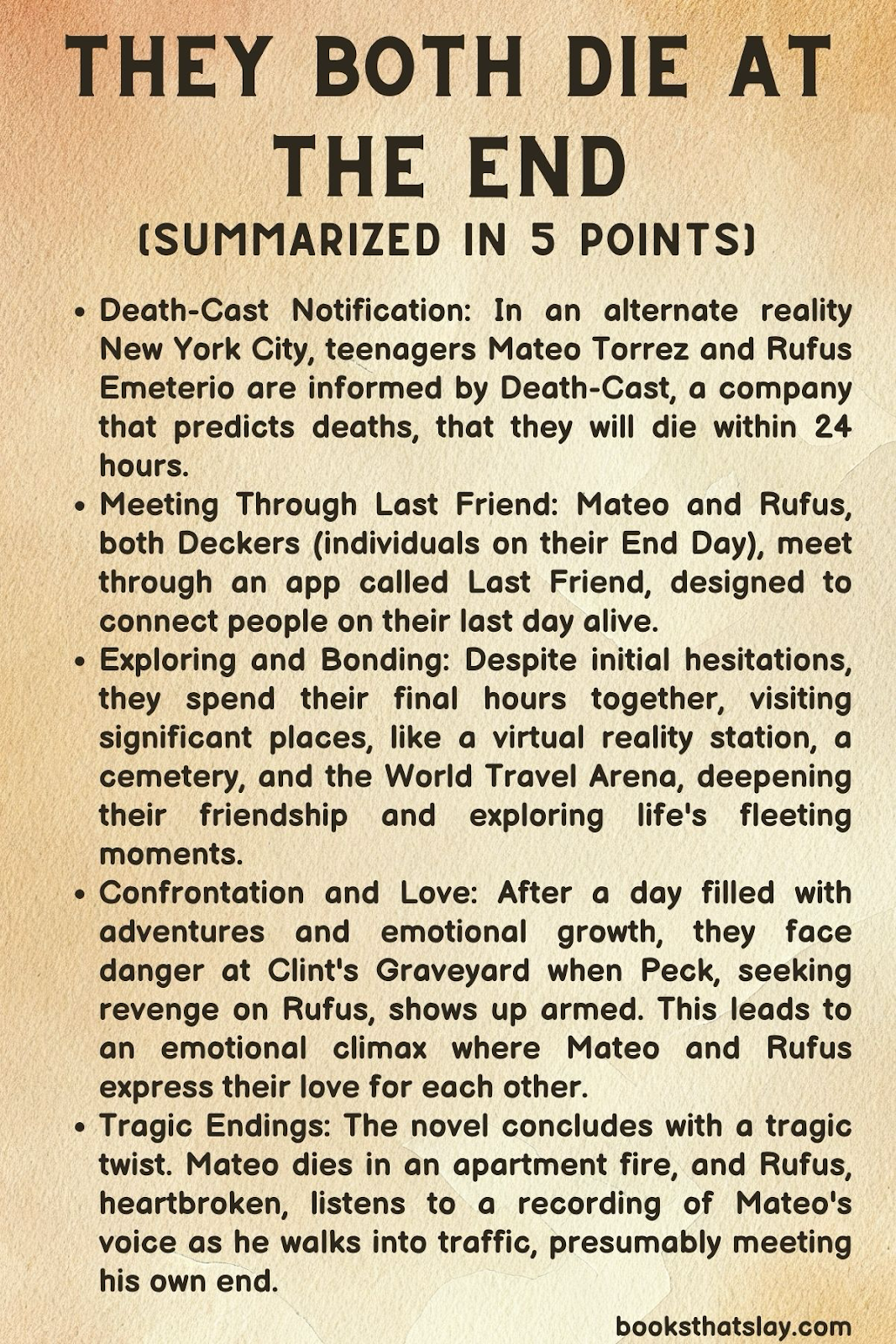
Summary
Mateo Torrez wakes just after midnight to a call from Death-Cast, the service that warns people they will die within the next twenty-four hours. The herald on the phone sounds tired and even mixes Mateo up with someone else, making the call feel routine and impersonal.
Mateo hangs up shaking. He’s lived cautiously for years, keeping his world small: his father has been in a coma for two weeks, and his closest friend is Lidia, who is raising her baby, Penny. Mateo tells himself he should go to the hospital and see his dad, and he should see Lidia and Penny one more time, but panic pins him inside his apartment. He showers, writes thank-you notes to neighbors, and sets small deadlines to force himself out the door, only to retreat again.
Across the city, Rufus Emeterio is already outside, running on adrenaline and rage. He’s in a parking lot fighting Peck, the new boyfriend of his ex, Aimee, when Death-Cast calls. Rufus ignores it at first, then answers and is told he will die today. He demands an explanation for how Death-Cast knows, but gets scripted responses. Rufus leaves the fight shaken by how close he came to doing something irreversible. His best friends, Malcolm and Tagoe, insist on sticking with him, and they return to their foster home, Pluto. Rufus tries to gather himself and calls Aimee, who panics and rushes over.
The foster family organizes an impromptu “funeral” while Rufus is still alive, telling him what he means to them. The goodbye is cut short when the police arrive. Someone has reported Rufus, and Peck shows up too, bruised and accusing. Malcolm and Tagoe create a distraction so Rufus can escape out the back, accepting arrest to buy him time.
Meanwhile, Mateo realizes he can’t face the day alone and downloads the Last Friend app, which pairs Deckers who want company. His first matches are unsettling, and he blocks them.
After another spiral of fear and wasted time, he tightens his settings and messages Rufus, who responds quickly. Rufus video-calls him and explains why he wants a stranger: he once survived a car crash that killed his parents and sister, and he can’t stand the idea of his friends watching him die too. Mateo admits he still hasn’t left his apartment. Rufus is blunt—if they’re going to spend the day together, Mateo has to step outside. Rufus bikes over to pick him up.
When Rufus arrives, Mateo hesitates at the threshold like it’s a cliff edge. Rufus jokes about avoiding elevators and bad luck, but he’s patient in a way that surprises Mateo.
With encouragement and a push of courage, Mateo steps out. They move through wet streets and into the city, Mateo scanning for every possible danger and Rufus insisting that fear is also a way of losing time.
Mateo’s first destination is the hospital to see his father. On the way, Mateo stops to bury a dead bird in the road, an act of care that catches Rufus off guard. In the hospital, Mateo needs help getting past a clerk, so Rufus exaggerates the urgency until they’re allowed in. Mateo sits beside his father’s bed, holds his hand, and leaves a note promising to be brave. He shares memories with the nurse and tells Rufus about his dad’s habits and the love that shaped their home.
Leaving feels like betrayal, but Rufus reminds him that his father would not want Mateo to spend his final day trapped in a goodbye.
Outside, Mateo gives money to a homeless man despite Rufus warning him to be careful. The man hugs Mateo tightly, and Rufus can’t dismiss the gesture, even if he pretends it’s about “karma.”
They eat at a diner where Deckers are treated like a public spectacle and a public charity at the same time. Over food, Rufus talks about growing up in foster care and how limited his world has been. Mateo admits he once dreamed of being an architect. They begin making small choices that feel like resistance: tipping anyway, paying anyway, being kind anyway.
Mateo then visits Lidia and Penny. He can’t say the truth out loud, especially after Lidia has already lost someone to Death-Cast. He plays with Penny, watches Lidia clean and talk, and quietly leaves cash behind for them. When he slips out, he blocks Lidia’s number so she can’t call him back and force a conversation he can’t survive.
Outside, he breaks down. Rufus steadies him, listens, and shares parts of himself too, including how his online persona doesn’t match how scared he is. Mateo suggests Rufus post a photo in color, so people remember him as alive, not as a shadow. Rufus does.
They spend the day moving from place to place: exploring an abandoned “graveyard” of pay phones, riding trains, talking about what disappears from the world and what stays. On a subway ride where the lights cut out, Mateo nearly panics, but Rufus gives him Legos he bought on impulse. Mateo builds a tiny sanctuary in his hands, something solid while everything else is uncertain. Mateo also visits his mother’s grave and is confronted by the system’s cold efficiency: a headstone with his name is being installed, and a grave beside hers is already being dug.
The reality of his death stops being abstract. He sits in his own half-dug grave with Rufus beside him, letting the fear exist without letting it win.
Mateo later takes Rufus to the river to face the memory that still controls him: the crash where Rufus lived and his family didn’t. Rufus finally lets the anger and guilt out, and Mateo tells him, plainly, that surviving was not a crime. Their bond deepens, not through grand gestures, but through permission—permission to feel, to speak, to keep walking.
A nearby gym is destroyed by a Decker who chooses to die violently and take others with him. Mateo and Rufus are thrown by the blast but survive. The shock makes their remaining time feel even thinner. They pass people on the edge—one woman steps back from a rooftop after seeing them run by, still choosing life.
At Althea Park, they play on the equipment like kids, then Rufus gives away his treasured bike to a stranger, letting go of one of the few things he’s always controlled.
Eventually, Mateo agrees to meet Lidia and later brings Rufus with him to Clint’s Graveyard, a club where Deckers spend their last hours singing, dancing, and writing messages on the walls. Mateo and Rufus go onstage and sing together. Afterward, charged with courage and relief, Mateo kisses Rufus, and Rufus kisses him back. Malcolm, Tagoe, and Aimee arrive, and for a moment Rufus has everyone he loves in one place.
Then Peck shows up with a gun.
Chaos erupts. Mateo is knocked down, then gets back up and helps disarm Peck as the crowd surges around them. Rufus grabs the gun and fires into a wall instead of at anyone, refusing to let his last day become a murder. He and Mateo escape and retreat to Mateo’s apartment, calling it their “safe island.” They eat snacks, take photos, trade jokes, and say “I love you” with a kind of urgency that doesn’t ask permission.
Mateo sings “Your Song” to Rufus at his keyboard, and Rufus records it, crying openly.
Later, Mateo wakes and goes to make tea. A fire starts in the kitchen and smoke fills the apartment. Rufus wakes choking, stumbles outside for air, then runs back in. He finds Mateo too late. Mateo dies from his injuries, and Rufus is taken to the hospital for smoke inhalation, carrying the weight of one day that felt like a lifetime.
From the hospital, Rufus posts their final photo and messages Malcolm and Tagoe about what he wants done with his ashes.
He calls Lidia and tells her Mateo is gone. He visits Mateo’s comatose father, leaves a note, and shows him proof that Mateo did not spend his last day alone. Near midnight, Rufus heads toward Althea Park, watching the video of Mateo singing as he crosses the street—still a Decker, still moving forward, and still running out of time.
Characters
Mateo Torrez
Mateo Torrez is a deeply introspective and compassionate young man whose life in They Both Die at the End is defined by fear, restraint, and an overwhelming sense of empathy. When he receives his Death-Cast alert, he initially retreats into isolation, paralyzed by the fear of the unknown and the inevitability of his fate.
Throughout the story, Mateo evolves from a boy who hides from life into someone who learns to embrace it fully, even knowing it will end soon. His cautious nature—evident in his reluctance to leave his apartment and his meticulous care for others—stems from his need to protect himself and those he loves from pain.
Yet, as the hours pass, Mateo’s kindness becomes his defining feature: he shows compassion to strangers, care for his comatose father, and love for his best friend Lidia and her daughter Penny. His journey with Rufus awakens in him the courage to live, love, and act spontaneously. By the end, Mateo embodies the theme that a life’s worth is measured not by its length but by its depth of connection and love.
His tragic death underscores his transformation—he dies trying to live meaningfully rather than hiding from fear.
Rufus Emeterio
Rufus Emeterio serves as the emotional counterpart to Mateo, his brashness balancing Mateo’s timidity. Rufus’s character is shaped by loss and anger; he carries the trauma of witnessing his family’s death in a car accident, which left him both hardened and vulnerable.
Living in a foster home with his close friends, the Plutos, Rufus projects toughness but conceals deep emotional wounds. His initial aggression—seen in his fight with Peck—reveals his struggle to control his pain.
However, when he receives his Death-Cast alert, Rufus channels his final day into a mission to connect authentically and atone for past mistakes. His bond with Mateo becomes transformative: through Mateo, Rufus learns gentleness, reflection, and the freedom to express love without fear.
While he teaches Mateo how to live boldly, Mateo teaches him to heal and forgive himself. Rufus’s grief, loyalty, and evolving tenderness make him one of the novel’s most dynamic figures.
His love for Mateo, culminating in their mutual acceptance of death, reveals the power of vulnerability and the courage to love despite knowing loss is inevitable.
Lidia Vega
Lidia Vega represents the quiet resilience of those left behind in They Both Die at the End. As Mateo’s best friend and a single mother to baby Penny, Lidia embodies both strength and compassion. Having already lost her boyfriend Christian to an untimely death, Lidia’s life is shaped by grief and the need to persevere for her child.
Her relationship with Mateo is one of deep trust and mutual dependence; he is her emotional anchor, and she is the family he never had. Lidia’s pain upon learning of Mateo’s death captures the story’s emotional gravity—how the living must continue even when burdened by loss. She symbolizes continuity and the everyday courage it takes to survive after others are gone. Lidia’s nurturing nature, maternal instincts, and faith in love’s endurance balance the chaos of mortality that surrounds her, grounding the narrative in the quiet heroism of ordinary life.
Aimee Dubois
Aimee Dubois, Rufus’s ex-girlfriend, stands as a reminder of lost connections and the difficulty of navigating grief. Her loyalty to Rufus remains even after their breakup, revealing her emotional maturity and empathy. Despite being caught between Rufus and her new boyfriend Peck, Aimee ultimately prioritizes compassion over conflict.
She plays a crucial role in helping Rufus accept his fate, offering understanding and forgiveness in their final interactions. Aimee’s character shows the complexity of young love and the emotional turbulence that accompanies loss. Her pain at Rufus’s impending death and her efforts to protect him, even in his final hours, highlight her enduring love and the bittersweet reality of saying goodbye.
Peck Gavin
Peck Gavin is a volatile and impulsive figure whose actions are driven by insecurity and anger. As Aimee’s new boyfriend and Rufus’s rival, Peck’s jealousy fuels much of the story’s external conflict. His need for revenge and dominance reflects his fragile sense of self-worth.
Peck’s decision to pursue Rufus even after learning about Death-Cast’s prediction exposes his inability to process emotions constructively. Rather than confronting his own guilt or fear, he externalizes blame, making him a symbol of toxic masculinity and unresolved rage. Peck’s reckless behavior at Clint’s Graveyard ultimately reinforces the novel’s message about the destructive consequences of living without empathy or self-awareness.
His character acts as a foil to Rufus—where Rufus learns to embrace love and peace, Peck remains trapped in bitterness and violence.
Malcolm Anthony and Tagoe Hayes
Malcolm and Tagoe, Rufus’s foster brothers and closest friends, provide warmth and loyalty in the face of death. Known collectively with Rufus as the Plutos, they function as his chosen family.
Their bond exemplifies the theme of found family—the idea that love and belonging transcend blood ties. When they sacrifice their own safety to protect Rufus, even getting arrested to buy him time, it shows the depth of their devotion. They represent steadfast friendship and the pain of letting go.
Through them, They Both Die at the End explores how love persists beyond loss and how friends can become the most genuine form of family. Their reunion with Rufus near the novel’s end brings both closure and heartache, showing the enduring power of human connection.
Delilah Grey
Delilah Grey’s subplot serves as a reflection on denial and fate. As a journalist who receives her own Death-Cast alert, Delilah initially dismisses it as a mistake, symbolizing society’s tendency to ignore mortality until it becomes unavoidable.
Her reckless decisions throughout the day and her multiple near-death experiences contrast sharply with Mateo and Rufus’s acceptance of their fates. Delilah’s survival until the very end, despite repeated brushes with death, suggests the randomness and unpredictability of life. She embodies the tension between disbelief and destiny, reminding readers that no one can truly control when or how death arrives.
Howie Maldonado
Howie Maldonado, the famous actor whose End Day becomes a media spectacle, represents the emptiness of fame and the yearning for authentic human connection. Though distant from the main plot, his reflections on lost relationships and the superficiality of his career echo the novel’s core theme: that true fulfillment comes from intimacy and honesty, not public admiration.
Howie’s death in a car crash after expressing regret about neglecting his loved ones reinforces the story’s message about the futility of fame in the face of mortality. His character, though brief, deepens the philosophical fabric of They Both Die at the End, showing that death spares no one, regardless of status or success.
Themes
Mortality and the Awareness of Death
In They Both Die at the End, death is not a distant or abstract notion—it is an imminent certainty that shapes every moment of the characters’ final day.
The existence of Death-Cast transforms mortality into an unavoidable reality that people must consciously engage with, rather than something they can push to the back of their minds. For Mateo and Rufus, the knowledge that they will die within twenty-four hours becomes the catalyst for radical self-reflection and transformation.
Mateo, previously paralyzed by fear and caution, is forced to confront the futility of his hesitation. His awareness of death liberates him from a life defined by safety and timidity, pushing him to finally act, love, and connect. For Rufus, the knowledge of his impending death compels him to find closure with his past trauma and the loss of his family. Through their shared experience, the novel examines how the proximity of death strips away superficiality, leaving behind only what truly matters—empathy, courage, and human connection.
Silvera’s portrayal of mortality is not fatalistic but deeply human; it suggests that awareness of death can illuminate the value of living authentically. The novel argues that death does not diminish life’s worth but enhances it by giving every moment weight and urgency.
The certainty of dying becomes a paradoxical affirmation of existence, transforming fear into purpose and the ordinary into something profound.
Friendship and Connection
The bond that develops between Mateo and Rufus serves as the emotional core of They Both Die at the End, highlighting how genuine connection can transform individuals, even in the face of death. Both characters begin the day isolated—Mateo trapped by anxiety and Rufus separated from his chosen family by circumstance and guilt.
Their meeting through the Last Friend app symbolizes the human need to be seen and understood, even at life’s end. As they share experiences, from quiet conversations to moments of laughter and courage, their relationship evolves into something deeply intimate and transformative. Through Rufus’s boldness, Mateo learns to confront the world, and through Mateo’s empathy, Rufus learns to forgive himself.
Silvera emphasizes that friendship is not measured by duration but by the depth of understanding and honesty it allows. Their brief but profound connection shows that human relationships can redefine meaning, even when time is limited. The novel suggests that love and friendship are not antidotes to mortality but companions to it—they give life its texture and make death bearable.
This theme underlines the importance of vulnerability, illustrating that true connection often occurs not despite fear, but because of it.
Fear and Courage
Fear governs much of Mateo’s existence before the events of They Both Die at the End, acting as both shield and prison. His fear of danger, rejection, and loss keeps him confined to routines that feel safe but hollow. The Death-Cast call shatters this illusion of safety, forcing him to realize that hiding from the world does not preserve life—it only prevents him from living it.
Courage, therefore, becomes the act of embracing vulnerability and stepping into uncertainty despite the inevitability of pain or loss. Rufus’s version of courage is different: his defiance of death initially manifests as recklessness, born from anger and grief.
Over the course of the novel, his understanding of bravery evolves from physical daring to emotional openness—accepting love, forgiving himself, and allowing others to care for him. Silvera portrays courage as an internal transformation rather than a heroic display; it is the quiet decision to face the truth of mortality with dignity and compassion.
The juxtaposition of fear and courage creates a dynamic tension throughout the story, illustrating that bravery is not the absence of fear but the determination to move forward in its presence. In doing so, the novel reframes courage as a deeply personal journey that allows individuals to reclaim agency in a world governed by uncertainty.
Fate and Free Will
The premise of Death-Cast raises profound questions about destiny and choice in They Both Die at the End.
If the characters’ deaths are preordained, what significance do their actions hold? Silvera constructs a narrative that challenges fatalism by showing how, even within the confines of an unavoidable fate, personal agency remains vital. Mateo and Rufus cannot escape death, but they can decide how to live the time they have left. Every decision—from Mateo stepping outside his apartment to Rufus choosing compassion over vengeance—becomes an act of resistance against the deterministic structure of Death-Cast.
This interplay between fate and free will underscores the novel’s philosophical core: while external forces may dictate the end, meaning arises from the choices made along the way. The technology of Death-Cast, which claims to predict death without explanation, also symbolizes society’s obsession with control in the face of uncertainty. Silvera uses it to expose the illusion of mastery humans seek over life and death, reminding readers that the value of living lies not in certainty but in experience.
By portraying how the boys transform their last hours into a day of love, forgiveness, and purpose, the novel asserts that free will exists not in altering fate but in defining one’s response to it.
Love and the Urgency of Living
The relationship between Mateo and Rufus transcends friendship and blossoms into love, serving as the ultimate expression of what it means to live fully. Their love emerges not from the fear of dying but from the clarity that death provides. Knowing that their time is limited strips away hesitation and allows them to embrace one another without pretense. Silvera portrays their love as spontaneous yet deeply authentic—a recognition of mutual need and understanding. This love does not seek permanence; rather, it values the present moment, illustrating how love can be both fleeting and eternal in emotional impact.
Through this bond, Silvera captures the essence of seizing life—choosing intimacy, laughter, and vulnerability even when the end is certain. The novel suggests that living urgently is not about recklessness but about presence—about noticing beauty, expressing gratitude, and giving oneself fully to experience. In their final moments, Mateo and Rufus achieve a completeness that years of cautious living could not provide.
Their love becomes a microcosm of the novel’s larger message: that mortality, far from diminishing love, intensifies its meaning, turning every shared moment into an act of defiance against oblivion.