Things We Left Behind Summary, Characters and Themes
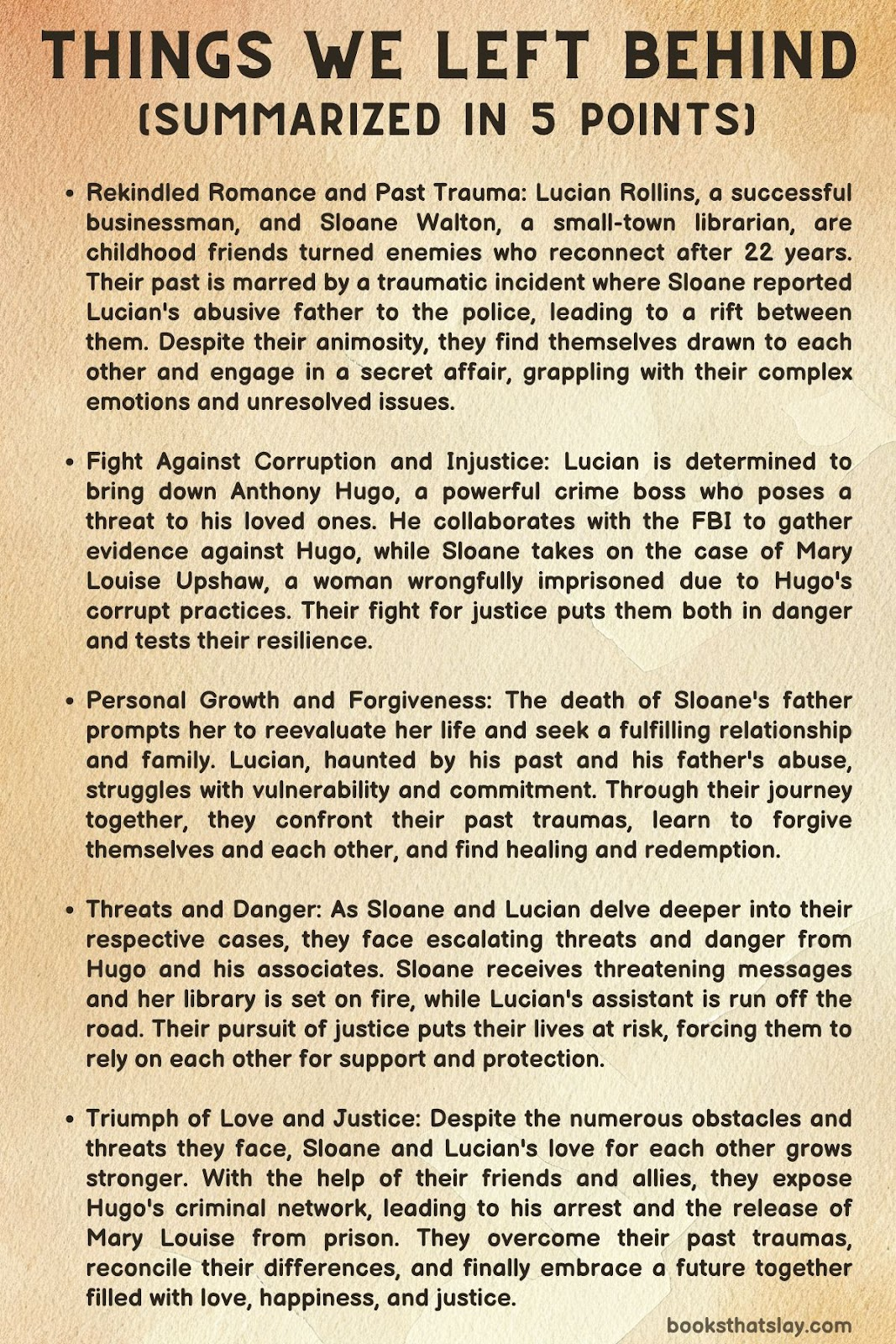
Things We Left Behind by Lucy Score is a contemporary romance that balances grief, family bonds, and second chances with the tension of an old love reignited. At its heart, the novel follows Sloane Walton, a small-town librarian grappling with the sudden loss of her father while being forced to confront the unresolved past she shares with Lucian Rollins, her childhood neighbor turned hardened political consultant.
Through shifting timelines, secrets, and moments of vulnerability, the story explores how two people bound by shared pain and history can rediscover trust, rebuild connection, and redefine what family and home mean against the backdrop of love, danger, and renewal.
Summary
Sloane Walton begins the story on her porch in January, mourning her father Simon’s death. Wrapped in a blanket, she leans on her mother Karen, her sister Maeve, and her niece Chloe before heading to the funeral.
Together, the family uses laughter and shared memories to steel themselves. Inside the funeral home, Sloane faces condolences and stories about her father’s influence, but the weight of her solitude grows heavier as she reflects on being unmarried and childless.
When she holds her cousin’s baby, a longing stirs inside her for a family of her own.
Her close friends Naomi, Knox, Lina, and Nash arrive to support her, but her composure is shaken when Lucian Rollins enters. Once her childhood neighbor and secret love, Lucian has become both her greatest resentment and a man she cannot ignore.
Though she bristles at his presence, her mother greets him warmly, thanking him for a kindness that Sloane does not understand. Overwhelmed, she escapes outside, where Lucian follows.
Their conversation is sharp but layered with care—he scolds her for not eating, wraps his coat around her, and quietly arranges her favorite breakfast burrito. Despite her resistance, she feels his presence chip away at her defenses.
Lucian, now a wealthy consultant involved in an FBI investigation against crime boss Anthony Hugo, returns home to process Simon’s death. Simon had once saved Lucian from his own destructive path, leaving him indebted.
Though he pretends distance, Lucian cannot help but watch over Sloane, knowing how deeply she is hurting. That night, she breaks down in her father’s study, surrounded by his belongings, only to be visited by Allen Upshaw, a young law student her father had mentored.
His gratitude for Simon’s generosity reinforces the legacy Simon left behind.
Meanwhile, Knox and Nash Morgan keep Lucian company with drinks and banter, pulling him into moments of camaraderie despite his insistence on being aloof. Across the night, grief binds both Sloane and Lucian, their paths crossing in ways that remind them of old bonds and secrets long buried.
Sloane later spends time with her friends, who bring food and laughter, encouraging her not to isolate. Their teasing about Lucian’s coat leads to playful speculation about romance, but the mood shifts when they discuss her fears about starting a family.
Together, they support her idea of creating a free legal aid initiative with money left by her father. Later, a snowball fight erupts between the women and Lucian with the Morgan brothers, breaking tension and bringing moments of joy.
Lucian, watching Sloane laugh, feels the pull of old desire. When he notices her outside later that night, wearing his coat, the sight leaves him conflicted yet drawn to her.
Flashbacks reveal their teenage years, when Lucian first climbed through her bedroom window to escape his abusive father. Despite his troubled home, he showed his intelligence and ambition, bonding with Sloane over books and life dreams.
Her parents welcomed him, treating him like family, which deepened Sloane’s crush. These memories surface as Sloane faces him again in the present, still unable to ignore their connection.
Their tension finally erupts when, after years of denial, they give in to their desire. What begins as a confrontation quickly becomes a physical relationship, raw and unrestrained, marked by repeated insistence that it’s a mistake even as they continue.
Between intimacy and arguments, their old familiarity resurfaces, and glimpses of tenderness emerge. They cook grilled cheese together, laugh, and confront questions they’ve avoided for years.
Lucian admits he secretly bought her parents’ condo as a gesture of gratitude, while Sloane recalls the pain of his arrest at eighteen, when her decision to call the police exposed his father’s abuse but left Lucian behind bars.
Lucian’s bitterness lingers, but so does his longing for Sloane. Their banter extends to text messages, filled with sarcasm and innuendo.
At the same time, Lucian juggles his high-powered consulting empire, where his colleagues notice his distraction, and his involvement in uncovering corruption tied to private prisons. A tracking device found on his vehicle reminds him of the danger circling close.
As Sloane and Lucian rebuild their bond, they confront the scars of the past. Lucian opens up about his abusive father, while Sloane affirms that he is nothing like the man he fears becoming.
He apologizes for blaming her and admits that he wants her permanently. Their renewed closeness culminates in his decision to reverse his vasectomy, proving his commitment to a future with her.
The scene, comedic and touching, shows the depth of his devotion. Soon after, he proposes on her porch with the help of Knox and Nash, pouring out his love until Sloane tearfully accepts.
Their joy spreads to friends and family, leading to multiple engagements and celebrations within their circle.
Yet danger intrudes again when Judge Atkins, tied to corrupt sentencing, and Wylie Ogden, guilty of framing Nash and other crimes, corner Sloane in her home. Atkins threatens her with a silenced gun, but Wylie kills him, only to reveal his own crimes and attempt to kill her.
Sloane fights back with courage, throwing books and fleeing through her home until Lucian arrives. In a violent clash, Lucian defeats Wylie without killing him, proving he has broken free of his father’s legacy.
Nash arrests Wylie, and Sloane and Lucian, though shaken, stand united.
Their love culminates in a Christmas Eve wedding, a date chosen to transform painful memories into joy. Surrounded by family and friends, they exchange vows, blending community, celebration, and healing.
They later honeymoon, begin the process to foster children, and establish the Simon Walton Foundation in her father’s honor. Sloane gifts Lucian a framed message from her late father, affirming his place in her family and in her heart.
Years later, the epilogue reveals a future filled with laughter, children, and traditions. Lucian narrates the scene of their lively Christmas Eve gathering, a sharp contrast to the loneliness of his youth.
Their home, filled with chaos and warmth, symbolizes the life they built together. Sloane gifts him a cherry blossom from their tree, a symbol of enduring love and growth.
The novel closes on this vision of family and fulfillment, showing that the pain of the past has finally given way to the peace and joy of a shared future.
Characters
Sloane Walton
Sloane stands at the heart of Things We Left Behind, a woman caught between grief for her father and the complicated pull of her past love, Lucian Rollins. She is portrayed as independent and accomplished, proud of her career as a librarian, yet constantly aware of the void left by her unfulfilled longing for a family.
Her resilience is tested by her father’s death, forcing her to navigate sorrow while caring for her mother and niece. Despite her sharp tongue and fiery temper, Sloane’s tenderness emerges in her relationships with friends and her quiet moments of vulnerability.
The contrast between her outward stubbornness and her private ache for belonging makes her an empathetic figure. Through the course of the novel, she evolves from a woman buried in loss and resentment to someone willing to forgive, embrace love, and build the future she once feared she had lost time for.
Lucian Rollins
Lucian is Sloane’s foil: a man hardened by an abusive childhood and molded into ruthlessness by ambition. As a powerful consultant, he projects control, precision, and detachment, yet beneath the surface lies a broken boy shaped by violence and abandonment.
His connection to Simon Walton, Sloane’s father, gave him both a lifeline and a sense of debt he could never fully repay. Lucian’s relationship with Sloane is tangled—equal parts hostility, desire, and buried affection.
He shields his emotions behind arrogance, but his small acts of care—arranging her favorite meal, offering her his coat, or reversing his vasectomy to prove commitment—reveal a deep, transformative love. His journey is one of redemption: learning to let go of bitterness, to accept love without suspicion, and to build the family he never thought possible.
Simon Walton
Though deceased when the novel begins, Simon’s presence reverberates through every page. He embodies generosity, wisdom, and quiet strength, a man whose influence reaches beyond his family to reshape the lives of many, including Lucian and Allen.
His belief in second chances and his readiness to help others define him as a moral compass in the narrative. For Sloane, he is both a source of pride and a haunting reminder of expectations unfulfilled.
For Lucian, Simon is savior, mentor, and surrogate father. His legacy binds characters together, fueling both grief and gratitude.
Simon is not merely remembered—he remains the foundation upon which the characters rebuild their lives.
Karen Walton
Karen, Sloane’s mother, embodies maternal resilience and grace under loss. Though shattered by Simon’s death, she shoulders responsibility for keeping the family intact.
Her warmth toward Lucian demonstrates her ability to forgive and embrace, reflecting Simon’s own values. She urges reconciliation between Sloane and Lucian, acting as a voice of reason and love.
Karen represents quiet endurance, the figure who steadies the storm of grief and shows that healing comes not only through strength but also through compassion.
Maeve and Chloe
Maeve, Sloane’s sister, and her daughter Chloe serve as anchors of familial love. Maeve’s presence reinforces the theme of sibling solidarity, helping Sloane balance sorrow with moments of levity.
Chloe, with her innocence and youthful energy, becomes both a reminder of what Sloane longs for and a symbol of continuity after loss. Together, they highlight the multigenerational bond of the Walton family, showing that love carries forward even in the face of death.
Allen Upshaw
Allen represents Simon Walton’s enduring legacy of kindness. A young man from a troubled background, he was lifted by Simon’s generosity into the path of law school.
His gratitude and determination underscore the ripple effect of Simon’s character. Through Allen, Sloane recognizes the profound impact her father had on countless lives beyond their family.
He also becomes a mirror for Lucian—another young man rescued by Simon’s guidance—reinforcing the theme that compassion can alter destinies.
The Morgan Brothers (Knox and Nash)
Knox and Nash inject humor, loyalty, and fraternity into the story. They are both protectors and companions, standing beside Lucian in his grief even as they tease him relentlessly.
Their presence grounds Lucian in friendship and prevents him from retreating fully into isolation. They also embody the community spirit that pervades the narrative, reminding both Lucian and Sloane that love and belonging are never solitary pursuits.
Supporting Friends (Naomi, Lina, Stef, Jeremiah)
This circle of friends forms Sloane’s emotional safety net. With food, laughter, and unwavering support, they push her to face her fears, dream of a family, and reconsider her feelings for Lucian.
Their interventions provide comic relief but also heartfelt wisdom, keeping Sloane from sinking into grief or isolation. Lina, with her directness, and Naomi, with her humor, exemplify how friendship can be both a shield and a guiding force.
Ansel Rollins
Ansel, Lucian’s abusive father, is a specter of cruelty that defines much of Lucian’s pain. His violence, neglect, and tyranny haunt Lucian into adulthood, shaping his distrust and bitterness.
Ansel’s shadow also plays a key role in the bond between Lucian and Sloane, as her youthful attempt to save him from his father’s brutality caused both rescue and betrayal. Ansel symbolizes the scars of trauma and the weight of survival, against which Lucian must prove himself different.
Wylie Ogden and Judge Atkins
These figures serve as embodiments of corruption and betrayal within the novel’s thriller subplot. Judge Atkins represents systemic injustice, while Wylie—initially trusted—reveals himself as a murderer and manipulator.
Their intrusion into Sloane’s life forces both her and Lucian to confront danger head-on. Wylie’s betrayal, in particular, tests Lucian’s growth, as he proves his strength not by vengeance but by restraint, choosing to protect rather than destroy.
Themes
Grief and Healing
The narrative of Things We Left Behind opens in the shadow of Simon Walton’s death, and grief becomes an all-encompassing force shaping the trajectory of Sloane’s life. Her mourning is not portrayed as a solitary process but rather as something deeply entwined with her family and community.
The story underscores how humor, ritual, and shared memory act as defense mechanisms against overwhelming loss. Sloane’s yearning for her father resurfaces in subtle ways, whether through her longing for stability, her desire for a family, or her constant reflection on his values.
Yet the novel makes clear that grief is not a static experience; it evolves, taking Sloane through phases of denial, anger, longing, and acceptance. Lucian’s grief, though quieter, parallels hers.
His connection to Simon is rooted in gratitude, as Simon’s guidance once pulled him from the brink of destruction. For him, mourning is interlaced with guilt, duty, and a restless need to repay debts he feels can never truly be settled.
The theme reveals how grief can fragment lives but also serve as a catalyst for growth. By acknowledging loss openly and finding ways to honor Simon’s legacy—through the legal aid initiative or the foundation—characters slowly reconstruct lives fractured by sorrow.
Healing here is not about forgetting but about reorienting: discovering new meaning, creating bonds that sustain, and carrying forward values instilled by those who are gone.
Family and Belonging
Family in this novel is portrayed not only through blood ties but also through chosen connections that defy conventional boundaries. Sloane’s closeness with her mother, sister, niece, and her network of friends creates a protective circle that helps her endure both grief and uncertainty.
These relationships reveal how love and loyalty function as stabilizing forces when the future feels precarious. Lucian’s arc brings an additional layer, showing the other side of family: the destruction wrought by abuse, violence, and neglect.
His father represents a legacy of pain that Lucian fights to escape, while Simon and the Walton family embody the alternative—compassion, acceptance, and guidance. The tension between these two models of family defines Lucian’s journey, forcing him to reconcile his past with the possibility of a future built on trust and love.
The idea of belonging becomes central, especially in Lucian’s struggle to accept that he is not destined to repeat his father’s cruelty. As Sloane and Lucian’s relationship matures, their bond expands into the creation of a new family unit, one rooted in mutual respect and an active choice to nurture.
By the novel’s conclusion, belonging is redefined as a state that transcends origin, where family is something constructed deliberately, infused with resilience, kindness, and an openness to those who need it most.
Love, Forgiveness, and Redemption
At the heart of Things We Left Behind is a love story that unfolds not as an easy romance but as a hard-fought reconciliation between two people weighed down by history. The relationship between Sloane and Lucian is one of volatility, attraction, and deep-seated wounds.
Their path toward love is complicated by betrayal, guilt, and fear, but the narrative insists that forgiveness is possible even in the most fractured of relationships. Forgiveness here is not passive; it requires effort, painful honesty, and the dismantling of walls built over decades.
For Lucian, love becomes the redemptive force that pulls him out of isolation and proves he is capable of change. For Sloane, it is an opportunity to release guilt and to embrace a future without being shackled by regret.
Their intimacy, at times fierce and confrontational, reflects not only desire but also the deeper emotional struggle to trust and be trusted. Redemption is achieved when Lucian finally accepts his worth, and Sloane recognizes that forgiveness does not mean erasure but rather a commitment to rebuild.
Their union becomes symbolic of how love can transform wounds into strength, and how redemption is less about undoing the past than about choosing a better future.
Justice and Moral Responsibility
Running parallel to the personal stories of love and grief is a thread of justice and accountability. Simon’s legacy is most visible through the lives he impacted—mentoring students, offering financial help, and inspiring others to rise above hardship.
This ethos becomes a guide for Sloane, who contemplates continuing his work through legal aid. On a larger scale, Lucian’s investigations into corruption and his efforts to expose abuse of power emphasize how justice requires courage, sacrifice, and an unrelenting pursuit of truth.
These storylines expand the scope of the novel beyond individual relationships, suggesting that morality is not only personal but also social. The characters are repeatedly forced to ask themselves what is owed to others: Sloane feels responsible for Lucian’s fate as a teenager, Lucian feels bound by debts to Simon, and Allen feels a duty to correct his mother’s mistakes.
Justice here is intertwined with personal responsibility, underscoring the idea that individuals must act decisively to protect others, even at personal cost. The climactic confrontation with corruption and betrayal further reinforces the belief that standing against wrongdoing—whether in family, community, or government—is a defining mark of character.
Identity, Growth, and Transformation
The trajectory of both Sloane and Lucian reflects the theme of transformation, where identity is not fixed but shaped by choices, resilience, and relationships. Sloane’s identity as a librarian, daughter, and sister is complicated by her sense of inadequacy—her longing for a family and her fear of time slipping away.
Through her journey, she comes to redefine herself not as someone incomplete but as someone capable of creating new beginnings. Lucian’s transformation is more dramatic, as he moves from a boy marked by abuse and anger to a man of power and control, and finally to a partner willing to be vulnerable.
His reversal of his vasectomy, a symbolic act of surrender to hope and commitment, captures his shift from guarded self-preservation to openhearted investment in a shared future. Growth in the novel is often painful, requiring confrontation with past trauma and acceptance of scars.
Yet it illustrates that identity is dynamic—capable of being reshaped by love, responsibility, and the deliberate rejection of destructive legacies. By the end, both characters embody transformation, not as a clean break from the past but as a continuous process of choosing differently, building better, and embracing possibility.