This Changes Everything Summary, Characters and Themes
This Changes Everything by Lisa Scottoline is a mystery thriller centered on Julia Pritzker, a woman whose uneasy psychic sensitivity returns when her best friend’s grandmother is murdered in rural Pennsylvania.
What begins as an effort to support a grieving friend grows into an investigation involving a wrongful arrest, an old unsolved death, corrupt officials, extremist violence, and secrets buried for decades. Alongside the crime story, the novel examines friendship, marriage, motherhood, prejudice, grief, and the difficult process of trusting one’s own perceptions. Julia’s journey ultimately becomes as much about accepting herself as it is about uncovering who killed Kay Patterson.
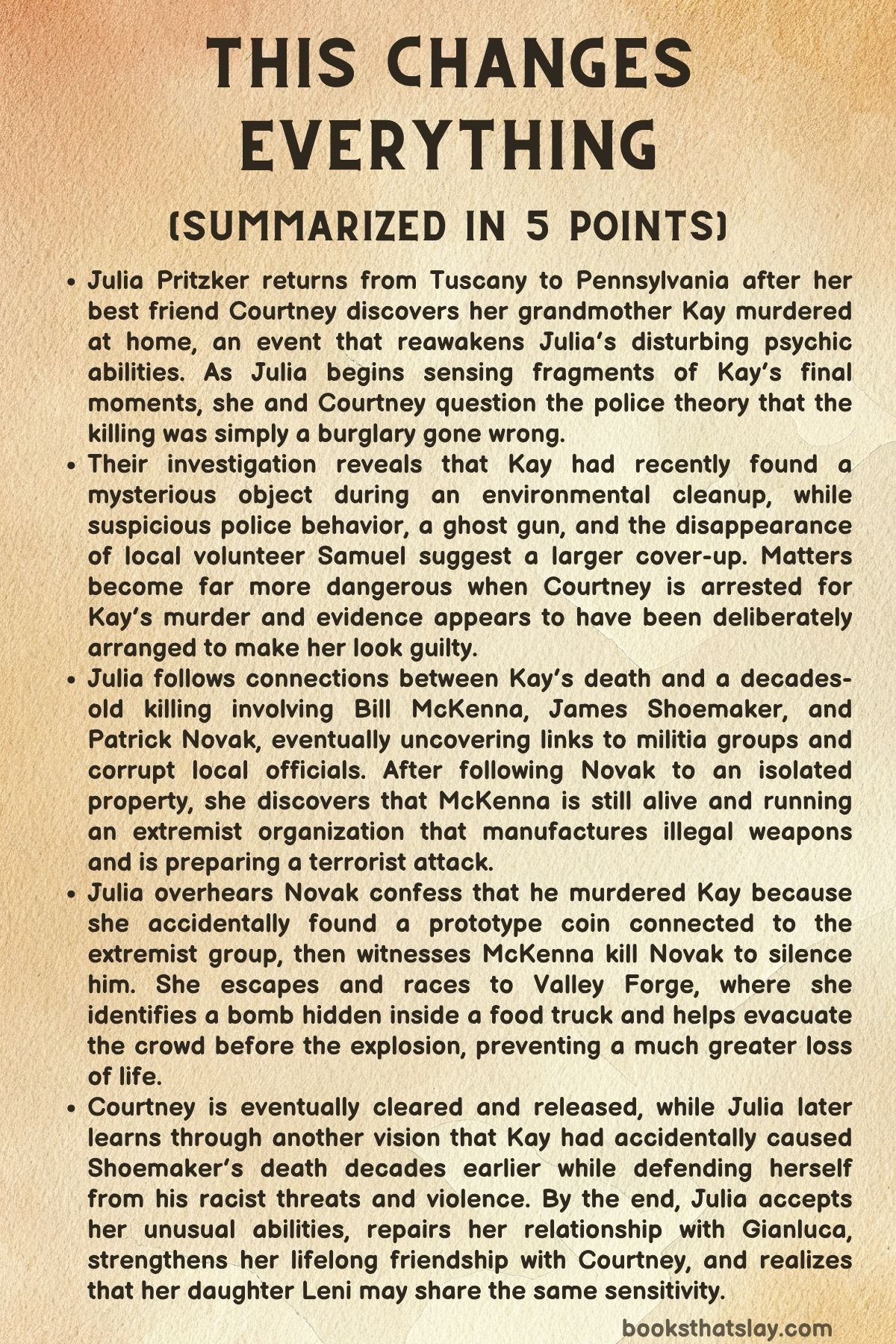
Summary
Julia Pritzker is living in Tuscany with her husband Gianluca and their three-year-old daughter Leni when she receives a frightening premonition during a video call with her best friend, Courtney Horan. Courtney is visiting her grandmother, Kay Patterson, in Pennsylvania, and despite Julia’s desperate warning not to enter the house, Courtney goes inside and discovers Kay dead from a gunshot wound.
Courtney briefly chases a man fleeing toward a black pickup but cannot identify him beyond a general physical description. Julia immediately flies to Pennsylvania, even though Gianluca fears the murder will revive the disturbing psychic experiences Julia suffered after the death of her first husband, Mike.
Her fears are quickly justified. While driving through Pennsylvania, Julia suddenly experiences what appears to be a massive fire surrounding her car, only for everything to vanish without leaving physical damage. Later, at Kay’s farm, she is mysteriously drawn to Kay’s garden and hears a woman screaming for her life before collapsing. Julia becomes convinced at an instinctive level that she heard Kay’s final terror.
Julia contacts Helen Davenport, the medium she consulted years earlier, seeking guidance about what is happening to her. Helen tells Julia that she may be experiencing communication from the dead and that future visions could place her inside events rather than allowing her to observe them from a distance. Afterward, Julia discovers that Helen herself died months earlier and that no phone call appears in Julia’s call history, forcing Julia to consider that she may have communicated with Helen after her death.
Meanwhile, the official investigation into Kay’s murder appears increasingly questionable. Police believe she interrupted a burglary, yet the crime scene does not fit that explanation because easily stolen jewelry remains while only a small amount of cash is missing. Kay’s friend Mona then realizes that a basket containing objects Kay collected during environmental cleanups has disappeared, and Kay had recently mentioned finding something unusual at her latest cleanup.
Julia and Courtney begin to suspect that Kay was killed because of whatever she found rather than because of a random robbery. A ghost gun recovered near the property raises further questions, while Chief Glushenko of the Buckley Police Department behaves dismissively and aggressively when Courtney demands more information about her grandmother’s death. Courtney also worries that Kay’s race and age have contributed to the lack of urgency shown by local authorities.
Their search leads them to Shenandoah Preservation, the environmental organization connected to Kay’s cleanup work, where Courtney reconnects with Alex Dudek, her former boyfriend. Alex directs them toward Samuel, an eccentric local volunteer who spent time with Kay during the cleanup, but when they visit Samuel’s cabin they discover photographs suggesting that he had secretly followed or photographed Kay. Samuel then disappears, making him appear increasingly suspicious.
Courtney’s personal life is deteriorating at the same time. Her marriage to Paul has become strained by resentment over her career, disagreement about children, and emotional distance, while reconnecting with Alex reminds her of an earlier version of herself. She eventually spends the night with Alex, even as Julia worries that grief and marital unhappiness are influencing Courtney’s decisions.
The investigation turns sharply against Courtney when police search both women’s motel rooms and later arrest Courtney during Kay’s funeral for Kay’s murder. Julia, who has just experienced a psychic vision of Kay’s final moments, cannot believe the accusation and immediately focuses on protecting Courtney from questioning until attorney Bennie Rosato can challenge the case.
Bennie determines that the evidence against Courtney is weak and suspiciously timed. Authorities lacked important forensic results before arresting her, making the location of the supposed murder weapon especially troubling and strengthening Julia’s belief that someone planted evidence. Their suspicions grow when Samuel is found dead in what authorities treat as suicide, eliminating another person who might have known what Kay discovered.
Julia begins investigating an older local mystery involving James Shoemaker, whose body was found in a well on Bill McKenna’s property in 1999. McKenna vanished afterward, and his buildings later burned. Guided partly by her unexplained instincts, Julia locates the old well and begins researching connections among McKenna, Shoemaker, Chief Glushenko, and another man named Patrick Novak.
Historical records reveal that Novak, Shoemaker, and McKenna were all connected through a local military reenactment organization. Before Julia can establish what that means, Courtney faces another threat when violence erupts inside the prison where she is being held. Alex is killed during the chaos, along with Courtney’s cellmate, leading Julia to believe that someone may have been attempting to murder Courtney and eliminate anyone connected with Kay’s discovery.
With Courtney still in custody, Julia attends a Revolutionary War reenactment and secretly watches Glushenko, Novak, and militia members. She spots a black pickup resembling the one Courtney saw fleeing Kay’s property and follows Novak after the event, despite being alone and nearly without phone power. The pursuit leads her to an isolated farm and barn.
Inside the barn, Julia discovers an illegal factory producing ghost guns with computers and 3D printers. More shocking still, Bill McKenna is alive and leading an extremist organization called the Two-Fifty Brigade, whose members are preparing a terrorist attack during anniversary celebrations at Valley Forge.
Julia finally learns why Kay was murdered. Kay had unknowingly found a prototype commemorative coin belonging to the extremist organization during the environmental cleanup, and Novak killed her to recover it. Julia also realizes that Novak is Matt Winger, a man she knew years earlier, before watching McKenna shoot Novak dead for creating dangerous loose ends.
Knowing that thousands of lives are at risk, Julia escapes the property in a stolen vehicle and races toward Valley Forge while McKenna’s men pursue her. She reaches the crowded celebration, realizes that the explosive device has been hidden in a Philly BBQ food truck, and begins screaming for everyone nearby to run. Paul appears and helps her evacuate people before the vehicle explodes, triggering additional blasts among neighboring trucks.
Julia is injured and loses consciousness, but her warning saves a large number of people. When she wakes in the hospital with Gianluca and Leni beside her, she immediately gives investigators a detailed statement identifying Novak as Kay’s killer and exposing McKenna’s operation. Novak’s body is recovered, the case against Courtney collapses, and Courtney is finally released.
The immediate crimes are solved, but their emotional consequences remain. Courtney mourns Kay, Alex, and the people killed during the effort to silence her, while she and Paul begin speaking honestly about the failures in their marriage. Julia and Gianluca also confront the damage caused by Julia’s secrecy and risk-taking, eventually recognizing that both of them need to communicate more openly rather than trying to protect one another by withholding difficult truths.
Courtney decides to use Kay’s estate in a way that continues the environmental and community work that mattered to Kay and Alex. She eventually scatters Kay’s ashes in the garden, fulfilling the promise she feared she would never be able to keep while imprisoned.
Kay, however, still appears to have one secret left. Julia is drawn toward a hidden container beneath Kay’s bed containing childhood objects, including a damaged Black Holiday Barbie that once belonged to Courtney. Touching it sends Julia into her most complete vision, revealing the truth about James Shoemaker’s death decades earlier.
Years before, Shoemaker had racially threatened Kay and young Courtney and had grotesquely damaged Courtney’s doll. When Kay confronted him, he assaulted her, and she pushed him in self-defense. Shoemaker fell backward into the well and died, leaving Kay burdened for decades by the belief that she had killed someone and could never be forgiven.
Julia tells Courtney the truth and helps her understand that Kay acted while protecting herself and her granddaughter rather than committing a calculated murder. The revelation finally releases the secret Kay had carried for most of her life, and Julia experiences her spiritual presence as peaceful rather than frightened.
Before returning to Italy, Julia receives a gentle vision of herself and Courtney as elderly women still sitting together decades in the future. She later visits the grave of her adoptive mother, Melanie, where Leni unexpectedly calls Julia “JJ,” the private nickname Melanie used for her and one Julia never taught her daughter. Julia accepts that Leni may possess the same unusual sensitivity and finally stops treating her own ability as something she must fear.
Six months later, Julia is back in Tuscany with Gianluca and Leni. McKenna and other participants in the conspiracy face justice, Courtney is reshaping her life and working to help others, Paul is addressing his grief, and Julia has strengthened her friendship with Courtney while becoming more comfortable with her family, her dual identity, and the psychic experiences she once tried to deny.
Characters
Julia Pritzker
Julia is the central character of This Changes Everything, and nearly every major conflict is filtered through her struggle between rational skepticism and instinctive knowledge. She begins the book determined not to repeat the dangerous behavior that followed Mike’s murder, yet Kay’s death forces her back into circumstances where conventional evidence and unexplained perception repeatedly overlap.
Her history explains why trusting herself is so difficult. As a child, her father deliberately taught her to doubt something she had clearly witnessed, and that early gaslighting leaves a lasting habit of questioning her own perceptions even when experience tells her otherwise.
Julia is also deeply loyal, sometimes to the point of recklessness. She refuses to abandon Courtney even when Gianluca makes clear that her continued involvement is frightening their daughter and damaging their marriage, because Julia understands Courtney not merely as a friend but as part of the family she created after losing her mother and growing up in an unstable household.
Her development lies in learning that accepting her intuition does not require believing she is infallible. By the end, she trusts her perceptions more readily, acknowledges the reality of her unusual sensitivity, and teaches Leni the lesson she was denied as a child: unusual experiences should be examined rather than automatically dismissed.
Courtney Horan
Courtney is Julia’s closest friend and the emotional center of the murder investigation. Kay’s death is devastating because her grandmother represents family, continuity, and unconditional support, while Courtney’s inability to stop the fleeing killer intensifies her grief with guilt and anger.
Her wrongful arrest reveals both her vulnerability and her strength. Courtney is imprisoned for murdering the person she loved most, survives a dangerous institutional environment, loses Alex shortly after reconnecting with him, and must confront the possibility that the authorities responsible for protecting her may instead be participating in her persecution.
Her marriage to Paul adds another complicated dimension. Courtney has become increasingly resentful of his dissatisfaction with her career and his changing expectations about children, and her reunion with Alex gives her temporary access to an earlier emotional life she thought had disappeared.
After her release, Courtney does not return unchanged to her previous existence. She reassesses Paul more fairly, acknowledges the grief and emotional difficulties affecting him, and decides to use Kay’s inheritance for constructive purposes rather than simply treating it as private wealth.
Kay Patterson
Kay is dead almost from the opening pages, yet she remains one of the most influential figures in This Changes Everything. Her murder starts the investigation, her environmental work leads directly to the extremist conspiracy, and her hidden past eventually provides the book’s final emotional revelation.
To Courtney, Kay is a loving grandmother who prepared carefully for death, maintained close friendships, cared for her community, and found meaning in environmental service. Mona and Susan’s memories reveal a woman who remained active, observant, generous, and engaged even at an age when society often makes older women feel invisible.
Her private history is far more painful. Decades earlier, she defended herself and Courtney from Shoemaker’s racist threats and violence, accidentally causing his death when he fell into a well.
Kay carries the resulting guilt for decades because her moral and religious conscience prevents her from viewing the event simply as self-defense. Her final communication through Julia becomes an attempt not to escape responsibility but to tell Courtney the truth and seek peace after years of silence.
Gianluca
Gianluca is both Julia’s loving husband and one of the strongest voices opposing her involvement in the investigation. His objections are not presented as simple cowardice or selfishness, because he has already seen what murder investigations and psychic experiences can do to Julia.
His frustration becomes sharper when Leni begins suffering emotionally during Julia’s absence. From Gianluca’s perspective, Julia repeatedly promises caution and then places herself in increasingly dangerous circumstances while concealing the seriousness of what is happening.
Yet Gianluca is capable of reconsidering his judgments. Once he understands more fully that Courtney occupies the place of family in Julia’s emotional life, he becomes less rigid about interpreting Julia’s choices as rejection of him and Leni.
Their reconciliation is significant because neither person is declared entirely right. Julia acknowledges that her secrecy and risk-taking caused genuine harm, while Gianluca admits that fear sometimes prevented him from understanding why she believed staying with Courtney was morally necessary.
Leni
Leni initially appears to be the young child left behind when Julia flies to Pennsylvania, but her behavior gradually becomes important to the novel’s supernatural dimension. Her fear, sleeplessness, bed-wetting, and references to someone called Wild Child suggest that she may be sensing danger surrounding Julia from thousands of miles away.
Julia’s response to Leni marks an important change in her own character. Rather than dismissing the child, interrogating her, or teaching her to distrust what she experiences, Julia encourages Leni to speak openly whenever something feels strange or frightening.
The final revelation at Melanie’s grave strengthens the possibility that Leni has inherited Julia’s sensitivity. Her use of the private nickname “JJ,” which Julia never taught her, gives Julia and Gianluca a reason to believe that Leni may have received a message from Melanie herself.
Paul
Paul initially appears largely through Courtney’s frustration with their troubled marriage. She describes him as resentful of her promotion, unhappy about her demanding career, and suddenly interested in having a child despite their earlier agreement not to.
His failure to reach Kay’s funeral intensifies Courtney’s belief that he has emotionally abandoned their marriage. Once Julia spends time with Paul, however, she discovers a more complicated man whose grief over Mike’s death has gone largely unnoticed.
Paul recognizes that he has been maintaining his marriage rather than actively caring for it. His admission that relationships require attention rather than simple endurance becomes one of the clearest moments of self-awareness in his character.
He later helps Julia evacuate people before the Valley Forge explosion and remains beside Courtney after her release. By the end, therapy and grief support suggest that Paul is beginning to address the problems he previously expressed through resentment and withdrawal.
Alex Dudek
Alex represents both Courtney’s past and an alternative emotional future she briefly imagines when her marriage is failing. Their reunion is immediately warm, and his continued dedication to environmental work confirms that the qualities Courtney once loved in him have survived.
He is also vital to the investigation because his work with Shenandoah Preservation connects Julia and Courtney to Samuel and to Kay’s final cleanup. His willingness to help places him inside a conflict far more dangerous than he initially understands.
Alex’s death is especially painful because it occurs just as his relationship with Courtney has been renewed. The book does not allow their reunion to develop into a simple romantic resolution; instead, his death forces Courtney to carry both renewed love and renewed loss.
His memorial later demonstrates that his significance extended beyond Courtney. The many people whose communities and environmental concerns he supported reveal a life defined by service rather than merely by his role in the central mystery.
Bill McKenna
Bill McKenna initially belongs to an old local mystery. After Shoemaker’s body was found in a well on his property, McKenna disappeared and seemed destined to remain a suspicious figure from Buckley’s past.
The later revelation that he is alive transforms him into the central organizer behind a far larger criminal operation. He leads the Two-Fifty Brigade, oversees the illegal manufacturing of ghost guns, and plans mass violence at Valley Forge.
McKenna is cold, disciplined, and willing to murder members of his own organization when they become liabilities. His execution of Novak makes clear that loyalty within his movement exists only as long as an individual remains useful to the cause.
His character also demonstrates how old crimes can survive beneath respectable or patriotic surfaces. Historical reenactment, militia culture, abandoned properties, and forgotten relationships provide camouflage for an organization preparing domestic terrorism.
Patrick Novak / Matt Winger
Patrick Novak is revealed as the immediate killer responsible for Kay’s murder and as someone Julia once knew under the name Matt Winger. His concealed identity gives his role an unsettling personal dimension because Julia unknowingly encounters the solution to part of the mystery through someone connected to her own past.
Novak kills Kay because she accidentally finds a prototype Two-Fifty Brigade coin during an environmental cleanup. Rather than allowing an elderly woman who does not understand its significance to keep it, he chooses murder to protect the organization.
His contemptuous racist language when discussing Kay exposes hatred as part of his character rather than merely a feature of the organization around him. He treats her life as expendable because she threatens the secrecy of a cause he values more than human beings.
His death at McKenna’s hands is not redemption or justice in any moral sense. It simply demonstrates the brutality of the world he chose to serve, where one murderer eliminates another when mistakes become inconvenient.
Samuel
Samuel is deliberately positioned as an ambiguous figure. His isolated lifestyle, strange reputation, disappearance, and secret photographs of Kay make him look suspicious at exactly the moment Julia and Courtney are searching desperately for a killer.
Yet Samuel ultimately becomes another victim rather than the central threat. The note insisting that he did not kill Kay and his subsequent suspicious death suggest that someone understood how easily his eccentricity could be used to redirect attention.
His character supports the novel’s interest in overlooked people. Like Kay, Mona, Susan, and several elderly residents who preserve local knowledge, Samuel initially seems marginal to those holding official power, yet his connection to the cleanup makes him important.
His fate also demonstrates the effectiveness of the conspiracy. The people protecting their secrets do not merely kill; they manipulate appearances so that deaths can be classified conveniently and suspicion can be directed toward those unable to defend themselves.
Helen Davenport
Helen functions as Julia’s guide to experiences Julia does not know how to interpret. Years earlier, Julia rejected Helen’s offer to help develop her abilities because she feared what accepting them might mean.
When Julia apparently contacts Helen after Kay’s murder, Helen encourages her to trust her perceptions while warning that psychic experiences can be physically and emotionally overwhelming. The later discovery that Helen has already died completely changes the meaning of their conversation.
Helen’s importance therefore extends beyond supernatural instruction. She becomes evidence for Julia that consciousness may continue after death and that communication cannot always be reduced to ordinary explanation.
Her guidance proves accurate when Julia begins experiencing events from inside another person’s consciousness rather than merely seeing symbolic images. Julia’s eventual acceptance of her abilities completes the development Helen had encouraged much earlier.
Bennie Rosato
Bennie brings legal clarity to a situation dominated by grief, supernatural uncertainty, police hostility, and conspiracy. Once she examines the case against Courtney, she quickly identifies weaknesses in the prosecution’s timeline and the suspicious circumstances surrounding the ghost gun.
She is direct, skeptical, strategic, and protective of Courtney’s rights. Unlike Julia, Bennie works primarily through evidence and procedure, creating an important contrast between legal reasoning and Julia’s intuitive method.
Nevertheless, Bennie does not dismiss Julia merely because her methods are unconventional. When Julia admits that psychic instinct has drawn her toward the old McKenna property, Bennie is willing to follow because she cares more about discovering relevant evidence than defending a rigid worldview.
Her relationship with Julia contains both respect and exasperation. She understands Julia’s courage but also recognizes that the same refusal to stop investigating can easily place her in unnecessary danger.
Chief Glushenko
Chief Glushenko initially appears as an incompetent and defensive local official whose department is poorly equipped for a murder investigation. His hostility toward Courtney and Julia gradually makes incompetence seem like an insufficient explanation.
He dismisses the missing basket, fails to communicate properly about important evidence, reacts aggressively when Courtney asks reasonable questions, and warns the women not to investigate organizations connected with Kay’s final activities.
Later revelations confirm that his behavior is connected to something more serious than professional pride. His links to militia members and eventual implication in the conspiracy surrounding Samuel’s death show that institutional authority is being used to obstruct rather than deliver justice.
Glushenko therefore represents a particularly dangerous form of corruption. His badge gives him the ability to control information, intimidate grieving relatives, and make legitimate investigation appear like civilian interference.
Mona
Mona is one of Kay’s closest friends and becomes valuable precisely because she knows the small details of Kay’s daily life that investigators overlook. Her recognition that the basket of found objects is missing changes the direction of the case.
She also articulates one of the story’s important observations about aging. Older people may become socially invisible, but they continue to possess knowledge, judgment, memory, skills, relationships, and detailed awareness of the people around them.
Mona’s friendship with Kay and Susan presents old age as socially rich rather than emotionally diminished. The eventual vision of Julia and Courtney growing old together echoes the kind of enduring female friendship represented by these women.
Susan
Susan, like Mona, helps preserve Kay’s memory as a full person rather than allowing her to become merely a murder victim. Her knowledge as a former physics teacher also proves immediately useful when she recognizes the recovered weapon as a ghost gun.
She is outspoken, loyal, and unwilling to suppress anger simply because institutions expect grieving relatives and friends to remain passive. Her courtroom protest over Courtney’s continued detention demonstrates how personally she experiences the injustice surrounding Kay’s family.
Susan also helps show how easily assumptions about age can conceal expertise. Other people may see an elderly woman first, but her education, experience, and intellectual confidence remain completely intact.
Mike
Mike, Julia’s murdered first husband, is absent physically but remains important to several living characters. His death is associated with Julia’s earlier psychic experiences and explains why Gianluca becomes so frightened when similar events begin again.
Mike’s death also affected Paul deeply because the two men were best friends. Julia eventually realizes that her own grief was so consuming that she failed to recognize how profoundly Paul had also been changed by the loss.
His presence therefore continues indirectly through memory. The unresolved emotional consequences of his death help explain Julia’s fear of investigation, Gianluca’s protectiveness, Paul’s depression, and the intensity with which Julia approaches sudden violence.
Melanie Pritzker
Melanie is Julia’s adoptive mother, whose early death remains one of the defining losses of Julia’s childhood. Julia remembers her as a source of security and love, especially in contrast with the emotional damage caused by her father.
Visiting Melanie’s grave near the end brings Julia’s supernatural experiences into a more intimate and comforting context. For much of the story, communication with the dead is associated with murder, terror, and unresolved guilt, but Melanie’s possible presence represents continued parental love.
Leni’s unexpected use of Melanie’s private nickname for Julia provides the clearest connection among grandmother, daughter, and granddaughter. The moment allows Julia to imagine that the people she has lost may remain present in ways she could not previously recognize.
Themes
Trusting Perception and Reclaiming Self-Belief
Julia’s central difficulty is not simply determining whether psychic experiences exist but deciding whether she has the right to believe herself. Her childhood experience with her father created a lasting pattern in which certainty is followed almost immediately by self-questioning, because she was taught that even something directly witnessed could supposedly be imaginary.
This Changes Everything gradually reverses that conditioning. Julia initially searches for ordinary explanations for the fire, Kay’s scream, and her conversation with the deceased Helen, but repeated experiences make automatic denial increasingly unreasonable.
Importantly, accepting intuition never becomes equivalent to perfect knowledge. Julia admits that she fails to recognize Novak despite her abilities, while Courtney reminds her that perception still requires interpretation, evidence, and other people’s perspectives.
That distinction shapes Julia’s treatment of Leni. Instead of telling her daughter what Wild Child must be, Julia teaches her to report frightening or confusing experiences and not immediately assume that her own perception is false.
The lesson is psychological as much as supernatural. Julia cannot undo the way her father damaged her confidence, but she can refuse to pass the same distrust to another generation.
Friendship as Chosen Family
Julia’s refusal to leave Courtney becomes one of the strongest sources of conflict in her marriage, yet her decision makes sense only when the depth of their friendship is understood. Courtney occupies a place created by Julia’s early losses, especially the death of Melanie and the instability of her relationship with her father.
For Julia, friendship is therefore not secondary to family. Courtney has become family through time, loyalty, shared history, and presence during the most difficult periods of Julia’s life.
The investigation repeatedly tests that bond. Julia remains beside Courtney through Kay’s death, police hostility, arrest, imprisonment, bereavement, and marital crisis, while Courtney trusts Julia enough to accept information that cannot be verified through ordinary means.
Their relationship is also allowed to contain disagreement and humor. Courtney wants Julia’s psychic abilities to produce answers more quickly, while Julia fears giving her false information, yet neither conflict destroys the affection beneath it.
The final vision of the two women as elderly companions gives their friendship a future beyond the murder case. Instead of treating friendship as temporary support between romantic relationships, the story presents it as a lifelong form of love capable of surviving distance, marriage, parenthood, grief, and old age.
Prejudice, Invisibility, and Unequal Power
Kay’s identity as an elderly Black woman shapes Courtney’s fear that officials may not approach her murder with the urgency they would give another victim. That concern becomes harder to dismiss as communication failures, dismissive behavior, hostility, and corruption accumulate around the investigation.
The prejudice surrounding Kay extends much further into the past. Shoemaker’s racist threats against her and Courtney reveal violence directed not only against Kay herself but also against her role as a grandmother trying to protect a young Black girl.
Age creates another form of invisibility. Mona explicitly observes that society often stops recognizing older people as complex individuals even though they retain knowledge, opinions, professional expertise, memory, and social understanding.
The investigation repeatedly proves her point. Mona notices the missing basket, Susan recognizes the ghost gun, elderly residents preserve essential information about Buckley’s past, and Kay’s environmental activities accidentally expose the conspiracy.
Institutional power makes these inequalities more dangerous. Glushenko can dismiss questions because he holds official authority, while Courtney must fight simply to be heard as a grieving granddaughter.
Justice depends on paying attention to people whom powerful institutions find convenient to ignore. Their memories, experiences, and observations repeatedly prove more reliable than the assumptions imposed on them.
Guilt, Forgiveness, and the Burden of Hidden Truth
Kay’s final secret changes the meaning of guilt within the story. For decades, she believes that Shoemaker’s death places an unforgivable moral stain on her life, even though the actual event occurred while she was defending herself from physical violence after he threatened both her and Courtney.
Her silence shows how guilt can survive independently of legal responsibility. Kay does not need a court to condemn her because she has already judged herself, and her religious beliefs intensify her fear that taking a life, even accidentally, has separated her permanently from forgiveness.
Other characters carry different forms of guilt. Courtney blames herself for failing to save Kay and later struggles with the deaths of people caught in the attempt to silence her, while Julia feels responsible for frightening Leni and damaging her marriage through secrecy and danger.
Paul also carries unresolved grief connected to Mike, while Julia eventually realizes that she failed to recognize how deeply he suffered. Each character illustrates the damage caused when pain is hidden rather than processed openly.
The eventual revelation of Kay’s past does not erase what happened, but it allows compassion to replace self-condemnation. Courtney can understand her grandmother’s actions in context, and Julia senses that Kay finally receives the peace she denied herself for decades.