This Immortal Heart Summary, Characters and Themes
This Immortal Heart by Jennifer Saint is a mythological retelling that places Aphrodite at the center of a story about love, freedom, power, violence, and choice.
Rather than presenting the Goddess of Love as a distant symbol of beauty and desire, Jennifer Saint imagines her as a restless, intelligent, proud, and emotionally vulnerable immortal who must learn that understanding love does not mean controlling it. Through her relationships with mortals and gods, especially Ares and Hephaestus, Aphrodite gradually discovers the difference between desire and possession, protection and control, independence and isolation. The book transforms familiar Greek myths into a larger exploration of what it means to love without surrendering freedom.
Summary
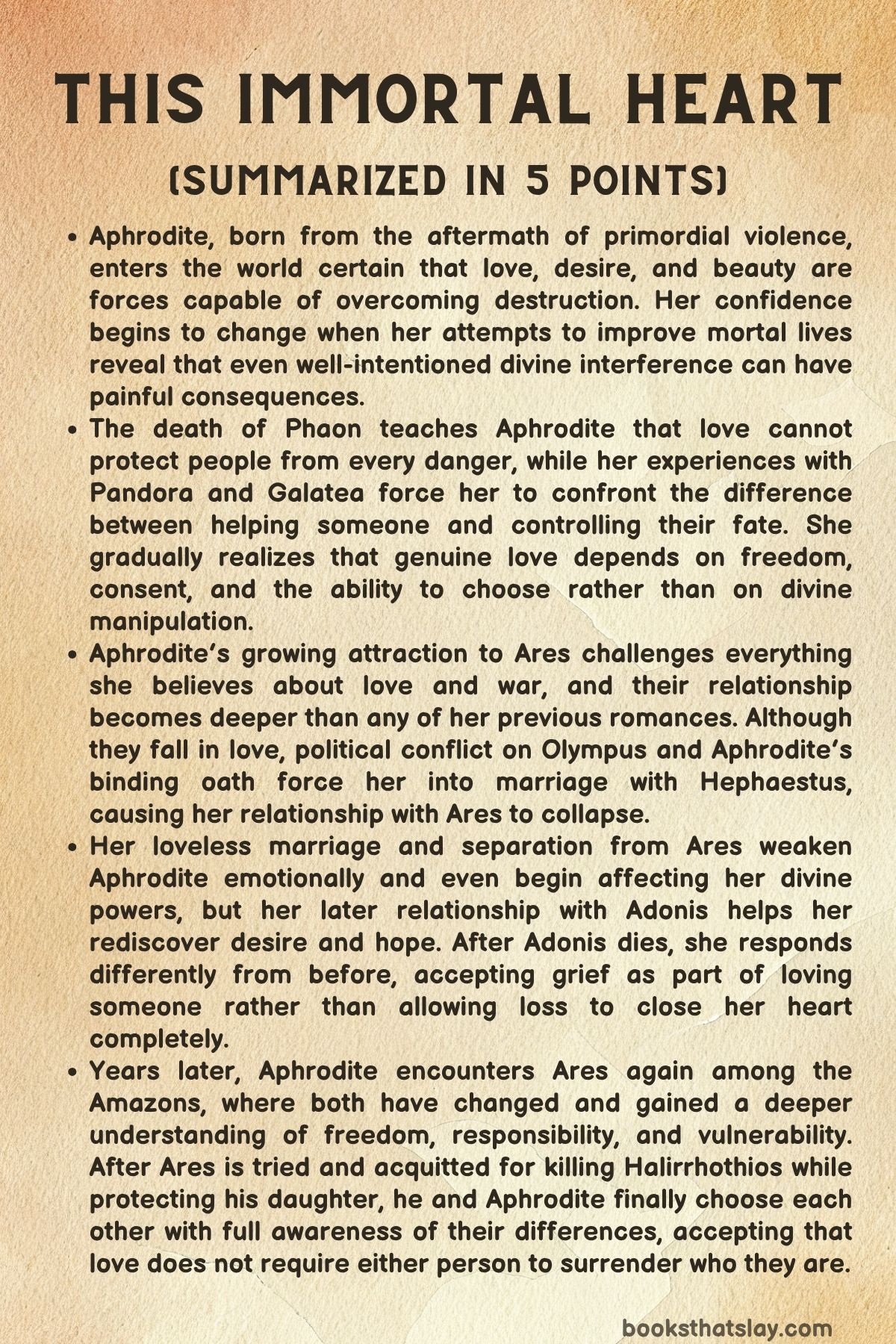
Aphrodite is born from an act of ancient violence when Ouranos is mutilated and his blood falls across earth and sea. From the same catastrophe that produces beings associated with vengeance and conflict, Aphrodite rises from the foam near Cyprus as the embodiment of beauty, desire, attraction, and love, immediately convinced that her power can stand against the destructive forces from which she emerged.
She delights in observing mortal desire and considers private longing more meaningful than formal worship. Aphrodite resists Zeus’s repeated efforts to marry her because she believes marriage and love are fundamentally different, and she values the freedom to choose lovers without becoming anyone’s possession.
Her certainty about her powers begins to change after meeting Phaon, an elderly fisherman who has spent his life loving the woman from whom he was separated in youth. Touched by his devotion, Aphrodite restores his youth and later finds his lost beloved, restores her as well, and reunites them, allowing them to marry and begin the life that circumstances once denied them.
Their happiness does not last. When war threatens Phaon’s homeland, he willingly becomes a soldier despite Aphrodite’s efforts to save him, arguing that he cannot protect only himself while his family and neighbors remain endangered.
Aphrodite appeals to Ares, the God of War, asking him to guarantee Phaon’s survival. Ares refuses because every warrior entering battle has someone who loves them, and he insists that he cannot choose one soldier for divine protection simply because Aphrodite favors him.
Unable to accept this answer, Aphrodite enters the battlefield herself and attempts to remove Phaon against his wishes. Before she can carry him away, he is killed by an arrow, leaving Aphrodite confronted with a painful truth: even the Goddess of Love cannot prevent loss simply because she believes love deserves protection.
Phaon’s grieving widow makes the consequences even clearer. Aphrodite had restored her youth and given her another chance at happiness, but that gift now means the woman must live for decades without Phaon, forcing Aphrodite to recognize that divine intervention can create suffering even when it begins with generous intentions.
Around the same time, Aphrodite becomes increasingly disturbed by the treatment of women within the Olympian order. She helps create Pandora by giving her the capacity for desire, only to discover that Zeus intends to blame the innocent woman for humanity’s existing suffering through a false story about a forbidden jar.
Another encounter forces Aphrodite to reconsider her own use of power. Pygmalion begs her to bring his ivory sculpture to life, and Aphrodite creates Galatea before causing the newly awakened woman to love her creator.
Aphrodite soon realizes that Galatea never had the opportunity to choose what she wanted. She removes the divine influence over her feelings, eventually helping her escape from Pygmalion after discovering that he values Galatea largely because she represents his fantasy of an obedient woman untouched by the independence he despises in others.
Meanwhile, Aphrodite’s hostility toward Ares begins changing. Their arguments reveal that he is not simply an unthinking lover of destruction but a god who accepts war as a terrible force that cannot be made harmless according to personal preference.
Their attraction grows until they become lovers. Aphrodite initially tries to treat the relationship like one of her temporary romances, yet Ares neither demands exclusivity nor tries to change her nature, and the freedom he gives her makes their bond increasingly difficult for her to dismiss.
Olympus becomes more unstable when Zeus attacks Hera after the death of his mortal lover Semele. Hephaestus intervenes to protect his mother, and Zeus violently throws him from Olympus, leaving him injured and exiled in Sicily.
Although forbidden to help, Aphrodite secretly visits Hephaestus and brings him nectar and ambrosia while he builds a new existence inside a volcano. Hephaestus, who has long loved Aphrodite, warns her that Ares will eventually destroy her, while she insists that Ares cannot be condemned merely for possessing the realm assigned to him.
Aphrodite finally admits that she loves Ares. Their relationship becomes one of the few places where she can be both powerful and vulnerable without being treated as property, but their happiness is threatened when Hephaestus retaliates against Olympus by trapping Hera in an unbreakable golden throne.
Zeus announces that whoever forces Hephaestus to release Hera will receive Aphrodite as his wife. Furious at being treated as a reward, Aphrodite nonetheless swears on the Styx that she will marry the winner because Zeus threatens her temples, attendants, and worshippers if she refuses.
Aphrodite believes she can solve the problem by personally convincing Hephaestus to free Hera. Her arguments fail, and Ares eventually confronts his brother, leading to a violent fight that Aphrodite stops by asserting her own divine authority.
The conflict ends differently than Aphrodite expects. Dionysus gives Hephaestus wine, Hephaestus eventually releases Hera, and Zeus declares him the winner, making Aphrodite bound by her oath to marry him.
Hephaestus admits that part of him hoped marriage would persuade Aphrodite that his love was better for her than Ares’s. Although ashamed of his choice, he cannot reverse what has happened, while Ares asks Aphrodite either to flee Olympus with him or fight Zeus openly.
Aphrodite refuses because breaking her oath could cost her power, worshippers, temples, and identity. Ares interprets the choice as evidence that she has chosen Olympus and Hephaestus over him, and their relationship collapses.
Aphrodite enters marriage determined not to become a prisoner. She and Hephaestus recover some of their old friendship, and he provides her with private chambers and makes no demand that she share his bed, yet the emotional damage beneath their union remains.
Soon Aphrodite’s powers begin weakening. Relationships she once helped create fall apart, revealing that her own closed heart is affecting the realm she governs.
She meets the mortal hunter Adonis and approaches him disguised as a nymph. Their attraction develops without divine manipulation, and the romance restores Aphrodite’s hope as well as her power.
Recognizing that neither she nor Hephaestus benefits from maintaining the appearance of a marriage founded on coercion, Aphrodite leaves him. Her relationship with Adonis gives her another chance to love freely, but tragedy returns when a boar attacks and Adonis sacrifices himself while believing Aphrodite is an ordinary woman who needs protection.
His death devastates her, yet Aphrodite refuses to let grief close her heart again. She learns that sorrow does not mean love was a mistake and that losing someone cannot erase the value of having loved them.
Her growing maturity also changes how she answers prayers. She becomes more careful about imposing solutions, as shown when she seeks Hera’s help for Iphis rather than assuming every problem belongs to her own realm.
Eventually Aphrodite travels far beyond familiar Greek lands after hearing the call of a young man in love with an Amazon woman. Among the Amazons she discovers a society built around female autonomy and learns that they call themselves the Daughters of Ares.
Ares has created a new life among them after abandoning Olympus. Aphrodite secretly discovers him with his daughter Alkippe and later watches him defend the Amazons during an attack, allowing her to see how differently his power can operate when placed in service of people he cares about.
When Aphrodite and Ares finally meet again, years of anger and longing remain between them. Their first conversation ends cautiously, but Ares later returns to her and admits that seeing her again made separation impossible.
They reunite, both understanding more clearly what their relationship requires. Their restored happiness is immediately threatened when Poseidon’s son Halirrhothios travels to Scythia and is killed by Ares.
Ares is brought to Athens for an unprecedented divine murder trial. The apparent crime changes completely when Alkippe reveals that Halirrhothios attacked and attempted to sexually assault her, and that Ares killed him while responding to his daughter’s screams.
Even Hephaestus defends Ares during the trial, and Zeus eventually declares him innocent. Ares decides to return to Olympus and reclaim his neglected responsibilities while continuing his connection with Scythia and the Amazons.
By the end, Aphrodite no longer expects love to eliminate danger, grief, conflict, or difference. She accepts Ares without demanding that he cease being the God of War, just as he loves her without trying to limit the freedom and multiplicity that belong to the Goddess of Love.
Their reconciliation does not suggest that love and war have become identical or that one has defeated the other. Instead, Aphrodite understands that loving someone means seeing the whole person, accepting vulnerability, and choosing freely even when certainty and safety can never be guaranteed.
Characters
Aphrodite
Aphrodite is the central consciousness of This Immortal Heart, and her development gives the book its emotional and philosophical structure. She begins with immense confidence in love as a force capable of correcting injustice, healing loneliness, and defeating destruction, but that confidence initially contains a dangerous assumption that she knows what other people need.
Phaon becomes the first major challenge to this belief because Aphrodite learns that loving someone does not give her the right to overrule his choices. Her attempt to protect him against his wishes reveals how easily care can become control when a powerful person assumes that good intentions justify interfering with another person’s autonomy.
Galatea deepens this lesson. Aphrodite realizes that manufacturing love in a woman who has only just become conscious denies Galatea the very freedom that makes genuine affection meaningful, leading Aphrodite toward a more mature understanding of her own divine responsibilities.
Her relationship with Ares also exposes vulnerabilities that she has spent centuries avoiding. Although Aphrodite is comfortable with desire and physical intimacy, lasting emotional dependence frightens her because loving Ares means allowing another person to matter enough to hurt her.
Her forced marriage to Hephaestus tests her determination to preserve her identity under coercive circumstances. Rather than allowing Zeus’s arrangement to redefine her, she separates the legal fact of marriage from the ownership Zeus expects it to represent and continues insisting that her body, sexuality, work, and affections remain her own.
By the end of the book, Aphrodite has become less certain but considerably wiser. She still believes passionately in love, yet she now understands that love cannot guarantee safety, prevent death, remove disagreement, or excuse control; its value lies in freely choosing connection despite those risks.
Ares
Ares is introduced as everything Aphrodite believes love should oppose. He represents battle, bloodshed, danger, and death, and his refusal to save Phaon initially makes him appear cold and morally inflexible.
His argument, however, reveals an important ethical consistency. Ares refuses to pretend that one soldier’s love makes his life more valuable than another soldier’s, and although Aphrodite hates his answer, she gradually understands that he is unwilling to transform war into a system where divine favoritism decides who deserves survival.
In This Immortal Heart, Ares becomes especially significant because his emotional conduct frequently contrasts with his frightening public identity. He does not demand Aphrodite’s exclusivity, does not try to contain her sexuality, and accepts that loving the Goddess of Love means accepting aspects of her nature that he cannot possess.
His greatest weakness is the violence that remains inseparable from him. His assault on Hephaestus in the volcano demonstrates how easily anger and protective instinct can overwhelm restraint, even though Aphrodite’s ability to stop him shows that he is not incapable of choice.
Ares’s years among the Amazons expand his character beyond Olympus. He becomes a protector, father, and god connected to a society whose warriors value autonomy, suggesting that his realm is not automatically equivalent to cruelty or conquest.
His killing of Halirrhothios completes this more complicated portrait. The act initially appears like another example of uncontrolled violence, but Alkippe’s testimony reveals that it occurred while Ares was defending his daughter from a brutal attack, forcing the other gods and the reader to confront the difference between aggression and violent protection.
Hephaestus
Hephaestus begins as a sympathetic figure whose intelligence, craftsmanship, insecurity, and loneliness make him markedly different from the more glamorous Olympians. His forge creates objects of extraordinary beauty, while his physical disability and awkwardness have taught him to expect judgment and rejection.
His affection for Aphrodite initially appears patient and restrained. He understands that her feelings cannot simply be manufactured, particularly after their conversations concerning Galatea, but his emotional pain eventually exposes the limits of that understanding.
Zeus’s brutal exile transforms Hephaestus. After being thrown from Olympus for defending Hera, he rebuilds himself inside the volcano and discovers a more dangerous form of power, yet suffering also hardens his belief that mercy will only invite further humiliation.
His golden throne for Hera is both a brilliant act of resistance and a troubling act of revenge. He wants his mother to experience helplessness after years in which he felt abandoned, but his refusal to release her shows how easily justified anger can become another form of domination.
His decision to free Hera despite knowing that it will make Aphrodite his wife is his greatest moral failure. Even though he regrets it, part of him hopes marriage will finally make Aphrodite recognize his devotion, demonstrating that he has momentarily confused loving someone with believing he deserves to be loved in return.
Hephaestus nevertheless remains capable of growth. His eventual acceptance that the marriage cannot become genuine, his willingness to let Aphrodite leave, and his defense of Ares during the murder trial show a man gradually releasing resentment and recovering the decency that pain almost destroyed.
Eros
Eros serves as Aphrodite’s son, companion, observer, and occasional voice of clarity. His closeness to his mother allows him to recognize changes in her emotional life long before she is prepared to admit them herself.
He participates enthusiastically in many of Aphrodite’s interventions, including the search for Phaon’s lost beloved, but he is not merely an extension of her will. His observations often help Aphrodite recognize the difference between what she claims to feel and what her actions reveal.
This becomes especially important in her relationship with Ares. When Aphrodite continues insisting that the affair is temporary, Eros calmly identifies the truth that she has fallen in love, forcing the Goddess of Love to recognize an emotion she can detect easily in everyone except herself.
Later, he helps diagnose the weakening of Aphrodite’s powers. By connecting the collapse of relationships around them with Aphrodite’s own emotionally closed state, Eros shows that love in the novel is not merely a power she controls from outside but something her own willingness to experience directly affects.
Zeus
Zeus represents political authority at its most entitled and coercive. He expects obedience from gods and mortals alike and repeatedly treats the lives, bodies, relationships, and reputations of others as resources that can be manipulated to preserve his dominance.
His treatment of Pandora is particularly revealing. Rather than taking responsibility for suffering already present in the world, Zeus devises a story in which an innocent woman can be blamed, demonstrating how authority creates convenient narratives that protect powerful men at the expense of women.
His violence toward Hera and Hephaestus exposes the brutality beneath Olympian order. Zeus speaks of loyalty and obedience, yet his idea of stability depends on everyone accepting his right to punish resistance.
The decision to offer Aphrodite as a prize for freeing Hera makes his attitude toward women unmistakable. Her divine status does not protect her from being treated as property when Zeus believes that controlling her can solve a political problem.
Even so, Zeus is not presented as absolutely incapable of judgment. His eventual acquittal of Ares after Alkippe’s testimony shows that evidence can occasionally force him toward a defensible decision, although it does not erase the larger system of intimidation he maintains.
Hera
Hera occupies a difficult position because she is both enormously powerful and repeatedly subjected to Zeus’s humiliation and violence. Her actions toward Semele are cruel and fatal, yet they arise within a marriage shaped by betrayal, jealousy, and a husband whose affairs continually undermine her dignity.
Her reaction to the Pandora scheme shows that she is capable of recognizing misogyny even within the Olympian system she helps govern. Hera understands that blaming a woman for all human suffering is an outrageous manipulation rather than justice.
Her role in making Aphrodite the prize for Hephaestus’s release is more morally complicated. Hera believes the threat will force Ares to act and imagines that marriage to him might eventually protect Aphrodite, but the plan still reproduces the same logic of treating another woman’s future as something others may arrange.
Later, Hera helps Iphis because Aphrodite recognizes that the young man’s wish concerns marriage and social identity as much as desire. This moment reveals a more constructive version of Hera’s power and shows that she can use her authority to help someone live more freely rather than merely enforcing convention.
Eris
Eris embodies strife without Ares’s sense of responsibility. Where Ares views war as a dangerous force governed by its own brutal rules, Eris actively enjoys disorder and frequently seeks opportunities to intensify suffering.
Her murder of Phaon is especially important because it distinguishes her from Ares. Phaon does not die simply because war is dangerous; Eris deliberately kills him and then takes pleasure in Aphrodite’s grief.
When Ares abandons his old position, Eris takes advantage of the vacuum. Warfare becomes increasingly uncontrolled under her influence, showing that conflict without boundaries or responsibility is far more destructive than Ares’s harsher but ordered conception of battle.
Eris also acts as a reminder that disruption can feed upon unresolved anger. She repeatedly appears when relationships, political structures, or wars are already unstable, making existing fractures worse instead of creating meaningful change.
Pandora
Pandora is one of the clearest examples of a woman created and then defined by other people’s intentions. Her body, abilities, desirability, marriage, and eventual reputation are all shaped by gods before she has any meaningful opportunity to determine her own identity.
Aphrodite initially participates unknowingly in this process by granting Pandora desire and desirability. Once she discovers Zeus’s plan, however, Pandora becomes central to Aphrodite’s growing recognition that myths themselves can become instruments of injustice.
Zeus intends to transform Pandora into the explanation for evils she never caused. Her character therefore represents not only victimization but the historical tendency to make women symbols of blame for problems created by wider systems of power.
Aphrodite eventually helps Pandora and Epimetheus escape. That act cannot erase the false story spreading about her, but it gives the woman herself a chance to live beyond the identity imposed upon her.
Phaon
Phaon initially represents Aphrodite’s ideal vision of enduring love. He has remained devoted to the same woman throughout decades of separation, refusing to treat affection as something that can simply be replaced when circumstances become difficult.
His generosity toward Aphrodite while she is disguised as an elderly woman also establishes his kindness independently of romance. Aphrodite rewards him not because he worships her magnificently but because his actions reveal patience, loyalty, and compassion.
His decision to fight creates the first serious conflict between Aphrodite’s desire to protect and another person’s right to choose. Phaon refuses safety because he believes his responsibilities extend beyond his individual happiness, forcing Aphrodite to confront a form of love expressed through duty rather than preservation.
His death becomes one of the defining events of Aphrodite’s development. Even after he leaves the story, the questions raised by his choices continue shaping how she understands freedom, grief, and the limits of divine intervention.
Phaon’s Beloved
Phaon’s beloved receives relatively little individual history, yet her response to his death gives her major moral importance. Aphrodite initially sees restoring the couple’s youth as an uncomplicated gift, but the widow reveals the hidden cost of that miracle.
Before Aphrodite intervened, she expected death to come relatively soon and imagined reunion with Phaon in the afterlife. Rejuvenation gives her love, marriage, and pregnancy, but after Phaon is killed it also condemns her to many additional years of mourning.
Her grief forces Aphrodite to understand that changing one part of a person’s fate can create consequences no god has fully anticipated. She therefore becomes less a passive beneficiary of divine generosity than one of the first people to challenge Aphrodite’s certainty about her own benevolence.
Charis
Charis represents a particularly mature understanding of love because she refuses the very solution Aphrodite is most capable of providing. Although deeply in love with Hephaestus, she asks Aphrodite never to manipulate his feelings on her behalf.
Her refusal becomes an ethical model that Aphrodite gradually learns to follow. Charis would rather experience genuine rejection than receive affection created through divine interference because she understands that love without freedom is not the relationship she wants.
Her later insight into vulnerability also helps Aphrodite reconsider her fear of suffering. Charis accepts that caring for someone creates the possibility of pain but argues, through her choices and perspective, that emotional safety purchased through complete detachment carries its own cost.
Demeter
Demeter frequently acts as one of Aphrodite’s wisest companions. She understands loss, protection, motherhood, and the limits of divine power in ways Aphrodite initially does not.
After Phaon’s death, Demeter explains that the gods cannot prevent every disaster but can help repair what remains. This idea becomes increasingly important to Aphrodite because it replaces fantasies of total control with a more sustainable model of care.
Demeter also interprets the reunion of Phaon and his beloved as the restoration of choice rather than merely a romantic miracle. Her perspective helps establish one of the story’s central moral distinctions: helping people reclaim stolen possibilities is different from deciding their lives for them.
Her secret protection of her own daughter in Sicily additionally shows that Demeter understands resistance to Olympian authority. She is cautious rather than openly rebellious, but her actions reveal a willingness to place personal loyalty above Zeus’s commands.
Athena
Athena is closely connected to Olympian authority and often functions as an efficient executor of Zeus’s decisions. Her intelligence and practical abilities make her highly capable, but those same qualities can become dangerous when detached from moral questioning.
Her role in Pandora’s creation demonstrates this problem. Athena gives the new woman skills and participates in the project without fully preventing the larger injustice Zeus intends to construct around her.
The fact that the Pandora scheme proceeds before Zeus’s delayed order reaches Athena further emphasizes her tendency toward action. She represents intelligence in service of systems of power, raising the question of whether competence deserves admiration when it operates without sufficient ethical resistance.
Her later frustration at being expected to contain the warfare unleashed during Ares’s absence also reveals the limits of unquestioning service. Even Athena becomes burdened when Zeus assumes every divine realm can be redirected according to his political needs.
Poseidon
Poseidon is powerful, entitled, and accustomed to asking Aphrodite to alter desire for his benefit. Early in the story, he requests that she make Nerites fall in love with him, treating divine influence over affection as a favor that can be negotiated between gods.
His character becomes more important near the end through Halirrhothios. Poseidon initially sees his son as the victim of an unjustified killing and reacts with the fury of a grieving father, showing how personal attachment can narrow even a god’s understanding of events.
When Alkippe reveals what Halirrhothios did, Poseidon’s grief is placed beside the reality of his son’s violence. This creates an uncomfortable but important distinction between loving someone and denying responsibility for that person’s actions.
Nerites
Nerites appears primarily through his relationship with Aphrodite and later through Poseidon’s attraction to him. His role helps establish Aphrodite’s early understanding of relationships as fluid experiences rather than permanent claims of possession.
Aphrodite does not regard the end of their affair as betrayal or tragedy. Instead, she sees changing attraction as natural and even agrees to help Nerites move toward another relationship, showing that her resistance to exclusivity exists long before Ares enters her life.
Pasithea
Pasithea provides one of the gentler romantic threads in the book. Her attraction to Hypnos gives Aphrodite an opportunity to assist love without confronting the severe ethical questions raised by Pygmalion or Phaon.
Yet the later deterioration of Pasithea’s relationship becomes evidence that something is wrong with Aphrodite’s realm. A romance that once appeared stable begins collapsing as Aphrodite herself closes emotionally after losing Ares.
Pasithea therefore helps transform Aphrodite’s private grief into a visible divine crisis. Her relationship demonstrates that the Goddess of Love cannot completely separate her personal emotional condition from the force she represents.
Hypnos
Hypnos, the God of Sleep, is associated mainly with Pasithea, yet his role contributes to the book’s wider depiction of divine relationships as vulnerable to the same instability experienced by mortals. Love does not become secure simply because both partners are immortal.
The conflict between Hypnos and Pasithea also has broader consequences because frustrated desire becomes connected with sleeplessness. Their troubled relationship thus reflects the way different divine realms can affect one another when emotional harmony fails.
Pygmalion
Pygmalion initially presents himself as a man so devoted to his art that he has fallen in love with his own creation. His request seems romantic until Galatea becomes conscious and his behavior reveals that his ideal woman is someone designed according to his preferences.
His love is ultimately rooted in possession. He praises Galatea because she has been created rather than born, turning her into an argument against real women whose independence he resents.
Pygmalion therefore becomes an important counterexample to the book’s developing definition of love. He desires a woman who cannot challenge him, which means that what he calls affection is inseparable from control.
His punishment is not physical destruction but Galatea’s freedom. Once divine compulsion disappears, he must face the fact that the living woman he claimed to adore does not owe him devotion.
Galatea
Galatea begins life in a uniquely vulnerable position because she becomes conscious only after Pygmalion has already imagined her identity. He names her, claims her, and expects love before she has had time to understand herself.
Aphrodite initially compounds this problem by creating affection inside her. Once that influence fades, Galatea gains something more important than the romance Pygmalion requested: the ability to discover what she wants.
Her eventual departure transforms her from an object created for male admiration into a person capable of choosing her own future. The fact that she later grows old and dies after a genuinely happy life confirms that mortality and uncertainty are preferable to an immortalized existence built on coercion.
Epimetheus
Epimetheus appears chiefly through his relationship with Pandora. His importance lies in providing the possibility that Pandora can experience affection and companionship beyond the false identity created for her by Zeus.
When Aphrodite helps the couple escape, their relationship becomes part of her attempt to protect a life rather than direct it. Epimetheus therefore belongs to a quieter form of resistance in which leaving the reach of oppressive authority becomes more important than confronting it openly.
Semele
Semele is a mortal woman caught inside the destructive politics of the Olympian marriage. Her relationship with Zeus makes her vulnerable to Hera’s anger, while Zeus’s divine power ultimately makes the demand to see his true form fatal.
Her death demonstrates how mortal women bear the consequences of conflicts among gods. Neither Zeus’s desire nor Hera’s jealousy protects Semele as an individual with a life of her own.
Her surviving son Dionysus ensures that her influence continues after death. His resentment toward Hera and determination to establish himself among the gods are shaped partly by the injustice surrounding his mother’s fate.
Dionysus
Dionysus arrives as a charismatic new god associated with wine, pleasure, music, ecstatic experience, and social disruption. His realm resembles Aphrodite’s in its attraction to surrender and pleasure, which makes him both appealing and potentially dangerous to her.
Unlike Aphrodite, however, Dionysus often appears entertained by instability. His involvement with Hephaestus and the golden throne suggests that he is willing to encourage situations whose consequences may be far more serious than the amusement they provide.
He is also politically ambitious. His interest in the vacant Olympian throne and his desire to secure his place among the gods show that pleasure and rebellion in his character exist alongside calculation.
Aphrodite’s refusal to take him as a lover becomes meaningful because attraction alone is no longer enough for her. By that stage, she understands that desire can be real without necessarily being something she should pursue.
Adonis
Adonis enters Aphrodite’s life when she is emotionally damaged by her separation from Ares and her forced marriage. His importance lies partly in the fact that their attraction develops while he believes she is an ordinary nymph, preventing divine status from shaping his feelings.
His history of family cruelty and unwanted desire gives him something in common with Aphrodite. Both are trying to escape circumstances imposed by others and experience affection without being controlled.
The relationship restores Aphrodite’s ability to hope, which in turn restores her divine power. Adonis therefore represents renewal rather than merely replacement for Ares.
His death repeats some elements of Phaon’s tragedy but produces a different response from Aphrodite. Instead of allowing grief to close her heart and damage her realm, she accepts mourning as the cost of having valued another life.
Artemis
Artemis initially appears threatening because Aphrodite suspects she may be responsible for the boar that kills Adonis. Their confrontation instead reveals a goddess fiercely committed to protecting women who escape into her forests after experiencing male violence.
This explanation gives Artemis moral depth and places her apparent hostility within a wider protective purpose. Aphrodite ultimately believes her claim that Adonis’s death was not deliberate, showing Aphrodite’s increased willingness to listen before assigning blame.
Artemis also represents an alternative model of female independence. Her realm is not based on romantic connection, reminding Aphrodite that freedom and meaningful identity do not depend upon everyone participating in love in the same way.
Iphis
Iphis challenges Aphrodite because his desire cannot be solved by simply making another person love him. He loves Ianthe, but he also wants his body and social life to reflect the man he understands himself to be.
Aphrodite’s response demonstrates how much she has changed. Rather than assuming that her own power should solve every problem, she recognizes the limits of her realm and asks Hera for assistance.
Iphis’s eventual transformation and marriage therefore represent cooperation rather than unilateral divine intervention. His happiness emerges from gods responding to his clearly expressed identity and desire rather than deciding those things for him.
Ianthe
Ianthe is central to Iphis’s hope for a shared future. Although the book gives greater attention to Iphis’s struggle, Ianthe represents the possibility of a relationship that can become socially and personally viable once the constraints surrounding the couple are addressed.
Her marriage to Iphis provides a contrasting model to Aphrodite’s marriage with Hephaestus. One union results from coercion and political bargaining, while the other becomes possible because the people involved actually desire the life being created.
Kydoime
Kydoime, queen of the Amazons, represents authority built around collective survival rather than Olympian domination. She leads women whose society originates in rebellion against enslavement and whose customs prioritize independence.
Her explanation of Amazon life changes Aphrodite’s understanding of both Ares and freedom. The Amazons do not reject love, men, motherhood, or partnership automatically; they reject arrangements that require women to surrender autonomy.
Kydoime’s eventual decision to allow certain Scythian men to join the community reflects this principle. Admission depends upon demonstrated trust and the desires of individual Amazon women rather than a general rule imposed upon everyone.
Dorymache
Dorymache, Kydoime’s partner, helps establish the Amazons as a society where relationships can exist without being organized according to conventional Olympian expectations. Her partnership with the queen demonstrates that authority, affection, and female independence can coexist.
Her presence also reinforces the Amazons’ broader refusal to prescribe one acceptable form of love. Women may love women, men, multiple partners, or nobody, and Dorymache belongs to a culture in which those possibilities do not require justification.
Melo
Melo embodies the tension between romantic desire and collective independence. She loves a Scythian man but fears that pursuing that relationship may require abandoning the Amazon community that gives her identity and freedom.
Her dilemma is particularly important because Aphrodite no longer tries to force an easy romantic solution. She acknowledges that love does not automatically erase political history, cultural mistrust, or practical conflict.
The eventual alliance between the Amazons and Scythian men resolves Melo’s problem through demonstrated behavior rather than magical persuasion. Her story therefore shows Aphrodite helping create conditions where choice becomes possible instead of selecting the choice herself.
Alkippe
Alkippe reveals an essential side of Ares that Aphrodite has not previously understood. His tenderness toward his daughter contrasts sharply with his public reputation, showing that the God of War possesses deep familial attachment.
Her assault by Halirrhothios becomes the central fact in Ares’s trial. By speaking publicly about what happened, Alkippe changes the entire meaning of the killing and prevents the gods from judging her father through appearances alone.
She also exposes the unequal way powerful men can be protected by reputation. Halirrhothios initially enters the trial as Poseidon’s admired son, while Alkippe’s testimony forces the divine court to recognize the violence hidden beneath that image.
Halirrhothios
Halirrhothios initially appears as Poseidon’s admired mortal son, celebrated for his skill and boldness. His fascination with the Amazons, however, develops into an act of violation when he attacks Alkippe.
His death is intentionally presented before the full circumstances are known. This structure demonstrates how judgment can change when the experiences of victims are initially absent from the story being told.
Halirrhothios therefore functions less as a complicated moral character than as a catalyst for exposing competing forms of power. Poseidon’s grief, Ares’s violence, Alkippe’s testimony, and Zeus’s judgment all converge around the question of whether reputation should outweigh evidence.
Helios
Helios plays a smaller but significant role through his ability to observe what others attempt to hide. His discovery of Ares’s location shows how difficult genuine escape from Olympian politics can be when divine surveillance remains active.
He also reinforces the vulnerability of Ares’s new life in Scythia. Even after leaving Olympus, Ares cannot simply disappear from Zeus’s attention because gods such as Helios can transform knowledge into political leverage.
Sisyphus
Sisyphus appears through the crisis he causes by trapping Thanatos. His actions interrupt death itself and create a problem serious enough that Zeus sends Ares to resolve it.
His role demonstrates the danger created when fundamental forces are removed from the world rather than accepted as part of existence. Just as Aphrodite eventually learns that love cannot remove all suffering, the Sisyphus episode shows that eliminating death does not automatically create a healthy world.
Thanatos
Thanatos represents death as a necessary cosmic force rather than simply a villainous presence. When Sisyphus imprisons him, the disruption becomes a crisis precisely because mortality is part of the balance governing human life.
His brief role supports one of the story’s larger conclusions: unpleasant forces cannot always be erased without consequences. The challenge is often learning how to live meaningfully in a world where loss remains unavoidable.
Dysis
Dysis is important primarily through her relationship with Kedalion, which Aphrodite encourages while spending time on Lemnos. Their early attraction provides evidence that Aphrodite’s powers are still functioning.
When their relationship abruptly deteriorates, Dysis becomes part of the pattern revealing the deeper crisis inside Aphrodite herself. Her failed romance helps show that divine power is connected to Aphrodite’s willingness to remain emotionally open.
Kedalion
Kedalion, an attendant of Hephaestus, participates in one of the relationships that begins under Aphrodite’s influence and later collapses. His romance with Dysis therefore serves as a practical indicator of the instability spreading through Aphrodite’s realm.
His presence on Lemnos also helps humanize Hephaestus’s world. Through craftsmen, attendants, and ordinary community life, Aphrodite discovers aspects of her husband that are more patient and generous than the resentment surrounding their marriage initially allows her to see.
Euryte
Euryte appears after Aphrodite has regained confidence through her relationship with Adonis. Her request for Poseidon’s affection gives Aphrodite an opportunity to exercise her powers again from a position of renewed emotional strength.
Aphrodite does more than create temporary attraction, strengthening Poseidon’s fondness so that Euryte will not be forgotten immediately. The decision shows that Aphrodite still intervenes in desire, but her approach has become more attentive to the emotional consequences for the person seeking her help.
Iris
Iris functions as a messenger whose appearances often connect Aphrodite with changes occurring elsewhere. Her arrival with news of Hera’s imprisonment propels Aphrodite back into the conflict involving Hephaestus and Olympus.
Her role reflects the interconnected nature of divine life. Aphrodite repeatedly tries to establish independence in Cyprus or elsewhere, yet messages from Olympus ensure that political crises continue entering her personal world.
Auge
Auge appears briefly through her reconciliation with Iris after Aphrodite’s relationship with Adonis begins restoring the Goddess of Love’s powers. The renewed connection provides visible evidence that emotional possibility is returning to the world around Aphrodite.
Though minor, Auge therefore participates in an important narrative function. Her reconciliation demonstrates that Aphrodite’s personal recovery affects not only herself but the relationships governed by her divine realm.
Ouranos
Ouranos appears only at the beginning, yet his violent fate establishes the symbolic foundation of the entire story. Aphrodite emerges from the consequences of his mutilation, meaning that love is born from the same event that produces forces associated with vengeance and conflict.
This origin challenges any simple division between creation and destruction. Aphrodite spends much of the book trying to separate love completely from violence, only to discover that vulnerability, grief, desire, conflict, and loss remain connected parts of existence.
Themes
Love, Choice, and Consent
Love repeatedly becomes meaningful only when the people involved retain the ability to choose. In This Immortal Heart, Aphrodite begins with the confidence that creating or strengthening desire is inherently generous, but encounters with Phaon, Galatea, Charis, Hephaestus, the Amazons, and others gradually expose the weaknesses in that belief.
Galatea provides the clearest example because Aphrodite initially makes her love Pygmalion before the newly created woman has even formed an independent identity. Once Aphrodite realizes what she has done, she understands that affection produced without meaningful choice may satisfy the person receiving love while imprisoning the person forced to give it.
Charis expresses the same principle from the opposite direction. She desperately wants Hephaestus but refuses Aphrodite’s offer to alter his feelings because receiving artificial devotion would destroy the very quality that makes love valuable to her.
Aphrodite’s forced marriage demonstrates how the same principle applies even to gods. Zeus treats marriage as a political mechanism and assumes Aphrodite can be transferred to a husband through an oath, but she refuses to interpret the arrangement as ownership of her body or emotions.
The Amazons later provide a social model built around this lesson. Relationships are permitted in many forms, but no woman must surrender freedom simply because love appears.
By the end, Aphrodite understands that her role is not to guarantee romantic outcomes. Her wiser form of intervention protects opportunities, removes unjust restrictions when possible, and allows individuals to determine what they want for themselves.
Love and Violence
Aphrodite’s birth establishes a relationship between love and violence before she has spoken a word. She emerges from the same act of bodily destruction that produces beings associated with conflict and vengeance, yet she initially believes her own realm stands completely apart from those forces.
Ares becomes the character who most directly challenges that assumption. Aphrodite sees war as the enemy of everything she represents, particularly after Phaon dies, while Ares argues that love and war both expose people at moments when ordinary caution disappears and fundamental loyalties become visible.
The story never treats this comparison as proof that love and violence are morally equivalent. Instead, it asks whether vulnerability links them, since loving another person creates fear of loss, the desire to protect, anger when that person is harmed, and grief when protection fails.
Ares’s killing of Halirrhothios makes this connection especially difficult. His violent response occurs because his daughter is being attacked, turning love into the motive behind an act that appears murderous until its context becomes known.
Aphrodite experiences the reverse movement through Adonis and Phaon. Their deaths show her that love cannot guarantee protection from violence, yet refusing love to avoid future pain would also mean refusing the joy and meaning those relationships created.
The final reconciliation between Aphrodite and Ares therefore depends on accepting contradiction. Love cannot simply abolish conflict, but it may influence how power is used, what people choose to defend, and whether destruction becomes an end in itself.
Power, Patriarchy, and Control
Olympus repeatedly demonstrates how authority protects itself by controlling narratives, relationships, bodies, and choices. Zeus represents the clearest form of this system because his power allows him to turn personal preference into law while expecting everyone around him to accept obedience as the natural condition of divine order.
Pandora’s story demonstrates the political use of blame. Zeus does not merely mistreat an individual woman; he creates a false explanation for suffering that allows generations of mortals to imagine female disobedience as the source of humanity’s problems.
Aphrodite’s marriage shows the same structure operating through sexual and marital politics. Zeus publicly offers her as a reward, treating one of the most powerful goddesses in existence as an object whose future can be assigned to whichever man solves his problem.
Hephaestus complicates the theme because someone harmed by this system can reproduce its logic. His humiliation and exile deserve sympathy, yet his hope that forced marriage might eventually produce Aphrodite’s love shows how victims of domination can still attempt to control others.
Pygmalion offers a mortal version of the same desire. He prefers Galatea because he imagines a woman created according to male expectations, revealing that domination does not always announce itself through violence; sometimes it appears as admiration for obedience.
Against these examples stand characters who redefine power through restraint. Aphrodite becomes more responsible when she stops assuming that divine strength gives her the right to decide for others, suggesting that ethical power begins with recognizing the limits of one’s authority.
Freedom, Identity, and Self-Determination
Freedom in the story involves more than escaping physical imprisonment. Characters repeatedly struggle against identities, relationships, duties, myths, and social arrangements imposed upon them by people who claim the authority to define what their lives should become.
Aphrodite’s resistance to marriage begins as a personal preference but develops into a larger defense of self-determination. She refuses the idea that becoming someone’s wife should change who she is, whom she may desire, how she uses her powers, or where she belongs.
Galatea experiences this struggle even more literally. She is created inside another person’s fantasy and must escape both Pygmalion’s household and the identity he designed for her before she can discover what living for herself actually means.
The Amazons turn individual freedom into a social principle. Their ancestors escaped enslavement, and their descendants build customs intended to prevent partnership from becoming another form of captivity, allowing different kinds of love while rejecting compulsory dependence.
Iphis extends the theme into bodily and social identity. Aphrodite helps him not by telling him who he should become but by taking seriously the person he already understands himself to be and finding the divine assistance that can allow his external life to reflect that truth.
Even Ares must redefine himself outside Olympus. His years in Scythia prove that identity is not exhausted by the role Zeus expects him to perform, while his eventual return shows that freedom can also include choosing responsibility rather than merely escaping it.
Across these characters, self-determination becomes inseparable from meaningful love. Relationships become sustaining rather than imprisoning only when people are allowed to enter them, leave them, redefine them, and remain fully themselves within them.