This Is Me: A Reckoning Summary and Analysis
This Is Me: A Reckoning is Hayden Panettiere’s candid memoir about growing up in the entertainment industry, becoming internationally famous, and surviving the personal crises hidden beneath her public image.
She recounts childhood success, family conflict, difficult relationships, motherhood, postpartum depression, addiction, domestic violence, and the devastating death of her brother, Jansen. Rather than portraying herself only as a victim of circumstance, Hayden examines the decisions she regrets and the emotional patterns that shaped them. The book becomes both a record of survival and an attempt to find responsibility, forgiveness, meaning, and gratitude after repeated experiences of loss.
Summary
Hayden Panettiere begins her account at her father and stepmother’s home in Rockland County, New York, where she seeks stability after several destructive years. The paintings of her younger brother, Jansen, surround her, forcing her to confront his sudden death in February 2023 while also considering the many personal “lifequakes” that have changed her identity.
Her acting career begins before she is old enough to understand what work means. At eight months, her mother, Lesley Vogel, signs her with a modeling agency, and Hayden soon starts appearing in commercials, supported by Lesley’s ambition and her father Skip’s practical assistance.
Lesley becomes the central force behind Hayden’s professional development. She manages auditions, rehearses lines, argues for opportunities, and expects discipline, while Skip offers humor, normality, and emotional comfort whenever the pressure becomes too intense.
Hayden works steadily throughout early childhood, appearing in commercials and soap operas while learning to memorize dialogue, recognize emotional changes in scenes, and cry on command. Her mother teaches her to produce tears by imagining terrible losses, a technique that earns professional praise but may also condition her nervous system to associate fear with approval.
Success separates Hayden from ordinary childhood. She moves between classrooms and professional sets, facing resentment from classmates who bully her for receiving special treatment while adults expect her to behave with maturity far beyond her age.
Her younger brother, Jansen, becomes one of the few people who shares the unusual reality of her upbringing. Hayden loves him fiercely and feels protective of him, although her fame and their different professional experiences later create jealousy, frustration, and emotional distance between them.
Some childhood projects give Hayden a genuine sense of belonging. Voicing Princess Dot in A Bug’s Life develops her technical abilities, while playing Sheryl Yoast in Remember the Titans allows her to express the tomboy identity that casting professionals and her mother often tried to disguise.
The production of Remember the Titans becomes one of her happiest professional memories. Denzel Washington, Will Patton, and the rest of the cast treat her with respect, and Hayden experiences the unusual freedom of being valued for her contribution without feeling that the entire project depends upon her.
Other experiences reveal how little control child performers possess. Hayden loses a major role in Panic Room after Nicole Kidman withdraws and Jodie Foster joins the production, apparently because Lesley refuses a requested haircut that would have made Hayden resemble Foster more closely.
The September 11 attacks produce a far more serious rupture in Hayden’s childhood. Fourteen firefighters from Skip’s former company are killed, and Hayden watches her father search at Ground Zero for men who had once been part of their family’s everyday life.
As Hayden grows older, professional success expands while her family becomes increasingly unstable. Her father has an affair, her parents communicate through anger and accusation, and Hayden is expected to absorb her mother’s grief as though she were a therapist rather than their daughter.
Her casting as Claire Bennet in Heroes brings the family to Los Angeles and turns Hayden into an international celebrity. She enjoys the action, stunt work, creative energy, and ensemble atmosphere, but the show’s success also attracts aggressive photographers, cruel tabloid commentary, and constant attention to her body.
A representative gives her an unidentified pill before a public appearance, introducing her to the immediate relief substances can provide. The drug makes her confident and energetic, establishing an early connection between emotional discomfort and chemical escape.
Hayden also uses her growing fame for marine conservation. Working with Jeff Pantukhoff and the Whaleman Foundation gives her a purpose beyond acting and allows her to confront physical fear while advocating for whales, dolphins, sharks, and ocean protection.
Her personal independence develops alongside the collapse of her parents’ marriage. After Skip is arrested following a domestic dispute with Lesley, Hayden becomes frustrated that their behavior is reported mainly through its connection to her public identity.
At nineteen, Hayden removes Lesley from her professional management and asks her to become simply her mother. The separation is necessary, but it leaves Hayden vulnerable to loneliness and eager for guidance from other powerful personalities.
She forms an intense friendship with Diana Jenkins, whose wealth, confidence, and international lifestyle provide excitement and maternal attention. At the same time, Hayden’s relationship with Milo Ventimiglia ends, and she uses travel, parties, and glamour to avoid sitting with the rejection.
At a Room 23 event, Hayden meets heavyweight boxer Wladimir Klitschko. His seriousness, discipline, physical presence, and distance from Hollywood attract her, while their differences in height, culture, language, and temperament give their early relationship humor and novelty.
Before fully committing to Wladimir, Hayden experiences betrayal from a socially connected friend she calls Stella. After Stella places her in a sexually exploitative situation aboard a yacht, Hayden escapes and recognizes that access, fame, and luxury do not guarantee safety.
Her relationship with Wladimir grows through travel, constant online communication, and emotional disclosure. Hayden sees similarities between his father’s involvement in the Chernobyl cleanup and Skip’s work at Ground Zero, believing both families have been shaped by courage, discipline, and public catastrophe.
Yet the relationship soon develops persistent problems. Wladimir spends long periods training and working in Europe, conducts business conversations Hayden cannot understand, and frequently appears emotionally absent even when they are physically together.
Alcohol becomes Hayden’s method for enduring isolation during dinners where other people speak Russian or Ukrainian. Natalia, the wife of Wladimir’s brother Vitali, recognizes Hayden’s discomfort and becomes an ally, but drinking increasingly functions as an emotional tool rather than occasional entertainment.
After Heroes ends, Hayden appears in Scream 4 and later joins Nashville as Juliette Barnes, an ambitious country singer with a difficult personal life. The role allows her to act and sing, but performing music revives her intense fear of public failure.
The Nashville set does not provide the close community Hayden had found on Heroes. Most cast members return to their families after work, while Hayden spends her free time drinking, dancing, and relying heavily on her friend Allie.
Hayden and Wladimir reunite, become engaged, and plan a wedding, but their differences remain unresolved. She hopes marriage will create the stability and shared purpose they lack, while Wladimir’s continued emotional distance leaves her uncertain and humiliated.
Their relationship changes when Hayden becomes pregnant. She prepares a secure Nashville home and begins imagining family life, although Wladimir’s career still keeps him largely in Europe and serious doubts about their future remain unspoken.
Pregnancy exposes Hayden to renewed body criticism and frightening medical uncertainty. Early examinations suggest possible developmental problems, but after specialist care in Hawaii, she learns that her daughter, Kaya, is healthy.
Kaya is born after a long labor and an emergency Cesarean section. Hayden then suffers severe hemorrhaging, requires extensive surgery and blood transfusions, and briefly accepts the possibility that she may die while trusting Wladimir to raise their daughter.
After surviving, Hayden does not experience the immediate maternal connection she expected. She feels emotionally numb, ashamed, physically depleted, and abandoned when Wladimir prepares to return to Europe.
Alcohol becomes her attempt to manufacture relief from postpartum depression. She drinks at night, wakes in withdrawal, hides bottles throughout the house, and eventually reaches the point where she searches for alcohol early in the morning because she believes she cannot function without it.
Treatment helps temporarily, but Hayden denies the full extent of her addiction and develops a dependence on prescribed medication. She later returns to vodka, while people around her protect the television production rather than confronting the danger.
The writers of Nashville give Juliette postpartum depression, addiction, maternal separation, and relationship problems. Hayden is forced to perform a dramatized form of her own crisis, removing the boundary between work and private suffering.
Her relationship with Wladimir deteriorates as he struggles to understand why she cannot simply choose happiness. When Kaya travels to Ukraine, Hayden is confronted with legal papers requesting that Wladimir receive full custody.
Hayden eventually signs the custody agreement because she believes an international legal battle would expose Kaya to years of instability and parental hostility. The decision devastates her, but she presents it as a sacrifice made for her daughter’s security rather than evidence of absent maternal love.
After Nashville ends, Hayden returns to Los Angeles, where her brother becomes an important source of comfort. She then meets Brian, whose humor, affection, and practical support initially make her feel safe, desirable, and understood.
The relationship becomes violent when alcohol and conflict are involved. Brian slaps, punches, threatens, and injures Hayden, while she repeatedly protects him because she loves his sober personality, fears public exposure, and believes accountability might permanently destroy him.
After a serious attack in Wyoming, Hayden finally cooperates with police and provides a full account of the abuse. She understands that another confrontation could end with her killing Brian in self-defense or suffering fatal injuries herself.
Long-term treatment forces Hayden to experience grief, fear, withdrawal, and responsibility without chemical escape. Through sobriety and the Twelve Steps, she learns that forgiveness does not require denial and that compassion for Brian does not remove the need for consequences.
Her relationship with Lesley becomes calmer as Hayden establishes boundaries and stops accepting responsibility for every family crisis. Her greatest concern shifts to Jansen, whose drug use, unstable friendships, anger, and growing despair suggest that he is moving toward serious danger.
Hayden and Skip attempt to confront Jansen, but he avoids drug testing and resists help. Hayden recognizes the familiar behavior of addiction and fears that heroin, stimulants, or fentanyl will kill him before the family can persuade him to seek treatment.
While preparing to return to acting as Kirby Reed in Scream VI, Hayden receives the call informing her that Jansen has been found dead. She must then tell Lesley, maintaining control long enough to deliver the news before collapsing into grief.
The memoir closes with Hayden preparing to fly home after Jansen’s death. Inside an old suitcase, she discovers a foam dart from a playful Nerf battle they once shared, and the object allows her to laugh through her tears.
Rather than allowing death to erase Jansen’s life, Hayden remembers his humor, art, affection, and ability to create joy during difficult periods. She ends by expressing gratitude for her brother and accepting that survival does not mean escaping grief; it means continuing to live while carrying love, responsibility, memory, and loss.
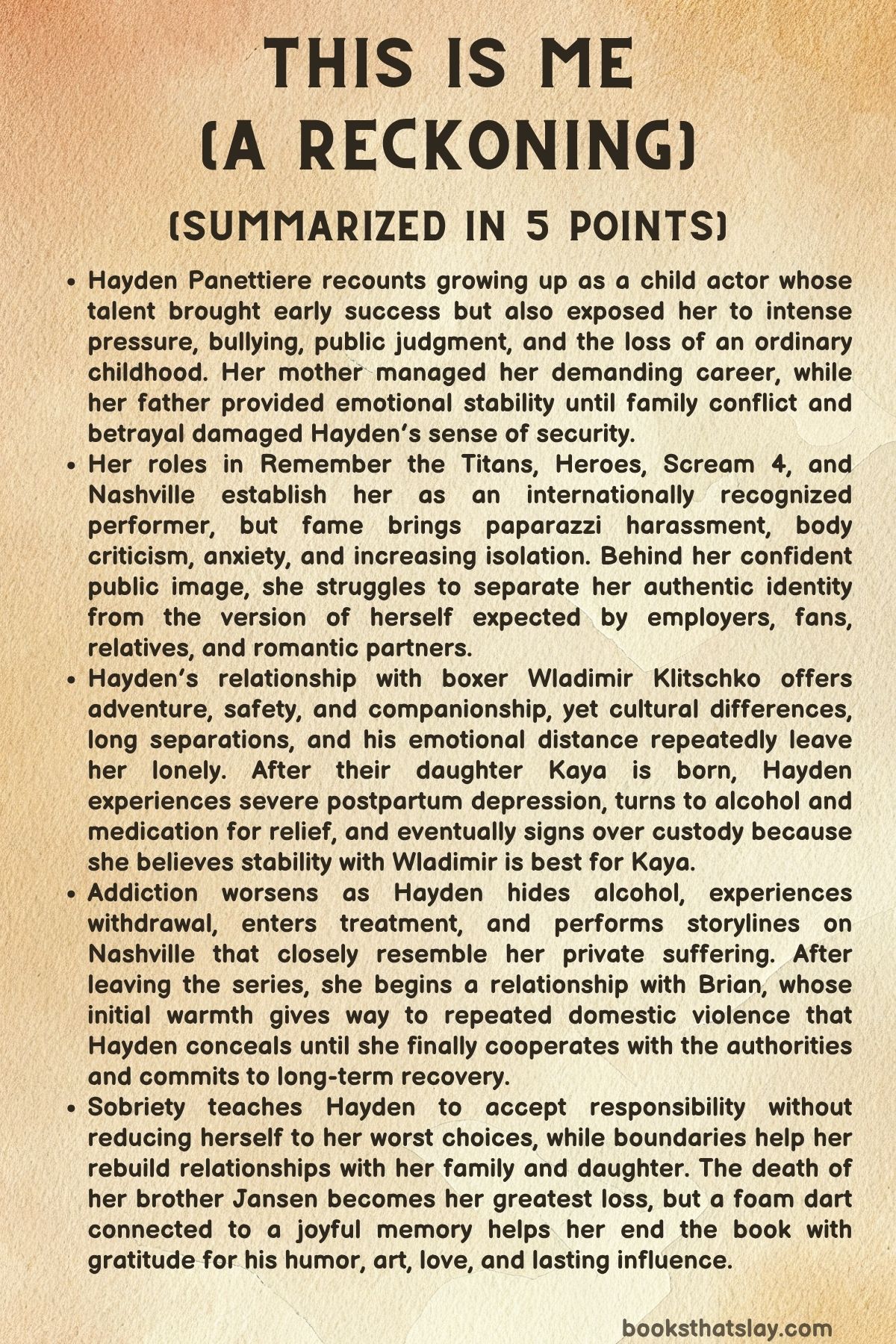
Key People
Hayden Panettiere
Hayden is the central subject and narrative voice of This Is Me, presenting herself as a gifted performer whose professional confidence often concealed severe fear, insecurity, and emotional exhaustion. Her ability to work under pressure develops before she has the maturity to understand how constant performance affects her identity.
Her defining conflict is the difference between the public Hayden and the private person beneath the celebrity image. She learns to appear energetic, grateful, beautiful, and composed even when she feels anxious, ashamed, isolated, or physically unwell.
Hayden is highly self-aware but does not always act upon what she recognizes. She repeatedly notices emotional absence, manipulation, addiction, and danger, yet her fear of abandonment encourages her to remain in destructive circumstances.
Her relationship with responsibility changes significantly over time. Early in life, adults make decisions for her, but she later acknowledges the ways her own choices contribute to addiction, unstable relationships, secrecy, and estrangement.
Motherhood exposes both her deepest love and her deepest shame. Her inability to bond immediately with Kaya intensifies postpartum depression, while signing away custody becomes the most painful example of choosing what she believes will protect her child despite the personal cost.
Hayden’s eventual recovery does not erase contradiction or regret. Her growth comes from accepting that she can be loving and flawed, brave and frightened, responsible for harm and still worthy of healing.
Lesley Vogel
Lesley is ambitious, resourceful, forceful, and deeply invested in Hayden’s career from infancy. She recognizes her daughter’s talent, creates opportunities, challenges casting decisions, and refuses to allow ordinary obstacles to interfere with professional progress.
Her dedication gives Hayden financial security and an extraordinary career, but it also makes maternal love difficult to separate from achievement. Hayden learns that success earns approval, while mistakes, hesitation, or resistance may produce disappointment and anger.
Lesley often treats Hayden as more emotionally mature than she is. During the collapse of her marriage, she shares adult fears and intimate details with her daughter, placing Hayden in the position of counsellor and emotional protector.
The conflict between them is not based on an absence of love but on the absence of healthy boundaries. Lesley sees management, sacrifice, protection, and motherhood as parts of the same role, while Hayden eventually needs those roles separated.
Their later reconciliation demonstrates meaningful change. When Hayden refuses to enter a family conflict after treatment, Lesley respects the decision rather than interpreting it as betrayal, suggesting that both women have begun to relate without control, debt, or professional dependence.
Alan “Skip” Panettiere
Skip represents humor, physical safety, and ordinary family life during Hayden’s childhood. His background as a police officer and firefighter strengthens her image of him as a protector who remains calm during emergencies.
He balances Lesley’s intensity by treating difficult situations as adventures and offering Hayden the possibility of leaving acting if she becomes unhappy. His warmth makes him an emotional refuge whenever professional or maternal pressure becomes overwhelming.
The affair that damages his marriage changes Hayden’s understanding of him. She must reconcile the heroic father she admires with the husband whose choices cause serious pain and place additional emotional burdens upon his children.
Skip is also shaped by the September 11 attacks and the deaths of former colleagues. His trauma is not fully processed, and the resulting emotional distance contributes to the deterioration of his marriage and family life.
Despite his failures, he remains involved in Hayden and Jansen’s lives. His response to Jansen’s addiction shows both love and denial, as he struggles to accept the severity of his son’s condition until Hayden insists that the danger is immediate.
Jansen Panettiere
Within This Is Me, Jansen is Hayden’s brother, closest companion, emotional mirror, and greatest final loss. His presence connects the memoir’s early memories of family life with its closing meditation on grief and gratitude.
As a child, Jansen shares Hayden’s unusual world but does not receive the same level of fame. His resentment grows from the belief that celebrity represents love, validation, and worth, causing him to pressure Hayden to use her influence on his behalf.
Jansen is talented in his own right, particularly as a painter. His artwork gives form to emotional states he cannot easily explain, but the increasing darkness of his paintings also reflects his dissatisfaction, instability, and sense that life has failed to meet his expectations.
His addiction places Hayden in the painful position once occupied by people who tried to help her. She understands his excuses, shame, avoidance, and manipulation because she has used similar methods to protect her own substance dependence.
Jansen’s death becomes the memoir’s final reckoning with powerlessness. Hayden cannot save him, but she can preserve his humor, creativity, affection, and influence without reducing his entire life to the manner of his death.
Wladimir Klitschko
Wladimir initially represents everything missing from Hayden’s Hollywood environment. He is disciplined, physically imposing, internationally respected, and seemingly uninterested in using her fame for personal gain.
His reserved manner makes Hayden feel safe after relationships defined by performance and emotional volatility. She is attracted to the contrast between his intimidating public image and the playful, curious personality he reveals privately.
Their differences eventually create loneliness rather than balance. Wladimir communicates through discipline, achievement, and practical responsibility, while Hayden needs emotional presence, physical affection, conversation, and reassurance.
His constant work, phone use, training, and multilingual business discussions make Hayden feel excluded. She often responds by drinking, hoping alcohol will make situations tolerable without requiring Wladimir to change his behavior.
Wladimir is a devoted father to Kaya and becomes the stable parent during Hayden’s addiction and postpartum crisis. His decision to seek custody is understandable from the perspective of protection, yet the secretive legal process makes Hayden experience him as emotionally distant and controlling.
He is neither presented as a villain nor as the ideal partner Hayden once imagined. He becomes a figure whose strengths as a disciplined parent coexist with serious limitations in emotional communication and mutual intimacy.
Kaya
Kaya is both Hayden’s daughter and the emotional center of her experience with motherhood, illness, sacrifice, and recovery. Even before her birth, medical uncertainty forces Hayden to confront the possibility of loss and her inability to control every outcome.
Kaya’s healthy birth brings relief, but Hayden’s postpartum depression prevents the immediate connection she expected. This emotional numbness produces intense shame because Hayden interprets delayed bonding as evidence that she is failing her child.
The separation between mother and daughter becomes one of the memoir’s deepest wounds. Hayden’s addiction and psychological instability affect her ability to provide consistent care, while geographical distance reduces motherhood to visits and brief video calls.
Kaya also gives Hayden a reason to reconsider what parental love requires. Signing away custody becomes an act Hayden experiences as both defeat and protection, because she chooses stability for her daughter over a legal struggle she feels unable to survive.
Although Kaya appears mainly through Hayden’s perspective, she is never treated as an emotional possession. Hayden repeatedly acknowledges Wladimir’s devotion and accepts that loving her daughter means placing Kaya’s security above her own desired identity as a full-time mother.
Brian
Brian enters Hayden’s life when she is grieving the loss of Kaya, Wladimir, Nashville, and professional direction. His humor, affection, practical assistance, and apparent acceptance make him feel like an immediate answer to loneliness.
The early relationship creates a private world in which Hayden can avoid cameras, work, public expectations, and unresolved grief. Brian listens to her repeated stories and gives her the physical closeness and emotional attention she has long wanted.
Alcohol reveals a dangerous side of him. Slaps develop into punches, threats, thrown objects, restraint, intimidation, and injuries severe enough to force Hayden into isolation.
Brian’s apologies and memory gaps allow Hayden to imagine that the abusive man is separate from the kind person she loves. This belief keeps her emotionally attached and encourages her to violate restraining orders, minimize injuries, and protect him from consequences.
Hayden’s final decision to cooperate with authorities is not based on the disappearance of love. It comes from recognizing that affection cannot make violence safe and that another confrontation could end with permanent injury or death.
Milo Ventimiglia
Milo becomes Hayden’s romantic partner during the height of Heroes, when she is moving into adulthood and experiencing freedom from parental supervision. Their relationship develops from professional closeness, international travel, and Hayden’s admiration for his maturity.
The significant age difference creates an uneven emotional dynamic. Hayden views the relationship as evidence of adult independence, while Milo often appears more prepared to define its boundaries and decide when it should end.
His breakup produces intense grief and anger in Hayden. Her reaction shows how quickly romantic attachment becomes connected to security, identity, and fear of abandonment.
Milo also functions as a transitional figure between her family-controlled adolescence and her later relationships. Through him, Hayden begins making independent choices, but she has not yet developed the emotional stability needed to experience rejection without seeking immediate distraction.
Diana Jenkins
Diana appears during Hayden’s separation from Lesley’s professional control. Older, wealthy, confident, and socially powerful, she offers Hayden a new source of guidance and admiration.
Her private jets, parties, travel, and international connections provide excitement after emotional conflict and romantic rejection. Hayden experiences Diana’s attention as both friendship and a form of maternal protection.
The relationship reveals Hayden’s continued need for dominant personalities. Although she has removed her mother as manager, she remains drawn to women who seem capable of controlling complicated environments and deciding what should happen next.
Diana is not portrayed as openly harmful, but the glamorous world surrounding her encourages avoidance. Travel and luxury help Hayden move rapidly away from pain without requiring her to understand it.
Allie
Allie is one of Hayden’s most important friendships outside her family and romantic relationships. Their connection is based on history, familiarity, trust, and the ability to share ordinary experiences away from professional expectations.
During Scream 4 and the move to Nashville, Allie acts as a companion and informal support system. She helps Hayden feel less isolated in new environments and creates social connections when the production itself does not provide a close community.
Their friendship weakens when Hayden becomes exhausted, emotionally unavailable, and increasingly dependent on Wladimir. Allie’s own developing relationship also changes the balance between them.
The eventual reconciliation is significant because it is not based on fame, management, or romantic dependence. Allie represents the possibility of friendship surviving distance and conflict when both people are willing to return with honesty.
Natalia
Natalia understands Hayden’s isolation within Wladimir’s European family world. She recognizes the discomfort of sitting through male-dominated conversations conducted in unfamiliar languages and provides companionship without demanding that Hayden pretend to feel included.
Her own frustration with traditional expectations allows the two women to connect. Natalia has talent, ambition, and a desire for creative expression, yet she often occupies a supporting position beside powerful men.
She offers Hayden warmth and validation when Wladimir is emotionally unavailable. Their private conversations, jokes, and shared drinking provide temporary relief, although alcohol also becomes part of the unhealthy coping pattern Hayden is developing.
Natalia’s role shows how women can create solidarity within restrictive environments. She cannot resolve the central problems in Hayden’s relationship, but she helps confirm that Hayden’s loneliness is real rather than merely oversensitivity.
Stella
Stella represents the dangerous side of celebrity access. She appears socially connected, wealthy, and familiar with influential people, encouraging Hayden to believe that proximity to power guarantees safety.
Hayden continues trusting her even after an older actor behaves sexually inappropriately at a party. Her faith in Stella reflects years of conditioning in which other people arrange situations and Hayden is expected to cooperate.
The yacht incident becomes a severe betrayal. Stella leads Hayden into a cabin with a famous musician and instructs her to enter his bed, treating Hayden’s body and compliance as social currency.
Hayden’s eventual refusal marks an important moment of self-protection. She escapes because her survival instinct overrides the habit of obedience, showing that personal boundaries can re-emerge even after years of manipulation.
Annie
Annie, Hayden’s makeup artist and friend, provides emotional companionship during the period when Hayden is separating from her mother and living independently. She is present during vulnerable moments and helps connect Hayden to new social experiences.
Her invitation to the Room 23 shoot introduces Hayden to Diana Jenkins and a new adult environment. This change contributes to Hayden’s sense that she is building a life outside her mother’s control.
Annie also appears after Milo’s breakup, arriving with a practical plan when Hayden is immobilized by grief. Her instinct is to move Hayden toward travel and activity, which offers immediate comfort even though it also supports Hayden’s tendency to escape emotional pain through stimulation.
Jeff Pantukhoff
Jeff gives Hayden a way to use fame for environmental action. Through the Whaleman Foundation, he helps her connect public visibility with marine conservation and animal protection.
His influence expands Hayden’s identity beyond acting and celebrity. Campaigning for whales, dolphins, sharks, and ocean habitats allows her courage to serve a purpose that is not based on ratings, appearances, or approval.
The activism also restores her connection to animals, which have represented honesty and uncomplicated affection since childhood. Jeff therefore contributes to one of the healthiest parts of Hayden’s public life: using attention to defend beings that cannot advocate for themselves.
Vitali Klitschko
Vitali is introduced as Wladimir’s powerful older brother and an important figure within the Klitschko family. His authority, professional achievements, and later political role contribute to the formal, male-dominated environment Hayden encounters in Europe.
He is not described as personally hostile toward Hayden, but the culture surrounding him makes her feel small and linguistically excluded. His presence reinforces the expectation that the family’s women will accommodate the schedules, conversations, and ambitions of powerful men.
Vitali also broadens Hayden’s understanding of Wladimir’s world. The brothers are not simply athletes; they are national figures whose family relationships, careers, and public responsibilities are shaped by Ukrainian history and expectations.
Connie Britton
Connie Britton represents established professional authority when Hayden joins Nashville. Hayden respects her position as the series’ leading star and worries that Juliette’s growing importance could be interpreted as competition.
Hayden deliberately lowers her physical position during promotional appearances to communicate respect. This behavior reveals both professional sensitivity and a deeper fear of being seen as ambitious at another woman’s expense.
Connie’s character, Rayna Jaymes, also becomes part of Hayden’s frustration with the writing. Hayden believes the scripts protect Rayna from flaws while allowing Juliette to carry harsher behavior, raising questions about likability, gender, and whose complexity television audiences are expected to forgive.
Denzel Washington
Denzel Washington becomes an important professional model during Remember the Titans. His serious preparation initially intimidates Hayden, but his playful attempts to make her laugh reveal generosity beneath his concentrated working style.
He treats her as a capable actor rather than merely a child on set. This respect helps create one of the rare environments in which Hayden feels both challenged and safe.
His performance style later influences her understanding of emotional truth. Hayden remembers how committed acting and strong writing must support each other, using his work as a standard when evaluating scripts and her own professional choices.
Themes
The Cost of Performing an Identity
From infancy, Hayden learns that being watched is connected to approval, money, family stability, and love. In This Is Me, performance is therefore not limited to acting roles; it becomes a method of surviving social situations, family conflict, interviews, relationships, and emotional crises.
She develops the ability to cry on command, memorize dialogue quickly, suppress physical pain, and appear confident while experiencing extreme anxiety. These abilities make her professionally successful but also weaken the boundary between authentic feeling and behavior designed to satisfy other people.
Celebrity intensifies the division by turning her body, romances, mistakes, and moods into public material. She cannot show anger toward photographers without producing damaging images, and she must maintain the clean, cheerful identity expected by employers even when her private life is deteriorating.
The theme becomes especially disturbing on Nashville, where Juliette’s fictional problems begin resembling Hayden’s addiction, postpartum depression, maternal separation, and relationship breakdown. Work no longer offers distance from suffering because her private crisis is transformed into entertainment.
Recovery requires Hayden to stop performing wellness and admit that she is frightened, dependent, grieving, and imperfect. Her progress begins when honesty becomes more important than maintaining the public character that once protected her career.
Addiction as Escape and Emotional Regulation
Substances repeatedly appear as immediate solutions to emotions Hayden has never learned to process safely. An unidentified pill before a public event teaches her that fear and social discomfort can be chemically replaced with confidence, concentration, and energy.
Alcohol later helps her tolerate loneliness, unfamiliar languages, strained relationships, postpartum numbness, domestic abuse, and separation from Kaya. Drinking provides temporary relief because it silences anxiety and grief without requiring her to confront their causes.
The relief gradually becomes dependence. Hayden hides bottles, drinks early in the morning, experiences withdrawal, loses consciousness at work, and continues despite professional, physical, and relational consequences.
Her addiction is sustained by denial and enabling. Treatment facilities address immediate crises, prescriptions replace one dependency with another, and coworkers protect production schedules rather than challenging the behavior that threatens her life.
Sobriety forces Hayden to experience emotions without escape. Withdrawal is physically painful, but genuine recovery begins when calmness, laughter, and joy return without being manufactured by alcohol, medication, performance, or another person.
The treatment of Jansen’s drug use adds tragic depth to the theme. Hayden recognizes his excuses because they resemble her own, yet experience cannot give her the power to make him accept help.
Motherhood, Separation, and Sacrificial Love
Hayden enters motherhood carrying expectations shaped by cultural stories about instant bonding and natural maternal certainty. When she feels numb after Kaya’s birth, she interprets postpartum depression as proof that she is morally inadequate rather than medically and emotionally unwell.
Her traumatic delivery worsens the crisis. Severe blood loss, infection, surgery, physical pain, hormonal change, isolation, and Wladimir’s departure create conditions in which caring for a newborn becomes inseparable from fear and exhaustion.
Alcohol appears to restore emotion temporarily, but it ultimately damages Hayden’s ability to provide stability. Her love for Kaya remains real, yet love alone cannot remove addiction, depression, distance, or the practical consequences of illness.
The custody agreement forces a painful distinction between possessing a maternal role and protecting a child’s immediate security. Hayden believes she could fight Wladimir internationally, but she fears that years of conflict would reproduce the hostile parental environment that damaged her own childhood.
Signing the agreement becomes both an act of surrender and an expression of love. She loses daily motherhood because she believes Kaya requires consistency, safety, and freedom from legal warfare.
The theme rejects simple judgments about good and bad mothers. Hayden’s experience shows that maternal love may exist alongside illness, failure, distance, shame, and decisions that cause lasting grief.
Grief, Accountability, and Finding Meaning
Loss shapes nearly every stage of Hayden’s life. The deaths connected to September 11, the collapse of her parents’ marriage, lost relationships, separation from Kaya, domestic abuse, career disruption, and Jansen’s death repeatedly force her to rebuild her identity.
Her concept of a “lifequake” expresses the destructive and transformative power of these experiences. Trauma can shatter stability, but it can also expose patterns that must change if survival is to become something more than endurance.
Accountability is essential to this process. Hayden does not excuse her addiction, secrecy, relationship choices, or periods of emotional absence simply because she has also been exploited, abused, or misunderstood.
At the same time, accountability is separated from permanent self-condemnation. The Twelve Steps teach her to examine harm honestly while resisting the belief that guilt must become another form of self-destruction.
Forgiveness is treated with similar complexity. Hayden can release resentment toward Brian without denying his violence, and she can understand Wladimir’s concern for Kaya while still feeling betrayed by the custody process.
Jansen’s death brings these ideas together. The Nerf dart found in her suitcase does not remove grief, but it allows memory, humor, and gratitude to exist beside devastation, giving Hayden a way to carry loss without allowing it to erase love.