This Kingdom Will Not Kill Me Summary, Characters and Themes
This Kingdom Will Not Kill Me by Ilona Andrews is a fantasy survival story about Maggie, a modern young woman who wakes inside the brutal world of her favorite unfinished book series. Stripped of her clothes, documents, power, and safety, she must use memory, courage, and hard choices to stay alive in Kair Toren, a city filled with magic, violence, politics, slavery, and hidden monsters.
What begins as a desperate fight for food and shelter becomes something larger as Maggie realizes that knowing the story does not mean she understands the world. Her survival depends on turning fiction into strategy before the kingdom destroys her. It’s the 1st book of Maggie the Undying series.
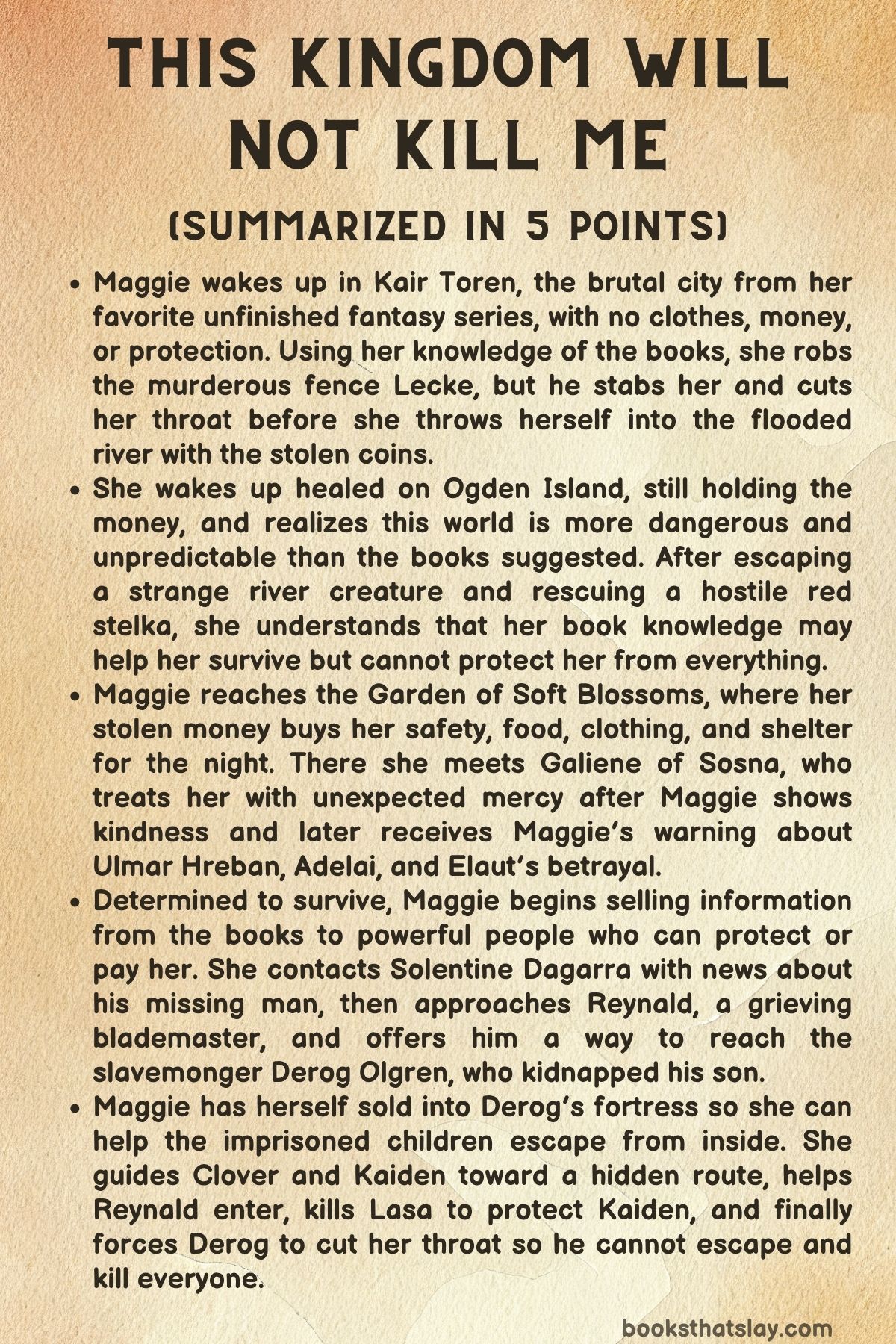
Summary
Maggie, a young woman from near Austin, suddenly wakes in Kair Toren, the dangerous fantasy city from her favorite unfinished book series. She arrives with nothing: no clothes, no money, no identity papers, no allies, and no explanation for how she got there.
The city is exactly as brutal as she remembers from the books, but living inside it is far worse than reading about it. For three days, she survives in the rain as a starving beggar, wrapped in a filthy discarded blanket, drinking rainwater and hiding from anyone who might notice her.
Guards, beggars, thieves, and unnatural creatures all become threats. Every hour teaches her that Kair Toren is not an adventure.
It is a place where weakness is punished quickly.
Because Maggie knows the book series almost by heart, she realizes she has arrived at the beginning of the first novel. That knowledge is the only advantage she has.
She remembers that a murderous fence named Lecke is supposed to cross Estret Bridge carrying a bag of coins. Desperate for money and with no lawful way to survive, Maggie waits for him.
When he appears, she attacks him with a rock and manages to seize the bag. Lecke fights back savagely, stabbing her again and again before cutting her throat.
Maggie knows that if he takes back the money, everything she has suffered will mean nothing. Rather than let him win, she throws herself over the bridge rail and falls into the flooded river.
Instead of dying, Maggie wakes downstream on Ogden Island. She is naked again, but her wounds are completely healed, and she is still clutching the money.
The impossible recovery proves that something strange has happened to her body, though she does not understand what it means. She steals a cloak from a drowned corpse, only to see a mysterious translucent river monster consume the body.
The scene frightens her because she does not remember such a creature from the books. She also rescues a hostile red stelka that had been stalking her, even though it gives her no reason to trust it.
These events force Maggie to accept that the world is bigger and more dangerous than the story she memorized. The books may help her, but they cannot protect her from everything.
After night falls, Maggie decides to reach the Garden of Soft Blossoms, an expensive and secure establishment where money can buy safety. On the way, she meets Ramond vi Everard, the Sleepless Duke.
He is an important figure from the books, and his attention could be dangerous, but he surprises her by giving her coins and telling her to get off the street and buy shoes. Maggie continues to the Garden and pays the entry fee just before a pursuing man can reach her.
Inside, she sees magical performances and receives the first real comfort she has had since arriving: a bath, food, clothing, and a private room.
The Garden’s manager, Galiene of Sosna, notices Maggie. Galiene is powerful, careful, and not easily moved, but something about Maggie catches her attention.
When she learns that Maggie thanked a servant, she allows Maggie to stay the night for free. Maggie understands that this kindness is rare in Kair Toren, and she also recognizes that Galiene is one of the people whose future she knows from the books.
The next morning, Maggie decides that her best chance of survival is to sell information. She has no papers and no official place in this world, but she knows secrets that others would pay for.
Before leaving the Garden, she warns Galiene that Ulmar Hreban plans to use Galiene’s hidden daughter, Adelai, to enslave and ruin her. Maggie also tells her that Elaut has betrayed her.
These revelations are dangerous, but Maggie hopes they will earn her protection, gratitude, or at least future value.
Maggie then searches for lodging, only to discover another problem. Legitimate inns reject her because she has no identity papers.
Without documents, she has no standing and no safe place in the city. She eventually rents a terrible room from a struggling baker family, but the arrangement does not make her feel secure.
When she sees one of Hreban’s victims displayed in the street with his severed hands, she understands how exposed she is. In Kair Toren, people can be used as warnings, and no one is safe unless someone powerful cares what happens to them.
To gain protection and money, Maggie contacts Solentine Dagarra, the head of the Shears. She uses a secret passphrase at the Three Moons tavern, relying again on knowledge from the books.
She tells Solentine where his missing man, Miro, is being held and proposes a business relationship. She promises to return in a week for payment.
Solentine is interested, but he does not fully trust her. When he sends an agent to follow her, Maggie notices and escapes through the hidden exit of a fabric shop.
The escape proves that she can use her knowledge well, but it also shows that everyone she deals with will test her.
Next, Maggie seeks out Reynald, a veteran blademaster whose son was kidnapped by the slavemonger Derog Olgren. Maggie knows enough about Derog’s fortress to offer Reynald a way inside.
In exchange, she wants protection. Reynald is dangerous and grieving, but he has a reason to listen.
Maggie’s plan is risky because it requires her to enter Derog’s operation from the inside, but she has few choices. If she wants allies, she must offer something valuable enough to make powerful people act.
That night, with help from Darotha, Maggie has herself sold to Derog. She pretends to be mentally impaired and valuable because of her perfect teeth.
The deception gets her inside the fortress, but it also places her among people who buy, sell, and murder children. Once inside, Maggie finds imprisoned children and the body of a murdered boy.
The reality of the place hardens her resolve. This is no longer only about earning protection.
Children will die unless someone gets them out.
Maggie helps two children, Clover and Kaiden, locate a hidden escape route. She works carefully, trying to create a chance for them to survive without exposing the plan too early.
Then she creates a distraction so Reynald can enter through the tunnel. Once inside, Reynald begins killing guards.
Maggie helps protect the children as chaos spreads through the fortress. She is terrified, but she keeps acting because hesitation would cost lives.
Kaiden runs upstairs after Derog, and Maggie follows. In the violence that follows, she kills Lasa with a club, crossing another line in her fight to survive.
Killing is not easy, but Kair Toren gives her no clean choices. Derog then captures her and holds a sword to her throat.
Maggie knows that if he escapes, he will kill them all and continue preying on children. She also knows that her strange healing may save her again, though she cannot be certain.
With no safer option, she stomps on Derog’s foot, forcing him to cut her throat. Everything goes black, leaving Maggie’s fate uncertain but showing the full shape of her will: she refuses to let the kingdom decide who lives and who is disposable.
Characters
Maggie
Maggie is the central character of This Kingdom Will Not Kill Me, and her role in the book is defined by desperation, intelligence, fear, and a powerful will to survive. She begins as an ordinary young woman from near Austin, but her sudden arrival in Kair Toren forces her into a brutal reality where knowledge alone is not enough to keep her safe.
Her familiarity with the unfinished series gives her an advantage, but the story quickly shows that this advantage is fragile because the world contains dangers and details beyond what she remembers. Maggie’s early suffering as a starving, powerless beggar reveals how completely she has been stripped of comfort, identity, and protection.
Yet even in that state, she remains observant and strategic. Her attack on Lecke is not heroic in a traditional sense; it is the act of someone pushed into a corner, willing to risk almost certain death for the smallest chance of survival.
Maggie’s repeated returns from death or near-death experiences add mystery to her character, but they also deepen her emotional toughness. She does not become fearless; instead, she continues acting despite fear.
Her decision to sell information from the books shows her adaptability. She understands that she cannot survive through strength, social status, or magic, so she turns memory into currency.
At the same time, her choices reveal a conscience that complicates her survival strategy. She warns Galiene about the threat to Adelai, helps imprisoned children escape, and risks herself to stop Derog.
Maggie is not simply using the world around her; she is gradually becoming involved in its suffering. Her willingness to endure violence and even sacrifice herself makes her both vulnerable and dangerous.
She is a character shaped by terror, but she refuses to let terror make her passive.
Lecke
Lecke is a violent and predatory figure whose importance in the book comes from the way he introduces Maggie to the real brutality of Kair Toren. He is not merely a criminal with money; he represents the kind of person who thrives in a city where the weak can be robbed, stabbed, and discarded without consequence.
Maggie targets him because she knows from the original story that he is murderous and carrying coins, but their encounter proves that knowledge does not make danger harmless. Lecke’s reaction is immediate and savage.
He stabs Maggie repeatedly and cuts her throat, showing that he is accustomed to violence and feels no hesitation in destroying someone who threatens his possessions.
As a character, Lecke functions as an early test of Maggie’s desperation. He forces her to cross a moral and physical boundary: she attacks him first, but he responds with lethal cruelty.
The scene with Lecke also establishes that survival in this world will not be clean or noble. Maggie’s refusal to release the money, even while dying, shows how thoroughly the city has already changed her priorities.
Lecke may not appear as a long-term emotional presence, but his impact is lasting because he teaches Maggie and the reader that this world punishes hesitation and weakness. He is a symbol of the city’s merciless underside.
The Red Stelka
The red stelka is one of the most intriguing nonhuman presences in the story because it begins as a hostile stalker and then becomes part of a moment that complicates Maggie’s understanding of the world. At first, it appears to be another threat among many, something strange and dangerous that follows her while she is already exhausted and exposed.
Its hostility reinforces the idea that Kair Toren is filled with dangers Maggie cannot fully predict. However, when Maggie rescues the creature while climbing to safety, the relationship between them becomes less simple.
Her decision to save it is significant because it shows that even after hunger, fear, murder, and near-death, she has not lost the instinct to help a vulnerable being.
The stelka also represents the limits of Maggie’s book knowledge. She realizes that Kair Toren is larger than the version she remembers from the novels, and the stelka becomes part of that realization.
It is not just a creature from a fantasy setting; it is evidence that the world has its own life beyond the written plot. In that sense, the red stelka helps shift Maggie’s thinking.
She can no longer treat the city as a fixed story where she knows every danger and every rule. The creature’s presence makes the world feel more independent, unpredictable, and alive.
Ramond vi Everard
Ramond vi Everard, the Sleepless Duke, is a character surrounded by power, mystery, and unexpected kindness. His brief encounter with Maggie is important because he acts differently from almost everyone else she meets on the street.
In a city where most people ignore, exploit, or threaten the helpless, Ramond notices Maggie and gives her money. His instruction to get off the street and buy shoes is practical rather than sentimental, but that practicality makes the gesture more meaningful.
He recognizes her danger and offers help without demanding anything in return.
Ramond’s title suggests status and influence, and his behavior implies that he is accustomed to seeing more than others see. He does not rescue Maggie completely, but he gives her enough assistance to change the direction of her night.
His presence creates a contrast between institutional power and personal mercy. He belongs to the elite world of Kair Toren, yet he is not shown as careless or cruel in this moment.
This makes him a morally interesting figure. He may be powerful, distant, and difficult to fully understand, but his interaction with Maggie suggests that he has the capacity for compassion, especially when faced with someone visibly trapped by the city’s violence.
Galiene of Sosna
Galiene of Sosna is one of the most powerful and emotionally layered characters in the book. As the manager of the Garden of Soft Blossoms, she controls a space where wealth can buy safety, beauty, pleasure, and protection.
She is clearly experienced, disciplined, and capable of surviving in a dangerous social world. Her authority is not loud or careless; it is controlled, intelligent, and built on an understanding of people.
When she notices that Maggie thanked a servant, she sees something important in her. That detail matters because it shows Galiene’s sensitivity to character.
She is not only judging Maggie by appearance, money, or usefulness, but by how Maggie treats someone with less power.
Galiene’s hidden vulnerability is revealed through her daughter Adelai and through the threat posed by Ulmar Hreban. The fact that Hreban can use Adelai to enslave and destroy her shows that Galiene’s strength is not absolute.
Her love for her daughter is the weak point enemies can exploit, and this makes her more human. Maggie’s warning to her is therefore not only a strategic exchange of information but also a deeply personal intervention.
Galiene represents survival through elegance, calculation, and controlled power, but beneath that control is fear, love, and a past that allows her to recognize something of herself in Maggie. She is formidable because she has built protection around herself, yet she remains emotionally exposed through the people she loves.
Ulmar Hreban
Ulmar Hreban is a threatening figure whose power lies in manipulation, cruelty, and the ability to use people’s deepest vulnerabilities against them. He is connected to one of the most frightening forms of danger in the story: not random street violence, but planned domination.
His intention to use Adelai against Galiene reveals him as someone who understands emotional leverage and is willing to exploit it without mercy. This makes him more sinister than a simple physical threat.
He does not merely harm bodies; he attacks bonds, loyalty, and love.
Hreban’s victim displayed in the street with severed hands shows the kind of public terror associated with him. That image helps Maggie understand how exposed she truly is.
Hreban’s world is one where punishment is made visible, where fear is used as a message, and where powerful people can destroy others in ways meant to intimidate everyone watching. Even when he is not physically present, his influence shapes Maggie’s decisions.
He represents the organized cruelty of Kair Toren, a cruelty backed by resources, reputation, and the confidence that people can be broken.
Adelai
Adelai is important less through direct action and more through what she represents to Galiene and to the larger conflict surrounding power. As Galiene’s hidden daughter, she is a source of love, vulnerability, and danger.
Her secrecy suggests that her existence is not simply private but politically or personally risky. The fact that Ulmar Hreban can use her to control Galiene shows how children and family bonds can become weapons in this world.
Adelai’s role reveals that even the strongest characters can be endangered through the people they protect.
As a character, Adelai also brings out Maggie’s moral instincts. Maggie could have treated the information about her as a bargaining tool only, but the warning carries emotional weight because it may save both mother and daughter.
Adelai’s presence expands the story beyond Maggie’s own survival and shows that other people in Kair Toren are also trapped in hidden forms of danger. She represents innocence caught inside adult schemes of power, secrecy, and coercion.
Elaut
Elaut is a character defined by betrayal. His importance comes from the trust he has broken and the danger his disloyalty creates for Galiene.
Maggie’s warning that Elaut has betrayed Galiene suggests that he is someone positioned close enough to matter. Betrayal from a distance is harmful, but betrayal from within a trusted circle is far more dangerous.
Elaut therefore represents the instability of alliances in Kair Toren, where even protected spaces can be compromised from the inside.
His role is significant because he adds to the atmosphere of suspicion. Galiene’s strength depends on control, secrecy, and reliable people around her.
Elaut’s betrayal threatens all of that. Through him, the story shows that danger is not always found in alleys, monsters, or open enemies.
Sometimes the greatest danger comes from someone already allowed inside the walls.
Solentine Dagarra
Solentine Dagarra, the head of the Shears, is a powerful underworld or intelligence-linked figure who values secrecy, coded communication, and useful information. Maggie reaches him through a passphrase, which immediately establishes that he operates in a hidden network where access must be earned or proven.
His position as leader of the Shears makes him someone who likely understands danger, loyalty, and betrayal better than most. Maggie’s decision to approach him shows her growing boldness.
She is no longer only reacting to threats; she is beginning to build strategic relationships.
Solentine’s interaction with Maggie also reveals the cautious nature of power in this world. Even after she offers valuable information about Miro, he sends someone to follow her.
This does not necessarily make him foolish or cruel; it makes him careful. He does not trust easily, and in Kair Toren, that caution is understandable.
Solentine represents the kind of authority Maggie must learn to deal with if she wants to survive through knowledge. He is dangerous because he is organized, but he is also potentially useful because he understands the value of information.
Miro
Miro is important because his imprisonment gives Maggie a way to prove the value of her knowledge. Though he is not shown directly in action here, his absence drives a key exchange between Maggie and Solentine Dagarra.
Miro’s situation demonstrates that even members of powerful groups can disappear, be captured, or become vulnerable. His imprisonment also suggests the existence of conflicts and networks beyond Maggie’s immediate struggle for food and shelter.
As a character, Miro functions as a bridge between Maggie and the Shears. By revealing where he is held, Maggie turns her memory of the original story into something practical and valuable.
Miro therefore becomes part of Maggie’s transition from helpless outsider to someone who can influence events. His role also reinforces one of the story’s central tensions: information can save lives, but sharing it draws attention and creates new risks.
Reynald
Reynald is a veteran blademaster shaped by skill, grief, and paternal desperation. His son’s kidnapping by Derog Olgren gives him a clear emotional purpose, and that purpose makes him one of the few characters whose goals align strongly with Maggie’s.
He is not merely a hired protector; he is a father trying to recover what has been taken from him. This gives his violence a moral and emotional context.
When Maggie offers him a way into Derog’s fortress in exchange for protection, their arrangement is practical, but it is also built on mutual need.
Reynald’s role during the rescue shows his competence and courage. Once inside the fortress, he kills guards and helps create the possibility of escape for the children.
His skill contrasts with Maggie’s lack of training, but the two characters complement each other. Maggie has knowledge and daring, while Reynald has combat ability and a personal reason to fight.
He represents disciplined strength used in defense of the vulnerable. At the same time, his grief makes him intense and dangerous, especially because Derog’s cruelty has made the conflict deeply personal.
Derog Olgren
Derog Olgren is one of the most openly monstrous human characters in the story. As a slavemonger, he represents the organized trade in human suffering.
His fortress, imprisoned children, and murdered boy make his cruelty impossible to soften or excuse. He is not simply a villain because he is violent; he is a villain because he profits from captivity, fear, and helplessness.
The children trapped under his control show the full horror of his power. He treats people as objects to be bought, sold, used, or killed.
Derog’s confrontation with Maggie reveals both his physical danger and his capacity for control. When he captures her and holds a sword to her throat, he temporarily turns her body into leverage, just as he has done with others.
Maggie understands that if he escapes, he will continue killing and enslaving. Her decision to stomp on his foot, knowing it will force him to cut her throat, shows how extreme the stakes are.
Derog is a character who must be stopped because survival around him is never secure. He embodies predatory power in its most direct and horrifying form.
Darotha
Darotha plays a crucial supporting role by helping Maggie get herself sold to Derog. This action is morally complicated on the surface because it involves participating in the machinery of enslavement, but in context, Darotha’s help enables Maggie to infiltrate the fortress and reach the imprisoned children.
Darotha’s involvement suggests that she is connected to the darker systems of Kair Toren or at least knows how to move within them. She is useful because she can help Maggie enter a place that ordinary methods cannot reach.
Darotha’s character shows how survival in this world often requires contact with morally dangerous people and spaces. Maggie cannot rescue the children by appealing to law or public justice; she has to enter the criminal system from within.
Darotha becomes part of that grim strategy. Her role may be brief, but it is important because she helps make Maggie’s most dangerous plan possible.
Clover
Clover is one of the imprisoned children, and her presence gives emotional weight to the rescue inside Derog’s fortress. She represents the innocent lives trapped by Derog’s cruelty.
Maggie’s interaction with Clover shows that the mission is not abstract or strategic only; real children are waiting in fear, needing someone to help them escape. Clover’s involvement in locating the hidden escape route also suggests courage and awareness.
Even as a captive, she is not merely passive.
Clover helps reveal Maggie’s protective side. Maggie’s survival has required theft, violence, and deception, but with the children, her purpose becomes clearer and more compassionate.
Clover’s vulnerability makes the stakes immediate. Through her, the book shows the human cost of Derog’s crimes and the reason Maggie’s risks matter.
Kaiden
Kaiden is another imprisoned child whose actions show both courage and impulsiveness. Like Clover, he is a victim of Derog’s slave operation, but he is not written as helpless.
He helps locate the hidden escape route, which makes him part of the rescue rather than only someone being rescued. This detail gives him agency despite his captivity.
He is frightened and endangered, but he still participates in the effort to survive.
Kaiden’s decision to run upstairs after Derog creates a dangerous turning point. It shows bravery, anger, or desperation, but it also places him in immediate danger and forces Maggie to follow.
This moment reveals how children in extreme situations may act from emotion rather than caution. Kaiden’s action helps bring about Maggie’s direct confrontation with Lasa and then Derog.
His character highlights the chaos of rescue, where even a successful plan can suddenly become unstable because fear and trauma drive people unpredictably.
Lasa
Lasa is one of the threats Maggie faces inside Derog’s fortress. Though not described as extensively as Derog, Lasa’s presence matters because Maggie kills this character with a club while trying to protect the children and follow Kaiden.
This act marks another stage in Maggie’s transformation. Earlier, her violence against Lecke was desperate and clumsy; here, her violence is tied to protection.
She is still not a trained warrior, but she is becoming someone who can act decisively in moments of danger.
Lasa functions as part of the fortress’s immediate brutality. The character stands between Maggie and the survival of the children, making the conflict physical and urgent.
Maggie’s killing of Lasa is not presented as glamorous. It is frightening, direct, and necessary within the situation.
Through Lasa, the story shows how Maggie is forced to cross lines that would have been unimaginable in her old life.
Themes
Survival Through Knowledge and Adaptation
Maggie’s survival depends less on strength than on her ability to observe, remember, and adjust quickly. She enters a brutal world with no clothes, no status, no papers, no allies, and no real protection, yet she refuses to remain only a victim.
Her knowledge of This Kingdom Will Not Kill Me gives her an early advantage, but the story makes clear that memory alone is not enough. She survives because she acts under pressure: stealing from Lecke, choosing the Garden as temporary safety, selling information to dangerous people, and planning her way into Derog’s fortress.
Each decision shows a shift from passive fear to active strategy. At the same time, her knowledge has limits.
The river monster, the red stelka, and the hidden realities of Kair Toren prove that this world is larger and more dangerous than the version she remembers. Survival therefore becomes a process of learning, improvising, and accepting that certainty can be deadly.
Power, Vulnerability, and Social Status
Kair Toren is a city where safety depends on power, money, identity, and reputation. Maggie’s helplessness is not only physical; it is social.
Without papers, clothing, shelter, or recognized status, she is treated as disposable. Inns reject her, strangers threaten her, and predators see her as someone who can be used or erased without consequence.
This shows how systems of power protect those already inside them while leaving outsiders exposed. The Garden of Soft Blossoms becomes important because it reveals another form of power: controlled luxury, reputation, and protection purchased through wealth.
Galiene’s authority contrasts sharply with Maggie’s lack of standing, yet Galiene also understands how easily women can be trapped by hidden weakness. Maggie’s warnings about Adelai and Elaut show that even powerful people can be vulnerable when enemies know where to strike.
The theme suggests that power is never simple; it can come from rank, violence, money, secrets, or information.
Moral Courage in a Violent World
Maggie repeatedly faces situations where survival would be easier if she ignored other people’s suffering, yet she chooses action even when it places her in greater danger. Her decision to rescue the hostile red stelka shows that compassion in this world is not reserved only for those who are friendly or useful.
Later, her plan to enter Derog’s fortress is not only a bargain for protection; it becomes a moral test. Once inside, she sees imprisoned children and the body of a murdered boy, and her goal becomes larger than her own safety.
She helps Clover and Kaiden, creates a distraction, and physically fights to protect them despite having no training or advantage. Her courage is not fearless or clean.
It is desperate, painful, and costly. By forcing Derog to cut her throat, she accepts death as the price of stopping him.
The theme presents morality as action taken under threat, not as easy idealism.
Identity, Rebirth, and Self-Transformation
Maggie’s repeated returns from death or near death create a strong pattern of rebirth, but these moments are not comforting miracles. Each return places her back into danger, stripped of security and forced to rebuild herself.
Waking naked and powerless marks the loss of her old identity, while waking healed downstream suggests that her body may obey rules she does not yet understand. This uncertainty makes her identity unstable: she is not fully the person she was, but she also does not belong to Kair Toren.
Her lack of papers turns that inner crisis into a public one, because the city refuses to recognize her as anyone meaningful. Yet Maggie begins forming a new self through choices rather than official identity.
She becomes a negotiator, a risk-taker, a rescuer, and someone willing to use forbidden knowledge to survive. Her transformation is not about becoming powerful overnight.
It is about being remade through pain, intelligence, and repeated refusal to disappear.