This Vicious Hunger Summary, Characters and Themes
This Vicious Hunger by Francesca May is a dark, gothic exploration of desire, knowledge, and transformation set in a reimagined world where science and death intertwine.
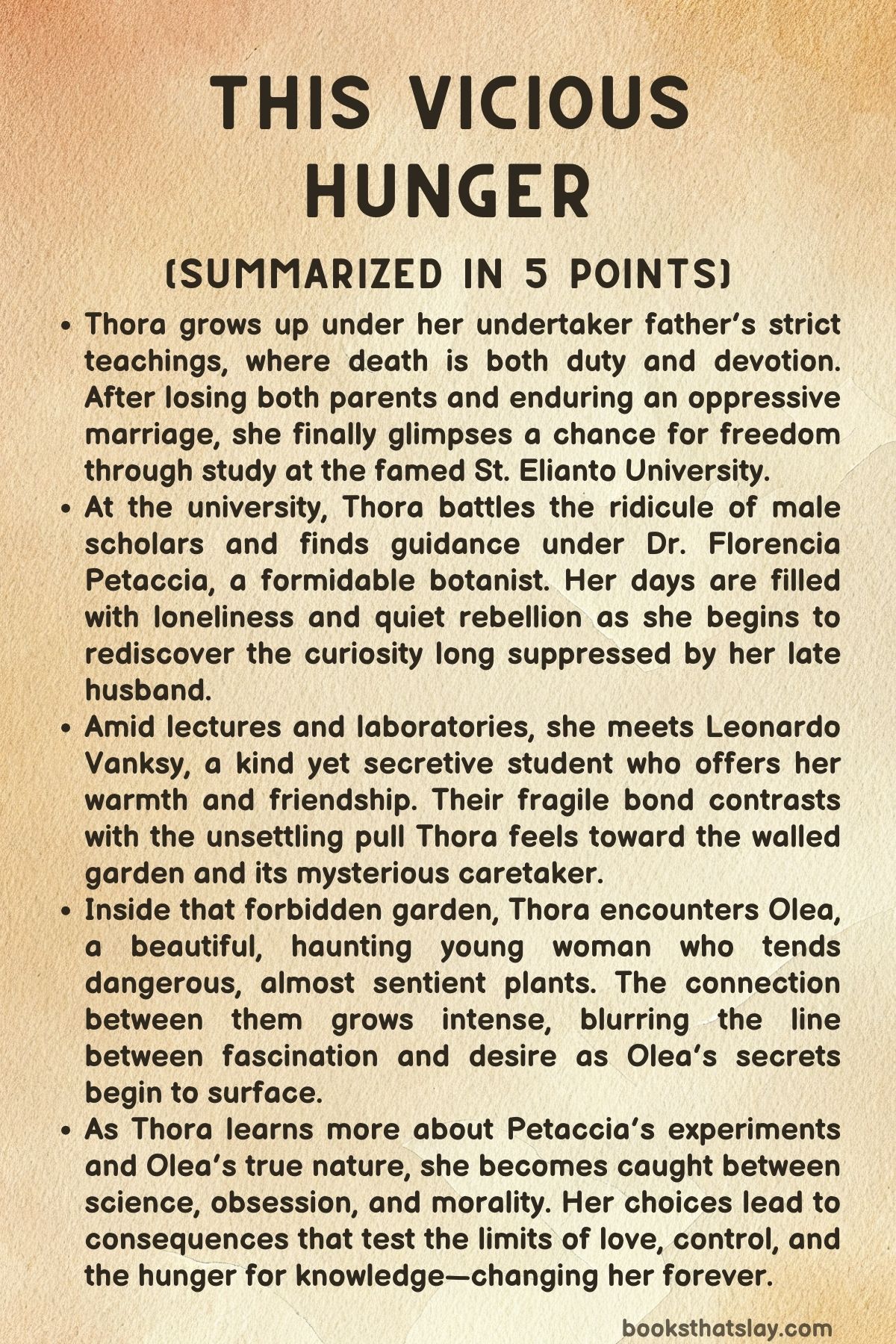
The story follows Thora Grieve, a young widow raised in the rituals of mourning, who finds herself drawn into the forbidden world of botany and the mysteries of life and decay at St. Elianto University. Under the mentorship of the enigmatic Dr. Florencia Petaccia and through her relationship with the mysterious Olea, Thora discovers both the intoxicating power of knowledge and the consuming cost of transgression. It’s a tale of rebirth, obsession, and the dangerous hunger for liberation.
Summary
Thora Grieve grows up in a household governed by death. Her father, an undertaker, teaches her the sacred customs of mourning and silence, embedding in her a deep sense of duty and guilt.
When both her parents die and her husband Aurelio follows soon after, Thora becomes a widow trapped in a house ruled by her overbearing mother-in-law, Madame LeVand. Through an accidental discovery, Madame learns that Thora’s father once had an academic connection to Dr. Florencia Petaccia, a botanist at St. Elianto University.
Hoping to be rid of Thora, Madame writes to Petaccia, offering her daughter-in-law as an assistant. What begins as an act of dismissal becomes Thora’s escape from a life of confinement.
Leaving behind mourning clothes and household servitude, Thora journeys to St. Elianto, a dazzling university her father once described in bedtime stories.
There she is lodged on the outskirts of campus, neither student nor servant, symbolizing her precarious social position. The male scholars mock and isolate her, but Thora clings to her purpose.
Her first meeting with Dr. Petaccia is transformative.
Petaccia is a brilliant, sharp, commanding woman surrounded by an eerie laboratory of vines and plants. She immediately recognizes Thora’s curiosity and offers her a position not just as a student but as a research partner, warning her to be wary of the university’s men and their motives.
In her new environment, Thora faces hostility and isolation but also a growing sense of purpose. She studies botany, philosophy, and medicine, enduring scorn from male students until she asserts herself using Petaccia’s name, realizing the doctor’s reputation commands fear.
Her routine begins to shape her identity. She meets Leonardo Vanksy, a gentle scholar whose kindness contrasts with the cruelty around her.
Their tentative friendship offers companionship amid academic rigor, though he warns her repeatedly to stay away from a strange walled garden near her quarters—a garden whispered to be cursed or haunted.
Curiosity wins over caution. One night, Thora sees a young woman in the garden among enormous flowers glowing under the moonlight.
The girl’s name is Olea, a mysterious figure who tends the plants and seems both alive and otherworldly. Against warnings, Thora begins to visit her in secret.
Their conversations grow intimate, exploring loneliness, curiosity, and forbidden knowledge. Olea hints that she shares a bond with the plants that others cannot understand, calling it “symbiosis.” The garden, lush and strange, becomes a space of awakening for Thora—one that is both seductive and dangerous.
As Thora’s relationship with Olea deepens, her mentor’s experiments take a darker turn. Petaccia reveals her goal: to end natural death by creating a universal cure derived from Olea’s garden.
Thora, drawn between fascination and fear, assists in experiments using the garden’s toxins on animals. She becomes physically unwell, plagued by fever and cravings that mirror intoxication.
She suspects a connection between her sickness and her time with Olea, whose touch kills living creatures. Eventually, Olea confides that she is not entirely human—she was raised among these poisonous plants as part of Petaccia’s experiments and carries their deadly essence in her blood.
Despite this danger, affection grows between them, transforming into desire.
Thora’s illness worsens, and she isolates herself, consumed by dreams of Olea. She eventually confronts Petaccia, who admits her experiments seek to extract a cure for mortality itself.
Believing she can help Olea escape this torment, Thora proposes they flee the garden. But outside its walls, Olea’s condition deteriorates.
Her skin blackens, and she suffers delirium, revealing she has accidentally killed others before—those who came too close, including Leonardo’s wife, Clara. Guilt consumes her, and she resigns herself to die, while Thora watches helplessly.
Desperate to save Olea, Thora redoubles her efforts with Petaccia to refine the antidote. They achieve a partial cure, and Olea survives.
The two women remain in the walled garden under Petaccia’s supervision, but their peace erodes. The cure’s side effects manifest as unending hunger, insomnia, and unnatural vitality.
Their appetites grow uncontrollable, their bodies healing instantly, their senses sharpened to predatory extremes. In a moment of horror, Thora discovers her touch kills like Olea’s.
They realize the antidote has turned them into something new—beings suspended between life and death.
As starvation and madness take hold, Thora and Olea quarrel about freedom, guilt, and their future. When Leonardo appears at the gate, Thora, overcome by hunger, nearly kills him before Olea intervenes.
Their relationship spirals into violence and desperation. Petaccia eventually returns, confirming their fears: the antidote’s effects are temporary.
Without fresh human blood as a stabilizing agent, their condition will worsen each time their blood renews itself. Petaccia coldly treats them as experimental subjects, justifying her cruelty in the name of science.
Realizing she has been used, Thora resolves to end Petaccia’s work.
When the doctor fails to return, starvation drives Thora to a horrifying act. She escapes the garden, kills a drunken scholar, and drinks his blood.
The act restores her vitality instantly. She lies to Olea, claiming she secured a medical supply.
When Olea learns the truth, fury and grief clash with gratitude. Thora admits she will hunt Petaccia, force her to finish a stable cure, and destroy her work forever.
Olea stays behind to tend the garden and protect their notes.
In the final moments, the two women part with mutual understanding. Thora steps beyond the walls, reborn as something neither human nor immortal, bound by love and vengeance.
Olea remains in the garden, guardian of what they have become—a symbol of beauty and ruin intertwined. Together, their choices redefine the boundaries between life and death, science and desire, creation and destruction, leaving behind a world forever changed by the hunger they embraced.
Characters
Thora Grieve
Thora Grieve stands as the heart and conscience of This Vicious Hunger, a woman molded by grief, repression, and an inherited intimacy with death. Raised among coffins and rituals, she carries the weight of her father’s undertaker teachings—a world where silence and composure are sacred.
This upbringing shapes her into someone who confuses obedience with morality and suppression with dignity. Yet beneath her self-restraint lies a latent defiance, a yearning for freedom long denied by patriarchal and societal expectations.
Her marriage to Aurelio, who forbade her from reading or thinking freely, becomes the crucible of her transformation. Widowhood releases her physically but leaves deep psychological scars.
When Thora reaches St. Elianto, she embodies both naiveté and fierce determination—a woman torn between ingrained subservience and the hunger to learn, live, and define herself.
As she meets Dr. Petaccia and later Olea, her transformation accelerates; knowledge and desire intertwine.
By the story’s end, Thora becomes something both human and monstrous, her intellectual ambition and emotional hunger fusing into an uncontrollable force. She evolves from a vessel of duty into a being driven by passion, science, and rebellion against mortality itself.
Dr. Florencia Petaccia
Dr. Florencia Petaccia is the formidable architect of forbidden knowledge within This Vicious Hunger, embodying both scientific brilliance and moral decay.
A pioneering botanist and scholar, she represents female intellect unbound by societal norms but also corrupted by ambition. Her charm and authority initially draw Thora in; she becomes both mentor and manipulator, shaping Thora’s worldview through fascination and fear.
Petaccia’s laboratory—a jungle of living, breathing plants—mirrors her own complex nature: fertile with genius yet choked by obsession. Her experiments blur ethical boundaries as she seeks to conquer death through botanical alchemy, turning life itself into a laboratory.
To her, human suffering is a necessary variable in the equation of progress. Petaccia’s dynamic with Thora fluctuates between genuine affection and control, maternal guidance and exploitation.
She is, in essence, the embodiment of unrestrained knowledge—a woman who seeks to heal the world but ultimately perpetuates its pain. Her refusal to see the consequences of her work transforms her from a mentor into an antagonist, one whose scientific pursuit erases empathy, leaving only the cold logic of experimentation.
Olea
Olea, the enigmatic gardener, represents nature’s vengeance and beauty intertwined. She is both creation and victim of Petaccia’s ambition—a woman born from the garden’s toxins, sustained by its poisons, and defined by her own lethal biology.
Her relationship with Thora blooms like the garden itself: lush, dangerous, and intoxicating. Olea is deeply aware of her monstrosity, carrying the tragedy of self-awareness in a body that kills by touch.
Her allure is inseparable from her danger; she is the living embodiment of forbidden desire and corrupted innocence. Throughout the story, Olea’s longing for connection clashes with her self-loathing and fatalism.
She yearns for love but believes herself undeserving of it, finding temporary solace in Thora’s devotion. Yet her existence exposes the moral rot beneath Petaccia’s science and the futility of playing god.
In the end, Olea becomes both muse and mirror for Thora—her pain a prophecy of what Thora will become if she continues down the same path of obsession.
Leonardo Vanksy
Leonardo Vanksy offers the rare touch of gentleness in the otherwise ruthless academic world of This Vicious Hunger. A scholar marked by grief and ostracism, Leonardo mirrors Thora’s loneliness, providing a fragile emotional anchor amid her descent into obsession.
His kindness and curiosity stand in sharp contrast to the cruelty of the male scholars who ridicule her. Yet Leonardo’s compassion is tinged with melancholy—his lost wife, Clara, a haunting reminder of the dangers that lurk behind Petaccia’s scientific veil.
His relationship with Thora oscillates between affection and caution, as he recognizes both her vulnerability and her growing darkness. Ultimately, Leonardo’s fate—poisoned by Thora’s touch—transforms him from a symbol of humanity into a victim of the very hunger he sought to understand.
His death is tragic yet inevitable, a consequence of love colliding with corruption.
Madame LeVand
Madame LeVand, Thora’s mother-in-law, is the embodiment of societal control and domestic tyranny. Cold, pragmatic, and steeped in the customs of mourning, she enforces the same oppressive silence that once ruled Thora’s life.
To her, grief is not an emotion but a ritual to be managed, a system of appearances that reinforces hierarchy and obedience. Her manipulation in sending Thora away to St.
Elianto stems not from kindness but from convenience—she sees her daughter-in-law as a burden to be discarded. Yet, paradoxically, this act becomes the catalyst for Thora’s liberation.
Madame LeVand’s rigid adherence to propriety contrasts sharply with the intellectual and moral chaos that follows, symbolizing the crumbling authority of the old world in the face of female self-determination and scientific rebellion.
Aurelio Grieve
Aurelio, Thora’s late husband, exists as a haunting echo of patriarchal domination throughout This Vicious Hunger. Even in death, his control lingers—his funeral arrangements, his household rules, and his symbolic presence in Thora’s psyche.
He is less a character of flesh than a ghost of suppression, representing every force that denies women intellectual and sensual autonomy. His insistence that Thora remain silent and uneducated reduces her to an ornament of obedience.
Yet his death becomes her rebirth, the moment when the chains of domestic servitude fracture. Aurelio’s influence persists as a psychological residue, shaping Thora’s ambivalence toward authority figures like Petaccia and her attraction to the forbidden.
He is the ghost that defines the contrast between the woman Thora was and the creature she becomes.
Themes
Death and Rebirth
In This Vicious Hunger, death is not only an inevitable human experience but also the central axis around which Thora’s existence revolves. From her childhood under the guidance of her undertaker father to her later experiences at St.
Elianto, death shapes every layer of her identity. Her early training in funerary rites instills in her both reverence and fear toward mortality, conditioning her to associate silence, order, and obedience with virtue.
When her father and husband die, she inherits not freedom but a deep psychological captivity, unable to distinguish between grief and duty. Yet, each death she endures—her mother’s, father’s, husband’s—marks a threshold of transformation.
Widowhood, initially a social death, becomes the portal through which she claims intellectual and emotional rebirth. At St.
Elianto, death shifts from the literal to the metaphorical; the corpse gives way to the experiment, and the mortuary becomes the laboratory. Her association with Dr.
Petaccia and later with Olea redefines mortality as something malleable, even defiable. The cure Petaccia pursues, designed to conquer death, mirrors Thora’s internal struggle to escape the burial shroud of her past.
But as the cure erodes their humanity, Thora realizes that life without mortality is its own form of decay. In the novel’s final pages, the boundaries between life and death dissolve entirely—Olea’s garden thrives on death’s sustenance, and Thora’s survival demands it.
The theme ultimately argues that to tamper with death is to distort life itself, and Thora’s transformation from mourner to predator completes this haunting cycle of unnatural rebirth.
Female Autonomy and Oppression
Thora’s journey through This Vicious Hunger traces the suffocating structures imposed on women and the perilous paths they must navigate to reclaim autonomy. Her world, defined by patriarchal hierarchies and religious formalities, reduces women to silent witnesses of male power.
Her father’s authority, her husband’s control, and her mother-in-law’s manipulation each represent the societal mechanisms that dictate female behavior. Even after escaping her marriage, Thora’s entry into academia exposes another hierarchy cloaked in intellectual prestige but equally restrictive.
At St. Elianto, her presence provokes ridicule and hostility; she becomes both spectacle and scandal.
Dr. Petaccia’s mentorship offers a radical alternative: a woman commanding authority through intellect and defiance.
Yet, Petaccia’s independence is not liberation but an inversion of control—her manipulation of Olea and Thora mirrors the male domination she critiques. Thora’s awakening comes when she perceives that autonomy cannot be inherited through submission to another’s will, no matter how enlightened.
Her eventual defiance of both Petaccia and societal norms reclaims agency in its rawest, most dangerous form. However, the cost of that freedom is monstrous: her body becomes uncontrollable, her hunger insatiable, her morality blurred.
The novel thereby examines how the pursuit of liberation in a world that denies it often demands self-destruction. Thora’s evolution from obedient daughter to self-determining being exposes the paradox that autonomy, when born from oppression, carries both empowerment and peril.
Knowledge and Forbidden Curiosity
Curiosity in This Vicious Hunger operates as both salvation and sin. Thora’s yearning for education, nurtured by her father’s secret bedtime stories, positions knowledge as a forbidden pleasure—something to be desired yet punished.
Her marriage extinguishes this spark, replacing intellectual hunger with domestic silence. When she finally steps into St.
Elianto, the university becomes both temple and battleground. Every lecture she attends, every plant she studies, is an act of rebellion against a system that deems her unworthy of knowing.
Dr. Petaccia’s laboratory initially appears as the fulfillment of that long-denied curiosity: a sanctuary of scientific discovery.
Yet, the deeper Thora ventures into Petaccia’s experiments, the more she recognizes the moral rot beneath the pursuit of absolute knowledge. Petaccia’s work on defeating death becomes an allegory for unrestrained scientific ambition—knowledge pursued without empathy or ethical restraint.
Thora’s complicity in these experiments reflects her transformation from innocent seeker to transgressor. Her relationship with Olea deepens this theme, as love and curiosity merge into obsession.
She cannot resist touching what she is forbidden to touch, learning what she is forbidden to know. Ultimately, knowledge becomes a contagion—each discovery corrupts as much as it enlightens.
By the end, Thora’s understanding surpasses her mentor’s, but what she gains is not wisdom—it is awareness of the price of forbidden curiosity: that the pursuit of knowledge without boundaries leads not to enlightenment, but to monstrous awakening.
Transformation and Corruption
Transformation in This Vicious Hunger is a relentless process that blurs the boundary between evolution and decay. Thora’s journey from a submissive mourner to an empowered scholar, and finally to a predatory creature, traces a progression that is at once liberating and horrifying.
Her metamorphosis begins with small acts of rebellion—reading forbidden books, defying her husband’s memory—and culminates in a physical and moral corruption that consumes her entire being. The transformations she undergoes are not metaphorical alone; her body itself becomes the site of experimentation, infection, and adaptation.
Through Petaccia’s failed antidotes and Olea’s toxic existence, the novel explores the idea that change, especially when artificially induced, carries the seeds of ruin. Thora’s growing addiction to the sensations of hunger and power symbolizes how transformation driven by pain and repression rarely leads to healing.
Olea, once an innocent victim of Petaccia’s experiments, mirrors Thora’s own fate—a woman altered beyond recognition by forces that sought to control her. Together, they embody the danger of seeking transcendence without balance.
Their final condition—half-living, half-consuming—suggests that transformation without acceptance of limitation corrupts the very essence of being human. The novel portrays change not as progress but as mutation, arguing that liberation pursued through unnatural means inevitably erodes the self.
Love, Desire, and Destruction
Love in This Vicious Hunger functions as both a refuge and a weapon. Thora’s emotional evolution—from her loveless marriage to her intoxicating relationship with Olea—illustrates how desire can become an act of rebellion against a world that denies female pleasure and intimacy.
Her connection with Olea, born from fascination and loneliness, grows into an overwhelming passion that transcends morality, reason, and even physical safety. Their union is simultaneously tender and lethal; each touch blurs the line between affection and annihilation.
Olea’s body, poisonous to the touch, transforms desire into a literal disease, mirroring how forbidden love in repressive societies is often pathologized. Thora’s hunger for Olea becomes indistinguishable from her craving for autonomy and understanding, binding eroticism to intellect and power.
Yet, as their relationship deepens, the same love that grants Thora purpose also devours her sense of self. The novel treats desire as inherently dual—creative and destructive, nurturing and consuming.
In the end, their love becomes inseparable from violence; it sustains them even as it drives them toward monstrosity. By rendering affection and death as parallel forces, the novel reveals how passion, when unrestrained by boundaries, transforms from liberation into ruin.
Through Thora and Olea, Francesca May portrays desire not as a redemptive force but as one that exposes the fragility of humanity itself.