This Will Be Interesting Summary, Characters and Themes
This Will Be Interesting by E. B. Asher is a comic fantasy adventure about old legends, broken public stories, second chances, and people learning to define themselves beyond the roles others forced on them. The novel begins with Galwell the Great, Mythria’s famous hero, returning after being pulled ten years into the future.
His comeback exposes the gap between the legend people worship and the real man behind it. Around him, queens, assassins, scribes, criminals, royals, and performers face false reputations, buried guilt, and dangerous power games. The result is a lively, character-driven story about truth, love, reinvention, and chosen purpose.
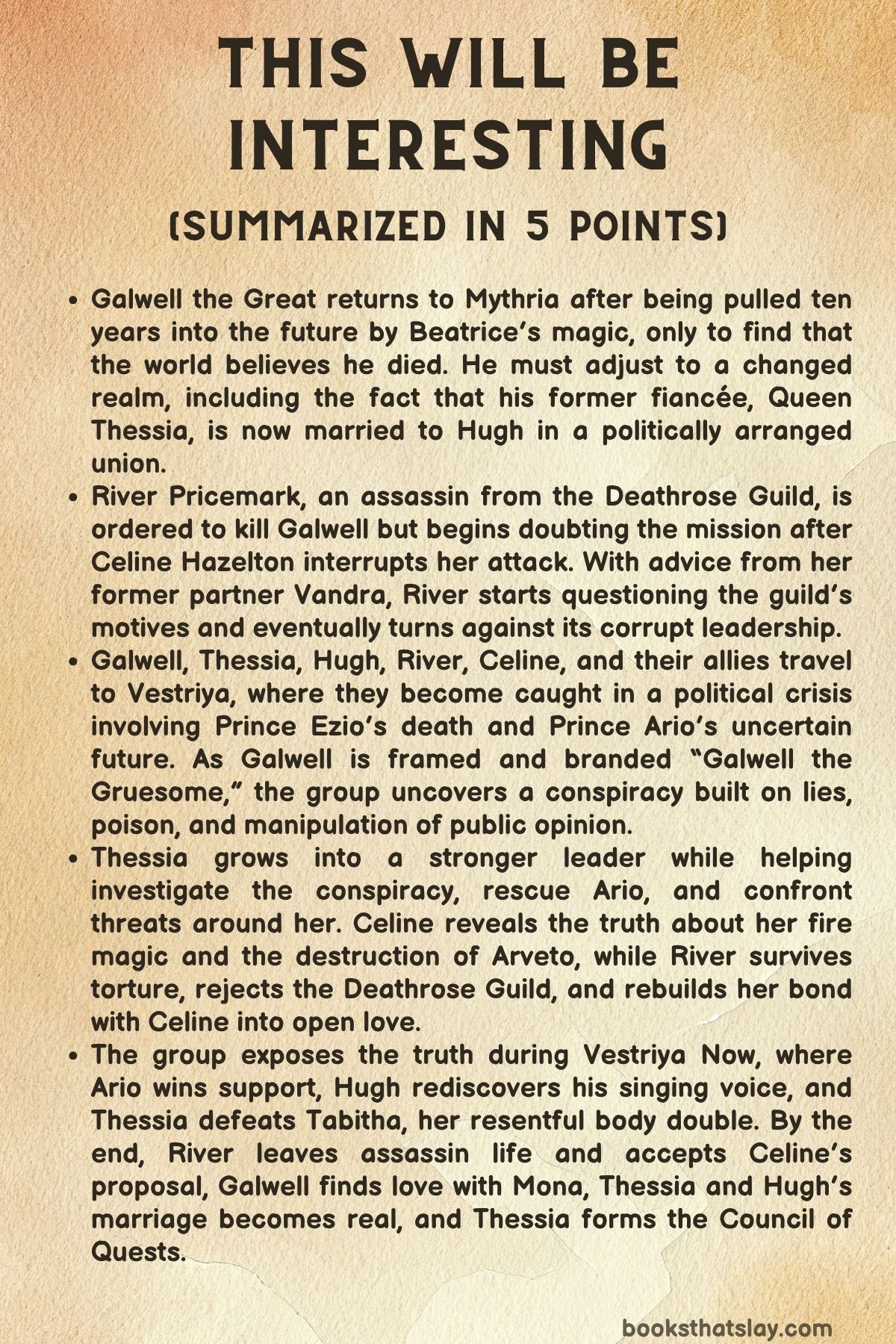
Summary
Galwell the Great returns to a world that has already turned him into a legend. Ten years earlier, Mythria believed he had died heroically, and the realm mourned him as its greatest champion.
For Galwell, however, almost no time has passed. Beatrice’s time-walking magic has pulled him forward, leaving him alive in a future where everyone else has had a decade to grieve, change, and build new lives.
This strange return becomes even more uncomfortable when he attends a play about his supposed death. The audience sees a grand tragedy, especially because Queen Thessia, once his fiancée, is now married to Hugh.
To the public, Galwell, Thessia, and Hugh seem trapped in a sad romantic triangle.
Galwell knows the truth is very different. He never truly loved Thessia in the way people imagined, and he is not angry that she has married someone else.
In fact, he is relieved that she has moved forward. Thessia, however, is not as happy as she appears.
Her marriage to Hugh is more political than romantic, and she has used it partly as a way to escape the shadow of Galwell’s memory. Hugh is kind, but the marriage begins as an arrangement rather than a true partnership.
Thessia carries the burden of being queen, symbol, widow in the eyes of the public, and wife in name.
While Galwell tries to settle into this changed world, danger arrives in the form of River Pricemark, an assassin from the Deathrose Guild. River has been ordered to kill Galwell, but her attempt fails when Celine Hazelton interrupts.
Celine, who is now a scribe, knows River from the past and refuses to treat the assassination as a simple job. River responds by kidnapping Celine through teleportation, but Celine does not simply panic or submit.
Instead, she challenges River to question the guild’s motives. Why does the Deathrose Guild want Galwell dead?
Who benefits from his murder? River begins to feel the first cracks in the certainty that has shaped her life as an assassin.
River turns to Vandra, her former partner, for guidance. Vandra has already left the guild and built a happier life with Elowen True.
Her example shows River that there is a future outside violence and obedience. Vandra tells River that she must either demand answers from the guild or walk away from it completely.
This advice forces River to face a hard truth: loyalty to an organization is not the same as loyalty to justice, and skill does not excuse blind obedience.
Galwell tells his friends about the attack, and they realize the Deathrose Guild will probably send more assassins. Rather than wait to be hunted, Galwell secretly boards the Sapphire Palace, the ship carrying Thessia and Hugh to Vestriya for their honeymoon.
River also sneaks aboard, following both her orders and her growing doubts. The journey quickly turns dangerous when another guild assassin, Dougal, appears disguised as the ship’s captain and attacks Galwell in front of Thessia.
River stops Dougal, proving that she no longer trusts the guild’s mission. Thessia takes command of the situation and orders Dougal cast off at sea with enough supplies to survive, showing both mercy and authority.
In Vestriya, the story expands from personal danger into political conspiracy. Galwell seeks help from Mona Grandhart, Clare’s estranged sister and a feared criminal with her own reputation and secrets.
Thessia, Hugh, Galwell, River, Celine, and their companions soon become caught in Vestriya’s unstable royal politics. Prince Ezio is killed, and his brother Ario is pushed into a position of weakness and suspicion.
Galwell is accused of the attack and is recast in public posters as “Galwell the Gruesome.” Once again, the story people tell about him becomes more powerful than the truth.
The group starts to uncover a larger plot connecting the Vestriyan royal family, the Deathrose Guild, and a network of lies. Public opinion is being managed through false narratives, fear, and blame.
Poisoned plots and staged stories keep people confused while the real villains hide behind official versions of events. Galwell’s legendary name becomes useful to his enemies because it can be twisted.
If people once believed he was a perfect hero, they can also be persuaded that he is a monster.
Thessia becomes one of the strongest forces in the investigation. Away from Mythria’s court and the false image of her marriage, she grows more direct, brave, and practical.
She helps guide the group’s efforts and plays a major role in rescuing Ario. Ario is awkward, sincere, and far less polished than a typical prince, but he has goodness and intelligence beneath his nervousness.
His affection for his snail, Benjamin, makes him oddly charming and human. The group sees that Ario may be exactly the kind of ruler Vestriya needs, if he can survive the forces working against him.
Celine’s own past also comes to light. She reveals painful truths about her uncontrolled fire magic and the accidental destruction of Arveto years earlier.
This event has shaped her guilt and her fear of herself. Like Galwell, she has been trapped inside a public story, though hers is one of blame rather than glory.
Celine’s struggle is not only about clearing a name but about learning how to live after causing harm, even unintentionally. Her honesty becomes part of the book’s larger concern with truth, responsibility, and repair.
River’s break from the Deathrose Guild becomes final after she is captured and tortured by guild members. The experience confirms that the guild is corrupt and that its leaders care more about power than principle.
River rejects the orders that once defined her. Her bond with Celine deepens as they confront old wounds and admit feelings that had remained unresolved.
Their relationship moves from tension and unfinished history into open love, giving both women a chance at a life not ruled by fear or secrecy.
The group’s plan depends on Vestriya Now, a major talent competition with enough public attention to shift the mood of the country. Ario must win support and expose the truth in front of an audience.
River joins the contest as an acrobat under the name Fearless Flyer, using the same physical skill that once served assassination for performance instead. Hugh also finds an unexpected role.
When he realizes that Ario has written a song rather than a poem, Hugh sings again after years of silence. This moment helps Ario’s cause and also marks a turning point for Hugh, who begins to step out from the quiet, secondary role he has accepted.
During the climax, Thessia is kidnapped and learns that the true mastermind is Tabitha, her own body double. Tabitha has spent years being treated as a replacement, a tool, and a shadow of the queen.
Her resentment has grown into a desire for control and revenge. She has manipulated events because she wants to be more than someone else’s copy.
Thessia refuses to remain a victim. She frees herself, wounds Tabitha with her tiara, and returns to help stop the conspiracy.
The final confrontations resolve the major threats. River kills the corrupt guild leader, ending the hold the Deathrose Guild has had over her life.
Galwell and Mona confront Cheswick Chestlewitt, another key figure in the conspiracy. Ario is crowned king, giving Vestriya a ruler whose honesty and awkward sincerity stand against the polished lies that nearly destroyed him.
Celine publishes the truth about Arveto and calls for restoration rather than scapegoating, turning confession into a demand for healing.
After the crisis, the characters begin new lives. River wins Vestriya Now, retires from assassin work, tours Mythria, and accepts Celine’s marriage proposal.
Her arc moves from killing for orders to choosing love, art, and freedom. Galwell reunites with Mona after giving her time to decide who she wants to be.
When she is ready, she introduces him to her parents as the man she loves. Their relationship suggests that love can be chosen honestly only after a person has space to understand herself.
Thessia returns to Mythria with Hugh, and their fake marriage grows into real love. What began as a political arrangement becomes a genuine partnership because both of them change and finally see each other clearly.
Thessia also discovers that she has transformation magic, a fitting sign of her own growth. By the end, she is no longer only the queen shaped by grief, duty, and public expectation.
She gathers her companions and forms the Council of Quests, turning the lessons of the adventure into a new purpose. This Will Be Interesting ends with its characters no longer trapped by legends, rumors, or assigned roles, but ready to choose their own futures.
Characters
This Will Be Interesting presents its characters as people struggling with reputation, duty, love, guilt, and the stories others tell about them. Many of them are not simply heroic or villainous; they are shaped by public expectation, political pressure, personal trauma, and the need to decide who they want to become.
Galwell the Great
Galwell the Great is one of the central figures in the book, and his character is built around the contrast between legend and reality. To Mythria, he is a lost heroic figure whose death has become part of public memory, but to Galwell himself, almost no time has passed.
This makes his return emotionally strange because everyone else has had years to grieve, change, and build new lives, while he is forced to step into a future that has already turned him into a story. His discomfort during the play about his death shows how uneasy he feels when he sees his life transformed into public entertainment.
Galwell is not vain about his heroic image; instead, he seems quietly overwhelmed by it.
His relationship with Thessia reveals an important part of his maturity. The public imagines him trapped in a tragic romance with her, yet Galwell understands that he never truly loved her in a romantic way.
Rather than feeling betrayed by her marriage to Hugh, he is sincerely glad that she has moved forward. This makes him emotionally generous and self-aware.
He does not cling to the version of events that would make him seem more romantic or important. His ability to separate truth from myth is one of his strongest qualities.
Galwell is also brave, but his bravery is not limited to physical danger. He takes risks because he understands that his survival is connected to larger political and moral problems.
When the Deathrose Guild targets him, he does not simply hide behind his heroic reputation. He secretly boards the Sapphire Palace and enters danger directly, showing that he still carries the instincts of a questing hero.
However, the book also complicates his heroism by making him vulnerable to false accusations and propaganda. The wanted posters naming him “Galwell the Gruesome” show how easily a hero can be rewritten as a monster when powerful people control the public story.
By the end of the story, Galwell’s emotional arc is not about reclaiming his old glory but about finding a future that belongs to him. His reunion with Mona matters because it is based not on legend but on personal choice.
Mona takes time to decide who she wants to be, and Galwell respects that. This shows that he has learned to live beyond the role of “the Great.” He remains heroic, but he becomes more human, defined not only by quests and fame but by patience, loyalty, and love.
Queen Thessia
Queen Thessia is one of the most layered characters in the book because she begins as someone trapped inside a public image and gradually becomes someone who acts with real authority. At first, she appears to be part of a tragic royal romance: the former fiancée of the legendary Galwell, now married to Hugh after Galwell’s supposed death.
However, her private life is far more complicated. Her marriage is not initially a love match but a political arrangement and an emotional escape from the memory of Galwell.
This makes Thessia’s position deeply lonely. She is a queen, but she is also a woman surrounded by expectations about whom she should love, how she should grieve, and what kind of story her life should represent.
Thessia’s misery in her marriage does not make her weak; rather, it reveals how much pressure she has been carrying. Her growth comes from slowly reclaiming control over her own life.
As the group becomes involved in the Vestriyan conspiracy, Thessia becomes increasingly assertive. She is not merely protected by others or moved around by the plot.
She investigates, gives orders, makes decisions, and helps rescue Ario. Her authority becomes active instead of ceremonial.
This development is important because it allows her to move beyond being remembered as Galwell’s former fiancée or Hugh’s political wife.
Her confrontation with Tabitha is one of the strongest moments in her arc. Tabitha’s resentment exposes the darker side of Thessia’s royal life: even her identity has been replicated and used through a body double.
When Thessia is kidnapped, she is forced to face not only physical danger but the consequences of a system that treats people as replaceable. Her escape, especially her use of the tiara as a weapon, symbolically turns an object of royal appearance into an instrument of survival.
She uses the very image of queenship to defend herself.
Thessia’s relationship with Hugh also changes meaningfully. What begins as a false or arranged marriage gradually becomes a real emotional bond.
This transformation shows that love in the story is not always immediate or dramatic; sometimes it grows through shared danger, honesty, and mutual respect. Her discovery of transformation magic at the end fits her character perfectly.
Thessia’s entire journey is about transformation: from symbol to leader, from trapped wife to active queen, and from someone haunted by old stories to someone ready to create new ones through the Council of Quests.
Hugh
Hugh is an important emotional counterpoint to both Galwell and Thessia. At first, he seems positioned as the third figure in a public love triangle, but the truth is much quieter and more painful.
His marriage to Thessia is political, and he appears to exist in the shadow of Galwell’s legend. This makes Hugh a character shaped by comparison.
He is married to a queen whose past is publicly tied to a famous hero, and he must live with the knowledge that others may see him as a substitute rather than as a person with his own worth.
Despite this, Hugh is not bitter in a simple or villainous way. His character is gentle, restrained, and emotionally wounded.
His silence as a singer suggests that he has lost confidence in a part of himself that once mattered deeply. This silence is not only about music; it reflects his broader difficulty in claiming space.
He is present, loyal, and observant, but he often seems unsure of whether his own voice matters.
His major turning point comes through Ario’s performance. When Hugh realizes that Ario has written a song rather than a poem, he returns to singing after years of silence.
This moment is powerful because it shows Hugh reconnecting with his own identity while helping someone else gain confidence. He does not take the spotlight selfishly.
Instead, he uses his gift in service of truth and public courage. His voice becomes both literal and symbolic: Hugh finally allows himself to be heard.
His relationship with Thessia becomes real because both characters stop living only inside the roles assigned to them. Hugh is not simply the replacement husband, and Thessia is not simply the grieving queen.
Their love develops through shared vulnerability and action. By the end, Hugh represents quiet emotional resilience.
He is not the loudest hero in the story, but his growth is deeply meaningful because he learns to step out of another man’s shadow and become fully present in his own life.
River Pricemark
River Pricemark is one of the most morally complex characters in the book. She begins as an assassin sent by the Deathrose Guild to kill Galwell, which immediately places her in opposition to the heroes.
However, her failure to complete the mission and her later doubts reveal that she is not simply cruel or blindly obedient. River has been shaped by the guild’s discipline, violence, and expectations, but she still has the capacity to question what she has been told.
Her character arc is about breaking away from a system that has trained her to treat killing as duty.
Her kidnapping of Celine after the failed assassination attempt shows both her danger and her emotional confusion. River reacts with force, but Celine’s challenge unsettles her.
The fact that Celine can make her question the guild’s motives suggests that River’s loyalty is already fragile. She is not comfortable with uncertainty because the guild has taught her to survive through obedience and skill.
Yet once doubt enters her mind, she cannot fully ignore it.
River’s conversations with Vandra are crucial because Vandra represents a possible future. Vandra has left the guild and built a peaceful life with Elowen, proving that escape is possible.
This matters deeply for River because she has likely seen the guild as the only structure that gives her identity. To leave it would mean more than changing jobs; it would mean rejecting the story of who she has been trained to be.
Her later torture by guild members makes this conflict even sharper. The guild’s cruelty confirms that it values control over loyalty.
River’s performance as Fearless Flyer during Vestriya Now reflects the transformation of her skills. Her agility, daring, and discipline were once tools of assassination, but in the competition they become art, courage, and public inspiration.
Her love for Celine also humanizes her without erasing her past. Their reconciliation is meaningful because it requires River to choose honesty over secrecy and love over fear.
By killing the corrupt guild leader and retiring from assassinry, River completes her break from the Deathrose Guild. Her acceptance of Celine’s marriage proposal shows that she is finally ready to build a life based on choice rather than command.
Celine Hazelton
Celine Hazelton is a deeply important character because she combines intellect, emotional courage, and painful guilt. As a scribe, she is connected to truth, record-keeping, and the power of written stories.
This makes her role especially significant in a plot full of propaganda, false accusations, and manipulated public opinion. Celine is not a warrior in the same way as Galwell or River, but she fights through questions, memory, and testimony.
Her interruption of River’s assassination attempt shows that Celine is brave even when physically outmatched. She does not defeat River through strength; she unsettles her through moral clarity.
By asking why the guild wants Galwell dead, Celine forces River to think beyond orders. This is one of Celine’s greatest strengths: she understands that truth begins with questioning the version of events that powerful people present as fact.
Celine’s hidden trauma over Arveto gives her character emotional depth. Her uncontrolled fire magic and the accidental destruction of Arveto have left her carrying guilt and fear.
This guilt could have made her withdraw permanently, but instead she eventually chooses to tell the truth. Her decision to publish the reality of Arveto is not only personal confession but public repair.
She refuses scapegoating and calls for restoration, showing that she understands truth as a responsibility rather than a weapon.
Her relationship with River is central to her emotional arc. Celine still has old feelings for River, but she does not simply excuse River’s actions.
Their love becomes possible only after River begins to reject the guild’s corruption and Celine begins to face her own painful past. This makes their romance feel earned.
Celine represents the healing power of truth, but the book does not make that truth easy. She must expose wounds before they can be repaired.
Mona Grandhart
Mona Grandhart is a fascinating character because she exists outside polite society and outside the simple categories of hero and villain. As Clare’s estranged sister and a feared criminal in Vestriya, Mona carries danger, independence, and mystery.
Galwell turns to her for help because she has access to worlds and knowledge that more respectable figures may not. This places her in the role of an outsider whose usefulness comes from surviving beyond official systems.
Mona’s criminal reputation suggests that she has made morally complicated choices, but the story does not present her as merely corrupt. Instead, she seems to be someone who has had to define herself apart from family expectations and public approval.
Her estrangement from Clare hints at emotional history and unresolved conflict. She is not simply a helper who appears when needed; she is a person with her own wounds, boundaries, and decisions to make.
Her connection with Galwell is important because it develops outside the false romantic narrative surrounding Galwell and Thessia. Mona is not part of the old legend Mythria has built around him.
She meets him as a person in the present, not as a dead hero or a tragic symbol. This makes their relationship feel grounded.
She does not rush into belonging to his story; she takes time to decide who she wants to be.
By the end, Mona’s introduction of Galwell to her parents as the man she loves shows growth and emotional courage. For a character associated with secrecy and criminality, this gesture is significant because it is open, personal, and vulnerable.
Mona’s arc is about self-definition. She does not become worthy by becoming respectable in a simple way; she becomes whole by choosing honestly, loving openly, and deciding her own future.
Prince Ario
Prince Ario is one of the most endearing characters in the book because he combines awkwardness, sincerity, and hidden strength. At first, he appears vulnerable within the dangerous world of Vestriyan politics.
After Prince Ezio is killed, Ario is framed as weak or kept hidden away, making him seem like someone others can control. His awkward nature makes him easy for political manipulators to underestimate.
However, this underestimation becomes part of his power.
Ario’s sincerity is his defining quality. He does not seem naturally suited to the ruthless performance of politics, but that does not mean he lacks the ability to lead.
His bond with his snail, Benjamin, adds charm and softness to his character. It also shows that Ario values gentleness in a world obsessed with image, strength, and manipulation.
His affection for Benjamin makes him memorable because it reveals his tenderness without turning him into a joke.
The plan involving Vestriya Now forces Ario to step into public view and claim support. His song becomes a symbol of honest self-expression.
He does not win people over by pretending to be a conventional strong prince. Instead, he succeeds by revealing something true about himself.
This is why Hugh’s recognition of the song matters so much. Ario needs others to see what he is really trying to say.
When Ario is crowned king, his rise feels meaningful because he has not become powerful through cruelty or deception. He has survived a system designed to erase or use him, and he emerges as a ruler whose sincerity may become a strength.
Ario represents the idea that leadership does not have to look like arrogance, hardness, or perfect confidence. Sometimes the person most fit to rule is the one who remains honest in a dishonest world.
Benjamin
Benjamin, Ario’s beloved snail, may be a small character, but he plays an important symbolic role in the book. He immediately makes Ario more distinct and emotionally accessible.
A prince with a cherished snail is not the image of power that court politics usually celebrates, and that contrast helps reveal Ario’s gentle nature. Benjamin shows that Ario’s private world is built around care rather than domination.
Benjamin also functions as a quiet reminder that affection does not need to be grand to be meaningful. In a story full of assassins, conspiracies, public performances, and royal manipulation, Benjamin represents softness and simplicity.
Ario’s love for him makes the prince seem more human and less like a political object. Through Benjamin, the book gives Ario an emotional anchor.
Although Benjamin does not drive the plot in the way the human characters do, his presence enriches the tone of Ario’s arc. He helps make Ario’s vulnerability visible.
He also adds humor and tenderness without weakening the seriousness of the political conflict. Benjamin matters because he shows what kind of person Ario is when no one is watching: loyal, gentle, and capable of love.
Tabitha
Tabitha is one of the most revealing antagonistic figures in the book because her villainy grows out of resentment, invisibility, and the pain of being treated as replaceable. As Thessia’s body double, she has spent her life being valued not for herself but for her ability to stand in for someone else.
This creates a deep wound in her identity. She is close to power but denied true recognition.
She looks like the queen when needed, but she is not allowed to fully exist as herself.
Her manipulation of events shows intelligence, patience, and bitterness. Tabitha is dangerous because she understands appearances.
As a body double, she knows how easily people believe surfaces, and she uses that knowledge to control events from behind the scenes. Her role as mastermind fits the story’s larger concern with false narratives.
Just as Galwell can be turned into “Galwell the Gruesome,” Tabitha understands that identity can be manufactured and weaponized.
However, Tabitha is not merely evil for the sake of evil. Her motives come from a recognizable emotional injury.
She resents being treated as a replacement rather than a person. This does not justify her actions, but it makes her more tragic and psychologically interesting.
Her anger exposes the cruelty of systems that use people as tools while pretending they are invisible.
Her confrontation with Thessia is powerful because it brings the real queen face to face with the woman forced to mirror her. When Thessia wounds Tabitha with her tiara, the scene becomes symbolically rich.
The royal image that Tabitha has been forced to imitate becomes the means of Thessia’s resistance. Tabitha’s downfall shows the danger of denying someone an identity, but it also shows that pain does not excuse manipulation and harm.
Dougal
Dougal is a clear example of the Deathrose Guild’s corruption and willingness to deceive. Disguised as the captain of the Sapphire Palace, he represents danger hidden beneath authority.
A ship captain should be a figure of guidance and safety, but Dougal turns that role into a mask for violence. His attack on Galwell in front of Thessia exposes how deeply the guild’s methods rely on infiltration, surprise, and betrayal.
His presence also helps River’s arc develop. When River stops him, she proves that her doubts about the guild are becoming active resistance.
Dougal therefore functions as more than a secondary assassin; he becomes evidence that the guild’s mission against Galwell is not honorable or straightforward. His actions make it harder for River to keep believing that the guild deserves obedience.
Thessia’s order to cast Dougal off at sea with supplies also reveals something about the moral boundaries of the protagonists. They punish him and remove the threat, but they do not simply execute him.
This moment contrasts the heroes’ justice with the guild’s brutality. Dougal is not deeply sympathetic, but he is useful in showing how corrupt systems turn ordinary roles and public trust into weapons.
Vandra
Vandra is an important supporting character because she represents the life River might have if she chooses freedom. As River’s former partner, Vandra understands the Deathrose Guild from the inside.
Her advice carries weight because it does not come from innocence or ignorance. She knows what the guild is, what it demands, and what it costs.
Her life with Elowen True shows that leaving violence behind is possible. This makes Vandra a living challenge to River’s assumptions.
River has been trained to think in terms of loyalty, orders, and survival, but Vandra proves that another kind of life can exist. She does not force River to leave; instead, she urges her to ask hard questions.
This is important because River’s transformation must come from her own moral awakening.
Vandra’s role may be brief, but it is emotionally significant. She is a mentor figure without being distant or abstract.
Her happiness with Elowen gives the story a model of peace after violence. Through Vandra, the book suggests that redemption is not only about one dramatic heroic act; it is also about building an ordinary life where love, safety, and honesty are possible.
Elowen True
Elowen True is significant because she represents stability, love, and the possibility of healing after a violent past. Her relationship with Vandra shows what life beyond the Deathrose Guild can look like.
While Vandra offers River advice from experience, Elowen’s presence helps make that advice emotionally real. She is proof that leaving the guild is not just escape from something bad but movement toward something good.
Elowen’s importance lies in the contrast she creates. The Deathrose Guild is built on secrecy, fear, obedience, and death.
Elowen’s life with Vandra is built on affection, openness, and peace. This contrast helps River understand the stakes of her own choices.
She is not simply deciding whether to obey an order; she is deciding whether she can imagine a different future.
Although Elowen is not at the center of the main conspiracy, she helps shape the emotional world of the story. She shows that love can be a form of resistance against systems that train people to be weapons.
Her role is quiet but meaningful because she helps embody the life River secretly wants but may not yet believe she deserves.
Prince Ezio
Prince Ezio is important even though his role is defined largely through his death. His killing becomes one of the key events that throws Vestriya into instability and allows the conspiracy to deepen.
Because he is removed from the story through violence, he becomes a political symbol almost immediately. His death is not treated only as a personal tragedy; it becomes a tool used by others to shape public fear and suspicion.
Ezio’s character therefore matters less through direct development and more through consequence. His death creates the conditions under which Galwell can be accused, Ario can be hidden or dismissed, and the public can be manipulated.
This makes Ezio part of the book’s larger interest in how people’s lives and deaths are turned into narratives by those seeking power.
The tragedy of Ezio is that he loses control over his own meaning. Once he is killed, others use the event to advance their plans.
In this way, he parallels Galwell, whose supposed death was also transformed into public drama. Ezio’s role reminds readers that political violence does not end with the act itself.
It continues through the stories told afterward.
Cheswick Chestlewitt
Cheswick Chestlewitt is a major figure in the conspiracy and represents the calculated manipulation of public events for power. His involvement places him among the characters who understand that controlling a story can be as powerful as controlling an army.
He is connected to the poisoned plots, false narratives, and political schemes that threaten both Vestriya and the protagonists.
Cheswick’s danger comes from his ability to operate within systems of influence. He is not merely a physical threat; he is part of the machinery that turns lies into accepted truth.
This makes him a fitting opponent for characters like Celine, who values truthful record, and Galwell, whose identity is repeatedly distorted by public myth. Cheswick thrives in confusion, accusation, and spectacle.
His confrontation with Galwell and Mona is important because it brings together two characters who understand life outside ordinary public narratives. Galwell has been mythologized, while Mona has been criminalized.
Together, they stand against a man who benefits from manipulating reputations and events. Cheswick functions as a reminder that villains in the book are not only those who kill directly, but also those who arrange the conditions that make injustice believable.
Beatrice
Beatrice is a crucial background figure because her time-walking magic creates the situation that brings Galwell into the future. Although she is not presented as one of the central emotional characters in the events, her magic has enormous consequences.
By pulling Galwell ten years forward, she separates him from the life he knew and places him in a world that has already mourned, mythologized, and moved beyond him.
Her role emphasizes the book’s interest in time, memory, and identity. Galwell’s displacement is not only a magical event; it is an emotional and social rupture.
Because of Beatrice’s magic, he must confront what happens when a person becomes a legend before he has had the chance to finish living. This makes Beatrice important to the foundation of the story.
Beatrice’s time-walking also indirectly affects Thessia, Hugh, and Mythria as a whole. The belief that Galwell died shaped political marriages, public grief, and heroic mythology.
Beatrice therefore stands behind one of the central tensions of the book: the difference between what truly happened and what people believe happened. Her magic begins a chain of consequences that the characters must spend the story untangling.
Clare
Clare is important mainly through her connection to Mona Grandhart. As Mona’s estranged sister, she hints at a family history that complicates Mona’s identity.
The estrangement suggests unresolved emotional conflict and helps explain why Mona exists partly outside ordinary social bonds. Clare’s presence in the character network gives Mona’s criminal reputation a more personal background.
Although Clare is not described as taking a major role in the central conspiracy, her relationship to Mona helps deepen the story’s emotional world. Mona is not simply a feared criminal who appears to help Galwell; she is someone with family ties, past conflict, and personal history.
Clare’s existence reminds readers that even the most independent characters come from relationships that have shaped them.
Clare’s role also helps contrast different forms of belonging. Some characters are trapped by public roles, such as Thessia and Hugh.
Others are trapped by organizations, such as River. Mona’s conflict appears tied partly to family and reputation.
Through Clare, the book suggests that estrangement can be as defining as connection, especially when a character is trying to decide who she wants to become.
Themes
Identity Beyond Public Legend
Galwell returns to a world that has turned him into a symbol, but his own sense of self does not match the story people have built around him. In This Will Be Interesting, the gap between who a person is and who others believe them to be becomes a central tension.
Mythria remembers Galwell as a dead hero locked inside a tragic romance, while he knows that his feelings for Thessia were never the grand love people imagined. This contrast shows how public memory can flatten real people into convenient stories.
Galwell’s discomfort during the play about his death reveals how strange it is to watch one’s life become entertainment and myth. The same theme appears in Vestriya, where wanted posters turn him into “Galwell the Gruesome,” proving how easily reputation can be twisted.
The story suggests that identity must be reclaimed from rumor, performance, and political storytelling. Galwell’s journey is not only about survival but about being seen as a person rather than a legend.
Truth, Rumor, and the Control of Public Opinion
False stories shape the lives of nearly every major character. Public opinion is treated as a weapon, especially in Vestriya, where political forces use fear, staged narratives, and accusations to control what people believe.
Galwell is framed as dangerous, Ario is made to seem weak, and Celine’s past is reduced to a simple story of guilt rather than pain, accident, and lack of control. The Deathrose Guild also depends on obedience to hidden motives, giving River orders without offering truth.
This makes the search for accurate information a form of resistance. Celine’s role as a scribe becomes especially meaningful because writing is not just record-keeping; it is an act of repair.
Her decision to publish the truth about Arveto challenges scapegoating and asks people to choose restoration over blame. The talent competition also becomes more than entertainment, since it gives Ario a public stage to replace lies with honesty.
The theme shows that truth must be spoken clearly because silence allows falsehood to harden into power.
Freedom from Roles Imposed by Others
Many characters are trapped inside roles chosen for them, and their growth comes from refusing to remain there. Thessia is expected to be the grieving almost-widow, the dutiful queen, and the wife in a political marriage, yet her real feelings are more complicated.
Her development comes through action: she leads investigations, rescues others, confronts danger, and eventually discovers magic that reflects her ability to change. River’s struggle is similar.
The Deathrose Guild has trained her to treat killing as duty, but her encounters with Celine and Vandra force her to ask whether loyalty without moral judgment is only another kind of prison. Tabitha’s resentment also grows from being treated as a substitute rather than a full person.
Her choices become destructive, but her anger still exposes the harm caused when someone is reduced to another person’s shadow. The theme connects personal freedom with self-definition.
Characters are not truly free simply because they survive; they become free when they stop obeying the identities, duties, and limits others have assigned to them.
Love as Choice, Honesty, and Renewal
Romance in the story is not treated as destiny alone; it becomes meaningful when characters choose each other honestly. Galwell and Thessia’s supposed tragic romance is exposed as a public fantasy, which allows both of them to move toward truer forms of love.
Thessia’s marriage to Hugh begins as a political arrangement, but it gains emotional weight because they gradually become honest, vulnerable, and present with one another. Hugh singing again is not just a performance; it shows trust returning to a part of himself he had closed off.
River and Celine’s relationship carries a different kind of healing. Their love grows through confrontation, confession, forgiveness, and the courage to leave behind old violence.
Galwell and Mona also need time rather than instant certainty, which makes their reunion feel based on choice instead of pressure. Across these relationships, love is shown as something active.
It asks people to tell the truth, reject false expectations, and allow themselves and others to become new.