Three Days in June Summary, Characters and Themes
Three Days in June by Anne Tyler is a quiet domestic novel about a divorced woman facing several changes at once: the possible end of her career, her daughter’s wedding, and the sudden return of her ex-husband into her daily life. Tyler centers the story on Gail Baines, a practical but emotionally guarded woman who has learned to live with disappointment by keeping her expectations low.
Across one wedding weekend, old regrets, family tensions, and unfinished feelings rise to the surface. The novel is less about dramatic events than about the small moments that reveal how people love, fail, forgive, and sometimes find their way back to one another.
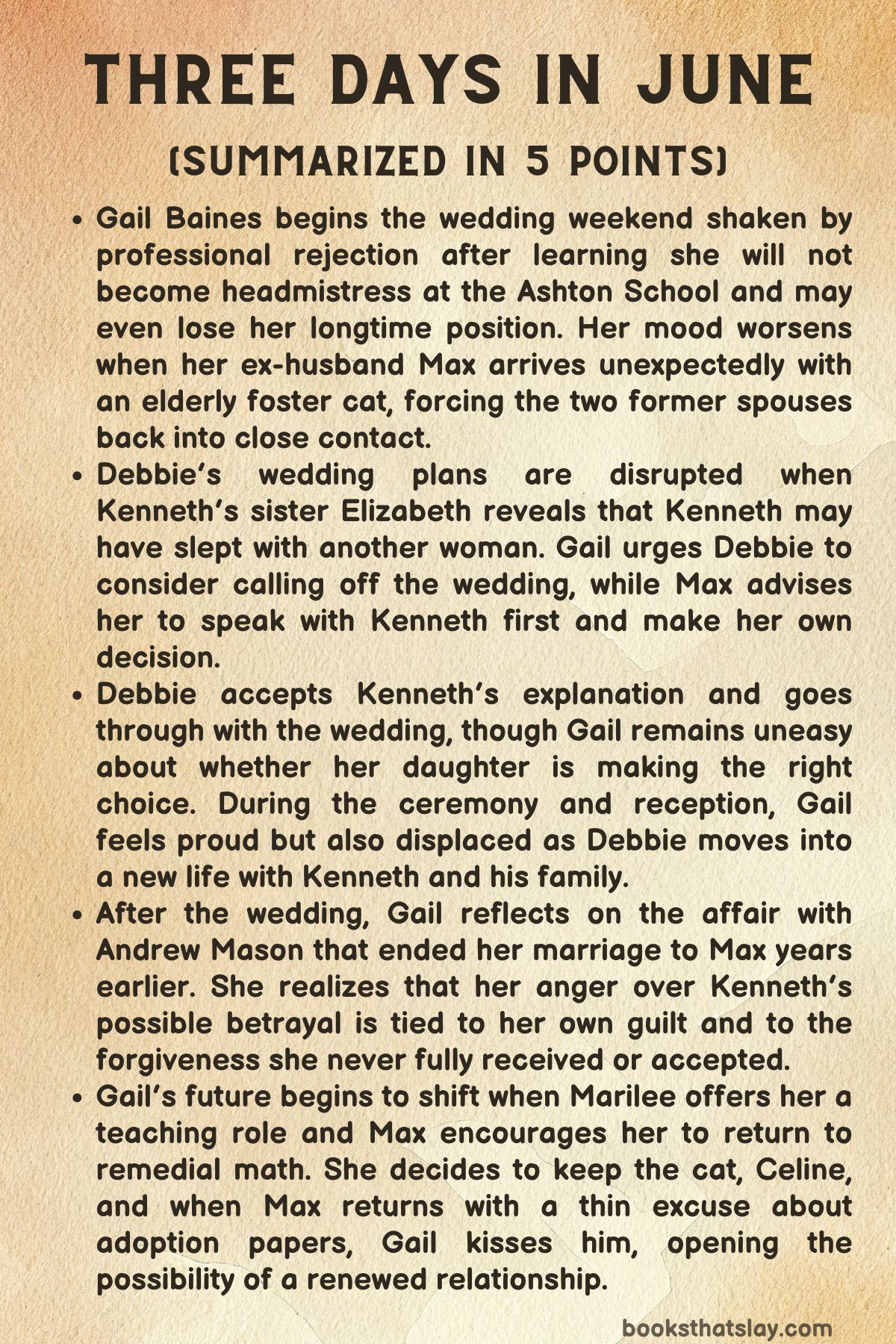
Summary
Gail Baines begins the wedding weekend in a state of shock and humiliation. She has worked for years at the Ashton School, serving as assistant to Marilee Burton, the headmistress, and she has expected that her loyalty and experience might eventually lead to advancement.
Instead, Marilee tells Gail that she is retiring and has already recommended Dorothy Edge as her replacement. The news itself is painful, but the real injury comes from the explanation.
Marilee suggests that Gail lacks the people skills needed for the role, making Gail feel dismissed not only professionally but personally.
The situation worsens when Gail realizes that Dorothy is likely to bring her own assistant. This means Gail may not merely be passed over for promotion; she may lose her place at the school altogether.
Hurt and angry, she walks out rather than stay and absorb more of Marilee’s polite rejection. Her mood is already unsettled when she returns home, and the weekend ahead promises even more strain because her daughter, Debbie, is about to be married.
At home, Gail finds her ex-husband, Max, arriving unexpectedly with an elderly foster cat. Max had planned to stay with Debbie during the wedding weekend, but Debbie’s fiancé, Kenneth, is severely allergic to cats, making that arrangement impossible.
Since Max has the cat with him, he needs another place to stay. Gail, despite their long divorce and the awkwardness between them, allows him and the cat into her house.
This sudden arrangement brings Max back into Gail’s private space in a way she has not expected. Their marriage ended years ago, and although they remain connected through Debbie, they are not emotionally easy with each other.
Max’s presence reminds Gail of the life they once shared and of the distance that formed between them. The cat, old and needy, becomes a strange little bridge between them, forcing them into ordinary cooperation.
Gail also feels uneasy about the wedding itself. Debbie is preparing to join Kenneth’s polished and socially confident family, and Gail senses a kind of displacement.
She does not fully trust the smoothness surrounding the occasion, and she is not sure whether her discomfort comes from motherly instinct, loneliness, jealousy, or memories of her own failed marriage. The wedding is supposed to be happy, but for Gail it carries loss as well as celebration.
The weekend takes a sharper turn when Debbie arrives in tears. Kenneth’s sister, Elizabeth, has told her that Kenneth may have slept with another woman.
Debbie is devastated and does not know whether she can go through with the marriage. Gail reacts strongly and supports the possibility of calling off the wedding.
To her, betrayal before the wedding seems like a warning sign that should not be ignored.
Max responds differently. He urges Debbie to speak to Kenneth before making any final decision.
His reaction frustrates Gail, who feels he is being too calm about something serious. Yet Max’s view is rooted in patience and in the belief that Debbie must hear the truth from Kenneth herself.
Rather than treat the matter as already decided, he wants their daughter to make her own judgment.
Debbie eventually talks to Kenneth and accepts his explanation. The crisis settles, at least on the surface, and the rehearsal continues.
Gail remains uneasy, partly because she does not know whether Kenneth has been truthful and partly because Debbie’s choice makes her feel powerless. She wants to protect her daughter but cannot live Debbie’s life for her.
This tension becomes one of the central pressures of the weekend.
On the morning of the wedding, Debbie calls Max and insists on taking him shopping for a proper suit. This small errand gives Gail and Max a final stretch of time with Debbie before the ceremony.
Gail watches her daughter move through wedding-day practicalities and feels how quickly the old family structure is giving way to a new one. Debbie is no longer simply Gail and Max’s child; she is becoming Kenneth’s wife.
Gail gently tries once again to raise her doubts about Kenneth. Debbie reacts sharply and accuses her mother of projecting her own failed marriage onto the situation.
The accusation forces Gail into an unexpected confession. She admits that the “stupid mistake” that ended her marriage to Max was not Max’s fault but hers.
This admission shifts the emotional ground between mother and daughter, because Debbie has carried a version of the past that Gail has not fully corrected.
Wedding preparations continue with ordinary disturbances. Max’s suit sleeves need attention, the flowers are late, and one of the bridesmaids breaks out in hives.
These small problems give the day a realistic, slightly chaotic rhythm. They also show how major life events are often surrounded by mundane details that must be handled even when everyone is emotionally strained.
At the church, Debbie appears calm and beautiful. Whatever doubts have existed before the ceremony, she carries herself with composure.
Gail watches as the wedding proceeds smoothly, and she and Max give their blessing together. This shared parental role briefly returns them to a united position.
For a moment, despite divorce and past damage, they stand together as Debbie’s parents.
Debbie and Kenneth marry without visible trouble. The ceremony does not resolve every question, but it confirms Debbie’s decision.
Gail must accept that her daughter has chosen Kenneth and chosen to continue despite the uncertainty surrounding him. Her role changes from protector to witness, and that change is painful.
At the reception, Gail feels proud but also out of place. Kenneth’s family seems more polished and socially assured than she feels herself to be.
She notices the difference between their world and hers, and this sharpens her sense of being on the outside of her daughter’s new life. The wedding gathers everyone together, but for Gail it also marks separation.
Elizabeth’s toast comes as a surprise. Earlier, Elizabeth’s revelation had nearly derailed the wedding, and Gail may have seen her as a source of trouble.
Yet Elizabeth speaks warmly about Kenneth, suggesting that the family conflict has softened or that the situation is more complicated than Gail first believed. The toast does not erase Kenneth’s possible mistake, but it complicates Gail’s judgment of him and his family.
Later, back at home, Gail and Max discuss Kenneth. Max says that Kenneth probably did make the mistake but that Debbie has chosen to forgive him.
This becomes a turning point for Gail. Max’s point is not that Kenneth’s behavior does not matter, but that the marriage now belongs to Debbie.
If Debbie has decided to continue, then Gail must step back.
Gail begins to see the irony in her own reaction. She is angry that Debbie may forgive Kenneth, yet Gail herself once needed forgiveness.
Her past mistake ended her marriage to Max, and part of her present bitterness comes from the fact that forgiveness was never truly completed in her own life. She recognizes, uncomfortably, that she is judging Debbie’s situation while still carrying unresolved guilt from her own.
The morning after the wedding, Gail wakes with the elderly cat beside her. The quiet after the celebration leaves her alone with memory.
She thinks back to the affair that ended her marriage. Years earlier, while still married to Max, she became involved with Andrew Mason, a colleague at Millwood High.
The affair was not long, but it was serious enough to damage the foundation of her marriage.
Gail’s relationship with Andrew ended after a frightening incident involving Debbie. Debbie dislocated her shoulder at gymnastics while Gail was with Andrew, and the event shocked Gail into realizing what her choices were costing.
She tried to end the affair by email, but Max found the unsent message and discovered the truth. The exposure did not lead to a dramatic confrontation so much as a lasting emotional withdrawal.
Max never fully attacked Gail, but he stopped seeing her in the same way. His trust was broken, and Gail could feel the change.
She eventually asked for a divorce because she could not bear living as someone who had lost his complete faith. The marriage ended not only because of the affair but because neither of them could find a way to rebuild honesty and ease after it.
In the present, Max encourages Gail to think about returning to remedial math teaching. His suggestion matters because it shows that he still sees abilities in her that she has begun to doubt.
Gail’s professional life has just been shaken by Marilee’s rejection, and Max’s faith in her competence offers a quiet counterweight. He remembers parts of her that her current workplace has failed to value.
Marilee later offers Gail a teaching position at Ashton, which gives Gail a possible future after the humiliation of being passed over. The offer does not erase the hurt of the earlier conversation, but it opens another path.
Gail may not become headmistress, and she may not keep the same role she has held, but she is not entirely finished. The idea of teaching again begins to feel possible.
Max also mentions a possible job at his school on the Eastern Shore. This suggestion carries practical meaning, but it also hints at emotional possibility.
It places Gail’s future near Max’s world, inviting her to imagine something beyond the isolated life she has been living. He does not state everything directly, but his presence and his suggestions create a quiet opening.
Gail decides to keep the elderly cat, now called Celine. This choice marks a small but important shift in her.
The cat arrived as Max’s problem, an inconvenience during a crowded weekend, but Gail accepts her as part of her own life. Keeping Celine suggests Gail’s willingness to care again, even in an ordinary and imperfect way.
Max leaves, and Gail feels the emptiness of her house. Debbie is married, her work future is uncertain, and Max’s departure returns her to solitude.
Yet the weekend has altered something. She is no longer simply moving through disappointment; she has been forced to face old guilt, present loneliness, and the possibility that the past may not be entirely closed.
Then Max returns with a practical excuse about adoption papers. The excuse is thin, and Gail understands that his return means more than paperwork.
He is coming back not only for the cat’s documents but for her. His return offers a chance to acknowledge what has remained between them after years of distance.
Gail steps onto the porch, cups Max’s face, and kisses him. The gesture does not guarantee a simple reunion or erase the damage of the past, but it shows that Gail is ready to meet him honestly.
After a weekend centered on marriage, forgiveness, and letting go, she accepts the possibility of a new beginning. Three Days in June closes with a quiet act of courage: Gail reaches toward the person she once lost and allows herself to hope.
Characters
Gail Baines
Gail Baines is the emotional center of Three Days in June, a woman whose sharpness and reserve hide deep hurt. At the beginning of the book, she is dealing with humiliation at work after being told she will not inherit the headmistress position and may even lose her current role.
This rejection stings because it confirms one of her private fears: that other people see her as difficult, cold, or lacking the warmth needed to be chosen.
Her guarded nature is not simple bitterness. Gail has spent years living with the consequences of her own mistake, and that guilt shapes how she responds to Debbie’s wedding crisis.
When she hears that Kenneth may have betrayed Debbie, she reacts with alarm and anger, but her reaction is mixed with memory. She knows what betrayal can do to a marriage because she once caused that damage herself.
Gail’s strongest conflict is between control and surrender. She wants to protect Debbie, judge Kenneth, and keep disaster from repeating itself, but the wedding forces her to admit that her daughter’s marriage belongs to her daughter.
At the same time, Max’s presence makes Gail confront the unresolved pain of her own marriage. By the end, her kiss on the porch is not a sudden romantic gesture but the result of a slow emotional softening.
She allows herself to accept uncertainty instead of hiding behind judgment and loneliness.
Max
Max is gentle, practical, and emotionally patient, though not without his own history of hurt. His unexpected arrival with the elderly foster cat brings him back into Gail’s home at exactly the moment when her life is unsettled.
He does not push himself into her affairs, but his calm presence changes the atmosphere of the weekend. He offers a kind of steadiness that contrasts with Gail’s irritation and anxiety.
His response to Debbie’s crisis shows his essential nature. While Gail immediately leans toward canceling the wedding, Max urges their daughter to speak with Kenneth first.
He does not excuse possible betrayal, but he understands that decisions made in panic can create their own damage. His instinct is to give Debbie room to decide, even if the decision is painful for her parents to watch.
Max’s past with Gail gives him quiet complexity. After discovering her affair, he withdrew rather than openly rage.
That withdrawal helped end the marriage, but it also shows how deeply the betrayal affected him. In the present, he still sees Gail clearly, including her talents and vulnerabilities.
His suggestion that she return to teaching is a form of faith in her. His return at the end suggests that he too may be ready to move beyond the old wound.
Debbie
Debbie stands at the threshold between daughterhood and married life. Her wedding gives the story its structure, but she is not merely the reason other characters gather.
She is a young woman trying to decide what kind of adult she wants to be, especially when she learns something troubling about Kenneth just before the ceremony. Her tears reveal her fear, but her later decision reveals her independence.
Her conflict with Gail is important because it shows how much she has grown beyond her mother’s control. When Gail tries to raise doubts about Kenneth, Debbie accuses her of projecting her own failed marriage onto the situation.
This is a harsh moment, but it forces honesty into the open. Debbie does not want her life interpreted through Gail’s regret, and she insists on making her own choice.
Debbie’s decision to forgive Kenneth, or at least to move forward with him, is not presented as childish blindness. The book leaves room for uncertainty, but Debbie’s choice has weight because she makes it after confrontation.
She may be young, emotional, and hurt, but she is also capable of deciding what she can live with. Her wedding marks Gail’s loss of authority, but it also marks Debbie’s entrance into responsibility.
Kenneth
Kenneth is seen largely through the reactions of others, which makes him a slightly uncertain figure. He is Debbie’s fiancé and later husband, but the question of his possible betrayal hangs over him.
Because the book does not turn him into a simple villain, the reader is left to consider him as Debbie must: flawed, possibly guilty, but still chosen.
His severe allergy to cats creates one of the practical complications that brings Max to Gail’s house. This detail may seem minor, but it helps set the weekend’s emotional machinery in motion.
Kenneth’s presence affects everyone even when he is not in the room. He is the man Debbie is choosing, the source of Gail’s anxiety, and the person Max believes Debbie must confront directly.
Kenneth’s possible mistake raises the question of what a marriage can survive before it has even begun. Max suspects that Kenneth probably did do what he was accused of, but he also recognizes that Debbie has accepted the matter in her own way.
Kenneth therefore functions as a test of Gail’s judgment and Debbie’s agency. He may be imperfect, but the story’s concern is less with condemning him than with asking who has the right to decide what forgiveness means.
Marilee Burton
Marilee Burton is the headmistress whose retirement announcement shakes Gail’s sense of stability. Her decision to recommend Dorothy Edge instead of Gail feels professionally devastating, but the deeper blow comes from her explanation.
By saying that Gail lacks people skills, Marilee reduces Gail’s years of service to a perceived defect in personality. This moment exposes how fragile Gail’s confidence has become.
Marilee is not portrayed as cruel in an obvious way. Her harm comes through institutional politeness, the kind of calm decision-making that leaves no room for the wounded person to object without seeming unreasonable.
She has already made arrangements, and Gail is expected to absorb them. The imbalance of power between them makes Gail’s anger feel both justified and trapped.
Later, Marilee’s offer of a teaching position complicates the earlier rejection. It suggests that she still values Gail in some capacity, though not in the way Gail had hoped.
This offer does not undo the insult, but it gives Gail a practical path forward. Marilee’s role in the book is brief but important because she forces Gail to reconsider who she is when a familiar identity is taken away.
Dorothy Edge
Dorothy Edge never needs to dominate the story to matter. She represents the person chosen instead of Gail, the woman Marilee believes is better suited to lead the school.
Her planned arrival with her own assistant makes Gail’s professional future feel even more precarious. Dorothy becomes a symbol of replacement, not only in the workplace but in Gail’s larger fear of being left behind.
Because Dorothy is mostly filtered through Gail’s reaction, she functions less as a fully explored person and more as an emotional trigger. Her presence in the plot pushes Gail into the vulnerable state that defines the weekend.
Gail has to face the possibility that loyalty and competence do not always guarantee recognition.
Dorothy’s significance lies in what she reveals about Gail. Gail’s reaction to being replaced shows how much of her identity has been tied to the school and to being useful there.
Dorothy’s unseen confidence and authority sharpen Gail’s feelings of inadequacy. Through this professional disappointment, the novel prepares Gail to confront deeper questions about worth, purpose, and the life she wants after Debbie’s wedding.
Elizabeth
Elizabeth, Kenneth’s sister, introduces the crisis that threatens to stop the wedding. By telling Debbie that Kenneth may have slept with another woman, she becomes the messenger of painful truth or possibly family discord.
Her revelation throws Debbie into distress and puts Gail and Max into opposing parental positions. For Gail, Elizabeth initially seems like proof that something is wrong within Kenneth’s family.
Yet Elizabeth becomes more complicated through her later toast. At the reception, she speaks warmly about Kenneth, suggesting that her earlier action did not come from simple malice.
She may have been trying to warn Debbie, or she may have been caught in a family conflict that softened by the time of the wedding. Her behavior reflects the messy ways families communicate before major events.
Elizabeth’s role in Three Days in June is important because she unsettles easy judgment. She first appears as a disruptive force, but later she becomes a sign that people and situations are rarely as clear as they seem in moments of panic.
Through her, Gail is forced to recognize that Kenneth’s family cannot be reduced to one bad revelation.
Andrew Mason
Andrew Mason is the man with whom Gail had the affair that ended her marriage. Although he belongs mostly to the past, his presence is central to understanding Gail’s guilt.
He was a colleague at Millwood High, and the relationship between him and Gail lasted only a few months. Its brevity does not lessen its impact, because it broke Max’s trust and changed the course of Gail’s family life.
Andrew represents temptation, escape, and failure of judgment. Gail’s affair with him was not described as a grand romance that justified its damage.
Instead, it appears as a mistake that grew out of human weakness and then collapsed under the pressure of real life. The moment Debbie was injured while Gail was with Andrew forced Gail to see the cost of what she was doing.
His importance lies less in who he is than in what he awakened and destroyed. Gail’s attempt to end the affair by email, and Max’s discovery of the unsent message, turned private guilt into exposed truth.
Andrew becomes the figure through whom Gail’s past enters the present, shaping her reaction to Kenneth and her difficulty with forgiveness.
Celine
Celine, the elderly foster cat, seems at first like a small comic inconvenience. Max brings her with him, Kenneth’s allergy prevents him from staying with Debbie, and Gail ends up housing both her ex-husband and the cat.
Yet Celine becomes one of the quiet emotional symbols of the book. She enters Gail’s home as a problem and gradually becomes a companion.
The cat’s age and neediness matter. Gail is not taking in something easy or charming in a simple way; she is accepting a creature that requires care and patience.
Her decision to keep Celine shows a shift in her willingness to attach herself to another living being. After years of emotional guardedness, this small act carries meaning.
Celine also links Gail and Max. The cat gives Max a reason to arrive, stay, leave, and return.
His excuse about the adoption papers may be practical, but it is also transparent enough to reveal emotional intent. Through Celine, the book turns an ordinary domestic detail into a sign of connection, care, and the possibility of beginning again.
Themes
Forgiveness and the Uneven Work of Letting Go
Forgiveness in the story is not treated as a clean decision or a noble statement. It appears as something awkward, delayed, partial, and deeply personal.
Debbie’s choice to continue with Kenneth after the accusation unsettles Gail because it seems too quick and too risky. Yet Gail’s reaction is shaped by her own past, where forgiveness was needed but never fully reached.
Gail once made the kind of mistake she now fears in Kenneth. Her affair with Andrew damaged her marriage, and Max’s trust in her never recovered in the same way.
This history makes Gail’s judgment of Kenneth complicated. She is not only a protective mother reacting to her daughter’s pain; she is also someone confronting a version of her own guilt from the outside.
The book suggests that forgiveness cannot be controlled by observers. Max understands this more clearly than Gail does when he says that Debbie has chosen to forgive and that the marriage is now hers to manage.
Gail’s late recognition of this truth opens the way for her own emotional change. Her kiss with Max does not erase the old betrayal, but it shows a willingness to stop living entirely inside it.
Marriage as a Place of Risk and Choice
Marriage is shown not as a fixed happy ending but as a living arrangement filled with uncertainty. Debbie and Kenneth’s wedding takes place under the shadow of possible betrayal, which makes the ceremony more complicated than a simple celebration.
The vows still happen, the guests still gather, and the rituals still proceed, but underneath them lies a question about trust.
Gail and Max’s former marriage gives the wedding a second emotional layer. Their relationship ended because of Gail’s affair, but also because neither of them could repair the silence that followed.
The contrast between the older broken marriage and the younger marriage just beginning gives the story much of its tension. Debbie’s choice forces Gail to see that every marriage contains risks known only to the people inside it.
In Three Days in June, marriage is not judged by whether it begins perfectly. Instead, the story looks at what people do with imperfection once it appears.
Debbie chooses to continue with Kenneth, while Gail and Max begin to consider whether something damaged long ago might still hold life. Both situations suggest that commitment is less about certainty than about the difficult act of choosing another person despite fear.
Mothers, Daughters, and the Pain of Stepping Back
Gail’s relationship with Debbie is full of love, irritation, misunderstanding, and reluctant release. As Debbie’s wedding approaches, Gail is forced to accept that her daughter is no longer someone she can protect through direct action.
She can offer advice, raise doubts, and express concern, but she cannot decide whether Debbie should marry Kenneth. This loss of control is one of Gail’s deepest struggles.
Debbie’s accusation that Gail is projecting her failed marriage onto the wedding is painful because it is partly unfair and partly true. Gail does have real reasons to worry, but her worries are tangled with her own history.
Debbie senses this and resists being treated as an extension of her mother’s regret. Their conflict shows how adult daughters often need to separate from even well-meaning parental fear.
The wedding becomes a ceremony of separation for Gail as much as a ceremony of union for Debbie. At the church and reception, Gail feels pride, but she also feels displaced by Kenneth’s family and by Debbie’s new role.
The story captures the quiet grief that can accompany a child’s happiness. Gail must learn that loving Debbie now means respecting her choices, even when those choices frighten her.
Identity After Loss and Unexpected Change
Gail’s weekend begins with the possible collapse of her professional identity. Being passed over for headmistress is painful, but the suggestion that she may not even remain as assistant makes the rejection feel total.
The school has been a major part of her life, and suddenly she has to imagine herself without the role that has structured her days and affirmed her usefulness.
This professional uncertainty mirrors the personal changes happening around her. Debbie is getting married, Max has returned temporarily, and the house that once held a family now feels emptier than ever.
Gail is caught between old versions of herself: wife, mother of a child at home, trusted school employee. Each identity is shifting or disappearing, leaving her unsure of what remains.
The possibility of teaching again gives Gail a new way to think about herself. Max’s encouragement matters because it reminds her that she still has abilities beyond the position she has lost.
Her decision to keep Celine also suggests a willingness to form new attachments rather than live only with absence. By the end, Gail’s future is unresolved, but it is no longer closed.
She begins to move from loss toward a life that may still contain work, care, and renewed connection.