Throne of the Fallen Summary, Characters and Themes
Throne of the Fallen by Kerri Maniscalco is a dark fantasy romance set in a world where immortal demon princes and mortal lives collide in dangerous games of power, temptation, and survival. The story follows the Prince of Envy, whose weakening court threatens his existence, and Camilla Antonius, a mortal painter hiding secrets of her own.
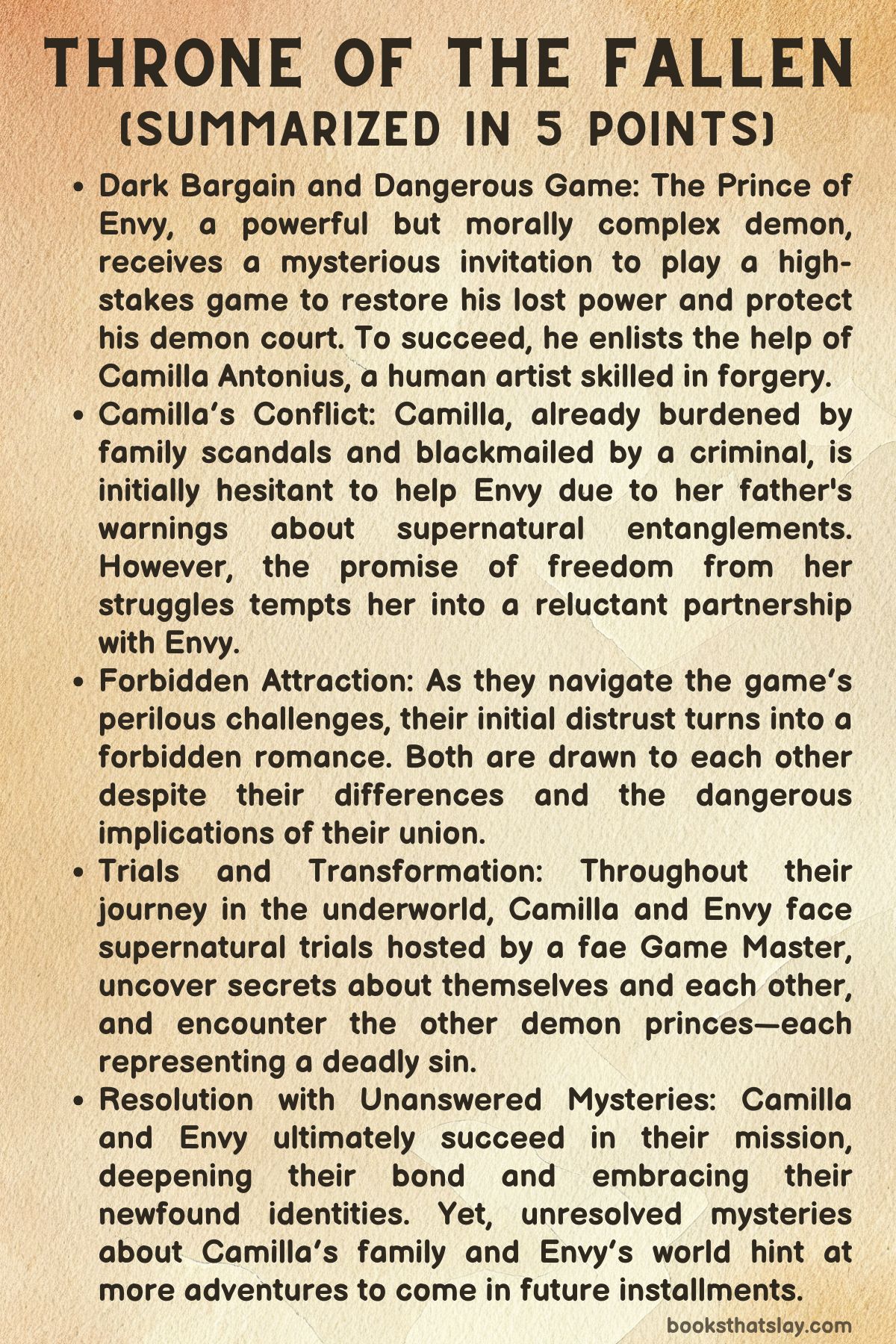
Drawn together through a deadly contest orchestrated by cruel fae powers, they must navigate deception, seduction, and betrayal. As Camilla is forced into a game beyond her understanding, both she and Envy are tested by desire, manipulation, and the dangerous cost of ambition. It’s the first book in the Prince of Sin series by the author.
Summary
The tale begins with the Prince of Envy receiving a feather from a fae adversary, a warning that a new game is about to begin. Though outwardly calm, he knows his court is crumbling, with courtiers losing memories and clarity.
Since envy depends on being witnessed and envied, such decline would destroy him. Furious yet determined, Envy vows to hide his weakness from his brothers and restore his court’s strength, burning the feather’s message in secret.
Years later, Lord Nilar Rhanes, one of Envy’s courtiers, collapses in the throne room as whispers echo in his mind. Bound to the Hexed Throne, he screams in magical flames, while Envy watches silently.
It is then revealed that a new contest has begun. The rules of the Game forbid magical persuasion, limit the number of attempts to pass clues, and demand absolute obedience to the Game Master, who serves the King of Chaos.
The winner will claim a prize tailored to their deepest desire.
In the mortal world, Camilla Antonius lives in Waverly Green as an art dealer and painter. She hides a shameful past: years earlier, she forged a masterpiece to pay her father’s debts, and Lord Philip Vexley discovered her crime.
Since then, he has blackmailed her, forcing her into producing forgeries to fuel his own greed. Vexley hints at marriage, but Camilla dreads being trapped by scandal.
One evening, a striking stranger arrives at her gallery. Introducing himself as Lord Ashford Synton, he is in truth the Prince of Envy in disguise.
He requests a painting of a throne half whole and half aflame, the Hexed Throne itself. Camilla refuses, unwilling to paint cursed objects.
Envy leaves frustrated, taunted later by his brother, Pride, who advises him to properly win Camilla’s cooperation.
At a party hosted by Vexley, Camilla intends to destroy one of her incriminating forgeries. Synton rescues her from Vexley’s advances and accompanies her upstairs.
She finds the forgery in Vexley’s bedroom but is interrupted by Synton. Their encounter grows heated until he urges her to escape as Vexley approaches.
Using supernatural strength, he helps her flee across the roof, though Camilla is terrified of heights. They escape in his carriage, where Envy pressures her to admit her blackmail situation.
Though wary of him, she senses he knows more than he reveals. Outside her home, columnists lurk, threatening her reputation.
Her failure to destroy the forgery and her closeness with Synton weigh heavily on her.
Envy becomes both protector and manipulator. In one intimate scene, he massages Camilla with enchanted oil, teasing her with pleasure only to abandon her, using both desire and frustration to test her boundaries.
Soon after, Camilla joins him and others at House Sloth to search for clues. During the search, she touches a sinister orb belonging to the Fear Collector, a monstrous ancient being.
When the orb shatters, the creature manifests and demands Camilla. Envy arms her with a silver dagger and escorts her into dangerous tunnels, where they confront the Fear Collector, who warns of betrayal and introduces the name Prometheus—Zarus, the vampire prince.
Camilla leaves troubled, and Envy grows more suspicious of her hidden past.
As they travel through Bloodwood Forest, Envy probes Camilla’s emotions using his power, forcing jealousy into her. She retaliates by projecting memories into his mind, provoking them both into a passionate embrace.
Suddenly, Camilla vanishes, taken by Zarus. She awakens on Malice Isle, surrounded by vampires.
Blade, a crimson-eyed vampire, warns her to act afraid around Zarus, who soon enthralls her with his touch. At a decadent vampire feast, she sees Vexley among the guests, revealing he too plays in the Game under fae protection.
Meanwhile, Envy realizes Zarus must die to free Camilla. He bargains with Vittoria, the Goddess of Death, who demands his heart in exchange for killing a fae rival.
Risking everything, Envy allows her to tear his heart from his chest, leaving him weakened but resolute.
Camilla learns she cannot return to her mortal life. Her father Lennox, the Unseelie King, forces her to create the Silverthorne Key, a cursed portal connecting his world to hers.
Imprisoned in a burning cage, she becomes bait for Envy. When he arrives, Lennox tests him, forcing a violent confrontation.
Camilla conjures an iron sword to fight alongside Envy. Together, they wound and ultimately kill Lennox, though Camilla is devastated by her role in her father’s death.
Envy seizes the Chalice of Memoria, leaving her behind.
With the chalice, Envy restores his courtiers’ sanity, regaining his power. Yet new threats arise.
Camilla’s brother Onyx plots to kill her, forcing Envy to storm the Wild Court and imprison him. Envy confronts Camilla, admitting he acted to protect her.
Casting aside his usual rule of keeping lovers only briefly, he declares her his. She agrees, despite the watching eyes of her allies.
Their betrothal solidifies Envy’s restored court. Privately, he aids Pride, revealing that his wife Lucia still lives, memoryless and hidden.
Envy and Camilla grow closer, sharing domestic intimacy in House Envy. He surprises her with a studio filled with enchanted paints, inviting her to create freely.
Using the Silverthorne Key, he ensures she can still visit her old world when she chooses. Together, they embrace their bond, both partners in passion and strategy, united in love and power as the Game’s deadly web continues to shape their future.
Characters
Prince Envy / Lord Ashford Synton
Prince Envy, one of the demon princes of sin, emerges as both an antagonist and reluctant romantic lead in Throne of the Fallen. At the novel’s beginning, he is presented as a ruler whose power is crumbling, his court weakened by memory loss and confusion.
This vulnerability gnaws at him, since envy cannot exist without witnesses to fuel it. Beneath his composed exterior lies a tempest of insecurity, pride, and desperation, and it is this tension that drives much of his character arc.
In his mortal guise as Lord Ashford Synton, Envy exudes charisma and menace, using mystery and allure as weapons. Yet as his relationship with Camilla deepens, another side surfaces—his frustration at needing her, his grudging respect for her independence, and his eventual willingness to abandon his strict “one night” rule for something far more binding.
His duality—demon and lover, manipulator and protector—makes him a figure of contradictions, equally seductive and dangerous. Ultimately, Envy evolves from a prince terrified of weakness to one who allows vulnerability through love, which paradoxically strengthens him more than fear ever could.
Camilla Antonius
Camilla is the mortal heart of the story, though her lineage and destiny prove far more entwined with the supernatural than she realizes. At the outset, she is an art dealer and forger living under the oppressive blackmail of Lord Vexley, forced into dangerous compromises to protect her family’s legacy.
Her intelligence, resilience, and quiet defiance mark her as someone unwilling to be caged, even when society, scandal, and demons press in from every side. Camilla’s artistry is more than skill—it becomes a medium of creation and transformation, revealing her latent Fae power.
Over the course of the novel, she undergoes a profound metamorphosis: from guarded mortal, to entangled pawn in the Game, to active player wielding her own strength. Her complicated relationship with Envy oscillates between attraction, mistrust, and reluctant dependence, eventually settling into mutual devotion.
Despite betrayals, temptations, and revelations about her Unseelie heritage, Camilla’s defining trait remains her will to choose her own path, whether in love, artistry, or survival.
Lord Philip Atticus Vexley
Lord Vexley embodies corruption within mortal society. A libertine who thrives on scandal, manipulation, and cruelty, he functions as both antagonist and cautionary figure.
Through his blackmail of Camilla, he represents the very real dangers of power imbalance in the mortal realm. Unlike the demon princes, whose machinations serve greater games and cosmic stakes, Vexley’s motivations are petty: greed, lust, and a need to dominate.
Yet his role is essential, for it forces Camilla to navigate human treachery alongside demonic temptation. His presence in both Waverly Green and the vampire courts underscores his adaptability as a parasite, clinging to whoever offers him advantage.
In contrast to Envy, Vexley has no growth or redemption; he remains a figure of degradation, useful primarily as a foil against which Camilla’s strength and Envy’s darker nobility are measured.
Lady Katherine Edwards / Kitty
Katherine begins as Camilla’s closest mortal confidante, a sharp-witted companion who offers counsel about navigating the treacheries of Waverly Green society. At first she appears to play the role of comic relief and loyal friend, but as the story progresses, her role expands into something more layered.
Revealed as Unseelie, Katherine—known also as Kitty—embodies dual loyalty: to her mortal friendships and her supernatural court. This complexity deepens her dynamic with Camilla, shifting from lighthearted advice to moments of suspicion and tension.
Katherine is both a warning and a mirror for Camilla: she shows how one can straddle worlds uneasily, but also how deception, even for survival, erodes trust. Ultimately, Katherine underscores the theme of masks—both social and supernatural—that permeates the novel, reminding Camilla that no relationship in this world is free of secrets.
Lennox, the Unseelie King
Lennox is both Camilla’s father and one of the story’s central antagonists. He epitomizes the cruelty and theatricality of the Wild Court, where mortals are reduced to playthings.
His manipulation of Camilla—forcing her to paint the Silverthorne Key under threat of destroying Envy’s court—demonstrates his cold pragmatism and disregard for paternal ties. Lennox thrives on control, spectacle, and the fear he instills, and his court reflects his decadence turned sadistic.
Yet his downfall comes at the hands of both Camilla and Envy, a symbolic overthrow of tyranny by those he sought to control. His role in the novel highlights the destructive extremes of unchecked power, while also providing Camilla with her most painful but liberating choice: to reject blood ties in favor of self-determination.
Zarus / Prometheus
Zarus, the vampire prince revealed as Prometheus, personifies the predatory allure of the vampire courts. His presence in the novel intensifies the atmosphere of danger, decadence, and temptation.
Ensnaring Camilla through his touch and enthrallment, Zarus represents another layer of seduction—one that blurs pleasure and control. His court thrives on indulgence, but beneath the revelry lies menace and exploitation.
As a rival player in Lennox’s Game, Zarus becomes both competitor and captor, shaping Camilla’s journey into the vampire realm. His dynamic with Blade and his looming threat to Envy’s mission underline the political intricacies of the immortal world.
Zarus’s eventual fate, tied to the riddle that only his death could restore balance, reinforces the novel’s theme that desire without restraint is destructive, no matter how enticing its form.
Blade
Blade, crimson-eyed and pragmatic, serves as an ambiguous ally within the vampire court. Though he initially plays the role of captor, delivering Camilla to Zarus, he quickly distinguishes himself from the other vampires by offering her advice and protection.
Blade’s motives remain layered; his guidance often stems from calculated self-preservation rather than altruism, yet his presence grants Camilla a tenuous lifeline amid the decadence of Malice Isle. His warnings to act afraid, his suggestion of a protective bite, and his subtle interventions position him as a foil to Zarus’s overwhelming dominance.
Blade functions as a reminder that not all dangers come in obvious forms—some masquerade as reluctant aid. His pragmatic morality leaves his loyalty uncertain, but his actions ensure Camilla survives her captivity long enough to confront greater threats.
Vittoria, Goddess of Death
Vittoria emerges as one of the most enigmatic figures in the narrative. She wields immense power, unbothered by mortal or demon alike, and her involvement with Envy demonstrates the dangers of bargaining with forces beyond comprehension.
When she rips his heart from his chest, she reveals the vulnerability even princes of sin face when confronted with divine will. Vittoria embodies inevitability—death, endings, and the harsh costs of ambition.
Her role in the story expands the scale of conflict beyond mortal, demon, or vampire games, reminding readers that higher powers manipulate the board as well. For Envy, she is both a terrifying obstacle and a grim ally, a figure who strips away his illusions of control while underscoring the theme that power always demands sacrifice.
Themes
Power and Decline
In Throne of the Fallen, the fragility of power is explored through the deterioration of Envy’s court. His courtiers’ memory lapses and disorientation highlight the unstable foundation of his dominion, since envy as a sin depends on recognition and an audience to thrive.
The weakening of his influence reveals the precariousness of authority built on perception rather than substance. For Envy, maintaining appearances is not simply about vanity but survival, as any exposure of weakness would invite destruction from his rivals.
This theme extends beyond the immortal courts into mortal society, where Camilla struggles with Vexley’s manipulation and her reputation’s fragility. Her social standing is just as vulnerable to exposure as Envy’s realm, showing how both human and immortal power structures rely heavily on secrecy, control, and perception.
The decline of Envy’s court becomes a metaphor for the larger truth that power, however vast, is never absolute. It requires constant maintenance, calculated strategies, and suppression of vulnerabilities.
As the story progresses, the tension between sustaining power and concealing decline underscores the dangerous games both Envy and Camilla must play to survive in their respective worlds.
Games and Manipulation
The presence of the Game at the heart of the story establishes a motif of manipulation, riddles, and strategic deception. Bound by rules that strip away certain abilities, the players are forced to rely on cunning rather than raw magical dominance.
This mirrors the manipulations in the mortal realm, where Camilla must navigate blackmail, false appearances, and hidden desires. Every relationship in the book becomes a type of game—whether it is Envy’s attempt to win Camilla’s compliance, Vexley’s coercive control over her through her secret forgery, or the larger contests orchestrated by Lennox and the King of Chaos.
Manipulation takes many forms, from emotional coercion to elaborate political schemes, suggesting that survival itself requires the ability to outmaneuver opponents. The theme emphasizes that games are not limited to entertainment but are weapons of power, tools for ensnaring others, and tests of endurance where failure means ruin or death.
The constant presence of rules, bargains, and shifting alliances also reflects how life in both mortal and immortal realms becomes a series of staged plays, where true freedom is scarce and every move carries hidden costs.
Desire and Temptation
Desire in Throne of the Fallen operates as both an intoxicating force and a perilous trap. Camilla’s attraction to Lord Syn is entwined with danger, drawing her into a world she fears yet cannot resist.
Her desires clash with her rational resolve to protect her independence, creating a tension between longing and survival. For Envy, desire is both his sin and his weapon—he feeds on others’ covetousness while wrestling with his own fascination for Camilla.
Their encounters blur the line between passion and manipulation, raising questions about agency when attraction can be weaponized. The theme expands further in the vampire court, where indulgence in lust, blood, and spectacle underscores the destructive side of unchecked temptation.
Desire is never portrayed as harmless; it binds, corrupts, and entangles, pushing characters toward decisions that blur morality. At the same time, it also fuels creativity, intimacy, and ambition.
For Camilla, her longing to create art and live freely reflects a purer form of desire that resists corruption. The story ultimately shows desire as a dual-edged force: capable of leading to ruin when exploited, but also capable of fostering connection and resilience when acknowledged on one’s own terms.
Identity and Transformation
The question of identity recurs throughout the novel, shaping both the mortal and immortal characters. Camilla’s journey from a guarded art dealer to someone who discovers her true Fae heritage forces her to confront the lies she has told herself to survive.
The exposure of her glamoured identity breaks the illusion of her mortal life, yet also grants her agency in a broader, more dangerous realm. For Envy, his dual role as Prince of Envy and Lord Syn reflects the masks he must wear to navigate both worlds.
His persona shifts depending on who he confronts, and even he struggles with whether his growing bond with Camilla is a manipulation or a genuine transformation of his own nature. The theme extends into the broader political games, where disguises, glamours, and false loyalties shape the progression of the Game.
Identity is presented as fluid and mutable, often imposed by external pressures yet carrying the potential for self-reinvention. By the novel’s end, Camilla’s acceptance of her Fae lineage and her bond with Envy signify that transformation, though painful, allows the reclamation of truth and strength.
In a world riddled with deception, true identity becomes the most dangerous yet liberating force.
Love and Sacrifice
Beyond sin, strategy, and deception, Throne of the Fallen threads love and sacrifice as central to its resolution. Envy, whose very nature embodies the corrupting force of envy, chooses to defy his own rules and allow himself vulnerability with Camilla.
This decision requires sacrificing his carefully maintained control, even exposing his court and heart to danger. Camilla, similarly, faces the devastating choice of fighting against her father, Lennox, and ultimately assisting in his death.
Her act is not one of cold ambition but a sacrifice to save others and resist being used as a pawn in his ruthless games. Love becomes an act of rebellion against manipulation, proving stronger than curses, bargains, and blood-bound games.
The sacrifices made by both mortal and immortal characters underscore the transformative potential of love—not as an idealized or safe force, but as something that requires risk, pain, and irrevocable choices. By the conclusion, love is portrayed not as an escape from danger but as the only thing capable of grounding two individuals amid chaos, restoring balance, and creating a future where survival is about more than power or strategy.