Through Gates of Garnet and Gold Summary, Characters and Themes
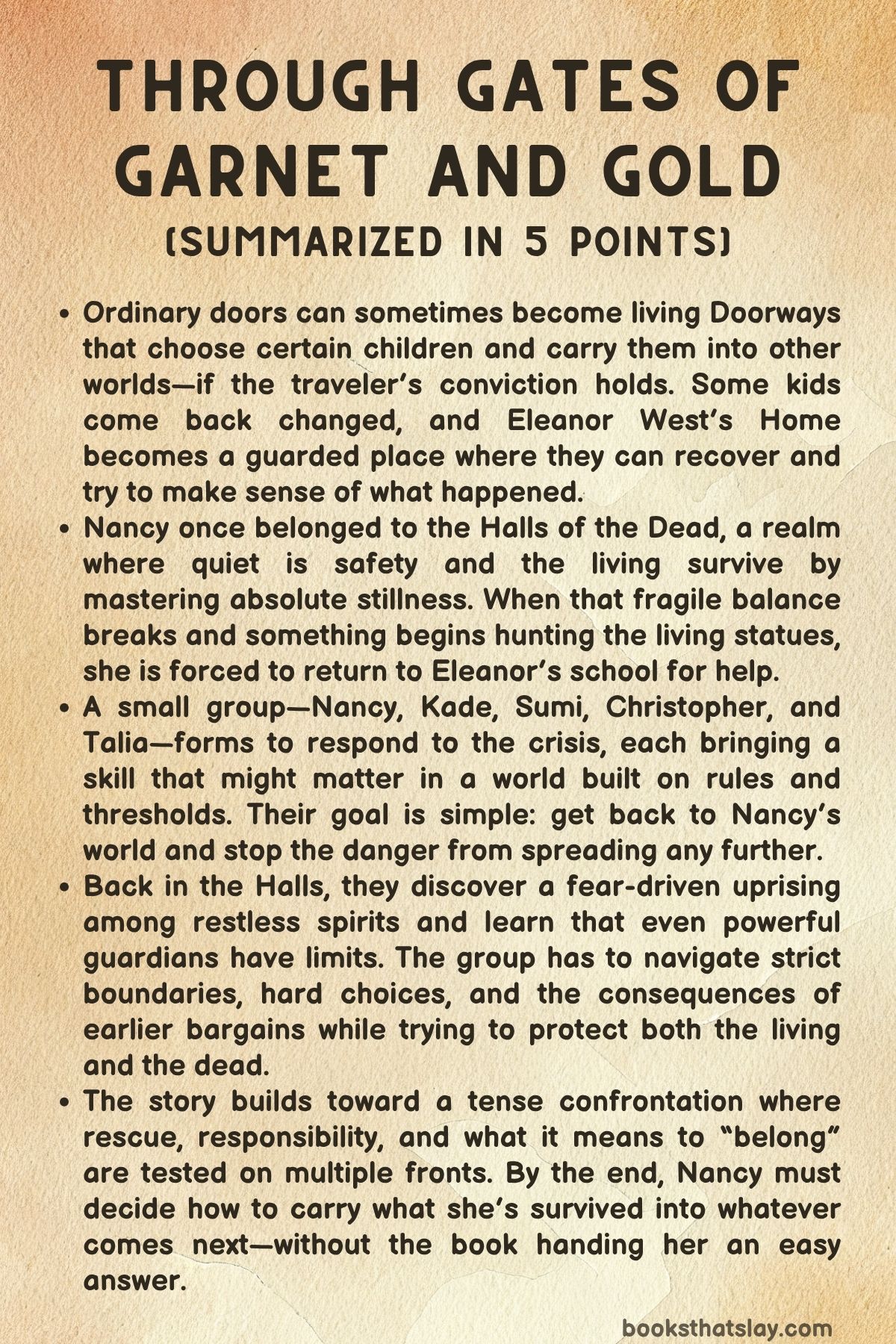
Through Gates of Garnet and Gold by Seanan McGuire is a fantasy novel about children who slip through Doors into other worlds—and what happens when they come back changed. Some return with memories that don’t fit into ordinary life, carrying homesickness for places no one else believes are real.
At Eleanor West’s Home for Wayward Children, those returnees are given rules, safety, and a strange kind of understanding. The story follows Nancy, a girl shaped by a silent realm of ghosts and stillness, when a crisis in her once-safe world forces her to risk everything—and ask others to follow. The book is the 11th book in the Wayward Children series.
Summary
Nancy learned how to survive by becoming still. In the Halls of the Dead, silence is not just an atmosphere; it’s a rule that keeps you alive.
The realm looks lush—pomegranate groves, asphodel fields, gardens that never seem to fade—but it belongs to the dead, and the dead notice movement. Living travelers who remain there long enough often become “statues,” training their bodies to quiet down until they can pass as carved stone.
Nancy has practiced longer and better than most. She can slow her breath, steady her heartbeat, and hold a pose until time seems to lose its meaning.
In that unmoving safety, she believed she could stay forever.
Then the screaming starts.
Nancy is holding her pose in the Halls when a sharp sound splits the quiet—running footsteps, panic, and a wet stop that tells her someone has been caught. A strange rushing presence follows, like wind with intent, sweeping through the halls.
One nearby statue shifts just a little, and that tiny mistake is enough. The rushing force swarms him, and he is destroyed so completely that only a red mist and fragments remain.
Nancy keeps herself rigid, tears falling without movement, and understands the worst truth of her world: the dead have escaped whatever kept them contained, and the statues are being hunted.
Nancy’s Door first appeared behind a washing machine in her parents’ basement, opening onto the pomegranate grove. She once lost her certainty and was dropped back into her old world, only to find the Door gone.
Fear and disbelief followed, and she ended up at Eleanor West’s Home for Wayward Children, where returned children live under strict rules meant to keep them safe from being used, exploited, or pushed into dangerous “quests.” Later, when Nancy’s certainty returned, a Door opened beneath the school and she went back to the Halls. Now she has fled again—not because she stopped loving her home, but because the Lady of the Dead told her to run while she still could.
Nancy reappears in the basement bedroom now occupied by Christopher Flores, another student at Eleanor’s school. Christopher is startled by her stiff, stop-and-start movement, the leftover rhythm of someone trained to freeze at any moment.
Nancy is blunt and shaken: people are dying, and the Halls are no longer safe. Christopher brings her to Eleanor, who reacts with a mix of shock and relief.
Nancy breaks down silently, and Eleanor comforts her while trying to understand how a world that once held Nancy so firmly could now be pushing her out.
Nancy explains that the dead have turned violent and are tearing apart statues who cannot maintain perfect stillness. Eleanor agrees that the crisis can’t be ignored, and they decide to involve Kade, who manages much of the school’s daily structure.
Christopher finds Kade and persuades him to come, then they collect Sumi—unpredictable, delighted by any chance for adventure—and Talia, who insists that joining a quest increases the odds of finding one’s own Door. Over a hurried meal, they piece together a plan.
Nancy believes she can open a Door back to the Halls by focusing on certainty and holding still until the world answers. Christopher hopes his bone flute, which can call to dead things, might help.
Sumi is eager to confront danger head-on. Kade wants order and safety.
Talia brings silk-thread skill, an understanding of moths, and the ability to see in the dark.
In a root cellar, Nancy concentrates. Light sketches an outline into the wall, and a door appears where there was only dirt and shadow.
Cold air spills out, carrying the scent of pomegranates. One by one, they step through into a moonlit grove, and the Door disappears behind them, leaving no easy retreat.
The grove feels like a boundary space with its own rules. Pomegranates drop when Sumi shakes the branches.
Moths with gray-and-orange wings gather on Talia as if they recognize her. Christopher plays his flute and senses attention from things that are not alive anymore.
Nancy warns them not to linger: the grove is safer than the halls, but the real danger is inside, where the dead are moving freely.
They pass a tall wall and a silver gate into manicured gardens leading toward a Grecian-style hall. In the gardens, living statues stand on plinths, posed with eerie patience, dressed much like Nancy.
Nancy speaks to a burly statue named Lief and, with Sumi’s practical help—pomegranate seeds to loosen his voice—learns what happened during the two weeks she was gone. The “unquiet dead” have found a leader: a newly arrived spirit full of anger has rallied others, broken seals, and driven them into a feeding frenzy.
Many statues inside are already gone. The Lady of the Dead has been trying to protect survivors by escorting them to the grove so they can search for Doors home.
Lief also reveals he isn’t from Earth at all, reminding the group that these worlds draw travelers from many places.
Inside the hall, silence is thicker, as if cloth has been hung over sound itself. The atrium is littered with empty plinths and dried blood.
The Lady of the Dead appears—calm, controlled, worried—and recognizes Nancy and the friends she has brought. Sumi realizes she has met the Lady before, during a time when Sumi herself was dead and waiting, then returned to life.
The Lady leads them toward her private chambers, which are warded against spirits.
At a corridor junction, Sumi suddenly senses danger and orders everyone to run. Something distorted follows them, and the moths trailing behind begin to crumble into dust when caught.
The Lady throws open her doors, pulls everyone inside, and declares that nothing may cross her threshold without permission. The pressure of the hungry dead pushes at the boundary like a storm held behind glass.
Sumi admits she can see the ghosts clearly; the others mostly cannot. Christopher raises his flute and plays in near silence, and silver motes gather into the form of Jill Wolcott, a teenage girl with a sharp, mocking presence.
Kade recognizes her immediately, and Jill’s fury spikes when she sees Sumi alive. Jill admits she once used Nancy as cover during earlier violence, and now she demands the Lady provide more “food” for the ghost army she has organized.
She argues that the dead should be allowed to consume life, and she taunts them with how easily statues fall. When Jill orders Christopher to stop, he does, and she dissolves back into motes and vanishes, leaving behind a chilling certainty: Jill is the leader, and she is growing bolder.
Nancy presses the Lord and Lady for answers. They admit they don’t command the dead; they offer passage, rules, and a waiting place, not absolute control.
They go to find the Lord of the Dead, moving through blood-speckled halls. Sumi challenges the logic of turning living people into statues for safety, and the Lady insists the statues choose their stillness and keep their humanity.
In the library, they find the Lord, who listens and proposes a direct plan: draw Jill and her followers back into the room meant to contain the unquiet dead, then seal it.
To lure the ghosts away from statues, Talia and Sumi go to the grove and call moths—thick clouds of them—to serve as bait. With moths swirling around them like a moving veil, they set roles: Sumi watches for danger, Christopher uses his flute to herd the spirits, Talia keeps the moth swarm between the living and the dead, and Nancy guides them toward the containment space.
But the unquiet dead close in faster than expected. As moths at the back of the swarm crumble into ash, panic spreads.
Nancy’s training takes over: she freezes so completely she might be marble, trying to become invisible to the dead. Jill manifests again, more solid than before from feeding, and whispers that Nancy will lose the moment she has to breathe.
Sumi snaps at Christopher to play, and the flute’s force pushes the ghosts into order while Talia throws moths into the gap, sacrificing them to buy seconds. Jill tries to bargain—she wants to be taken elsewhere and returned to life—but the group refuses.
In the struggle, the ghost-light tightens around Nancy like a net and yanks her away. In a blink, she is gone.
Kade turns on Christopher, stunned and furious, thinking a mistake or hesitation allowed Nancy to be taken. Christopher insists Nancy’s stillness is her best defense, but Sumi argues that leaving her captured gives Jill too much power.
Talia, exhausted and defensive, points out how much she has already lost in moths. They force themselves forward anyway, following the Lord toward the silver filigree door where the peaceful dead wait for rebirth.
Nancy, dragged by cold hands and relentless force, does not fight. She keeps herself rigid, because any struggle would mean immediate destruction.
She also knows the risk of her own skill: stillness held too long can become permanent, turning a living person into something truly lifeless. The dead shove her through a golden door into a vast black void.
She expects death at once, but instead she finds strange air—like ashes and newborn stars—and Jill appears, smiling. Jill says Nancy is a hostage, proof that Jill can take what she wants.
Jill claims she deserves life again and blames others for what she became. Nancy refuses that excuse and holds to her silence, staying still in the darkness.
In the silver-door void, Sumi and the Lord see lights gather, forming Lundy, a young girl who speaks with blunt authority and no interest in treating the Lord as her ruler. Kade explains Jill has returned and taken Nancy.
Lundy confirms Jill killed her and is furious. A dead statue named Iason confesses that the unquiet dead gained their first strength through him: grieving a boy he loved, he listened to the wrong promises, opened ways he shouldn’t have, and bled for the hungry dead, only to be discarded and left without the reunion he wanted.
The Lord realizes the unquiet dead now have too much substance, fed by stolen life and continued killing, and that this substance can be used against them—solid barriers can trap them.
The plan shifts. With Lundy and the peaceful dead willing to act, they go to the golden door.
On the other side is a colder void full of chittering darkness and flashes like dying stars. Jill appears, confident, expecting support or surrender.
The Lord refuses her demands and offers only confinement and eventual passage to rebirth. Jill attacks, and Lundy restrains her as the peaceful dead surge forward to drive the unquiet dead back through the golden threshold.
In the chaos, Iason finds Aleksy’s shade and holds him, sobbing, in a moment of reunion that comes at a terrible price.
Sumi, Kade, and Christopher slip into the void to find Nancy. They locate her curled and barely glowing, rigid with exhaustion.
Christopher can’t pull her up. The Lord enters, warns them not to stay, and lifts Nancy into his arms, carrying her out while moths swarm protectively.
Some moths vanish into the retreating hunger, but the living make it through.
Outside, the peaceful dead force the unquiet dead back through the golden door. Christopher slams it shut.
Lundy asks for a message to be delivered someday to the Archivist in the Goblin Market: that she has been lost, paid fair value, and will return for rebirth when time allows. To keep the seal secure, Sumi packs chewed strawberry gum along the bottom of the door, and Talia winds silkworm silk to tighten the frame.
The Lord approves the practical, stubborn solution.
Back in the library, the Lady of the Dead panics at Nancy’s limp state. The void drained her while she stayed passive and still.
They give her pomegranate juice and sugar wafers, promising care and time. The Lord opens a Door back to the school’s basement for the teens.
Talia stays briefly to sing to her moths before returning.
Six months later, a Door appears again in the empty basement. Nancy steps through, barefoot and dressed in white, and whispers thanks to the Halls of the Dead as her home.
The Door vanishes. She doesn’t turn back.
She climbs the stairs with a steadier gait than before, carrying the memory of silence, the cost of survival, and the knowledge that her future will be built in motion.
Characters
Nancy
Nancy is defined by disciplined stillness that began as survival and became identity, shaping how she moves, speaks, and even thinks after years in the Halls of the Dead. Her “statue” training isn’t just a skill; it’s a philosophy built on certainty, restraint, and a belief that peace can be found in quiet permanence, which is why the massacre of the statues hits her as both horror and betrayal of the order she trusted.
In Through Gates of Garnet and Gold, when she returns to Eleanor West’s Home, her grief is muted but immense, expressed through controlled motion and silent tears, and that contrast reveals how deeply the Halls have rewritten her emotional language. Nancy’s arc is a struggle between passivity as safety and action as responsibility: she wants to preserve what she loves, but saving it requires movement, teamwork, and risk—everything her body has been trained to reject.
Her eventual return six months later shows growth without erasing who she is: she still honors the Halls as home, yet she chooses forward motion, accepting that certainty can mean living on rather than staying still forever.
Eleanor West
Eleanor functions as both caretaker and boundary-maker, running her home with strict rules designed to protect traumatized children from the very narrative traps that once swallowed them—quests, temptation, and the lure of being “special.” Her emotional reaction to Nancy’s return reveals that beneath her institutional firmness is genuine attachment and accumulated sorrow for the students she can’t permanently save. Eleanor’s leadership is pragmatic rather than heroic: she doesn’t pretend she can fix worlds, but she recognizes when inaction is morally impossible, and she authorizes the group’s return to the Halls because she understands what it means to be pulled between realities.
She represents adulthood shaped by repeated loss, trying to replace the chaos of Doors with structure, even while knowing that structure can never fully contain the mythic forces that keep intruding.
Christopher Flores
Christopher is driven by an empathetic, practical bravery that shows up in small choices—offering help, making space, acting quickly—rather than dramatic speeches. His bone flute becomes a symbolic extension of him: it translates his respect for death into a tool that can negotiate with it, letting him herd or ward spirits instead of trying to dominate them through force.
He also embodies the danger of making “clever” decisions under pressure, as seen when his actions contribute to Nancy being taken; even when his reasoning is grounded in the statue logic of the Halls, the fallout exposes how strategy can become moral error when it discounts another person’s agency. Across the crisis, Christopher’s steadiness helps the group function, but his arc also interrogates the cost of intervention—how helping can still harm, and how responsibility doesn’t end at good intentions.
Kade
Kade is the group’s stabilizer, carrying the burden of day-to-day order at Eleanor’s and reacting to Nancy’s return with a kind of existential shock: if someone can lose certainty and then regain it, what does that say about the rules that are supposed to govern Doors and belonging? His leadership style is weary but sincere—he tries to keep people focused, assigns roles, and holds the group together when emotions spike.
Underneath that competence is fear, not of danger itself but of uncertainty as a force that can unravel identity, purpose, and hope. His anger after Nancy is taken reads less like simple blame and more like panic at losing the one person who “proved” the system could make sense; by the end, he hasn’t solved that fear, but he has endured it, continuing to act even when certainty feels fragile.
Sumi
Sumi is a bright, chaotic catalyst who treats danger like an invitation, not because she’s shallow but because her relationship to narrative is fundamentally different—she sees quests as the natural language of survival. Her exuberance masks sharp perception: she senses threats first, asks incisive questions that expose the Halls’ moral compromises, and reframes Kade’s fear with the idea that people can hold multiple certainties at once.
She also carries a haunting intimacy with the Halls through her prior death and restoration, making her reactions to the Lady and to Jill unusually personal; she isn’t merely visiting Nancy’s world, she has history embedded in it. Sumi’s role becomes moral as much as tactical—she refuses Jill’s self-serving revision of her own cruelty, and she pushes back against authority when rules feel unjust, insisting that the story must make ethical sense, not just procedural sense.
Talia
Talia is motivated by longing and probability—she believes that participating in quests increases the chance of finding her own Door, which makes her both vulnerable to mythic thinking and remarkably brave in practice. Her connection to moths and silk is not decorative; it is a language, a community, and a strategic resource that becomes central to the group’s plan, especially when moths serve as sacrificial bait that spares living statues.
Talia’s development hinges on commitment: she begins as someone chasing an outcome for herself, but she becomes someone who chooses solidarity, repeatedly spending what she values—her moths, her labor, her calm—to protect others. Her insistence on staying behind briefly to sing to her moths after the crisis underscores her tenderness and her sense that companionship across species matters, even in a world built on thresholds and tradeoffs.
Jill Wolcott
Jill is the story’s embodiment of predatory hunger fused with grievance, a spirit who weaponizes victimhood to justify ongoing cruelty. Her increasing solidity as she feeds mirrors her moral trajectory: the more she consumes, the more “real” she becomes, but that reality is built on theft, not growth.
Jill’s manipulations—mocking the Lady, taunting Nancy, framing herself as misled by “bad company”—are less about persuasion and more about control, an attempt to rewrite accountability into tragedy. Her special venom toward Sumi underscores how Jill cannot tolerate contradictions to her narrative; Sumi alive is proof that Jill’s violence did not get the final word, and that affront enrages her.
As a champion of the unquiet dead, Jill also represents what happens when certainty curdles into entitlement: she is utterly certain she deserves life back, and she is willing to make everyone else pay the cost.
Lundy
Lundy appears as blunt, independent, and morally clear, refusing to perform reverence even in the presence of the Lord, which immediately establishes her as an agent rather than a subject. Her rage at Jill is personal and righteous—she is not participating because the Halls’ rulers ask, but because someone she cares about was harmed and because injustice demands response.
Lundy’s presence also expands what “the dead” can be in this world: not only hunger and haunting, but solidarity, memory, and purpose that resists corruption. Her request for Christopher to carry a message to the Archivist in the Goblin Market highlights her ongoing story beyond this crisis, suggesting that death in this universe is less an ending than a state with its own obligations, economies, and future movement toward rebirth.
Lief
Lief functions as a grounded witness to catastrophe, someone still standing—still posing—long enough to provide the group with crucial reality: the scale of loss, the emergence of a champion, and the fragile safety of the grove. His need for pomegranate seeds to speak after prolonged stillness underscores the bodily cost of survival in the Halls, turning communication itself into something that must be earned or purchased.
By revealing he is from the Goblin Market, Lief also quietly broadens the story’s cosmology, reminding the group that the Halls collect travelers from many worlds and that the crisis is not only an Earth-child tragedy but a multiversal rupture. He represents the survivors who aren’t leaders or villains—just people enduring, conserving motion, and hoping the rules hold.
Nadya
Nadya is mostly an absence, but it is a charged absence that exposes the hidden costs of bargains and the way quests leave people behind as collateral. The revelation that she vanished weeks earlier reframes the urgency and the moral landscape: while the group is focused on visible slaughter, someone else may already have been forced into a Door, displaced again without closure.
In narrative terms, Nadya operates like a wound in the story’s logic—proof that “saving the world” can still mean failing individuals, and that even well-intended systems like the Lady’s escorted exits can scatter people in ways that feel like loss disguised as rescue. Her mention sharpens Sumi’s protective instincts and reinforces the theme that survival often comes with debts that are never neatly repaid.
Iason
Iason is the tragedy at the root of the unquiet dead’s empowerment, a character whose grief becomes the breach through which disaster enters. His love for Aleksy and the unbearable pain of losing him make him sympathetic, but his choices show how sorrow can be exploited when it becomes single-minded and desperate.
By bleeding for promises of reunion, he demonstrates the Halls’ darkest temptation: the dead offer stories that sound like hope, and those stories can make the living complicit in their own undoing. Iason’s confession also shifts blame away from abstract evil alone and toward a more unsettling truth—catastrophe can begin with one broken heart and one wrong door opened.
His reunion with Aleksy amid chaos is bittersweet, suggesting that even manipulated grief can still contain real love, and that accountability and compassion can exist side by side.
Aleksy
Aleksy is present primarily through the consequences of his death and the longing it inspires, which makes him feel like a symbol of the line between chosen stillness and actual dying. His attempt to practice statue-stillness but truly die underscores the razor edge the statues walk: survival requires flirting with lifelessness, and sometimes the body does not come back.
Aleksy’s role becomes most potent when he appears in the climactic battle and is embraced by Iason, turning the abstract motivation—“I did it for love”—into something heartbreakingly tangible. In that moment, Aleksy represents what everyone in the Halls wants in some form: to be found, to be held, and to have loss acknowledged rather than swallowed by silence.
Themes
Certainty as a Requirement for Belonging
Doors in Through Gates of Garnet and Gold do not respond to longing in a vague, wishful sense; they respond to a clean internal decision that settles into the body like gravity. That rule changes what “home” means for the characters, because home stops being a geographic place and becomes an active state of mind that must be held, renewed, and defended.
Nancy’s experience shows how certainty can be both refuge and trap. When her confidence wavers, the Door abandons her, and the abandonment is not framed as moral punishment but as a mechanical consequence of doubt.
The result is brutal: a child who has already been altered by another world is forced back into a life that no longer fits, then placed under institutional care. The school exists as a response to that discontinuity, yet even there, certainty functions like a social currency.
Students measure themselves and each other by how close they feel to a Door, how “aligned” they are with the world that claimed them, and whether they can maintain the inner stance required to return. Kade’s fear after Nancy’s return exposes a more unsettling implication: if certainty can be lost and regained, then it is not a stable identity but a fluctuating condition, and that makes everyone’s future feel less dependable.
Sumi’s insistence that a person can hold multiple certainties at once pushes against a simplistic reading of destiny, arguing that the self is not a single locked direction but a set of commitments that can coexist without canceling each other. The Halls of the Dead intensify the theme by showing certainty as literal survival.
Nancy’s stillness is not just preference; it is a practiced embodiment of unwavering control. When the unquiet dead begin targeting statues, they are hunting for the smallest crack in that control.
Certainty becomes a discipline measured in breath and heartbeat, and the story keeps returning to the same hard question: what happens when the only way to be safe is to become less alive?
Stillness, Control, and the Cost of Self-Erasure
Nancy’s statue training turns a psychological coping strategy into a bodily technique so extreme that it borders on self-deletion. The ability to slow breath and pulse, to reduce the signs of life until predators lose interest, creates a version of safety that demands constant self-monitoring.
That bargain is presented without romantic framing; it is effective, and it is damaging. Stillness protects Nancy, but it also reshapes her movement, her speech, and her responsiveness to other people.
Even after she returns, she moves in stiff bursts, as if her body has learned that flowing motion is a risk. The theme gains weight because the Halls are not only dangerous; they are also a place where Nancy feels understood and calm.
The comfort she experiences there complicates any assumption that healing must look like reintegration into ordinary life. Her peace is real, but it is built on making herself smaller, quieter, harder to notice.
That becomes the story’s emotional pressure point when the statues are slaughtered: the very method designed to keep them alive becomes a standard they can fail by a fraction, and failing means annihilation. The massacre turns stillness into something like a cruel audition for continued existence, where perfection is demanded by forces that do not care that the performers are children.
The danger of “calcifying” into true lifelessness makes the metaphor explicit: survival tactics can become identity, and identity can harden into something that cannot adapt. Nancy’s kidnapping into the void escalates the cost.
Her refusal to react, her insistence on staying passive and controlled, keeps her from provoking immediate destruction, yet it also allows the void to drain her because she does not fight for herself in any active way. The narrative does not treat this as weakness; it treats it as training working exactly as intended, and that is what makes it frightening.
Control saves her again and again, but it also places her in positions where others must intervene to keep her from disappearing. When her friends return her and revive her with sugar and juice, it is not just physical recovery; it is a reminder that being alive requires participation, appetite, and motion.
By the end, her steadier climb upstairs after the final Door closes suggests growth, but not a reversal. She carries the discipline with her; she simply refuses to let it be the only way she knows how to exist.
Predation, Entitlement, and the Ethics of Taking Life
The unquiet dead operate on a logic of consumption that tests every character’s sense of moral boundaries. Their hunger is not abstract; it has a method and a politics.
They target statues because statues are living, available, and trained not to resist in obvious ways. That choice makes predation feel systemic rather than random, a pattern that resembles exploitation more than accident.
Jill’s role sharpens the theme because she is not only hungry; she argues for hunger as a right. She mocks the Lady, demands “food” for her army, and treats other beings as supplies for her restoration.
Her desire to live again could have been written as grief or regret, but the story places it alongside her refusal to accept responsibility. She blames “bad company,” reframes herself as a victim of circumstance, and tries to turn Nancy into both hostage and bargaining chip.
That posture reveals a particular kind of entitlement: the belief that wanting something badly enough should grant permission to harm others for it. The Halls’ rulers complicate the ethical landscape by refusing the position of absolute authority.
The Lord and Lady do not command the dead; they maintain a waystation and enforce thresholds, but they cannot simply order hunger to stop. Their limitation forces the living characters into moral action rather than passive reliance on a higher power.
The plan to use moths as bait becomes ethically charged for that reason. It is a strategic substitution—offering smaller lives to protect larger ones—and the narrative refuses to make it clean.
Talia’s moths dissolve into dust as they are consumed, and the sacrifice is presented as real loss, not a convenient tool. At the same time, the story distinguishes between harm done for survival under threat and harm done to satisfy domination.
Jill wants statues eaten so she can build strength and leverage; the group uses moths to prevent slaughter and create a narrow path toward containment. That contrast frames an argument about necessity: some choices are made under coercion with the aim of reducing harm, while others treat harm as acceptable collateral for personal gain.
Iason’s confession adds another layer by showing how vulnerability can be exploited. His grief opens the door to predatory promises, and the dead use the most intimate human need—reunion—to extract blood and life.
The theme lands not as a simple warning about monsters, but as a critique of any system or individual that turns desperation into a resource. In this world, predation grows stronger the more it is fed, and resisting it requires not just courage but an ethical refusal to accept other people as fuel.
Thresholds, Rules, and the Meaning of Sanctuary
The story treats thresholds as more than passageways; they are instruments that define who is protected, who is excluded, and what kinds of behavior can exist in a space. Eleanor’s school runs on strict rules—no visitors, no quests—because the children it shelters are magnetized toward danger and mythic patterns.
Those restrictions can feel harsh, but they are built from a realistic understanding that some stories punish participation. Sanctuary, here, is not a warm sentiment; it is a structure with boundaries.
The Halls of the Dead mirror that idea in a different register. The grove functions as an enforced safe zone where rules are maintained by the environment itself, keeping the dead from attacking and allowing the living to breathe for a moment.
The Lady’s chambers are another sanctuary, protected by a threshold she can defend with language and authority: nothing crosses without permission. That moment matters because it shows safety as something actively declared and upheld, not something that exists by default.
Yet the story also keeps pointing out how limited sanctuaries are. The atrium plinths are blood-stained, the halls have empty spaces where statues used to be, and the garden’s safety cannot stop the wider collapse.
A protected room does not solve a world-level crisis; it only buys time for decisions. The theme becomes sharper when the characters confront the idea that making more safe spaces is not a simple fix.
Sumi challenges the Lady about why travelers must become statues, and the Lady answers by emphasizing choice and retained humanity, but the question lingers: how voluntary is “choice” when the alternative is being torn apart? Sanctuary can slide into coercion when protection is offered only on terms that require self-transformation.
The climactic push into the void underlines the ambiguity. The silver-door space where peaceful dead wait can feel safe to the living because it is stable and solid underfoot, yet it also carries the cold authority of an afterlife system that does not exist for them.
Lundy appears not as a servant but as a separate power with her own priorities, reminding everyone that sanctuary is negotiated, not granted. Even the final sealing of the golden door uses ordinary materials—gum and silk—to reinforce a cosmic boundary, suggesting that protection sometimes comes from small, practical acts rather than grand magic.
The ending, with Nancy stepping through a new Door months later and choosing not to look back, reframes sanctuary again. She acknowledges the Halls as home, but she also accepts forward motion, implying that sanctuary is not only a place to hide; it can be a base that makes growth possible.
The story’s rules about doors and thresholds therefore become a way of asking what safety should cost, who gets to set its terms, and how a person can live when every refuge is also a boundary.