Till Death Do Us Part Summary, Characters and Themes
Till Death Do Us Part by Lauren Elizabeth Flynn is a suspenseful family drama that explores the complexities of love, betrayal, and buried secrets spanning generations. The novel follows June Kelly, a woman haunted by her husband Josh’s mysterious drowning, and Bev Kelly, Josh’s mother, whose own past in Napa Valley holds dark truths that ripple through time.
Moving between the late 1990s and the present, the story unravels the tangled relationships that bind two families across decades. Through lies, loss, and mistaken identities, the novel examines how the past refuses to stay buried—and how love can become both a salvation and a curse.
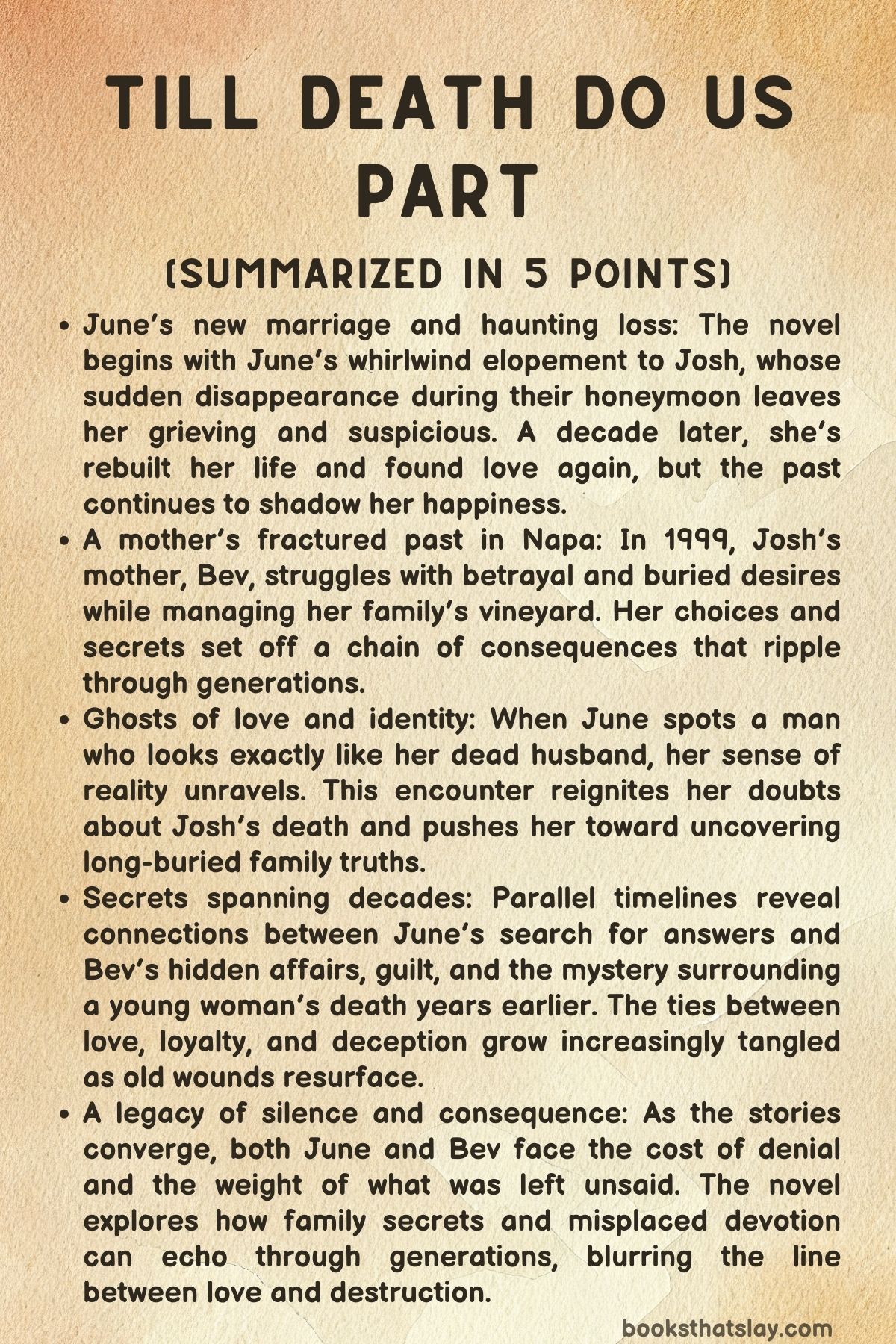
Summary
The novel opens in 2012, where June and her new husband, Josh Kelly, celebrate their elopement on a Santa Barbara beach. Their happiness is short-lived when Josh vanishes during a swim only a week later, leaving behind a cryptic text message that June is certain he didn’t send.
Believing there’s more to his disappearance than an accident, June’s life fractures under grief.
A decade later, June has rebuilt a quiet existence in Brooklyn. She runs a successful natural wine bar called Grape Juice and has found stability with her new partner, Kyle Parker.
When Kyle proposes during a picnic, June accepts, feeling both joy and the lingering ache of loss. Yet beneath her composed life, she remains haunted by doubts about Josh’s death.
Meanwhile, in 1999, Bev Kelly, Josh’s mother, manages the Golden Grape vineyard in Napa Valley with her husband, David. Once united by their shared passion for winemaking, their marriage has soured after Bev discovers David’s affair.
Reeling from betrayal, Bev faces the collapse of both her marriage and her family’s reputation. When Emilia Rosser, an old college acquaintance and former lover, reappears as a wine buyer, buried emotions resurface.
Their reunion ignites a secret affair that mirrors the same self-destructive patterns Bev once endured in her youth. As she wrestles with guilt and desire, her choices begin to shape the fate of her sons—Josh and Andrew—in ways she cannot foresee.
In the present, as June prepares for her upcoming wedding to Kyle, she glimpses a man who looks exactly like Josh watching her from across Prospect Park. Shaken, she convinces herself it must be coincidence, but the encounter triggers her long-buried suspicions.
When she later sees the same face outside her bar, her unease deepens. Determined to find answers, June plans a getaway to the Catskills with Kyle but remains tormented by visions of her dead husband.
During the trip, June stumbles across a Napa Valley winery website called the Backyard Winery. Its owner, Andrew Smith, bears an uncanny resemblance to Josh.
The discovery shocks her—Josh’s body was never recovered after his supposed drowning. Overcome with panic and disbelief, June becomes obsessed with uncovering the truth.
She hides her turmoil from Kyle, pretending everything is fine while secretly plotting to confront “Andrew.
The story shifts again to the late 1990s. Bev continues her affair with Emilia, finding fleeting solace amid the ruins of her marriage.
But her secret life begins to crack when Michelle Young, a local teenage girl romantically involved with her son Josh, dies by drowning near the family’s vineyard pond. The tragedy devastates the community and casts a shadow over the Kelly family.
Both Josh and his twin brother Andrew are questioned, but their vague statements leave Bev uneasy. When she finds Michelle’s necklace hidden beneath her mattress, she begins to suspect one of her sons knows more than he’s saying.
Fearing the destruction of her family, Bev chooses silence, burying the truth to protect them.
In 2022, June flies to California under the pretense of sourcing wines for her bar but is really on a mission to confirm Andrew Smith’s identity. At the Backyard Winery, she meets Marcel, the tasting-room manager, who casually reveals that the property was once the Golden Grape—the very vineyard owned by Josh’s family.
The revelation confirms June’s suspicions: Andrew Smith is actually Andrew Kelly, Josh’s twin brother. Still, Andrew remains unseen, and June’s obsession intensifies as she tries to uncover whether Josh could still be alive—or if Andrew has assumed his identity.
The novel continues to alternate between the two timelines, gradually exposing the generational web of lies. In Napa’s past, Bev’s affair with Emilia collapses when David unexpectedly returns home to reconcile.
Torn between guilt and longing, Bev chooses to stay with her husband, ending things with Emilia. But their family fractures further after Michelle’s death.
Andrew, tormented and unstable, accuses Josh of being responsible, while Josh denies it. Bev’s silence, meant to preserve her family, instead fuels a legacy of secrecy and mistrust.
Back in the present, June digs deeper into Josh’s history. She learns from Sadie Smith—Andrew’s wife—that Josh once blamed Andrew for leaking an explicit photo of his ex-girlfriend, an incident that sent Andrew to boarding school.
Sadie also reveals that Josh may have played a role in Michelle’s drowning, echoing local rumors that never died. Horrified, June confronts the possibility that Josh, the man she loved, had a dark side.
When she collapses from stress during a visit to the winery, she awakens to overhear Sadie whispering to someone—likely Andrew—about her. Terrified, June realizes she’s walked into danger but refuses to leave without answers.
The tension comes to a head when Kyle travels to Napa to bring June home. Instead, she persuades him to stay one more night so she can confront the truth.
As she pieces together the connections between Josh, Michelle, and Andrew, she learns of Michelle’s father, Rodney, who believes Josh killed his daughter. Rodney’s bitterness and erratic behavior unsettle June, but his words echo what others have hinted—that Josh’s charm hid something sinister.
The confrontation leaves her unsure of who to trust.
Parallel revelations in the past show Bev’s final unraveling. After discovering that her husband’s affair was with Michelle’s mother, Sylvie Young, Bev’s world implodes.
She divorces David, leaves California, and eventually rekindles her relationship with Emilia. The two women move abroad, leaving Bev’s youngest son, Kieran, in the care of her sister Camille.
Bev lives out her later years in Greece, at peace with her choices but forever burdened by silence.
In the present, June’s investigation spirals toward a deadly confrontation. Andrew, driven by grief and resentment, attacks Kyle, convinced he is connected to Josh’s death.
Chaos follows, and the truth remains obscured by conflicting testimonies and guilt. With no clear proof, June chooses to believe Kyle’s innocence, though she is haunted by the possibility that Josh was not the man she thought he was.
The novel closes with an epilogue that reveals the final secret. Eleven years earlier, Sadie—suspecting her husband Andrew of having an affair—arranged to confront him.
When she found Josh instead, she mistook him for Andrew and, in a jealous rage, pushed him off a cliff. Realizing her mistake, she covered up the death by sending June the final text from Josh’s phone.
His supposed drowning was, in fact, a murder born from mistaken identity.
The truth completes the novel’s circle of tragedy. Bev’s silence, Josh’s deception, and Sadie’s guilt intertwine across decades, leaving each generation scarred by the consequences of secrecy and misplaced love.
In the end, the title Till Death Do Us Part becomes both literal and symbolic—a reminder that love, when twisted by betrayal, can destroy the very lives it was meant to bind.
Characters
June Kelly
June Kelly stands at the emotional core of Till Death Do Us Part, a woman whose life is shaped by grief, love, and obsession. Once a carefree newlywed, June’s transformation from a hopeful young bride into a haunted, determined investigator illustrates the enduring impact of loss.
Her love for Josh is romantic yet fragile, built on intensity rather than understanding, and his mysterious disappearance leaves her trapped in a cycle of disbelief and longing. A decade later, she has reconstructed her life with painstaking care—running a wine bar, engaged to a steady man, Kyle—but her fragile peace collapses when she believes she sees her dead husband alive.
June’s mind becomes a battleground between reason and emotion, grief and hope. Her need for closure borders on self-destruction, yet it also defines her resilience.
Through her, the novel explores how the human heart clings to unresolved love and how trauma reshapes identity. June’s character reflects the novel’s central theme: that love, when entangled with secrecy and guilt, can both heal and destroy.
Josh Kelly / Andrew Smith
Josh Kelly is the story’s most elusive presence—both victim and perpetrator in the tangled web of family secrets. Charismatic and impulsive, Josh’s charm masks darker traits: jealousy, manipulation, and a volatile temper.
His relationships, particularly with Michelle Young and his twin brother Andrew, are poisoned by rivalry and insecurity. His supposed death sets the novel’s events in motion, but even in absence, Josh dominates June’s psyche.
When he reappears under the alias Andrew Smith, the truth of his character becomes murkier—he is no longer just a tragic figure but a man whose life and lies reverberate across generations. The eventual revelation that his death resulted from mistaken identity only heightens his symbolic role: Josh becomes the embodiment of how hidden desires and suppressed truths can twist into tragedy.
Kyle Parker
Kyle Parker represents the antithesis of Josh—a stabilizing presence who embodies rationality, care, and steadiness. His love for June is patient and sincere, yet shadowed by her past.
Kyle’s character raises questions about emotional inheritance: can one love fully when haunted by another? Despite his seeming normalcy, his connection to Michelle Young ties him to the dark legacy of the Kelly family, showing how no one in this story escapes the web of secrets.
Kyle’s journey from quiet supporter to possible suspect forces June—and the reader—to confront how perception and truth can diverge dangerously. His steadiness becomes a mirror reflecting June’s chaos, and his ambiguous past underscores the novel’s obsession with hidden sins.
Bev Kelly
Bev Kelly, matriarch of the Kelly family, embodies guilt and repression, her life spanning the vineyard’s rise and fall and the moral decay within her family. Her story in Till Death Do Us Part mirrors her son’s—an emotional portrait of passion curdled by secrecy.
Bev’s marriage to David is outwardly prosperous but inwardly corroded by betrayal. Her affair with Emilia Rosser revives her sense of identity yet also awakens long-buried guilt.
Bev’s defining conflict is not only with her husband but within herself—between duty and desire, truth and silence. Her complicity in concealing the truth about Michelle Young’s death marks the novel’s turning point, symbolizing how maternal instinct can warp into moral blindness.
By the end, Bev’s retreat into exile and eventual peace with Emilia reveal her as both victim and enabler, burdened with knowledge she believes too destructive to expose.
Andrew Kelly
Andrew Kelly, Josh’s twin, is the novel’s shadow self—a figure consumed by resentment, guilt, and displacement. Always in Josh’s shadow, Andrew’s life becomes a study in duality: he is both brother and mirror, rival and survivor.
His boyhood experiences in a fractured family shape him into a man who longs for recognition but is defined by secrets. The accusation that he was involved in Michelle’s death—and later, his mistaken involvement in Josh’s—cements his tragic role in the family’s cycle of pain.
Under the alias Andrew Smith, he attempts to build a new life, but even his new identity cannot sever the past. His confrontation with Kyle and June in adulthood collapses the illusion of reinvention, exposing how trauma repeats itself when left unspoken.
Andrew’s life is an echo of Bev’s choices, bound by the same silence and moral compromise.
Emilia Rosser
Emilia Rosser is the catalyst for Bev’s personal awakening and moral decline. Intelligent, enigmatic, and emotionally intuitive, Emilia represents the life Bev could have led—one defined by authenticity rather than repression.
Their rekindled affair blurs lines between love, nostalgia, and escapism. Emilia’s presence in the novel symbolizes temptation and truth, pushing Bev toward self-discovery while also deepening her guilt.
Her role transcends romantic subplot; she embodies the theme of forbidden love and the consequences of denying one’s nature. Through Emilia, the novel juxtaposes emotional honesty against societal constraint, showing how unacknowledged desire can fester into destructive secrecy.
David Kelly
David Kelly serves as the patriarchal core around which the Kelly family’s dysfunction revolves. Once a passionate vintner and devoted husband, David’s infidelity shatters both his marriage and his moral authority.
His pragmatic façade conceals cowardice—a man unwilling to confront the emotional fallout of his actions. David’s affair with Sylvie Young, Michelle’s mother, entwines his family’s fate with tragedy.
His moral weakness and insistence on silence perpetuate the Kelly family’s cycle of deceit. David is not villainous in intent, but his passivity and fear of scandal make him complicit in every hidden sin.
By the time Bev leaves him, his decline mirrors the decay of the Golden Grape vineyard—a symbol of a family consumed by the rot of its own lies.
Sadie Smith
Sadie Smith, Andrew’s wife, emerges late in the narrative but delivers its most devastating twist. Her character encapsulates the destructive power of jealousy and mistaken perception.
Outwardly the image of domestic perfection, Sadie hides deep insecurities and suspicions about her husband’s fidelity. Her fatal mistake—killing Josh, whom she confuses for Andrew—reveals how misunderstanding and possessiveness can lead to irreversible ruin.
Sadie’s act is both horrifying and tragically human, the final manifestation of the novel’s theme that love, when poisoned by secrecy and mistrust, can destroy the very thing it seeks to protect.
Michelle Young
Michelle Young is the ghost who haunts both timelines of Till Death Do Us Part. Though her presence is brief, her death anchors the Kelly family’s descent into darkness.
A young woman full of promise, Michelle’s drowning is more than a personal tragedy—it becomes a symbol of innocence destroyed by hidden desire and youthful cruelty. Her relationship with Josh, and possibly Andrew, exposes the toxic interplay of power, jealousy, and male entitlement.
Michelle’s death triggers decades of silence, shaping Bev’s guilt, Andrew’s resentment, and June’s quest for truth. She is the story’s first victim of secrets, her life and death setting in motion the generational curse that defines the novel.
Camille
Camille, Bev’s twin sister, represents the conscience and moral steadiness the Kelly family lacks. She stands as a voice of caution, urging Bev toward honesty and restraint.
When Bev ultimately abandons her family, Camille becomes the surrogate mother—raising Bev’s youngest son and preserving what little innocence remains. Her presence is understated yet essential; she embodies the possibility of redemption through love and responsibility.
Unlike her sister, Camille faces pain without retreating into denial. She serves as the moral counterbalance to the Kelly family’s collapse, the quiet strength that contrasts the chaos surrounding her.
Themes
Love, Loss, and the Persistence of Memory
In Till Death Do Us Part, love and grief form the emotional spine of the story, defining both June’s and Bev’s lives across time. For June, love begins as an intoxicating rush when she meets Josh—a relationship driven by chemistry and spontaneity.
But that same intensity becomes the source of endless grief when Josh disappears, leaving her with a hollow absence she can never fill. Even a decade later, as she builds a new life with Kyle, her love for Josh remains a living presence.
His memory seeps into her new beginnings, shaping her decisions and perceptions. The story suggests that grief never truly ends; instead, it evolves, transforming from raw pain into something subtler but equally powerful.
The text portrays love not only as a source of joy but as an indelible mark that survives even death. Bev’s experiences mirror this in a different register—her love for David decays under betrayal, and her rekindled affection for Emilia becomes both liberating and destructive.
The novel treats love as cyclical and volatile, capable of redemption and ruin alike. Both women wrestle with the permanence of emotional bonds—how love refuses to be confined by time, marriage, or morality.
The persistence of memory is what keeps June chasing ghosts and Bev tethered to her regrets. Love, in this world, is not an ending but an echo that endures long after the people who inspired it are gone.
Secrets, Lies, and the Corrosion of Truth
Every relationship in Till Death Do Us Part is built upon concealment, showing how secrecy corrodes even the most intimate connections. From the opening pages, deception is central—Josh’s final text, the disappearance that may not be what it seems, and Bev’s quiet knowledge of the moral rot within her family.
Lies become a form of survival, a means to preserve fragile illusions of happiness or control. Bev hides her affair and her suspicions about Michelle’s death, David hides his betrayal, and later, Sadie conceals the fatal truth about Josh’s drowning.
These layers of deceit form a generational chain that links past and present, showing how silence can be as destructive as overt violence. The novel portrays truth as something feared rather than sought; it is the one force capable of dismantling the façades that characters build around themselves.
June’s obsessive pursuit of what really happened to Josh becomes both a quest for closure and a descent into the same web of dishonesty that trapped those before her. Flynn’s portrayal of secrecy exposes how people lie not only to others but to themselves—to protect love, pride, or identity.
The slow unraveling of those lies demonstrates that the absence of truth is not neutral; it festers, reshaping families and identities until reality itself becomes suspect.
Identity, Duality, and the Question of Self
The motif of twins in Till Death Do Us Part turns identity into a haunting question rather than a fixed fact. Josh and Andrew’s mirrored existence—one dead, one living—reflects the fragile boundaries between who we are and who others believe us to be.
June’s confusion over whether she’s seeing her dead husband or a living twin symbolizes her deeper uncertainty about the man she loved. Was Josh truly the kind, passionate husband she remembers, or someone capable of cruelty and deceit?
The narrative suggests that identity is mutable, constructed through memory, perception, and lies. Bev’s hidden desires and her affair with Emilia reinforce this theme: she lives as a dutiful wife and mother while concealing a different, truer version of herself.
Across generations, the characters shape and reshape their identities in response to guilt, love, and societal expectations. Even Sadie’s fatal mistake—killing Josh believing he was Andrew—underscores how easily identity can blur into illusion.
By the end, the novel offers no stable truth about who anyone really was; it presents selfhood as something contingent and performative. Each person wears masks—of faithfulness, grief, or virtue—and those masks often become indistinguishable from their real faces.
Guilt, Redemption, and the Weight of Silence
Guilt saturates every corner of Till Death Do Us Part, driving characters toward decisions that deepen rather than resolve their pain. Bev’s silence about Michelle’s death becomes a lifelong burden that shapes her choices and isolates her from her children.
Her eventual flight to Greece represents not freedom but exile, an attempt to live with the unbearable knowledge of what she allowed to remain unspoken. For June, guilt manifests differently—she feels complicit in her inability to move on, as though loving again betrays her lost husband.
Her quest for answers is less about uncovering truth than about seeking absolution for surviving. Flynn’s treatment of guilt shows how it can become a form of identity in itself—something people nurture because it gives meaning to suffering.
Redemption, when it comes, is fragile and partial. Bev’s peace in the epilogue is not forgiveness but resignation; she accepts that some wounds are beyond repair.
Silence, therefore, becomes both shield and punishment. By choosing not to speak, the characters preserve their families but destroy their own sense of self.
The novel’s ending—where secrets remain buried—suggests that redemption often lies not in confession but in the capacity to live with ambiguity.
The Cycle of Inheritance and Generational Echoes
Across its dual timelines, Till Death Do Us Part traces how trauma and choices echo through generations, shaping lives long after the original events have passed. Bev’s decisions in 1999 ripple into June’s life in 2022, binding them in an unseen chain of consequence.
The Kelly family’s history of betrayal, concealment, and moral compromise becomes a legacy inherited by those who come after. The vineyard itself symbolizes this continuity—a space that outlasts its caretakers yet absorbs their sins.
June’s journey, though seemingly her own, mirrors Bev’s earlier path: both women try to rebuild from loss, both chase love as a means of healing, and both find that the past refuses to stay buried. Flynn’s portrayal of generational patterns suggests that emotional inheritance is more potent than bloodline; children unconsciously repeat their parents’ mistakes, carrying forward unspoken lessons about love, fear, and survival.
The final revelation—that Josh’s death was an accident born from mistaken identity—closes the circle but does not break it. Each generation inherits not just memory but the moral weight of what was concealed before them.
The novel’s lasting power lies in showing how history is never distant—it lives quietly inside every choice, waiting to surface when least expected.