To Kill a Queen Summary, Characters and Themes
To Kill a Queen by Amie McNee is a historical mystery novel set in 1579 London, blending intrigue, crime, and the complex dynamics of family and loyalty. The story follows Jack, a young man caught between the criminal world and his search for justice.
The city of London serves as the backdrop to his investigation into the murder of a woman named Mary Platter, while he simultaneously becomes entangled in a conspiracy involving an assassination attempt on Queen Elizabeth. As Jack navigates a web of lies, his strained relationship with his notorious father and his internal struggles come to the forefront, driving him toward an uncertain future.
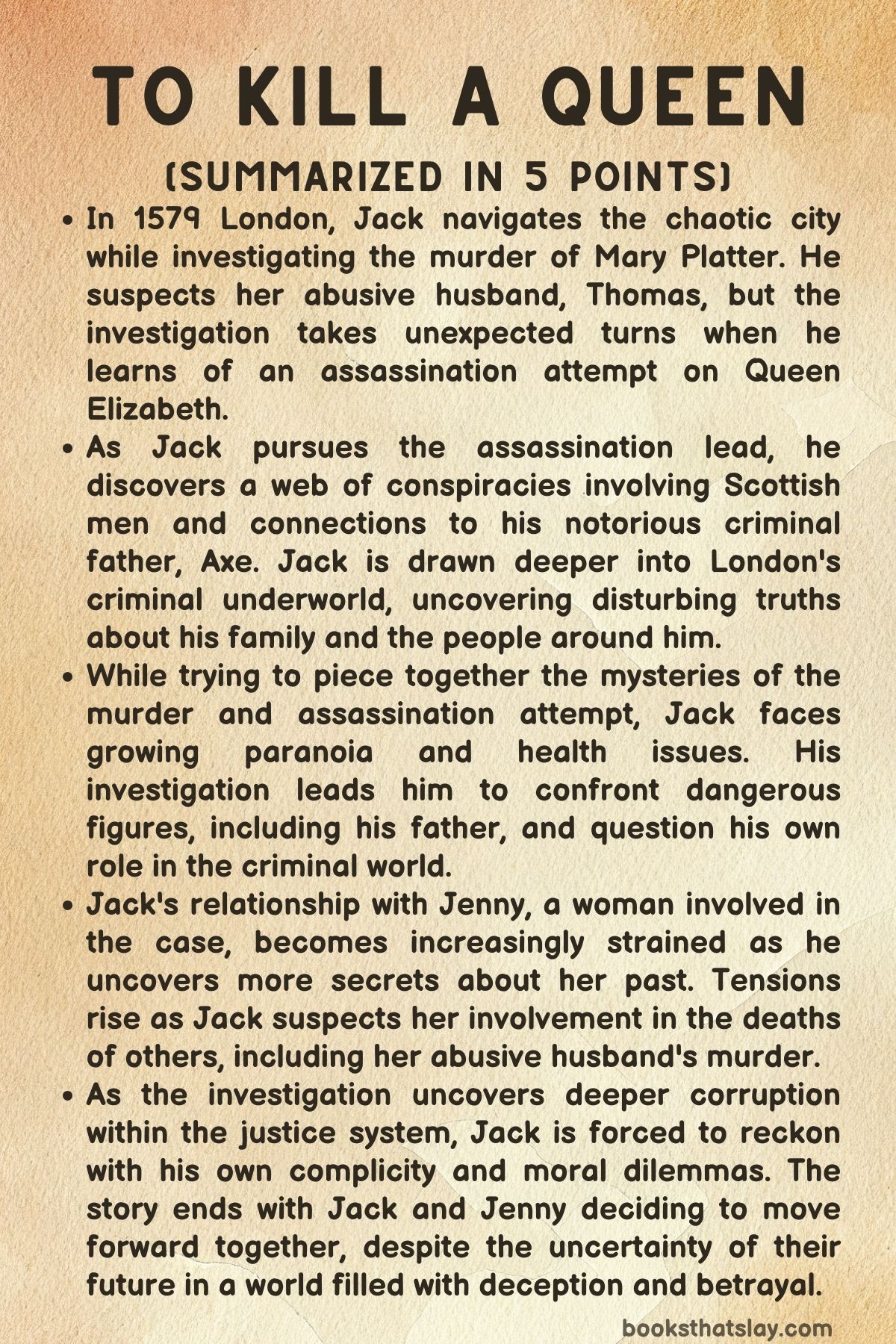
Summary
The story begins in the bustling streets of 1579 London, where Jack, the protagonist, is waiting for a meeting with Mad John, a madman who pretends to be disabled to earn money. After John performs his usual antics, he and Jack discuss Jack’s complicated relationship with his father, Axe, a notorious criminal.
Jack reveals that he is investigating the murder of Mary Platter, whose abusive husband, Thomas, is suspected of being the murderer. Jack’s investigation leads him to a brothel where he meets Jenny, a barmaid who helps him uncover more information about Thomas.
While Jack pursues leads on the murder, the city is shaken by news of an assassination attempt on Queen Elizabeth. Jack becomes caught up in the investigation of this new crime, meeting various characters who provide him with information.
He learns from his half-sister Lizzie that Catholic Scotsmen might be involved in the assassination attempt. Jack’s investigation brings him into contact with the darker sides of London, including its criminal underworld, and he uncovers conflicting information about both the murder and the assassination plot.
Jack’s quest for answers leads him to his father’s lair, Axe’s Den, where he confronts his father about his criminal past and learns more about the Scotsmen who might be involved in the royal incident. Axe reveals that his men had encountered a group of Scotsmen recently, offering Jack a lead to follow.
Jack also discovers a Bible that might hold clues regarding the Scotsmen’s activities. As Jack delves deeper into the criminal world, he continues to grapple with his identity and his connection to his father’s illegal dealings.
In one of his investigations, Jack encounters Fob, a shady character who mentions the presence of three Scotsmen in the area, one of whom has a red beard. This clue becomes crucial as Jack’s investigation into the assassination attempt intensifies.
Despite his growing health problems and paranoia, Jack presses on, seeking more information. His search brings him to the Justice of the Peace, Benjamin, and the Queen’s spymaster, Walsingham.
Jack shares his findings with them, hoping to gain official approval for his investigation into the Scotsmen and the assassination attempt.
Meanwhile, Jack struggles with his deteriorating health, including bouts of madness, which further complicate his investigation. As the story progresses, Jack faces moments of reflection and internal conflict, grappling with his sense of guilt, especially after the death of Mad John, who had warned him of the dangers ahead.
Jack’s suspicion grows, and he begins to believe that his father may be involved in the conspiracy surrounding the Queen’s assassination. He finds an orange beard at a theater, which matches the description of the red-bearded man linked to the assassination attempt.
Jack’s relationship with his father becomes increasingly strained as he continues to probe deeper into the plot. Axe denies any involvement, but Jack’s suspicions only grow stronger.
At the same time, Jack’s relationship with Jenny becomes more complicated as he discovers that she has her own secrets, including her involvement in her husband’s death, which she claims was in self-defense. Jack is torn between his loyalty to Jenny and his growing doubts about her innocence.
He continues to investigate, even as he becomes more entangled in the dark web of deceit surrounding him.
The investigation eventually takes Jack and Jenny into the world of theater, where they meet figures like Richard Tarleton and Burbage, uncovering more connections between the Scotsmen and Axe. Jack learns that his father has been manipulating people in the theater world, including a Scottish apprentice, for his own gain.
Despite his suspicions, Axe downplays the seriousness of the situation, pushing Jack to question his father’s true intentions.
As Jack continues his investigation, he uncovers more troubling details about the people involved, including his father’s role in orchestrating some of the events. Jack is left feeling trapped, uncertain about whom to trust, and questioning his own motivations.
His search for justice becomes increasingly complex as he struggles with his past actions and his internal battles. In the end, Jack realizes that no one is truly innocent, and everyone is hiding something.
His investigation into the Scotsmen and his father’s possible involvement in the assassination attempt continues, but Jack is left with a sense of betrayal and uncertainty, unsure of what the future holds.
The story concludes with Jack and Jenny deciding to move forward together, despite the dark world they live in. They both seek redemption for their past actions, but their future remains unclear, and they must navigate a corrupt and dangerous world filled with lies, manipulation, and deceit.
Jack’s journey through this tumultuous time in London serves as a reflection of his struggle to find meaning and purpose in a world where truth is elusive and the consequences of one’s actions are often far-reaching.
Characters
Jack
Jack is the protagonist of To Kill a Queen, a man caught in the chaos of London’s lawless streets, seeking answers about the murder of Mary Platter and the assassination attempt on Queen Elizabeth. Jack is a complex character, struggling with both personal and external challenges throughout his investigation.
He is haunted by his past, especially the estranged relationship with his notorious father, Axe, and his guilt over not intervening in the deaths of those he cares about, such as Annie, a prostitute with whom he had been close. This sense of guilt drives much of his actions, making him feel responsible for the harm done to others, even though his motivations are rooted in a desire for redemption.
Jack is intelligent, resourceful, and persistent, though his investigation leads him deeper into a web of lies and deception, often testing his trust in others. He is deeply conflicted between his loyalty to his family and his determination to uncover the truth, especially as he navigates the dangerous underworld of London, involving political conspiracies and personal betrayals.
Despite his internal chaos and health struggles, Jack remains focused on finding justice, though he increasingly questions his role in the conspiracy and his own identity.
Axe
Axe is Jack’s estranged father, a criminal mastermind whose influence looms large over Jack’s investigation and his personal life. Axe’s manipulative nature and his involvement in the criminal underworld make him a figure of both fear and necessity for Jack, as he continuously seeks information from him about the potential conspiracy surrounding the assassination attempt on Queen Elizabeth.
While Axe denies any direct involvement in the royal plot, his connections to various shady characters, including the Scotsmen, suggest that he might be more deeply entangled in the events than he lets on. Axe’s relationship with Jack is complicated and strained, characterized by both emotional manipulation and tough love.
Though he sometimes offers help or shelter, Axe’s true motives remain unclear, making him a constant source of both guidance and tension for Jack. His behavior often reinforces the themes of betrayal and mistrust, forcing Jack to confront uncomfortable truths about his father and his own role in the criminal world.
Jenny
Jenny is a key figure in To Kill a Queen, both as Jack’s lover and a woman with a troubled past. Her complex relationship with Jack is marked by secrecy, guilt, and a fierce desire to protect her children.
Jenny’s role in the investigation is significant, as she helps Jack gather information and provides emotional support, but her own secrets complicate the situation. Jenny confesses to having killed her abusive husband in self-defense, which adds a layer of moral ambiguity to her character.
She is also linked to the death of Annie, another woman Jack cared about, which deepens the mystery surrounding the murders. Jenny’s motivations are driven by desperation to protect her family, but as Jack uncovers more about her past, he struggles to reconcile the woman he loves with the possibility that she might be involved in the deaths of others.
Her actions reveal a deeply human struggle for survival and redemption, showing her as a flawed but ultimately sympathetic character.
Mad John
Mad John is an intriguing character who plays a pivotal role in Jack’s investigation. A madman who pretends to be disabled in order to earn money, John offers Jack valuable insights into both the criminal world and Jack’s personal struggles.
Despite his madness, John is perceptive and insightful, acting as a kind of moral compass for Jack at times. John’s relationship with Jack is complicated, as he represents both the chaotic, unpredictable nature of the world Jack is navigating and a sense of honesty that Jack often lacks.
John’s death marks a turning point for Jack, as he feels responsible for not heeding John’s warnings and becomes more determined to uncover the truth, even at great personal cost. Mad John’s role highlights the theme of fate and responsibility, forcing Jack to confront the consequences of his actions and the people he fails to protect.
Lizzie
Lizzie is Jack’s half-sister, a street urchin who provides him with valuable information about the attempted assassination of Queen Elizabeth. Her role in the investigation is crucial, as she helps Jack navigate the world of the royal court and introduces him to key players in the plot against the Queen.
Lizzie’s involvement in the story is marked by her resourcefulness and street smarts, which provide Jack with insights that others might overlook. She serves as a foil to Jack in many ways, being more attuned to the realities of life in the streets while Jack is consumed by his investigations and guilt.
Lizzie’s pragmatic approach to life and her willingness to help Jack, despite their complicated family dynamics, highlight her loyalty and practical sense, even though she operates in the shadows of the criminal world.
Damian
Damian is the coroner and a key figure in the unfolding investigation. As someone Jack turns to for information, Damian plays a dual role as both an ally and a source of mystery.
Throughout the story, Jack uncovers the truth about Damian’s troubled personal life, including his gambling habits and growing debts. Damian’s breakdown and eventual involvement in covering up crimes shed light on the darker aspects of the investigation, revealing that not everyone involved is working toward justice.
Damian’s complicity in the corruption of the investigation and his struggle with his own moral failings present a tragic aspect to his character, as he becomes entangled in the very system he was meant to uphold.
Fob
Fob is a shady character who provides Jack with important information about the Scotsmen, who might be involved in the assassination attempt on Queen Elizabeth. Fob is a figure who operates on the fringes of society, offering Jack leads while also introducing him to the paranoia and danger that accompanies the investigation.
Though Fob seems to know more than he lets on, his motivations remain unclear, leaving Jack to decide whether he can be trusted. Fob’s role emphasizes the theme of uncertainty, as Jack navigates a world where no one is fully trustworthy, and everyone has their own agenda.
Benjamin
Benjamin is the Justice of the Peace, a key player in the political and legal structures that Jack is trying to navigate. While initially appearing to be a trustworthy ally, Benjamin’s role in the corruption of the justice system comes to light as the story progresses.
He is shown to be more interested in his own advancement than in seeking true justice, making him another figure in the story who complicates Jack’s search for answers. His involvement in the investigation, though seemingly helpful at first, ultimately points to the pervasive nature of corruption, as he contributes to covering up the truth.
William Appletree
William Appletree is a witness who claims to have seen something suspicious during the assassination attempt. While Jack initially trusts him, Appletree’s reluctance to provide full details creates a sense of unease.
His involvement in the investigation is marked by ambiguity, as Jack begins to suspect that Appletree might have ulterior motives. Appletree’s role highlights the theme of unreliable testimony, as Jack finds himself questioning the motivations and integrity of everyone he encounters.
Richard Tarleton and Burbage
Richard Tarleton and Burbage are characters who appear later in the story, adding depth to the theater world and its connections to the conspiracy. Tarleton, a famous actor, and Burbage, the owner of the theater, are key figures in the world that Jack is investigating, with connections to Axe and the Scottish apprentice.
Their involvement in the investigation highlights the theme of theater as both an art form and a cover for political machinations, as Jack uncovers the role of actors and apprentices in the broader conspiracy against Queen Elizabeth. Through these characters, the story also explores the blurred lines between performance and reality, with Jack increasingly unsure of what is true and what is part of a larger deception.
Themes
Family and Legacy
The theme of family and its impact on identity is central to To Kill a Queen. Jack’s journey is marked by his complicated relationship with his father, Axe, a notorious criminal mastermind.
His father’s influence looms large throughout the investigation, shaping Jack’s actions, decisions, and his sense of self. The darker side of family ties is explored as Jack grapples with the reality of his criminal background and how his father’s deeds have affected his own choices.
Jack’s attempt to distance himself from his father’s legacy, while still being entangled in his father’s world, highlights the tension between familial loyalty and the desire for personal redemption. As Jack navigates the criminal underworld of London, he is continually confronted by the realization that his family, especially his father, has a significant hand in the events unfolding around him.
His investigations into the murder of Mary Platter and the attempted assassination of Queen Elizabeth bring him face-to-face with not only his father’s possible connections to the conspiracies but also the harsh truth that family ties are inescapable. These familial connections, filled with manipulation, deceit, and control, act as a constant reminder of how much of Jack’s actions are determined by the shadow of his father’s past.
Jack’s sense of guilt and responsibility is compounded by his relationships with others, such as his half-sister Lizzie and the troubled bond with his lover Jenny. Both relationships reflect the idea of family as a complex and burdensome force.
Lizzie, who provides him with crucial information about the royal assassination plot, also represents the loyalty that family members often feel for one another, despite their separate lives. Jenny’s connection to Jack is similarly fraught with secrets, including her role in the murder of her husband, which complicates Jack’s feelings of love and duty.
These tangled familial relationships reveal the difficulties of maintaining personal integrity when surrounded by betrayal and deception. The idea that one’s legacy and family history can shape their destiny, regardless of personal will, is one of the most pervasive themes throughout the novel.
Justice and Corruption
The quest for justice is a driving force for Jack throughout To Kill a Queen, yet the concept of justice becomes increasingly muddied as he uncovers more of the world around him. Jack’s investigation into the murder of Mary Platter and the assassination attempt on Queen Elizabeth reveals the complexities of the justice system in a city that is rife with corruption.
Jack constantly faces the challenge of distinguishing truth from lies, with multiple characters deceiving him, including those in positions of authority. His encounter with Walsingham, the Queen’s spymaster, exemplifies the blurred lines between justice and manipulation.
Although Walsingham claims to be seeking the truth, Jack realizes that the pursuit of justice is often entangled with personal and political interests, making it difficult to trust anyone.
The theme of corruption within the system is also highlighted by the actions of Damian, the coroner, whose personal vices, including gambling, have led him down a morally ambiguous path. Damian’s involvement in covering up crimes, as well as his manipulation of the truth, points to a larger critique of the justice system, where the desire for personal gain outweighs the pursuit of fairness.
Additionally, the role of figures like Ben, the justice of the peace, further complicates the idea of justice. His actions and alliances reveal the extent to which individuals in power are willing to turn a blind eye to corruption, further undermining the notion of a fair and just society.
As Jack uncovers more clues and pieces together the complex web of crimes, he realizes that justice is not always about righting wrongs but about navigating a world where corruption has eroded the very foundations of truth. This realization forces Jack to confront his own complicity in a system that is inherently flawed, questioning whether true justice can ever be achieved in such a world.
Redemption and Guilt
Redemption is a theme that runs parallel to Jack’s investigation into the darker corners of London, as he grapples with his past actions and the consequences of those actions on others. Throughout To Kill a Queen, Jack is tormented by feelings of guilt, particularly in relation to his father, Axe, and his involvement in the criminal world.
His personal quest for redemption is driven by his desire to atone for the wrongs he has committed, even though the path to redemption is obscured by the corrupt nature of the world around him. Jack’s feelings of guilt are compounded by the death of his friend, Annie, whose death Jack believes is partially his fault for failing to intervene in situations that could have saved her.
Jack’s sense of responsibility for her death, despite his inability to prevent it, becomes a pivotal moment in his emotional journey. He seeks redemption not only for his own actions but for the systemic wrongs he sees around him, particularly in relation to the deaths he is investigating.
Jack’s complex relationship with Jenny also plays into the theme of redemption. Jenny’s own confession about killing her abusive husband in self-defense complicates Jack’s view of her.
While he initially struggles with trusting her, understanding her actions allows Jack to see the desperation and survival instincts that led her to commit the murder. Jenny’s own guilt and her desire to protect her children mirror Jack’s own feelings of inadequacy and his need to reconcile with his past.
Both characters are searching for ways to make amends, but their journey is hindered by the web of lies and deceit that surrounds them.
The theme of redemption is also reflected in Jack’s desire to distance himself from his father’s legacy. He sees his work, particularly his investigation into the royal conspiracy, as a way of doing something right in a world filled with wrongs.
However, the more he unravels the mysteries of the crimes, the more he realizes that redemption may not be attainable, especially in a society where corruption and moral ambiguity reign. His quest for redemption becomes a constant internal struggle, highlighting the difficulty of reconciling personal guilt with the harsh realities of life.
Power and Manipulation
Power and manipulation are central themes in To Kill a Queen, with characters constantly seeking to control or influence one another in their pursuit of their own agendas. Jack’s interactions with his father, Axe, reveal the extent to which power is wielded and manipulated in the criminal underworld.
Axe’s manipulative nature is apparent as he continues to control Jack through psychological tactics, using their familial bond to maintain influence over him. Axe’s actions highlight how power can be used to shape individuals, forcing them to comply with the wishes of those in positions of authority, even when they are morally compromised.
The theme of power is also explored through the character of Walsingham, who represents the political forces that operate behind the scenes, manipulating events for their own gain. Walsingham’s role as a spymaster is a constant reminder of the influence that power holds in shaping the course of history.
Jack’s investigation into the attempted assassination of Queen Elizabeth reveals the complex interplay between political power and personal ambition, with Walsingham’s hidden motives becoming a central part of the narrative. The theme of manipulation is further explored through Jack’s relationships with others, such as Jenny, whose secrets and lies reveal how people use information and relationships to control the narrative.
As Jack unravels the web of deceit, he comes to understand that the power dynamics at play are often more dangerous and influential than any single act of violence or betrayal.
In To Kill a Queen, the struggle for power manifests in various forms—through familial relationships, political intrigue, and personal ambitions. The constant manipulation and control exercised by those in power, particularly Axe and Walsingham, demonstrate the lengths to which people will go to protect their interests.
Jack’s journey reveals that power, in all its forms, is not just about authority or force, but about the ability to manipulate and control the lives of others.