Tourist Season Summary, Characters and Themes
Tourist Season by Brynne Weaver is a dark romantic thriller centred on two killers whose planned confrontation becomes an intense battle of attraction, revenge, guilt, and survival.
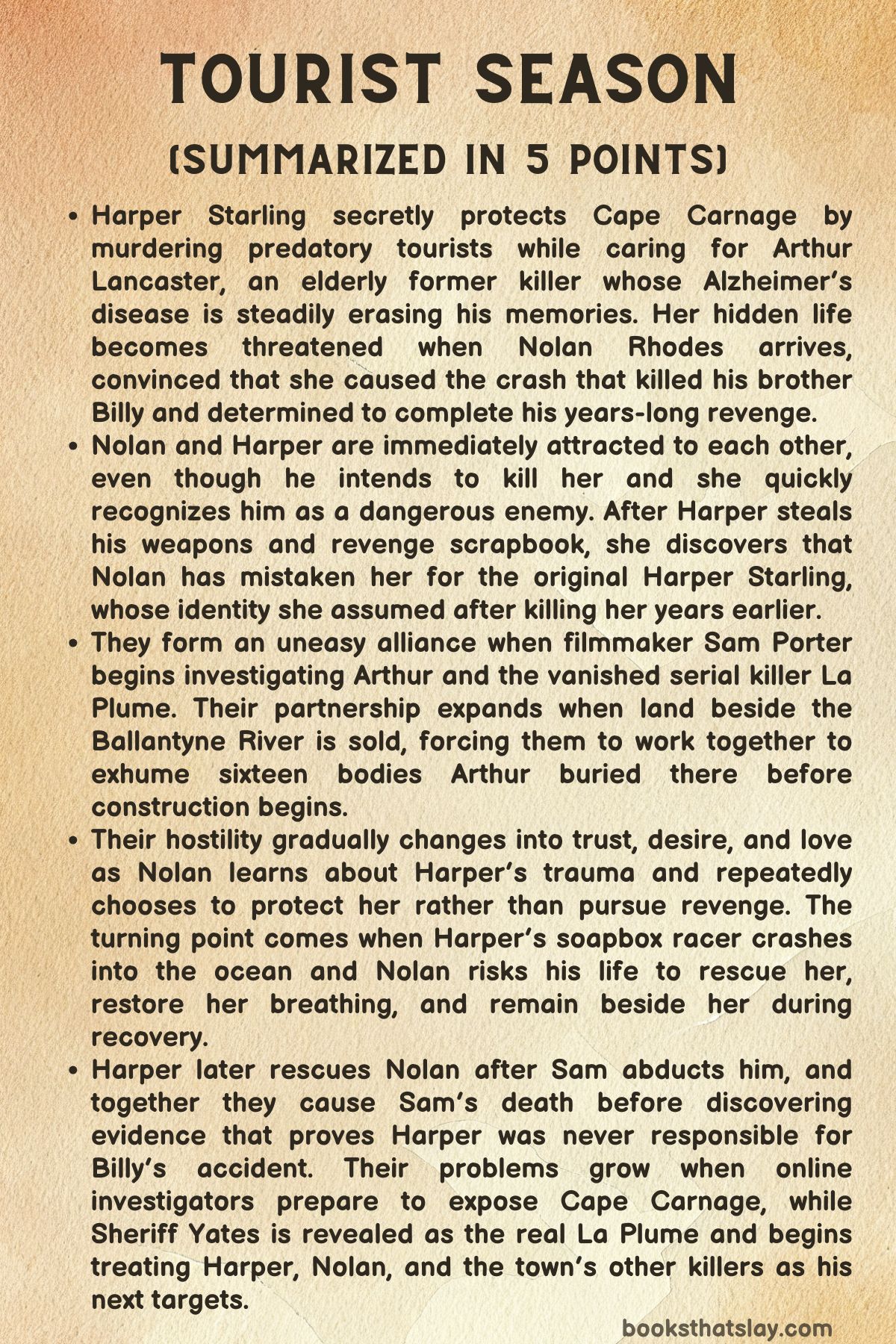
Harper Starling secretly protects the coastal town of Cape Carnage by murdering predatory visitors, while Nolan Rhodes arrives intending to punish her for a fatal accident that destroyed his family. Their conflict gradually exposes mistaken identities, hidden crimes, buried bodies, and a dangerous investigation into the town’s past. Violent humour, morally complicated characters, consensual power dynamics, and emotional vulnerability shape a story in which love develops between two people who initially believe they should destroy one another.
Summary
Harper Starling has lived in Cape Carnage, Maine, for four years under a stolen identity. She works as the gardener at Lancaster Manor, but she also murders tourists who abuse, exploit, or endanger local residents.
Her latest target is Bryce Mahoney, a repeat offender who secretly photographs women. Harper kills and dismembers him before feeding his remains through her woodchipper, Cookie Monster, and using the material in her garden.
Harper’s closest companion is Arthur Lancaster, the elderly owner of the manor. Arthur once protected Cape Carnage through his own murders, but Alzheimer’s disease is steadily damaging his memory, balance, and sense of identity.
Harper cares for him, hides his mistakes, preserves his stories, and protects the evidence of his crimes. Her loyalty comes from gratitude because Arthur gave her a home when she was frightened, isolated, and running from a traumatic past.
Nolan Rhodes arrives in town pretending to be an ordinary birdwatching tourist. In reality, he has spent four years searching for Harper because he believes she drove the car that killed his younger brother, Billy, and left Nolan critically injured.
After recovering from the collision, Nolan began killing the other passengers who abandoned him and Billy. He murdered Marc Beaumont, Dylan Jacobs, and Trevor Fisher, preserving pieces of their matching tattoos in a scrapbook documenting his revenge.
Nolan believes the driver survived after sending the car into the sea and disappearing. Financial activity connected to Harper Starling eventually leads him to Cape Carnage, where he plans to make her his final victim.
Harper and Nolan meet at a coffee shop before either fully understands the other’s identity. Their conversation is awkward, flirtatious, and charged with immediate recognition because both sense something dangerous beneath the other’s attractive appearance.
Their attraction changes when Nolan hears Harper’s name. He instantly realizes that she is the woman he came to kill, while Harper notices the sudden coldness in his expression and understands that he represents a serious threat.
Nolan later sees Jake Hornell watching Harper through her cottage window. Although Nolan still wants revenge, jealousy and protectiveness take control, and he kills Jake before placing the severed head inside Harper’s bird feeder.
Nolan expects Harper to react with horror. Instead, she calmly examines the head, asks Arthur whether he committed the murder, and treats the discovery as a practical problem.
When Nolan reveals himself, Harper learns that he has been hunting her. Their confrontation establishes them as equally dangerous opponents, yet Nolan is unsettled to discover that killing Jake has helped rather than hurt her.
Harper breaks into Nolan’s room to learn why he is targeting her. She finds his weapons, his scrapbook, photographs of his injuries, and the names of everyone connected to the fatal collision.
The evidence reveals Nolan’s belief that Harper was driving. Harper knows that his central assumption is wrong because she is not the original Harper Starling.
The real Harper was Harper’s first victim. After killing her, the woman now living in Cape Carnage stole her identity and used it to disappear from everyone searching for Autumn Bower, her real name.
Harper steals Nolan’s scrapbook and weapons, using them as protection. Nolan is furious but increasingly fascinated because she is not frightened prey; she is an intelligent rival capable of anticipating and challenging him.
A documentary filmmaker named Sam Porter creates another threat. Sam is investigating La Plume, a serial killer who carved writing into victims and disappeared after murdering Arthur’s daughter, Poppy.
Sam suspects that Arthur is La Plume and believes Cape Carnage has protected him. Harper is terrified because Sam previously participated in the online investigation into Autumn Bower’s disappearance and could expose her real identity.
Harper offers Nolan a bargain. He must protect Arthur and drive Sam out of town, and she will eventually return his weapons and scrapbook.
Their forced alliance expands when Lukas Lancaster sells land beside the Ballantyne River to developers. Arthur’s private criminal record reveals that sixteen bodies are buried there, meaning construction could expose decades of murders.
Harper asks Nolan to help her remove the remains before the sale closes. During their nightly exhumations, their hostility remains, but physical attraction and emotional curiosity become increasingly difficult to ignore.
Nolan notices Harper’s exhaustion, loyalty, strength, and concealed fear. Harper begins to feel safer beside him in the darkness, even though she still believes he intends to kill her once their agreement ends.
Arthur’s worsening condition shows Harper how much she stands to lose. He admits that his murder bag and criminal records help him remember who he once was, while Harper reminds him that his identity also includes kindness, humour, gardening, and love.
A drone appears over Harper’s cottage, making her think Nolan has betrayed her. Nolan denies flying it and realizes that Sam’s investigation is becoming more aggressive.
Harper later drugs Nolan with psilocybin while they work beside the river. When Sam unexpectedly approaches, Nolan pulls Harper into the water to hide, only to discover that she cannot swim and is terrified of drowning.
Nolan supports her until Sam leaves. Under the drug’s influence, he admits that he finds her beautiful and deliberately releases his grip when touching her throat, demonstrating that he can possess power without violating her limits.
At Harper’s cottage, their anger, desire, grief, and guilt lead to rough but consensual sex. Harper asks him to express the punishment she believes she deserves, while Nolan repeatedly respects her choices and offers her opportunities to stop.
Afterward, Nolan notices that Harper sleeps with several lamps burning because darkness frightens her. Instead of killing her while she is vulnerable, he gently kisses her cheek, revealing how far he has already moved from revenge.
Harper’s past gradually becomes clearer. She and her boyfriend, Adam Cunningham, were kidnapped by serial killer Harvey Mead, and Harper was forced to hear Adam being murdered.
Another captive, Sloane Sutherland, helped defeat Mead and was later revealed as the Orb Weaver, a killer who targeted other murderers. Harper has tried to imitate Sloane’s fearlessness, but she privately believes she failed Adam by surviving when he did not.
Harper’s protective instincts lead her to abduct Sean McMillan after he attacks a pregnant nurse. She plans to murder him while Arthur is hospitalized so that Sam will have proof that Arthur cannot be responsible for every killing.
Nolan discovers McMillan restrained in Harper’s garden. When McMillan escapes and attacks them, Harper kills him with an axe, but her inability to trust Nolan turns his concern for her safety into another argument.
Their relationship begins changing after they attend a theatrical performance with Arthur. Sam confronts Harper and reveals that he knows the original Harper Starling should be dead, proving that he is close to uncovering Autumn’s identity.
Nolan silently supports Harper during the performance by holding her hand. Arthur, briefly mistaking Harper for Poppy, warns her never to reveal her real name because dangerous people use personal truths as weapons.
Harper later explains that she met Arthur while they were both hunting the same predator. Arthur killed the man first, recognized Harper’s nature, and offered her a home on the condition that she protect Cape Carnage after he could no longer do so.
Nolan asks who protects Harper while she protects everyone else. His question exposes the loneliness beneath her independence, and their growing intimacy allows Harper to experience controlled fear and pain without losing agency.
During a dinner date, Harper asks about Billy and Nolan’s family. Nolan realizes he no longer wants only an explanation for the collision; he wants to understand Harper as a complete person.
Nolan breaks into Sam’s room and finds tide charts, photographs of Harper, and evidence concerning a submerged camper van. He recognizes that Sam’s interest has become predatory and that the van may be connected to Harper’s concealed past.
Harper enters Cape Carnage’s gravity race using an old soapbox vehicle called the Pocket Rocket. The brakes and steering fail, sending her racing toward a cliff above the ocean.
Nolan pursues her on a bicycle, but the racer leaves the cliff and sinks. Harper becomes trapped underwater, and Nolan dives after her despite his injuries and trauma.
He cuts her free, brings her to the surface, and performs CPR after finding that she has no pulse. Harper eventually begins breathing again, forcing Nolan to accept that her death is the last thing he wants.
During her recovery, Nolan continues exhuming Arthur’s victims alone. Harper tells him that he has restored her desire to live, while Nolan admits that she dominates his thoughts and dreams.
Harper retrieves Nolan’s backpack from the manor basement, even though the cellar triggers memories of Mead’s captivity. Her decision to return the evidence shows that she no longer wants their relationship to depend on blackmail.
Arthur later manipulates Nolan into returning his murder bag. He kills another tourist, forcing Harper and Nolan to manage both his declining condition and the practical consequences of his continued violence.
Nolan decides to move into Harper’s cottage and help her permanently. Before he can leave the inn, Sam captures him at gunpoint and takes him to the abandoned Lancaster Distillery.
Harper initially believes Nolan has abandoned her after recovering his belongings. She soon discovers that he never checked out and overhears Vinny, Sam’s drone operator, discussing Nolan’s abduction.
Harper incapacitates Vinny and goes to the distillery. Sam has restrained Nolan and is trying to force him to confess to several murders while threatening to expose Harper.
Harper secretly frees Nolan’s legs, and together they knock Sam over a railing. When Sam is left hanging upside down, Harper loosens his boot and causes him to fall to his death.
Nolan assures Harper that he did not leave her. They clean the scene, remove Sam’s research, and attempt to present his death as an accident.
Nolan later accesses the private Sleuthseekers server and finds records concerning missing influencer Autumn Bower. Videos show Autumn travelling with Adam before surviving Harvey Mead and disappearing.
The silver bracelet Morpheus gave Nolan carries initials belonging to Autumn and Adam. Comparing Autumn’s image with photographs of the original Harper proves that they are two different women.
Nolan finally understands that trauma distorted his memory and that the woman he blamed never drove the car that killed Billy. His revenge was built on a mistaken identity, leaving him horrified by everything he threatened to do to an innocent person.
Before he can confront Harper, the Sleuthseekers learn that Sam and Vinny are dead and prepare to descend on Cape Carnage. Nolan and Harper now face a wider investigation capable of exposing every secret they have protected.
Sheriff Yates arrives at the distillery and finds Sam’s body. When the injured Vinny appears, Yates questions him about Nolan, Arthur, the buried bodies, and Harper’s real identity.
Rather than arresting Vinny, Yates stages a violent confrontation and shoots him. His behaviour reveals that he has quietly observed Cape Carnage’s killers and views them as possessions within a private game.
Yates then uses language associated with La Plume and describes the calculated methods he uses to disorient his victims. The final revelation confirms that Arthur was never La Plume; Sheriff Yates is the serial killer, and Harper and Nolan have become his newest targets.
Characters
Harper Starling / Autumn Bower
At the centre of Tourist Season, Harper is a killer, survivor, gardener, caregiver, and protector whose violence cannot be separated from her trauma. She selects victims who have harmed vulnerable people, allowing her to frame murder as a private form of justice rather than uncontrolled cruelty.
Her stolen identity represents both survival and self-erasure. By becoming Harper Starling, she avoids the attention surrounding Autumn Bower, but she also traps herself inside a name connected to Nolan’s grief and revenge.
Harper’s loyalty to Arthur reveals her greatest strength and weakness. She loves him as a mentor and father figure, yet her determination to preserve his freedom makes her accept impossible responsibilities, including hiding bodies, controlling his weapons, and managing his declining health alone.
Her fear of darkness, drowning, basements, and abandonment shows that competence has not erased her trauma. She has constructed a frightening persona because she believes fearlessness is necessary for survival, but the novel repeatedly shows the frightened woman beneath that performance.
Her relationship with Nolan challenges her belief that safety must come exclusively from self-reliance. She slowly learns that accepting protection does not require surrendering independence, identity, or control.
Nolan Rhodes
Tourist Season presents Nolan as a man who has transformed grief into a disciplined system of revenge. His killings, scrapbook, preserved tattoos, and yearly rituals create the illusion that punishment can give structure to a life shattered by Billy’s death.
Nolan initially sees Harper as the final object in that system rather than as a person. His failure to recognize her before hearing her name proves that his hatred is attached more strongly to an imagined enemy than to the actual woman standing before him.
His attraction to Harper produces jealousy, protectiveness, guilt, and confusion. Killing Jake reveals that his instinct to defend her appears before he consciously abandons revenge, while his work against Sam demonstrates that concern eventually becomes more powerful than hatred.
Nolan’s physical injuries remain central to his identity. Chronic pain connects him to the collision, but it also emphasizes his persistence when he swims through freezing water, excavates bodies, pursues the Pocket Rocket, and dives from a cliff to save Harper.
His emotional development depends on replacing certainty with curiosity. Once he stops demanding that Harper fit the role he created for her, he begins seeing her vulnerability, loyalty, humour, intelligence, and capacity for care.
Arthur Lancaster
Arthur is Harper’s employer, mentor, closest friend, and chosen family. His history as a killer complicates his warm personality because the same man who murders offensive tourists also teaches, shelters, jokes with, and deeply loves Harper.
His Alzheimer’s disease creates one of the novel’s most painful conflicts. Arthur is not only losing memories but also losing access to the identity he built, causing him to cling to his murder bag and criminal records as proof that he once possessed power and purpose.
Harper’s relationship with him shows that care involves more than physical assistance. She protects his dignity, redirects his confusion, preserves his stories, and reminds him that violence is not the only quality that defines him.
Arthur also carries unresolved grief over Poppy. His tendency to mistake Harper for his daughter reveals both the depth of his loss and the emotional role Harper has assumed in his life.
Despite his decline, Arthur remains clever and manipulative. His ability to convince Nolan to retrieve the murder bag proves that illness has weakened his memory without entirely removing his cunning.
Sheriff Yates
Sheriff Yates initially appears to be a quiet authority figure who knows more about Cape Carnage than he openly admits. His carefully worded questions suggest that he monitors the town’s crimes while deciding which actions deserve investigation.
The ending reveals that his apparent tolerance is not kindness or loyalty. Yates protects the town because he considers its killers part of his private collection, turning observation into a form of ownership.
As La Plume, he represents violence driven by artistry, control, and psychological domination. Unlike Harper, who selects targets according to a personal moral code, Yates treats human beings as materials for elaborate experiences.
His police position gives him institutional power in addition to physical danger. He can manipulate evidence, stage self-defence, influence investigations, and approach his intended victims while appearing legitimate.
Yates becomes especially threatening because he now knows Harper’s identity, Nolan’s crimes, Arthur’s burial locations, and the weaknesses within their relationships. He is positioned not merely as another killer but as someone capable of controlling the entire narrative surrounding them.
Sam Porter
Sam presents himself as a documentary filmmaker seeking truth about La Plume. His investigation initially appears reasonable because Arthur possesses a violent history, Poppy’s death remains unresolved, and Cape Carnage clearly hides criminal activity.
His methods gradually expose a more exploitative personality. He trespasses, flies drones over private property, collects photographs of Harper, studies her emotions, and attempts to turn personal trauma into profitable entertainment.
Sam’s obsession with producing a sensational story matters more to him than protecting victims or establishing justice. He threatens Harper’s identity and tortures Nolan for information because suffering becomes valuable when it can be recorded and distributed.
He functions as a predator without the same type of violence used by Harper and Nolan. His weapon is exposure, and he believes access to private information grants him authority over the people he investigates.
His death results from underestimating Harper and Nolan’s loyalty to one another. He believes fear will separate them, but the threat against Nolan motivates Harper to risk everything to rescue him.
Lukas Lancaster
Lukas is Arthur’s grandson and one of the few people Harper trusts with practical responsibilities. His willingness to hide Nolan’s backpack without examining it shows faith in Harper, even when he senses that she is involved in something dangerous.
His decision to sell the Ballantyne River property unintentionally creates the crisis involving Arthur’s buried victims. The sale illustrates how ordinary choices can threaten secrets that have remained hidden for decades.
Lukas’s unresolved love for Maxine adds emotional vulnerability to his character. Her unexplained disappearance has left him unable to fully separate memory from hope.
Although he lacks complete knowledge of Harper’s life, Lukas treats her as part of the Lancaster family. His trust helps Harper recognize that she possesses a community even when she continues behaving as though she is alone.
Irene
Irene owns the Capeside Inn and welcomes Nolan without recognizing the violence behind his pleasant behaviour. Her easy trust allows both Nolan and Harper to gain access to information, rooms, security codes, and private spaces.
She contributes humour and warmth to a town filled with death. Her interest in Nolan’s relationship with Harper reflects Cape Carnage’s tendency to absorb outsiders quickly and observe personal developments collectively.
Irene also represents the apparent innocence of the local community. Whether she understands more than she reveals remains uncertain, but her casual reactions suggest that unusual behaviour has become normal within Cape Carnage.
Arthur’s attraction to her gives him an emotional identity beyond murder and illness. Through Irene, the story reminds readers that elderly characters continue to experience romantic interest, embarrassment, pride, and desire.
Maya
Maya is Harper’s neighbour and a symbol of the ordinary life Harper tries to protect. Her unexpected arrival while Harper and Nolan are concealing body parts creates dark humour but also shows how closely violence exists beside everyday friendship.
Her strawberry products repeatedly become part of Harper and Nolan’s criminal activities. The contrast between homemade sweetness and hidden danger reflects Cape Carnage itself, where charming businesses coexist with murder.
Maya trusts Harper and accepts strange explanations because she has no reason to imagine the truth. That trust increases Harper’s responsibility because every reckless choice could place innocent neighbours in danger.
Adam Cunningham
Adam is Harper’s murdered boyfriend and the emotional centre of her unresolved grief. His death under Harvey Mead’s control becomes the event against which Harper measures every later decision.
Harper remembers his kindness through small details, including his willingness to lose chess games for her. These memories prevent Adam from becoming only a symbol of suffering; he remains connected to affection, humour, and the future they expected to share.
Harper believes she failed him because she survived. Her killings, secrecy, and refusal to accept protection are partly attempts to ensure that she will never again be powerless while someone she loves is harmed.
The bracelet bearing their initials represents both love and a lost identity. When it helps Nolan discover the truth, Adam’s memory becomes the evidence that finally frees Harper from blame for Billy’s death.
Billy Rhodes
Billy is Nolan’s younger brother, whose death motivates the revenge campaign. Although he is absent from the main action, his ambitions, particularly his hope of becoming a pastry chef, give emotional specificity to Nolan’s loss.
Nolan has reduced Billy’s memory to the moment of death because rage makes that moment easier to preserve than the whole person. Harper’s questions about Billy encourage Nolan to remember his personality and dreams rather than only the collision.
Billy also becomes a measure of Nolan’s changing priorities. During Harper’s drowning, Nolan relives his failure to save his brother but refuses to accept the same ending again.
Saving Harper does not erase Billy’s death. Instead, it allows Nolan to honour his brother by choosing life over another act of punishment.
Sloane Sutherland
Sloane is a fellow survivor of Harvey Mead and secretly operates as the Orb Weaver, a murderer of other killers. Her calmness during captivity gives Harper a model of strength that later becomes almost impossible to imitate.
Harper views Sloane as fearless, capable, and self-sufficient. This admiration contributes to Harper’s belief that visible fear represents failure, even though courage does not require the absence of terror.
Sloane’s influence helps explain Harper’s decision to target predators. Harper adopts a similar moral structure but combines it with Arthur’s commitment to protecting a specific community.
Harvey Mead
Harvey Mead is the serial killer responsible for Harper’s deepest trauma. By kidnapping Harper, Adam, and Sloane, he establishes the conditions that destroy Harper’s previous identity.
His cruelty continues influencing Harper years after his death. Darkness, confinement, basements, helplessness, and emotional attachment all become connected to the danger he created.
Mead’s greatest lasting impact is Harper’s belief that loving someone gives an enemy a weapon. Nolan’s relationship with her therefore threatens the survival strategy she developed after Adam’s murder.
Poppy Lancaster
Poppy is Arthur’s murdered daughter and Lukas’s mother. Her death connects the Lancaster family to La Plume and shapes Arthur’s determination to protect Harper.
Arthur’s confusion between Poppy and Harper shows that the two women occupy related emotional spaces in his mind. Harper cannot replace Poppy, but Arthur’s fear of losing another daughter explains his secrecy and protectiveness.
Poppy’s murder also demonstrates the consequences of attracting a killer’s attention. Her fate supports Arthur’s warning that hidden truths can become dangerous when discovered by someone who values control.
Morpheus
Morpheus is the raven Harper raised and one of her most reliable companions. He assists with the disposal of human remains, warns Harper of approaching danger, and moves comfortably between the story’s grotesque and affectionate elements.
His loyalty reflects Harper’s ability to nurture despite her violence. She does not treat him merely as a tool but as a trusted presence within her isolated household.
Morpheus also becomes an unexpected carrier of truth when he gives Nolan the bracelet bearing Autumn and Adam’s initials. Through this action, the animal Harper protected helps expose the identity she has worked hardest to conceal.
Vinny
Vinny serves as Sam’s drone operator and accomplice. He assists with surveillance even after it becomes clear that Sam’s investigation violates privacy and places people in danger.
Unlike Sam, Vinny appears uncertain about the extreme direction of the investigation. His concerns suggest that he recognizes the risks but lacks the courage to withdraw.
Harper incapacitates him rather than killing him, but Yates later uses him to stage a false act of self-defence. Vinny’s fate demonstrates how weaker participants can become disposable once more powerful predators no longer need them.
Jake Hornell
Jake is a local predator who secretly watches Harper through her window. His behaviour makes him an immediate target for Nolan, whose jealousy and protectiveness override his original plan.
Jake’s death is important because it reveals that Nolan’s relationship with Harper begins changing before either acknowledges it. Nolan wants to terrify her with the severed head, yet the murder actually removes a danger from her life.
Jake also demonstrates Harper’s familiarity with predatory men. Her calm reaction shows that violence has become an expected part of her environment rather than an unimaginable disruption.
Themes
Revenge, Justice, and Moral Contradiction
Violence in Tourist Season is repeatedly justified through personal codes rather than legal standards. Harper kills predators who harm residents, Nolan murders those he blames for Billy’s death, Arthur protects the town through selective executions, and Yates uses institutional authority to conceal his artistic cruelty.
The differences between these killers matter, but none of them can claim moral innocence. Harper’s victims may be abusive, yet she still appoints herself investigator, judge, and executioner without allowing the possibility of error.
Nolan’s revenge demonstrates the danger of certainty. He spends years hunting people on the strength of damaged memories and incomplete information, eventually discovering that his final target was not responsible for the collision.
His mistake does not make his grief false, but it exposes how grief can become destructive when punishment replaces understanding. The person seeking justice may create new victims while continuing to believe that suffering proves loyalty to the dead.
Sheriff Yates represents the darkest form of this contradiction because he possesses legal authority but pursues violence for ownership and creative satisfaction. The novel therefore refuses to divide its characters into simple heroes and villains, asking instead what motives, limits, choices, and consequences distinguish protection from predation.
Identity, Memory, and the Reinvention of the Self
Harper’s stolen name allows her to survive, but it also places her inside another woman’s history. She becomes responsible for crimes, relationships, and accusations attached to Harper Starling, while Autumn Bower remains hidden beneath fear and guilt.
Nolan’s identity is similarly controlled by the past. He defines himself as Billy’s avenger, preserving evidence of his killings because the scrapbook gives his pain a visible structure.
Arthur’s illness presents identity from another direction. While Harper and Nolan actively construct identities, Arthur loses access to his memories and fears that the disappearance of his violent history means the disappearance of himself.
Harper tries to preserve Arthur through stories, routines, and reminders of qualities unrelated to murder. Her care suggests that identity exists not only in memory but also in relationships and in what others continue to hold for someone.
The discovery of Harper’s real name does not restore the person she once was. Autumn cannot simply return to life unchanged because survival, murder, grief, caregiving, and love have all altered her.
The story instead treats identity as something continually rebuilt. Healing does not require returning to an untouched former self; it requires accepting that every name, scar, memory, and choice belongs to the same evolving person.
Love as Recognition, Trust, and Protection
Harper and Nolan’s relationship begins with false assumptions. Nolan sees a murderer responsible for Billy’s death, while Harper sees a hunter who can never care about her beyond revenge.
Attraction develops before knowledge, but lasting attachment only becomes possible when they start observing one another accurately. Nolan notices Harper’s fear of darkness, loyalty to Arthur, guilt over Adam, inability to swim, and exhaustion from carrying responsibilities alone.
Harper recognizes Nolan’s chronic pain, grief, protectiveness, patience, and ability to respect boundaries even during intense encounters. Their physical relationship becomes meaningful because danger exists within negotiated control rather than being imposed without consent.
Protection is one of their clearest expressions of love. Nolan kills Jake, blocks Sam’s investigation, saves Harper from drowning, and continues excavating bodies while she recovers.
Harper risks exposure to rescue Nolan from Sam and abandons her plan to use his evidence as permanent leverage. Their actions show that trust develops through repeated choices rather than declarations.
Love does not make either character harmless or conventional. Instead, it allows them to be fully recognized without being forced to hide the violent, frightened, or damaged parts of themselves.
Community, Secrecy, and Complicity
Cape Carnage functions as more than a setting because its identity depends on shared oddity, local loyalty, and selective silence. Businesses celebrate death through entertainment, residents tolerate eccentric behaviour, and official authority quietly observes crimes without applying ordinary rules.
Harper protects the community because Arthur taught her that certain outsiders arrive intending to exploit or harm residents. Her murders therefore grow from a territorial understanding of belonging: those who respect the town are welcomed, while predators may disappear.
This protection becomes morally unstable when secrecy shields killers as well as victims. Arthur’s bodies remain buried for years, Harper hides evidence, Nolan avoids accountability, and Yates uses his office to manage threats according to his own interests.
Sam challenges the town’s secrecy but does so for exploitative reasons. His investigation could expose real crimes, yet he values sensational material more than safety, privacy, or justice.
The approaching Sleuthseekers represent the danger of mass attention. Once strangers treat Cape Carnage as a mystery to conquer, every resident risks becoming evidence, entertainment, or collateral damage.
The novel leaves the community suspended between sanctuary and trap. Its secrecy protects Harper and Arthur from people who would destroy them, but the same silence allows Yates to operate unnoticed and treat the town’s killers as possessions.