Town and Country Summary, Characters and Themes
Town and Country by Brian Schaefer is a captivating exploration of small-town life, personal struggles, and the intersection of family, politics, and societal change. Set in the town of Griffin, the story follows the Riley family as they navigate the pressures of a political campaign, shifting social norms, and evolving family dynamics.
At its core, the book examines the tensions that arise when personal beliefs, ambitions, and relationships collide. With compelling characters and a vivid portrayal of a community at a crossroads, Town and Country is an insightful reflection on modern life and the complexities of finding one’s place in a changing world.
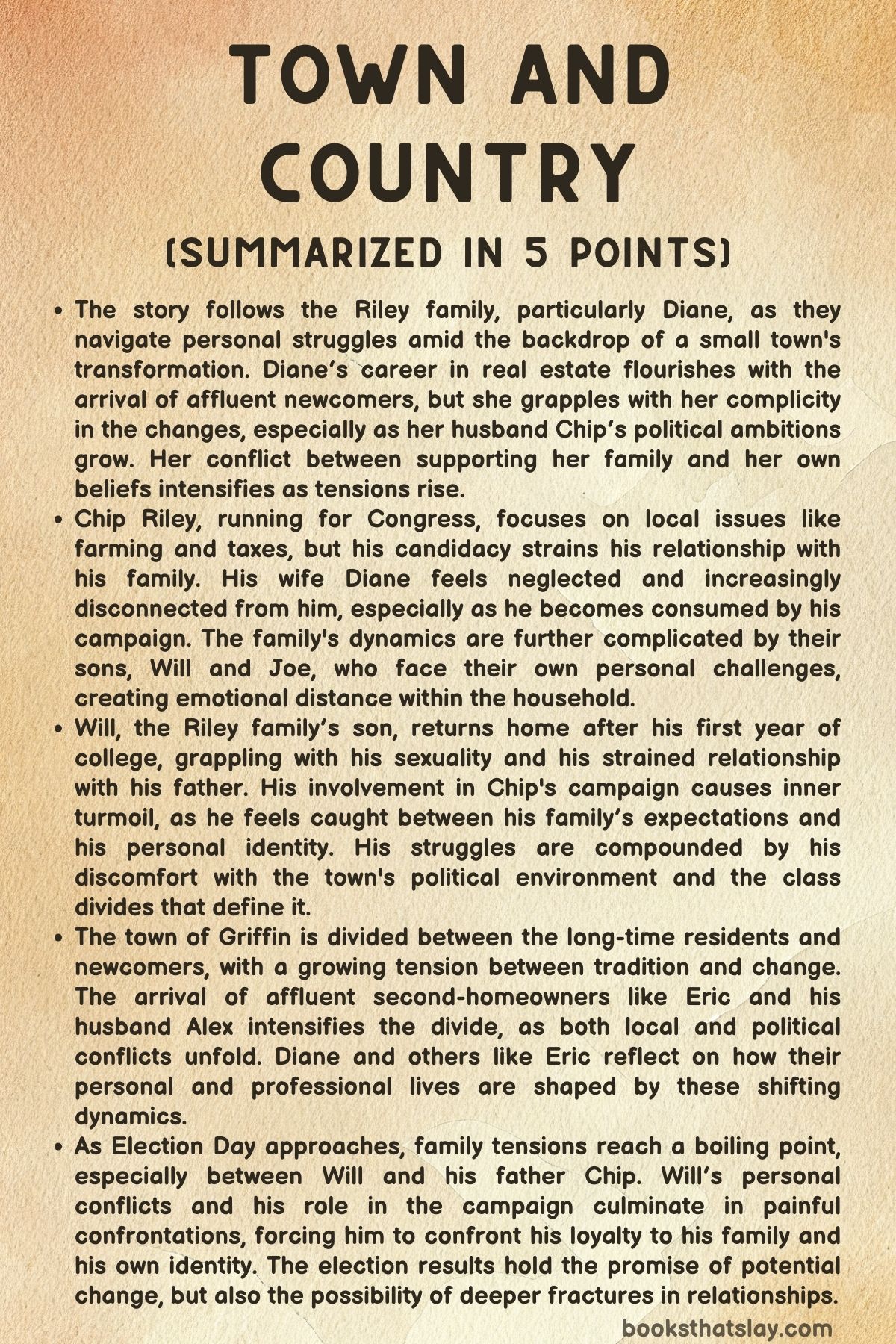
Summary
The story of Town and Country begins on a Monday morning in the town of Griffin, where the streets are lined with people eagerly awaiting the annual Memorial Day Parade. It’s a time of celebration and reflection, with families and volunteers preparing for the event.
Among the participants is Chip Riley, a local candidate running for Congress, who is joined by his sons, Joe and Will. As the parade kicks off, the town’s residents pay tribute to fallen soldiers and enjoy the spectacle of local groups and organizations marching down Granger Street.
While Chip and his family march, Diane, his wife, reflects on the changes in Griffin. The town, once struggling, has seen a surge in new businesses and affluent newcomers, and Diane is caught between celebrating the town’s transformation and worrying about the future of their family-owned business, the Lucky Buck, if Chip’s political aspirations succeed.
Her son Will is less than thrilled about the parade, feeling embarrassed by his family’s public appearance and wishing he could be elsewhere. His desire to escape is in part driven by his own internal conflicts, particularly his strained relationship with his father.
As the parade progresses, Joe, Diane’s other son, grapples with the grief of losing his friend Matt to an overdose. He struggles with his emotions and becomes more withdrawn as the parade continues, deeply affected by the loss.
Diane also notices how Griffin has evolved over time, with new boutique shops popping up alongside vacant storefronts that reflect the changing nature of the town. The tension between old and new residents becomes palpable, particularly with the presence of newcomers like Eric and his husband Alex, who represent the affluent “Duffels” that have transformed the town’s demographic.
Despite a brief mishap during the parade, the Riley family continues their march, with Diane feeling the weight of her growing connection to the influx of newcomers. As they finish their procession, the family heads to the Lucky Buck for an afternoon meet-and-greet.
Meanwhile, Paul Banks, a political opponent of Chip, participates in the parade with his own campaign. Paul and his husband, Stan, are newcomers to Griffin, and their presence highlights the ongoing friction between the town’s longtime residents and the more affluent newcomers.
As the parade concludes and the day winds down, the town remains divided. Some residents embrace the changes, while others resist them.
The election season is heating up, and the political campaigns of both Chip and Paul continue to fuel tension. Diane, for her part, reflects on her role in promoting Griffin to newcomers, but she also feels conflicted about the implications of her actions.
Will’s discontent with the family grows as he struggles to reconcile his personal identity with the expectations placed on him, particularly in relation to his father’s political ambitions.
Diane’s personal and professional life is further complicated by Chip’s announcement that he is running for Congress. Initially shocked by the news, Diane is unsure how to balance her own career as a successful real estate agent with the growing political aspirations of her husband.
The couple’s relationship begins to strain as Chip becomes more focused on his campaign, while Diane grapples with her feelings of guilt and complicity in the changing dynamics of their town. Meanwhile, Will’s return home for the summer brings more tension, as he struggles with his sexuality and his increasingly distant relationship with his father.
Diane’s concerns about her family’s well-being are compounded by the struggles of her sons. Joe’s behavior becomes more erratic as he copes with the grief of losing his friend, and Diane finds herself increasingly isolated from both her husband and her children.
Will, who had hoped to escape the small-town life, feels trapped by his family’s expectations. As Diane navigates her personal and professional conflicts, she is confronted by the growing political divide within the town and her role in enabling the changes that are reshaping Griffin.
As the summer progresses, Will’s discomfort with his family’s involvement in the political landscape deepens. He becomes more entangled in his father’s campaign, even though he feels increasingly out of place.
His strained relationship with Chip is exacerbated by his growing awareness of the class divides and social expectations that define their small town. Will’s struggle with his identity and his role in the family leads to emotional confrontations, particularly with his father, who seems more interested in his political ambitions than in understanding his sons’ struggles.
Diane, too, is torn between her loyalty to her family and her desire to maintain her successful real estate career, which has flourished thanks to the influx of newcomers. She feels the weight of her complicity in the town’s changing social fabric, particularly when she encounters same-sex couples like Paul and Stan, who are buying homes in Griffin.
Diane’s discomfort with the shifting societal norms is compounded by the fact that Paul, who is running against Chip in the congressional race, represents everything she is conflicted about.
The family’s tensions come to a head when Diane learns of a land dispute between Chip and a local property owner, Gerry. The conflict over the land is tied to a project that Chip is championing, which Diane has been quietly involved with in her real estate career.
She fears that Chip’s political ambitions could jeopardize the family’s future, and the rift between them deepens as Chip remains oblivious to her concerns. Meanwhile, Will’s increasing isolation and his involvement in the political campaign only further strain the family dynamic.
As Election Day approaches, the Riley family faces a crossroads. The political race between Chip and Paul intensifies, and the characters are forced to confront the consequences of their choices.
Will, torn between his family and his personal convictions, struggles with his identity and his relationship with his father. Meanwhile, Diane continues to question her role in the changes taking place in Griffin and her complicity in the growing divide between old and new residents.
The narrative culminates in a tense election night, where both Chip and Paul await the results of a bitter race. Will, caught between family loyalty and his personal beliefs, votes for his father, while Joe votes for Paul, reflecting his own conflicted feelings.
The election results hold the potential to reshape the future of the Riley family and the town of Griffin, with the personal and political stakes intertwining in ways that none of the characters could have anticipated. As the dust settles, the story leaves the characters at a pivotal moment, forced to reckon with their choices and the future that lies ahead.
Characters
Diane Riley
Diane Riley is a central character in Town and Country, embodying the tensions between personal fulfillment and societal expectations. A successful real estate agent in the small town of Griffin, Diane is deeply connected to the community, but her life is shaped by internal conflicts and a growing sense of alienation.
She struggles with her role in her family, particularly with her husband Chip’s increasingly ambitious political career. Diane is torn between her professional success and the changing dynamics in her family.
Her relationship with Chip is strained, as his political ambitions overshadow their personal connection, leaving Diane feeling sidelined and unimportant. She is also conflicted about her son Will’s sexuality, as she grapples with her conservative values and her love for him.
Throughout the story, Diane reflects on her complicity in the town’s shifting values, particularly regarding the rise of affluent newcomers and the growing political divide. Her evolving feelings about these changes are marked by guilt, resistance, and eventual acceptance, especially as her real estate career thrives thanks to the new residents.
Diane’s internal conflict is mirrored in the external changes to Griffin, making her a complex character caught between tradition and transformation.
Chip Riley
Chip Riley, Diane’s husband and a local political figure, is an ambitious and self-assured man whose focus on his congressional campaign creates a rift between him and his family. As the town supervisor, Chip has long held political power in Griffin, and his decision to run for Congress only amplifies his ego and personal ambition.
Throughout the novel, Chip remains fixated on his political goals, often neglecting his family’s emotional needs. His growing indifference to his wife Diane’s concerns and his distant relationship with their sons, especially Will, become sources of tension.
Chip’s political views are traditional, and his campaign, centered around issues like farming and taxes, contrasts with the evolving societal values in Griffin. His disregard for his family’s struggles, particularly Will’s emotional turmoil, highlights his inability to connect on a personal level.
His pursuit of political power drives a wedge between him and his loved ones, and the novel explores the consequences of his ambition on both his family and the community.
Will Riley
Will Riley, the Riley family’s eldest son, is a deeply conflicted character who struggles with his identity and his place within both his family and the broader political landscape of Griffin. After coming out as gay to his parents before leaving for college, Will faces tension with Diane, who finds it difficult to reconcile her conservative beliefs with her love for her son.
Will’s relationship with his father, Chip, is even more strained, as Chip’s political ambitions seem to overshadow any meaningful connection with his sons. Will’s return home for the summer brings these tensions to the forefront, as he is increasingly caught between his family’s expectations and his own desires.
Throughout the novel, Will feels isolated and alienated, particularly as he grapples with his role in Chip’s political campaign. His discomfort is further exacerbated by the societal pressures of living in a small town where everyone’s actions are scrutinized.
Will’s internal struggle is a central theme, as he navigates the complexities of family loyalty, personal identity, and political involvement. His journey is marked by a growing sense of emotional distance from his family, especially his father, as he seeks to reconcile his personal truth with the expectations placed upon him.
Joe Riley
Joe Riley, the younger son of Diane and Chip, is another deeply affected character, whose struggles with grief and loss are a central theme of his journey. The recent death of his friend Matt, likely due to a drug overdose, leaves Joe in a state of emotional turmoil.
Throughout the novel, Joe becomes increasingly withdrawn, reflecting the internal pain he carries with him. His participation in the Memorial Day Parade is overshadowed by his inability to cope with his grief, and his erratic behavior causes concern within the family.
Diane, despite her efforts to confront him, struggles to understand Joe’s isolation, which only deepens as the story progresses. Joe’s struggles highlight the darker side of life in Griffin, where personal tragedies are often hidden beneath the surface of small-town life.
His journey through grief is one of the more poignant arcs in the novel, as he confronts his emotional pain in a town that is unprepared to deal with such raw and unspoken issues.
Eric
Eric is one of the affluent newcomers to Griffin, a member of the “Duffels” — a term used to describe second-homeowners who visit on weekends. He and his husband Alex are part of the wave of new residents drawn to the town by its transformation.
Eric’s role in the story is primarily as an outsider, observing the tensions between the old and new residents of Griffin. He is deeply conflicted about his place in the community, particularly as he becomes involved in the lives of the Riley family.
His relationship with his husband is strained, and Eric’s emotional turmoil is compounded by his growing connection to Dalton, a local farmer struggling with addiction. Eric’s character is marked by his sense of guilt and his struggle to reconcile his past with his present.
His interactions with Will also serve as a reflection of generational and personal conflicts, as Eric comes to terms with his own role in the social dynamics of the town. Despite his outsider status, Eric’s internal struggles mirror those of many characters in the story, as they grapple with issues of belonging, personal identity, and societal change.
Paul Banks
Paul Banks, a political opponent to Chip Riley, is another key figure in the story, representing the new wave of political ideals that challenge the traditional values of Griffin. Paul, along with his husband Stan, is part of the group of newcomers who are trying to establish themselves in the community.
Their presence is met with resistance from many of the long-time residents, including Diane, who feels uncomfortable with their growing influence. Paul’s campaign is marked by his progressive views, particularly on issues like same-sex marriage, which creates tension with Diane’s own conservative stance.
His character is driven by his desire to change the status quo, not only in politics but also in the community’s social dynamics. The election between Paul and Chip serves as a battleground for the future of Griffin, with Paul representing the promise of change, even as his own struggles with fitting into the town highlight the complexities of being an outsider in a tight-knit community.
Through Paul, the novel explores the challenges faced by newcomers trying to carve out a space in a town that is both resistant to and welcoming of change.
Themes
Change and Transformation
The town of Griffin undergoes a significant transformation throughout the narrative, reflecting the broader changes that individuals and families face. Diane, the protagonist, witnesses the economic boom and the influx of new residents, particularly affluent second-homeowners, which alters the fabric of the town.
This transformation, however, is not just about the physical landscape; it is also about the shifting dynamics of the community and the people within it. Diane, as a real estate agent, is at the heart of these changes, and while she benefits from the rising property values and new business opportunities, she also feels a sense of loss.
The arrival of new residents like Eric and Paul, who are perceived as outsiders, represents the gentrification of Griffin, which is met with resistance from long-time locals. This tension between the old and new is central to the story, as characters like Diane struggle with the ethical implications of embracing the changes that come with economic growth.
The sense of nostalgia for the past is ever-present, as Diane and others recall a simpler time when the town was less prosperous but more cohesive. Yet, as the narrative progresses, it becomes clear that change is inevitable.
The evolution of Griffin serves as a backdrop to the characters’ own internal transformations, particularly Diane’s growing acceptance of the newcomers, despite her initial resistance.
Family and Identity
The Riley family’s internal struggles and evolving relationships are at the heart of the story. Diane’s complex relationship with her husband Chip is central to the exploration of family dynamics.
Chip’s political ambitions create a growing divide between them, especially as his focus on his campaign intensifies. Diane feels increasingly sidelined, both in her marriage and in her personal life, as Chip becomes absorbed in his quest for political power.
This strain is compounded by their son Will’s return home from college. Will’s journey is one of self-discovery, and his sexual identity creates tension within the family, particularly with Diane, who grapples with reconciling her love for her son with her conservative beliefs.
This personal conflict is mirrored in Will’s interactions with his father, who is oblivious to the depth of his son’s struggles. Will’s discomfort at public events and his growing sense of alienation highlight the challenges of being true to oneself in the face of family expectations.
The theme of identity is also explored through the lens of the broader political landscape, where Will’s connection to his father’s campaign forces him to confront his place in the world. The family’s attempts to navigate their personal struggles against the backdrop of the town’s political and social upheaval illustrate the complexities of modern family life, where personal identity and familial loyalty often come into conflict.
Political Ambition and Its Consequences
Chip Riley’s congressional campaign is a major catalyst for the unfolding drama in the story. His ambition to rise beyond the small town of Griffin is a driving force for many of the characters, particularly Diane, who is caught between supporting her husband’s political aspirations and dealing with the personal fallout of his campaign.
The campaign becomes a symbol of Chip’s growing ego and his desire for power, which increasingly distances him from his family. His political ideology, centered around farming and taxes, contrasts with the deeper emotional issues his family faces.
The narrative reveals the often-painful consequences of political ambition, not just for the candidate but also for their loved ones. Chip’s focus on the campaign blinds him to the emotional needs of his family, particularly his children, who feel neglected and misunderstood.
Will, in particular, is forced to navigate the tension between his identity and his father’s public persona, leading to internal conflicts about loyalty and self-expression. The book illustrates how political ambitions can seep into personal lives, often with unintended consequences.
The political divide in Griffin, where new residents and longtime locals clash over their vision for the future, further exacerbates the tensions within the Riley family, underscoring the way political ideologies can tear apart even the closest relationships.
Grief and Loss
Grief is a pervasive theme in the story, particularly in the lives of the Riley family members. Joe, Diane’s son, is deeply affected by the recent overdose death of his friend, Matt, and his emotional turmoil is evident throughout the narrative.
His grief manifests in withdrawal, erratic behavior, and an increasing sense of isolation. Diane’s awareness of Joe’s pain grows as she reflects on her own role in his life and her inability to help him cope.
The theme of loss is also explored through the lens of the broader community, as residents of Griffin grapple with personal tragedies and the loss of the town’s former identity. Diane’s reflections on the changes in Griffin mirror her internal struggle with the loss of the simpler, more familiar town she once knew.
The presence of addiction, particularly in the character of Dalton, highlights the ongoing struggles many face in the face of personal loss. Grief, both personal and communal, serves as a powerful undercurrent in the story, influencing the decisions and actions of the characters as they try to navigate their complex emotional landscapes.
Class and Social Divide
The story also explores the theme of class and the social divide that exists between the long-time residents of Griffin and the influx of newcomers, particularly those with wealth and political influence. Diane’s role as a real estate agent places her in direct contact with affluent outsiders, and while she benefits from their presence, she also feels a sense of discomfort and guilt.
The social divide is evident in the relationships between characters like Eric and Will, who come from different backgrounds yet find themselves in similar emotional turmoil. Will, in particular, feels the weight of class expectations as he grapples with his identity and his role in his family’s political campaign.
His discomfort at social events, like the luxurious birthday party, reveals the alienation he feels as he tries to navigate between the world of the political elite and his own sense of self. The growing tension between the newcomers and the established residents of Griffin reflects the broader social shifts that are taking place, where class and privilege become increasingly important factors in defining one’s place in the world.
The characters’ interactions with each other reveal the complexities of social stratification and the ways in which people from different walks of life struggle to coexist within the same community. The theme of class and social divide highlights the challenges of navigating identity, loyalty, and personal ambition in a rapidly changing world.