Traverse by E. J. Meyers Summary, Characters and Themes
Traverse by E. J. Meyers is a science-fiction horror novel that moves between nineteenth-century Newport, modern Rhode Island, and an alien world linked to Earth through unstable spatial gateways.
The story combines psychiatric mystery, government conspiracy, cosmic horror, historical tragedy, and questions about perception and reality. At its center are psychiatrist Cyrus Warren and Wilcox Jennings, a Victorian butler who appears more than a century after vanishing from Bellecliff Mansion. Their meeting exposes a long history of disappearances, alien parasites, suppressed evidence, and secret government operations, eventually revealing that the strange yellow world haunting Cy’s visions is not imaginary at all.
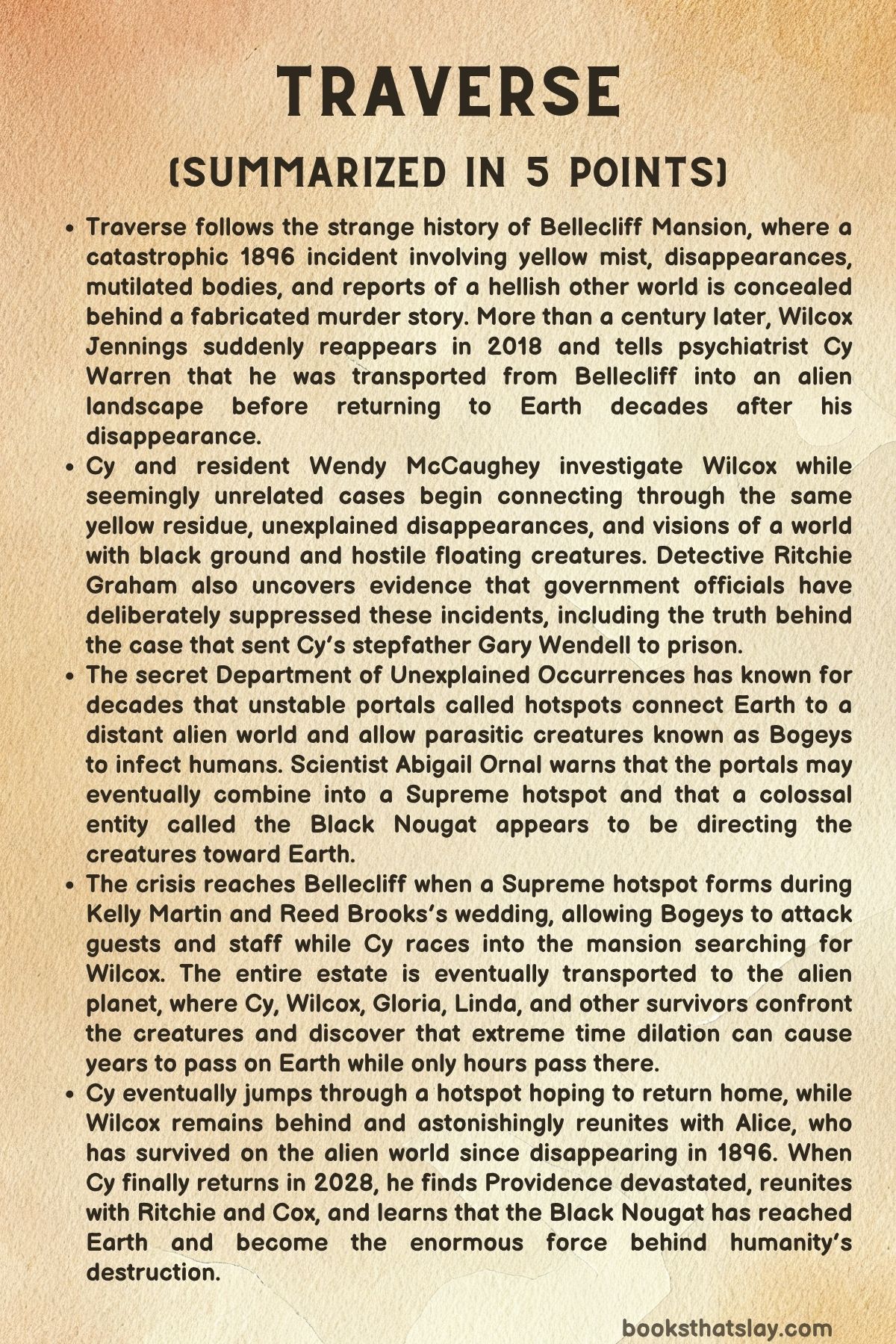
Summary
In 1896, Bellecliff Mansion in Newport becomes the scene of an apparently impossible massacre. Months earlier, wealthy Alexander Bellevue and his wife Kathleen had moved there after a fire destroyed their Manhattan residence, but Alexander gradually became withdrawn and sick after encountering a foul odor, yellow smoke, and terrifying phenomena inside the mansion.
Alexander’s grandfather, Maximillian Bellevue, arrives with investigator William “Big Bill” Keegan and finds his grandson physically ruined and frightened by visions he refuses to describe. The servants have also noticed increasingly disturbing events, especially Wilcox Jennings, Bellecliff’s disciplined English butler, whose hopes for a future with nurse Alice are suddenly threatened when Alexander appears covered in slime and claims he has been in hell.
Big Bill begins investigating the possibility of poisoning, but ordinary explanations collapse when Kathleen materializes inside the library covered in yellow residue, and Wilcox is later swallowed by yellow mist and disappears. The mansion descends into chaos, and when police finally investigate the devastation, Alexander himself reappears badly injured, bearing a strange circular wound on the back of his neck.
Authorities construct a convenient explanation rather than admit that the physical evidence makes little sense. Inspector Jones concludes that Kathleen poisoned Alexander, causing him to lose his sanity and slaughter the household, while Maximillian suppresses evidence that Alexander had a romantic relationship with Jacob Collier because he considers that revelation more damaging to the family name than allowing Alexander to be remembered as a murderer.
More than a century later, strange events connected with the same yellow phenomenon continue. In 1993, a three-year-old boy at the New England Aquarium is attacked during an unexplained incursion, briefly experiences a mysterious yellow world, and later awakens with surgical stitches on his neck after secret government intervention.
That boy grows up to become Dr. Cyrus “Cy” Warren, a psychiatrist working at Baywater Mental Health in 2018. Cy is assigned a confused man dressed in nineteenth-century clothing who has been arrested in Providence and repeatedly insists that he needs to return home; the man eventually identifies himself as Wilcox Jennings.
Wendy McCaughey, a talented young resident, joins Cy after a dangerous experience at Stillwater’s secretive Project 47. There she had warned administrator Dr. Hammond that violent patient Tom Jensen was studying security procedures and might be preparing to escape, but Hammond ignored her concerns and even informed Jensen that she had reported him, placing Wendy in direct danger.
As Cy investigates Wilcox’s claims, the supposedly delusional man’s knowledge of Bellecliff becomes increasingly difficult to dismiss. Wilcox describes serving Alexander Bellevue, disappearing from the mansion, and awakening in a horrifying place with a yellow sky, black porous terrain, oceans of yellow slime, and floating flesh-like creatures before somehow returning to Earth more than a century later.
Cy is particularly shaken because Wilcox’s description resembles visions he has experienced since childhood. Those visions intensified after Cy’s friend Josiah Fields was shot in the back by a police officer in 2002, after which Cy repeatedly dreamed of Josiah appearing within the same impossible yellow landscape.
Cy’s family history also intersects with unexplained disappearances. His stepfather Gary Wendell has spent decades imprisoned for the presumed murder of convenience-store worker Bob Killinger, even though Bob’s body was never recovered; Cy asks his longtime mentor, investigator Ritchie Graham, to reopen the case.
Ritchie’s investigation exposes a pattern. Phillip Jewkes, Melanie Johnson, Edwin Brennen, Bob Killinger, and others vanished in circumstances involving yellow fog or strange slime, while witnesses occasionally reported armed men and government officials arriving afterward and warning people to remain silent.
Bellecliff itself has become a luxury hotel owned by Linda Brewer, who consistently suppresses unexplained incidents because she fears damage to the business. During renovations, workers reported yellow mist and disappearances, and in 2018 employee Alison Casey vanishes from a basement locker room, leaving behind clothing soaked in yellow residue.
Detective Eileen Jacobs refuses to accept Linda’s claim that Alison simply abandoned her job. Her persistence is rewarded when Alison suddenly falls back through yellow mist weeks later, alive but confused, and describes the same alien environment Wilcox has already described independently.
The matching accounts fundamentally change Cy’s investigation. Alison and Wilcox have never met, yet both describe the same black landscape, yellow slime, hostile spherical creatures, and strange method of transportation, making a conventional shared delusion increasingly implausible.
At the same time, the novel follows several psychiatric cases that complicate the distinction between delusion and reality. Cy successfully persuades teenage Eddie Palm that the CIA agent he believes is communicating with him is part of a psychotic experience, demonstrating that reason can expose a false belief even while Cy himself struggles with experiences that appear irrational but may actually be true.
Wendy’s professional life becomes increasingly unstable as well. Her ability to recognize obsessive intrusive thoughts allows her to connect deeply with patient Alexa Sanchez, partly because Wendy once suffered similar symptoms herself, but empathy turns into a serious ethical violation when the two begin a sexual relationship.
Cy’s former partner Gloria Thrasher represents another uncertain boundary between invention and reality. Gloria built a public identity around supposedly communicating with ghosts despite knowing she did not possess such powers, and after finally admitting the deception, she receives treatment for histrionic personality disorder and depression.
Cy himself experiences an increasingly physical connection with the alien world. During one terrifying episode, he seems to enter the yellow landscape, encounters an enormous buried mass producing smaller creatures, and is attacked in the neck; afterward he returns to his bathroom unsure whether the experience was psychological or whether he briefly crossed into another place.
Behind these events operates the Department of Unexplained Occurrences, a covert organization that has known about the alien incursions for decades. Director Robert Hunt survived an attack as a child in 1961, when a creature attached itself to his father Victor and transformed him into a deadly host, forcing Robert to kill both his father and the parasite.
The government later recruits physicist Dr. Abigail Ornal to study invisible spatial anomalies called hotspots. DUO learns that the creatures, known as Bogeys, cross through these openings, attach themselves to human hosts, and transform them, while survivors sometimes experience visions connected with an enormous intelligence the agency calls the Black Nougat.
Ornal theorizes that the hotspots may eventually merge into a massive Supreme event, potentially allowing an invasion. DUO’s commitment to secrecy is so extreme that it removes Bob Killinger after he becomes infected and knowingly allows Gary Wendell to spend years imprisoned for a crime the agency knows he did not commit.
By 2018, signs of the predicted Supreme hotspot gather around Bellecliff. Wilcox escapes Baywater and returns to the mansion, while Gloria follows him there with her GhostThrasher crew, hoping to film evidence of the portal despite having recently undergone treatment.
The situation becomes catastrophic during the wedding of Kelly Martin and Reed Brooks. A Bogey attaches itself to Kelly, takes control of her body, and uses her transformed form to kill Reed, while other creatures spread through Bellecliff and attack guests and employees.
Cy enters the mansion searching for Wilcox and finds devastation everywhere. He kills the transformed Kelly and later manages to force another parasite away from Linda Brewer using alcohol-based hand sanitizer, a discovery that connects with his own childhood infection and the scar on his neck.
Outside, Ritchie confronts Hunt and finally learns how far DUO has gone to preserve secrecy. Hunt admits that the organization manipulates criminal investigations and sacrifices innocent people whenever officials decide that public knowledge of the Bogeys would be too dangerous.
The Supreme hotspot then reaches full strength above Bellecliff. Instead of merely opening a temporary passage, it transports the entire mansion away, leaving a huge crater in Newport and carrying Cy, Wilcox, Gloria, Linda, and other survivors into the alien world itself.
There, Cy finally sees the yellow sky and black landscape that have haunted him for most of his life. The survivors soon learn that the place is even more dangerous than they imagined when Linda transforms because the earlier alcohol treatment removed only part of the parasite rather than eliminating it completely.
A DUO expedition commanded by Abigail Ornal arrives and destroys the transformed Linda. Ornal reveals that scientists have previously traveled to the planet under Operation Traverse and explains that extreme time dilation separates the two worlds, meaning that hours spent there can correspond to years passing on Earth.
She also recognizes Cy as the child attacked at the aquarium in 1993. His visions are therefore not random psychiatric symptoms: infection linked him to the Black Nougat, a vast alien organism capable of influencing or deceiving those who have survived contact with the Bogeys.
When another hotspot appears inside Bellecliff, Cy becomes desperate to return before years pass for the people he loves. He jumps through despite Ornal’s warnings, while Wilcox refuses because he still believes Alice may be alive somewhere in the alien world and refuses to abandon the possibility of finding her.
Back on Earth, DUO erases the truth by claiming Bellecliff was destroyed by a tornado accompanied by chlorine gas. Alison is secretly imprisoned, tested, drugged, and eventually returned home with fabricated memories, while Ritchie becomes a potential target because Hunt suspects he has preserved evidence outside DUO’s control.
Years pass. Wendy eventually loses her psychiatric career when Alexa renews her complaint, while Gloria unexpectedly reappears in Providence and is immediately detained with Wendy by Ember Cox after another hotspot is detected.
Meanwhile, Wilcox travels across the alien terrain with the wounded Ornal and other survivors. After more than a century from his perspective, he finally discovers Alice alive in a cave, revealing that she too was transported from Bellecliff in 1896 and has experienced the passage of time very differently.
Their reunion occurs as enormous numbers of Bogeys gather around a rising black sphere. Wilcox watches through Ornal’s equipment as the creatures deliberately converge on the Black Nougat, which rises through a massive rift and crosses into another location.
Cy finally emerges from his own passage in April 2028, ten Earth years after leaving Bellecliff in 2018. Providence has been devastated, infected creatures roam the ruins, and Ritchie and Cox rescue him shortly after his arrival.
Cy asks what caused the destruction and receives the answer he has feared without fully understanding for most of his life. The Black Nougat has reached Earth, and the colossal organism now stands partly buried in the ruined landscape, transforming a mystery that began with one haunted mansion into a catastrophe threatening the entire world.
Characters
Cyrus “Cy” Warren
Cy Warren is the central modern protagonist and the character through whom the boundary between psychiatric illness and objective reality is most thoroughly tested. A trained psychiatrist, he is accustomed to separating hallucination from fact, yet his own life contains experiences that resist every clinical explanation he knows.
His childhood is shaped by two forms of trauma: the unexplained aquarium incident that leaves him connected to the alien world and the police killing of his friend Josiah. Those events influence his fascination with paranormal phenomena before he eventually retreats toward scientific skepticism and medicine.
Cy’s greatest strength is his willingness to revise his assumptions when evidence demands it. Traverse places a psychiatrist in the unusual position of having to accept that an apparently impossible patient’s claims may be entirely true, and Cy does so not because he abandons reason but because the accumulating evidence makes disbelief less rational than acceptance.
He is also strongly protective of people he considers his responsibility. He supports Wendy after her ethical failure, fights Jensen to save her, searches for Wilcox at Bellecliff, and repeatedly places himself in physical danger once the Bogey threat becomes undeniable.
Cy is nevertheless flawed by secrecy and emotional uncertainty. He hides his visions, avoids confronting some aspects of his past, and struggles with Gloria because his movement away from paranormal belief conflicts with the identity around which she has built her life.
His final decision to enter the Grand hotspot alone reflects both courage and impatience. He understands the danger but cannot tolerate the idea that years may pass for everyone he loves while he remains on the alien world, a choice that ultimately returns him to a devastated Earth ten years later.
Wilcox Jennings
Wilcox Jennings begins as a figure defined by discipline, order, loyalty, and service. Born into poverty in London, orphaned after his mother’s death, and raised for a time among street children, he develops the self-control that eventually allows him to rise from a footboy to a respected butler.
His relationship with Alice gives his life a deeply personal purpose beyond service. He crosses the Atlantic partly because America offers the possibility of building a new life with her, making his disappearance shortly after learning of her pregnancy especially cruel.
In Traverse, Wilcox also serves as the strongest human bridge between the historical and modern narratives. When he appears in 2018 still believing Bellecliff is his home, his existence itself challenges the assumption that the events of 1896 can be explained as murder, madness, or folklore.
Wilcox’s adaptability is remarkable. Although modern technology, language, medicine, and social customs are foreign to him, he does not collapse psychologically; instead, he concentrates on understanding what happened and returning to the people he believes he has lost.
His loyalty to Alice eventually becomes stronger than his desire to return to Earth. When Cy chooses the Grand hotspot, Wilcox stays behind because he cannot abandon the possibility that Alice may still exist somewhere on the alien world.
That decision is rewarded by their reunion. The moment confirms that Wilcox’s refusal to accept the official story of Bellecliff was justified and transforms his century-long displacement into a deeply personal struggle against time itself.
Wendy McCaughey
Wendy McCaughey is intelligent, observant, ambitious, and unusually sensitive to the emotional experiences of patients. Her early warning about Jensen demonstrates excellent clinical judgment, especially because she recognizes deliberate behavior that more senior staff dismiss as paranoia or overreaction.
Her professional development is repeatedly damaged by authority figures. Hammond knowingly uses her resemblance to Jensen’s victims to provoke the patient, effectively treating her safety as an acceptable research risk.
Traverse uses Wendy to examine the difference between empathy and ethical responsibility. Her history with intrusive thoughts allows her to understand Alexa in a way few doctors could, but that personal identification also weakens the distance required in a therapeutic relationship.
Her sexual relationship with Alexa is therefore not presented merely as romantic complication. Wendy knows the professional boundary she has violated and eventually tries to end the relationship and remove herself from the case, but by then the imbalance of power and emotional dependence have already created serious consequences.
Wendy also displays considerable courage under direct physical threat. During Jensen’s murderous rampage she fights desperately alongside Cy and ultimately drives a pen through Jensen’s eye, helping stop a man who has already killed several people.
Her later loss of her psychiatric career makes her arc particularly complicated. She is both a victim of institutional exploitation and someone responsible for a serious ethical violation, preventing the story from reducing her to either an innocent martyr or a reckless doctor.
Alexander Bellevue
Alexander Bellevue is the tragic center of the nineteenth-century Bellecliff mystery. Initially a wealthy socialite concerned with influence and status, he becomes increasingly isolated after encountering the yellow phenomenon inside the mansion.
His illness is initially interpreted through the limited frameworks available to those around him. He speaks of hell, demons, visions, and creatures because he lacks the scientific vocabulary that later generations use to describe hotspots and Bogeys.
Alexander’s disappearance and reappearances suggest that he has already been crossing between Earth and the alien environment before anyone understands what is happening. His physical decline and neck wound eventually acquire greater meaning once the nature of Bogey infection becomes known.
His tragedy is compounded by the official version of his death. Evidence connected with poisoning, his relationship with Jacob Collier, and the inexplicable massacre is rearranged into a story in which Alexander simply becomes an insane mass murderer.
Later revelations show that Alexander had actually been infected and was responsible for killing Elenore and Kathleen while under the parasite’s influence. This makes him physically responsible for terrible acts without making those acts an expression of his ordinary personality or conscious desires.
Alice
Alice represents perseverance, competence, and emotional stability in the historical storyline. As a Black woman who succeeds in becoming a nurse despite discrimination, she has already fought considerable social restrictions before the supernatural events at Bellecliff begin.
Her relationship with Wilcox is defined by genuine partnership rather than convenience or social advancement. Their plans for a future become even more important when Alice reveals that she is pregnant shortly before Wilcox disappears.
Alice also possesses practical courage during the Bellecliff crisis. When the mansion is overtaken by yellow fog and violence, she attempts to protect Kathleen rather than surrender to panic.
Her disappearance initially seems to confirm Wilcox’s worst fear that everyone he loved died in 1896. The revelation that she survived in the alien world completely changes the emotional meaning of Wilcox’s decision to remain behind.
Their eventual reunion does not erase the suffering caused by separation, but it shows how extreme time distortion has preserved relationships in unexpected ways. For Wilcox, more than a century has passed; for Alice, the experience follows a radically different temporal scale.
Ritchie Graham
Ritchie Graham combines personal loyalty with a strong investigative conscience. He enters Cy’s life after investigating the police shooting of Josiah and eventually becomes an important mentor, giving Cy a trustworthy adult presence after a deeply destabilizing childhood event.
When Cy asks him to reconsider Gary Wendell’s conviction, Ritchie does not dismiss the request as emotional bias. He recognizes the obvious weakness in a murder conviction without a body and follows the evidence even when it leads toward claims that initially seem impossible.
Within Traverse, Ritchie functions as the conventional investigator whose methods gradually expose an unconventional conspiracy. He compares old disappearances, interviews witnesses, notices suppressed details, and deliberately avoids digital systems when he suspects official monitoring.
His moral opposition to DUO becomes especially important once Hunt admits that the agency has knowingly allowed innocent people to suffer in order to protect secrecy. Ritchie understands that the organization’s stated goal of protecting the public does not erase the injustice committed against individuals such as Gary.
His survival into 2028 also makes him one of the few characters who can connect the pre-invasion world to the destroyed future. When Cy returns, Ritchie is still fighting, suggesting that his refusal to accept convenient official narratives has become essential rather than merely stubborn.
Gloria Thrasher
Gloria Thrasher is driven by an intense need to be noticed, believed, and emotionally valued. Her claims of psychic communication are eventually revealed to be fabricated, but the deception is less about deliberate exploitation than about constructing an identity that guarantees attention.
Her relationship with Cy begins when both are fascinated by paranormal phenomena. As Cy becomes increasingly skeptical and professionally absorbed, Gloria remains committed to a worldview that has become inseparable from her public persona, contributing to the breakdown of their relationship.
She eventually demonstrates unusual self-awareness by admitting that her psychic claims are false and asking Cy for help. Her treatment for histrionic personality disorder and depression initially appears to offer a path toward stability.
However, Gloria quickly stops taking her medication after leaving treatment and returns to GhostThrasher. She even manipulates Wilcox by falsely claiming that she and Cy are engaged so that she can obtain information about Bellecliff.
Her behavior remains frustrating because genuine emotional attachment and deliberate performance constantly overlap. She clearly loves Cy, yet her desire for recognition repeatedly places herself and others in danger.
Her disappearance on the alien world and eventual reappearance years later preserve her as a major unresolved figure. Like Cy and Wilcox, she becomes living evidence that crossing between worlds destroys ordinary assumptions about time.
Robert Hunt
Robert Hunt’s personality is built around childhood trauma and the conviction that alien incursions must be contained at almost any cost. As a boy, he watches a Bogey infect his father, loses his mother, and is forced to shoot the transformed man himself.
That experience explains why Hunt dedicates his adult life to DUO. Unlike officials who treat the phenomenon as an abstract national-security problem, he has personally seen what an infected human can become.
Traverse makes Hunt morally difficult because his fear is justified even when his methods are not. The Bogeys truly are dangerous, the Black Nougat truly poses an existential threat, and public panic could create serious problems, yet Hunt turns those realities into permission for nearly unlimited institutional power.
He knowingly accepts the imprisonment of Gary Wendell for a crime DUO knows he did not commit. Later he supports memory erasure, suppression of investigations, false public explanations, and threats against knowledgeable witnesses.
Hunt therefore becomes an example of how protection can become authoritarian when accountability disappears. His tragedy is that the catastrophe he has spent his life trying to prevent eventually occurs anyway, leaving the moral cost of decades of secrecy impossible to justify through success.
Dr. Abigail Ornal
Abigail Ornal is one of the story’s most important scientific figures. A theoretical physicist willing to consider ideas outside established assumptions, she is recruited because her work on wormholes offers a possible framework for understanding the hotspots connecting Earth with the alien world.
Unlike Hunt, Ornal is primarily interested in understanding the phenomenon rather than controlling information about it. She identifies different classes of hotspots, considers whether they are natural or intentional, and recognizes that the Black Nougat may be directing the movement of the Bogeys.
Her participation in Operation Traverse also establishes her as more than a laboratory scientist. She physically enters the alien world and survives direct exposure to conditions that most researchers know only through instruments or survivor testimony.
In Traverse, Ornal becomes the character most capable of translating impossible experience into scientific language. She explains the time dilation, identifies Cy as the child infected in 1993, and gives him a biological and physical explanation for visions he has spent years questioning.
Her later injury leaves her dependent on Wilcox and the other survivors, reversing her earlier position as the knowledgeable authority. Even then, the equipment and theories she provides become essential to understanding the Black Nougat’s movement.
Maximillian Bellevue
Maximillian Bellevue is powerful, controlling, and deeply committed to preserving the Bellevue family’s public reputation. His initial response to Alexander’s illness is practical: he brings Big Bill to Bellecliff, demands an investigation, and wants Alexander returned to New York for treatment.
After the massacre, however, reputation becomes more important than truth. When evidence of Alexander’s relationship with Jacob Collier appears, Maximillian decides that public knowledge of his grandson’s homosexuality would be more shameful than allowing him to be remembered as a homicidal madman.
His response reflects the prejudices of his social world while also revealing his personal priorities. Alexander’s actual suffering matters less than maintaining the Bellevue name.
Maximillian therefore contributes directly to the historical erasure surrounding Bellecliff. By paying witnesses and investigators to remain silent, he helps establish the false narrative that later generations inherit.
Kathleen Bellevue
Kathleen is introduced as Alexander’s emotionally distant wife, which initially makes her an obvious suspect once Alexander becomes mysteriously ill. Big Bill briefly considers whether she may have poisoned him, especially because the marriage appears troubled.
Her sudden materialization from yellow vapor destroys the simplicity of that theory. Covered in slime and claiming she has been in hell, Kathleen is revealed as another victim of the same phenomenon affecting Alexander and Wilcox.
Her fate illustrates how ordinary human suspicion can obscure a much larger threat. Because poisoning and marital conflict seem understandable, investigators prefer those explanations even when physical evidence contradicts them.
The later revelation that an infected Alexander kills Kathleen makes her death especially tragic. She becomes a victim not simply of her husband but of the organism controlling him and of the false historical story later constructed around their deaths.
William “Big Bill” Keegan
Big Bill is Maximillian’s trusted investigator and one of the first people to approach the Bellecliff mystery systematically. He interviews household members, examines the yellow residue, and initially considers poisoning because it provides a familiar explanation for Alexander’s deterioration.
His investigation is significant because it preserves evidence that later officials selectively reinterpret. The incompleteness of his conclusions is not incompetence; he simply lacks any framework for portals, alien organisms, or interplanetary transport.
Big Bill also becomes politically useful after the massacre because Maximillian attempts to shift blame toward him. His treatment demonstrates how powerful people respond to dangerous information by controlling responsibility rather than establishing truth.
Inspector Jones
Inspector Jones represents institutional pressure to produce a comprehensible explanation even when the evidence does not support one. Faced with dismembered bodies, strange residue, unusual wounds, and impossible circumstances, he struggles to make the Bellecliff massacre fit recognizable categories.
Eventually he turns speculation into certainty. Kathleen’s possible poisoning of Alexander becomes the basis for a story in which Alexander goes insane and murders everyone.
Jones is not portrayed as possessing the information necessary to discover the real cause, but his willingness to formalize an unsupported explanation allows the mystery to remain buried. His actions show how official records can transform uncertainty into false history simply because institutions require a conclusion.
Dr. Hammond
Hammond is an example of professional authority corrupted by ambition. As administrator of Project 47, he is more interested in producing clinically interesting results from Jensen than in protecting Wendy from an obviously dangerous patient.
His most disturbing decision is deliberately assigning Wendy to Jensen because she resembles his murder victims. He effectively treats Wendy as an experimental stimulus without adequately informing her of the risk.
Hammond compounds the danger by telling Jensen that Wendy suspected him of planning an escape. This demonstrates a serious failure of judgment and makes his later confidence in Jensen’s supposed improvement especially revealing.
His eventual murder by Jensen is the final result of repeatedly ignoring evidence that contradicts what he wants to believe. The institution he controls collapses because he values the appearance of therapeutic success over careful assessment.
Tom Jensen
Tom Jensen is one of the story’s most dangerous human antagonists. He is physically intimidating, highly observant, manipulative, and capable of understanding how clinicians interpret behavior well enough to exploit their expectations.
Wendy correctly recognizes that he is studying routines and security procedures. After his initial violence, he later changes tactics and presents himself as cooperative, remorseful, educationally motivated, and eager to manage his illness.
His apparent recovery is entirely calculated. The private statement that he is “God’s warrior” reveals that his dangerous beliefs remain intact while staff members increasingly reward the performance he has constructed.
Jensen’s eventual escape from control and murder of Hammond, Emma, and others demonstrates the catastrophic consequence of confusing behavioral compliance with genuine psychological change. His final fight with Wendy and Cy also forces Wendy to confront, in physical form, the danger she had recognized long before her supervisors did.
Eileen Jacobs
Eileen Jacobs is defined by resistance to easy institutional answers. She previously left the Providence police after reporting another officer for excessive force, establishing that her willingness to challenge authority predates the Alison Casey investigation.
When Linda claims Alison simply walked away from her job, Eileen examines the surrounding details instead of accepting the explanation. Alison’s abandoned car, ordinary errands, and the information about yellow residue convince her that something more serious occurred.
Her cooperation with Ritchie later becomes essential because both investigators understand that official channels may compromise the cases they are trying to solve. Eileen’s instinct to preserve evidence therefore places her in direct opposition to DUO’s culture of suppression.
Linda Brewer
Linda Brewer is not initially malicious; she is a business owner whose decisions become increasingly irresponsible because she consistently chooses reputation over safety. After purchasing Bellecliff and converting it into a luxury hotel, she encounters unexplained odors, yellow mist, and disappearances but repeatedly minimizes them.
Her treatment of Alison’s disappearance is particularly revealing. Rather than preserve the yellow residue as evidence, Linda orders it cleaned because she fears damage to the hotel.
Even after increasingly impossible incidents occur, Linda’s first instinct is public-relations management. This denial does not cause the alien phenomenon, but it makes Bellecliff more dangerous because warning signs are ignored.
Her eventual infection and transformation on the alien world provide a grim conclusion to that pattern. The danger she repeatedly treated as an inconvenience ultimately consumes her directly.
Alison Casey
Alison Casey is crucial because she becomes the first modern civilian whose disappearance and return directly confirm Wilcox’s account. She vanishes from Bellecliff’s basement in yellow mist and reappears weeks later by falling into a room coated in slime.
Her description of the alien world independently matches Wilcox’s story, undermining any claim that his experience is merely delusional. Alison therefore becomes living evidence that the phenomenon is physical.
That evidence also makes her dangerous to DUO. She is eventually imprisoned in a secret facility, subjected to extensive testing, drugged, and returned home with false memories of being kidnapped by a serial killer.
Her treatment demonstrates the human cost of government secrecy. Alison survives the alien world, but the institution claiming to protect society takes away her knowledge of her own life.
Ember Cox
Ember Cox operates between field investigation and institutional enforcement. She first appears at Bellecliff pretending to represent environmental authorities while secretly searching for unexplained activity using specialized equipment.
As DUO activity increases, Cox becomes more directly involved in containment operations and the protection of classified information. Her competence makes her effective, but her loyalty to the agency means she participates in suppressing evidence and detaining witnesses.
Her later presence with Ritchie in devastated Providence suggests that the collapse of ordinary society has altered some earlier relationships. By 2028, survival against the Black Nougat has become more urgent than the divisions that once separated investigators from DUO personnel.
Jason Rhymer
Jason Rhymer is one of DUO’s operational specialists and works closely with Cox during the escalation around Rhode Island. His role emphasizes the technical infrastructure the organization has developed over decades to detect phenomena invisible to ordinary observers.
Rhymer helps identify the enormous exotic-energy field indicating that a Supreme hotspot is forming. Although less psychologically developed than Hunt or Ornal, he represents the professionalized generation of personnel for whom Bogeys and hotspots are established operational realities rather than unbelievable discoveries.
Gerald Kinder
Gerald Kinder is a scientist whose experience shows the psychological cost of understanding the threat too clearly. He helps introduce Ornal to DUO’s discoveries and is himself a survivor of Bogey infection.
His later vision of vast numbers of creatures deliberately entering a hotspot convinces him that the incursions are not random. After writing the word “Invasion,” he kills himself.
Kinder’s death functions as both warning and evidence. He recognizes the organized nature of the threat years before the Supreme event, but the knowledge leaves him unable to imagine a survivable future.
Gary Wendell
Gary Wendell is one of the clearest victims of institutional injustice. He attempts to help the badly injured Bob Killinger but is arrested after police interpret the scene as evidence of robbery and violence, with racial prejudice strengthening the assumption of his guilt.
The absence of Bob’s body should create serious doubt, yet Gary is convicted and loses decades of his life. Later evidence proves that DUO removed Bob after his infection and knowingly permitted Gary to remain the convenient suspect.
Gary’s case gives the government conspiracy a personal dimension for Cy. The secrecy surrounding Bogeys is not merely about classified documents; it has destroyed an innocent person’s freedom.
Bob Killinger
Bob Killinger is an ordinary worker whose encounter with the alien phenomenon becomes the foundation of a false murder case. Gary finds him badly injured, covered in unusual mucus, and behaving as though he has endured something beyond ordinary violence.
Bob then disappears before police can properly establish what happened. Later revelations show that he was infected during a DUO containment failure and secretly removed by the organization.
His fate demonstrates how quickly an unexplained victim can be erased from public reality. Once DUO controls the narrative, Bob becomes less important to authorities than preserving the explanation they want others to believe.
Josiah Fields
Josiah Fields is Cy’s childhood friend and one of the most important influences on his emotional development. Grieving the death of his military father, Josiah gets into trouble after stealing a phone and is chased by police officer Gregg Lewis.
Lewis shoots Josiah repeatedly in the back while he is running away. The killing becomes a permanent trauma for Cy and helps connect him with Ritchie Graham.
Josiah also continues appearing within Cy’s strange visions of the yellow world. Whether these appearances come from memory, the Black Nougat’s manipulation, or some interaction between trauma and infection remains uncertain, but they ensure that Cy’s grief and his alien connection become psychologically inseparable.
Alexa Sanchez
Alexa Sanchez initially appears as a patient suffering from violent intrusive thoughts that terrify her precisely because she does not want to act on them. Wendy recognizes the condition because of her own history with Pure O and provides the kind of personal understanding Alexa has struggled to find elsewhere.
That therapeutic bond becomes unhealthy when Wendy enters a sexual relationship with her. Alexa’s position as a patient means that even genuine affection cannot remove the professional imbalance between them.
When Wendy ends the relationship, Alexa responds with anger, accusations, and emotional pressure. She later offers to withdraw her complaint and claims she has left her husband, placing Wendy in the desperate position of pretending that reconciliation may be possible to protect her career.
Alexa is therefore neither simply victim nor antagonist. Her legitimate grievance against Wendy exists alongside emotionally coercive behavior that makes the consequences increasingly destructive for both women.
Eddie Palm
Eddie Palm demonstrates Cy’s effectiveness as a psychiatrist before the supernatural mystery overwhelms ordinary categories. Eddie believes a figure called Agent Vapor is a CIA whistleblower warning him that his family members have been replaced by government agents.
The belief becomes dangerous when he approaches his infant brother with a knife. Rather than using immediate force, Cy calmly questions the logic of Vapor’s claims until Eddie can recognize contradictions within the delusion.
Eddie later indirectly affects the central plot when he helps Wilcox obtain access to Kevin’s phone. His role therefore shifts from patient in a psychiatric crisis to an unexpected participant in Wilcox’s escape.
Kelly Martin
Kelly enters Bellecliff expecting a glamorous wedding and honeymoon with Reed Brooks. Her rapid engagement, high-profile relationship, and unusual prenuptial agreement initially place her within the novel’s social storyline surrounding the hotel.
She becomes one of the clearest demonstrations of what Bogey infection actually does to a human body. Once a creature attaches to her neck, Kelly rapidly transforms and kills Reed under the parasite’s control.
Cy later shoots the infected Kelly during the Bellecliff disaster. Her fate transforms the abstract warnings about hosts into immediate horror and shows why DUO has spent decades treating the creatures as an extreme biological threat.
Reed Brooks
Reed Brooks is Kelly’s fiancé and later husband, a horror-film producer whose carefully planned wedding becomes tragically ironic when genuine horror overtakes Bellecliff. He enters the mansion expecting a highly managed luxury event despite the disturbing incidents occurring around the property.
Reed has little opportunity to understand the scale of the danger. Once Kelly is infected, the transformed woman attacks and kills him, making him one of the first major casualties during the Supreme event.
Cynthia
Cynthia is Kelly’s mother and one of the survivors transported with Bellecliff to the alien planet. She has just experienced the loss of her daughter and son-in-law when she is forced into an even larger survival crisis.
Her presence among Cy, Gloria, Wilcox, and Linda keeps the human consequences of the Bellecliff massacre visible. She is not a scientist, psychiatrist, investigator, or government operative; she is an ordinary person caught inside events created by forces she never knew existed.
Baker
Baker is part of the armed DUO expedition operating on the alien planet. He represents the practical military side of Operation Traverse, protecting scientists and survivors from creatures that cannot be handled through observation alone.
He destroys the transformed Linda alongside Ornal’s team and later continues searching for missing personnel. His eventual death occurs when the transformed Jeff attacks; although Baker kills Jeff, he is himself decapitated during the encounter.
Morris
Morris is a survivor on the alien world whose importance becomes clear near the end. While the other expedition members are fighting to remain alive and understand their surroundings, Morris has been protecting Alice.
His role directly enables Wilcox’s reunion with the woman he has spent the entire story believing may have died more than a century earlier. Morris also helps carry the wounded Ornal back toward Bellecliff while Wilcox and Alice move toward the slime sea searching for another possible route through the hotspots.
Daniel Bellwether
Daniel Bellwether is hired by Linda to handle strange incidents at Bellecliff without attracting official attention. His employment itself demonstrates how far Linda is willing to normalize unexplained hazards rather than confront them.
Unlike Linda, Daniel eventually cooperates with Eileen by revealing the slime found after Alison disappears. That information becomes important evidence that Alison did not simply leave voluntarily.
During the Supreme event, Daniel is mortally wounded and dies in Cy’s arms after warning him about the monster inside Bellecliff. His final action helps Cy understand the scale of the danger awaiting him.
Elenore
Elenore is Bellecliff’s head maid and one of the household members caught in the original disaster. She provides Big Bill with information about Alexander’s increasingly disturbing behavior and later helps Alice protect Kathleen as yellow fog spreads through the mansion.
The final revelation that an infected Alexander kills her clarifies a death that had been buried beneath the false murder narrative. Elenore’s fate also demonstrates that the nineteenth-century massacre was an early version of the same host transformation later seen with Kelly and Linda.
Jacob Collier
Jacob Collier is Alexander’s friend and secret lover. Evidence of their relationship becomes politically important after the Bellecliff massacre because Maximillian fears the social consequences of Alexander’s sexuality more than the consequences of allowing him to be remembered as a murderer.
Jacob therefore becomes central to the corruption of the historical record even though he is not responsible for the catastrophe. His relationship with Alexander provides powerful people with another reason to suppress evidence and control the public story.
Phillip Crane
Phillip Crane belongs to Alexander’s Newport social circle and appears during Alexander’s attempts to strengthen his position within elite society. His presence helps establish the social world Alexander inhabits before illness isolates him.
Although Phillip does not become central to the later mystery, he contributes to the contrast between Alexander’s early ambitions and his later physical and psychological collapse.
Kevin
Kevin is a Baywater staff member whose role becomes unexpectedly important when Wilcox decides to escape. Eddie helps Wilcox steal Kevin’s phone, allowing the nineteenth-century butler to arrange a rideshare and reach Bellecliff.
Kevin’s minor involvement also highlights Wilcox’s increasing ability to navigate modern life. A man initially bewildered by the twenty-first century becomes resourceful enough to use contemporary technology indirectly when his desire to return home becomes overwhelming.
Hunter Baines
Hunter is a senior resident who first helps Wendy understand how badly Hammond manipulated her during Project 47. He reveals that Wendy was selected for Jensen specifically because she resembles the murderer’s victims.
His later resentment develops when Cy selects the less-experienced Wendy as acting chief resident. This reaction illustrates the professional hierarchy surrounding Wendy and reinforces how controversial Cy’s confidence in her appears to colleagues.
Themes
Reality, Perception, and the Limits of Rational Explanation
The story repeatedly asks how a person should respond when evidence contradicts what accepted knowledge says is possible. Cy is professionally trained to recognize hallucinations, delusions, intrusive thoughts, and distorted beliefs, which makes Wilcox’s claims about a yellow alien world appear at first like material for psychiatric diagnosis rather than scientific investigation.
Yet rationality in Traverse does not mean automatically rejecting extraordinary claims. Cy gradually changes his position because separate witnesses report identical environments, physical residue appears after disappearances, Alison literally returns through a ceiling, and Cy’s own experiences begin producing physical consequences.
The contrast with Eddie Palm is particularly important. Eddie’s belief in Agent Vapor collapses when Cy exposes contradictions inside the supposed conspiracy, demonstrating that some extraordinary experiences really are products of illness; Wilcox’s account survives similar scrutiny because evidence keeps confirming it.
Wendy’s work with Alexa adds another variation by showing that thoughts can feel frighteningly real without representing desire or intention. The book therefore refuses the simplistic idea that either every unusual perception should be believed or every unusual perception should be dismissed.
Knowledge becomes a process of testing evidence rather than protecting an existing worldview. Characters fail when they decide what must be true before examining what actually happened, while those who survive longest are generally willing to revise their understanding when new information appears.
Secrecy, Institutional Power, and Manufactured Truth
Government secrecy begins as a response to legitimate danger but gradually becomes a system capable of destroying innocent lives. DUO possesses knowledge that could cause widespread fear, and the Bogeys genuinely represent an extraordinary biological and existential threat, giving officials a believable reason to control sensitive information.
The problem is that secrecy soon becomes more important than justice. Bob Killinger is removed after his infection, Gary Wendell is allowed to remain imprisoned for a crime DUO knows he did not commit, witnesses are intimidated, police records are manipulated, and survivors such as Alison are deprived of their memories so that public knowledge can be controlled.
The nineteenth-century Bellevue family creates a smaller version of the same system. Maximillian suppresses evidence about Alexander and Jacob, pays people to remain silent, and accepts a false murder narrative because family reputation matters more than historical truth.
Linda Brewer repeats the pattern commercially when she hides evidence of strange incidents to protect Bellecliff’s reputation. These different institutions operate for different reasons, yet each begins by deciding that maintaining a preferred public story is more valuable than allowing others access to uncomfortable facts.
The result is a society in which official explanations can be completely false without appearing irrational. A mansion massacre becomes domestic madness, a disappearance becomes murder, an alien attack becomes a bomb threat, and Bellecliff’s destruction becomes a freak tornado.
Time, Separation, and the Human Cost of Crossing Worlds
Crossing between Earth and the alien planet is not simply movement through space. Extreme time dilation means that even short periods on the alien world can consume years on Earth, turning every passage into a potential loss of home, relationships, identity, and historical belonging.
Wilcox embodies this theme most completely. He leaves Bellecliff in 1896 and returns to a world more than a century beyond everything he knew, while the woman he loves remains somewhere he cannot reach.
His eventual reunion with Alice transforms Traverse from a story of permanent historical loss into one of radically uneven time. Wilcox has experienced more than a century of separation from his own perspective, yet Alice’s experience follows the alien world’s altered chronology.
Cy faces the same danger knowingly. Once Ornal explains the time distortion, he understands that staying only a little longer may mean losing years with everyone on Earth, so he takes the risk of entering a hotspot alone.
The decision still costs him ten years. When he emerges in 2028, the society he wanted to return to has largely disappeared, Providence is devastated, and the Black Nougat has already crossed into his world.
Time therefore becomes almost as threatening as the creatures themselves. Characters can survive physical attacks and still lose entire portions of their lives simply because the two worlds refuse to move at the same speed.
Responsibility, Guilt, and the Consequences of Human Choice
Many of the novel’s conflicts involve people facing consequences created partly by forces beyond their control and partly by decisions they willingly make. The distinction matters because the story repeatedly separates misfortune from responsibility rather than treating every damaged character as either innocent or guilty.
Wendy provides the clearest personal example. Hammond exploits her and places her in danger, yet his misconduct does not excuse her later sexual relationship with Alexa; she can simultaneously be a victim of one abuse of professional authority and responsible for abusing another professional boundary.
Alexander presents a more extreme problem because the Bogey controls his infected body when he kills members of the Bellecliff household. His physical actions cause death, yet treating those acts as ordinary murder ignores the destruction of his autonomy.
Hunt occupies the opposite position. His childhood trauma explains his fear of the creatures, but he repeatedly makes conscious decisions to imprison, deceive, threaten, and erase innocent people in the name of containment, making explanation different from moral justification.
Linda similarly cannot control the existence of the hotspots, but she can control whether she preserves evidence, reports disappearances honestly, and prioritizes safety over the hotel’s reputation. Her refusal to do so worsens the danger around her.
The story ultimately treats responsibility as a matter of choice within limitation. Characters cannot determine what world they enter, what trauma reaches them, or whether impossible phenomena exist, but they remain answerable for what they choose once they possess enough knowledge to act differently.