Tress of the Emerald Sea Summary, Characters and Themes
Tress of the Emerald Sea by Brandon Sanderson is an imaginative tale that blends adventure, quiet resilience, and the transformative power of love. At its heart is Tress, a young woman living on an isolated island surrounded not by oceans of water but by seas of spores—strange, dangerous substances that sprout violently when touched by moisture.
Life on her island is harsh, yet she finds joy in small comforts, cups, and companionship. When her closest friend Charlie is taken away to a dark fate, Tress resolves to do the impossible: leave her island and cross seas of peril to rescue him. Along the way, she discovers courage, unlikely allies, and her own capacity for leadership in a world full of danger and wonder. It’s the 1st book in the Hoid’s Travails series.
Summary
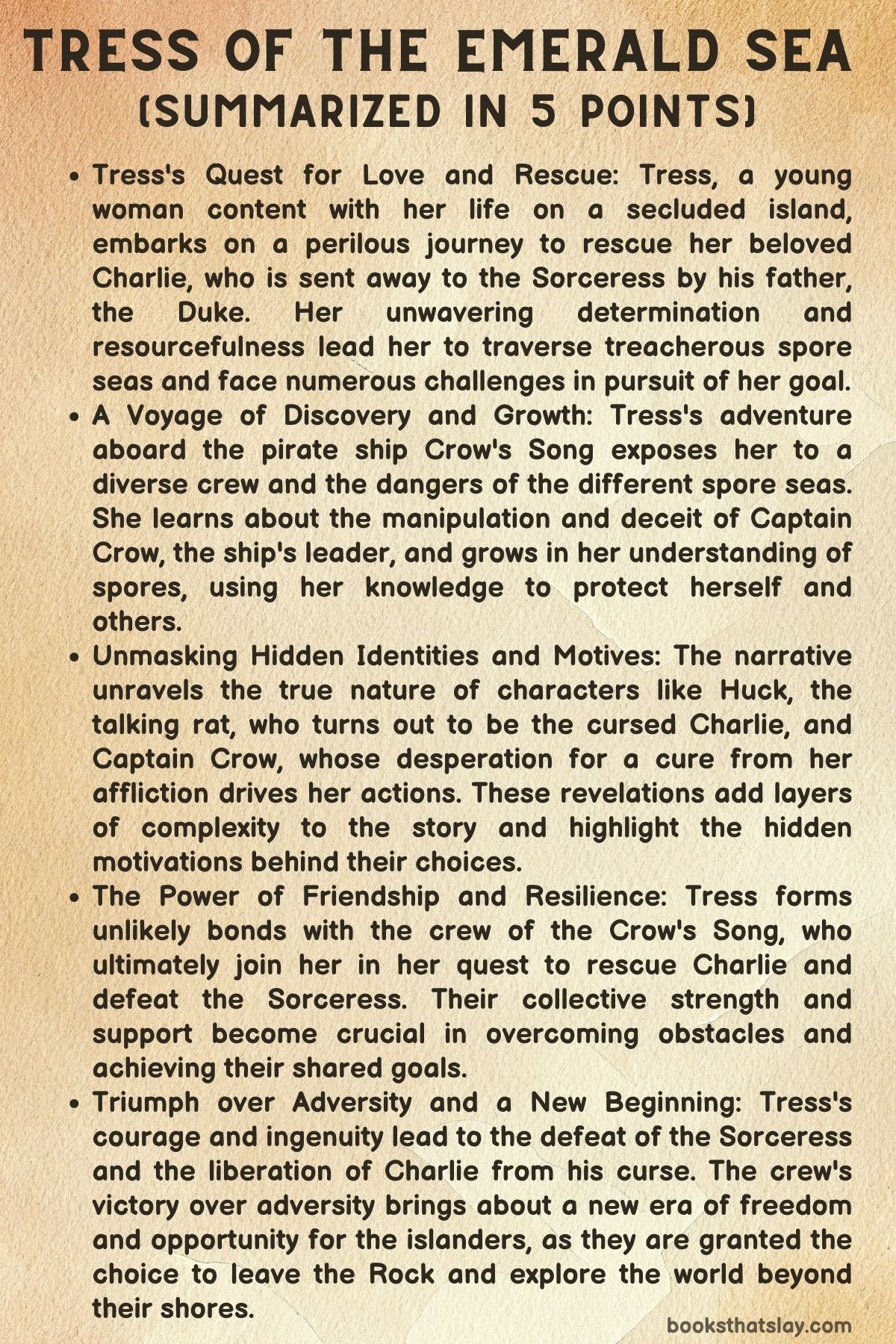
Tress grew up on Diggen’s Point, a barren island called the Rock, hemmed in by oceans made of deadly spores. Exposure to even a drop of water caused them to sprout uncontrollably, making travel hazardous.
The islanders lived under suffocating restrictions, their movements and futures controlled by royal decree. Despite the bleakness, Tress found comfort in collecting cups from passing sailors and in her quiet companionship with Charlie, a supposed gardener who was in truth the duke’s son.
Their bond was steady and gentle, filled with shared stories, pies, and moments of watching ships together. Neither dared to name it love, yet it gave meaning to their days.
The stability was broken when the duke arranged for Charlie to court a princess. Charlie tried to resist, writing letters and sending Tress cups to show his loyalty, but his rebellion only delayed the inevitable.
When the letters stopped, Tress learned the truth: Charlie had been sent to the Midnight Sea to seek the hand of the Sorceress, a fate closer to execution than marriage. The duke dismissed Tress’s pleas and forbade her from even helping with menial tasks.
Though despair threatened to consume her, Tress resolved to take action herself. She decided to escape the Rock, an act nearly impossible under the watch of inspectors who guarded against smugglers.
With the help of her family and townsfolk, who admired her quiet determination, she disguised herself and smuggled aboard a ship, setting her rescue plan into motion.
Her voyage began with betrayal. The captain of the Oot’s Dream poisoned her and locked her away.
There she met Huck, a talking rat with a sharp wit. The ship, revealed as a smuggler vessel, soon came under attack.
As cannon fire tore through the hull and spores exploded into life, Tress narrowly escaped death, clambering aboard the attacking pirate ship, the Crow’s Song. She survived by proving her usefulness, scrubbing decks and enduring humiliations under Captain Crow, a ruthless leader feared even by her own crew.
Among the pirates, Tress encountered a gallery of personalities: Fort, the deaf but kind quartermaster; Ann, the carpenter struggling with confidence; Salay, the skilled helmswoman; Laggart, the cruel first officer; and Hoid, a cursed, eccentric cabin boy. Though treated as expendable, Tress began quietly building relationships.
She learned the workings of cannons and spores, experimenting with combinations that showed her own ingenuity. She offered better meals in exchange for supplies, slowly earning respect.
What began as mere survival grew into leadership, as her ability to listen and solve problems inspired those around her. While she had once been timid, Tress was learning to command.
Yet danger loomed. Crow planned to trade Tress to a dragon named Xisis, who demanded servants unafraid of spores.
Tress realized too late that her bravery had marked her as a perfect candidate. Escape was impossible, so she leaned into her growing role as a problem solver, devising weapons, supporting crew morale, and preparing for the Crimson and Midnight Seas.
Along the way, her friendship with Huck deepened, though he often avoided questions about his past.
In time, the pirates reached the Midnight Sea. Tress insisted on facing its monsters herself, seeking to prove she could fight the Sorceress’s creatures.
Huck accompanied her, and when a massive midnight essence threatened to kill her, Huck commanded it to take them instead to the Sorceress. There he revealed his secret: he had always belonged to her.
The truth was harsher still—Huck was Charlie, cursed into the body of a rat and compelled to bring Tress to his captor.
Inside the Sorceress’s fortress, Tress confronted trials of deception and manipulation. The Sorceress tried to trick her with illusions of Charlie restored, but Tress saw through them, recognizing that her true Charlie had changed just as she had.
When the Sorceress demanded surrender, Tress stalled for time, rallying her friends who arrived at the fortress, guided by her earlier warnings. Using ingenuity, the crew immobilized the Sorceress’s Awakened soldiers with spore-filled cannonballs.
Hoid, freed from his own curse within the fortress walls, shielded Tress at the decisive moment.
Cornered, the Sorceress departed, her fortress vanishing with her. Charlie’s curse, however, remained.
Hoid adjusted its terms, altering it so that Charlie could break it not by betraying Tress but by expressing his love through words. Months later, aboard a new ship named the Two Cups, Charlie finally broke his curse with a poem he wrote for Tress.
Together with their crew, now pardoned and prosperous, they returned to Diggen’s Point to rebuild lives touched by freedom and adventure.
Tress emerged not just as Charlie’s savior but as a leader in her own right. What began as a quiet girl’s mission to rescue her companion had become the story of her growth into a captain, a master sprouter, and a woman who turned love and determination into strength.
With Charlie at her side and her crew united, she looked toward horizons yet to be explored, the seas of spores no longer barriers but paths to endless possibility.
Characters
Tress
Tress begins as a quiet, unassuming girl living a restricted life on Diggen’s Point, finding joy in the smallest details such as her cups, her tea, and evenings spent in simple companionship. Despite her timid nature, her heart is filled with a steadfast love for Charlie, which gradually transforms into a source of unshakable courage.
Tress’s journey from washerwoman to resourceful leader showcases her resilience and adaptability. On the pirate ship, she learns to navigate not just the dangers of spores and seas but also the harshness of human nature.
By applying patience, observation, and ingenuity, she evolves into a figure of authority and inspiration. Her compassion and practicality set her apart, enabling her to forge alliances, maintain her humanity amid peril, and ultimately challenge forces far greater than herself.
Tress’s growth is central to Tress of the Emerald Sea, embodying the theme of strength found in quiet determination.
Charlie
Charlie is introduced as the duke’s son, though he hides behind the guise of a groundskeeper to build an authentic relationship with Tress. Gentle and humorous, he uses his stories and wit to resist the political constraints imposed upon him, though ultimately his father’s ambition sends him into grave danger.
His devotion to Tress never falters, even when cursed into the body of Huck the rat. Though bound by the Sorceress’s curse, Charlie’s strength lies in his creativity and unyielding love.
His cleverness allows him to endure indignities and his faith in Tress empowers her in moments of despair. By the novel’s end, Charlie emerges not just as Tress’s beloved but as her equal, both transformed by hardship and strengthened by their bond.
Captain Crow
Captain Crow is a complex antagonist whose ruthlessness masks a deep-seated desperation. Commanding the Crow’s Song with absolute authority, she cultivates fear and obedience, thriving in chaos and cruelty.
Her obsession with bargaining with the dragon Xisis, even at the expense of her crew’s lives, reveals her willingness to sacrifice others for her own ends. Yet Crow is not one-dimensional; her intellect and manipulative nature make her both a formidable enemy and a dark mirror to Tress’s leadership.
Where Crow wields fear, Tress learns to wield trust. Crow’s fate at the hands of the crew she once ruled highlights the story’s moral balance: leadership born from compassion triumphs over tyranny rooted in fear.
Huck / Charlie under Curse
Huck, the sardonic talking rat, provides comic relief and companionship to Tress, while subtly guiding her toward survival and courage. His humor is laced with melancholy, and his apparent loyalty is revealed to be bound to the Sorceress’s curse.
The revelation that Huck is Charlie cursed into a rat reframes their interactions, showing the depth of Charlie’s sacrifice and the pain of his deception. His struggle between loyalty to Tress and the compulsion of the curse adds layers of tragedy and complexity to his character.
Huck’s role underscores the novel’s exploration of identity, trust, and the endurance of love in the face of manipulation.
Fort
Fort, the massive but gentle quartermaster, offers a stark contrast to the brutality of Crow. Deaf but equipped with a magical board that allows him to communicate, he becomes one of Tress’s earliest allies among the pirates.
His kindness, practicality, and sense of fairness provide stability in an environment defined by danger and betrayal. Fort’s appreciation for Tress’s cooking and ingenuity fosters a bond of mutual respect, making him both a protector and a symbol of the better humanity within the pirate crew.
His presence highlights the importance of small kindnesses as anchors in chaotic worlds.
Ann
Ann, the carpenter and gunner, represents resilience scarred by fear. Believing herself cursed due to past failures, she is hesitant and self-doubting.
Yet through Tress’s encouragement and shared training, Ann regains confidence, revealing her true skill and strength. Her bond with Tress grows into one of loyalty and shared purpose, showing how belief in another can help heal wounds of self-doubt.
Ann’s arc emphasizes the theme of rediscovered worth and the redemptive power of friendship.
Salay
Salay, the helmswoman, embodies loyalty, precision, and quiet leadership. She understands the dangers of the seas better than most and consistently demonstrates skill and calm under pressure.
More than once, she pleads with Tress to accept help, reminding her that leadership is not about isolation but about trusting others. Salay becomes the voice of the crew’s faith in Tress, making her role crucial in transforming the pirates into a family bound by trust.
Her presence is essential to the successful rebellion against Crow and the voyage into the Midnight Sea.
Laggart
Laggart, Crow’s cruel first officer, exemplifies the harshness of a world ruled by fear. He delights in enforcing discipline and pushing others to their limits, often at Tress’s expense.
Yet his influence is not wholly negative; through his relentless drilling, Tress learns essential skills in gunnery and combat. His dual role as tormentor and unintended teacher highlights the paradox of growth in hostile environments.
Though he never sheds his cruelty, his function in the narrative is to sharpen Tress’s resolve and test her endurance.
Hoid
Hoid, the eccentric and cursed cabin boy, provides both levity and enigma. His strange behavior, cryptic remarks, and ultimate significance to the breaking of curses make him one of the story’s most mysterious figures.
Though appearing bumbling and ineffective, his true nature as a powerful, long-lived figure is revealed when the Sorceress’s curse unravels. Hoid’s presence ties the novel to a larger mythos while also serving as a reminder that appearances are often deceptive.
His role in shielding Tress and altering Charlie’s curse is pivotal to the resolution.
The Sorceress
The Sorceress is the central embodiment of manipulation and control. Enigmatic, radiant, and terrifying, she rules through curses, illusions, and coercion.
Her ability to twist love into a weapon—forcing Charlie into betrayal—demonstrates her cruelty. Yet her arrogance becomes her weakness, as she underestimates the power of compassion, ingenuity, and solidarity.
The Sorceress is not simply an external antagonist but a representation of the oppressive forces that crush individuality and love. Her eventual banishment underscores the triumph of resilience, unity, and the belief in better ways of leading and living.
Themes
Love and Devotion
At the center of Tress of the Emerald Sea, love becomes the force that pushes Tress beyond the boundaries of her bleak life on the Rock. Her affection for Charlie is quiet and grounded, expressed not through declarations but through shared moments, cups exchanged, and promises that linger even after separation.
What is striking in this portrayal is the way love is shown as both fragile and resilient. On one hand, it is threatened by power, politics, and distance, easily dismissed by those like the duke who see relationships as tools of advantage.
On the other hand, it sustains Tress through her darkest moments, fueling the courage to challenge laws, confront pirates, and face a sorceress whose cruelty has cowed many. The theme underscores how devotion often begins in small, unremarkable gestures but matures into the strength to endure peril and loneliness.
Tress’s love is not idealized; it wrestles with betrayal when Charlie’s absence deepens into silence, and later when she discovers his curse. Yet she never reduces her affection to blind faith.
Instead, she grows into an individual who demands honesty, who recognizes when a false Charlie is presented, and who chooses the real bond over the illusion of comfort. Through her, the narrative shows that love is not static—it requires recognition of change, the courage to act, and the willingness to redefine what it means to be together after hardship.
Transformation and Growth
Tress’s journey is fundamentally about change, not only in her circumstances but in her sense of self. At the beginning, she is a quiet washer girl, more at home with cups and tea than with confrontation.
Yet by the end, she commands a ship, negotiates with monsters, and stands unflinching before the Sorceress. The novel makes clear that transformation does not erase one’s roots but builds upon them.
Her careful, thoughtful nature—the same qualities that made her good at scrubbing and observing—becomes the foundation for her inventive use of spores, her leadership in crises, and her ability to read people and situations. The story emphasizes that growth is not born from sudden revelations but from cumulative choices: agreeing to leave home, surviving betrayal at sea, experimenting with cannons, learning from allies, and facing fears step by step.
Unlike traditional heroes who are defined by boldness from the start, Tress demonstrates how quiet persistence and adaptability can be just as powerful. Her transformation is also mirrored in the crew, who move from fear under Crow’s tyranny to renewed purpose under Tress’s guidance.
The theme speaks to the idea that anyone, no matter how humble their beginnings, can rise to leadership and strength when motivated by care, conviction, and responsibility.
Power and Corruption
The novel presents power as something that both attracts and destroys, with the Sorceress and Captain Crow serving as its sharpest examples. Crow’s delight in cruelty, her manipulation of her crew, and her willingness to bargain away Tress illustrate how authority without accountability festers into corruption.
Similarly, the Sorceress embodies domination, building her fortress on fear, curses, and control over Midnight creatures. In contrast, Tress gradually learns to wield influence differently, earning the crew’s trust not by force but by service, fairness, and genuine care.
This theme highlights the divide between those who see power as a means of exploitation and those who see it as a responsibility. The duke, too, reflects this corruption, sacrificing his own son for political gain.
Through these figures, the book examines how power often reveals character more than it changes it, corrupting those who are selfish while empowering those willing to bear its weight for others. In the end, the Sorceress departs not because she is defeated in strength but because she realizes her dominance has been undercut by a group bound together by loyalty and courage rather than fear.
The contrast between Crow and Tress particularly reinforces the moral that leadership rooted in empathy can dismantle structures built on coercion.
Courage and Sacrifice
Fear is ever-present in Tress of the Emerald Sea: the explosive spores, the suffocating Rock, the tyranny of captains, and the menace of the Sorceress. Against this backdrop, courage emerges not as the absence of fear but as the choice to act despite it.
Tress embodies this when she resolves to leave the Rock, despite the impossibility of escaping the inspector, or when she steps onto the spore seas armed with nothing but spit and determination. Her courage is quiet, persistent, and often disguised as practicality, yet it sets the course for every victory that follows.
Sacrifice is entwined with this courage, seen in the risks her parents, Lem, and the townsfolk take to help her escape, and in the willingness of the crew to face death rather than remain under Crow’s shadow. The theme is sharpened through Charlie’s curse—his transformation into Huck embodies the ultimate sacrifice, as he risks losing his humanity and his relationship with Tress to resist the Sorceress’s demands.
These sacrifices are never glorified but shown as heavy costs carried for love, loyalty, or freedom. The narrative insists that true bravery is not about heroic posturing but about choosing to protect and preserve what matters most, even when it means enduring suffering or uncertainty.
Hope and Resilience
From the start, life on the Rock is suffocating, defined by restrictions, poisonous air, and the impossibility of change. Yet even here, Tress clings to hope, finding meaning in cups, stories, and Charlie’s letters.
The novel portrays hope as both fragile and sustaining, a force that can be nourished by something as small as a gift from afar but also crushed by silence and betrayal. What makes Tress compelling is her refusal to let despair permanently root itself in her, even after months of hopeless waiting.
Her resilience is shown not through denial of hardship but through adaptation—when letters cease, she chooses to act; when Crow reveals her schemes, Tress finds another path; when confronted with betrayal by Huck, she transforms pain into resolve. Hope in the book is not naive optimism but the recognition that better futures are possible, even when they demand extraordinary risk.
The crew’s journey also embodies this resilience, moving from despair under Crow to unity under Tress. By the end, hope has reshaped not only individuals but entire communities, as trade routes reopen and the Rock receives new opportunities.
This theme underscores the novel’s larger message: resilience in the face of despair is not about denying difficulty but about choosing persistence, creativity, and faith in human bonds.