Trial of the Sun Queen Summary, Characters and Themes
Trial of the Sun Queen by Nisha J. Tuli is a dark fantasy tale that mixes survival, politics, and forbidden destiny. It follows Lor, a prisoner hardened by years of brutality in Nostraza, who unexpectedly finds herself thrust into the dangerous Sun Queen Trials.
What begins as a desperate fight for survival in a cursed forest turns into a battle of wits and endurance against powerful Fae competitors, with the ultimate prize of becoming queen. Alongside ruthless rivals, manipulative rulers, and her own haunted past, Lor must navigate deadly games while unraveling the mystery of her identity and why she was chosen for this fate. It’s the 1st book in the Artefacts of Ouranos series.
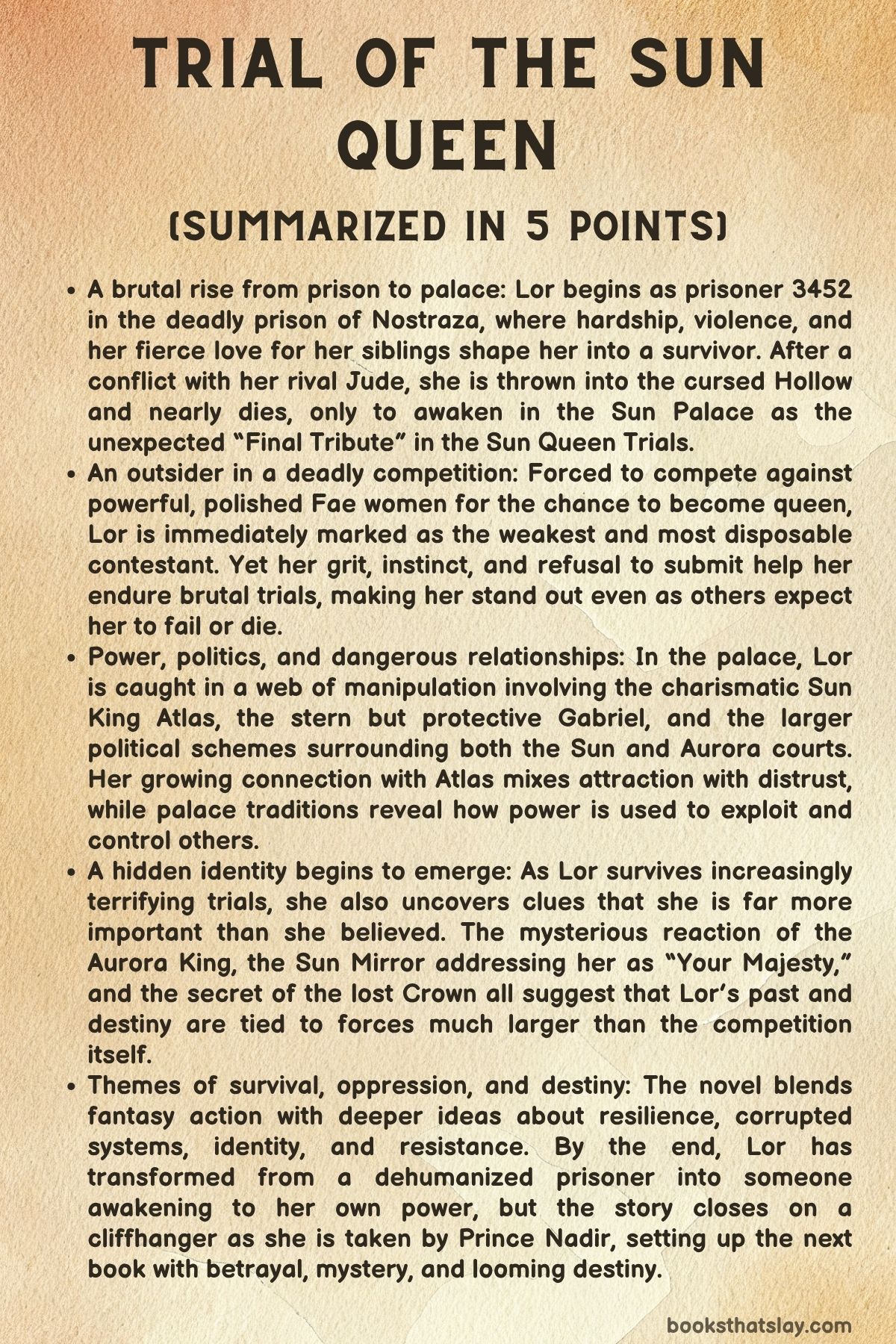
Summary
Lor’s life begins in the prison of Nostraza, where survival means clinging to scraps of dignity and resisting her rival Jude’s constant torment. Her protective brother Tristan and gentle sister Willow offer her some sense of family, though their bond is strained by the harsh environment.
When Jude steals Lor’s last piece of soap, the conflict spirals into violence, ending with Lor punished by being cast into the Hollow, a pit in the cursed forest beyond the prison walls. Alone, starving, and battered by storms, she narrowly survives until one night she is carried away, unconscious, her fate unknown.
In the Aurora King’s court, his son Nadir learns of a riot at Nostraza and that a prisoner—number 3452, Lor—has gone missing. Though the warden claims she was killed, the king reacts with relief and fury, suggesting Lor held great significance.
To Nadir’s shock, the king executes the warden and orders further investigations, though he refuses to reveal why Lor matters.
Lor awakens not in the Hollow, but in a luxurious palace, tended by an elderly woman named Mag. To her confusion, she learns she has been chosen as the Final Tribute in the Sun Queen Trials—a brutal competition where young women compete to marry the Sun King, Atlas.
Unlike the others, flawless Fae warriors groomed for the Trials, Lor is the lone mortal. Though mocked for her scars and thin frame, she realizes failure means not only humiliation but death or bondage.
With Gabriel, her winged guardian and trainer, at her side, Lor is forced into a world of opulence and cruelty, where every gesture is scrutinized and her survival is far from guaranteed.
The palace overwhelms her with its beauty, but danger lurks behind every gilded door. Gabriel warns her that Atlas chose her specifically to die in the Trials.
During combat training, Lor’s lack of skill sets her apart, though her ferocity catches Atlas’s attention when she fights back against Apricia, a cruel rival. Against expectation, Atlas singles her out for dinner, sparking suspicion and envy among the other Tributes.
Over time, Lor and Atlas grow closer, their relationship blurring the line between romance and manipulation. Atlas charms her with stories of realms and forgotten queens, while Lor challenges his views of justice, questioning his complacency with the suffering in Nostraza.
Their bond strengthens, yet Gabriel insists Atlas cannot truly care for her, fueling her doubts. The politics of the palace sharpen these tensions, as eliminated Tributes face grim fates as bound handmaidens or concubines, making survival even more urgent.
The Trials themselves prove deadly. In a vast stadium, Lor and the other Tributes navigate a swinging obstacle course suspended over a pit containing a ravenous beast.
Lor barely survives, wounded but triumphant, even helping rivals along the way. The spectacle costs one Tribute her life, and the dangers weigh heavily on Lor, reminding her of the brutality of her prison days.
Later, Lor and several others awaken in a mountain cave, confused and half-dressed. The “trial” has begun early, and their only escape seems to lie through illusions and fear.
She discovers the cliffside is an illusion, but soon enters a maze filled with apparitions of her siblings. Struggling to separate truth from deception, she faces monstrous threats and the anguish of seeing Tristan and Willow endangered.
Only by courage and brutal survival instinct does she press forward, finally reaching a mysterious door that leads her back to the Sun Palace throne room. There, Atlas declares she has completed the final challenge alongside Apricia.
Lor’s relief is short-lived. She is forced before the Sun Mirror, a magical relic that judges the worthiness of a queen.
To her astonishment, it addresses her as “Your Majesty” and warns that her union with Atlas is forbidden. It speaks of a lost Crown and promises a gift if she finds it and returns.
Determined to keep this secret, Lor lies to the court, claiming the Mirror rejected her. Atlas, bound by tradition, allows Apricia to be crowned instead, though he imprisons Lor for her defiance.
Locked away, Lor holds onto the shard hidden in her locket, a relic from her mother, and begins to embrace a new sense of destiny. Her imprisonment ends abruptly when masked Fae abduct her and deliver her to Aurora’s Prince Nadir.
Smiling, he greets her as prisoner 3452 and claims her for his father’s realm, leaving her to face yet another unknown fate.
Through her journey from prisoner to Tribute, Lor battles not only deadly Trials but the weight of secrets and hidden power. Each step brings her closer to the truth of who she is and why kingdoms tremble at her name.
Trial of the Sun Queen closes its first chapter on a cliffhanger of betrayal, survival, and looming destiny, setting the stage for the next part of her story.
Characters
Lor
Lor stands at the heart of Trial of the Sun Queen, a character forged in the brutal environment of Nostraza prison. Her early life of deprivation and cruelty sharpens her into someone who views survival as her primary instinct, often resorting to violence when cornered.
Yet beneath this hardened exterior lies deep devotion to her siblings, Tristan and Willow, who anchor her humanity and remind her of what she has lost. Throughout her journey, Lor constantly battles with her identity—first as a prisoner stripped of dignity, then as the Final Tribute thrust into the glittering but deadly world of the Sun Queen Trials.
Her suspicion of others, shaped by years of betrayal and brutality, makes her cautious, yet she also possesses an inner fire that captures Atlas’s attention. Her resilience, willingness to challenge authority, and capacity for empathy—seen in moments where she helps fellow Tributes like Halo—highlight her evolution into someone not only fighting for survival but also considering what justice and leadership mean.
Tristan
Tristan, known as the “Prince of Nostraza,” is a figure of paradox within Lor’s life. Favored by the guards, he enjoys privileges that his sisters lack, a source of both envy and gratitude for Lor.
His role as protector defines him; he shields Lor and Willow whenever possible, yet this same role casts a shadow, as Lor grapples with feeling less cared for by authority and resenting the disparity in their treatment. Tristan embodies loyalty and responsibility, but also the silent burden of carrying his family’s survival on his shoulders.
To Lor, he is both a reminder of love and a painful emblem of inequality within Nostraza.
Willow
Willow provides a softer contrast to Lor’s hardened personality. Gentle and empathetic, she represents innocence preserved against impossible odds.
Lor’s fierce protectiveness of Willow underscores the depth of her humanity. In visions and illusions during the Trials, Willow becomes a figure of emotional torment for Lor, symbolizing both her deepest fear—failing to protect her family—and her greatest motivation to endure.
Willow is less a participant in the external conflict and more a living tether to Lor’s compassion and vulnerability.
Jude
Jude, Lor’s rival in Nostraza, personifies cruelty within captivity. Her theft of Lor’s soap and her taunts showcase her willingness to exploit weakness for dominance in an environment where survival often means subjugating others.
Her insults and open mockery highlight the toxic competition that festers in such oppressive systems. For Lor, Jude becomes a spark that ignites her darker instincts, showing how easily violence can surface when humiliation and rage collide.
Jude serves less as a complex character and more as a foil to Lor, embodying everything vicious and petty about prison survival.
Aero
Aero exists in Lor’s life as both comfort and complication. Their secret relationship provides Lor with fleeting intimacy and escape from the crushing weight of Nostraza, yet it also leaves her vulnerable to ridicule, as seen in Jude’s mockery.
Aero represents the human need for connection even in the bleakest places, but his presence underscores Lor’s precariousness, highlighting how little room she has for true love or trust when every choice is a gamble for survival. His role is more functional than transformative, yet he reveals Lor’s craving for closeness beneath her hardened shell.
Warden Kelava
Warden Kelava exemplifies the abuse of power. His cruelty, callousness, and indifference to prisoner suffering reveal how deeply corruption runs in Nostraza.
When Lor tries to manipulate him to avoid punishment, his rage and eventual condemnation of her to the Hollow demonstrate the futility of bargaining with authority that thrives on domination. His eventual downfall—strangled by the Aurora King—underscores his expendability in a system where even those in power serve at the whim of greater, more ruthless figures.
Nadir
Nadir, prince of the Aurora Kingdom, emerges as a foil to his father and a character of growing intrigue. Unlike the king, whose actions are defined by secrecy and cruelty, Nadir shows curiosity, restraint, and unease at the brutality around him.
His investigation into Lor’s disappearance signals a more cautious and thoughtful approach, suggesting he may be a character with the potential to challenge the ruthless systems in place. His smirk at the end, when Lor falls back into Aurora’s grasp, reveals both confidence and ambiguity, making him a figure whose loyalties and intentions remain uncertain but central to the unfolding narrative.
Atlas
Atlas, the Sun King, dominates the Trials with his charisma and power. He is both captivating and dangerous, weaving charm with control.
His attraction to Lor, expressed through intimate encounters and promises of consideration, highlights his complexity—part romantic sovereign, part manipulator who bends tradition to his will. While he listens to Lor’s perspective on inequality and entertains the idea of reform, his insistence on her imprisonment after the Sun Mirror’s rejection reveals the darker edge of his rule.
He embodies both the allure of absolute power and the peril of entrusting one’s fate to a man who sees people as players in his game of authority.
Gabriel
Gabriel, Lor’s warder, is stern, disciplined, and often harsh with her. His role as both protector and trainer positions him as someone who shapes Lor’s ability to survive the Trials.
Yet his criticisms, sharp words, and moments of genuine concern create tension between them. Gabriel views Lor as unprepared and unworthy, but also as someone he must harden to survive.
His complexity lies in this dual role: a figure who frustrates Lor deeply while also serving as the forge that tempers her resilience.
Mag (Magdalene)
Mag introduces Lor to the world of the Sun Palace with warmth, care, and maternal patience. She provides nourishment, comfort, and explanations, easing Lor’s transition from a world of cruelty to one of luxury and danger.
Yet even in her kindness, Mag remains bound by her position within the palace’s rigid hierarchy, hesitant to defy authority. She represents compassion within constraint—a reminder that even within systems of control, humanity can persist, though never freely.
Madame Odell
Madame Odell embodies judgment and cruelty wrapped in refinement. Her scorn for Lor’s scars and unpolished background reflects the elitism of the Fae world, where worth is tied to beauty and breeding.
She maintains the structure of the Trials with strictness and disdain, ensuring that Lor is constantly reminded of her outsider status. Her role as an instructor is less about teaching and more about reinforcing hierarchy, making her an emblem of the prejudice Lor must overcome to be seen as worthy.
Themes
Survival and Resilience
In Trial of the Sun Queen, survival is not simply a matter of avoiding death but an ongoing test of willpower, adaptability, and determination. Lor’s time in Nostraza demonstrates how she has been forged in the harshest conditions—scarcity of food, abusive guards, and constant rivalry with other inmates.
Her survival is not passive endurance but an active struggle that shapes her entire identity. When she is cast into the Hollow, facing storms, starvation, and monstrous threats, the narrative highlights the razor-thin boundary between life and death.
Yet her ability to endure hallucinations, physical collapse, and despair without surrender emphasizes the depth of her resilience. This survival instinct continues into the Trials, where she is pitted against Fae who are trained, wealthy, and privileged, unlike her.
She compensates for her lack of refinement and skill with raw determination, brute strength, and a refusal to accept defeat, even when humiliation and danger are constant companions. Her resilience becomes both a weapon and a shield, setting her apart from the other Tributes and allowing her to carve out a sense of worth where none was granted before.
The novel uses her survival to question what it truly means to be strong: is it the grace and training of the Fae, or the desperate, lived determination of someone who has endured more than they should have?
Power and Corruption
Power in the world of Trial of the Sun Queen is never neutral—it is political, manipulative, and often brutal. The Aurora King embodies this corruption most directly, ruling with cruelty, secrecy, and violence.
His decision to strangle Kelava in front of his son reveals not only ruthlessness but the fragility of power when built on fear. Similarly, the Sun King Atlas represents a different but equally dangerous kind of authority, cloaked in beauty, charm, and seductive influence.
The Trials themselves are a manifestation of institutionalized cruelty—an ancient tradition designed to enforce hierarchy under the guise of honor. The elimination of Tributes does not only mean death; it can mean a lifetime of servitude, stripping away agency and identity in the process.
Through Lor’s perspective, the reader is reminded of how power is maintained by exploiting those deemed disposable, whether prisoners in Nostraza or mortal Tributes in the palace. Even characters like Gabriel, who appear bound by duty, highlight how systems of power corrupt individuals by forcing them into complicity.
Power here is seductive but corrosive, and Lor’s growing awareness of its mechanics sets the stage for her own challenge to authority, especially as she begins to imagine a role beyond victimhood—one where she might claim influence herself.
Identity and Transformation
Lor’s journey in Trial of the Sun Queen is equally an exploration of identity—what defines her, and whether she can escape the labels others impose on her. At Nostraza, she is a number—prisoner 3452—robbed of individuality and reduced to mere survival.
Within the Sun Palace, she becomes the “Final Tribute,” marked not for her worth but for her expected death. Both identities are defined by others and carry the weight of erasure.
Yet Lor’s strength lies in her refusal to fully accept these imposed roles. Her scars, her roughness, and her lack of refinement are mocked as evidence of her inferiority, but she begins to wield them as proof of her authenticity.
Atlas’s fascination with her grows not because she is like the other Tributes but because she is different—unpolished, unpredictable, and unwilling to bend. The Sun Mirror deepens this theme when it speaks directly to her, acknowledging a hidden truth about who she is and hinting at a destiny that others have long tried to suppress.
Her transformation, therefore, is not merely about surviving the Trials but about reclaiming a selfhood that has been systematically denied. By the end of the novel, she is no longer simply a prisoner or a disposable competitor; she is someone aware of her own potential to change the structures around her.
Love, Desire, and Manipulation
Romantic and sexual dynamics in Trial of the Sun Queen are deeply entangled with power, trust, and survival. Lor’s relationship with Aero in Nostraza is framed around comfort and fleeting escape, showing how intimacy can serve as a survival mechanism.
With Atlas, however, desire becomes both opportunity and danger. Their growing bond promises protection and the possibility of elevation, yet it is also fraught with manipulation.
Atlas’s attention could be genuine, but it is equally possible that it serves his interests within the Trials, where the king’s authority looms over every choice. Lor herself oscillates between attraction, suspicion, and self-preservation, recognizing that intimacy with him might make her vulnerable even as it gives her leverage.
Gabriel adds another layer, as his harsh training and sharp criticisms mask a protective instinct, creating a tension between antagonism and reluctant reliance. The theme of love and desire is not portrayed as purely romantic fulfillment but as a series of negotiations within systems that commodify women’s bodies and emotions.
Lor’s struggle lies in discerning genuine connection from manipulation, and whether desire can exist untangled from the power structures that define her world.
Oppression and Resistance
The novel consistently presents oppression as an inescapable force shaping Lor’s life and that of those around her. Nostraza itself is a symbol of systemic cruelty, where human dignity is stripped away, and survival depends on submission or violence.
In the palace, oppression takes on a more polished form, hidden beneath beauty, luxury, and ancient traditions. The Trials appear gilded but remain mechanisms of control, forcing women to compete not just for survival but for the “honor” of servitude as queen or handmaiden.
The Final Tribute tradition, with its unbroken history of mortal failure, is perhaps the clearest expression of this oppression—it exists to remind mortals of their inferiority. Yet resistance permeates the story, often embodied by Lor’s refusal to conform to the roles designed for her.
Her defiance during training, her willingness to fight back against Apricia despite the consequences, and her bold confrontation with Atlas about the injustices of Nostraza all mark her as someone unwilling to remain silent. Resistance here is not a single act but a mindset, a rejection of the inevitability of oppression.
It suggests that while power structures seem immovable, even small acts of defiance can crack their foundations and pave the way for change.