Tropesick Summary, Characters and Themes
Tropesick by Lauren Okie is a contemporary romance about two former childhood friends whose unfinished love story returns when they are unexpectedly hired to write a romance novel together.
Katie Caruso has spent years avoiding the grief surrounding her brother’s death, while Tyler McNally has built his life around sobriety, guilt, and the belief that he causes pain to people he loves. Their professional reunion forces them to confront the past while rediscovering the creative connection that first brought them close. Blending second chances, family grief, addiction, metafiction, and a touch of the supernatural, the book examines whether people can accept love without pretending their past never happened.
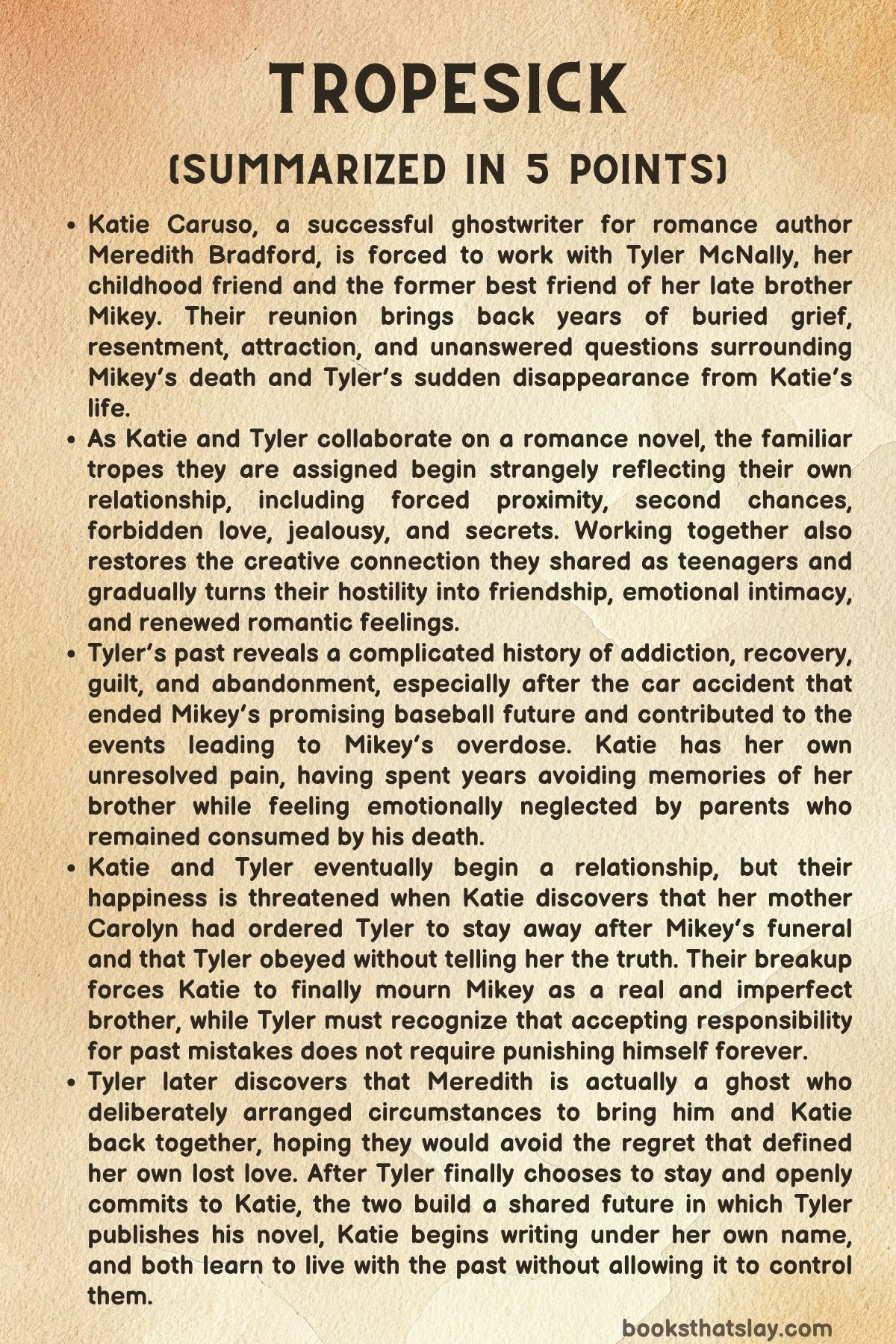
Summary
Katie Caruso is twenty-five and living in New York, where she has quietly built a successful career as the anonymous ghostwriter behind bestselling romance novelist Meredith Bradford. Writing under someone else’s name gives Katie everything she thinks she wants: financial stability, millions of readers, and the security of never having to discover whether readers would accept a novel carrying her own name.
Her controlled life is disrupted when Meredith’s agent, Selma, assigns a second writer to help Katie meet an impossible deadline. The replacement turns out to be Tyler McNally, Katie’s childhood neighbor, her late brother Mikey’s best friend, and the person associated with some of the most painful memories of her adolescence.
Katie immediately wants Tyler removed from the project. She has spent eight years separating herself from her old life, even allowing most people in New York to believe she was an only child, and Tyler’s appearance threatens the emotional distance she has carefully maintained.
Tyler is equally shaken by the reunion. Now an English teacher and aspiring novelist, he has been sober for years and remains deeply burdened by guilt surrounding Mikey’s death. His literary career has stalled, however, and Selma promises to help sell his manuscript if he completes the romance assignment.
Neither Katie nor Tyler can afford to walk away. They reluctantly agree to divide the work, but their first attempt at remote collaboration becomes disastrous as old resentment turns every edit into an argument.
Eventually, Katie takes control of Tyler’s education in romance fiction. Tyler initially considers commercial romance artistically inferior, but Katie patiently teaches him its conventions, emotional structure, reader expectations, and familiar tropes. As he reads more widely, his contempt gives way to respect.
Their old creative rhythm also begins returning. Katie and Tyler once spent their teenage summers writing beside each other on Long Island beaches, and working together again reminds them how naturally they understand each other as writers.
Their assignment becomes stranger when Meredith summons them to her Southampton estate. Although Katie has written several novels under Meredith’s name, she has never met the famously private author before.
Meredith decides that their new romance should be set in Southampton and allows her cat, Pinot, to choose the story’s tropes from a bowl. The selected ideas include forced proximity, second chances, secrets, forbidden love, kissing in the rain, and brother’s best friend, all of which resemble Katie and Tyler’s own history with unsettling accuracy.
The novel they begin writing follows Willa and Henry, former friends forced to work together while renovating an inn. Without consciously intending it, Katie and Tyler begin placing their own feelings, jealousies, memories, and arguments inside their fictional characters.
Their professional friendship soon expands beyond writing. Tyler continues attending recovery meetings, and when Katie learns that he has remained sober, she sees evidence that the man standing before her is not simply the reckless teenager preserved in her memory.
Their renewed closeness also exposes the emptiness of Katie’s relationship with Danny, a successful lawyer who fits the uncomplicated life she believes she should want. Danny knows very little about Mikey, her family, or the grief underneath Katie’s bright personality because Katie has deliberately chosen relationships that do not require emotional exposure.
Tyler knows those hidden parts instinctively. His jealousy toward Danny becomes increasingly obvious, while Katie becomes equally jealous when Tyler appears with another woman. Their fictional characters reproduce much of the same tension.
Soon Katie loses access to her Manhattan apartment after a gas leak exposes serious building violations. Selma arranges for her to stay at Meredith’s Southampton estate, creating an unexpected displacement almost identical to a trope Katie and Tyler have recently written into their manuscript.
Writing alone in Southampton proves surprisingly difficult. Katie’s creativity disappears without Tyler beside her, and Tyler experiences the same problem in New York.
Meredith concludes that they need each other and brings Tyler to Southampton, where he stays in a cottage on the property. Their forced proximity restores both the manuscript and the companionship they thought they had lost years earlier.
Days become filled with writing, meals, beach walks, bicycle rides, jokes, and late-night conversations over pink walkie-talkies. Those exchanges echo the childhood nights when Katie and Tyler talked through neighboring bedroom windows.
At the same time, the story gradually reveals what happened between them as teenagers. Tyler had been almost another member of the Caruso family because his own father had abandoned him, and Mikey’s parents frequently included him in their lives.
Katie and Tyler discovered that they shared a passion for writing and began meeting regularly to create stories together. Their friendship developed into romantic attraction, but Mikey warned Tyler not to pursue his younger sister.
Everything changed after Tyler was driving during a car accident that catastrophically damaged Mikey’s pitching arm. Mikey had once seemed destined for a professional baseball career, and losing that future devastated him.
Prescription pain medication eventually became an addiction. Tyler, already struggling with abandonment and emotional instability, also began using drugs, and for a period the two friends moved through addiction together.
Tyler eventually survived an overdose and entered recovery. Mikey continued struggling and later died from an overdose, leaving Tyler convinced that the accident, the drugs, and Mikey’s death formed one chain of destruction for which he was personally responsible.
In the present, Tyler grows closer to Meredith and discovers that she has her own history with alcoholism and regret. She challenges his belief that serious literature requires hopelessness and encourages him to revise his unsold manuscript so that its emotional relationships matter as much as its darkness.
Katie and Tyler meanwhile stop pretending their feelings are purely professional. Tyler admits that he has never completely stopped thinking about her, but Katie is frightened because his history of approaching and then retreating from her taught her to expect rejection.
After Katie ends her relationship with Danny, she and Tyler finally kiss during a storm. Their attraction nearly leads to sex, but Tyler suddenly stops, leaving Katie convinced that their old pattern is repeating itself.
Forced together in Tyler’s cottage during the storm, they finally speak honestly. Tyler explains that his adult sexual relationships have always ended with immediate emotional detachment; after sleeping with someone, he becomes nauseated, loses interest, and never wants to see that person again.
He is terrified that the same reaction will happen with Katie. Rather than interpreting the confession as rejection, Katie asks him simply to share the bed and hold her.
That quiet intimacy becomes a turning point. Tyler wakes the next morning still wanting Katie beside him, and together they decide to approach their relationship slowly through actual dates, conversation, affection, and increasing trust.
Eventually they become lovers, and Tyler discovers that physical intimacy with Katie does not destroy his emotional connection. Their relationship grows happier while both writers also begin taking greater artistic risks.
Tyler completes a stronger version of his manuscript after accepting that its love story matters. Katie begins considering writing under her own name instead of permanently remaining hidden behind Meredith’s career.
Yet the history surrounding Mikey remains unresolved. Katie still struggles with her mother Carolyn, whose entire emotional life has become centered on mourning her dead son and running the memorial foundation established in his name.
Katie has spent years feeling like the forgotten surviving child. Her father Paul has emotionally withdrawn as well, leaving Katie to manage her grief largely alone.
When Katie finally challenges Carolyn and reveals her relationship with Tyler, Carolyn demands that she choose between her family and him. Katie chooses Tyler, refusing to sacrifice another part of herself to her mother’s grief.
Tyler, however, knows something Katie does not. After Mikey’s funeral, Carolyn confronted him and ordered him to disappear from Katie’s life, deliberately encouraging Katie to believe he had abandoned her voluntarily.
Already overwhelmed by guilt, Tyler obeyed. He convinced himself that leaving Katie was another form of making amends.
When the truth finally comes out, Katie is devastated. She is furious with Carolyn for manipulating her, but she is also furious with Tyler for deciding on her behalf that she would be better without him.
Tyler again prepares to leave, believing Katie deserves someone untouched by his past. Katie recognizes that despite all his recovery, he is still repeating the same emotional pattern: whenever love becomes difficult, he decides that disappearing is an act of protection.
Their relationship breaks apart. Instead of immediately searching for another distraction, however, Katie turns toward the grief she has avoided for years.
She contacts Ingrid, Mikey’s former girlfriend, and returns to the Long Island home where they grew up. The house now belongs to another family, forcing Katie to recognize that the past has continued moving even while she has remained emotionally trapped inside it.
Through Ingrid, Katie begins remembering Mikey as an actual person rather than a saint, an addict, a baseball prodigy, or the tragedy around which everyone else organized their lives. She finally allows herself to ask who her brother really was and to mourn him honestly.
Tyler receives his own confrontation from Arthur, his longtime sponsor and friend. Arthur makes him recognize that accepting responsibility does not require lifelong punishment and that leaving Katie is not noble simply because Tyler calls it protection.
Another mystery is also reaching its conclusion. Tyler remembers seeing Meredith at Mikey’s funeral years earlier and investigates the forbidden carriage house on her property.
There he discovers evidence that Meredith has been following Katie and Tyler’s lives for years and intentionally arranged their professional reunion. His confrontation with her produces an even stranger revelation when he discovers that Meredith is a ghost.
Meredith explains that regret over her own lost love led her to become invested in Katie and Tyler’s unfinished relationship. She used Selma, their writing careers, the Southampton estate, and carefully arranged circumstances to place them close enough to make their own choices.
She insists that she never created their love. She merely gave them opportunities to stop running from it.
Meredith also tells Tyler the truth he has resisted accepting: Katie does not need some imaginary version of him who never made mistakes. She needs the real Tyler to become capable of staying, taking responsibility, and living differently.
Katie attends Mikey’s memorial gala without Tyler and finally separates herself emotionally from Carolyn’s judgment. She recognizes that loving her mother does not require organizing the rest of her life around Carolyn’s unresolved grief.
Tyler then makes the opposite choice from every earlier version of himself. He puts on a suit, heads toward the gala, encounters transportation problems, and keeps going instead of using difficulty as permission to disappear.
He arrives soaked and exhausted but finally stands in front of the Caruso family. He acknowledges the accident, the drugs, his failures, and the harm he caused while refusing to accept sole responsibility for Mikey’s death.
Carolyn cannot forgive him, but Paul finally speaks. He apologizes to Katie for emotionally abandoning her after Mikey died and tells Tyler that he has missed him and is proud of the man he became.
Outside the gala, Tyler finally tells Katie that he wants more than an extraordinary summer. He wants ordinary life with her: errands, difficult days, celebrations, domestic routines, marriage, family, and all the unremarkable moments he once believed he could never sustain.
Katie accepts him. When they return to Southampton, Meredith and the magnificent estate are gone, leaving behind a decaying property and a newly completed manuscript titled Tropesick, credited to Meredith Bradford.
A year later, Katie and Tyler sit together on a Long Island beach much as they did when they were teenagers. Tyler has sold his novel, Katie is finally writing one under her own name, and their relationship has become rooted in ordinary routines rather than fantasy.
They have not erased what happened to them. Instead, they have learned to carry memory, accountability, grief, creativity, and love into a life that continues beyond the ending Meredith arranged for them.
Characters
Katie Caruso
Katie Caruso is the emotional center of Tropesick, and much of her development comes from the difference between how functional she appears and how much grief she has actually avoided. She is professionally accomplished, independent, witty, fashionable, and financially secure, yet almost every stable element of her adult life has been designed to reduce emotional risk.
Her ghostwriting career illustrates this contradiction particularly well. Katie is talented enough to produce bestselling romances, but publishing under Meredith Bradford’s name allows her to receive professional success without placing her own identity before readers.
The same defensive strategy shapes her relationships. Danny and the other men she dates are attractive partly because they cannot reach the parts of her life connected to Mikey, her parents, or Tyler, which allows Katie to experience companionship without exposing the wounds she is afraid another person might touch.
Katie’s cheerful personality therefore operates both as a genuine quality and as a defense. She really is energetic, funny, imaginative, romantic, and capable of bringing light into other people’s lives, but she has also learned to use activity, exercise, sex, work, and humor to outrun feelings she does not know how to process.
Her relationship with Mikey is especially complicated. She loves her brother, yet she also spent much of childhood feeling secondary to his baseball talent, her parents’ attention toward him, and his privileged closeness with Tyler.
After Mikey dies, Katie is barely permitted to possess grief on her own terms because Carolyn’s mourning dominates the family. Katie becomes the surviving daughter who is expected to understand everyone else while receiving little recognition of what she has lost.
Her anger toward Tyler consequently contains several kinds of pain at once. She feels abandoned by the boy she loved, betrayed by the person who understood her most deeply, and humiliated by years of believing that his disappearance proved she had misread their entire relationship.
Reuniting with him forces Katie to distinguish between the Tyler preserved in her memories and the adult man standing before her. His sobriety, patience, professional respect, vulnerability, and willingness to discuss his fears gradually challenge her assumption that people cannot meaningfully change.
Katie nevertheless grows independently of the romance. Her confrontations with Carolyn and her decision to speak with Ingrid are crucial because they show her finally addressing wounds that Tyler cannot heal for her.
By the end of the novel, Katie no longer requires another person’s approval to justify her life. Choosing Tyler matters, but choosing to write under her own name is equally significant because she finally accepts that safety cannot remain the organizing principle of her identity.
Tyler McNally
Tyler McNally is defined by the enormous difference between responsibility and the exaggerated responsibility he assigns himself. He genuinely made harmful choices as a teenager, yet he has transformed those choices into a belief that he is fundamentally dangerous to anyone who loves him.
His earliest emotional wound comes from his father’s abandonment. Tyler grows up believing that people leave and gradually begins to suspect that his father’s departure says something about Tyler’s own worth.
The Caruso family partially fills that absence. Mikey becomes his closest friend, and Katie’s parents provide the family environment he lacks at home, which makes the later accident and Mikey’s death feel to Tyler like the destruction of people who had given him something precious.
His addiction intensifies this self-condemnation. Tyler participates in drug use with Mikey and later survives his own overdose, while Mikey ultimately dies, producing a survivor’s guilt that becomes central to Tyler’s identity.
Sobriety saves Tyler physically but does not automatically remove the beliefs created during addiction. Years later, he still interprets love through the assumption that leaving someone may be kinder than allowing that person to remain close to him.
This explains his complicated sexual behavior. Tyler repeatedly seeks physical intimacy while avoiding enduring attachment, and his immediate emotional withdrawal afterward allows him to leave before vulnerability can become dangerous.
Katie presents a threat to that pattern because she matters too much for emotional detachment to feel safe. His reluctance to sleep with her is therefore not uncertainty about desire but terror that his familiar response will destroy the relationship he values most.
Writing becomes essential to Tyler’s development because his artistic assumptions resemble his emotional assumptions. He initially believes serious literature should resist romance and hope, just as he believes a damaged person like himself should resist a hopeful future.
Katie and Meredith challenge both beliefs. By learning how romance functions and allowing his own manuscript to contain emotional connection, Tyler gradually accepts that hope does not make either literature or life less truthful.
His greatest failure in adulthood is repeating the old pattern after Katie chooses him. Tyler again decides that leaving is protection, demonstrating that sobriety and emotional growth are related but not identical achievements.
His eventual arrival at the gala marks genuine change because he chooses presence over disappearance. Tyler does not deny what he did, but he finally refuses to treat permanent suffering as the only acceptable form of accountability.
Meredith Bradford
Meredith Bradford initially appears to be an eccentric, enormously successful romance novelist whose wealth has separated her from ordinary life. Her Southampton estate, drinking, unusual behavior, mysterious rules, technological isolation, and dependence on Maurice make her seem theatrical enough that even Katie struggles to understand her.
As the book develops, Meredith becomes one of its most layered figures. Behind the famous author persona is a lonely woman whose career success could not protect her from addiction, estrangement, regret, and the consequences of decisions she wishes she could reverse.
Her relationship with romance fiction is deeply personal. Meredith understands that stories promising emotional connection are often dismissed as unserious, and she challenges Tyler’s belief that hope or love automatically weakens literary ambition.
She also becomes a mentor to both writers. Tyler learns from her that his bleak manuscript needs an emotional reason for its protagonist to continue living, while Katie receives from Meredith the kind of recognition and encouragement that Carolyn has rarely given her.
Meredith’s connection to Katie becomes particularly maternal. Giving Katie the green gown before the gala is not merely an extravagant gesture; it symbolically gives her permission to enter a room where she has long felt secondary and allow herself to be visible.
The supernatural revelation completely changes the reader’s understanding of Meredith without erasing her earlier qualities. Her ghostly existence is rooted in regret, especially the lost relationship she never recovered and the life she could not stop imagining differently.
Her manipulation of Katie and Tyler remains morally complicated. She arranges their reunion and creates circumstances that resemble romance conventions, yet she insists that she cannot manufacture emotion or force either person to choose the other.
Meredith therefore functions as both matchmaker and warning. Her own life demonstrates what can happen when fear and regret are allowed to make permanent decisions, while Tropesick uses her impossible intervention to give Katie and Tyler opportunities she believes she once wasted.
Mikey Caruso
Mikey is physically absent from the present-day story but psychologically present almost everywhere. His life, injury, addiction, death, and memory shape the Caruso family, Katie’s emotional defenses, Tyler’s guilt, and the history separating the central couple.
As a teenager, Mikey is exceptionally talented at baseball and is treated as someone with an extraordinary future ahead of him. That promise affects the family dynamic because much of the parents’ attention naturally revolves around his career.
Katie consequently experiences him through both affection and resentment. She loves her brother while also feeling ordinary beside him and envying his closeness with Tyler.
His reaction to Katie and Tyler’s attraction adds another complication. Mikey warns Tyler away from his younger sister, establishing a boundary that Tyler takes seriously even when his feelings for Katie become obvious.
The accident destroys the identity that had been organized around baseball. Mikey’s physical pain and shattered ambitions create conditions in which prescription medication becomes increasingly dangerous.
His later addiction should not reduce him to a cautionary figure. Ingrid’s memories become important precisely because they restore Mikey as funny, selfish, loving, difficult, frightened, and human rather than merely the dead son his mother memorializes.
After his death, other characters turn Mikey into different symbols. Carolyn makes him the center of permanent mourning, Tyler makes him proof of his own destructiveness, and Katie initially makes his death the event she must avoid remembering.
Katie’s eventual willingness to hear ordinary stories about him represents a healthier form of remembrance. Mikey can remain loved without his death determining every decision made by the people who survived him.
Carolyn Caruso
Carolyn is one of the story’s most difficult characters because her behavior emerges from genuine devastation while still causing serious harm to Katie and Tyler. Mikey’s death becomes the central fact of her emotional existence, and she appears almost unable to imagine life outside that loss.
The memorial foundation gives Carolyn a socially productive structure for her grief, but it also allows grief to remain permanently active. Mikey is continually preserved as the brilliant son whose future was stolen rather than remembered as a complicated human being.
Katie pays much of the emotional cost. Carolyn is so consumed by the child she lost that she repeatedly fails to recognize the loneliness of the daughter who survived.
Her treatment of Tyler is harsher still. Carolyn reduces a complicated sequence involving an accident, addiction, individual choices, and tragedy into a single explanation in which Tyler becomes responsible for Mikey’s destruction.
Her demand after the funeral that Tyler disappear from Katie’s life is particularly damaging because she intentionally manipulates Katie’s understanding of what happened. Carolyn decides that hatred toward Tyler will be easier for her daughter than continued attachment and therefore removes Katie’s right to make the decision herself.
Yet Carolyn is not presented as emotionally untouched by suffering. Her inability to move forward is itself tragic, and Katie eventually recognizes that her mother may simply be incapable of providing the relationship Katie has spent years hoping to earn.
Katie’s final boundary with Carolyn is therefore not based on revenge. She can acknowledge her mother’s pain and retain love for her while refusing to sacrifice the rest of her own life to it.
Paul Caruso
Paul responds to Mikey’s death differently from Carolyn but causes harm through absence rather than domination. He becomes emotionally diminished, withdrawn, and largely incapable of speaking about what happened.
For Katie, his silence creates another form of abandonment. Her mother’s grief fills every available space while her father retreats, leaving Katie without either parent capable of recognizing what she needs.
Paul’s relationship with Tyler carries additional emotional weight because Tyler had once been practically another son in the Caruso household. His inability to address Tyler after the tragedy leaves both men trapped inside grief that neither knows how to discuss.
His behavior at the gala therefore becomes unusually significant. When he finally tells Carolyn to let Katie and Tyler go, Paul chooses to re-enter an emotional situation he has avoided for years.
His apology to Katie acknowledges that surviving parents can fail a surviving child even while experiencing genuine devastation themselves. More importantly for Tyler, Paul’s embrace gives him affirmation from one of the parental figures whose loss he has quietly mourned.
Paul cannot reverse years of withdrawal, but his final actions suggest that emotional absence does not have to remain permanent.
Arthur
Arthur serves as Tyler’s sponsor, older friend, moral counterweight, and one of the strongest voices of accountability in the story. He cares about Tyler without allowing affection to become indulgence.
Early in the book, Arthur warns Tyler that career opportunities do not justify reopening Katie’s wounds. He repeatedly reminds him that wanting to apologize does not mean Katie owes him an opportunity to feel forgiven.
That distinction makes Arthur important to Tyler’s recovery. He consistently separates responsibility from self-centered guilt, teaching Tyler that even remorse can become another way of making every event about himself.
Arthur also refuses Tyler’s habit of romanticizing disappearance as sacrifice. When Tyler claims that Katie deserves someone better, Arthur recognizes the belief as another form of avoidance.
His guidance becomes especially important near the climax. He tells Tyler that the past cannot be undone and that making amends is meant to help a person live differently, not sentence that person to endless punishment.
Arthur therefore represents the mature philosophy Tyler has learned intellectually but struggles to apply emotionally. He does not provide easy reassurance; he keeps directing Tyler toward honesty, boundaries, accountability, and present action.
Lola
Lola is Katie’s closest friend and one of the few people in her adult life able to recognize the difference between Katie’s cheerful performance and her actual emotions. Her observations often reach conclusions Katie is unwilling to admit.
She quickly notices that Tyler still has feelings for Katie and later recognizes that Katie’s fixation on him is incompatible with her insistence that Danny is her meaningful romantic relationship. Her teasing is humorous, but it regularly exposes uncomfortable truths.
Lola also understands Katie’s avoidance patterns. She sees that Katie chooses men who cannot seriously hurt her because they also cannot seriously know her.
Her importance lies partly in representing the life Katie built after leaving Long Island. Unlike Tyler, Lola does not know Katie because of childhood history, yet she becomes loyal enough to challenge the stories Katie tells herself.
Lola is therefore not simply a comic best friend. She is evidence that Katie has built genuine chosen relationships in adulthood, even while keeping certain parts of herself hidden.
Danny
Danny functions less as a villain than as a demonstration of the kind of emotional safety Katie has deliberately chosen. He is successful, attractive, available, and uncomplicated, making him suitable for a relationship that never needs to touch Katie’s deepest wounds.
The limitation becomes increasingly obvious as Tyler re-enters her life. Katie can discuss writing, Mikey, family, fear, grief, and memory with Tyler, while Danny remains largely outside the most important parts of her identity.
Danny correctly notices Katie’s fixation on Tyler before she admits it herself. His discomfort is therefore understandable because he gradually realizes that he occupies the official relationship while another man receives Katie’s emotional attention.
His insensitivity toward Tyler’s sobriety finally clarifies the contrast for Katie. She recognizes that compatibility cannot be measured merely through social suitability when genuine intimacy requires curiosity, knowledge, respect, and emotional responsibility.
Ending the relationship allows Katie to stop pretending that choosing the safer person automatically constitutes the healthier decision.
Ingrid
Ingrid initially belongs to the category of people Katie avoids because they connect her too directly to Mikey. As Mikey’s former girlfriend, she possesses memories of him that exist outside both Carolyn’s idealization and Katie’s resentment.
Her importance increases dramatically after Katie and Tyler separate. Instead of numbing herself, Katie contacts Ingrid because she finally wants to understand the brother she has spent years trying not to remember.
Ingrid helps restore Mikey’s humanity. Her recollections allow Katie to recognize that her brother was neither a perfect dead son nor merely the source of family catastrophe.
By accompanying Katie into their former home, Ingrid becomes part of one of Katie’s most important acts of mourning. She helps Katie encounter memory without allowing memory to dictate the present.
Selma
Selma is a powerful literary agent whose professional decisions bring Katie and Tyler back together. Her insistence that both writers complete their contractual responsibilities removes the easiest escape available to them at the beginning.
She is pragmatic, demanding, and highly aware of career leverage. Katie’s reputation matters to her because reliability has made the ghostwriting arrangement successful, while Tyler’s desire for publication gives Selma a powerful reason to keep him on the project.
Later revelations show that her role has also been influenced by Meredith’s long-term plan. Selma helped place Katie in Meredith’s ghostwriting career and eventually created the professional circumstances through which Tyler could enter the same project.
Her actions therefore sit between publishing practicality and hidden orchestration. She rarely acts as an emotional guide herself, but without her professional pressure the central relationship would have been much easier for both writers to avoid.
Maurice
Maurice appears primarily as Meredith’s driver and practical connection between the strange Southampton estate and the outside world. His timely arrivals often strengthen Tyler’s suspicion that events around Meredith are being deliberately arranged.
He maintains a calm acceptance of circumstances that other characters find bizarre. Even after the supernatural elements become clearer, Maurice remains associated with the logistical side of Meredith’s impossible world.
His role is small but effective because he gives Meredith’s plans an almost ordinary mechanism. Cars still arrive, people are transported, and practical problems are solved even when the person directing those arrangements is operating outside normal reality.
Tom McNally
Tom is Tyler’s absent father and one of the unseen forces shaping Tyler’s adult psychology. His repeated betrayals and eventual abandonment become Tyler’s earliest model for intimacy.
Tyler internalizes his father’s departure as evidence that he may not be worth staying for. Later, he unconsciously reproduces part of Tom’s pattern by leaving emotional relationships before another person can reject him.
Carolyn’s comparison between Tyler and his father therefore strikes at one of Tyler’s deepest fears. Tyler desperately wants to believe he is different from Tom while repeatedly interpreting his own mistakes as proof that abandonment is somehow hereditary.
His eventual decision to stay with Katie is important partly because it breaks this inherited emotional pattern. Tyler cannot change what his father did, but he can refuse to make leaving his own defining response to love.
Pedro
Pedro belongs to Tyler’s recovery community and has a relatively small but revealing role. His importance comes from recognizing the contradiction Tyler cannot see while he is learning to write romance.
When Tyler complains that the manuscript has stopped working after Katie moves away, Pedro identifies that Tyler understands romantic structure better than he understands his own feelings. His observation cuts through Tyler’s intellectual defenses.
Pedro therefore briefly serves the same larger function as Arthur: he reflects Tyler back to himself without allowing literary language to hide an obvious emotional truth.
Naomi
Naomi appears as Tyler’s companion at the Mets game and primarily functions as a catalyst for Katie’s jealousy. Her presence immediately reveals how little emotional distance Katie actually has from Tyler.
She is not significantly developed beyond that social role, and the provided material does not establish a substantial independent storyline for her. Within the novel’s romantic structure, however, she helps turn unspoken possessiveness into something Katie can no longer completely deny.
Pinot
Pinot, Meredith’s Persian cat, occupies an unusual position between comic device, supernatural clue, and narrative guide. The cat selects the romance tropes that appear almost impossibly specific to Katie and Tyler’s history.
Pinot repeatedly appears at moments that make Tyler suspicious of Meredith’s world. The animal’s apparently uncanny behavior contributes to the gradual sense that ordinary explanations cannot account for everything occurring at the estate.
The fact that Pinot remains with Katie and Tyler afterward gives the cat symbolic value as well. Pinot becomes a small living connection to Meredith and to the extraordinary summer that changed both writers’ lives.
Alan
Alan has only a limited presence in the provided account, but his role becomes relevant once Meredith’s supernatural history is explained. Alongside Selma, he helps preserve the public fiction surrounding Meredith after her death.
His participation demonstrates how carefully Meredith’s absence from ordinary public life has been managed. The character is not developed enough in the supplied material for a deeper independent psychological reading without adding information that the source does not provide.
Willa
Willa exists inside the romance manuscript Katie and Tyler are commissioned to write, but she serves as a revealing reflection of Katie. Her choices repeatedly absorb Katie’s frustrations, desires, jealousies, and questions about whether emotional security requires avoiding the person she truly wants.
Because Katie can control Willa more easily than she can control her own feelings, the fictional heroine becomes an indirect language for emotional disclosure. Decisions about Willa’s relationships repeatedly expose what Katie is unwilling to say openly about Tyler.
Willa also demonstrates the book’s argument that fictional characters can help writers understand themselves. Katie believes she is simply constructing a commercially satisfying heroine, yet Willa repeatedly leads her back toward unresolved parts of her own life.
Henry
Henry performs a similar function for Tyler. His brooding temperament, jealousy, damaged past, and reluctance to act on desire closely reflect the emotional habits Tyler brings into the collaboration.
Tyler’s growing investment in Henry becomes particularly revealing whenever Danny enters Katie’s life. Editorial disagreements about Henry’s jealousy frequently become thinly disguised arguments about Tyler’s own feelings.
His difficulty writing Henry’s vulnerable sexual perspective is equally significant. Tyler can write physical action, but emotional connection makes the prose mechanical until Katie shows him how desire can include tenderness and attention.
Henry therefore becomes a rehearsal space through which Tyler slowly learns to imagine a man like himself receiving something other than a tragic ending.
Themes
Grief, Memory, and the Right to Continue Living
Grief in Tropesick becomes destructive when remembrance turns into an obligation to remain emotionally frozen. Mikey’s death affects everyone around him, but the characters suffer in very different ways because each person builds a different relationship with memory.
Carolyn makes grief the organizing principle of her life. The memorial foundation may create something socially valuable, but it also preserves Mikey in a permanent state of lost promise and leaves little emotional space for Katie, whose life keeps being measured against the child who died.
Katie responds in the opposite direction by avoiding memory almost completely. She leaves home, conceals the existence of her brother from many people, avoids emotionally intimate relationships, and uses work, exercise, sex, and cheerfulness to prevent grief from becoming conscious.
Neither approach produces genuine mourning. Carolyn cannot move beyond Mikey, while Katie cannot move toward him.
The turning point comes when Katie visits her former home with Ingrid and asks to hear about Mikey as an actual person. Remembering his humor, faults, fears, selfishness, love, addiction, and ordinary habits breaks the impossible image that has formed around him.
The book therefore distinguishes forgetting from healing. Katie does not recover by leaving Mikey behind, nor does she honor him by allowing his death to dictate every future decision.
Healthy memory becomes possible when the dead can remain part of a person’s life without controlling that life. Katie’s final growth lies in allowing herself to remember her brother while also accepting that continuing to live is not a betrayal of him.
Accountability, Addiction, and Self-Forgiveness
Tyler’s story repeatedly asks where accountability ends and self-punishment begins. He has real reasons to feel remorse: he drove during the accident, used drugs with Mikey, behaved badly while addicted, hurt Katie, and obeyed Carolyn’s demand to disappear rather than giving Katie the truth.
Yet Tyler converts responsibility into something much larger. He begins believing that he personally caused the entire sequence ending in Mikey’s death and therefore treats his own future happiness as something morally suspicious.
Recovery challenges that logic. Arthur repeatedly reminds Tyler that making amends requires honest recognition of harm but does not require a person to spend the remainder of life proving that harm through misery.
The distinction becomes crucial because Tyler’s guilt initially appears almost virtuous. He tells himself that leaving Katie protects her, that refusing love is responsible, and that accepting happiness would disrespect the people he hurt.
In practice, those beliefs allow him to repeat abandonment. His self-hatred becomes another force capable of hurting Katie.
The novel also refuses to present sobriety as a magical solution to every problem created during addiction. Tyler has remained sober for years, yet emotional patterns formed through shame, fear, abandonment, and compulsive behavior continue requiring attention.
His final growth comes when he accepts both sides of his history simultaneously. He did cause harm, and he is still entitled to become someone capable of doing better.
Self-forgiveness does not erase accountability. It gives accountability a purpose by allowing changed behavior to matter.
Romance Fiction, Tropes, and Emotional Truth
Familiar romance conventions become a language through which the characters express emotions they cannot initially discuss directly. The forced proximity, brother’s best friend, second chance, one-bed situation, jealousy, rain kiss, secrets, and grand romantic gesture are knowingly recognizable, yet their predictability does not make the emotions occurring inside them meaningless.
Tyler initially assumes formula equals artistic weakness. His literary ambitions depend partly on separating his serious writing from the popular romance Katie produces, but working beside her forces him to recognize the technical skill required to create emotional expectation and satisfaction.
Katie understands tropes professionally but has difficulty trusting them personally. She can write hopeful endings for millions of readers while arranging her own life so that genuine emotional risk remains limited.
That contradiction gives the romance framework greater significance. Willa and Henry gradually become indirect versions of Katie and Tyler, allowing both writers to express jealousy, vulnerability, fear, and desire through characters before they can acknowledge those feelings themselves.
Meredith takes the idea further by turning recognizable conventions into circumstances that encourage action. Her intervention raises ethical questions because Katie and Tyler are being guided without fully understanding who is guiding them.
Even so, the story insists that structure cannot manufacture genuine emotion. A trope can place two people in one room, but it cannot make them trust, forgive, desire, or choose each other.
Familiar stories therefore become useful not because life follows formulas perfectly but because recognizable patterns can give frightened people a temporary framework for doing something emotionally unfamiliar.
Love as the Choice to Stay
Staying becomes more meaningful than passion because abandonment shapes nearly every important relationship in the novel. Tyler’s father leaves him, Tyler repeatedly leaves romantic partners, Carolyn emotionally loses herself inside Mikey’s death, Paul withdraws from Katie, and Tyler disappears from Katie after the funeral.
Katie consequently associates love with waiting for someone who may not remain. Her attraction to emotionally limited relationships reflects an attempt to solve that problem by caring only where abandonment cannot hurt deeply.
Tyler approaches the same fear from the opposite direction. He leaves first because controlling the departure feels safer than discovering that someone else might eventually choose to leave him.
Their romance begins changing only when both recognize that love cannot be proven during exceptional moments alone. Kissing in a storm, dramatic declarations, luxurious dates, and supernatural matchmaking matter less than what Tyler eventually asks Katie to share with him: errands, holidays, difficult mornings, family problems, boring routines, future disappointments, and ordinary days.
His journey to the gala gives that idea physical form. Every obstacle offers him an excuse to repeat the old pattern, yet he continues forward.
Katie also learns a version of staying that does not mean tolerating everything. She stays emotionally present with her grief while setting boundaries with Carolyn, proving that commitment to another person does not require surrendering oneself.
The second chance succeeds because neither character truly returns to the relationship they once had. They build a different one in which remaining present becomes an active decision made again and again.