Twice by Mitch Albom Summary, Characters and Themes
Twice by Mitch Albom is a profound exploration of love, regret, and the complexity of human choices. The novel follows Alfie Logan, a man with the extraordinary ability to “time jump” and alter key moments from his past
As he revisits significant events in his life, particularly his relationships and the loss of loved ones, he grapples with the consequences of trying to rewrite history. Alfie’s journey is a poignant reflection on how our decisions shape our lives, and how even with the power to change the past, some things—like love and loss—remain beyond our control. Mitch Albom weaves a compelling narrative that examines how our attempts to avoid pain and regret can often lead to more heartache and confusion.
Summary
Alfie Logan is a man with an extraordinary ability to “time jump,” a gift that allows him to go back in time and relive pivotal moments in his life. This power, which he inherited from his grandmother, gives him the opportunity to correct his mistakes and alter the course of events.
Alfie’s journey begins in his childhood when he first realizes his gift while living in Kenya with his missionary parents. There, he befriends an elephant named Lallu and a girl named Princess.
When Princess suggests building a house by the ocean and marrying, Alfie’s mother unexpectedly dies of a pulmonary embolism. Alfie, using his power, goes back to the morning of her death and witnesses it again, realizing that even his gift cannot change certain events, such as mortality.
After the tragic loss of his mother, Alfie returns to the United States, where he continues to explore his ability to change small, seemingly insignificant moments. In high school, Alfie uses his power to manipulate events with girls, including his crush on Jo Ann Donnigan, a popular girl in school.
While he succeeds in getting her attention, the relationship eventually falls apart, and Alfie learns that changing the past doesn’t always lead to the outcomes he desires. As he continues to experiment with his ability, he uses it to help a friend, Wesley, avoid a fatal fate by convincing him to take a safer job in the military.
However, despite his efforts, Wesley dies in the Cambodian conflict, reinforcing Alfie’s understanding that some things in life are predestined and beyond his control.
Years later, in Nassau, Alfie’s life takes a new turn when he is interrogated by Detective Vincent LaPorta, who is skeptical of Alfie’s claims about his ability to time jump. Alfie recounts his life story, explaining how his gift shaped his decisions and relationships.
LaPorta, unconvinced, listens as Alfie describes his attempts to alter both major and minor events in his life, including his failed romance with Jo Ann and his efforts to prevent Wesley’s death. Though LaPorta doubts the truth of Alfie’s story, he is intrigued and continues to question him.
Alfie’s life becomes even more complicated as he grows older and enters adulthood. He starts working as a plumber, using his time-jumping ability to fix small mistakes and avoid uncomfortable situations.
It is during this time that he reconnects with Gianna Rule, a woman he had known from childhood. They share a deep bond, and despite their different lives, Alfie follows Gianna to Boston, where she attends university.
However, their relationship is fraught with challenges. Alfie, unable to stop using his power, repeatedly tries to perfect their connection, making missteps that prevent them from truly being together.
Their relationship continues to evolve, but Alfie’s constant manipulation of time leaves him feeling increasingly disconnected from Gianna. His obsession with controlling every moment of their lives creates distance between them, even as they grow closer.
Alfie’s realization that life cannot be controlled, no matter how many times he goes back to fix things, becomes evident when Gianna moves forward with her life despite his attempts to change the past.
Despite their love for each other, Alfie and Gianna’s relationship faces its greatest test when Gianna expresses her desire to have children. Alfie, terrified of the responsibilities and uncertainties that come with parenthood, continues to use his gift to avoid facing his fears.
However, his power cannot prevent the inevitable challenges they face as a couple. When Alfie tries to manipulate reality by preventing his father from being in a car accident, his actions result in unintended consequences, and he realizes that some things are beyond his control.
In a turning point in the story, Alfie proposes to Gianna, and they begin making plans for their future together. But even as they move forward with their relationship, Alfie’s ability to time jump continues to haunt him.
He feels disconnected from Gianna and struggles with the consequences of trying to perfect every moment in his life. He revisits his grandmother’s lessons, learning that his gift has the potential to erase the very emotions and spontaneity that make life meaningful.
Alfie and Gianna’s relationship continues to fluctuate, marked by moments of joy and deep regret. Alfie reflects on the missed opportunities in his past, his complicated relationship with his family, and his ongoing desire to fix everything.
Despite the love they share, Alfie begins to realize that his attempts to control the past and avoid pain have only led to more dissatisfaction.
In the final stages of the novel, Alfie’s emotional turmoil reaches a breaking point. His relationship with Gianna deteriorates as they struggle with the loss of a child and their inability to reconcile their differences.
Alfie, now confronted with the truth that love cannot always be controlled or fixed, writes a letter to Gianna, hoping to explain his actions and the consequences of his time-jumping ability. Before he can share his letter with her, Alfie suffers a stroke, marking the end of his journey.
As Alfie’s story unfolds, his time jumps reveal the complexity of his gift and the consequences of his attempts to alter the past. Despite his deep love for Gianna, Alfie learns that some things cannot be undone, and the pursuit of perfection in life only leads to further heartache.
The novel ends with Alfie’s death, leaving Gianna to reflect on their strange journey together. In the end, Alfie’s time jumps offer him no answers, only the understanding that life, love, and loss are beyond his control, no matter how many chances he gets to rewrite his past.
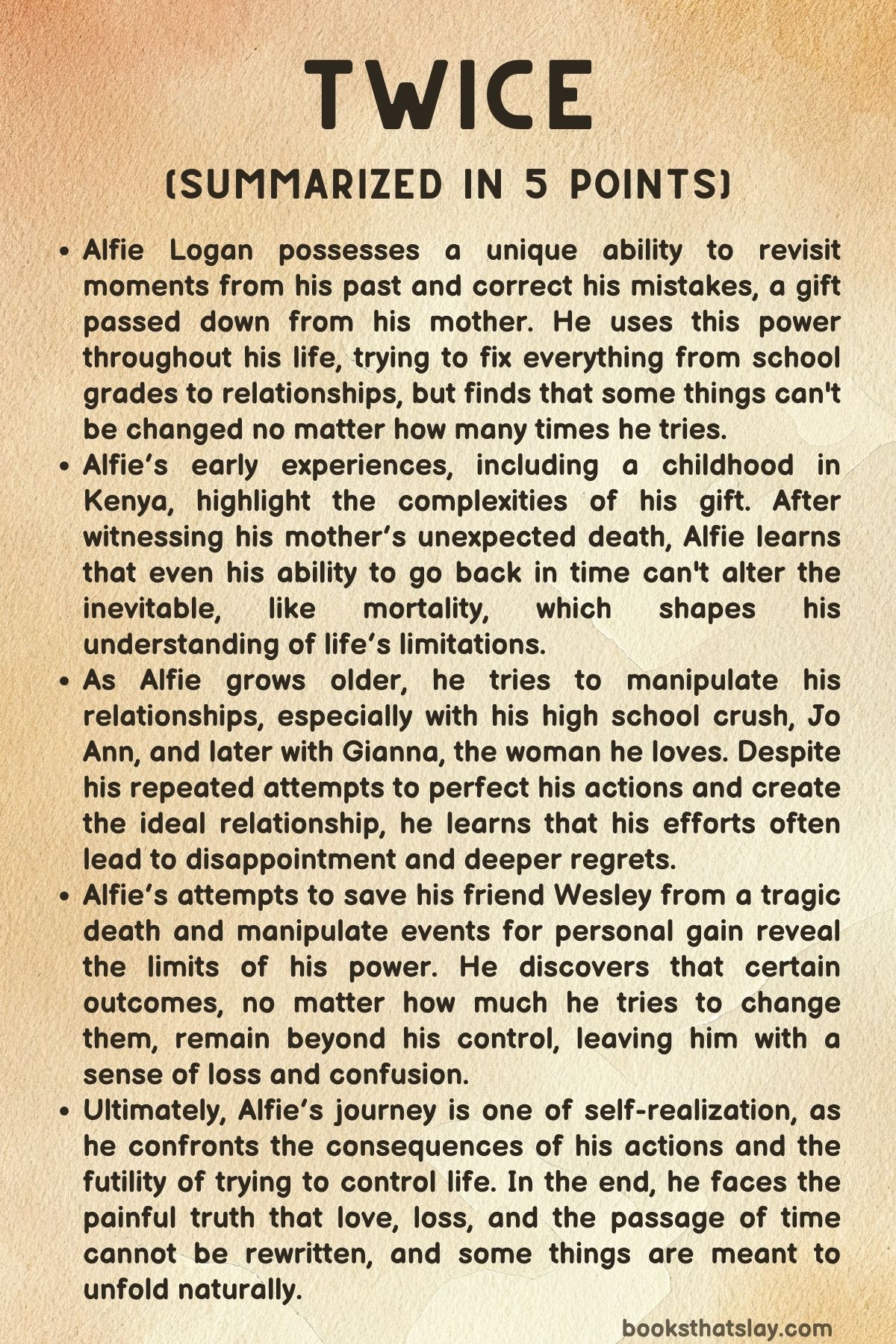
Characters
Alfie Logan
Alfie Logan is the protagonist of Twice and serves as the focal point of the novel’s exploration of regret, second chances, and the complexities of time. Throughout his life, Alfie is marked by his extraordinary ability to “time jump” or revisit moments in the past, giving him the chance to fix mistakes and alter outcomes.
However, his gift, rather than being purely beneficial, becomes a source of deep emotional turmoil. From a young age, Alfie learns that although he can change certain events, some things, such as death or the passage of time, cannot be undone, no matter how many times he revisits them.
This realization shapes his journey, particularly his efforts to rectify mistakes in his relationships, especially with Gianna Rule, the woman he loves.
His ability to relive moments comes with unintended consequences, such as erasing memories of others and sometimes even altering his own recollections. This constant manipulation of reality leaves him disconnected from the world around him and, most significantly, from the people he loves.
Despite his best intentions, Alfie’s repeated attempts to perfect his life lead him to a profound sense of dissatisfaction. His relationship with Gianna is a key example of this struggle.
While his feelings for her are genuine, his obsessive need to undo moments of discomfort causes a rift between them. Ultimately, Alfie comes to understand that no matter how many times he tries to rewrite the past, the future will unfold naturally, and not everything can be controlled or fixed.
His journey is one of emotional growth, learning to let go of past mistakes and accept the unpredictability of life.
Gianna Rule
Gianna Rule is Alfie’s love interest, and her relationship with him is central to the narrative of Twice. Initially, Gianna and Alfie share a deep connection, but as Alfie continues to use his ability to “time jump” to fix his past mistakes, the dynamic between them becomes increasingly strained.
Gianna is portrayed as a woman who is both independent and emotionally complex, struggling to understand Alfie’s need for perfection and his obsession with rewriting their history. Her personal ambitions, especially her desire for children, clash with Alfie’s avoidance of difficult decisions, such as parenthood.
This discord becomes a major source of tension between them, as Alfie’s reluctance to confront reality leads to a growing emotional distance.
Despite their love for each other, Gianna and Alfie’s relationship suffers because Alfie is constantly trying to “fix” their past, which only serves to undermine their connection. She becomes frustrated with his actions and is unable to fully reconcile with the idea of his ability to alter time.
Gianna’s journey reflects her struggle to come to terms with Alfie’s flaws and her own desires, culminating in her eventual separation from him. While Gianna’s feelings for Alfie remain deep, she ultimately recognizes that some things, like their love, cannot be forced or saved by revisiting the past.
Her character highlights the emotional complexities of love, particularly how it can evolve or dissipate when subjected to unrealistic expectations.
Wesley
Wesley is Alfie’s best friend and a significant figure in Twice, representing the theme of fate and the inevitability of life’s challenges. As a child, Wesley is a loyal friend to Alfie, but as their lives unfold, Wesley’s fate becomes intertwined with Alfie’s repeated attempts to manipulate time.
Despite Alfie’s efforts to prevent Wesley’s tragic death in the Cambodian conflict, Wesley dies, reinforcing the novel’s message that certain events in life are predestined and beyond the reach of time manipulation. Wesley’s character serves as a poignant reminder that, no matter how much one may try to rewrite the past, some things are simply out of our control, and fate cannot be changed.
Wesley’s death deeply impacts Alfie, further shaping his understanding of the limitations of his gift. Though Alfie strives to change Wesley’s destiny, he cannot alter the course of events, ultimately forcing him to confront the harsh reality that not all loss can be avoided or undone.
Wesley’s character embodies the idea of the inescapable nature of certain life events, providing a counterpoint to Alfie’s belief that he can control everything through his time-altering ability.
Yaya
Yaya, Alfie’s grandmother, plays a crucial yet subtle role in Twice as the one who passes down the gift of time travel to Alfie. Through Yaya, Alfie learns about the emotional weight and consequences of his power, especially the notion that trying to perfect every moment can lead to dissatisfaction and a loss of life’s spontaneity.
Yaya’s warnings to Alfie serve as a catalyst for his eventual understanding that some things, particularly love and life’s natural course, must be allowed to unfold without interference. Her influence is felt throughout the novel, even though her appearances are limited, as she is the one who imparts the knowledge of his ability and its emotional toll.
Her wisdom ultimately guides Alfie toward accepting the imperfection of life and the necessity of moving forward instead of dwelling on past mistakes.
Detective Vincent LaPorta
Detective Vincent LaPorta is a key figure in the latter part of Twice, serving as the skeptical interrogator of Alfie. He is tasked with questioning Alfie after he allegedly cheats a casino by predicting roulette numbers.
LaPorta’s role in the story is one of doubt and investigation, serving as the voice of reason and skepticism. Initially dismissive of Alfie’s claims, LaPorta becomes intrigued by the strange story Alfie unfolds, though he never fully accepts the notion of Alfie’s time-altering abilities.
LaPorta’s perspective provides a counterbalance to the fantastical elements of the novel, as he struggles to reconcile the events Alfie describes with his understanding of reality. Through LaPorta’s eyes, the reader is able to question the authenticity of Alfie’s experiences and the nature of his powers, ultimately leaving the detective with more questions than answers.
LaPorta’s role is essential in grounding the novel’s more surreal aspects while adding a layer of tension and curiosity to the narrative.
Themes
The Burden of Regret and Second Chances
In Twice by Mitch Albom, the central theme revolves around the emotional weight of regret and the complexities of second chances. Alfie Logan’s ability to revisit and alter his past allows him to “correct” mistakes and try to right wrongs, but the consequences of constantly redoing moments are far from ideal.
Rather than achieving perfection or peace, Alfie’s repeated attempts to alter events reveal a deeper truth: that some regrets cannot be erased and some consequences cannot be avoided. This theme is particularly significant when Alfie tries to mend his relationships, especially with Gianna.
His repeated attempts to fix mistakes often leave him in a cycle of dissatisfaction, and the harder he tries to change things, the more disconnected he becomes from the people and moments he cherishes. Despite having the power to undo errors, Alfie’s life becomes one of increasing loneliness and emotional turmoil, as he realizes that changing the past does not necessarily lead to happiness or personal growth.
In the end, Alfie’s reflections illustrate how living in the past, trying to rewrite it, can lead to a loss of authenticity in one’s relationships and a failure to accept the natural flow of life.
The Illusion of Control
Alfie’s gift to time-jump highlights the illusion of control that many people wish for in their lives. At the beginning of his journey, Alfie believes that with enough effort, he can perfect every situation.
This belief in his ability to control outcomes drives many of his decisions, from his romantic relationships to his career. However, as the narrative progresses, it becomes clear that even with the ability to rewrite events, Alfie cannot control the most significant parts of life, such as death, loss, and the complexity of human emotions.
His relationship with Gianna, in particular, serves as an example of how even the best-intentioned interventions can lead to unintended consequences. Despite his repeated efforts to mend their relationship and fix their past, the couple ultimately drifts apart, as Alfie’s obsession with controlling time causes him to neglect the unpredictability that love and life require.
This theme serves as a cautionary tale about the futility of attempting to control all aspects of life and the importance of letting go and accepting things as they unfold.
The Impact of Time on Relationships
Another central theme in Twice is the profound effect that time has on relationships. Alfie’s ability to alter his past provides him with the opportunity to relive and attempt to perfect moments in his relationships, particularly with Gianna.
However, rather than strengthening their bond, his time-jumping abilities deepen the emotional distance between them. Time, in this context, becomes both a tool for correction and a source of strain.
Each time Alfie goes back to redo a moment, he inadvertently changes the nature of his connection with Gianna, erasing the original, raw emotions that were present in their first interactions. His efforts to control their relationship through manipulation of time rob their connection of the spontaneity and authenticity that come with living in the present.
Furthermore, the passage of time in the story reveals how relationships inevitably evolve, and how love, in its purest form, is not about perfecting moments but about accepting imperfections. The theme highlights that while time can be a means of healing and growth, it can also act as a force that changes people, causing them to grow apart or develop in ways that are not immediately understandable.
The Nature of Regret and Acceptance
The theme of regret and the eventual need for acceptance is woven throughout Alfie’s journey. Despite his extraordinary gift, Alfie’s life is marked by an overwhelming sense of regret, especially after his friend Wesley’s death.
Although Alfie believes he can go back and change the past, he learns that there are events beyond his control, and that some decisions and outcomes are simply part of the human experience. His struggle to accept his own limitations, both with his gift and in his relationships, is a key emotional arc.
Alfie’s efforts to undo his past only serve to magnify his feelings of inadequacy, revealing that the true resolution lies not in fixing mistakes but in learning to live with them. Ultimately, Twice is about Alfie coming to terms with the idea that life is not a series of moments to be perfected but an experience to be accepted in all its imperfections.
Through this, the story demonstrates that personal growth and emotional healing are not about erasing past mistakes, but about finding the strength to move forward with the knowledge that regret is a natural part of the human condition.
Fate and the Unchangeable Nature of Life
In Twice, the theme of fate is explored through Alfie’s experiences with time travel. Although Alfie possesses the power to revisit moments and change them, he finds that not all events can be altered.
This realization, especially after his attempts to prevent Wesley’s death, leads him to understand that some aspects of life are predestined and beyond his control. The novel suggests that no matter how much one may try to alter the course of events, there are certain things that are simply meant to happen, and these are beyond any individual’s ability to change.
Alfie’s journey, marked by his inability to save Wesley and his struggle to change other significant moments in his life, points to the idea that fate plays a crucial role in shaping the events of our lives. This theme underscores the limitations of personal agency and the realization that, despite our best efforts, there are moments in life that are destined to unfold in specific ways.
This acceptance of fate becomes an important lesson for Alfie as he grapples with the understanding that not everything can be fixed or controlled, and that part of living a fulfilled life is accepting what comes, even when it feels unfair or out of reach.
The Complexity of Love and Loss
The final theme explored in Twice is the complexity of love and loss. Throughout the novel, Alfie’s relationships, especially with Gianna, reveal the delicate balance between love, attachment, and the inevitability of loss.
Alfie’s obsession with using his power to redo moments in his relationship with Gianna reflects his deep fear of losing her and his desire to perfect their love. However, his actions only drive a wedge between them, as they grow further apart due to Alfie’s inability to let go of the past.
Love, in this context, is shown as something that cannot be controlled or perfected by manipulating time. It is a force that evolves and changes, and sometimes it fades despite our best efforts to preserve it.
The theme of loss is also evident in Alfie’s reflection on his mother’s death and Wesley’s fate, demonstrating that love and loss are intertwined in the human experience. Alfie’s journey is ultimately one of understanding that love, while powerful, cannot always withstand the passage of time, and that the pain of loss is a natural and unavoidable part of life.
His acceptance of this reality marks his growth as a character and highlights the book’s poignant message about the fleeting nature of love and the importance of embracing it while it lasts.