Two Left Feet Summary, Characters and Themes
Two Left Feet by Kallie Emblidge is a contemporary sports romance set inside a Premier League club where every week can change a career. Midfielder Oliver Harris gets injured at the worst possible moment, just as a new manager starts applying pressure and the club’s future hangs on Champions League qualification.
When academy talent Leo Davies-Villanueva is recalled and Oliver is told to guide him, what begins as rivalry turns into partnership—on the pitch and off it. The story follows recovery, competition, fear of exposure, and the cost of being honest in a world that watches everything.
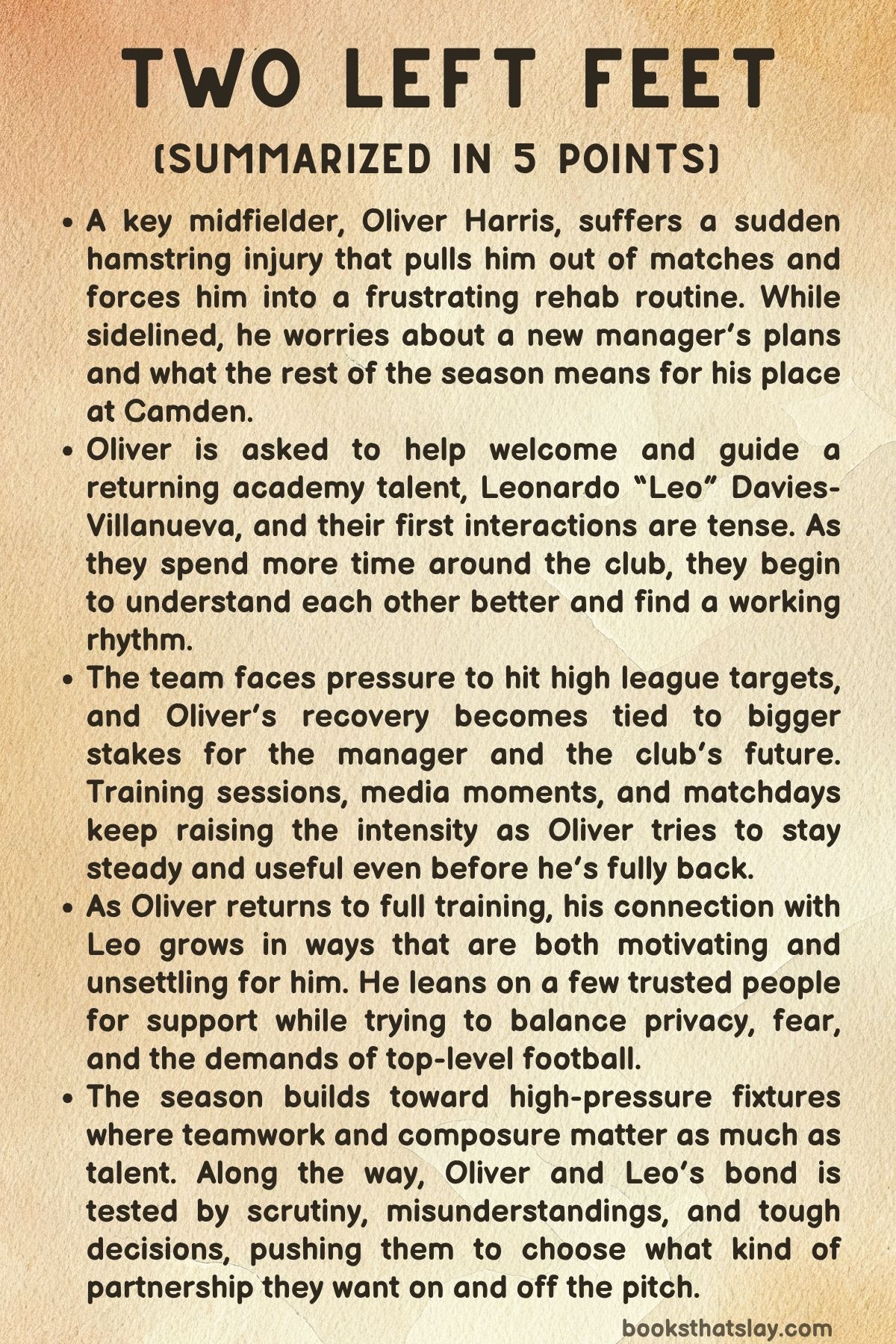
Summary
On New Year’s Day 2017, Camden midfielder Oliver Harris is injured before a match even starts. He slips on wet steps in the tunnel, lands badly, and can’t move his left leg without sharp pain.
While the crowd roars outside and Camden go on to beat West Bromwich Albion, Oliver is taken away for scans. Club doctor Anna Zhang confirms a hamstring tear: not catastrophic, but serious enough to sideline him for months if he doesn’t handle rehab properly.
Oliver leaves on crutches, angry and scared, riding home still in full kit and pretending to himself that the setback is manageable.
At home, Oliver avoids most calls and messages until he speaks to his mother, Nicola, who works long hospital shifts and worries about him the way only a parent can. He downplays things, insisting the club has it under control.
But the injury isn’t the only problem pressing on him. Camden recently hired a new manager, Willem de Boer, after the owner replaced the previous boss mid-season.
Willem has already unsettled the squad with his blunt style and has refused to appeal Oliver’s recent suspension. Oliver suspects the new regime is looking for reasons to move him on.
The next day, Willem calls Oliver in for a meeting. Oliver expects criticism or a warning about his place in the team.
Instead, Willem tells him the club will recall a player from loan to cover the midfield during Oliver’s absence, and he wants Oliver to help the player settle. Oliver hears only one thing: he’s being asked to train his replacement.
He pushes back hard, accusing Willem of trying to edge him out. Willem insists that isn’t the point.
The recalled player, he says, is meant to be Oliver’s eventual partner in midfield and a sign that Camden can promote from within. The player is Leonardo “Leo” Davies-Villanueva—talented, creative, and long shuffled through loan spells abroad.
Oliver’s resentment doesn’t cool when he meets Leo. In the rehab area, Leo tries to make friendly conversation, but Oliver answers with clipped politeness that reads as hostility.
Their first real interaction becomes a small disaster: they watch a dull draw together, argue, and Leo calls Oliver a dick. Oliver admits he’s furious about being forced into a mentoring role and warns Leo that Camden can chew players up and spit them out.
Later, Oliver vents to Maggie—his ex-girlfriend and closest friend—who listens without letting him dodge the truth: Oliver is threatened, and he hates feeling replaceable.
Despite Oliver’s initial mess with Leo, Willem doesn’t punish him. Instead, he raises the stakes.
In a private meeting he tells Oliver the club owner expects immediate results. If Camden don’t finish at least fourth and qualify for the Champions League, Willem will likely be sacked—and Oliver will likely be sold.
The pressure isn’t abstract. It’s tied to contracts, valuations, and a club that sees players as assets.
Willem frames Oliver’s mentoring job differently: if Oliver helps Leo succeed, Camden get better, the season can be rescued, and Oliver protects his own future.
Oliver decides to cooperate. He brings Leo into the dressing room, walks him through personalities and routines, and forces himself to stop treating Leo like a threat.
The tone begins to change. Leo scores a decisive goal in training that lifts the squad’s energy, and Oliver notices how quickly teammates respond to Leo’s confidence.
They share a guarded car ride home and manage a few jokes. The hostility doesn’t disappear, but it starts making room for something more complicated.
As Oliver continues rehab, he swings between numb routine and restless frustration. Team activities become reminders that he’s sidelined, but they also create unexpected openings.
A team-building drill pairs players up to head a ball back and forth while talking. Oliver thinks it’s nonsense, yet when he’s paired with Leo, the exercise forces them to pay attention.
Leo blurts out odd facts—multiple passports, an allergy, a habit of drawing, a stupid shoplifting incident as a kid, a love of dancing—and, almost casually, that he broke Oliver’s academy passing record. Oliver listens, surprised by how disarming Leo can be when he isn’t posturing.
Later, a PR executive, Nina Clarke, schedules Oliver’s charity hospital visit and recruits Leo to join him for photos and publicity. Leo volunteers instantly, as if being near Oliver is obvious.
Outside the training ground, their connection grows in small increments. Oliver invites Leo to watch a match at a pub with injured teammates.
The night is easy: Camden win, the atmosphere is loud and warm, and Oliver and Leo share a long look that hits Oliver with confusion he doesn’t want to name. Leo walks him home, their hands brush at Oliver’s keys, and the moment stays with Oliver afterward in the quiet of his house.
Training continues, and Leo keeps shining. When Willem leaves Leo out of a matchday squad, Oliver offers extra work.
They train alone—hard, fast, and playful in the way football can be when it’s just two people testing each other. Leo is told he’ll debut soon, and Oliver congratulates him, feeling a flash of jealousy he tries to swallow.
The night before Leo’s debut, Leo panics and calls Oliver, convinced he’ll fail. Oliver meets him at the training ground and talks him down by admitting his own debut was a mess.
They pass, then push the tempo, and Leo’s intensity turns reckless. He challenges too hard, Oliver hits the ground, and his hamstring flares.
Oliver snaps, accusing Leo of trying to steal his place. Leo snaps back that Oliver is hot-and-cold and unfair, and that he thought they were becoming friends.
Sebastian Carr, now on staff under Willem, breaks it up, sending Leo away and scolding Oliver for endangering his recovery.
That night Oliver can’t sleep. He watches old footage of Leo and finally admits what he’s been refusing to say even to himself: he’s attracted to Leo, and the attraction isn’t going away.
Camden lose the match Leo debuts in, though Leo plays well. Oliver texts encouragement; Leo doesn’t reply.
The next morning, Leo shows up with coffee and forces a tense truce by refusing to let the silence stand. A squad tradition—an annual hide-and-seek game—lightens things.
Oliver and Leo hide together in a broom cupboard, win, and come out laughing. The laughter doesn’t fix what’s between them, but it cracks open a door.
Oliver talks to Maggie about fear: fear of being outed, fear of the career consequences, fear of what it means to want another man when his life has been built under constant scrutiny. Maggie is blunt: Oliver is lonely, and Leo’s attention isn’t subtle.
Oliver tries to stay cautious. He and Leo swim after training, and in the water Leo is a mess, which lets Oliver be teasing and gentle without feeling exposed.
Leo invites Oliver to dinner; Oliver declines, using caution as a shield.
Camden’s results dip again. They’re beaten badly by Chelsea, and afterward the team goes out in a sour mood.
Leo drinks too much, insisting he doesn’t need anyone looking after him, then collapses against Oliver and admits how badly he wants to win. Oliver steadies him and asks about his family.
Leo begins to open up: a mother from Medellín, a British father, a life shaped by moving and by football’s constant relocation.
By March, Oliver is mentally exhausted. He has kissed Leo, can’t stop replaying it, and is caught between desire and panic.
One morning he oversleeps and arrives late; Willem immediately calls him in and asks, directly, if something happened between Oliver and Leo. Oliver dodges, then tries to redirect into football talk—loans, mentoring, tactics.
Willem doesn’t bite. He tells Oliver he believes Oliver and Leo are meant to play together, and that Leo’s improvement has been fueled by Oliver’s influence.
The message lands: whatever Oliver is trying to avoid is already visible.
Anna clears Oliver medically after reviewing scans, warning him that clearance isn’t a guarantee and discipline matters. Oliver rushes to Willem and Sebastian, eager to return, and is tested on the pitch.
He’s rusty and frustrated that being “back” doesn’t make the rest of his problems disappear, but he still shows his quality. Soon Oliver hears that Leo has debuted for England and drawn a penalty.
The attention on Leo spikes. Oliver’s anxiety spikes with it.
Unable to keep pretending nothing happened, Oliver goes to Leo’s flat late at night and insists they need to be “normal” at training. Leo refuses to accept that.
He admits he’s attracted to men too, that he’s been drawn to Oliver for a long time, and that he thought Oliver wanted him to look back. Oliver insists football comes first and says they never have to discuss it again.
As Oliver leaves, Leo kisses him again, and the tension becomes a live wire rather than a buried secret.
Oliver returns to full training. The squad celebrates his first sharp touch, and he and Leo combine well on the pitch while refusing to look at each other off it.
Camden draw Manchester City after falling behind, with Oliver coming on and scoring. A key moment later breaks: Leo mishits a chance created by Oliver’s cross.
In the showers, Leo explodes—about the miss, about Oliver’s attitude, about the distance between them. Oliver refuses to apologize for trying to set him up.
The argument ends with an agreement that they have to make it work on the pitch, because the club can’t afford their dysfunction.
Another draw follows at Arsenal, and the pattern continues: on-field chemistry, off-field avoidance, frustration boiling over. Willem finally confronts them both, furious that he can’t rely on a midfield partnership that won’t even look at each other.
He threatens to bench one of them if it continues. Oliver promises they’ll sort it out; Leo storms away.
Pressure builds before Middlesbrough away. Teammates talk about transfers and uncertainty.
Oliver speaks up, insisting Camden is home and they should play like it. Leo unexpectedly backs him.
The team responds with a strong performance. Oliver scores early, Camden add more, and late in the match Oliver wins a penalty and insists Leo take it.
Leo scores, celebrates, and gives Oliver a small acknowledgment that says more than words.
Camden ride momentum into a run of big wins. Success doesn’t erase the personal strain, but it forces Oliver and Leo into the same current.
Rival players needle Oliver with insinuations; Oliver snaps back; Leo pulls him away. Leo challenges Oliver afterward: why let people assume things instead of owning the truth?
Oliver refuses to build extra lies, but he also refuses to hand strangers power over his life. Their arguments start shifting—less about hostility, more about what kind of life Oliver thinks he’s allowed to have.
Before a key match against Manchester United, Leo finds Oliver late at the training ground and they practice together. They admit they miss each other and hate what the last weeks have felt like.
Oliver finally stops resisting and kisses Leo. For a moment, they choose what they want without solving the consequences.
Against United, Camden trail at halftime. Willem demands they keep pressing.
They equalize through a move sparked by Leo, and in stoppage time Leo and Oliver combine again, with Oliver scoring the winner. Camden climb into fourth, the position that keeps the club’s plans alive.
Afterward, Oliver takes Leo home, and they become intimate for the first time. The next morning the routine of football returns instantly—training, even a bizarre team yoga session—and Leo casually calls what they’re doing “dating.” Oliver panics.
He insists they must be careful, because the scrutiny is real and the fallout could be brutal. Leo pushes back, refusing to live as someone’s secret.
When Oliver won’t promise commitment, Leo offers something simpler: no promises, no public label, but no shame either. Oliver tries to hold caution and affection in the same hand, telling Leo he deserves to be treated well even if their situation is complicated.
They attempt to act normal around teammates, but cracks appear. Oliver organizes a team pub night partly because he wants to be near Leo.
Teammates tease Oliver about texting someone, and Leo accidentally confirms Oliver texts him back, making both of them tense. Leo leaves early.
Oliver tells him to meet at his place and follows soon after, expecting Leo to be there. When he arrives, the steps are empty, and Leo calls immediately.
The season ends with a derby away at Kilburn Rovers, a match with table implications and a hostile crowd. Oliver wears the captain’s armband and tries to steady the team.
Camden race to a lead, then lose control as Kilburn score from set pieces and the game turns brutal. Late, Camden are behind and time is running out.
In stoppage time, Oliver drives forward on one last attack and is taken down in the box. A penalty is given.
Oliver is hurt and dazed and can’t take it. He tells Leo to step up.
In the rush and the fear, Oliver pulls Leo close, kisses him, and says he loves him, telling him the moment belongs to Leo.
Leo takes the penalty and misses. Camden collapse in despair—until the referee orders a retake because the goalkeeper has moved off the line.
Oliver calls encouragement from the sideline. Leo takes it again, scores, and Camden draw.
The final table flips in unexpected ways: other results fall right, and Camden finish third.
After the match, a photo circulates showing Oliver and Leo forehead-to-forehead and kissing. Media speculation explodes.
Nina proposes a statement dismissing the rumors. Oliver can’t stomach the idea of denying queerness as if it’s something dirty.
He goes straight to Willem and admits the relationship is real, even offering a transfer request if it protects Leo. Willem refuses to punish them and urges Oliver to face it directly, with the club behind them.
Leo thinks Oliver is ending things and lashes out in fear, even punching him, demanding the truth. Oliver says it clearly: he’s in love with Leo, and Willem wants them to tell the truth publicly.
Leo agrees. Oliver tells his mother, who supports him without hesitation.
Key teammates react with blunt warmth and protection. Then Oliver and Leo tell the entire squad: Oliver is gay, Leo is bisexual, and they’re together.
After a tense beat of silence, the room turns toward them with jokes, hugs, and loyalty. The team chooses unity over discomfort.
They step into the press together, hand in hand, prepared for whatever follows. In the weeks after, their lives are flooded with attention—support, backlash, debate—but they keep moving forward.
As preseason approaches, Leo shows Oliver a cheap flight deal to Medellín, and Oliver realizes that for the first time in a long time, he isn’t imagining the future as something to survive. He’s imagining it as something to share—with Leo beside him.
Characters
Oliver Harris
Oliver is the emotional and tactical center of Two Left Feet—a star Camden midfielder whose sense of self is built on control, competence, and being indispensable. His hamstring tear doesn’t just remove him from the pitch; it strips him of the identity that keeps his anxiety in check, exposing how much he equates worth with performance and selection.
That fear curdles into defensiveness, especially when Willem asks him to “help” Leo: Oliver reads it as replacement-by-proxy because, deep down, he already suspects the club’s loyalty is conditional and that his status can be traded away to satisfy ownership. What makes Oliver compelling is the constant collision between his public discipline and private volatility—he can be generous, funny, and intensely protective, yet he lashes out when he feels cornered, then punishes himself afterward with silence and self-denial.
His arc isn’t simply accepting attraction; it’s learning that courage can look like openness rather than stoicism, and that leadership isn’t only about winning matches but about refusing to treat truth as a liability.
Leonardo “Leo” Davies-Villanueva
Leo arrives as a walking trigger for Oliver’s insecurity—young, creative, highly rated, and immediately positioned as both partner and future. But Leo is not a polished wunderkind stereotype; he’s earnest, socially bold, and emotionally impulsive, which reads as cocky when Oliver is in threat mode and reads as brave once Oliver softens.
The “three passports,” the cumbia dancing, the drawing, the petty shoplifting confession—these details make Leo feel like someone who has lived in multiple worlds and learned to cope through charm and candor, even when it backfires. Leo’s core need is not simply minutes on the pitch; it’s to be chosen without games, to be wanted plainly rather than managed, hidden, or kept at arm’s length.
He is also competitive and proud, which is why he reacts so sharply when Oliver goes hot-and-cold: Leo experiences Oliver’s caution as rejection dressed up as professionalism. Over time, Leo becomes the one who forces the story’s emotional honesty—he refuses to be treated as a secret arrangement and, when the crisis hits, his fear is real but so is his willingness to stand beside Oliver in public.
Willem de Boer
Willem is an unsettling presence because he operates like a realist in a world where players want to believe in loyalty and sentiment. He is blunt, strategic, and constantly triangulating between performance, politics, and survival under James Finch’s expectations.
At first, he looks like a threat to Oliver’s place—he recalls a loanee, doesn’t appeal a ban, and speaks in cold terms about mistakes and consequences—yet his deeper function is to force Oliver into growth by confronting what leadership actually costs. Willem’s most revealing trait is that he sees the Oliver–Leo pairing as both tactical and psychological: he believes they are meant to play together, and he pushes Oliver to become the kind of captain who steadies the dressing room rather than simply shining in it.
When the relationship becomes public, Willem’s refusal to scapegoat them complicates him: he may be hard-edged, but he isn’t small-minded, and he understands that protecting the team’s integrity can matter as much as managing headlines.
Sebastian Carr
Sebastian embodies a specific kind of intimacy that has soured—someone who used to be Oliver’s friend and now sits in the uncomfortable role of staff, close enough to see Oliver’s cracks but not close enough to soothe them. As fitness manager and assistant coach, he represents the institution’s practical demands: rehab, discipline, schedules, and consequences.
The tension between him and Oliver feels layered because it’s not pure hostility; it’s the ache of changed loyalties and the quiet resentment of watching someone you knew become guarded. Sebastian’s key moments are interventions—he appears when Oliver and Leo clash and acts like a boundary line, separating emotion from professionalism.
That makes him a necessary friction point: he doesn’t exist to comfort Oliver’s narrative about being wronged; he exists to remind him that injuries and reputations are managed, and that Oliver’s choices ripple through other people’s careers.
Dr. Anna Zhang
Anna is the story’s grounded authority, but she’s written with enough sharpness to avoid becoming a generic “team doctor.” She gives Oliver reality without cruelty: the tear is small, but recurrence risk is real; healing doesn’t mean permission to be reckless; progress doesn’t excuse ego. She functions as both caretaker and gatekeeper—someone who wants Oliver well, yet won’t indulge the athlete’s impulse to bargain with pain.
Her scolding after Oliver pushes too hard lands because it isn’t moral judgment; it’s professional insistence that discipline is part of survival. In a story where Oliver constantly tries to control perception, Anna is one of the few characters he cannot charm or out-argue, which makes her role quietly stabilizing: she anchors consequences in the body, not the rumor mill.
Nicola Harris
Nicola is Oliver’s emotional home base, and her presence reveals what Oliver looks like when he isn’t performing for teammates, staff, or fans. She works hospital shifts, understands injury and risk in a non-romantic way, and offers care that is both practical and deeply personal.
Oliver’s refusal to stay with her early on shows his pride and his need to maintain independence, but the later “normal day” of cooking, Scrabble, and falling asleep under an old blanket exposes the truth: he is desperate for uncomplicated safety. Nicola’s comment that he looks more like his dad is especially significant because Oliver receives it as comfort, suggesting grief or longing under the surface—his father’s absence, memory, or ideal clearly shapes Oliver’s sense of manhood and steadiness.
When Oliver comes out to her, her immediate support underscores that the real threat was never love itself; it was Oliver’s belief that love must be paid for with loss.
Maggie
Maggie is both mirror and pressure valve: she knows Oliver best, has history with him as an ex, and stays close enough to call him out without being dazzled by his status. She sees patterns—his loneliness, his fear of exposure, his tendency to intellectualize feelings as “professionalism”—and she refuses to let him pretend the problem is only Willem or only Leo.
Maggie’s role matters because she validates Oliver’s fear without validating his self-erasure; she understands the stakes in football culture, but she also recognizes when Oliver is using the stakes as a reason to avoid intimacy. Her teasing about Leo’s admiration is not trivial—it’s Maggie gently forcing Oliver to admit that being wanted feels both intoxicating and terrifying to him.
Anthony Moss
Anthony functions as the club’s spine: the captain who clears the tunnel, calls the medical staff, and sets the tone of responsibility when chaos hits. Even when he is absent from the back line later, that absence is treated as structurally important, which implies how much the team depends on his leadership and positional discipline.
Anthony’s dynamic with Oliver is quietly respectful; he doesn’t compete for spotlight, he protects the standard. When Oliver eventually wears the armband, Anthony’s earlier captaincy becomes the template Oliver is trying to live up to—leadership as containment, as steadiness, as making space for others to function.
Joe
Joe is the blunt, protective friend—the goalkeeper who picks Oliver up, tries to reframe Willem’s request as trust, and later reacts to the relationship news with warmth that feels uncomplicated. He offers a masculinity that isn’t fragile: he can be direct, even crude, but not cruel; loyal without requiring Oliver to perform toughness.
Joe’s importance grows when pressure spikes because he models the kind of teammate solidarity Oliver fears won’t exist if the truth comes out. In a narrative full of image management, Joe is refreshingly uninterested in polishing anything—he cares about people, results, and honesty in that order.
Nina Clarke
Nina is the clearest voice of institutional optics, the character who translates human mess into headlines, sponsorship risk, and “appropriate” statements. She is not villainous so much as committed to a system where truth is secondary to control of narrative.
The hospital visits show her at her most palatable—leveraging charity for good publicity while still enabling Oliver to do something meaningful—but the crisis reveals the limit of that pragmatism when it veers into denial that frames queerness as scandal. Nina’s presence makes the story’s theme sharper: it isn’t only personal fear that keeps Oliver closeted; it’s an entire machinery trained to treat authenticity as a reputational hazard.
Conor Bishop
Conor, the pub owner, is a small but vivid social lens: he greets Oliver warmly, flirts lightly, and creates a space where injured players and newcomers can breathe outside the club’s controlled environment. The Castlehaven Arms scenes matter because they show Oliver in semi-public, semi-safe territory—recognized but not managed, social but not scrutinized like a press conference.
Conor’s charm and ease highlight how tense Oliver normally is; around Conor, Oliver can almost be ordinary, which makes the charged moments with Leo feel even more intimate against that casual backdrop.
Finn
Finn is a useful contrast point in the team-building drill: paired with Oliver, he yields little emotional discovery, which emphasizes how closed-off Oliver can be when he isn’t compelled to pay attention. Finn also represents the steady teammate who benefits from the group’s improved momentum—he scores in a key win, participates in bonding, and helps set the environment that eventually makes solidarity possible.
He isn’t drawn as a dramatic individual arc, but as part of the everyday fabric of a squad that can either isolate someone or carry them.
Henri Dupont
Henri is introduced through a simple, telling fact: he scores while Oliver is stretchered out, and the stadium keeps roaring. That contrast—personal crisis versus public continuation—frames the early emotional logic of Two Left Feet.
Henri’s function is less about inner life and more about the team’s relentless forward motion; he is the reminder that football doesn’t pause for individual pain, which is precisely what terrifies Oliver once his own place feels vulnerable.
James Finch
Finch is the distant but powerful engine of pressure: the owner who replaces the previous manager, expects immediate results, and implicitly treats players as assets whose value can be cashed out. Even without constant page time, his influence is everywhere—Willem’s urgency, the Champions League threshold, the threat of Oliver being sold if the club falters.
Finch represents the cold logic that turns identity and intimacy into “risk,” not because he personally polices it in the summary, but because his model of success encourages the club to prioritize controllable narratives over messy truths.
“Woodsy”
Woodsy acts as social glue in the injured-player circle and a friendly buffer when Leo first enters their orbit outside training. By quizzing Leo about impressions and sharing space at the pub, he helps normalize Leo’s presence in the group and reduces the sense that Leo is an intruder.
Characters like Woodsy matter in a locker-room story because culture is built less by grand speeches than by who gets included in casual rituals.
Ji-Hoon
Ji-Hoon’s moment with the captain’s armband during the Kilburn match is symbolic: when Oliver is down injured, responsibility transfers instantly and the team must keep functioning. Ji-Hoon represents continuity under pressure—the idea that leadership is shared infrastructure, not a single hero’s possession.
His presence also underscores how the squad, by season’s end, has learned to adapt in chaos rather than fracture.
Ryan Loxley
Ryan is a personification of football’s uglier social atmosphere: insinuation, needling, and the casual cruelty of weaponized rumor. His taunts are less about personal grievance and more about dominance—testing whether Oliver will flinch, whether identity can be used as destabilization.
Ryan’s role matters because he shows that the threat Oliver fears is not imaginary; there are always people ready to turn “maybe” into a knife, especially when stakes are high and rivalries are personal.
Stewart Reed
Stewart is antagonism with a captain’s armband—confident enough to taunt Oliver at handshakes, central to set-piece chaos, and emblematic of how rivalry games magnify psychological warfare. His presence in the final-day match underscores that leadership can be performed as intimidation just as easily as it can be performed as steadiness.
Stewart’s provocations force Oliver to practice composure publicly even while his private life is detonating, which heightens the drama of Oliver choosing tenderness—kissing Leo and confessing love—inside the most hostile arena.
Max Wheatley
Max is the decisive physical threat in the climax, the tackle that collapses Oliver’s last run and forces the penalty that becomes Leo’s proving ground. In narrative terms, he’s less a fleshed-out villain than an instrument of crisis: the moment where Oliver’s body, career fear, and love converge under maximum visibility.
The fact that the referee does not send him off adds to the sense of injustice and volatility, making Oliver’s decision to hand the moment to Leo feel even more poignant.
Karim Ahmadi
Karim’s headed goal from a corner is part of the final-day unraveling, the embodiment of how quickly control can slip when momentum turns and a match becomes chaotic. Like other opposition players, he functions as a reminder that outcomes are often shaped by brutal, simple details—set pieces, exhaustion, lapses—rather than the cleaner narratives players want to tell about “deserving” wins.
Garcia
Garcia’s goal in a key win during Oliver’s injury spell signals that Camden can still perform without Oliver, which is both comforting for the club and unsettling for Oliver. That duality matters: the team’s success helps their table position, but it also pokes Oliver’s deepest fear that he might be less necessary than he believed.
Emmanuel
Emmanuel’s contribution in the same match extends that theme: Camden’s threat is distributed, not dependent on a single star. For Oliver, that reality is psychologically complicated—healthy teams need shared scoring, but insecure stars interpret shared scoring as replacement looming closer.
Sergio Agüero
Agüero’s two goals for Manchester City are a reality check: elite opponents punish mistakes and expose gaps, and Camden’s margin for error is thin. His presence in the summary functions as a benchmark—when Oliver is subbed on and changes the match, it highlights Oliver’s quality, but Agüero’s early dominance underscores how fragile momentum can be against top-level execution.
Harry Kane
Kane appears as the finisher of a penalty Leo wins on England debut, and that small detail matters because it instantly raises Leo’s profile and market value. For Oliver’s anxiety, it is gasoline: it turns Leo from internal competition into a national storyline, increasing attention, temptation for the club to monetize him, and the perceived cost of any scandal.
Themes
Injury, vulnerability, and the loss of control
From the first moment Oliver goes down in the tunnel in Two Left Feet, the injury is not just a physical setback but a sudden collapse of the version of himself that feels safest: the player who can always respond with performance. The hamstring tear forces him into stillness, dependence, and uncertainty, and those conditions expose how tightly his identity is tied to being useful to the club.
His frustration at being told to rest, to take a cab, to live on crutches in his own home shows how foreign vulnerability feels to him. Even small details—going home in full kit, turning down teammates, hiding behind painkillers as an excuse—underline how he tries to keep control of the narrative when his body has taken that control away.
That loss of control then spreads into everything else. Willem’s meeting arrives when Oliver is already raw, turning rehab into a political and emotional pressure cooker.
The idea that someone might be recalled during his absence lands like an accusation: you are replaceable. Because he cannot compete on the pitch, he competes in his head, reading every managerial decision as a verdict on his worth.
The injury also becomes a stress test for his discipline and his self-image. When he pushes too hard in private training and feels the hamstring flare again, it shows how quickly fear can become self-sabotage: he would rather risk damage than sit with the helplessness of waiting.
What makes this theme hit hard is that recovery is portrayed as uneven emotionally even when it is going well medically. Dr. Zhang clears him, but that clearance doesn’t clear his anxiety, jealousy, or shame.
The body can heal faster than the person. That mismatch explains why Oliver swings between warmth and cruelty with Leo, why a good day of training doesn’t fix his life, and why returning to matches can actually increase pressure instead of relieving it.
By the end, injury remains present as a reminder that his career can be altered by one misstep, but it also becomes the pathway through which he learns a different strength: letting people see him when he isn’t winning, performing, or in charge.
Power, job insecurity, and the politics of “trust”
Willem’s arrival changes the air inside the club, and the story shows how quickly professional sport turns into a workplace where everyone is being evaluated, repositioned, and quietly threatened. Oliver feels that shift in the smallest things: a two-match ban not appealed, a new manager who speaks in measured challenges, and the sense that ownership expects immediate results.
The narrative makes it clear that power rarely announces itself as cruelty; it often arrives as “professionalism,” “standards,” and “taking stock.” Willem’s request that Oliver help Leo settle can be read two ways at once—either as trust and leadership development, or as a demand to participate in his own displacement. Oliver’s instant defensiveness is not paranoia so much as realism formed by experience in a system where a player’s value can change overnight.
The book also examines how leadership manipulates fear without needing to raise its voice. When Willem explains Finch will sack him if the club misses the Champions League and that Oliver may be sold, the message is blunt: your future is conditional.
Even when Willem later praises Oliver and talks about captain potential, that praise is tied to outcomes. It is approval that must be continually earned.
Oliver is pushed into an identity that is both honor and trap: mentor, captain, face of the club, symbol of stability. The result is a pressure loop—if he performs and leads, he saves Willem and protects his own status; if he fails, he loses both.
What complicates the theme is that Willem is not drawn as a cartoon villain. He can be cold, but he can also be pragmatic and even protective, especially when the relationship rumors erupt.
That contrast forces a sharper point: the institution can be harsh even when individuals inside it are trying to be fair. Nina’s instinct to issue a denial shows the club’s default reflex to control public perception, while Willem’s insistence on telling the truth marks a different kind of authority—one that understands long-term damage.
Still, the story keeps returning to the same reality: in this environment, privacy, relationships, and even medical recovery are never fully personal. They are connected to contracts, optics, results, and the owner’s impatience.
Oliver’s growth involves learning how to operate within those forces without letting them define his entire self.
Intimacy, identity, and the cost of secrecy
Oliver’s connection with Leo develops under conditions that make honesty feel dangerous. The fear is not abstract; it has clear consequences: tabloids, dressing-room dynamics, sponsorship pressure, transfer threats, and the possibility that a personal truth could become a professional weapon.
Oliver’s caution is shaped by that landscape, but it also reflects internal fear—of being known, of being labeled, of losing the protections that come with staying unreadable. That is why he tries to keep the relationship in a vague category, why “dating” alarms him, and why he periodically attempts to reset them to “normal.” For Oliver, normal means controllable: teammates first, feelings second, silence always available.
Leo represents a different posture toward identity. He is not careless, but he is less willing to treat affection like a problem to manage.
His frustration isn’t only romantic; it is existential. Being asked to shrink himself into secrecy feels like being told his truth is negotiable.
Their conflict repeatedly shows the collision between two survival strategies: Oliver’s strategy is to minimize risk through restraint and denial; Leo’s is to minimize harm through clarity and refusal to play pretend. The emotional damage comes from the gap between what they feel and what they allow themselves to say.
Miscommunications on the pitch mirror miscommunications off it: a missed chance, a stormed-off argument, a refusal to meet each other’s eyes.
The narrative also captures how secrecy changes the texture of everyday life. A joke in the pub about Oliver texting someone becomes a threat.
A casual tag in a photo becomes loaded. A shared look during a match becomes both thrilling and frightening.
Even acts of care—walking someone home, bringing coffee, training together late—carry the tension of “what does this mean and who might notice?” That constant vigilance is exhausting, and the narrative shows it driving Oliver toward sharpness and inconsistency, the very traits Leo calls out as unfair.
The turning point arrives when secrecy is no longer a private choice but a public event. The kiss caught in a photo forces the question: will they deny themselves to protect a brand, or tell the truth and demand dignity?
Oliver’s rejection of a statement that frames queerness as “inappropriate” is the moment he stops treating identity as an acceptable casualty. Coming out becomes not just romantic commitment but moral refusal.
The team’s solidarity, Nicola’s support, and Willem’s stance do not erase backlash, but they reshape what is possible: intimacy can exist without apology, and identity can be named without surrendering ambition.
Belonging, mentorship, and the creation of trust inside a team
Oliver begins from a place of guarded isolation even though he is surrounded by people. The story shows how a team can be loud, joking, and supportive while still leaving an individual alone with his fear.
Oliver ignores calls, declines celebrations, and holds most of his panic in private rooms—his townhouse, Willem’s office, the training ground late at night. Belonging is treated as something more demanding than being included; it requires being understood and being able to rely on others without feeling weak.
Oliver’s first interactions with Leo show how far he is from that. He assumes threat before he allows curiosity, and he uses status and skepticism to keep distance.
Mentorship becomes the pressure point where belonging is tested. Being asked to guide Leo feels humiliating because it sounds like training the person who might take his place.
Yet once Oliver chooses to do it intentionally—introducing Leo, translating the dressing room chaos, supporting extra training—he discovers that leadership can be stabilizing rather than diminishing. The team responds to Leo’s energy, and Oliver’s willingness to help helps the group, not just the individual.
This is how the book reframes mentorship: not as charity or surrender, but as an act that builds a shared future and protects the culture of the club.
Trust is built in small repeated scenes that accumulate meaning. The heading drill forces attention and listening, and Oliver realizes that teamwork is partly about absorbing the person beside you, not just playing your role.
Pub nights create informal bonds that formal training cannot. Hide-and-seek becomes a childish game that breaks tension and lets them laugh without calculation.
Even the hospital visit planning matters because it shows Oliver’s need to be more than a footballer and Leo’s instinct to step into that space with him. These moments demonstrate how belonging is often constructed outside the spotlight: in cars, corridors, canteens, pools, and late-night pitches.
By the finale, belonging expands from two people to an entire squad. The teammates’ reaction to Oliver and Leo’s relationship is crucial because it shows a locker room choosing protection over gossip, humor over hostility, and unity over discomfort.
That response does not happen by magic; it grows out of shared work, shared wins, shared setbacks, and the credibility Oliver earns as captain. The final press conference walk, hand in hand, is the public version of what has already been built privately: a trust that can hold under pressure.
In that sense, the team is not just the setting; it is the structure that makes survival possible—professionally, emotionally, and personally.