Unreliable Narrator Summary, Characters and Themes
Unreliable Narrator by Araminta Hall is a psychological novel about memory, storytelling, power, guilt, and the dangerous authority people gain when they control the version of events others are asked to believe.
At its centre is Hope Jenkins, a woman who has spent ten years convinced that she killed the man she loved during one extraordinary summer at a country estate. When a celebrated novelist appears to transform that private tragedy into fiction, Hope finally challenges the past she has spent years avoiding. What follows repeatedly questions whether memory records reality, reconstructs it, or sometimes becomes inseparable from stories created by other people.
Summary
Ten years after the summer that destroyed her life, Hope Jenkins lives almost entirely cut off from emotional experience. She avoids relationships, books, music, old friends, and anything that might remind her of who she once was, while alcohol has become one of the main ways she keeps painful memories under control.
Her carefully restricted existence changes when she sees famous novelist Ambrose “Rosie” Glencourt discussing a forthcoming sequel to his bestselling novel The Ruined Girl. Rosie describes the new book as an exploration of how someone continues living after deliberately killing the person they love, a premise that seems horrifyingly close to Hope’s secret.
Hope retrieves the journal she kept during the summer of 2016 and begins rereading it. At twenty-three, she had arrived at Shadowlands, Rosie and Delia Glencourt’s Somerset estate, as Rosie’s new secretary after several uncertain years in London.
Hope was already an aspiring novelist, and Shadowlands seemed to offer access to the artistic life she wanted. Rosie was charismatic, famous, intellectually intimidating, and capable of making Hope feel that proximity to him might transform her into the writer and person she hoped to become.
Delia fascinated Hope just as strongly. Beautiful, confident, stylish, and apparently unconcerned with conventional rules, she represented everything Hope believed herself not to be.
Hope quickly began altering herself to fit the household. She copied Delia’s clothes and gestures, questioned her previous moral instincts, and treated Rosie’s unpredictable behaviour as evidence of artistic brilliance rather than something she should resist.
Another resident at Shadowlands was Tom Markham, a young man recovering from heroin addiction. Delia had met him through her volunteer work and had become an important source of support during his recovery.
Hope and Tom gradually grew close. Unlike Rosie, whose attention made Hope feel selected and validated, Tom listened to her seriously and responded to her as a person rather than merely an audience or employee.
Their relationship developed into love. Hope became increasingly convinced that meeting Tom was not chance but destiny, and she began imagining that their bond could provide the permanent belonging she had always wanted.
Yet Hope’s attachment to Shadowlands was never limited to Tom. She wanted Rosie’s intellectual approval, Delia’s affection, Tom’s love, access to the estate’s privileged world, and eventually a secure place inside the entire Glencourt household.
Rosie’s relationship with Hope also became increasingly uncomfortable. He touched her intimately, flirted with her, tested boundaries and encouraged her to believe that serious writers needed to move beyond ordinary judgments, while Hope found refusing him almost impossible because he controlled both her employment and the artistic future she desired.
Hope also discovered unsettling facts about Rosie and Delia’s marriage. Rosie had children with other women, openly pursued relationships outside the marriage, and appeared to expect Delia to tolerate freedoms that he might never have granted her.
Despite signs that Delia was suffering, Hope repeatedly convinced herself that the Glencourts understood relationships at a level she did not. Even when outsiders accused Rosie of selfishness and entitlement, Hope’s desire to remain inside his world encouraged her to dismiss the criticism.
At the same time, Rosie was struggling to complete The Ruined Girl. He wanted to understand the emotional intensity of young love and repeatedly drew material from Hope, questioning her about love while also observing her growing attachment to Tom.
Eventually Hope overheard fragments suggesting that Rosie and Delia were planning something connected to the ending of his novel. Tom also became increasingly troubled and distant, arguing with Rosie about privilege and resisting something Delia wanted him to do.
Then Rosie directed Hope toward a box containing his father’s silver handgun. Although Rosie claimed the discovery was accidental, he made sure Hope understood where the weapon was kept.
Soon afterward, Tom approached Hope beside the swimming pool and told her he was romantically in love with Delia. Hope was devastated, but she could not accept the possibility that their relationship had truly ended.
The crisis escalated when Delia rushed to Hope and said Tom and Rosie were fighting. Hope entered Rosie’s study and saw Tom apparently strangling Rosie while angrily speaking about Delia.
Unable to pull Tom away, Hope remembered the gun. She aimed at Tom, and when he looked toward her and smiled, she interpreted his expression as mockery and betrayal.
Hope fired and saw him collapse. She later admitted that she had not acted purely to protect Rosie; anger and emotional devastation were also present when she pulled the trigger.
Her memories of what followed became fragmented. She became seriously ill, Tom’s body vanished, and her mother eventually collected her from Shadowlands.
Rosie later telephoned and begged Hope never to reveal what had happened because the consequences could destroy them both. Hope therefore spent the next decade believing Rosie had disposed of Tom’s body and protected her from prosecution.
The absence of punishment did not free Hope. Instead, she punished herself by abandoning relationships, writing, ambition and emotional connection because she believed one violent act had revealed that she was fundamentally dangerous.
After seeing Rosie promote his sequel ten years later, Hope finally goes to the police. Detective Inspector Natalie Evans initially doubts her extraordinary confession but becomes interested when she discovers that Tom genuinely disappeared from official records after 2016.
The investigation immediately becomes a contest between incompatible narratives. Rosie and Delia insist Hope was unstable, obsessed with Rosie and psychologically disturbed after he rejected her, while Hope maintains that she loved Tom and shot him after discovering his supposed feelings for Delia.
Rosie eventually admits that an incident involving his gun occurred, but claims Hope tried unsuccessfully to fire an unloaded weapon. He acknowledges that the incident influenced The Ruined Girl while denying that the novel reproduces an actual murder.
Natalie discovers that Hope’s journal cannot be treated as a perfectly objective record. Hope often reconstructed conversations, mixed interpretation with observation, and had spent months transcribing Rosie’s fictional material, raising the possibility that fiction and memory had influenced one another.
Hope herself gradually discovers examples of her unreliability. She had long believed Rosie had nine children, for instance, before discovering that she had simply assumed every child photographed at Shadowlands was his.
Yet other details are independently confirmed. Rosie had repeatedly become sexually involved with young female assistants, including Sara and Annie, who later describe how his professional and emotional power made genuine refusal feel extremely difficult.
Natalie also discovers that the original investigation into Tom’s disappearance involved Chief Constable Andrew Lambert, a personal friend of Rosie. Evidence disappeared from the file, the case was closed unusually quickly, and the possibility emerges that wealth and personal connections shaped the official investigation.
Meanwhile, Hope begins confronting the consequences of believing herself permanently bad. At the school where she works, she has developed a quiet bond with a lonely boy named Charlie Cunningham and becomes increasingly convinced that Charlie and his mother are being abused by Charlie’s father, Dominic.
Hope initially hesitates because the police investigation has damaged her faith in her perceptions. Eventually, however, she directly witnesses Dominic physically intimidate his wife and realizes that uncertainty cannot always excuse inaction.
Hope then returns secretly to Shadowlands to examine Rosie’s archives. She finds photographs showing that someone has monitored her for years and discovers notes proving that Rosie is using her present life as material for the sequel.
Her growing determination brings her back to Shadowlands once more. Hiding near the estate, Hope sees Rosie and Delia sitting outside before a third person appears.
The man is Tom.
Hope is devastated because Tom’s survival appears to prove that the central belief around which she built ten years of self-punishment was false. She initially concludes that she must truly be unstable and that Rosie and Delia were right about her.
Tom eventually reveals what actually happened. The shooting had been staged as an elaborate experiment devised by Rosie, who wanted to observe young love closely enough to produce the ending of his novel.
Tom had originally agreed to form a relationship with Hope as part of Rosie’s research. What neither man anticipated was that Tom would genuinely fall in love with her.
Rosie later instructed Tom to claim he loved Delia and deliberately ensured Hope knew where the gun was stored. The weapon contained fake ammunition, and Tom’s apparent injury was created with fake blood.
The entire scene had been designed to provoke Hope while Rosie observed what she would do. Hope became seriously ill before anyone explained the deception, after which the Glencourts removed her from Shadowlands and kept Tom away from her.
Tom confirms that he later tried to find Hope before eventually returning to Shadowlands, where he remained under the Glencourts’ influence. The revelation means Hope did not kill him, although she must still face the fact that when she fired the weapon, she believed the bullet was real.
Hope takes Rosie’s genuinely loaded gun but ultimately refuses to kill him. Instead, she later confronts Dominic Cunningham and threatens him into leaving Charlie and his mother alone.
For a moment Hope experiences the attraction of having complete power over another frightened person. Nevertheless, remembering what ten years of believing herself a murderer did to her, she chooses not to fire.
That decision transforms the way Hope understands herself. One violent intention from her youth no longer has to define everything she becomes afterward.
Natalie eventually apologizes for not fully believing her and gives Hope the contact information of Rosie’s former assistants. Hope begins recognizing that human beings live within competing stories about themselves, and none of those stories automatically deserves permanent authority.
Several years later, Hope has become a successful novelist. Her debut novel, The Muse, examines a famous male artist who abused the young woman he treated as his muse, clearly drawing inspiration from Delia’s history with painter Robert Seigal.
Delia secretly attends one of Hope’s literary events and later approaches her. She admits that Seigal abused her when she was young and conditioned her to believe that the abuse proved something corrupt within herself.
Delia gives Hope an old recording from Rosie’s archives. On it, Tom speaks about his relationship with Hope and describes how safe, happy and hopeful she made him feel, confirming that although their relationship began inside Rosie’s manipulation, Tom’s love became genuine.
Hope no longer needs one flawless version of the past to move forward. She accepts that memory can be mistaken, manipulated and incomplete while still containing emotional and factual truths.
She is sober, writing again, rebuilding relationships and imagining a future filled with books, family, friendship and creative independence. Instead of remaining trapped inside the story Rosie created from her life, Hope finally claims the right to decide what story she will tell next.
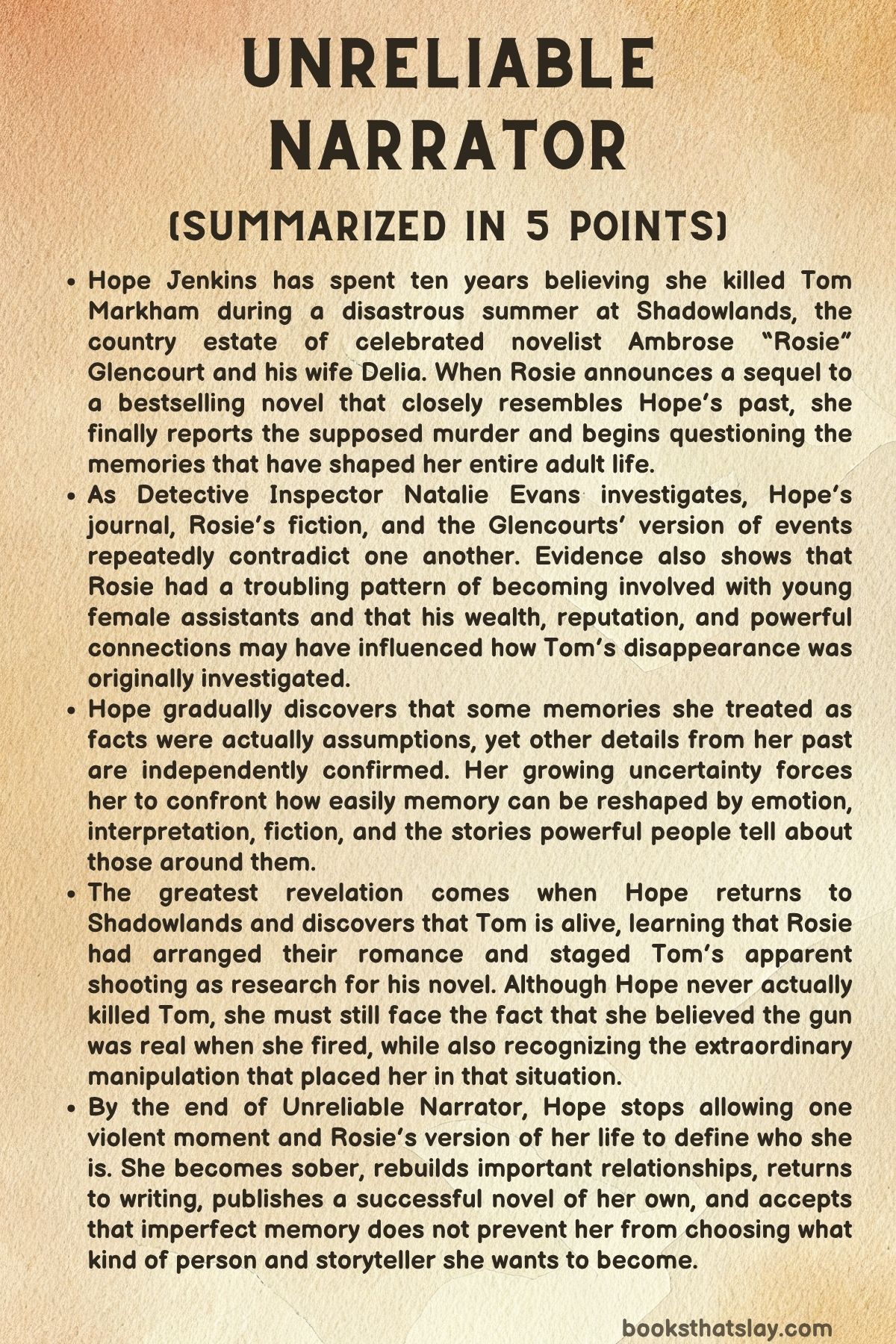
Characters
Hope Jenkins
Hope is the emotional and psychological centre of Unreliable Narrator, and nearly every major question in the book is filtered through her uncertain understanding of herself and other people. At twenty-three, she is intelligent, observant, ambitious and deeply insecure, arriving at Shadowlands with the belief that proximity to exceptional people might help her become exceptional herself.
Her strongest weakness is not simple gullibility but her hunger to belong. She repeatedly edits her reactions, opinions, clothes, desires and moral judgments because she fears that behaving conventionally will expose her as ordinary and cause Rosie, Delia or Tom to stop valuing her.
Hope’s relationship with identity is therefore unstable even before the supposed shooting. She imitates Delia, seeks Rosie’s intellectual approval and becomes emotionally dependent on Tom, with each relationship offering a different version of the woman she thinks she should become.
Her unreliability is also more complicated than dishonesty. Hope genuinely believes many things that later prove inaccurate because she has confused assumptions with facts, reconstructed conversations from memory and allowed Rosie’s fiction to become entangled with her recollections.
The revelation that Tom is alive destroys the identity she has maintained for ten years. Hope discovers that she punished herself for a murder that never occurred, even though she must still confront the disturbing truth that she intended the gunshot to be real.
Her most important growth comes when she refuses to repeat that choice with Dominic. She finally understands that character is produced through continuing decisions rather than permanently determined by the worst impulse a person has ever experienced.
By becoming a novelist herself, Hope also reclaims something Rosie took from her. Storytelling changes from a means through which others define her into a means through which she can examine experience without pretending that any single perspective possesses complete truth.
Ambrose “Rosie” Glencourt
Rosie is a celebrated novelist whose intelligence and charm allow him to exercise enormous influence over people who want access to his approval. In Unreliable Narrator, his most disturbing characteristic is his belief that artistic creation gives him permission to convert other people’s experiences into material regardless of the consequences.
He understands how desperately Hope wants to become a writer and uses that desire to make his attention seem like an extraordinary privilege. His lessons about observing people, using real life and refusing conventional moral limitations initially sound like artistic advice, but they also encourage Hope to distrust the instincts that might otherwise protect her.
Rosie’s relationships with Annie, Sara and potentially Hope establish a repeated pattern. He chooses young assistants whose employment places them below him in status, creates emotional and sexual intimacy, and allows them to interpret that attention as special even though he has behaved similarly before.
His greatest act of manipulation is the experiment involving Tom and Hope. Rather than imagining the emotional crisis required for his novel, Rosie constructs one in real life and observes it, reducing two vulnerable young people to research subjects.
Rosie also benefits from wealth, class and professional connections. His social relationship with Andrew Lambert helps explain why the original disappearance investigation could be controlled so effectively, while his later friendship with the Metropolitan Police Commissioner demonstrates how institutional power continues protecting him.
He does not regard himself as conventionally cruel. His more dangerous quality is his ability to create explanations in which his own desires appear intellectually justified, artistically necessary or emotionally harmless.
Delia Glencourt
Delia initially appears to Hope as almost impossibly composed. Her beauty, confidence, clothes, social ease and apparent acceptance of Rosie’s behaviour make her the model around which Hope begins reconstructing herself.
Gradually, however, the image of Delia as completely powerful breaks down. She drinks more heavily, loses weight, cries privately, reacts painfully to Rosie’s other relationships and reveals that her apparent acceptance of his behaviour requires enormous emotional suppression.
Her history with Robert Seigal changes the interpretation of many of her choices. She was sexualized by an adult artist from childhood and later lived with explicit images of herself being treated as culturally significant objects even when she wanted them removed.
Rosie’s refusal to remove Seigal’s painting from his study becomes especially disturbing in this context. Delia has escaped one powerful male artist who controlled the meaning of her body only to marry another powerful male artist who continues deciding what artistic value should outweigh her discomfort.
Delia is nevertheless morally responsible for helping Rosie manipulate Hope and Tom. Her own history of victimization does not erase the harm she participates in, particularly when she pressures Tom and helps create the staged shooting.
Her relationship with Tom also reveals her need to be needed. She originally supports him through addiction recovery and treats him almost as a son, but that bond later becomes another mechanism through which he can be pressured.
Delia’s later decision to destroy the Seigal portrait by remaking the canvas is symbolically important. Rather than simply removing the image, she takes control of the object that once represented another man’s authority over her body and transforms it through her own art.
Tom Markham
Tom enters the story carrying a history that other people repeatedly use to define him. His addiction, homelessness, criminal behaviour and time in rehabilitation make him vulnerable to the belief that he owes the Glencourts permanent gratitude for helping him recover.
He is more perceptive about class than Hope because he recognizes that Shadowlands operates through inherited privilege and personal connections. He sees that many people Hope regards as naturally extraordinary have benefited from networks that make talent easier to display and reward.
Tom initially agrees to Rosie’s experiment, meaning his relationship with Hope begins through deception. This is a serious betrayal because Hope believes their meeting and growing intimacy are spontaneous while Tom knows Rosie is observing them as material.
Yet Tom genuinely falls in love with Hope. His increasing anxiety, withdrawal and hostility toward Rosie come partly from the conflict between the original arrangement and feelings that have become real.
His false declaration of love for Delia is therefore especially cruel because he knows exactly how dependent Hope has become on their relationship. His warnings shortly beforehand suggest that he wants to prepare her for pain but lacks the courage or freedom to expose the whole plan.
After the staged shooting, Tom remains at Shadowlands for years, suggesting that the psychological influence of the Glencourts never completely disappears. His survival resolves the murder mystery but does not convert him into a simple innocent, since he must also live with the consequences of having participated in Rosie’s experiment.
Detective Inspector Natalie Evans
Natalie provides an important second perspective because she approaches Hope’s claims from outside the emotional world of Shadowlands. She is skeptical, practical and professionally conscious of the difference between something that sounds convincing and something that can actually be proved.
Her investigation demonstrates the difficulty of determining truth when every available source is compromised. Hope’s memories are unstable, Rosie’s explanations change, Delia withholds information, Tom has vanished from official life, and the old police file itself appears to have been manipulated.
Natalie’s strength is that she eventually begins questioning not only witnesses but the systems that determine which witnesses are considered credible. Her discovery of Andrew Lambert’s connection to Rosie makes her recognize that official evidence can also be shaped by social privilege.
Her weakness is emotional distance. She often treats work as a space where she can avoid the uncomfortable intimacy of her marriage and family, repeating in a less extreme way Hope’s habit of building a life around avoidance.
Her growing relationship with Hope changes both women. Natalie eventually accepts that uncertainty does not require complete emotional detachment and apologizes for failing to recognize how much of Hope’s account deserved serious attention.
Kira
Kira is Natalie’s wife and represents the domestic reality Natalie repeatedly tries to avoid. Her exhaustion after becoming a mother exposes the unequal emotional and practical burden that has developed inside their marriage.
Kira’s dissatisfaction is not based on lack of love for her children. Instead, motherhood has consumed so much of her identity that she struggles to remember who she was before becoming responsible for them.
Her conversations with Natalie challenge the idea that love is something people either naturally understand or permanently fail to understand. Kira treats intimacy as an ongoing willingness to allow another person access to fear, confusion and vulnerability.
Through Kira, the novel presents an ordinary relationship struggling with difficult emotional patterns without turning those struggles into dramatic destruction. She offers a contrast to both Hope’s romantic idealization of Tom and the destructive model provided by Rosie and Delia.
Hope’s Mother
Hope’s mother is initially one of the strongest sources of stability in her life. She encourages Hope’s move to Shadowlands because she knows her daughter wants to become a writer and believes the opportunity could help her.
Hope’s growing secrecy gradually damages their closeness. Shadowlands becomes something Hope wants to possess privately, and even her relationship with Tom remains hidden from the person who previously knew her best.
After Hope becomes ill, her mother accepts the Glencourts’ explanation that Hope became obsessed with Rosie. Because Rosie and Delia appear wealthy, composed and respectable while Hope is feverish and confused, their version seems easier to believe.
Years later, her statement that Hope has always invented stories is devastating because it reinforces Hope’s fear that her entire memory may be unreliable. Yet their eventual reconnection shows that damaged relationships do not necessarily have to remain permanently defined by misunderstanding.
Sara Clarke
Sara is Rosie’s assistant immediately before Hope and initially exists mainly as an unexplained absence. Rosie repeatedly calling Hope by Sara’s name creates the first suggestion that Hope’s apparently unique position may actually belong to a recurring pattern.
When Natalie eventually contacts Sara, she learns that Rosie had a sexual relationship with her while controlling nearly every important condition surrounding their interactions. Sara once believed she had freely chosen the relationship, but later recognized how difficult meaningful refusal had been.
Sara is important because her experience independently supports parts of Hope’s perception. Even when Hope’s memory of the supposed murder collapses, her sense that Rosie’s attention involved an imbalance of power proves substantially accurate.
Annie Metcalf
Annie worked for Rosie before Sara and provides further evidence that his behaviour toward young assistants was systematic rather than accidental. Her account is even more troubling because Rosie entered her bedroom and initiated sexual contact before she had clearly agreed.
Annie’s continuing shame demonstrates how coercion can survive without obvious physical force. She repeatedly tells herself that Rosie might have stopped if she had resisted strongly enough, shifting responsibility toward her own failure to say no rather than toward the powerful employer who created the situation.
Her experience closely resembles Hope’s feeling that Rosie produced an “absence of choice.” Annie therefore helps Natalie understand that a person’s participation does not automatically prove that power, pressure and manipulation were absent.
Charlie Cunningham
Charlie is a lonely child who quietly becomes one of the most important people in Hope’s later life. His habit of spending lunch breaks in her office allows a caring side of Hope to emerge despite her conviction that she is incapable of being good.
His bruises, hunger, anxiety and fear of his father gradually alert Hope to the possibility of abuse. Charlie becomes a test of whether Hope can trust herself enough to protect another person without requiring absolute certainty first.
Hope’s eventual intervention on behalf of Charlie and his mother does not excuse every decision she makes, but it forces her to reconsider the identity she constructed after Shadowlands. Someone who notices another person’s fear, worries about his safety and chooses to act cannot easily be reduced to the single label of “bad.”
Dominic Cunningham
Dominic represents cruelty hidden inside an ordinary respectable household rather than an extraordinary artistic one. His behaviour toward Charlie and his wife is revealed through controlling gestures, intimidation, injuries and deliberately frightening messages.
Hope’s confrontation with Dominic creates the clearest moral test of her development. She has a loaded weapon, believes he deserves punishment and briefly enjoys the power of making him afraid.
Her refusal to shoot him matters precisely because she could have done so. Dominic therefore becomes the person through whom Hope proves to herself that intention, restraint and future choices matter more than the permanent moral identity she assigned herself after firing at Tom.
Tilly
Tilly is one of Rosie’s daughters and spends a brief but memorable period with Hope at Shadowlands. Hope’s genuine kindness toward the child later becomes especially important because Tilly independently remembers their time together many years afterward.
When Tilly tells Hope that a doll was named after her, she provides confirmation that one of Hope’s memories occurred essentially as remembered. This does not prove that every memory is accurate, but it prevents unreliability from becoming the simplistic conclusion that Hope imagined everything.
Tilly also gives Hope evidence that she once affected another person’s life positively. At a time when Hope believes herself dangerous and morally damaged, that remembered kindness becomes an important challenge to the story she tells about herself.
Mrs Markham
Tom’s mother provides an important independent view of who Tom was shortly before his disappearance. She confirms that he telephoned her in August 2016 sounding happy and speaking about a woman he intended to bring home.
Her evidence supports Hope’s claim that the relationship between Hope and Tom was genuine. She also rejects the idea that Tom would naturally have gone to London if he had relapsed, weakening the assumptions behind the original investigation.
Mrs Markham represents the people who suffer when authorities reduce a complicated person to his worst history. Because Tom had once been an addict, his disappearance was easier for powerful people to explain away as relapse rather than investigate with sustained seriousness.
Themes
Memory, Storytelling, and the Instability of Truth
Memory in Unreliable Narrator is neither presented as a perfect record nor dismissed as meaningless simply because it contains mistakes. Hope remembers certain events with extraordinary confidence, yet she gradually discovers that some of her strongest “memories” were actually interpretations that hardened into facts over time.
Her assumption that Rosie had nine children is one of the clearest examples. She saw photographs of children and built a conclusion from them without anyone explicitly telling her that every child pictured belonged to Rosie.
The more serious problem is that Hope spent months transcribing Rosie’s fictional material. Language, scenes, emotional ideas and narrative structures from his work therefore occupied the same mental space as the experiences she later tried to remember.
Rosie understands this instability exceptionally well because constructing convincing stories is his profession. He can take fragments of reality, rearrange them and create a version that feels emotionally true even when its factual arrangement has changed.
The book refuses to solve this problem by supplying one perfectly objective account. Tom’s survival disproves Hope’s belief that she killed him, but Tom’s explanation simultaneously proves that many of her memories surrounding manipulation, love and fear contained essential truths.
The result is a distinction between factual accuracy and meaningful experience. A person can misremember details while still accurately understanding that something harmful happened, just as a polished and internally consistent narrative can still conceal deliberate deception.
Power, Privilege, and Who Gets Believed
Rosie’s influence extends far beyond fame or money. He possesses cultural prestige, inherited wealth, professional connections and the authority of a respected male artist, all of which affect how easily his version of events can become the accepted one.
Hope understands this imbalance only gradually. At Shadowlands she initially interprets access to wealthy artists and intellectuals as evidence that she has entered a world of naturally exceptional people.
Tom sees the system differently. He explains that opportunities circulate through family connections, schools, friendships and professional networks, meaning social privilege can help produce the very appearance of extraordinary merit.
The police investigation demonstrates the practical consequences. Andrew Lambert’s friendship with Rosie creates a plausible mechanism through which evidence could disappear and an investigation could be closed before uncomfortable questions were properly asked.
Hope faces the opposite problem. She is isolated, alcoholic, emotionally unstable and openly uncertain about parts of her own memory, making her appear unreliable beside Rosie and Delia’s calm confidence.
The novel therefore asks whether credibility is ever distributed neutrally. People already protected by status can present contradiction as complexity, while people without that protection may find that any emotional response becomes evidence against them.
Natalie’s investigation becomes more serious only when she stops treating privilege as background information and starts considering it as evidence. Truth is not merely a question of what happened; it is also shaped by who has the power to preserve records, remove evidence, influence authorities and appear respectable while doing so.
Love, Possession, and the Desire to Lose Oneself
Hope repeatedly experiences love as the desire to erase boundaries between herself and another person. With Tom, she wants complete emotional and physical closeness; with Delia, she wants to wear her clothes and absorb her confidence; with Rosie, she wants artistic recognition that might transform her identity.
This makes love inseparable from Hope’s uncertainty about who she is. Rather than bringing a stable identity into her relationships, she often hopes relationships will provide one for her.
Her feelings for Tom become especially intense because his love seems to make her feel real. When he becomes distant, Hope experiences the withdrawal almost as if parts of herself are disappearing.
Rosie and Delia offer a darker version of attachment. Rosie repeatedly describes freedom as compatible with love, yet the supposed freedom in their marriage largely serves his desires while Delia bears the emotional consequences.
Delia herself suggests that people may recreate the emotional conditions they learned in childhood. Her history with Seigal helps explain why pain, devotion, shame and submission have become difficult for her to separate.
The novel ultimately moves away from the idea that love requires complete merging. Hope’s recovery begins when she stops needing Tom, Rosie, Delia or Shadowlands to tell her who she is.
Natalie’s relationship with Kira develops along a similar path. Their marriage improves not through romantic intensity but through the more difficult act of expressing fear honestly while allowing two separate people to remain separate.
Guilt, Moral Identity, and the Possibility of Choosing Again
Hope spends ten years believing that one terrible action exposed her permanent moral nature. Because she thinks she deliberately killed Tom, she concludes that relationships, motherhood, ambition and happiness should be denied to her as both punishment and protection for everyone else.
This belief depends on treating identity as fixed. One violent decision becomes enough evidence to define everything Hope is and everything she might ever become.
Tom struggles with a similar question because of addiction. He fears that the person capable of lying, stealing and betraying others for drugs never disappeared but remains permanently inside him.
Delia carries another version of the same wound. Seigal taught her to interpret abuse as proof that something bad within her had invited or desired what happened, leaving shame attached to her identity rather than to the man who harmed her.
The later confrontation with Dominic gives Hope a genuine opportunity to test whether people are permanently determined by previous behaviour. She has the power, anger and weapon necessary to kill him.
She chooses not to fire.
That decision does not erase the fact that she intended to shoot Tom years earlier. Instead, it proves something more useful: moral character remains active rather than completed.
Hope can acknowledge that she was capable of a violent choice without concluding that violence must define every future choice. Her eventual recovery therefore depends not on proving she has always been innocent, but on accepting that people can act badly, understand what they have done, choose differently and continue becoming someone new.