Unseen Academicals Summary, Characters and Themes
Unseen Academicals (Discworld #37) is a comic fantasy novel by Terry Pratchett set in Ankh-Morpork, where football, politics, class, food, fashion, romance, and prejudice collide around Unseen University. The book begins with a practical problem: the wizards must play football or lose a vital bequest that pays for their lavish meals.
What follows is far more than a sporting inconvenience. Pratchett uses the chaos of football to examine identity, belonging, fame, fear, and the strange ways people decide who has value. With wit and warmth, Unseen Academicals turns a citywide game into a story about change.
Summary
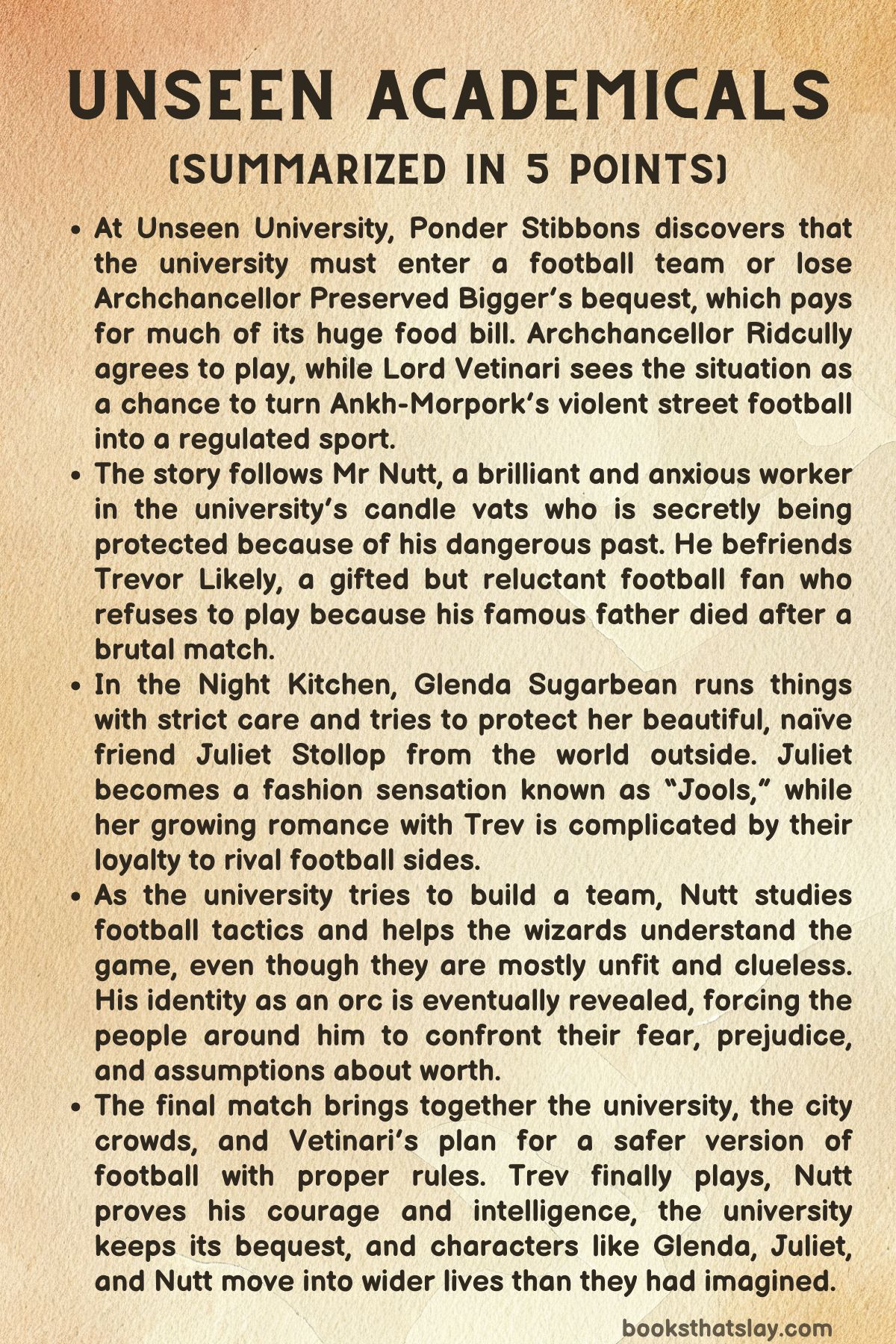
At Unseen University, life usually revolves around magic, meals, academic comfort, and the avoidance of unnecessary effort. That routine is disturbed when Ponder Stibbons discovers an awkward condition attached to an old bequest from Archchancellor Preserved Bigger.
The money has been quietly supporting the university’s huge food bill, and without it the wizards’ comfortable way of life would suffer badly. The problem is that the bequest depends on the university taking part in football, the rough street game loved across Ankh-Morpork.
Archchancellor Ridcully quickly understands the seriousness of the matter. A threat to food is a threat the wizards can understand, even if the rules, traditions, and social meaning of football are foreign to most of them.
The university therefore begins the strange process of preparing a team. At the same time, Lord Vetinari, the ruler of Ankh-Morpork, sees an opportunity.
Football in the city is passionate, ancient, and often violent. Street matches can turn into mobs, and rival supporters treat one another with deep hostility.
Vetinari wants the game controlled, not destroyed. By drawing Unseen University into it, he hopes football can be given rules, structure, and a new public form.
Below the university, in the candle vats, Mr Nutt works quietly and carefully. He is polite, extremely intelligent, and almost painfully eager to be useful.
Nutt believes he must “accumulate worth,” as if his right to exist depends on constant proof of value. He has been placed at the university under secret protection arranged by Lady Margolotta and Vetinari.
To most people, he appears to be a goblin, but his true identity is far more dangerous in the eyes of the world. Nutt’s fear, self-control, and brilliance make him one of the most important figures in the story, though he begins as someone who tries hard not to be noticed.
Nutt becomes friends with Trevor Likely, a candle-worker who seems lazy, charming, and unwilling to take much seriously. Trev is deeply connected to football through his father, Dave Likely, a legendary player who once scored four goals in a famous match.
That achievement made him a hero, but the brutal nature of the game also led to his death. Because of this, Trev has promised never to play football.
His refusal is complicated by the fact that he has extraordinary natural skill. He can kick a tin can with amazing accuracy and control, revealing the kind of talent that would make him a remarkable player if he allowed himself to step onto the field.
In the Night Kitchen, Glenda Sugarbean runs the food operation with discipline, intelligence, and fierce pride. She is practical, sharp-eyed, and used to taking responsibility for everyone around her.
Her closest friend is Juliet Stollop, a beautiful and innocent young woman who also works in the kitchen. Juliet’s looks attract attention from almost everyone who sees her, but she is not calculating or vain.
Glenda protects her, partly out of love and partly because she does not trust the world to treat Juliet kindly.
Juliet and Trev are drawn to each other, but their romance is complicated by football loyalties. Juliet supports Dolly Sisters, while Trev supports Dimwell.
These rival sides are separated by the kind of hatred that makes ordinary affection seem almost impossible. Glenda distrusts Trev and sees him as a risk to Juliet’s safety and future.
She also fears that Juliet’s beauty may carry her away from the familiar life they share in the kitchen.
As the university tries to understand football, Nutt becomes increasingly useful. He studies the game with seriousness and insight, seeing patterns, possibilities, and tactics that others miss.
The wizards, meanwhile, are not natural athletes. They are unfit, confused, and often more interested in the rituals around sport than in the physical effort required to play it.
Ridcully, Ponder, and the other faculty members begin investigating football traditions, while Vetinari keeps pressure on the process, guiding events toward a cleaner and more orderly version of the game.
The football project spreads through the university and the city. It is no longer only about preserving a bequest.
It becomes tied to civic order, public entertainment, class tension, and the emotional lives of the people drawn into it. Trev is pulled closer to the sport he has tried to avoid.
Nutt, who has never had a secure place in society, finds that his intelligence gives him a role. Glenda watches all of this with suspicion, especially as Juliet’s life begins to change.
Juliet is discovered by Madame Sharn, a dwarf fashion expert who recognizes her beauty and turns her into a model. Juliet becomes known publicly as “Jools,” and her image begins to circulate beyond the kitchen.
Fame changes how people look at her. To some, she becomes an object of admiration.
To others, she becomes a symbol to be shaped and sold. Glenda is proud of Juliet but also frightened and resentful.
She worries that Juliet is being used by people who understand fashion, money, and status far better than Juliet does. She also worries that she is losing the person she has always protected.
While Juliet’s public identity grows, Nutt’s hidden identity threatens to destroy him. It is revealed that he is not a goblin but an orc.
Orcs are feared and hated because they were created and used as weapons in war. The word itself carries terror, and people judge Nutt through old stories before they consider who he actually is.
His past has been terrible: he was once chained to an anvil for years before being rescued and educated. His careful manners and hunger for worth come from trauma as well as hope.
He wants to be good, useful, and acceptable, but the world has taught him that acceptance can be withdrawn in an instant.
The revelation creates fear around him. People who had begun to trust Nutt must decide whether they believe in the person they know or the monster they have been taught to imagine.
This conflict gives the story one of its central questions: does a person’s origin define them, or do their choices matter more? Nutt’s struggle is not only external.
He also fears what he might be, and that fear makes his desire for control and goodness even more urgent.
As the match approaches, football becomes a public test for the university and the city. The new version of the game must prove that football can be more than a violent clash between mobs.
Nutt helps develop training and tactics, bringing thought and discipline to a sport often ruled by instinct and aggression. Trev, despite his promise, finds himself moving toward the field.
His father’s memory weighs heavily on him. To play is to risk repeating the past, but not to play is to deny a gift that is clearly his.
Glenda also faces change. Her life in the Night Kitchen has given her authority and purpose, but it has also kept her within narrow limits.
Juliet’s transformation, Trev’s arrival, and Nutt’s situation force Glenda to question the habits of protection and fear that have guided her. She has to accept that loving someone does not mean keeping that person small or safe from every possible risk.
The climactic match brings these tensions together. The university team plays under the new rules, showing that football can become a sport of skill rather than uncontrolled violence.
Trev finally uses his talent openly and plays the game he has avoided for so long. His performance honors his father without being trapped by his father’s fate.
Nutt’s tactical intelligence and courage prove essential, and his actions help others see him as an individual rather than as a feared category.
The match helps change football in Ankh-Morpork. It does not remove passion from the game, but it redirects that passion into structure, rules, and play.
Vetinari gains the regulated football he wanted. The university keeps the bequest and protects its beloved food supply.
Juliet and Trev’s relationship survives the hatred between their rival sides. Glenda begins to see that her world can grow beyond the kitchen without losing everything that matters.
Nutt, most importantly, moves closer to acceptance. By the end of Unseen Academicals, football has become the means through which many characters confront fear, identity, loyalty, and the possibility of becoming more than others expected.
Characters
In Unseen Academicals, Terry Pratchett builds the character drama around football, class, prejudice, food, fashion, friendship, and the painful desire to be accepted. The characters are not only involved in the formation of a university football team; they are also pushed into confronting what they believe about worth, identity, loyalty, and change.
Mr Nutt
Mr Nutt is one of the most emotionally powerful and morally complex figures in the book. At first, he appears to be a quiet, anxious, extremely polite worker in the candle vats beneath Unseen University.
He speaks carefully, behaves humbly, and constantly tries to be useful, as if every action must prove that he deserves to exist among other people. His repeated need to “accumulate worth” shows how deeply he has been shaped by fear, rejection, and past suffering.
He does not simply want praise; he wants proof that he is not the monster the world expects him to be.
As the story develops, Nutt’s intelligence becomes one of his defining qualities. He studies football with extraordinary seriousness and sees patterns, strategies, and possibilities that others miss.
While many characters treat football as either a violent street habit or a joke, Nutt understands that it can become a disciplined, thoughtful, beautiful game. His mind gives structure to chaos, and his tactical thinking helps transform the sport from mob violence into something more organized and skillful.
In this way, he becomes central not only to the university’s team but also to the larger reshaping of football in the city.
Nutt’s revelation as an orc gives his character his deepest tragic weight. He is feared not because of what he has done in the present, but because of what people believe his kind represents.
His past as someone chained, abused, and treated as a weapon makes him a victim of history, yet he carries the burden of other people’s terror as if it were his own guilt. His politeness, learning, and discipline are not superficial traits; they are survival strategies.
He has built himself carefully because he knows that one uncontrolled moment could confirm everyone’s worst assumptions.
By the end of the story, Nutt’s journey becomes a moving argument against judging people by inherited fear. He does not become accepted because his identity disappears; he becomes accepted because others begin to see him fully.
His courage lies not only in facing danger but in continuing to be gentle in a world that expects brutality from him. He represents the book’s strongest idea about worth: that a person’s value cannot be decided by origin, reputation, or fear, but by choice, action, and the capacity to grow.
Trevor Likely
Trevor Likely is a character shaped by talent, grief, loyalty, and avoidance. He begins the story as a relaxed, somewhat lazy candle-worker who appears to take very little seriously.
Beneath that casual surface, however, he carries the painful legacy of his father, Dave Likely, a legendary footballer who died after a brutal match. Trev’s refusal to play football is not a lack of interest or ability; it is an act of mourning and self-protection.
Football took his father from him, so rejecting the game becomes his way of refusing to repeat the same tragic pattern.
Trev’s natural skill is obvious from his ability to kick a tin can with astonishing precision. This talent makes his refusal more meaningful because he is not someone outside the world of football; he is someone born into it, gifted for it, and haunted by it.
His relationship with the sport is therefore conflicted. He loves the culture around football, understands its passion, and feels its pull, but he also fears the violence and loss connected to it.
His character shows how inheritance can be both a gift and a burden.
His relationship with Juliet adds another layer to his development. Their romance is complicated by the rivalry between Dimwell and Dolly Sisters, turning personal affection into a challenge against tribal loyalty.
Trev has to decide whether inherited divisions should define his future. His attraction to Juliet is not just romantic; it forces him to imagine a life that is not controlled by old grudges, football loyalties, or fear of what others will say.
By finally playing football, Trev does not betray his father’s memory. Instead, he reclaims the game from the violence that destroyed his father.
His choice suggests that the past should be remembered, but not allowed to imprison the living. Trev matures by accepting his talent and using it in a changed version of the sport, one governed by rules, skill, and possibility rather than brutality.
Glenda Sugarbean
Glenda Sugarbean is one of the most grounded, practical, and emotionally rich characters in the book. She runs the Night Kitchen with discipline, competence, and pride, and she is deeply attached to the world she understands.
Glenda is not glamorous in the way Juliet becomes glamorous, but she has strength, intelligence, and moral seriousness. She is the kind of person who holds everything together while other people receive attention for being charming, beautiful, or important.
Her protectiveness toward Juliet is one of her central traits. Glenda loves Juliet, but that love is mixed with control, anxiety, and resentment.
She sees Juliet as innocent and easily exploited, so she tries to shield her from Trev, from fame, and from people who might use her beauty for their own purposes. Yet Glenda’s protection is not purely selfless.
She is also afraid of being left behind. Juliet’s rise into fashion and public attention threatens Glenda’s sense of stability, because it suggests that the life they shared in the Night Kitchen may not be enough for Juliet anymore.
Glenda’s inner conflict is about change. She is intelligent enough to see when the world is shifting, but emotionally reluctant to trust that change can be good.
She distrusts glamour, romance, ambition, and social mobility because they seem dangerous and false. Her suspicion often protects others, but it also limits her.
She has learned to survive by being sensible, and the story challenges her to see that being sensible does not have to mean refusing every possibility beyond the familiar.
Her growth comes through her gradual acceptance that other people must be allowed to become more than what she expects them to be. She learns that Juliet can be beautiful and still have agency, that Trev can be more than a lazy football boy, and that Nutt can be more than the frightening identity others place on him.
Glenda’s development is quiet but important: she begins the book guarding a small world and ends it more willing to let life expand.
Juliet Stollop
Juliet Stollop is introduced as beautiful, naïve, and somewhat simple in the eyes of those around her, but her character is more important than a surface reading suggests. She works in the Night Kitchen with Glenda and initially seems to be defined by her appearance and by other people’s reactions to it.
Almost everyone notices her beauty, and that beauty becomes a force that changes her life. Yet Juliet is not merely an object of admiration; she becomes a character through whom the story explores fame, self-discovery, and the way people underestimate those they think they understand.
Her transformation into “Jools” shows how identity can be shaped by opportunity. Madame Sharn sees something in Juliet that the Night Kitchen cannot contain, and Juliet is drawn into the world of fashion.
This shift gives her visibility and power, but it also makes her vulnerable to being turned into a public image. The tension in her character comes from the difference between Juliet the person and Jools the figure created by fashion, attention, and other people’s expectations.
Juliet’s relationship with Trev is important because it challenges the inherited hatred between rival football supporters. She supports Dolly Sisters, while Trev supports Dimwell, and their attraction crosses a boundary that the crowd culture around them treats as serious.
Through Juliet, the book shows how social divisions can seem huge until individual affection makes them look absurd. Her romance with Trev is gentle but symbolically important because it resists the idea that old rivalries should decide personal relationships.
Juliet’s innocence should not be mistaken for emptiness. She may not analyze the world like Nutt or control it like Glenda, but she has a natural openness that allows her to move into new spaces.
Her character reveals how people who are dismissed as simple can still become agents of change. By stepping beyond the Night Kitchen and becoming part of the fashion world, she forces others, especially Glenda, to reconsider what she is capable of becoming.
Lord Vetinari
Lord Vetinari is the political mind behind much of the story’s larger movement. He understands that football cannot simply be crushed, because it is too deeply rooted in the city’s habits and passions.
Instead, he chooses to reshape it. His genius lies in recognizing that power often works best not by forbidding people’s desires, but by redirecting them into forms that serve order.
For Vetinari, football is not just a game; it is a civic problem, a social force, and an opportunity.
His support for the university’s involvement is strategic. He sees Unseen University as a tool that can help transform violent street football into a sport with rules, structure, and legitimacy.
Vetinari’s character is defined by this kind of indirect control. He rarely needs to force events openly because he is skilled at arranging circumstances so that others move in the direction he wants.
His calm, controlled manner contrasts with the noise and chaos of the football crowds.
Vetinari is also important in relation to Nutt. His involvement in Nutt’s protection suggests that he is capable of seeing value where society sees danger.
However, his compassion is never sentimental. He is practical, calculating, and always aware of the political consequences of identity, fear, and public opinion.
This makes him a morally complicated figure: he may help people, but he also places them within larger designs.
In the book, Vetinari represents order, intelligence, and civic manipulation. He does not love football in the ordinary emotional sense, but he understands why people do.
His achievement is to make passion useful without destroying it. Through him, the story shows that civilization is often created not by removing chaos entirely, but by giving it rules.
Archchancellor Ridcully
Archchancellor Ridcully brings energy, stubbornness, and comic authority to the university side of the story. He agrees to the football project mainly because the university risks losing a valuable bequest that supports its enormous food bill.
This practical motive fits Ridcully perfectly. He may be a powerful wizard, but he is also deeply concerned with comfort, meals, institutional pride, and keeping the university functioning in its own eccentric way.
Ridcully’s character often combines confidence with limited understanding. He is willing to act decisively even when he does not fully grasp the situation, which makes him both funny and strangely effective.
His approach to football is not scholarly at first; he treats it as something the university must handle because circumstances demand it. Yet his willingness to engage with the problem helps set the plot in motion.
As Archchancellor, Ridcully represents the old authority of Unseen University. He is not naturally modern, but he is adaptable when survival, food, or prestige are involved.
His leadership style is loud, physical, and instinctive, contrasting strongly with Ponder Stibbons’s methodical thinking. This contrast gives the university scenes much of their humor and also shows how the institution functions through a mixture of tradition, panic, intelligence, and appetite.
Ridcully’s role in the story is not primarily emotional, but he is essential to the machinery of change. By agreeing that the university must field a team, he accidentally helps football become something new.
His character shows that even conservative institutions can become engines of transformation when their own interests are threatened.
Ponder Stibbons
Ponder Stibbons is the voice of reason, calculation, and administrative intelligence within Unseen University. He is the one who discovers the danger to the university’s bequest, and this makes him responsible for turning an obscure legal problem into a major institutional crisis.
Ponder often functions as the person who understands the details before anyone else does, even if the people above him do not always listen properly.
His character is defined by competence under absurd conditions. He works among senior wizards who are eccentric, distracted, and often resistant to practical thinking, yet he continues trying to impose order through research, planning, and explanation.
In the football plot, Ponder helps connect the old traditions of the game with the university’s need to participate in it. He represents the modernizing force inside an ancient institution.
Ponder’s seriousness also makes him funny. He approaches magical, academic, and sporting problems with the same analytical mindset, even when the surrounding situation is ridiculous.
This makes him a useful contrast to Ridcully. Where Ridcully acts from instinct and authority, Ponder acts from information and procedure.
The two together show the strange balance that keeps the university alive.
In the book, Ponder is not the most emotionally dramatic character, but he is structurally important. Without him, the problem might not be understood in time, and the university would not be pushed into action with the same urgency.
He embodies the idea that knowledge, even when surrounded by chaos, can change events.
Madame Sharn
Madame Sharn is a sharp, perceptive, and transformative figure in Juliet’s storyline. As a dwarf fashion expert, she recognizes Juliet’s beauty as something that can be shaped into public glamour.
Her role is not simply to discover Juliet, but to introduce her into a new world where appearance, identity, and performance become forms of power. Through Madame Sharn, the story connects fashion with social change.
Madame Sharn sees possibilities that others miss. Where Glenda sees a friend who needs protection and the university staff see a pretty young woman, Madame Sharn sees a model, an image, and a future public figure.
This ability makes her both exciting and unsettling. She helps Juliet expand beyond the limits of the Night Kitchen, but her involvement also raises questions about whether Juliet is being empowered or used.
Her character also contributes to the book’s broader interest in identity. Fashion in the story is not treated as shallow decoration; it becomes a way of remaking how someone is seen.
Juliet’s transformation into Jools shows that public identity can be created, styled, and consumed. Madame Sharn understands this process and uses it with confidence.
Madame Sharn’s importance lies in her role as a catalyst. She does not merely change Juliet’s clothes; she changes the way Juliet is perceived by the city and by herself.
In doing so, she forces Glenda, Trev, and others to respond to a Juliet who is no longer safely contained within their old expectations.
Lady Margolotta
Lady Margolotta is a mostly distant but deeply significant presence in Nutt’s life. She is one of the people responsible for placing him in relative safety and ensuring that he receives education and protection.
Her role shows that Nutt’s existence at the university is not accidental; it is part of a larger effort to see whether someone feared by society can be given the conditions needed to live differently.
Her importance comes from her belief in cultivation, reform, and controlled opportunity. She does not simply rescue Nutt in a sentimental way.
Instead, she helps place him within a structure where learning, discipline, and usefulness can give him a chance to survive. Like Vetinari, she seems to understand that society’s fear of Nutt cannot be ignored, but she also refuses to accept that fear as the final truth about him.
Lady Margolotta’s influence highlights one of the story’s central questions: what does a person become when they are given education instead of chains? Nutt’s manners, knowledge, and self-control are partly the result of the opportunities she helped create.
Her presence behind the scenes reminds the reader that compassion can be strategic and that rescue must sometimes be followed by careful preparation for a hostile world.
Although she is not always at the center of the action, Lady Margolotta’s role is essential to understanding Nutt’s journey. She represents the possibility that even those created or remembered as instruments of violence can be offered a different future.
Dave Likely
Dave Likely is physically absent from the main action, but his memory strongly shapes Trev’s character. He was a famous footballer remembered for scoring four goals and dying after a brutal match.
His story captures the older, more violent form of football, where glory and danger were tightly connected. For Trev, Dave is not just a legend; he is a wound.
Dave’s importance lies in the emotional inheritance he leaves behind. His death turns football into something frightening for his son, even though Trev clearly possesses remarkable talent.
Trev’s refusal to play is therefore a tribute, a protest, and a defense mechanism. Dave’s memory prevents Trev from stepping easily into the role others might expect him to fill.
At the same time, Dave’s legacy is not entirely negative. He represents passion, skill, and the powerful emotional bond between football and community.
The tragedy is that the game he played was not yet civilized enough to protect its players from mob violence. His death becomes one of the reasons the new version of football matters.
If the game can change, then Dave’s legacy can become more than a warning.
Dave Likely’s character shows how the dead continue to influence the living. He does not need to appear directly to shape the book’s emotional direction.
Through Trev, his memory becomes part of the struggle to transform football from a dangerous street battle into a sport where talent can survive.
Themes
Worth, Identity, and the Fear of Being Judged
Mr Nutt’s struggle gives Unseen Academicals its strongest emotional centre. He has been taught to believe that his right to exist depends on proving his value, so he treats every action as a chance to “accumulate worth.” This makes his politeness and intelligence moving rather than merely impressive, because they come from fear as much as character.
Once his identity as an orc becomes known, the people around him are forced to face how easily they confuse inherited stories with moral truth. Nutt has done nothing to deserve hatred, yet the label attached to him is enough to make others suspicious.
Through him, the novel questions a society that judges people by reputation, race, and history before looking at their conduct. His acceptance is not simple or automatic; it has to be earned by those around him as much as by him.
The theme shows that dignity cannot depend on public approval, and that real worth lies in choice, kindness, courage, and self-control.
Football, Violence, and the Need for Order
Football begins as a rough street tradition shaped by loyalty, anger, and old rivalries. The crowds treat the game as an outlet for identity, but that identity often becomes dangerous because it is built around opposition rather than skill.
Lord Vetinari’s interest in reforming football is not only political; it is also social. He understands that a city cannot remove passion from its people, but it can give that passion a form that prevents it from destroying them.
The university’s involvement turns football from mob conflict into a structured contest where rules, tactics, and talent matter. This does not make the game dull.
Instead, order allows its beauty to appear. Trev’s natural ability, Nutt’s strategic mind, and the public excitement all show that discipline can strengthen joy rather than weaken it.
The theme suggests that civilization is not the absence of wild energy, but the process of giving that energy limits, meaning, and shared purpose.
Change, Ambition, and Leaving the Life Others Expect
Glenda’s story explores how difficult change can feel when safety has been built from routine, duty, and control. She takes pride in the Night Kitchen because it gives her authority and certainty, but it also becomes a boundary around her imagination.
Juliet’s rise into fashion unsettles Glenda because it threatens the old balance between them. Glenda wants to protect Juliet, yet her protectiveness is mixed with fear: fear of losing her friend, fear of being left behind, and fear that the world outside familiar work may not have a place for her.
Juliet’s transformation into a public figure is not treated simply as vanity or escape. It becomes proof that people may contain futures that others have not allowed them to see.
Glenda’s growth lies in recognizing that care should not become possession. The theme shows that loyalty must make room for freedom, and that stepping beyond a known life can be frightening without being wrong.
Legacy, Love, and Personal Choice
Trev lives under the shadow of his father’s death, and his refusal to play football is both an act of grief and an attempt to protect himself from repeating the past. His talent is obvious, but talent alone cannot free him because the game carries emotional weight.
Every kick reminds him of fame, violence, loss, and expectation. His relationship with Juliet adds another kind of pressure, since their rival loyalties reflect the wider divisions of the city.
Yet their bond shows that inherited sides do not have to decide a person’s future. Trev’s eventual choice to play matters because it is not a surrender to public demand; it is a decision to reclaim football on different terms.
He does not erase his father’s legacy, but he refuses to be trapped by it. The theme presents maturity as the ability to honor the past without becoming its prisoner, and to choose love and action over fear.