Upstanding Young Man Summary, Characters and Themes
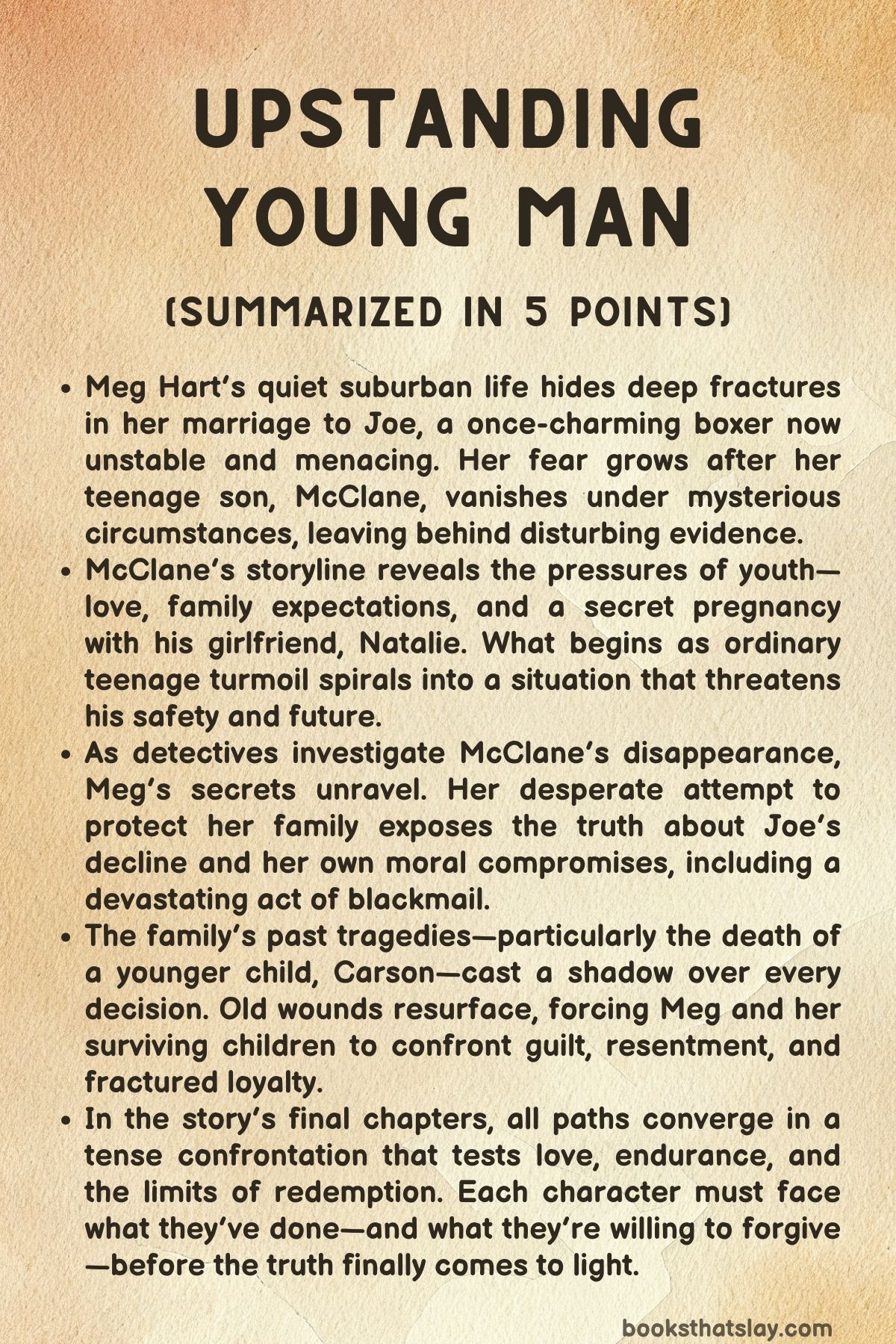
Upstanding Young Man by Sharon Doering is a psychological thriller that explores the fragile dynamics of family, morality, and buried trauma within a suburban household. Through alternating perspectives of a mother, Meg Hart, and her teenage son, McClane, the novel examines how guilt, secrecy, and love can twist under pressure.
The story begins with a disappearance that tears apart the illusion of stability in the Hart family. As police uncover disturbing evidence, Meg’s buried secrets resurface—revealing a history of manipulation, shame, and violence. Doering crafts an unsettling portrait of how past sins echo through generations, blurring the line between protector and destroyer.
Summary
The novel opens with Meg Hart lying beside her husband, Joe, overwhelmed by dread and exhaustion. Once charming and strong, Joe has grown unpredictable and frightening.
Their marriage, like their home, has deteriorated—marked by silence, fear, and resentment. Meg moves through the house early in the morning, reflecting on her children and the life they built.
Her youngest, Whitney, is moody and secretive; her middle child, McClane, is eighteen and recently earned a wrestling scholarship. Her older children, David and Jamie, are grown and gone.
The trees planted for each child still stand in the yard, symbols of the family’s rooted history. But Meg’s unease builds when she notices blood on her knee and remembers fragments of “last night.
Across town, McClane spends an afternoon with his friends Jack and Hudson. They fish, joke, and tease him about his girlfriend, Natalie.
Their camaraderie masks the quiet fears of adolescence—uncertain futures, broken families, and unspoken grief. When McClane checks his phone, he finds a message from Natalie telling him she’s pregnant.
Panic grips him, but he drives to her house determined to help. Chaos meets him there: Natalie’s furious parents shout, and she storms out, insisting McClane take her away.
They flee to the lake called Breakneck, infamous for a past tragedy. Lying under a blooming tree, they talk about the pregnancy and dream of a shared future.
McClane feels both love and dread. When he drops her home, he senses the moment marks the end of innocence.
The perspective shifts to Meg. She learns McClane never arrived at school.
Natalie appears at her door, frantic that he’s missing. Though Meg tries to stay calm, her anxiety spirals when police arrive.
The officers initially assume McClane ran off, but after searching his room, they call for an evidence unit. Detectives Ali Flemming and Drew Becker take over.
They discover a bloody knife and an explicit photograph that could be considered child pornography. Meg’s world collapses—she insists her son is innocent, but the detectives’ calm professionalism only deepens her dread.
Through diary entries from McClane’s childhood, the reader glimpses a disturbed imagination—fascination with death and control. These fragments complicate the question of his innocence.
Meanwhile, Meg’s memories expose her own desperate acts. When Joe stopped working months earlier, she secretly began completing his assignments, pretending to be him in emails.
To keep his job, she endured sexual coercion from his boss, Vincent. She eventually recorded one of their encounters and blackmailed him, hoping to protect her family.
But she sent the video the morning McClane disappeared, unaware of the chain reaction it would set off.
When Vincent confronts her, furious about the blackmail, Meg realizes the police are already linking her to McClane’s case. As she returns home, she sees detectives guiding a bloodied, naked man wrapped in a blanket—it’s Joe, found near Breakneck Cliff.
Disoriented and damaged, he mutters about moving a boulder and their dead child, Carson. Meg bathes him, questions him, but gets only fragments in return.
Detective Flemming confronts Meg about lies in her statements and plays a disturbing video from years ago showing Meg shouting that Carson was “too hard” to handle hours before his death. Horrified, Meg realizes how she appears to others: a mother linked to one child’s death and another’s disappearance.
Whitney overhears and questions her mother, asking if Carson’s and McClane’s cases are truly unrelated. The confrontation leaves Meg shattered.
Determined to act, she sets out to find Hudson, believing he holds answers. In his squalid apartment, she learns the truth about the incriminating photo: Hudson had taken it from a violent man at a party to protect a victim but lost it after being beaten.
McClane likely found Hudson’s bag and kept the photo without understanding. Relieved yet furious at the misunderstanding, Meg urges Hudson to call Detective Flemming and confess.
Soon after, Meg receives a call that her oldest son, Dave, may be involved. A federal agent, Dave had worked disturbing abuse cases and recently showed signs of unraveling.
Police locate Natalie’s car abandoned in Missouri, suggesting both she and McClane were abducted. Guided by Whitney’s online sleuthing, Meg tracks Dave’s vehicle to a wooded area.
Inside a dilapidated shack in those woods, McClane lies zip-tied and injured. Dave’s mind is fractured by delusion and obsession; he believes he is protecting children by exposing evil, convinced that Meg caused Carson’s death.
Natalie is imprisoned alongside McClane, both terrified as Dave’s behavior shifts between rage and remorse. When Dave leaves, McClane and Natalie work together to escape.
McClane dislocates his shoulders to maneuver his restraints, cuts himself free, and follows the sound of Dave leading Natalie outside.
Meg and Whitney arrive at the same location. While Whitney contacts police, Meg enters the forest alone.
She finds the pit traps, a bloody crib mattress, and finally the shack. Hearing screams, she runs toward them.
In the clearing, she finds Dave striking Natalie. McClane, having followed with a rock, attacks his brother to save her.
Dave collapses, bleeding and dazed. Police sirens close in.
Meg sends McClane and Natalie toward safety, staying with Dave as his life fades. She comforts him, calling him her boy, even as he murmurs paranoid fragments about unseen enemies.
Months later, the family is forever changed. McClane, haunted by killing his brother, gives up wrestling and plans to study psychology.
Natalie loses the baby but remains with him, both trying to rebuild. The FBI investigates Dave’s crimes and links him to a murdered woman from his past case.
Joe leaves Meg, unable to face what remains of their marriage. Meg rents a small house in Shady Grove and begins a cautious new life with Whitney and McClane.
The scandal makes her infamous; the leaked video of her breakdown goes viral, and Dave gains posthumous notoriety online. Jamie, now a journalist, visits to write about their story.
In the final pages, Meg reflects on survival. The family is scarred but alive.
Amid the noise of neighbors and the ordinariness of her new street, she finds a strange calm. She realizes there is no perfect redemption—only the daily act of choosing to live with what one has endured.
Upstanding Young Man closes not with victory, but with acceptance: that even in the ruins of guilt and loss, love persists, flawed and fragile but still present.
Characters
Meg Hart
Meg Hart stands at the emotional center of Upstanding Young Man, a woman hollowed by guilt, endurance, and the slow decay of her family life. Once hopeful and bright, Meg has been eroded by years of quiet suffering under the weight of her husband’s decline and her own compromises.
Her marriage to Joe, once rooted in passion and admiration, has become a haunting shadow of control, silence, and fear. Meg’s life is characterized by sacrifice—taking over Joe’s job in secret, enduring humiliation to protect her family’s livelihood, and carrying unbearable guilt for the past death of her child, Carson.
Her actions often stem from desperation rather than strength, but beneath that desperation lies a profound resilience. She is a mother who does terrible things for what she believes is love, and a woman who cannot escape the ghosts of her choices.
As the story unfolds, Meg’s moral boundaries blur; she becomes both victim and participant in deception, coercion, and violence. Yet, by the end, Meg’s journey is one of reluctant self-confrontation—she acknowledges her brokenness but also reclaims fragments of control and courage.
McClane (Mick) Hart
McClane, Meg’s teenage son, embodies both innocence and the inherited flaws of his family. A gifted wrestler with a scholarship to Indiana University, McClane’s life seems promising until he becomes ensnared in a web of love, secrecy, and violence.
His relationship with Natalie marks his transition from youth to adulthood, exposing his vulnerability and his yearning to protect what he loves, even when he lacks the means or wisdom to do so. McClane’s moral compass is strong but fragile; he acts out of loyalty and fear, often unable to comprehend the depth of the adult corruption surrounding him.
His struggle with identity—being a “good son” while resisting his father’s shadow—mirrors Meg’s battle for self-worth. The horror of his kidnapping and the act of killing his own brother, Dave, leave psychological scars that redefine him.
McClane emerges as a survivor shaped by trauma, guilt, and endurance, haunted by what he has lost but clinging to the possibility of renewal.
Joe Hart
Joe Hart is a tragic figure—a once-proud athlete, a Golden Gloves boxer, now unraveling under the weight of brain trauma, shame, and loss. His transformation from a charismatic man into a violent, unpredictable presence symbolizes the physical and emotional rot within the Hart family.
Joe’s deterioration blurs the line between madness and malevolence. His erratic behavior, secrecy, and inability to confront his past create an atmosphere of fear, particularly for Meg.
His psychological decline, possibly tied to chronic traumatic encephalopathy (CTE), turns him into both a danger and a pitiable shell. His role in Carson’s death and his complicity—direct or indirect—in the family’s moral collapse mark him as a catalyst for the story’s tragedy.
Yet, there are flickers of humanity left in him: moments of remorse, confusion, and tenderness that reveal a man trapped within his own failing mind. Joe becomes the embodiment of a legacy of violence passed down to his sons—a man whose ruin echoes through the lives he’s shaped and broken.
Dave Hart
Dave, the eldest son, is perhaps the novel’s darkest creation—a man twisted by grief, misplaced righteousness, and the family’s unspoken trauma. His transformation from a neglected older brother into a delusional kidnapper reflects the corrosive power of unresolved pain.
Dave’s work in child-abuse investigations feeds his obsession with protecting innocence while simultaneously corrupting his perception of right and wrong. His fixation on exposing Meg for Carson’s death and his abduction of McClane and Natalie merge familial duty with pathological zeal.
Dave operates in a moral paradox: he believes he’s saving others while enacting cruelty. His violence is both personal and symbolic—an eruption of everything the Hart family refused to confront.
By the time he dies, he has become a mirror of Joe: consumed by the same violence he sought to control. Yet even in death, Dave remains an enigmatic figure, both monster and martyr, a man undone by the very justice he believed in.
Natalie
Natalie represents both youthful defiance and tragic vulnerability. Her relationship with McClane begins with innocence and passion but quickly becomes burdened by adult realities—an unexpected pregnancy, parental rage, and the suffocating morality of their small town.
Natalie’s courage contrasts sharply with McClane’s fear; she confronts the world head-on, often recklessly, as if daring life to punish her. Her parents’ hypocrisy and violence shape her resilience, making her both independent and emotionally fragile.
Natalie’s captivity and miscarriage strip away her earlier bravado, leaving behind a young woman forced to confront the fragility of love and control. By the novel’s end, she stands not as a victim but as a survivor, her jump with McClane from Breakneck cliff symbolizing both release and rebirth—a leap from pain into uncertain freedom.
Whitney Hart
Whitney, the youngest Hart child, exists largely in the background until the family’s collapse forces her into awareness. She embodies the quiet resilience of children raised in chaos—observant, skeptical, and emotionally armoured.
Whitney’s relationship with Meg shifts from dependence to judgment as she learns about her mother’s moral compromises and the leaked video. Her cynicism and intelligence contrast with Meg’s guilt, making her the moral witness of the family’s tragedy.
Whitney represents a generation scarred by their parents’ failures but determined to face the truth. In the aftermath, she allies with her sister Jamie to investigate Dave’s story, symbolizing a younger generation reclaiming narrative and agency from the wreckage left by their elders.
Hudson
Hudson serves as a reflection of the socio-economic despair lurking beyond the Hart family’s suburban veneer. Poor, grieving, and adrift after his mother’s death, he straddles the line between victim and survivor.
His friendship with McClane is complex—based on loyalty but strained by guilt and shame. When he becomes entangled in the child pornography subplot, Hudson’s moral courage is tested, and his confession redeems him partially from the chaos he helped unleash.
His battered body and haunted demeanor symbolize the collateral damage of a world where children inherit not just trauma but also responsibility for adult sins.
Detective Ali Flemming
Detective Flemming is the calm center of the novel’s investigative thread, embodying empathy wrapped in authority. She approaches Meg with quiet skepticism, unraveling lies not through aggression but through understanding.
Flemming’s presence forces Meg to confront the truths she’s buried, functioning as both investigator and mirror. Her methodical, almost maternal demeanor contrasts sharply with the media frenzy and moral panic surrounding the case.
Through her, the novel examines how justice operates in shades of gray—seeking truth not just in evidence but in the fractured psychology of those it investigates.
Vincent
Vincent represents the predatory power dynamics that pervade Upstanding Young Man. As Joe’s boss and Meg’s abuser, he exploits desperation with chilling precision.
His manipulation—using job security as leverage for sexual coercion—shows how institutional power can mask personal depravity. Vincent’s encounters with Meg are transactional and degrading, yet they expose the broader theme of corruption hidden under respectability.
His fear when Meg blackmails him reveals his fragility beneath the facade of control. Though not a central player in the mystery, Vincent embodies the moral rot at the heart of the novel’s world—a man whose quiet cruelties ripple outward into destruction.
Jamie Hart
Jamie, the eldest daughter, functions as both observer and catalyst in the story’s aftermath. Her role as a reporter gives her a voice in reshaping the family’s narrative, bridging private trauma and public exposure.
Jamie’s return home signifies not reconciliation but reclamation—she confronts the family’s shame with pragmatism and a journalist’s detachment. Alongside Whitney, she represents a new kind of resilience: one that seeks truth rather than redemption.
Her intent to investigate Dave’s story implies a cyclical continuation of the family’s reckoning, suggesting that truth, however painful, may be the only path to survival.
Themes
Family Dysfunction and Emotional Decay
The narrative of Upstanding Young Man presents a family structure that appears ordinary on the surface yet is corroded from within by secrets, guilt, and emotional isolation. The Hart family embodies the disintegration of familial bonds when communication and empathy are replaced by fear, denial, and resentment.
Meg and Joe’s marriage stands as the emotional nucleus of this theme. Once filled with love and physical vitality, it has devolved into silence and mutual distrust.
Joe’s mental decline and volatile temper mirror the physical decay of their home—cracks, stains, and shadows that symbolize the deterioration of intimacy and understanding. Meg’s attempts to preserve a semblance of normalcy for their children become acts of self-delusion, deepening the gulf between appearances and reality.
Each child’s coping mechanism—McClane’s pursuit of perfection, Whitney’s withdrawal, and Dave’s moral rigidity—illustrates how familial dysfunction radiates through generations. The novel reveals how the pressure to maintain the façade of an “upstanding” family drives individuals toward moral compromises and psychological collapse.
In the Hart household, love is conditional, communication is weaponized, and forgiveness becomes an impossible luxury. This breakdown of domestic stability not only fuels the novel’s suspense but also exposes the fragility of the modern family’s moral foundation.
Secrets, Guilt, and the Weight of Moral Compromise
Throughout Upstanding Young Man, secrecy operates as both a protective mechanism and a corrosive force. The Hart family’s survival depends on layers of lies—Meg conceals her husband’s professional failures, her coerced sexual encounters, and her blackmail attempt; McClane hides Natalie’s pregnancy and his involvement in the darker aspects of his friends’ lives; Dave buries his trauma beneath a distorted sense of justice.
These secrets are born of guilt, fear, and misguided love, and each concealment triggers further catastrophe. Sharon Doering portrays guilt not as a singular emotion but as an evolving psychological state that binds the characters to their worst impulses.
Meg’s guilt manifests as self-punishment—taking on Joe’s job, submitting to Vincent’s exploitation, and enduring emotional humiliation in silence. Her rationalizations blur the boundaries between moral righteousness and complicity.
The novel examines how individuals justify wrongdoing when driven by desperation or loyalty, suggesting that moral decay often arises from the attempt to preserve others. By the time Meg’s video scandal erupts publicly, her private compromises become communal shame, exposing how secrecy metastasizes into collective ruin.
The novel’s exploration of guilt underscores that redemption requires truth, yet truth itself may be too unbearable to confront.
Violence, Control, and the Inheritance of Fear
Violence in Upstanding Young Man exists not only as physical aggression but also as psychological domination passed down through generations. Joe’s past as a boxer represents controlled violence, a discipline of body and will, yet his mental deterioration transforms that control into volatility.
His presence instills fear even when he does not strike—a reflection of how domestic terror can thrive in silence. Meg’s subjugation by Vincent continues this cycle; coercion replaces consent, and power dynamics replicate abuse under a different guise.
The novel draws a connection between male authority and the social expectation of strength, illustrating how both destroy the capacity for tenderness. McClane and his brothers inherit this legacy of control—one through repression, another through rage, and the youngest through imitation.
Dave’s obsessive mission to “protect” others reveals how righteousness can mutate into violence when empathy is consumed by ideology. Even Natalie’s pregnancy becomes a site of control, where male and parental forces dictate the fate of her body and future.
Doering presents violence as a contagion that infiltrates family and community, perpetuating fear until someone chooses to break the cycle. Yet by the novel’s conclusion, even survival demands an act of confrontation against inherited brutality.
Motherhood, Sacrifice, and the Burden of Care
Meg’s journey in Upstanding Young Man is a profound examination of motherhood as both sanctuary and crucible. Her identity is consumed by her roles as protector, provider, and emotional anchor in a collapsing family.
Through Meg, the novel explores how maternal sacrifice, when taken to extremes, becomes self-erasure. Her decisions—to impersonate Joe, to endure sexual coercion, to conceal the truth—stem from a relentless duty to preserve her children’s security.
Yet every sacrifice draws her further from moral clarity and personal autonomy. Doering’s portrayal of motherhood rejects sentimental tropes; instead, it reveals the exhaustion, rage, and loneliness of women expected to endure endlessly.
Meg’s relationship with her daughters encapsulates generational shifts in female endurance: Whitney’s skepticism and Jamie’s detachment contrast sharply with Meg’s habitual self-blame. The resurfacing of the old footage, where Meg voices resentment toward her deceased child, shatters the illusion of the perfect mother and exposes the raw humanity beneath the myth.
By the end, motherhood is reframed not as unconditional purity but as a complex negotiation between love and survival. Meg’s final acts—rescuing her children, confronting her past, and accepting her imperfections—transform caregiving from martyrdom into courage rooted in truth.
Redemption, Survival, and the Reconstruction of Self
In its final movements, Upstanding Young Man evolves into a meditation on endurance and the possibility of rebuilding identity after devastation. Each character faces the wreckage of their own making: Meg must confront public disgrace and internalized shame; McClane must live with the trauma of violence and lost innocence; and the family must navigate the moral aftershocks of Dave’s actions.
Redemption in this novel is not a return to purity but an acknowledgment of imperfection. Doering’s conclusion resists sentimental closure; instead, it locates hope in persistence—the quiet rebuilding of life amid judgment and grief.
Meg’s move to Shady Grove and her tentative reconnections with her children symbolize a shift from secrecy to transparency, from isolation to acceptance. The viral spread of her scandal and Dave’s posthumous cult following serve as reminders that redemption in the digital age is never private.
Yet Meg’s refusal to vanish into shame suggests resilience: the strength to exist authentically despite moral scars. The novel closes on the recognition that survival is not triumph but endurance—the capacity to continue living with one’s choices, learning to coexist with guilt, and finding meaning in the fragments that remain.