Valentine’s Slay Summary, Characters and Themes
Valentine’s Slay by Navessa Allen is a contemporary romantic thriller set in a small Louisiana town where power and reputation can cover up almost anything. On Valentine’s night, cemetery worker Noah Evans hears screams rising from a grave that was filled earlier that day.
The impossible turns real when he realizes the voice belongs to Emma Broadturn—the woman he personally helped bury. Noah’s split-second choice to dig her out pulls him into a dangerous secret involving Emma’s wealthy husband, Beau, and a local system stacked in Beau’s favor. What follows is a tense fight for survival, proof, and a second chance Emma never expected to have.
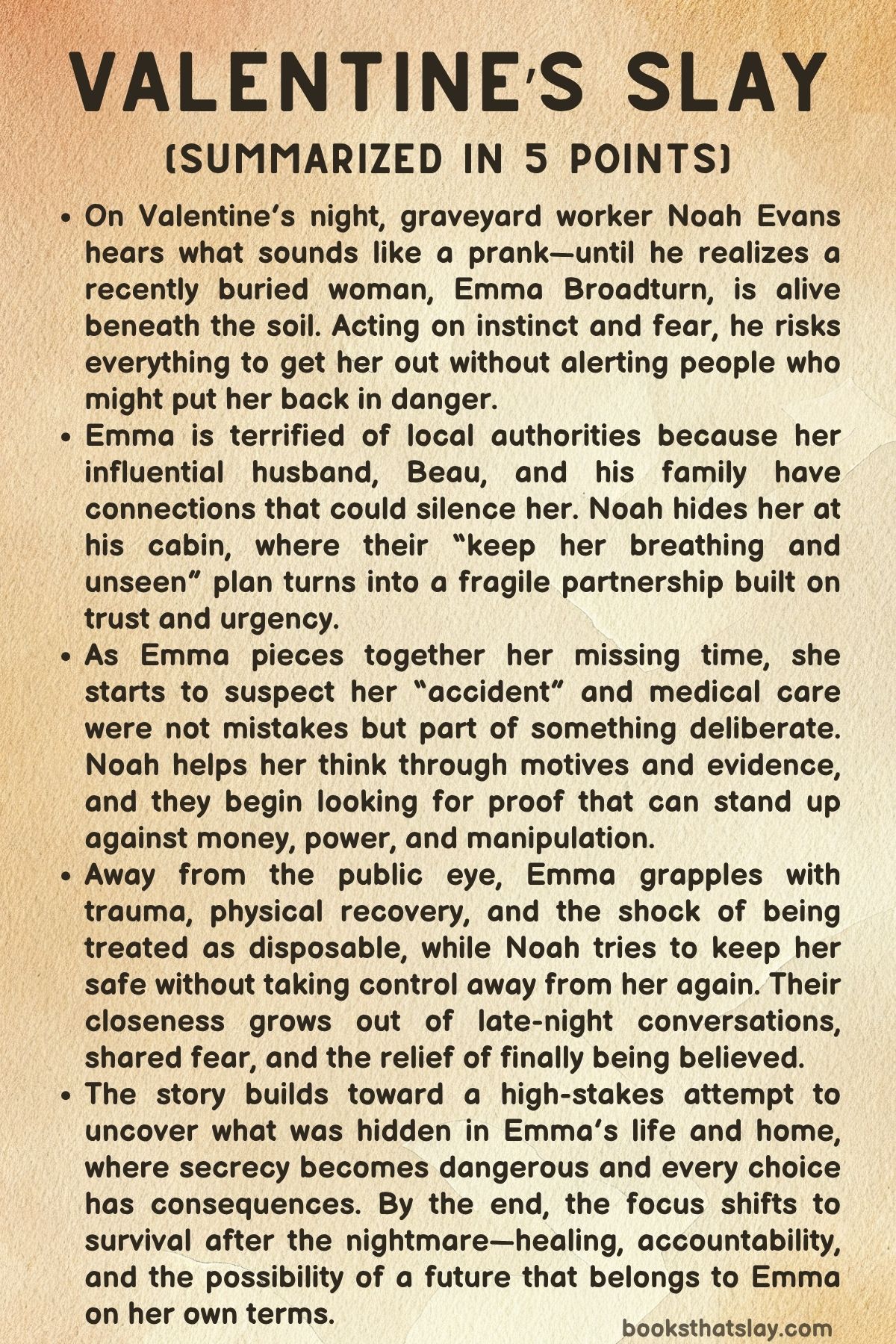
Summary
Late on Valentine’s Day, Noah Evans is closing up at Thibodeaux Graveyard when he hears moans in the dark. At first, he assumes it’s another couple fooling around or someone looking for a scare, because the cemetery attracts that kind of trouble.
But the sounds shift—fear replaces pleasure, and a woman begins screaming as if she’s being hurt. Noah grabs his lantern and shovel and runs, calling out to whoever might be out there.
The screams don’t come from the trees or the paths. They come from the ground.
Noah stops at a freshly filled grave and recognizes the name on the headstone: Emma Broadturn. He helped bury her earlier that day.
His mind rejects it, but the voice answers him from beneath the soil. Emma begs him to help.
She’s alive, trapped in her coffin, and running out of air.
Noah’s shock snaps into action. He promises he’ll get her out, then sprints to the garage, starts the excavator, and drives it hard across the cemetery, cutting over graves to save time.
Back at Emma’s burial site, he talks to her through the dirt, telling her to scream if the coffin shifts or buckles. He scrapes away layers carefully, stopping often to check if she’s still responsive.
When he gets close enough that the excavator becomes too risky, he jumps down and digs by hand. He asks Emma to knock so he can pinpoint where her body is inside the coffin and keep his shovel from striking the lid too hard.
While Noah digs, Emma’s terror grows sharper. She begs him to keep talking so she doesn’t feel alone in the dark.
Noah forces himself to talk—about anything—while his hands move faster than he thought possible. He tells her he’ll call 911 the moment he gets her out.
Emma refuses. The sheriff is Beau’s brother, she says, and Beau can’t find out she’s alive.
If Beau learns it, he’ll come back to finish what he started. Noah doesn’t understand yet, but he hears how sure she is.
He agrees not to call.
Finally, Noah’s shovel hits the coffin lid. He clears the last of the dirt, warns Emma to cover her face, and pries it open.
Emma is inside, filthy, shaking, and gasping, still wearing a white sundress. She tries to scramble out, slips, and Noah catches her.
She clings to him, crying hard, begging him not to leave her alone. Noah wants medical care for her immediately, but he also understands that getting the wrong people involved could get her killed.
Emma begs for somewhere safe, somewhere Beau can’t reach quickly. Noah thinks of his cabin.
There’s still the disturbed grave to handle, though—evidence of what he’s done, and evidence that Emma isn’t dead. Emma can’t stand the idea of Noah leaving her, even briefly.
Noah makes a choice he never imagined making: he calls his father, Hank Evans, and says, bluntly, that Emma Broadturn is alive. Hank hangs up on him.
Noah calls back. This time Emma speaks.
Hank goes quiet, then agrees to come fix the grave and keep the secret.
Noah carries Emma to his truck, turns the heat up, and drives out by back roads to avoid being seen. Emma tries to piece together what happened.
Noah tells her what he knows: after Emma’s fall, Beau took her to the family-owned hospital. Her parents weren’t notified right away.
Beau blocked visitors and outside specialists. As her husband, he controlled her care through medical power of attorney.
Eventually Beau declared her brain dead and removed life support, and Emma’s family didn’t even get a proper goodbye. Emma’s anger hits like a physical force.
She screams, swears she’ll kill Beau, and the vow doesn’t sound dramatic—it sounds like a plan forming. Noah, trying to keep her grounded, jokes that he knows how to dispose of bodies, but even his humor carries a rough edge.
At the cabin, Emma is surprised to find it clean, warm, and comfortable. Noah walks her upstairs, shows her the shower controls, and tries to give her privacy.
Emma can’t handle being alone behind a locked door. Noah stays in the bathroom with his back turned while she showers, and they talk through the curtain.
Emma starts confessing what she remembers. She’d heard another rumor about Beau cheating and went searching through his locked desk.
What she found didn’t match the life Beau showed the world: overdue bills, signs of serious debt, proof they were in trouble financially. When she confronted him, they fought at the top of the stairs.
She believes he pushed her. She also admits something else—she’d been sick for months, symptoms rising and falling depending on whether Beau was around.
Noah begins connecting pieces that make his stomach turn: debt, control, a “brain death” declaration, a quick burial, a closed casket, and a husband with the influence to keep everyone away. He suggests what Emma is already afraid to say out loud—maybe Beau planned this, maybe he kept her drugged through the hospital and mortuary so no one would notice she wasn’t truly dead, and maybe the burial was meant to make the outcome permanent.
Emma finishes her shower and pulls on Noah’s oversized clothes: sweats, a T-shirt, and a sweater that swallows her. Noah showers next, staying close enough that Emma won’t panic.
When they’re both downstairs, Noah worries about feeding her after days without real food. He looks up advice and makes a blended version of leftover stew so it’s easier on her stomach.
Emma drinks what she can, but nausea stops her halfway.
As the night settles, their conversation shifts from survival to the parts of themselves they haven’t been able to voice. They talk about high school and the town they both grew up in.
Noah offers her the guest room, then hesitates—he doesn’t want her alone if Beau comes looking. Emma admits she’s terrified, but exhaustion is catching up.
Noah insists she take his bed so he can protect her. He checks every door and window.
In his room, Emma notices a skylight above the bed. Outside, two comets—nicknamed the “Star-Crossed Lovers”—are set to appear as if they’re meeting.
The timing lands on her like a cruel joke: it’s Valentine’s Day, and Beau buried her on that date. Noah tries to steady her, telling her Beau’s cruelty says more about Beau than it ever did about her.
Emma asks Noah to hold her. She admits she hasn’t been touched with care in a long time, and the shock of almost dying has left her desperate for something human and safe.
Noah holds her, trying to keep it simple, trying not to cross a line while she’s vulnerable. But Emma’s need shifts into desire, and she tells him plainly she wants him.
She says her marriage has been dead for a long time, even when her body wasn’t. She describes how Beau used belittling and control until she stopped recognizing herself.
Noah resists at first, worried about taking advantage of her. Emma insists she’s thinking clearly.
Eventually Noah gives in, and the night turns physical. Afterward, as the comets align in the skylight, they share Valentine’s wishes that feel both strange and honest—Emma, alive by sheer luck and Noah’s hands, refuses to waste the second chance she’s been given.
Soon after, they decide they need proof—something solid enough to survive Beau’s family influence. They plan to break into the Broadturn house and search Beau’s office.
They watch for his routine, then slip in from the woods behind the neighborhood after Beau leaves for his night shift. Emma knows the hiding spot for a spare key tucked in a stone frog.
Inside, they disable the alarm and move through the quiet luxury of the home toward the third floor.
In Beau’s office, Emma finds the first bad sign: the computer password has been changed. The desk drawers are empty.
Beau has cleaned house, as if he predicted someone might come looking. Then they hear a sound downstairs—an alarm beep, a door opening, and the alarm being disabled again.
Someone is inside. Beau’s voice calls out.
He knows something is wrong.
Noah pulls Emma into a nearby bedroom and hides her in the closet, making her promise she won’t come out. He positions himself near the door, listening as Beau climbs the stairs with a shotgun.
Beau moves with purpose, not confusion, searching toward the office. Noah catches a glimpse of him through the crack of the door and feels pure fear: Beau isn’t checking a noise.
He’s hunting.
Beau suddenly swings the gun toward Noah’s hiding place. Noah freezes, sure he’s about to die.
Beau turns away and steps into the office. Noah slips out, grabs a heavy paperweight, and waits for Beau to re-emerge.
When Beau opens the door, he fires. Noah knocks the barrel aside as the shot blasts.
In the chaos, Beau recognizes him. Emma screams from the bedroom.
Noah strikes Beau with the paperweight but doesn’t drop him. They wrestle for control of the shotgun, more shots going off in flashes and noise.
After three rounds, the gun clicks empty. The fight becomes brutal hand-to-hand violence—punches, choking, bodies slamming into walls.
Emma comes out, switching on the light, refusing to hide while Beau controls the story. Beau tries to pivot into a performance, claiming Emma is confused, blaming her memories on injury, insisting he tried to save her.
Emma answers with details Beau can’t explain away: the fight at the stairs, the sickness that followed him like a shadow, the way he isolated her, the way her “death” happened without dignity or choice.
Beau snaps. He attacks Emma and slams her head into the wall, knocking her limp.
Noah drags him off her and the fight turns vicious. Beau reaches for the shotgun and tries to reload with a shell from his pocket.
Noah pins him and knocks the shell away over the stairwell. Beau strikes Noah with the gun and then gets his hands around Noah’s throat, squeezing until Noah’s vision starts to narrow.
Emma, dazed but moving, grabs a picture frame and smashes Beau with it, glass scattering. Beau yanks her down onto the shards.
Noah and Beau crash into the railing at the top of the open stairwell. Emma swings the shotgun’s butt into Beau’s head as Noah ducks.
The railing gives way. Beau falls through, tumbling down multiple levels.
The sound of the impact ends the fight in one final crack and then silence. Noah looks down and sees Beau motionless on the first floor, blood spreading across the tiles.
Emma vomits from shock. Noah holds her while she sobs, both of them realizing how close they came to being erased.
They call the state police instead of local officers, afraid of the Broadturn family’s reach. Paramedics from a different hospital arrive.
Emma panics when Noah is separated from her, and they allow him to ride in the ambulance while Sergeant Wade questions them. Wade listens, and when they finish, he says he believes them, because no one invents a story like this to gain something simple.
A year later, Emma and Noah live together, building a quieter life. Emma is still recovering; tests confirmed Beau poisoned her with arsenic, leaving lasting damage that requires daily medication.
The investigation uncovered Beau’s debts, his affairs, forged insurance paperwork, and the drugs used to keep Emma in a coma. Noah still carries anger, even admitting he once urinated on Beau’s grave because the rage didn’t vanish with Beau’s death.
Beau’s brother Ben continues to harass them, and Emma considers formal complaints to protect their peace.
Emma plans to start college in the fall, aiming for a criminal justice degree, funded partly by what remains after Beau’s debts are paid. On Valentine’s Day, their home fills with life in a different way: Emma brings home two rescued kittens, only to learn Noah secretly adopted two more.
They keep all four. That night, Noah proposes by hiding a diamond ring on a kitten’s collar.
Emma says yes, choosing a future that belongs to her—earned the hard way, but finally her own.
Characters
Noah Evans
Noah is introduced as a grounded, blue-collar caretaker of death and memory—someone who spends his nights keeping order in Thibodeaux Graveyard, chasing off thrill-seekers, and doing a job most people avoid. In Valentine’s Slay, he becomes the story’s moral center because his instinct in a horrifying moment is not self-protection but action: he runs toward screams, problem-solves under pressure, and commits fully to saving Emma even when it means tearing up cemetery ground, risking his job, and inviting the wrath of a powerful family.
His practicality shows in how he works the excavator carefully, switches to hand digging when it becomes too risky, and keeps Emma oriented with steady conversation—he understands that survival is physical and psychological at once. Yet Noah is not portrayed as a flawless rescuer; he’s emotionally reactive in a believable way, swinging between terror, anger, tenderness, and grim humor.
That dark humor—like the half-joke about being good at disposing of bodies—signals both coping and a capacity for ruthlessness when someone harms the vulnerable. As the romance develops, Noah’s decency becomes more complicated: he tries to set boundaries because of Emma’s trauma and recent coma, but he also wants her, and the story leans into his internal conflict between protector and partner.
By the end, Noah remains marked by violence—his admission about urinating on Beau’s grave and being unsettled by how easy Beau’s death felt suggests a lingering moral injury—but he channels that intensity into building a safer life with Emma, turning his fierce loyalty into commitment rather than revenge.
Emma Broadturn
Emma begins the story as a victim of an almost unimaginable violation—declared dead, sealed away, and buried—yet the narrative quickly frames her as more than a survivor by giving her agency the moment she’s heard. Even from under the soil, she’s coherent enough to answer questions, make urgent strategic decisions, and identify the true danger: she refuses 911 not out of irrationality but because she understands the local power structure and knows that exposure could get her killed.
Emma’s characterization is shaped by layered trauma—fear of being alone, panic at separation, a desperate need for touch—and the narrative uses those responses not as weakness but as evidence of what she has endured, especially the emotional starvation in her marriage. She carries sharp perception too: she remembers the fight on the stairs, connects her long illness to Beau’s presence, and recognizes the financial motives hidden behind his charm.
Her rage is not performative; it’s a turning point that reclaims her identity after being belittled and controlled, and it fuels her willingness to take risks to find proof. At the same time, Emma’s vulnerability is consistent and human: she breaks down, she vomits from shock, she panics in medical settings, and she struggles with long-term physical damage from arsenic poisoning.
A year later, she is still recovering, which keeps her arc honest—survival doesn’t erase consequences—but she’s also future-facing, choosing a criminal justice degree and taking steps to confront ongoing harassment. Emma ultimately embodies a blend of softness and steel: she can want comfort desperately and still swing a weapon when it’s the only way to stop the person who tried to erase her.
Beau Broadturn
Beau is the story’s architect of cruelty, but he isn’t written as a simple brute; he’s a controlled predator who weaponizes institutions—marriage, medicine, law enforcement connections, wealth—to make harm look legitimate. His most terrifying trait is his ability to shape reality around Emma: he isolates her in the family-owned hospital, blocks visitors, leverages medical power of attorney, and creates a narrative—brain death, “confusion,” head injury—that makes her doubts sound like delusions.
This is coercive control taken to an extreme, where the goal is not only to hurt but to define what everyone else is allowed to believe. The implication that he poisoned her over months, used pentobarbital to keep her compliant, and orchestrated a closed-casket burial points to meticulous planning and a willingness to let her die slowly rather than risk exposure.
Beau’s violence also escalates strategically—he comes into the house with a shotgun, searches methodically, attempts to manipulate Emma when confronted, and flips into physical assault the moment his story stops working. What makes him chilling is not just that he’s violent, but that he expects the world to protect him; even in the confrontation he tries to reassert authority by recasting Emma as confused and himself as savior.
His death—brutal, accidental in its final mechanics, and immediate in its consequences—fits the character because it ends the same way he lived: pushed by his own arrogance into a situation he assumed he would dominate.
Hank Evans
Hank functions as the pragmatic, morally flexible support system in the story, and his initial hang-up is important because it shows he isn’t instantly heroic—he reacts like a person confronted with an impossible claim and the legal nightmare attached to it. Once Emma confirms she’s alive, Hank’s defining trait becomes loyalty over legality: he agrees to come fix the grave and keep the secret, stepping into the same dangerous web Noah is entering, but doing it in a way that reflects his experience and grounded competence.
Hank’s role also subtly reframes Noah’s character by suggesting where some of Noah’s steadiness comes from; Noah can act decisively because he has a father who, once convinced, will show up and handle the ugly logistics without melodrama. Hank doesn’t dominate the plot, yet his presence expands the world beyond the central couple and signals that survival requires community, not just romance.
Ben Broadturn
Ben is less central on-page, but his function in Valentine’s Slay is crucial as an extension of the Broadturn family’s ongoing threat. He represents the aftermath of killing a powerful abuser: even when Beau is dead, the social machine that protected him doesn’t instantly disappear, and Ben’s harassment keeps Emma and Noah from fully relaxing into safety.
As the sheriff’s brother and a member of the same influential family, Ben’s presence reinforces why Emma refused local authorities early on and why institutional power is one of the story’s recurring dangers. He also complicates the ending by preventing it from becoming a neat, closed victory; the couple gets peace, but it’s a peace they still have to defend.
Sergeant Wade
Sergeant Wade serves as the story’s counterweight to corrupted local influence, providing a version of authority that is skeptical but ultimately fair. He functions as a credibility bridge: the situation is so extreme that belief itself becomes a plot obstacle, and Wade’s reaction—acknowledging that the story is too insane to invent—validates Emma and Noah without turning him into a magical fixer.
He listens, evaluates, and acts as a professional rather than as someone swayed by the Broadturn name, which is exactly what Emma needed but could not risk seeking locally. His presence also marks a thematic shift from secrecy and hiding to testimony and accountability, helping transition the narrative from immediate survival to longer-term justice.
Themes
Survival, agency, and the fight to be believed
Being conscious inside a coffin forces Emma into the most extreme version of helplessness, but the story quickly shifts from helplessness to agency. Once Noah gets her out, Emma’s first clear decision is not about comfort or revenge—it is about information control.
She refuses 911, not because she rejects help, but because she understands how systems can be turned against her when the sheriff is tied to Beau’s family and the hospital already functioned as Beau’s private instrument. Her survival becomes more than staying alive; it becomes staying undiscovered until she can shape the narrative on her own terms.
That’s why the escape route matters, the back roads matter, and the secrecy around Hank matters. Emma is calculating risk while still physically fragile, which shows that agency is not presented as strength only when a person is unafraid; it can be present in panic, shaking hands, and incomplete information.
The theme intensifies with the way Emma anticipates disbelief. Beau’s strategy depends on the world accepting an official version of events: brain death, a controlled hospital environment, a closed-casket funeral, and a burial that erases the last chance for contradiction.
Emma’s return threatens that “paper reality,” but the threat is useless unless others accept her truth. That is why the decision to involve state police instead of local authorities is so central: it is not just about safety, it is about jurisdictional distance from the family network that previously sealed her fate.
Even after Beau dies, the harassment from Ben keeps the theme alive by showing that survival is not a single escape scene; it becomes an ongoing negotiation with power, reputation, and institutions. In Valentine’s Slay, agency is portrayed as the ability to keep choosing under pressure—where to hide, whom to trust, what story to tell first, and how to build a life that cannot be rewritten by someone else’s influence.
Intimacy as refuge, risk, and reclaiming the body
Emma’s need for closeness is not framed as simple romance; it is a survival response to prolonged control and isolation. She has just experienced the most intimate violation imaginable: her body handled, declared “gone,” dressed for burial, and hidden from anyone who would advocate for her.
When she asks Noah to keep talking while she is buried, conversation becomes an oxygen substitute—proof that a human presence exists on the other side of the dark. That same need for presence carries into the cabin, where she cannot tolerate being alone behind a bathroom door.
The story uses small practical moments—staying nearby during a shower, brushing teeth in the same space—to show how trauma shrinks the world to immediate safety cues. Intimacy here begins as proximity and attention, not sexuality.
When the relationship turns sexual, the theme becomes complicated rather than celebratory. Emma insists on desire as a form of reclamation: she chooses touch after a year of neglect and manipulation, and she refuses to let her body remain defined by Beau’s contempt.
At the same time, the narrative acknowledges the ethical edge: Noah worries about taking advantage, and the timing is uncomfortable by design because it forces the question of what “consent” feels like after terror and near-death. Emma’s insistence is part agency and part urgency—she is trying to prove to herself, immediately, that she is alive and self-directed.
That creates risk: sex can be refuge, but it can also be a way to outrun fear without processing it. The comets overhead underscore this impulse without needing romantic exaggeration; the sky becomes a witness to a moment where Emma uses choice to overwrite what was done to her.
Later, the partnership turns into coordinated action—breaking into the house, moving together, hiding, protecting. The story connects erotic intimacy and practical intimacy as two expressions of trust: “stay in the closet” is as intimate a request as “hold me,” because both ask for surrender to someone else’s judgment.
Intimacy is not treated as a reward after danger; it is a tool for regulation, identity repair, and rebuilding a sense of bodily ownership, while still carrying the danger of becoming a substitute for healing rather than a companion to it.
Domestic power, coercive control, and the weaponization of respectability
Beau’s threat is not only physical violence; it is the way he converts social legitimacy into a weapon. Marriage gives him access, credibility, and procedural authority.
Medical power of attorney becomes a lever that blocks Emma’s parents, blocks outside specialists, and creates a sealed environment where “care” can function as captivity. Respectability—wealth, a family-owned hospital, the appearance of a stable marriage—turns suspicion into something that seems impolite or unreasonable.
Even Emma’s earlier illness is shaped by this dynamic: symptoms that worsen when Beau is present point to poisoning, but in a respectable household the default assumption is stress, psychosomatic issues, or vague health problems. Coercive control thrives when the victim can be made to look irrational, unwell, or unreliable.
The theme is sharpened by how Beau anticipates the chain of institutions that will protect him. If Emma dies quietly, the system will produce documentation that confirms the lie.
The closed-casket funeral is not just secrecy; it is narrative management. The burial is the final seal, and choosing Valentine’s Day adds a layer of symbolic domination—turning a public celebration of love into a private proof of ownership.
Emma’s fear of contacting local authorities shows that Beau’s reach is not limited to a house; it extends through family ties, law enforcement, and community perception. The story’s tension depends on the reader seeing how easily “the right family” can turn the town itself into an accomplice without anyone needing to explicitly conspire.
Even after Beau’s death, the shadow of that respectability remains through Ben’s harassment. The conflict doesn’t end when the abuser is gone because the social structure that enabled him still exists.
Emma’s consideration of filing complaints suggests she is learning to use formal systems in reverse—to demand accountability rather than be crushed by procedure. Coercive control is portrayed as a sophisticated form of violence that doesn’t rely on constant brute force; it relies on the ability to decide what counts as truth, who gets access, and whose voice is treated as credible.
Moral aftermath, justice outside neat boundaries, and the cost of survival
The death at the stairwell is presented as chaotic, reactive, and frightening rather than cleanly heroic. That matters because the story is less interested in courtroom righteousness than in what survival does to the people who survive.
Noah’s rage and the ease he feels about Beau’s death create an unsettling emotional residue: he is relieved, but also disturbed by his own relief. The admission that he urinated on Beau’s grave isn’t played as a triumphant punchline; it signals lingering bitterness and a refusal to perform polite closure.
Survival brings freedom, but it also leaves behind impulses that don’t fit the “good victim” or “noble rescuer” roles. The story allows that contradiction to remain visible.
Justice, in practical terms, becomes a set of choices about which authorities to involve and what kind of proof matters. Calling state police is not simply a procedural detail; it represents an attempt to reach a version of justice less contaminated by local influence.
The investigation’s discoveries—debts, poisoning, forged paperwork, drugs used to induce coma—suggest that truth can eventually surface, but only after catastrophic damage. That creates a bleak realism: institutions may validate the victim, but often too late to prevent the harm.
Emma still lives with organ damage and daily medication, which turns justice into something incomplete. The system can name what happened; it cannot restore what was taken.
The theme also includes the rebuilding of a future that is intentionally ordinary: kittens, a proposal, college plans. These are not just “happy ending” decorations; they represent a form of justice that doesn’t depend on punishment alone.
Emma pursuing a criminal justice degree suggests a long-term desire to convert personal catastrophe into expertise and agency, but it also implies she will keep living near the subject of her trauma. The relationship’s stability, the home they share, and the small surprises are attempts to reassert predictability after a life where reality could be rewritten overnight.
Moral aftermath is the recognition that surviving violence can demand morally messy actions, that “justice” may arrive through imperfect channels, and that the true cost of survival is paid in the body, the mind, and the ongoing effort to build a life that feels safe without pretending the past was clean.