Valley of the Moms Summary, Characters and Themes
Valley of the Moms by Hannah Selinger is a domestic mystery and social thriller centered on privilege, motherhood, friendship, and the hidden machinery of an affluent Massachusetts town.
Anna Plummer believes she is challenging nothing more sinister than an unfair elementary-school PTO system, but her refusal to accept exclusion places her against people whose influence extends far beyond school events. After Anna is murdered, her husband Denny begins discovering how much of her final year he never understood. The story moves between Anna’s growing conflict with Hamilton’s social elite and Denny’s attempt to uncover the truth behind her death, gradually revealing a dangerous system built on wealth, loyalty, secrecy, and power.
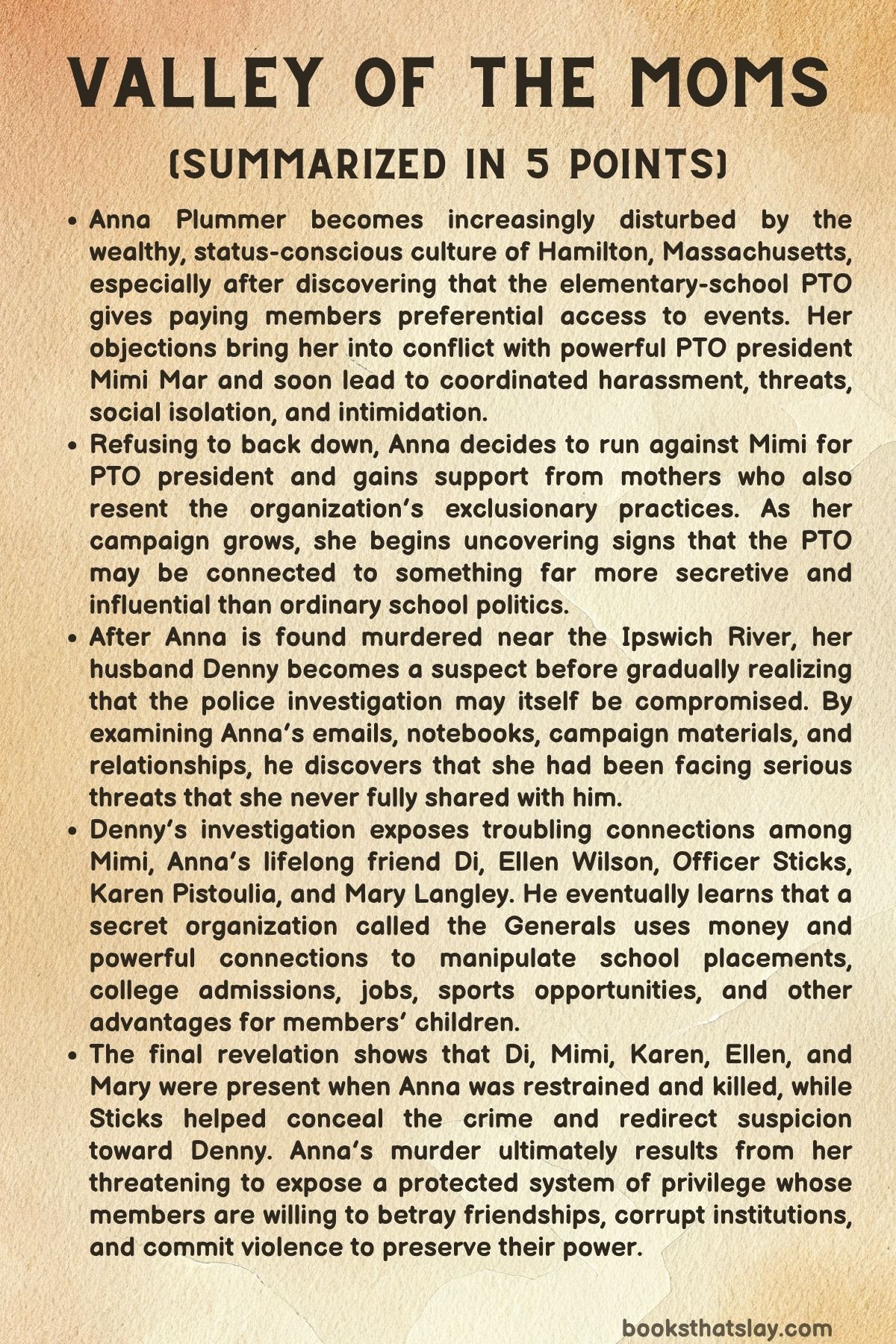
Summary
Anna Plummer is forty-two and living in Hamilton, Massachusetts, with her husband Denny and their children, Louisa and Ben. Their life appears comfortable from the outside, yet Anna feels dissatisfied with the competitive social culture surrounding her, particularly the wealthy mothers who seem to measure belonging through houses, clothing, social connections, and elaborate parenting performances.
She also carries regret over the artistic ambitions she abandoned years earlier. Anna once dreamed of becoming a painter, but perfectionism persuaded her that anything short of exceptional talent represented failure, and watching Ben display a natural gift for drawing reminds her of the creative life she left behind.
The story soon reveals that Anna will not survive. After she disappears for several days, police locate her body near the Ipswich River, and her husband learns that what initially appears to be death from exposure is actually murder: Anna has been strangled.
Before her death, Anna’s conflict with Hamilton begins with what seems like a small school matter. She tries to register Louisa for a popular elementary-school dance and discovers that the event has sold out because parents who purchase an expensive premium PTO membership receive early access to tickets.
Anna sees the arrangement as discriminatory. Families with enough money can essentially buy priority access to public-school activities, while children from less affluent households can be excluded through circumstances they cannot control.
Her anger leads her toward Mimi Mar, the polished and influential president of the Hamilton PTO. Mimi represents everything Anna distrusts about the town’s social structure: wealth, carefully managed appearances, political connections, and an ability to make exclusion seem normal.
Anna meets Mimi at Honeycomb, a fashionable local bakery, and directly challenges the PTO’s incentive system. Mimi insists that Hamilton is affluent enough that virtually every family can afford the membership and argues that struggling parents can privately request assistance.
Anna rejects that reasoning because it requires families to expose their financial hardship simply to obtain access to ordinary school experiences. When Anna calls the system classist, Mimi’s friendly manner briefly disappears, and the conversation ends with a warning that Anna interprets as threatening.
Soon afterward, Anna receives an extraordinary wave of online harassment. Hundreds of messages arrive through email, texts, Facebook, and Instagram, including misogynistic abuse, threats, references to her children, her addresses, and even Denny’s life-insurance policy.
Anna initially tries to convince herself that teenagers or random online trolls are responsible. Her lifelong friend Di is much more alarmed and points out that the attack resembles coordinated doxxing rather than casual harassment.
Di eventually persuades Anna to file a report with Hamilton police. Officer Malkin, commonly called Sticks, receives the complaint and assures Anna that the matter will be handled, creating an important record that the police knew Anna had been threatened long before she was killed.
Instead of feeling safe afterward, Anna becomes increasingly isolated. She leaves social media, avoids many Hamilton activities, and tries to reduce her visibility, but her conflict with Mimi follows her into ordinary family life.
At an expensive health-club pool, Anna believes she sees Mimi deliberately knock Louisa into the water. Louisa suffers only a cut heel and says she tripped, but Mimi’s behavior afterward convinces Anna that the incident was intentional.
Anna now believes that Mimi is willing to use intimidation against her children. She writes to the school superintendent describing the premium membership system, the harassment, the pool incident, and her concerns about Mimi’s leadership.
When acquaintances begin avoiding her in public, Anna concludes that Hamilton’s social network is closing around her. Rather than withdrawing, she decides to challenge Mimi directly by running for PTO president.
She soon meets Mary Langley, a South Hamilton mother who seems far removed from Mimi’s polished circle. Mary supports Anna’s ideas and helps her transform a private protest into an organized campaign based on accessibility, broader participation, fairer school events, and a less money-driven PTO.
Anna discovers that many mothers have complaints they were previously reluctant to voice. Her campaign attracts increasing support, and a garden gathering organized with Mary and Di draws dozens of women interested in changing the organization.
Mimi unexpectedly arrives at the event with Karen Pistoulia. After most of the guests leave, Mimi physically grabs Anna and makes it unmistakably clear that she expects the campaign to end.
The confrontation confirms Anna’s belief that something larger than ordinary social competition is at stake. Nevertheless, instead of abandoning the election, she becomes more committed because she believes backing down would reward intimidation.
Meanwhile, the timeline following Anna’s death focuses on Denny. At first, police treat him as a likely suspect because he is the murdered woman’s husband, but his DNA does not produce relevant evidence, and his presence with the children during their ski lessons provides partial support for his alibi.
Denny eventually discovers 187 threatening messages stored on Anna’s backup computer. He also finds her correspondence with Mimi and realizes that Anna had been dealing with a frightening situation while he remained largely unaware of it.
The discovery deeply changes his understanding of their marriage. Denny had often dismissed Anna’s complaints about Hamilton as unnecessary conflict, but after her death he begins recognizing the exclusion, artificial friendliness, status competition, and hidden alliances that she had noticed from the beginning.
He starts investigating Mimi and discovers how difficult her earlier life is to trace and how extensive her social connections are. Di also tells him about Anna’s belief that Mimi deliberately pushed Louisa into the pool.
Denny brings his concerns to Sticks, but the officer reacts defensively and refuses to treat Mimi as a serious suspect. Sticks’s eagerness to defend her makes Denny wonder whether the investigation is being deliberately restricted.
His suspicions increase when he learns that Sticks is Ellen Wilson’s brother. Ellen had once been friendly with Anna but belonged to Mimi’s social circle, giving the officer investigating Anna’s murder a direct family connection to people Denny considers suspicious.
Danger begins reaching Denny personally. Anna’s former car suffers brake failure despite having recently passed inspection, and Denny finds what appears to be brake fluid beneath the place where the vehicle had been parked.
He also discovers campaign signs and notebooks hidden among Anna’s belongings. Her notes reveal how extensive the campaign had become and include mysterious references to a PTO cover operation, a secret society, college admissions, and a pay-to-play system.
Denny turns to Di for help, and their shared grief results in a brief sexual encounter that he immediately regrets. More troublingly, he realizes afterward that Di has taken one of Anna’s most important notebooks.
His doubts lead him to Mary, who claims she had tried to warn Anna before the murder. Mary tells him that the person he should fear is not only Mimi but Di, Anna’s closest friend since childhood.
The earlier timeline confirms that Mary had indeed warned Anna. She had seen Di secretly meeting Mimi and Ellen, but Anna could not accept that a woman she had trusted for decades might be involved with the people threatening her.
Signs of intrusion become increasingly direct. Someone enters Anna’s home, removes the dog Hank’s collar, leaves a sympathy card announcing a loss that has not yet occurred, and uses Anna’s computer to create a threatening document connected to her campaign.
Anna briefly considers whether Di could have helped whoever entered the house because Di knew exactly how long the family would be away. Yet the possibility feels so emotionally impossible that Anna suppresses it and says nothing to Denny.
After Anna’s death, Denny gradually reconstructs the network surrounding her. Mimi, Karen, Ellen, Sticks, Di, and even Mary appear connected in ways he previously could not understand.
He eventually discovers anonymous emails sent to Anna by someone using the name Mouse. The messages explain that the Hamilton PTO conceals a private organization that uses wealth, institutional influence, and personal connections to manipulate opportunities for members’ children.
The organization reaches into schools, politics, law enforcement, employment, athletics, and elite-college admissions. Becoming PTO president would have given Anna access to records capable of exposing how the system operated.
Denny confronts Di, who effectively confirms his worst suspicions. She admits that people connected to the organization tried to stop his investigation and reveals that the brake failure was not an accident.
She also possesses one of the gold buttons removed from Anna’s sweater after the murder. Denny warns her to stay away from his family, but when he returns home, he finds that someone has broken inside and killed Hank, demonstrating that the organization is still prepared to punish him.
The final revelation returns to the night Anna disappeared. Di invited Anna to her home under the appearance of friendship, but Anna was attacked, restrained, and held in Di’s unfinished carriage house.
When Anna regained consciousness, she discovered Di, Mimi, Karen, Ellen, and Mary together. They revealed that the true organization operating behind the PTO called itself the Generals.
The Generals consisted of selected women who paid enormous annual fees for membership in a network designed to secure advantages for their children. Those advantages could include preferred teachers, improved grades, sports positions, internships, prestigious employment, college admissions assistance, waived penalties, and bureaucratic favors.
Approximately fifty-seven members financially supported a much larger network of officials and influential participants. The PTO provided an acceptable public face for a system built to convert money and connections into opportunities unavailable to ordinary families.
Sarah Saunders, a former treasurer, had developed doubts about the organization and secretly contacted Anna under the name Mouse. Her warnings helped Anna understand that her campaign was threatening far more than Mimi’s social status.
Di admits that her support for Anna’s campaign was partly strategic. By remaining Anna’s closest adviser, she could watch her, influence her decisions, and report developments while Sticks and others ensured Anna’s police complaints led nowhere.
Mary’s position is more conflicted because she genuinely tried to warn Anna, yet she remained a member of the same organization. Her fear and divided loyalties prevented her from taking the decisive action that might have saved Anna.
The women ultimately murder Anna by strangling her with Mimi’s Gucci belt. They remove gold buttons from Anna’s sweater as shared tokens, turning physical pieces of her clothing into symbols of collective responsibility and enforced silence.
Sticks participates in covering up the crime. He helps move Anna’s car and guides suspicion toward Denny, while Ellen takes Anna’s engagement ring before the body is abandoned near the river.
Anna’s final moments are not centered on the election or the people who betrayed her. She thinks instead about Denny, Louisa, Ben, and the ordinary life she believed she still had years to live.
Her death reveals the full cost of challenging a system whose members consider privilege an entitlement worth protecting at any price. What began as Anna’s objection to unfair access to a school dance ultimately exposes an organization willing to manipulate institutions, threaten families, betray friendships, sabotage investigations, and commit murder in order to preserve the advantages its members believe belong to them.
Characters
Anna Plummer
Anna Plummer is the moral and emotional center of Valley of the Moms. She is intelligent, outspoken, restless, fiercely protective of her children, and almost constitutionally incapable of ignoring something she believes is unfair.
Her strongest quality is also one of her greatest vulnerabilities: once Anna becomes convinced that something is wrong, she finds retreat psychologically unbearable. The PTO dispute matters to her not because she desperately wants Louisa to attend one dance, but because the system represents a larger principle in which children receive different opportunities according to their parents’ ability to pay.
Anna’s personality contains significant contradictions. She condemns Hamilton’s obsession with status while living a financially comfortable life herself, and she criticizes social performance while remaining highly conscious of how other women perceive her.
She is also stubborn enough to disregard evidence of danger because accepting fear would feel like surrender. Even when harassment, physical intimidation, social isolation, and threats accumulate, Anna repeatedly persuades herself that she should continue because yielding would validate the people trying to silence her.
Her abandoned artistic ambition adds another dimension to her character. Anna once allowed perfectionism to convince her that painting was not worth pursuing unless she could become extraordinary, and her PTO campaign becomes a rare opportunity to pursue something without abandoning it when uncertainty appears.
Her greatest tragedy lies in misplaced trust. Anna becomes increasingly perceptive about Mimi while remaining emotionally unable to apply the same suspicion to Di, demonstrating how long friendship can become a form of blindness when a person cannot imagine betrayal from someone central to her identity.
Denny Plummer
Denny begins the book as a loving husband who nevertheless understands far less about Anna’s interior and social life than he assumes. He is practical, quieter than Anna, less interested in Hamilton’s interpersonal conflicts, and accustomed to interpreting his wife’s arguments as situations that will eventually pass.
His relationship with Anna is genuine and affectionate, but it contains a dangerous imbalance of attention. Anna recognizes possibilities in Denny, encourages him to abandon IT for furniture making, and becomes one of the primary forces behind his professional transformation, while Denny fails to notice how isolated and threatened Anna has become.
After her death, guilt becomes inseparable from his grief. Discovering the harassment, campaign materials, notebooks, and warnings forces him to confront the uncomfortable fact that his wife was living through a crisis in their own home while he remained largely unaware of it.
That guilt gradually becomes determination. The same man who once considered Anna’s criticism of Hamilton exaggerated begins studying social connections, police behavior, notebooks, emails, physical evidence, and hidden relationships with almost obsessive attention.
Denny’s investigation also reveals his emotional vulnerability. His sexual encounter with Di arises from loneliness and shared grief, but he quickly understands that his need for comfort has made him susceptible to manipulation.
By the later stages of Valley of the Moms, Denny has inherited Anna’s distrust of the town and her willingness to resist intimidation. His transformation gives the novel one of its central ironies: only after losing Anna does he finally learn to see Hamilton through her eyes.
Diane “Di” Foley
Di is the story’s most devastating example of betrayal because her relationship with Anna is not superficial. She has known Anna since childhood, shared adolescence with her, remained close through adulthood, encouraged the Plummers to move to Hamilton, and occupies a position in Anna’s life that should make her safer rather than more vulnerable.
Her betrayal is disturbing precisely because genuine affection and calculated manipulation can exist within her at the same time. Di appears to care about Anna, yet that care never becomes stronger than her commitment to the social system from which she benefits.
She repeatedly positions herself as Anna’s protector. She urges Anna to report the harassment, assists with the campaign, listens to her fears, and remains close enough to know what Anna suspects and what she plans to do next.
That closeness also makes Di the perfect monitor. She can direct Anna toward a police department already compromised by the Generals, observe the campaign from inside, and reassure Anna whenever suspicion threatens to move toward the truth.
The childhood history of Anna and Di reveals that competition and resentment were present long before the murder. Di’s old comment that Anna was merely ordinary suggests that friendship never completely eliminated comparison, envy, or the desire to possess the stronger social position.
Di ultimately represents loyalty corrupted by self-interest. She chooses the structure that guarantees influence, privilege, and opportunities for her family over the woman who trusted her for most of her life.
Mimi Mar
Mimi Mar operates as the visible face of Hamilton’s hierarchy. She is socially polished, politically connected, wealthy, confident, and exceptionally skilled at presenting exclusion as normal administration.
Her early conversations with Anna demonstrate how power can hide behind friendliness. Mimi rarely begins by openly threatening anyone; she smiles, uses cheerful language, speaks about community, and presents herself as a public servant even while defending policies that favor families with more money.
When Anna refuses to respond to social pressure, Mimi’s control begins to crack. Her physical intimidation at the campaign event reveals the aggression beneath the cultivated appearance.
Mimi’s greatest fear is not simply losing the PTO presidency. The position protects an organization whose influence depends upon secrecy, and Anna’s possible victory threatens access to information capable of exposing the Generals.
This makes Mimi more than a stereotypical wealthy social rival. Her behavior shows how quickly a person can justify increasingly extreme actions after becoming convinced that status, opportunity, and institutional control are rights rather than advantages.
Her participation in Anna’s murder is the final expression of that belief. Mimi would rather destroy a challenger than allow a system designed to benefit her group to become accountable to the wider community.
Mary Langley
Mary initially appears to be the alternative to Hamilton’s elite mothers. She is approachable, humorous, less polished, and immediately receptive to Anna’s desire to make the PTO more inclusive.
Her friendship with Anna gives the campaign genuine momentum. Mary helps organize supporters, creates opportunities for Anna to speak with other mothers, and seems to provide the kind of uncomplicated alliance Anna has struggled to find in Hamilton.
The later revelation that Mary belongs to the Generals radically complicates that image. Unlike Mimi or Di, however, Mary appears genuinely disturbed by what is happening and makes repeated attempts to warn Anna.
Her warning about Di represents a significant moral effort, even though she does not tell Anna the entire truth. Mary wants Anna to recognize the danger without forcing herself to openly confront the organization to which she still belongs.
That partial courage is ultimately insufficient. Mary’s fear for herself and her children becomes stronger than her willingness to expose the Generals before Anna is killed.
Her character therefore occupies an uncomfortable space between perpetrator, witness, friend, and coward. She understands that the organization has crossed moral boundaries but remains attached to it until the consequences become irreversible.
Officer Malkin “Sticks”
Sticks represents institutional corruption in its most practical form. He is not merely someone socially connected to the Generals; he possesses official authority capable of determining whether threats are investigated, evidence is pursued, suspects are protected, and innocent people are placed under suspicion.
His role becomes especially disturbing because Anna personally reports the harassment to him. He knows that she has received organized threats before her murder and later behaves as though the connection is of little importance.
After Anna dies, Sticks focuses significant attention on Denny. Questioning a spouse would normally be reasonable in a homicide investigation, but his continued resistance to evidence pointing toward Mimi transforms professional skepticism into obstruction.
His relationship with Ellen supplies a direct connection between the police department and Mimi’s social circle. Once Denny discovers that Ellen is his sister, Sticks’s defensive reactions become far more suspicious.
His eventual threat toward Denny eliminates any remaining ambiguity about his loyalties. Sticks uses the language and authority of law enforcement not to protect the community but to protect the people who have captured its institutions for private benefit.
Ellen Wilson
Ellen initially occupies an ambiguous position because Anna once regards her as one of the more approachable mothers connected to the PTO. That early friendliness demonstrates how effectively the Generals operate through people who do not immediately appear threatening.
Her importance grows after Denny learns that she is Sticks’s sister. The discovery connects the PTO directly to the police officer involved in Anna’s investigation and provides one explanation for why information threatening Mimi never receives appropriate attention.
Ellen is also significant because her social behavior depends heavily on concealment. When Denny questions her, she appears uncomfortable and looks toward Sticks, suggesting that family loyalty and organizational loyalty have become difficult to separate.
Her participation in Anna’s murder reveals that her involvement is not passive. Ellen is present when Anna is killed, assists in the aftermath, and takes Anna’s engagement ring before the body is abandoned.
The theft makes her behavior especially chilling because it combines organized violence with personal opportunism. Even during the disposal of a murdered woman’s body, Ellen remains capable of treating Anna’s possessions as something available to take.
Karen Pistoulia
Karen functions as one of Mimi’s reliable allies and reinforces the image of Hamilton as a community in which influence moves through social relationships rather than formal titles alone. She appears repeatedly around powerful people and remains firmly positioned inside Mimi’s circle.
Her interactions are marked by polished social language. When Denny encounters her after Anna’s death, her offer of PTO support sounds caring on the surface but feels empty to a man whose wife had already been targeted by people associated with that organization.
Karen’s presence alongside Mimi during Anna’s campaign signals collective pressure. Mimi may be the public leader, but Karen helps demonstrate that the conflict is not between two individual mothers; Anna is confronting a network.
The final revelation confirms that Karen’s loyalty extends to direct participation in violence. She is present during Anna’s captivity and murder, making her another example of how ordinary community roles can conceal extreme moral corruption.
Louisa Plummer
Louisa is essential to understanding why the PTO dispute matters so intensely to Anna. Her exclusion from the school dance turns an abstract argument about privilege into something immediate and personal.
Anna sees through Louisa how adult systems impose consequences on children. Louisa has no control over PTO membership structures, yet she experiences the embarrassment of being excluded while her classmates attend an event associated with their school.
The pool incident further increases Louisa’s importance. Whether or not Louisa fully understands what happens, Anna believes Mimi deliberately uses her child as a method of intimidation.
Louisa also represents the ordinary future Anna is fighting to protect. Anna’s resistance is repeatedly connected to a desire for her daughter to grow up in a community where opportunities are not quietly reserved for children whose parents possess more money or influence.
After Anna’s death, Louisa becomes part of Denny’s emotional burden. His grief is intensified by the realization that he must raise her without the mother whose fierce protectiveness shaped so much of the family’s life.
Ben Plummer
Ben is quieter in the central conflict than Louisa, but he carries considerable emotional significance. His natural drawing ability reminds Anna of the artistic ambitions she abandoned and forces her to consider how much of herself she gave up through fear of failing.
He therefore connects Anna’s present conflict to her earlier life. When she sees Ben creating freely, she is reminded of a version of herself that might have continued painting without demanding perfection.
Ben also helps establish what Anna stands to lose. Her home life may sometimes feel repetitive or frustrating, but her thoughts about her children reveal that she understands motherhood as both an obligation and an extraordinary privilege.
After her murder, Ben becomes another reason Denny must continue functioning despite grief. Caring for Ben and Louisa forces him to remain connected to daily life while his investigation increasingly exposes how unsafe their community may be.
Sarah Saunders
Sarah Saunders appears largely through the identity of Mouse, yet her actions become crucial to understanding how Anna discovers the truth. As a former treasurer connected to the organization, Sarah possesses knowledge that outsiders could not easily obtain.
Her decision to warn Anna indicates that the Generals are not entirely unified. Sarah develops enough moral discomfort to recognize that the system she has helped support has become indefensible.
At the same time, she chooses anonymity rather than public exposure. That decision reflects the degree of power the organization possesses and the fear it creates even among people who understand its internal operations.
Sarah functions as a contrast to Mary. Both recognize wrongdoing, but Sarah takes the additional step of supplying Anna with information capable of exposing the larger system.
Her actions do not save Anna, but they ensure that the truth leaves traces behind. Through the messages signed Mouse, Sarah helps create the evidence that later allows Denny to understand what his wife had discovered.
Themes
Privilege as a System of Control
Privilege operates in Valley of the Moms not simply as personal wealth but as a structure capable of deciding who receives access, attention, forgiveness, and opportunity. The PTO’s premium membership initially appears to be the clearest example: families who can afford additional fees receive priority access to events, while less affluent families must either accept exclusion or publicly reveal financial hardship.
The Generals transform that small injustice into a much larger pattern. Their members are not satisfied with giving their children comfortable homes or expensive educations; they use money and relationships to influence teachers, grades, sports positions, internships, college admissions, employment, tickets, and bureaucratic decisions.
The result is a self-reinforcing system. Wealth purchases influence, influence produces better opportunities, and those opportunities help privileged families maintain their social and economic position.
The organization becomes dangerous because its members no longer distinguish between advantage and entitlement. When Anna threatens to expose the mechanism, they respond as though she is attempting to steal something that rightfully belongs to them.
Her murder therefore grows directly from the logic of privilege taken to its extreme conclusion. Once people become accustomed to controlling outcomes, accountability itself begins to appear threatening, and preserving an unfair system can seem more important than preserving another person’s life.
Friendship, Loyalty, and Betrayal
Anna’s relationship with Di demonstrates how trust can become dangerous when it is treated as permanent evidence of another person’s character. Their friendship begins in childhood, survives adolescence and adulthood, and becomes so central to Anna’s sense of stability that she struggles to imagine a version of Di capable of betraying her.
That history repeatedly defeats Anna’s instincts. When Mary reports seeing Di secretly with Mimi and Ellen, Anna protects the older friendship rather than examining the warning objectively.
Even after someone enters her house during a period Di could account for, Anna rejects the possibility that her closest friend could have participated. Emotional history becomes stronger than physical evidence.
The betrayal is more complicated because Di does not necessarily feel nothing for Anna. Her years of companionship appear genuine, yet genuine affection proves weaker than self-interest, social position, and loyalty to the Generals.
Mary offers a different form of compromised friendship. She cares enough to warn Anna but lacks the courage to fully expose what she knows.
Through both relationships, the story questions whether loyalty has moral value when it is disconnected from truth. Protecting a friend can be admirable, but loyalty becomes destructive when it requires ignoring wrongdoing, concealing danger, or protecting institutions that harm innocent people.
Motherhood and the Desire to Protect
Motherhood shapes the motivations of nearly every major woman in the story, yet the same parental impulse produces radically different moral choices. Anna wants her children to have opportunities, but she insists that those opportunities should exist within a system that treats other children fairly.
The Generals also claim to act for their children. Their entire organization is constructed around securing educational, athletic, professional, and social advantages for the next generation.
The difference lies in the boundaries each mother accepts. Anna’s protectiveness encourages her to challenge exclusion, while the Generals’ protectiveness becomes a justification for creating exclusion.
This contrast makes the story’s examination of motherhood particularly sharp. Love for one’s children is not presented as automatically virtuous because parental devotion can become morally destructive when it treats other families as obstacles.
Anna also experiences motherhood through time and loss. She remembers wishing that the exhausting early years would pass more quickly, only to mourn their disappearance once her children become more independent.
Her death intensifies that awareness because she is deprived of the future stages she assumed she would witness. Motherhood becomes connected not only to protection but also to the painful recognition that ordinary family time is temporary, uncertain, and impossible to recover once it is gone.
Appearance, Reputation, and Hidden Power
Hamilton functions through appearances. Houses, clothing, memberships, school involvement, political acquaintances, and carefully managed friendliness create a surface image of prosperity and community-minded respectability.
Mimi masters this language of appearances. She can defend discriminatory policies while sounding cheerful, intimidate Anna while publicly presenting herself as devoted to children, and maintain enough respectability that Sticks can describe her as a model of public service.
The Generals operate according to the same principle on a larger scale. The PTO provides a respectable public identity for activities that depend upon secrecy, financial influence, and institutional manipulation.
Even friendships become part of this culture of performance. Di appears to be Anna’s most reliable supporter while simultaneously acting as one of the people monitoring her.
Denny’s investigation is largely a process of learning to distrust surfaces. Sympathy may conceal suspicion, friendliness may conceal intimidation, police procedure may conceal obstruction, and community service may conceal private advantage.
Anna understands this earlier than Denny, although she makes one crucial exception for Di. The story ultimately suggests that reputation becomes a powerful defensive weapon when an influential community collectively agrees to protect appearances, because anyone challenging the accepted image can be dismissed as angry, unstable, jealous, or unreasonable before the underlying accusation is ever seriously examined.