Vanishing Daughters Summary, Characters and Themes
Vanishing Daughters by Cynthia Pelayo is a horror novel that blends ghost story, crime story, and dark fairy tale.
Set around Chicago and anchored in a decaying family mansion, it follows Briar Rose Thorne as she returns home after her mother’s death and begins experiencing frightening dreams, strange voices, and signs that the house is trying to tell her something. As grief unsettles her sense of reality, old folklore, murdered women, and a killer’s obsession begin closing in around her. The novel is interested in memory, inheritance, and the way stories can preserve both love and violence long after people are gone.
Summary
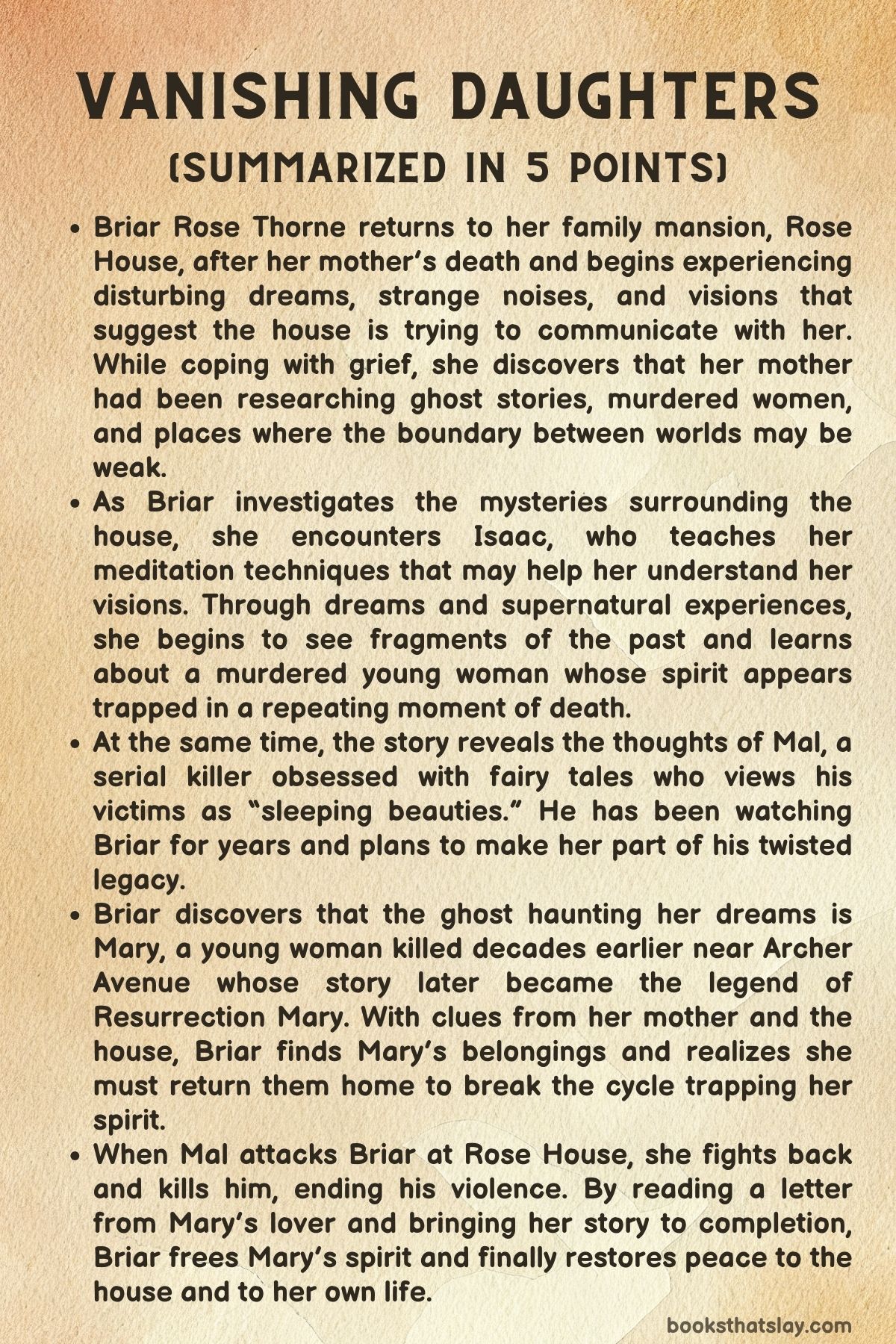
Briar Rose Thorne returns to Rose House, her family’s old mansion on Chicago’s South Side, shortly after her mother Aurora dies. The house is full of absence but also full of traces of her mother, from familiar scents to half-felt sounds and impressions. Briar is barely functioning.
She is grieving, sleeping badly, and waking from terrifying episodes with only fragments left behind. She starts keeping track of the times she wakes because the experiences feel too vivid to dismiss. In those moments between sleep and waking, she senses roads, cemetery gates, locked doors, roses, blood, and a beautiful woman in white asking to be taken home.
Rose House does not feel empty. Briar hears pounding in the walls, scratching at windows, whispers, and radios playing on their own. The house seems to pull her attention toward certain rooms and objects, especially a locked trunk among her mother’s things. Briar’s mother had always believed in dreams, stories, and places where time did not move normally.
She treated the house as a place layered with memory, where the past could press against the present. Briar used to hear those beliefs as eccentric ideas, but now, alone in the house, she begins to suspect her mother may have understood more than she admitted.
Briar is not completely alone. Her dog Prairie stays close to her, and her best friend Emily has moved in temporarily to help after the funeral. Emily is practical, caring, and worried that grief and exhaustion are pushing Briar toward a breakdown. Briar also has a boyfriend, Daniel, but she keeps him at a distance, not wanting to burden him.
Even so, the support of others cannot quiet the sense that something real is happening. Briar’s dreams become more detailed, and her mother seems to appear in them with warnings and instructions. She speaks of keys, books, letters, roses, and a need to break an old pattern.
As Briar sorts through Aurora’s papers, she learns more about what her mother had been researching. Aurora, a conservator of rare books at the Art Institute of Chicago, had filled folders with material on Chicago ghost lore, fairy tales, dreams, and murdered women.
She was especially interested in Archer Avenue, Resurrection Cemetery, and other places thought to be “thin places,” where the living and the dead might draw near each other. Among the papers are references to the Forgotten 51 and to women whose names faded while their murders turned into rumor or legend.
Briar begins to see that her mother’s work was not only academic curiosity. Aurora had been protecting something, waiting for Briar to understand it.
At the same time, the novel reveals the mind of the killer. A man called Mal stalks women through Chicago, murdering them and thinking of them as sleeping beauties. He frames his crimes through fairy-tale logic, imagining that he sends women into an eternal night where he still possesses them.
His thinking is warped by the influence of his father, another killer who raised him to see murder as inheritance, ritual, and destiny. Mal watches Briar from afar and considers her different from the others. He has waited for her for years, ever since an earlier encounter with Aurora. In his mind, Briar belongs to a much older story, one he intends to finish himself.
Briar’s search for answers widens beyond the house. In Jackson Park she meets Isaac Adler, a mysterious man who presents himself as a psychology professor. He speaks to her about grief, dreams, meditation, and altered consciousness.
He introduces her to the Gateway Project, a method meant to sharpen the mind’s ability to cross boundaries of time and perception. Isaac also gives Briar one crucial warning: if someone asks for the date and time in a dream, she must never answer. His advice sounds strange, but Briar is already deep in experiences that do not fit ordinary explanations, so she listens.
The house continues to intensify its messages. Briar finds a red rose left at her door. Lights shift, curtains move, music starts, and a chandelier falls. At one point she undergoes what seems like an out-of-body vision in which she sees another version of herself inside the house while a black car approaches outside.
A threatening man asks her for the date and time, and she refuses. The vision changes again, bringing her face to face with a young woman in white who begs to be taken home. When Briar wakes, details from the experience remain physically present, making it harder to insist it was only a dream.
Briar and Emily travel to Red Gate Woods and Archer Avenue, drawn by Aurora’s research and the recurring images in Briar’s sleep episodes. These places carry real histories of violence, death, and urban legend.
Briar senses that the stories attached to them are not random. They are ways the dead continue to be noticed after official accounts fail them. Back at Rose House, Briar experiences scenes that seem to fold time over itself. She witnesses moments from her mother’s past, hears lines from old fairy tales, and sees herself almost trapped by the symbolism of the spinning spindle.
Aurora appears again and again, explaining that stories change in the telling, but victims’ names matter. If Briar is going to stop what is happening, she must recognize the person at the center of the legend.
That person is Mary, the young woman who later became known through the ghost story of Resurrection Mary. Through dreams, meditations, and visions, Briar begins reliving Mary’s final night. She sees Mary at a dance hall, falling for Jerry Poulos and expecting him to take her home.
Instead, Mary is left alone and begins walking down Archer Avenue, where something terrible follows her. The killer who hunts women appears almost supernatural in these visions, less a single man than a force that survives by repeating the same act across generations.
Mary explains that she is trapped in the loop of her own death and that the only way to stop the repetition is for Briar to bring one of them home and complete what was left unfinished.
As Briar investigates further, the history around Mary becomes clearer. Jerry spent his life carrying guilt for failing to protect her. An old man who has long watched Rose House from outside turns out to be Jerry himself, still haunted by what happened decades ago.
When he dies, Briar realizes time is running short. She writes about the Resurrection Mary story, linking the legend back to a real woman whose identity and suffering were overshadowed by folklore. This act of naming is important. It pushes against the way murdered women are forgotten and turned into background.
The house finally gives Briar the last clues she needs. Guided by signs from Aurora and by the house itself, she discovers an iron key in the greenhouse and uses it to open the trunk hidden among her mother’s belongings. Inside are Mary’s dress, shoes, ribbon, and a letter from Jerry.
Mal appears soon after, openly threatening Briar and confirming that he is the killer from her dreams. Briar takes Mary’s things and drives to Resurrection Cemetery, where Mary’s presence becomes undeniable. Mal follows and tries to claim Briar as his final sleeping beauty, but Briar now understands what must be done. She must get Mary back to Rose House, where the pattern can be broken.
When Briar returns, the last confrontation takes place in the attic. Mal attacks her brutally, and the struggle becomes a fight not only for Briar’s life but for every woman he has tried to claim. Prairie defends her, buying her time. Guided by her mother’s voice, Briar reaches for a knitting needle and kills Mal.
The act ends his pursuit in the physical world, but the emotional ending belongs to Mary. Briar reads Jerry’s letter aloud, giving Mary the words and recognition she was denied for decades. Mary is reunited with Jerry, her spirit finally able to leave the repeated night of her death. Aurora appears once more, proud of Briar for finishing what had remained broken.
Afterward, the house changes. It feels calmer, lighter, less burdened by what it had been holding. Briar survives, though she is exhausted enough to want only sleep. In the months that follow, Daniel moves into Rose House, bringing steadiness and warmth.
Emily remains part of Briar’s life, and the future begins to look possible again. Isaac disappears from ordinary life, yet Briar understands he had been helping her all along, whether as a man, guide, or something harder to define. In the end, the novel closes on peace rather than terror.
Mary and Jerry are together at last, Aurora is no longer trapped in unfinished worry, and Briar has inherited not only a haunted house but the strength to live in it without fear.
Characters
Briar Rose Thorne
Briar is the emotional and narrative center of Vanishing Daughters, and nearly every major idea in the novel is filtered through her grief, fear, memory, and awakening. At the beginning, she is deeply destabilized by her mother’s death, and that loss shapes the way she experiences everything around her. Her sleeplessness, panic, confusion, and fractured dreams make her an especially effective protagonist because she is never certain whether she is confronting haunting, trauma, inherited knowledge, or some combination of all three. This uncertainty gives her character depth.
She is not introduced as fearless or especially prepared for what lies ahead. Instead, she is vulnerable, exhausted, and emotionally raw, which makes her gradual movement toward clarity feel earned rather than automatic.
What makes Briar compelling is that she is both a grieving daughter and a reluctant inheritor of unfinished history. Rose House does not simply belong to her in a practical sense; it demands something from her.
As the last Thorne left to face its secrets, she becomes responsible for more than property and memory. She becomes the one who must interpret the signs her mother left behind, recover buried truths, and confront violence that has repeated across time. Her development is not a simple movement from weakness to strength. Rather, she learns to trust parts of herself she had doubted, especially her intuition, her dreams, and her emotional intelligence.
The same sensitivity that initially seems to make her fragile becomes the quality that allows her to understand what others cannot.
Briar also represents the novel’s concern with how women carry inherited fear and inherited resilience at the same time. She is stalked, watched, and targeted, yet she is never reduced to victimhood.
Even when terror presses in from every side, she keeps searching, keeps interpreting, and keeps choosing action. Her final confrontation with Mal matters not only because she survives, but because she actively breaks a cycle that existed long before her.
By the end, Briar has changed from someone overwhelmed by the house and its messages into someone capable of reading them, responding to them, and reshaping the future. Her journey is about grief, but it is also about authority: she becomes the one who names, remembers, and ends what others could not.
Aurora Thorne
Aurora, Briar’s mother, is one of the most powerful presences in the story despite being dead before the central action fully unfolds.
She continues to shape events through memory, research, dreams, and the emotional architecture of the house itself. As a character, she stands at the meeting point of intellect and mysticism.
Her work as a rare-book conservator suggests patience, care, and respect for the survival of stories, while her beliefs about dreams, haunted places, and time imply an openness to realities that exceed rational explanation. She is not presented as irrational. Instead, she comes across as someone who understood that stories preserve truths conventional history often fails to hold.
Aurora’s role in the novel is deeply maternal, but not in a sentimental or passive way. She protects Briar not only through affection but through preparation. The clues she leaves behind, the objects she preserves, and the warnings she embeds in Briar’s memory all suggest that she knew danger was approaching long before Briar understood it. Her love is strategic.
She knows her daughter will have to face something terrible, and so she does what she can to equip her without stripping her of agency. This makes Aurora more than a nurturing figure. She is also a guardian of knowledge, a keeper of lineage, and a woman who has spent years carrying truths that could not yet be spoken openly.
Aurora also deepens the novel’s treatment of generational inheritance. Through her, the past is not dead material; it is active, waiting, and sometimes dangerous. She understands that stories can become distorted over time, but she also believes that names and patterns matter.
That belief shapes Briar’s quest. Aurora’s ghostly guidance never feels random. She is trying to move her daughter toward recognition, toward a breaking of repetition. In that sense, Aurora functions almost like a counterforce to the killer. Where he turns women into objects in an endless cycle of violence, Aurora preserves memory so women can be restored to identity.
Her presence after death shows that maternal care continues beyond physical life, but it also suggests that unfinished responsibility can bind the dead to the living until justice is done.
Mal
Mal is the clearest embodiment of violence in the novel, but he is more than a straightforward murderer. He is written as a predator who has constructed a fantasy system to justify cruelty, possession, and the erasure of women’s personhood.
His obsession with fairy tales, sleep, beauty, and ritualized killing reveals how completely he has transformed murder into myth in his own mind. He does not see women as human beings with full lives and histories. He sees them as figures in a private story where he controls the ending.
That distorted imagination is what makes him especially disturbing. He is not driven only by impulse; he is driven by ideology, one inherited and reinforced by his father.
His family background is important because it shows that evil in the novel is both personal and generational. Mal has received not only violent habits but an entire worldview from the man who raised him.
He treats murder almost as legacy, something passed down, repeated, and perfected. This makes him a dark mirror to Briar. She inherits memory, intuition, and the burden of unfinished stories from her mother.
He inherits domination, delusion, and ritualized brutality from his father. The conflict between them therefore becomes larger than one woman versus one killer. It becomes a struggle between two family lines and two different uses of inheritance.
Mal’s fixation on Briar gives his character another layer. He does not place her among his victims in a casual way. He imagines her as special, almost preordained, which reveals his need to turn his violence into destiny. He cannot simply kill; he must tell himself he is fulfilling an ancient pattern. That self-mythologizing exposes his weakness.
He depends on repetition, fantasy, and fear to sustain his sense of power. Once Briar understands the pattern and refuses the role he has assigned her, he begins to lose control. His final defeat is important because it strips away the grandeur of his self-image.
In the end, he is not an immortal dark prince of his own legend. He is a killer whose power ends when a woman fights back, names what he is, and refuses to be contained by his story.
Mary
Mary is one of the novel’s most tragic and symbolically rich figures because she exists both as a murdered young woman and as the ghostly shape of a legend that has outlived the truth of her life. Through her, the story examines how female suffering is often transformed into folklore while the woman at its center is forgotten.
Mary has become a haunting presence associated with Archer Avenue and Resurrection Cemetery, but Briar gradually learns that behind the legend is a real person whose death was never properly resolved. That distinction matters. Mary is not meant to remain a romantic ghost image. She must be restored as an individual with fear, longing, and unfinished pain.
Her repeated appearances in dreams and visions reveal how trapped she is. She is not at rest, and the novel presents that unrest as the result of interruption: interrupted love, interrupted identity, interrupted return.
She keeps reliving the last stretch of her life because the conditions of her death were never fully answered. In that sense, Mary becomes the emotional key to the larger mystery. She is not just a clue for Briar to decode. She is the person whose restoration makes breaking the cycle possible. Her plea to be taken home carries both literal and symbolic meaning. She wants physical return, but she also wants recognition, truth, and an ending that belongs to her rather than to the killer or to rumor.
Mary’s connection to Briar is also essential. She becomes a bridge between past and present, showing Briar that violence against women is not isolated in time. It repeats because it is forgotten, distorted, or allowed to become legend without justice. Yet Mary is not only a victim figure.
She also provides knowledge. She understands the pattern because she has been trapped inside it, and she gives Briar the insight needed to resist it. Her final release is one of the novel’s most meaningful resolutions because it turns a ghost story back into a human story. She is finally allowed to be someone loved, mourned, and named, rather than a beautiful mystery left wandering forever.
Emily
Emily plays a crucial grounding role in the novel. As Briar’s best friend and a paramedic, she brings practical care, emotional loyalty, and ordinary reality into a story increasingly filled with dreams, hauntings, and historical echoes. Her presence matters because she never feels disposable or merely functional.
She represents the kind of friendship that persists even when understanding is incomplete. Emily does not always believe Briar’s interpretation of events, but she still remains close, protective, and willing to help. That distinction is important. Her loyalty does not depend on fully sharing Briar’s worldview. It depends on love and trust.
Emily’s skepticism is one of her strongest qualities. In a novel built around uncertainty, she provides a necessary counterweight. She asks whether grief, exhaustion, or fear might be shaping Briar’s experiences, and that perspective helps prevent the supernatural elements from becoming too easy or too absolute.
Emily keeps the novel emotionally honest because she reflects how an ordinary, caring person might respond to someone who seems to be unraveling under pressure. She worries about Briar’s safety, pushes her to rest, and tries to anchor her in food, sleep, and routine. These acts may seem small compared with visions and murder, but they are forms of care that keep Briar connected to life.
At the same time, Emily is not closed-minded. She may resist dramatic conclusions, but she continues to move with Briar into unsettling territory, including visits to charged locations and the mounting danger around the house. This gives her character flexibility and courage. She does not exist to dismiss Briar; she exists to stand beside her while trying to protect her. Emily therefore represents a very human kind of strength, one based not on special insight but on steadiness. In a narrative where many forces pull Briar toward isolation, Emily helps keep her from disappearing into fear altogether.
Isaac Adler
Isaac is one of the most enigmatic figures in the novel, and that uncertainty is central to his function. He appears as a knowledgeable, somewhat unsettling man who offers Briar guidance on dreams, consciousness, and the boundaries between worlds.
On the surface, he can be read as an intellectual with unusual interests, someone who gives Briar conceptual tools for understanding what is happening to her. Yet he also feels more than human at times, almost like a protective presence working according to rules he cannot fully explain. The novel deliberately leaves room around him, and that ambiguity makes him compelling.
What Isaac provides most of all is orientation. Briar is drowning in signs and experiences she cannot interpret, and he gives her language for altered states, for meditative practice, and for the possibility that consciousness can move beyond ordinary sequence. He does not solve the mystery for her, but he helps her navigate it. This is an important distinction.
He is not a rescuer who takes over the story. Instead, he acts as a guide who can point toward doors but cannot walk through them for her. That role connects him to fairy-tale traditions, where helpers appear to aid the heroine without removing the trial she must undergo herself.
Isaac’s deeper significance lies in how he complicates the boundary between the psychological and the supernatural. His advice can be heard as grounded in meditation and consciousness studies, but the story increasingly suggests he may be operating from a space beyond conventional reality.
By the end, he feels almost like a benevolent counterpart to the dark force represented by Mal: a figure associated with knowledge, timing, and protection rather than domination. His disappearance from ordinary life after the main events only strengthens that impression. He leaves behind not closure but understanding, and in doing so he becomes one of the novel’s quietest yet most memorable presences.
Daniel
Daniel is not as symbolically charged as some of the other figures, but his role is important because he represents stability, affection, and the possibility of a future not defined by terror. Briar keeps him at a distance for much of the story, partly because of grief and partly because she feels overwhelmed by what is happening to her.
That distance says as much about Briar’s emotional state as it does about Daniel himself. He belongs to the part of life that is ordinary and sustaining, which is precisely the part Briar struggles to trust while the house and its secrets take over her world.
His care for Briar is shown through patience rather than dramatic speeches or heroic gestures. He answers her calls, worries when she acts strangely, comes when she needs help, and tries to protect her in practical ways.
This makes him useful as a contrast to the more mysterious men in the story. Mal embodies possessive violence, and Isaac embodies uncertain guidance. Daniel, by contrast, offers human reliability. He does not seek to control Briar or interpret her for his own purposes. He simply wants her safe.
Daniel’s significance becomes clearest near the end, when life begins to settle again and he moves into the house. That change carries thematic weight. Rose House, once dense with grief and threat, slowly becomes habitable in a new way. Daniel’s presence signals restoration rather than conquest.
He is part of the novel’s movement toward warmth after prolonged fear. Though he is not the engine of the mystery, he matters because he helps show that survival is not just about defeating danger. It is also about allowing love, companionship, and ordinary living back into spaces once ruled by loss.
Jerry Poulos
Jerry is one of the novel’s most sorrowful characters because he embodies the long afterlife of guilt. In the past, he was the young man connected to Mary on the night of her death, and his failure to bring her home becomes the defining wound of his life. He is not portrayed as malicious, but as tragically unable to repair a single missed act that echoes for decades.
His later appearances as the old man outside the house are quietly devastating because they show how fully he has been haunted by memory. He has not moved on. He has remained emotionally bound to what happened.
Jerry’s importance lies in the fact that he links legend back to human regret. Without him, Mary risks remaining only a spectral figure. Through him, she becomes part of a love story interrupted by violence.
That does not romanticize her death; rather, it reminds the reader that murder destroys not only an individual life but entire possible futures. Jerry carries the emotional evidence of that destruction. His years of watching, mourning, and remembering suggest that some losses never become manageable, only survivable.
The letter he leaves behind becomes one of the novel’s most meaningful objects because it gives voice to what could never be said in time. In narrative terms, Jerry helps complete the act of return.
He cannot save Mary in life, but his love and grief still matter in the work of bringing her finally to rest. His character therefore expands the novel’s understanding of haunting. The dead are not the only ones haunted. The living can spend their whole lives inside an unfinished moment.
Prairie
Prairie, Briar’s pit bull, serves more than a comforting domestic role. The dog functions almost as an instinctive witness to the invisible pressures in the house, often sensing shifts before Briar can fully process them.
Prairie’s loyalty gives Briar a form of companionship untouched by doubt, explanation, or theory. In a story full of uncertain motives and unstable perceptions, that kind of presence matters. Prairie reacts directly, protects directly, and loves directly.
The dog also helps preserve Briar’s connection to the physical world. During visions, panic, and emotional collapse, Prairie is often the creature that pulls her back into her body and into the immediate present. This gives the character a subtle narrative value. Prairie acts as an anchor, reminding the reader that survival is lived through the body as much as through thought or dream.
That grounding becomes especially important in the final struggle, when Prairie physically fights to defend Briar from Mal.
Prairie’s role in that confrontation confirms what the novel has already suggested: loyalty and love are active forces, not soft background details. The dog is part of the network of care surrounding Briar, and that care proves stronger than the killer’s fantasy of isolation and possession.
Prairie may not speak or interpret, but the character still carries emotional weight because devotion itself becomes a form of resistance.
Detectives Kowalski and Rodriguez
Detectives Kowalski and Rodriguez serve as the novel’s connection to institutional reality. They represent law, procedure, and the official effort to understand a series of murders, yet they also reveal the limits of those systems when confronted with patterns of violence that stretch across decades and shades of reality.
Their presence helps keep the story from floating entirely into dream logic because they remind the reader that women are being killed in a recognizable social world, one where investigations happen, evidence matters, and disbelief can have consequences.
They are also important because of how they respond to Briar. At times they seem skeptical or constrained, which reflects the broader theme that women’s fear and testimony are often not fully honored until danger becomes undeniable.
Even when they do not understand the full picture, they remain part of the mechanism through which the final truth comes into public view. They do not solve the central mystery, but they help frame it within a world that demands names, bodies, timelines, and accountability.
Their role is therefore less about emotional complexity and more about thematic contrast. The novel places private knowledge, ghostly inheritance, and women’s intuition beside official investigation.
The detectives show that both matter, but they are not equally equipped to confront every kind of evil. Briar must go where procedure cannot go. Still, their arrival at the end confirms that what happened was not only supernatural struggle or personal nightmare. It was also a real crime, with a real killer, in the shared world.
Themes
Grief, Memory, and the Persistence of the Dead
Grief shapes Briar Rose Thorne’s entire experience in Vanishing Daughters, transforming the house she returns to into a place where memory feels alive and constantly active. The death of her mother Aurora does not simply create absence; instead, it creates an atmosphere where every object, room, and scent carries emotional weight. Briar walks through Rose House surrounded by reminders of the life that once filled it. The hallway, the mirrors, and the furniture become quiet witnesses to her loss. These memories do not remain passive recollections. They begin to influence how Briar perceives reality. Her grief weakens the boundary between present experience and remembered moments, allowing dreams, visions, and voices to feel almost as real as ordinary life.
The novel treats grief as something that alters perception rather than something that exists only in the mind. Briar repeatedly hears or senses her mother’s presence even when she knows Aurora is gone. Instead of dismissing these moments as hallucinations, the story presents them as emotional truths. Aurora’s teachings about stories and memory continue guiding Briar long after her death. In this way, the relationship between mother and daughter survives through knowledge and influence rather than physical presence. The house itself becomes a container of memory, almost functioning like a living archive where past lives leave echoes behind.
This connection between grief and memory also extends to the murdered women whose stories have faded from public attention. Briar begins to realize that the world often moves forward quickly after acts of violence, especially when the victims are women. Their names disappear while rumors and legends take their place. By researching these cases and uncovering the truth behind Mary’s story, Briar resists the cultural tendency to forget. Memory becomes a form of justice because it restores individuality to victims who have been reduced to folklore.
The novel therefore presents grief not only as personal suffering but also as a force that keeps the past visible. Briar’s mourning compels her to listen carefully to the voices of those who came before her. Her emotional vulnerability becomes the reason she is able to perceive what others overlook. Through grief, the living remain connected to the dead, and forgotten stories gain the chance to be remembered and finally resolved.
Violence Against Women and the Culture of Forgetting
Violence against women forms a central concern throughout Vanishing Daughters, especially in the way society reacts to such crimes. The novel repeatedly points to how murdered women become statistics, headlines, or urban legends rather than individuals whose lives mattered. Briar reflects on a murder that occurred near her home before her mother died. The attention around the case faded quickly, replaced by silence and indifference. This moment establishes a pattern that continues throughout the story. Women disappear, their bodies are discovered, and public memory gradually erases them.
The serial killer Mal thrives in this environment of neglect. His crimes depend on a culture that allows victims to become anonymous. He imagines himself as a collector of sleeping beauties, turning real women into symbolic figures within his private fantasy. His language strips victims of their identities and replaces them with roles taken from fairy tales. This disturbing mindset reflects how violence can distort storytelling itself. Instead of being remembered as daughters, sisters, or friends, the victims become part of a myth created by the murderer.
The transformation of Mary into the legend of Resurrection Mary demonstrates how easily reality can be replaced by folklore. Over time, people focus on the eerie ghost story rather than the life of the young woman who was killed. Her identity disappears beneath layers of retold anecdotes about a vanishing hitchhiker. Briar’s investigation challenges this transformation by returning attention to Mary’s name, her relationship with Jerry, and the circumstances of her death. Restoring those details breaks the cycle of reducing her to a ghostly rumor.
The novel also links these patterns of violence to generational influence. Mal inherits both the mindset and the practices of murder from his father, suggesting that cruelty can be passed down when it remains unchallenged. The repetition of violence mirrors the repetition of stories that forget victims. Both systems rely on the same mechanism: a cycle that continues because people stop questioning it.
By uncovering the truth about Mary and confronting Mal directly, Briar disrupts that cycle. Her actions show that acknowledging victims as individuals can weaken the power of those who harm them. The novel ultimately argues that remembrance and storytelling carry moral responsibility. When victims are remembered accurately and compassionately, their humanity resists the forces that tried to erase it.
The Power of Stories and Fairy Tale Influence
Fairy tales influence the structure and meaning of Vanishing Daughters in significant ways, shaping how characters understand their experiences and how the story interprets violence. Briar’s mother Aurora worked with rare books and preserved old texts, which meant that stories were always present in Briar’s childhood. One of the most important books connected to the family is The Sleeping Beauty of the Wood. Its themes echo throughout Briar’s journey, particularly the image of a young woman trapped in a state between life and death. These elements gradually move from symbolic references to guiding principles that help Briar interpret what is happening around her.
Mal also frames his crimes through fairy tale imagery, though his interpretation twists the meaning completely. He calls his victims sleeping beauties and imagines that he is granting them a strange form of eternal sleep. This disturbing fantasy reveals how stories can be manipulated to justify cruelty. Instead of understanding fairy tales as moral narratives or cautionary tales, Mal turns them into personal mythology that glorifies violence. The story therefore contrasts two different uses of storytelling: one that preserves wisdom and another that distorts reality for selfish purposes.
Aurora’s interpretation of stories offers a very different perspective. She believed that fairy tales survive because they preserve patterns of human behavior. The details may change over time, but the core events remain recognizable. In the novel, these patterns appear through repeated acts of violence against women. The tale of Sleeping Beauty becomes a symbolic framework that reflects the danger women face when others attempt to control their fate. Briar eventually recognizes that breaking the pattern requires changing the ending of the story.
Mary’s situation illustrates this idea clearly. Her death became part of a legend that repeated endlessly, much like a fairy tale told again and again. Each retelling focused on the eerie aspects of the ghost story while ignoring the human tragedy behind it. Briar’s role resembles that of a character who alters the traditional narrative. Instead of allowing Mary to remain trapped in the role of a ghostly princess wandering the road, Briar brings her home and restores her unfinished story.
The novel suggests that stories possess real power because they shape how people interpret events. They influence whether victims are remembered or forgotten and whether cycles of violence continue or end. By reclaiming the meaning of the fairy tale and giving Mary a different conclusion, Briar demonstrates that stories are not fixed. They can be rewritten in ways that honor truth and compassion rather than fear.
Place, History, and the Idea of Thin Places
The setting plays a crucial role in Vanishing Daughters, particularly through the concept of thin places where boundaries between worlds seem less stable. Chicago becomes more than a simple backdrop for the narrative. Its parks, cemeteries, and streets carry layers of history that affect the present. Locations such as Archer Avenue, Resurrection Cemetery, and Red Gate Woods appear throughout the story as places where unusual events and ghost stories have accumulated over decades. The idea that certain environments hold memories creates a sense that the past remains physically embedded in the landscape.
Rose House itself embodies this connection between place and history. Built by Briar’s ancestors, it has witnessed generations of lives and deaths. Aurora described it as a forever house, meaning that time behaves differently within its walls. Briar’s experiences seem to confirm this belief. She encounters visions of past events, hears voices from other moments in time, and sees spaces transform into earlier versions of themselves. The house functions almost like a crossroads where different periods overlap. These experiences suggest that locations with strong emotional histories can preserve fragments of what happened there.
The concept of thin places also reflects how trauma and memory linger in physical environments. Sites associated with violence, such as the area where the Grimes sisters were discovered, carry emotional resonance long after the events themselves. People continue telling stories about these places because they sense that something unresolved remains attached to them. The land becomes a silent witness that holds evidence of the past even when official records fail to provide answers.
Through Briar’s journey, the novel shows how understanding a place requires acknowledging the histories embedded within it. Ignoring those histories allows harmful patterns to continue unnoticed. When Briar studies the locations connected to Mary and the other victims, she begins to see the connections between geography, memory, and violence. Recognizing these links allows her to intervene in the cycle that has been repeating for decades.
The emphasis on place reinforces the idea that stories are not separate from the physical world. Buildings, roads, and landscapes act as carriers of memory. By listening to the signals coming from Rose House and the surrounding locations, Briar learns how the past continues shaping the present. Her ability to read these spaces ultimately leads her to uncover the truth and bring closure to a story that had been trapped within those places for years.