Variation by Rebecca Yarros Summary, Characters and Themes
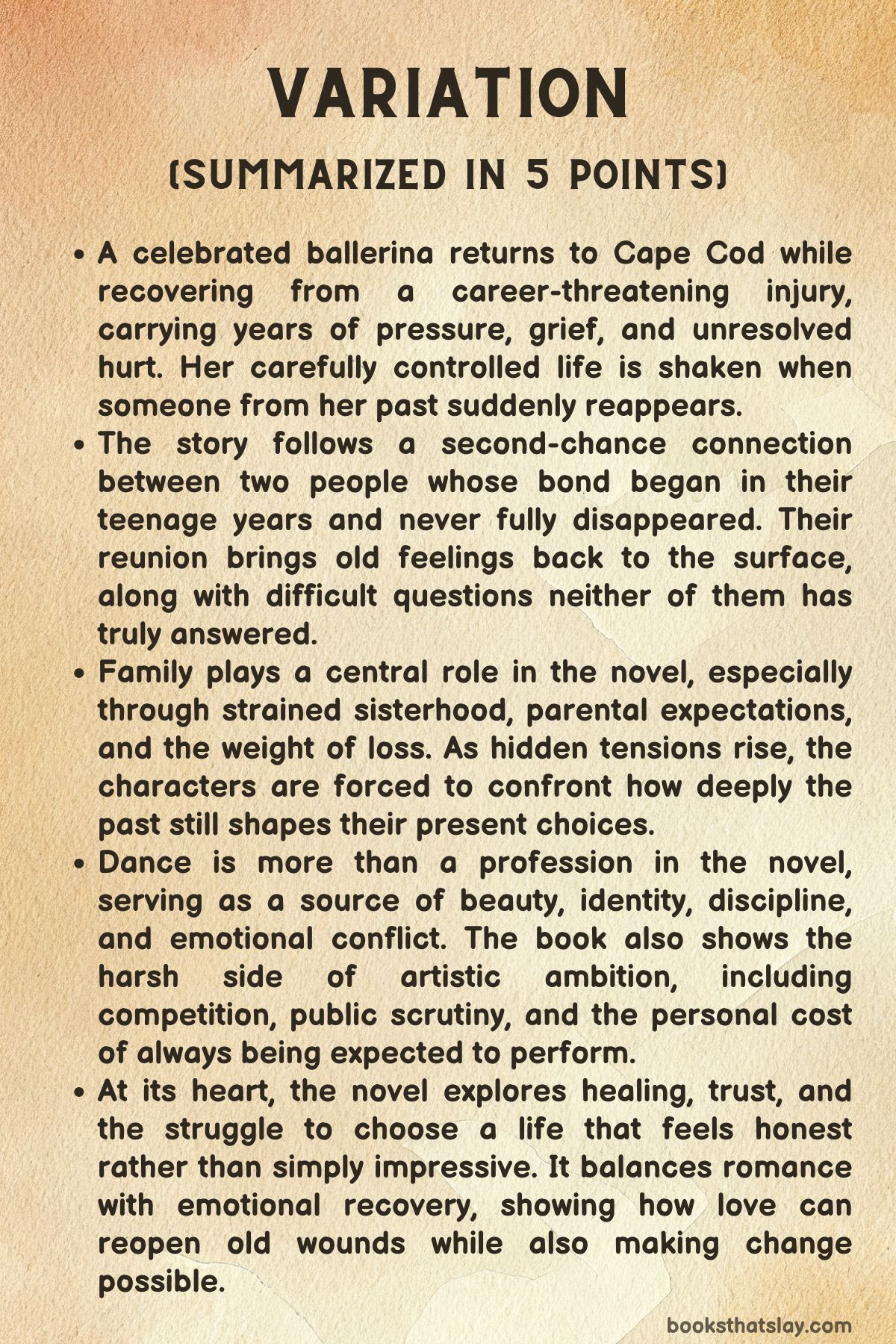
Variation by Rebecca Yarros is a contemporary romance with family drama, buried secrets, and second-chance love at its center. It follows Allie Rousseau, a celebrated ballet dancer whose career is shaken by injury, grief, and the pressure of a demanding legacy.
When Hudson Ellis, the boy who once saved her and then disappeared from her life, reappears years later, old feelings rise alongside painful questions from the past. The novel balances romance with recovery, identity, and the weight of family expectations. It is a story about choosing your own life after years of living for other people, and about finding love that can survive truth.
Summary
The story begins years before the main events, when Hudson Ellis is a teenager training for a future in rescue work. While out on the water near Cape Cod with his older brother Gavin, he sees a rowboat capsize.
Ignoring the danger, he dives in and rescues two sisters, Allie and Eva Rousseau. Their older sister Lina meets them at the dock, but Hudson’s attention fixes on Allie.
A connection sparks immediately, and although they are young, this moment becomes the start of something lasting between them.
Not long after, tragedy strikes the Rousseau family. Allie survives a terrible car accident, but Lina dies.
The event leaves Allie physically injured and emotionally marked, though much of what happened that night remains blurred in her memory. Lina’s loss becomes the defining absence in Allie’s life, and the accident quietly shapes the choices everyone around her makes afterward.
Ten years later, Allie is now a principal ballet dancer performing at the highest level. She is about to take the lead role in Giselle, a performance heavy with pressure from her family history and her mother Sophie’s impossible standards.
Allie pushes through severe ankle pain, determined to deliver perfection. During the performance, she thinks she sees Hudson in the audience, a shock that throws her off balance.
Moments later, the pain in her ankle becomes unbearable, and she collapses onstage, bringing her performance and career momentum to a halt.
Months later, Hudson is working as a Coast Guard rescue diver near Cape Cod. He has built a life around service, danger, and discipline, but he has never fully forgotten Allie.
His niece June, who has become fascinated with ballet, persuades him to bring her to see Allie. When they arrive at the Rousseau home, Hudson mistakes Allie’s underwater training for drowning and rushes to save her, only to discover that she is very much alive and furious with him.
Their reunion is tense. Allie has not forgiven him for vanishing from her life after the accident, and Hudson has no satisfying explanation that can undo the hurt.
The visit takes an unexpected turn when June reveals why she wanted to meet Allie. She believes Allie is her biological mother.
Though Allie rejects the claim at first, a DNA test shows that while she is not June’s mother, she is June’s biological aunt. This means Lina must have been June’s mother.
The revelation changes everything. June, who was adopted by Hudson’s sister Caroline and her late husband, suddenly has a hidden link to the Rousseau family.
Allie, Hudson, and June are forced into each other’s lives as they try to understand what Lina kept secret and why.
Allie’s family is complicated long before this discovery. Anne, the most steady of the sisters, wants truth and legal clarity.
Eva, ambitious and often resentful, is deeply tied to ballet and competition. Their mother Sophie, once a famous dancer, is controlling, cruel, and emotionally abusive.
Her treatment of her daughters has shaped all of them, especially Allie, who has spent her life chasing approval she will never truly receive. Even as an adult, Allie is still measuring herself against Sophie’s demands and against Lina’s memory.
Because Caroline dislikes the Rousseau family and is fiercely protective of June, June invents a plan to soften the situation: Allie will pretend to be Hudson’s girlfriend so Caroline can get to know her without learning the truth all at once. What begins as a strategy slowly becomes emotionally dangerous.
Hudson and Allie still have strong feelings for each other, and proximity makes it impossible to ignore them. At family gatherings and quiet moments alike, they begin to remember what they once meant to each other.
Hudson shows that he still remembers small details about Allie, and she starts to see that his absence did not erase his love.
At the same time, June’s growing interest in ballet pulls Allie into a mentoring role. June has talent, but she has been learning in an unhealthy environment that reminds Allie of her own harsh training.
Allie decides to teach her properly and protect her from the physical and emotional damage ballet can cause when adults value winning more than wellbeing. Teaching June gives Allie a new relationship with dance.
For the first time in years, ballet becomes something she can offer with care instead of something extracted from her through fear.
As Hudson and Allie spend more time together, the fake relationship becomes real in everything but name. They kiss, then pull back.
They admit attraction, then retreat again. Allie is deeply drawn to him, but she is still wounded by his disappearance and by the emotional conditioning that taught her not to trust happiness.
Hudson is patient, open, and devoted, but he is also carrying secrets of his own. He wants another chance, yet he knows he failed her once in a way that still matters.
Meanwhile, Allie’s professional world grows more hostile. Her injury recovery is watched publicly, and social media turns cruel.
Other dancers circle her role, eager for her to fail. Eva, desperate for recognition, makes things worse by posting material that damages Allie’s reputation and helps her take over part of Allie’s place in the ballet Equinox.
This betrayal cuts deeply, because Allie has spent years sacrificing for her sisters and still finds herself treated as a rival. Even so, she continues training, helped by Kenna, her doctor and close friend, and by Eloise, a longtime family figure who brings both perspective and support.
A turning point comes during the Haven Cove Classic, the ballet competition connected to the Rousseau family name. June performs, and the adults around her are forced to confront the consequences of Lina’s hidden choices.
Caroline reveals that the adoption came with strict conditions: June was not supposed to pursue ballet or seek out her biological parents before adulthood. This explains the panic around June’s dancing and raises the stakes of every decision already made.
As the truth closes in, Allie realizes that June’s father is Vasily Koslov, the artistic director of the ballet company and a powerful figure in her professional life. Vasily had everything to lose if June’s existence became public.
Allie confronts him and forces him to sign away his parental rights in exchange for silence, choosing June’s protection over scandal and power. But June overhears enough to understand that her identity has been used as leverage, and in distress she runs, falls from a yacht, and ends up in the water.
Allie dives in after her, and Hudson rescues them both, repeating the role he first played when he saved Allie years before.
Afterward, the emotional cost of everything becomes impossible to avoid. Hudson tells Allie he has been willing to reshape his future for her, even changing his career preferences to be closer to her.
But then the deepest hidden truth comes out: on the day of the accident years ago, Hudson was there. He had confessed his love to Allie earlier that day and planned a future with her.
He followed the sisters, saw the crash, pulled Allie from the car, and could not save Lina before the vehicle exploded. Sophie then threatened and manipulated him, forcing him out of Allie’s life and letting Allie believe he abandoned her.
This confession devastates Allie. She is grateful he saved her, but she cannot accept that he hid the truth for so long.
Already burdened by survivor’s guilt and years of manipulation, she breaks things off, unable to imagine rebuilding trust. She then confronts Sophie and finally sees the full extent of her mother’s control, lies, and damage.
Learning that Sophie is now a patient in failing health does not erase the harm, but it helps Allie understand that she has spent too long chained to someone else’s version of her life.
In the final stretch, Allie faces the central choice of the novel: remain in the company that has given her status but taken her joy, or leave and build a life that is actually hers. She realizes she no longer wants the world that shaped her pain.
She leaves the company, chooses freelance dance on her own terms, and goes to find Hudson, who has moved to Alaska for the assignment he once dreamed of. There, she tells him she cannot stay away.
She forgives him, not because the past did not matter, but because love and truth now stand stronger than fear and silence.
Years later, the story closes with healing made visible. Hudson and Allie are married, their family ties have settled into something healthier, and June performs beautifully onstage.
The ending shows that the future did not come from preserving the Rousseau legacy as it was. It came from breaking away from it, telling the truth, and choosing love, freedom, and a gentler way forward.
Characters
Allie Rousseau
Allie is the emotional center of the novel, and her character is built around pressure, damage, talent, and slow self-reclamation. At the start, she appears disciplined, accomplished, and admired, but that outer control hides a life shaped by grief and emotional conditioning.
She has spent years trying to become the perfect daughter, the perfect dancer, and the perfect continuation of her family’s artistic legacy. Her injury exposes how fragile that identity really is.
Once dance is no longer something she can command with certainty, every unresolved part of her life begins to surface: Lina’s death, Hudson’s disappearance, her mother’s cruelty, and her own buried depression. What makes Allie compelling is that she is not simply a romantic heroine waiting to be healed by love.
She is a woman who has been trained to ignore pain, distrust comfort, and equate worth with performance.
Her relationship with ballet is central to understanding her. Dance is not merely a profession for her; it is the language through which she was valued, controlled, and judged.
She has extraordinary ability, but her devotion to excellence comes from both passion and fear. Much of her emotional conflict comes from not knowing where ambition ends and conditioning begins.
She has been praised for her strength, but that strength often looks like self-erasure. She pushes through pain, ignores her body, and keeps trying to prove herself to people who are never satisfied.
Her recovery forces her to confront a terrifying question: if she is not the version of herself built for other people, who is she? This makes her arc richer than a simple comeback story.
She is not just fighting to dance again; she is deciding whether the life built around dance still deserves her.
Allie’s emotional guardedness also defines her. She loves deeply, but she protects that love behind distance, sharpness, and restraint.
Her reunion with Hudson shows how much of her remains vulnerable beneath that control. She wants him, misses him, and still carries the ache of losing him, but she cannot easily trust him because abandonment has shaped her understanding of intimacy.
Even when she moves toward him, she often does so with conditions, time limits, or emotional escape routes. This is not coldness but self-defense.
She has lived too long in a world where dependence becomes danger. Her hesitation, contradictions, and moments of withdrawal feel true to a person who has survived both grief and manipulation.
What ultimately makes Allie’s arc satisfying is that she does not merely return to love; she returns to herself. By the end, she understands that healing is not the same as endurance.
She learns that love without truth is not enough, excellence without joy is hollow, and loyalty to family does not require lifelong surrender. Her final choices show growth because they are rooted in self-knowledge rather than guilt.
She stops living as an extension of her mother’s ambitions and her family’s damage, and begins living as a person with her own desires, boundaries, and future.
Hudson Ellis
Hudson is written as a man whose steadiness hides years of regret. He is brave, physically capable, and instinctively protective, but he is more than the familiar image of the dependable rescuer.
His profession as a Coast Guard diver reflects his nature: he moves toward danger, acts quickly under pressure, and defines himself through saving others. Yet this strength is shadowed by the one loss he could not prevent.
The accident that killed Lina and changed Allie’s life becomes the silent burden he carries into adulthood. His character gains depth because his greatest emotional wound comes not from failure of feeling, but from incomplete rescue.
He saved Allie, lost Lina, and then allowed himself to be pushed out of Allie’s life. That mixture of courage and silence defines much of who he becomes.
Hudson’s love for Allie is constant, but it is not simplistic. He does not move through the story as a man who assumes he deserves a second chance.
He clearly wants one, but he understands that the passage of time has not erased the hurt he caused. His patience with her is one of the strongest aspects of his characterization.
He notices small details, remembers who she was before fame and injury hardened her, and tries to create space where she does not have to perform. At the same time, he is not emotionally perfect.
His decision to keep the truth about the accident from her is a serious failure, and the novel does not pretend otherwise. He loves her, but he also underestimates how much trust depends on honesty.
His silence, though understandable in context, becomes another form of damage.
One of Hudson’s most appealing qualities is that he brings a different value system into Allie’s life. He respects work and discipline, but not at the cost of a person’s soul.
He sees the toxicity around her more clearly than she does because he is outside it. Through him, the story contrasts two kinds of excellence: one built on fear and hierarchy, and one built on skill, service, and moral clarity.
He does not want to possess Allie or reshape her. He wants her to be well, to choose freely, and to have a life that does not consume her.
That makes him more than a romantic reward. He represents an alternative model of love, one that is active, attentive, and honest about risk.
His bond with June also deepens his character. He is not her father, but he is one of the adults she trusts most, and his tenderness with her shows the domestic, emotionally available side of him.
He is playful, responsible, and willing to stand in uncomfortable spaces for her sake. Through her, he is connected not only to Allie’s past but also to the future that all the adults are trying to protect.
By the end, Hudson becomes most powerful not as a rescuer but as a man who finally allows love and truth to coexist, even when it costs him.
June
June functions as the catalyst of the entire present-day story, but she is far more than a plot device. She is curious, emotionally perceptive, talented, and far more aware than the adults often assume.
Her desire to know where she comes from and her hunger to dance are linked in important ways. She is not just searching for information; she is searching for identity.
Because the adults around her have built her life on secrecy, she grows into a girl who starts asking direct questions and pursuing her own answers. That makes her bold, but also vulnerable.
She is old enough to sense that she is at the center of something hidden, yet young enough to be hurt by the way truth keeps arriving in fragments.
Her instinctive draw toward ballet is one of the most interesting parts of her characterization. It suggests inheritance, resemblance, and the pull of a history she was never told.
Yet June’s connection to dance is also personal. She does not want it simply because it belongs to her biological family.
She wants it because she loves it. This distinction matters because much of the tension around her comes from adults projecting their fears onto her.
Caroline sees danger, Allie sees both promise and risk, and the hidden history around Lina makes ballet feel almost cursed. June, by contrast, sees possibility.
Her talent becomes the force that makes the adults confront agreements, lies, and buried motives they would rather leave alone.
June is also emotionally intelligent in ways that shift the balance of power in many scenes. She notices tension, reads emotional undercurrents, and often understands what people are not saying.
She recognizes Hudson’s history with Allie before she is told. She also understands that Caroline’s resistance is not really about dance alone.
This sharpness makes her feel believable as a child who has grown up under protective love but also under the shadow of unexplained boundaries. At the same time, she still has the impulsiveness of youth.
She tests limits, moves too quickly, and sometimes pushes for truths before the adults know how to manage them. Those choices make her feel real rather than idealized.
By the end, June becomes a symbol of both continuity and correction. She carries Lina’s bloodline and the family’s artistic gifts, but she is not meant to repeat the same cycle of control and exploitation.
The adults’ struggle over her becomes meaningful because she represents the chance to do better. Her final position in the family suggests not just revelation, but repair.
She is the younger life everyone failed to protect properly at first and then gradually learns to place above pride, secrecy, and fear.
Lina Rousseau
Lina is absent for most of the story in a physical sense, but she remains one of its most powerful presences. Nearly every major conflict traces back to her choices, her death, or the emotional legacy she leaves behind.
At first, she appears through memory as the lost sister whose absence froze the family in grief. She is idealized, mourned, and treated as a figure who cannot answer back.
As more truth comes out, however, her character becomes more complicated. She was loving, protective, and clearly important to both Allie and June, but she was also capable of secrecy, calculation, and morally difficult choices.
This complexity makes her far more interesting than a sainted dead sister.
Lina seems to have understood the family system better than the others did while she was alive. She knew the risks of reputation, the politics of the company, and the danger of certain truths becoming public.
Her decision to keep June hidden and placed outside the ballet world suggests both fear and strategy. She may have wanted to protect her daughter, protect the child’s father from exposure, and preserve her own standing.
These motives are not equally noble, and the novel allows that tension to remain. Lina loved June, but love in this family has often been mixed with self-protection, ambition, and control.
Her decisions reflect that world.
Her relationship with Allie is one of the emotional anchors of the book. Even in death, she shapes Allie’s sense of duty, guilt, and memory.
Allie has spent years partly living for Lina, honoring her, and carrying the weight of surviving when Lina did not. This gives Lina a kind of moral authority in Allie’s mind that takes a long time to question.
When the truth becomes messier, it does not erase the love between them, but it does force Allie to stop using Lina as a fixed, ideal image. In that sense, Lina’s character matters because she must be understood as human, not just mourned as perfect.
Lina’s role also sharpens the novel’s larger interest in legacy. She is what remains when beauty, talent, secrecy, and family expectation are fused together.
Her life and death reveal what happens when a person tries to survive inside a system built on image and silence. Even from beyond the grave, she shapes every major turning point, proving that unresolved truth can govern the living for years.
Caroline Ellis
Caroline begins as a barrier figure, someone suspicious, controlling, and openly hostile toward the Rousseau family. It would be easy to reduce her to the overprotective sister, but her characterization becomes more sympathetic as the story unfolds.
Her protectiveness comes from grief, responsibility, and promises she took seriously. Having lost her husband and become the primary guardian of June, she has built her life around vigilance.
Her caution is not arbitrary. It is rooted in legal agreements, fear of disruption, and the knowledge that adults with power can make choices that children pay for.
In many ways, Caroline is the only one who has been thinking about the practical consequences all along.
Her resistance to ballet is especially revealing. On the surface, it seems like prejudice against a wealthy and difficult family.
In reality, it is tied to the terms of June’s adoption and to what Caroline believes she must do to keep her daughter safe. This gives her moral weight.
She is not trying to deny June joy for no reason; she is trying to honor commitments and avoid the chaos that hidden truths might unleash. Her anger, then, is often the anger of the only adult in the room who sees how fragile legal and emotional security can be.
What makes Caroline effective as a character is that she is capable of change without losing her core. Once she begins to see Allie more clearly, she softens.
She remains blunt and cautious, but she becomes fairer. Her eventual acceptance feels earned because it grows from observation rather than manipulation.
She does not suddenly become easy or sentimental. Instead, she allows evidence to revise her judgment.
That gives her maturity and credibility.
Caroline also represents a different kind of womanhood than the Rousseau sisters. She is not glamorous, elite, or artistically consumed.
Her life is practical, work-centered, and grounded in caretaking. This contrast matters because it broadens the emotional world of the story.
She offers a model of female strength built not on brilliance or ambition, but on endurance, labor, and fierce loyalty. By the end, she becomes one of the novel’s moral stabilizers.
Anne Rousseau
Anne is one of the quiet pillars of the story. She lacks the dramatic volatility of Allie, the ambition of Eva, or the haunting mystique of Lina, but she often emerges as the most functional and responsible member of the Rousseau family.
She is observant, protective, and much better at facing unpleasant truths than her sisters. Where Allie tends to internalize and endure, Anne investigates.
She looks for documents, asks direct questions, manages practical problems, and pushes the others toward clarity. Her role in the family is not glamorous, but it is essential.
She also serves as a counterpoint to the emotional chaos around her. Anne understands the damage their mother caused and does not romanticize it.
She is capable of compassion, but she is not naive. This makes her particularly important in scenes involving June, legal realities, and long-buried secrets.
She wants connection, especially with June, but she does not lose sight of consequences. Her drive to be part of June’s life is moving because it comes from grief as much as longing.
She lost Lina too, and June offers a fragile continuation of that bond, but Anne still approaches that possibility through action rather than fantasy.
Anne’s care for Allie is one of her most defining features. She notices Allie’s exhaustion, depression, and self-destructive patterns even when Allie tries to hide them.
She cannot save her sister outright, but she consistently provides the practical support Allie cannot provide for herself. This includes pushing for medical oversight, demanding honesty, and refusing to let Allie disappear into performance and pain.
In a family shaped by manipulation, Anne often acts as the closest thing to emotional accountability.
Her decision to step away from the company and build a legal career on her own terms reinforces the novel’s theme of breaking inherited systems. Anne may be less visibly dramatic than the others, but her strength lies in choosing structure over illusion.
She is one of the clearest examples of survival without surrender.
Eva Rousseau
Eva is one of the most conflicted and difficult characters, which makes her one of the most interesting. She is talented, sharp, insecure, and hungry for recognition.
Unlike Allie, who has already achieved the status everyone chases, Eva is still fighting for a place that feels fully hers. Living in the shadow of both Lina’s memory and Allie’s success has shaped her into someone who is always measuring, competing, and trying to force opportunity before it passes her by.
Her betrayal of Allie grows from this desperation. She wants the role, the notice, and the validation that seem perpetually close but never fully secure.
What keeps Eva from becoming flatly antagonistic is that her flaws are clearly rooted in the same family damage that shaped her sisters. She has learned that attention must be seized, that love is conditional, and that worth is public.
She manipulates, posts damaging material, and allows jealousy to distort her judgment, but beneath that behavior is a person terrified of being left behind. She has internalized the family’s competitive logic so completely that she sometimes treats even intimacy as a contest.
This makes her painful, but believable.
Eva also reveals how abuse replicates itself in sibling relationships. She has not invented cruelty out of nowhere; she has absorbed a system in which bodies, careers, and identities are constantly compared.
Her harshness toward Allie is part resentment, part self-protection. If Allie remains the star, then Eva remains secondary.
Her acts of sabotage are ugly, but they emerge from a recognizable emotional wound. The novel does not excuse her, but it does place her in context.
Her redemption is partial rather than absolute, which works well. Eva is not transformed into a different person overnight.
Instead, she is given chances to choose differently, to help rather than undermine, and to become more honest about what drives her. That restraint makes her character feel more human.
She is not the villain of the family, only one more person shaped badly by it.
Sophie Rousseau
Sophie is the clearest embodiment of generational damage in the story. She is controlling, abusive, manipulative, and emotionally devastating, particularly in the way she binds motherhood to ambition.
Her daughters are not raised simply to dance; they are raised to carry her unfinished desires. She sees them less as separate people than as extensions of a legacy she wants preserved.
This makes her terrifying not because she is loud all the time, but because she has normalized cruelty as discipline and sacrifice as love. Her words and judgments have governed her daughters’ self-worth for years.
What makes Sophie especially damaging is her ability to rewrite emotional reality. She lies, withholds, and uses guilt as a method of control.
Her treatment of Hudson after the accident is a key example. Rather than allowing truth, grief, and love to coexist, she imposes a false narrative that shapes years of separation.
She also fosters the sisters’ competition and insecurity by making approval scarce and conditional. Her influence persists even when her power seems to fade, which is exactly how deeply internalized control works.
At the same time, the story complicates her slightly through illness. Learning that she is declining, confused, and receiving care does not erase what she did.
Instead, it creates emotional discomfort for her daughters, especially Allie, who wants confrontation to produce release and finds that it does not. This is an effective choice because it refuses the simplicity of punishing an abuser in a neat way.
Sophie becomes frail, but the damage remains. Her weakness does not restore what she broke.
As a character, Sophie matters because she is not just an individual source of pain; she is the structure the others must escape. To reject her worldview is to reject the false belief that excellence requires cruelty, that love is earned through suffering, and that a daughter’s life belongs to the mother who shaped it.
Her role is essential because the story’s deepest liberation is not romantic reunion, but freedom from her hold.
Kenna
Kenna plays the role of truth-teller, but she does more than provide support. As Allie’s friend and doctor, she stands at the intersection of emotional care and physical reality.
She is one of the few people who can speak to Allie with authority while also caring about her as a person rather than a performer. This gives her a unique narrative function.
She sees both the injury and the psychology around it. She understands that recovery is not just about healing tissue, but about asking whether the life waiting on the other side is still one Allie wants.
Her directness makes her especially effective. She does not indulge Allie’s self-deception, and she is one of the first people to push her toward the essential question of desire.
Does she truly want ballet, or does she only know how to survive inside it? That distinction is crucial, and Kenna keeps returning to it.
She is not anti-dance or anti-ambition. She is anti-destruction disguised as devotion.
In that way, she becomes a moral corrective to the culture Allie has normalized.
Kenna is also refreshingly free of pretense. In the New York scenes especially, she quickly identifies what is false, political, or performative.
Her presence highlights how artificial Allie’s professional environment has become. She supports Hudson not because she is playing matchmaker for its own sake, but because she sees that he offers Allie honesty and grounding.
Her approval matters because it is not based on fantasy.
Though she is a supporting character, Kenna is vital because she provides language and perspective when Allie cannot yet do so for herself. She helps turn pain into clarity, which is one of the most useful forms of care in the novel.
Gavin Ellis
Gavin is steady, practical, and less emotionally demonstrative than Hudson, but he plays a crucial structural role in the story. He is often the one standing closest to danger and consequence, seeing what others miss or refusing to dramatize what is already difficult enough.
As Hudson’s older brother, he understands him well and carries long memory about the events that shattered everyone’s lives. His perspective helps bridge the gap between what Allie believes about the past and what actually happened.
Gavin’s value as a character lies in his groundedness. He is not swept up by romance, status, or fantasy.
He pays attention to logistics, family pressures, and obligations. At times he appears brusque, but he is usually reacting from realism.
He also serves as one of the few people who has known the truth about Hudson’s love for Allie and the devastation that followed the accident. Because of this, his eventual revelations carry weight.
He becomes a witness figure, someone who can confirm that memory and assumption are not the same thing.
His relationship with Caroline also adds texture to the family story. He understands her burdens and seems to recognize both her rigidity and the reasons behind it.
He is often caught in the middle, helping maintain balance between protective instincts and emotional truth. That intermediary position suits him.
Gavin is rarely the loudest presence in a scene, but he often makes the scene possible.
He also adds an important masculine contrast to Hudson. Where Hudson is emotionally intense and openly devoted, Gavin is more reserved and observational.
Together they show two different forms of loyalty: one passionate, one practical.
Vasily Koslov
Vasily represents the corruption of power when artistry, reputation, and self-interest are bound together. As artistic director and a major authority figure in the ballet world, he embodies the institutional side of everything Allie has had to survive.
He decides roles, shapes careers, and benefits from the silence of others. His hidden connection to June reveals the hypocrisy at the center of that power.
He is willing to enjoy authority and prestige while leaving others to absorb the cost of his secrecy.
What makes Vasily effective is that he is not presented as a melodramatic villain. He is polished, influential, and entirely believable as a man protected by status.
His real menace comes from how easily he can keep living as though private wrongdoing has no public consequence. He depends on the imbalance of power around him.
Lina’s secrecy, the adoption terms, and the fear of scandal all help preserve his position. In that sense, he stands for more than one personal betrayal.
He represents a professional culture in which talent can be exploited and truth suppressed if the right people benefit.
His interaction with Allie near the end is significant because it reverses the usual power dynamic. Instead of pleading for a role, approval, or mercy, she corners him with knowledge and demands action that protects June.
This strips away some of his authority and reveals how fragile it really is. He is not a strong moral force; he is a man relying on institutions and silence.
Vasily’s role in the story reinforces the idea that systems do not become toxic by accident. They are sustained by people who value their own position more than the vulnerable lives affected by their choices.
Isaac
Isaac is less central than Hudson or the family members, but he is useful in showing the emotional and professional world Allie has inhabited. He carries a certain artistic self-importance and emotional superficiality that contrasts sharply with Hudson’s sincerity.
Through Isaac, the novel shows a version of intimacy based on collaboration, image, and proximity rather than true emotional depth. He exists in the same orbit as Allie’s work, and that matters because it reveals how little genuine refuge she has found inside that world.
His interactions with Hudson also help clarify both men. Isaac comes across as performative and somewhat smug, while Hudson reads the emotional truth beneath surfaces.
The contrast is not subtle, but it works because Isaac belongs to the polished, competitive environment that has taught Allie to guard herself. He may not be deeply malicious, but he does not offer safety or real understanding.
That is the point.
Isaac’s significance is therefore less about his individual psychology and more about what he reflects. He is part of the ecosystem in which Allie has been admired, desired, and used without ever feeling fully known.
His presence sharpens the difference between attention and devotion.
Everett
Everett serves as one of the quieter links between past and present. His connection to June’s birth certificate reveals how deeply the adults around the company were involved in covering up the circumstances of her birth.
He is not painted as a mastermind, but as someone who participated in an arrangement because Sophie asked him to. This makes him another example of how systems of secrecy are maintained not only by primary offenders, but also by people willing to cooperate, stay silent, and smooth over the practical details.
He is also connected to Allie’s path back toward dance, since he helps with training and performance preparation. This dual role is interesting.
On one hand, he is part of the machinery that helped conceal truth. On the other, he contributes to Allie’s effort to reclaim her craft.
That ambiguity makes him more realistic than if he existed purely on one side of the moral line.
Everett is not a transformative character, but he helps show how many adults were willing to prioritize convenience, status, or loyalty over transparency. His presence broadens the sense that the family’s pain was never contained to one or two bad decisions.
It was supported by a network of complicity.
Eloise
Eloise carries emotional authority because she belongs to the older generation without replicating Sophie’s damage. She offers guidance, clarity, and a steadier form of care than the Rousseau sisters received from their own mother.
Her presence is important because it shows that artistic rigor and emotional support do not have to be enemies. She can coach, assess talent, and speak honestly without humiliating or controlling.
That alone makes her stand out in a story full of harmful mentorship.
Her bond with the family gives her insight into what has happened across the years, and she often seems to understand more than she immediately says. When she works with Allie and June, she becomes part mentor, part witness.
She recognizes lineage, resemblance, and truth even when others are still circling around them. Yet she does not force revelation for spectacle.
She helps create conditions where people can face what is real.
Eloise also matters because she participates in Allie’s redefinition of dance. Under her guidance, performance becomes something that can still be excellent without becoming abusive.
She helps restore craft to a healthier frame. In that way, she belongs to the novel’s movement away from inherited damage and toward chosen forms of discipline and love.
Rachel
Rachel has a smaller role, but she contributes to the portrait of the environment surrounding Sophie. As an assistant and intermediary, she represents the people who keep difficult systems functioning while also absorbing their fallout.
She apologizes, manages access, and tries to contain Sophie’s behavior, which suggests both awareness and limitation. Rachel is not powerful enough to change the family dynamic, but she is close enough to witness it.
Her presence also reinforces how normalized Sophie’s behavior has become. When Rachel responds with embarrassment and apology rather than shock, it is clear this is not new.
That subtle detail matters because it shows that the daughters have been living inside a long-standing structure of harm, not a series of isolated incidents.
Though minor, Rachel helps contextualize the family history. She is one more sign that abuse can be visible, recognized, and still allowed to continue around the edges of institutions and households.
Sean
Sean is dead before the main plot unfolds, but his absence shapes Caroline and June’s life in meaningful ways. He represents the lost stability of their household and helps explain Caroline’s fierce protectiveness.
Because he adopted June with Caroline, his absence leaves Caroline carrying both grief and responsibility alone. This makes him important less as an individual fully explored on the page and more as a missing support beam whose loss changed the architecture of a family.
His role underscores one of the novel’s recurring truths: absence can govern behavior as strongly as presence. Just as Lina’s death shapes the Rousseau sisters, Sean’s death sharpens Caroline’s fear, control, and determination to hold on to the daughter they chose together.
Themes
Inherited Pressure and the Fight for Selfhood
Allie’s life is shaped by a version of success that was decided long before she was old enough to choose it. Ballet is not simply an art form in her world; it is a system of expectation handed down through family, status, and fear.
Her mother’s ambitions sit at the center of that system, turning talent into obligation and discipline into control. Because of this, Allie grows up believing that excellence is the same as worth.
She is taught to push past pain, ignore her own limits, and measure herself by achievement rather than by peace or personal desire. That pressure does not stay contained within her career.
It affects how she loves, how she speaks, how she interprets failure, and how she imagines the future. Even after becoming an accomplished dancer, she still feels as though her life belongs to someone else’s unfinished dream.
What makes this theme especially strong is that the story does not treat inherited pressure as something abstract. It appears in the body, in memory, in family conversations, and in emotional habits.
Allie’s injury becomes an especially powerful part of this idea because it forces a confrontation between the self she performs and the self she has neglected. Once her body refuses to cooperate with the demands placed on it, she can no longer keep living on momentum and obedience alone.
She has to ask whether she actually wants the life she has fought to maintain. That question is difficult precisely because she has spent so many years confusing desire with conditioning.
The same pressure shapes the other sisters in different ways. Eva becomes competitive and resentful because she has learned that visibility must be earned through rivalry.
Anne becomes practical and controlled, always trying to manage damage. Lina’s hidden decisions also suggest how deeply she understood the consequences of living inside a family where image mattered as much as truth.
In this way, the family does not simply produce talented women; it produces women who have learned to survive by adapting themselves to pressure, even when that adaptation costs them joy.
The eventual movement toward selfhood comes when Allie stops asking who she is supposed to be and starts asking what kind of life she can actually bear to live. That shift is central to the emotional force of the novel.
It is not just about leaving behind one company or one expectation. It is about refusing to remain a symbol, a replacement, a daughter performing duty, or a public image crafted by others.
Her final choices matter because they show that freedom is not the absence of talent or commitment. It is the right to choose where those gifts belong.
Love, Trust, and the Cost of Silence
The love story between Allie and Hudson is shaped as much by absence as by desire. Their connection survives for years, but survival alone is not enough to create a healthy relationship.
The true obstacle between them is not whether they still care for each other. It is whether love can hold when truth has been delayed, buried, or distorted.
Their history is marked by unfinished explanations, painful assumptions, and the emotional wreckage created when silence becomes a substitute for honesty. That makes trust one of the most important emotional concerns in the story.
Love remains powerful between them because it is real, but it cannot become stable until both of them face what silence has done.
This theme works because silence in the novel is never neutral. It is often a result of fear, manipulation, guilt, or the belief that someone else cannot bear the truth.
Hudson keeps what happened after the accident to himself because he is young, devastated, and influenced by Sophie’s cruelty. His silence is understandable, but it is still destructive.
It leaves Allie to build her own explanation from abandonment and grief. Years later, when they reconnect, attraction returns quickly, but trust does not.
Allie wants him and fears him at the same time. Her emotional caution is not framed as stubbornness for its own sake.
It is the natural result of loving someone who once disappeared without giving her the truth she needed.
The story also shows that silence runs through more than their romance. Families hide facts from children.
Adults conceal legal arrangements. People protect reputations at the expense of emotional clarity.
Lina’s choices, Caroline’s withheld information, and Vasily’s secrecy all contribute to a world where people are constantly reacting to truths they should have had earlier. The result is not safety.
The result is confusion, misdirected anger, and relationships strained by incomplete understanding.
What gives this theme depth is that the novel does not suggest honesty is painless. In fact, truth arrives late and often hurts terribly.
When Hudson finally tells Allie what really happened on the day of the accident, the confession does not instantly heal them. It breaks them apart first.
This is important because it respects the seriousness of lost trust. Reconciliation becomes meaningful only because the story accepts that love without honesty cannot endure.
By the end, the relationship matters not because the past is erased, but because both characters finally choose truth over fear. Their reunion feels earned because it rests on openness rather than longing alone.
Family Damage, Grief, and the Long Reach of the Past
Grief in this story is not a single event that characters mourn and then move beyond. It becomes a force that shapes identity, loyalty, resentment, and memory over many years.
Lina’s death is the clearest example, but the novel presents grief as something much wider than mourning one person. The Rousseau family is organized around loss: loss of a daughter, loss of emotional safety, loss of honest connection, and loss of the version of life each person believed should have existed.
The past remains active because no one has truly dealt with it in a healthy way. Instead, it has been turned into guilt, silence, competition, and control.
Allie carries survivor’s guilt in especially painful ways. She has lived for years with the idea that her life must justify Lina’s death, and that burden affects nearly every part of her character.
It helps explain why she tolerates so much pain, why she clings to expectation, and why she struggles to imagine happiness without punishment. Her grief is mixed with self-blame, and that makes it difficult for her to grieve honestly.
She does not simply miss Lina; she feels responsible to her memory in ways that trap her. Hudson, too, is shaped by grief, but his is linked to helplessness and shame.
He saved Allie, failed to save Lina, and then lost the chance to speak openly about what happened. In both cases, grief becomes inseparable from identity.
The family structure intensifies this theme. Sophie uses loss as a form of power, turning grief into emotional leverage rather than shared healing.
Eva responds to the family atmosphere with rivalry and insecurity. Anne responds with control and vigilance.
Each sister carries the same damaged inheritance differently, which makes the family dynamic feel layered rather than repetitive. Even June, who did not witness the original tragedy, becomes part of its aftermath because the hidden truth of her birth grows out of decisions made under pressure, secrecy, and fear.
The story also shows how unreliable memory becomes when trauma is left unresolved. Allie remembers fragments of the accident, but those fragments do not line up cleanly with the official version she has lived with.
This gap between event and narrative becomes central. The past has not simply been painful; it has been edited by those in power.
Recovering truth is therefore not only emotional but moral. The characters cannot build healthy relationships until they confront how grief has been used to manipulate them.
By the end, healing begins not because the past disappears, but because its authority starts to weaken. The dead are still loved, the losses still matter, but memory no longer has to function as a prison.
Art, Ambition, and the Difference Between Devotion and Consumption
Ballet is presented as beautiful, demanding, and deeply vulnerable to corruption. The novel is sharply aware that art can give shape, discipline, and meaning to a life, but it can also become the place where exploitation hides behind praise.
This tension runs through Allie’s entire experience. She genuinely has talent, and there is no suggestion that her skill is false or exaggerated.
At the same time, the culture surrounding that skill is full of pressure, vanity, replacement, emotional cruelty, and competition disguised as professionalism. Art is not romanticized as naturally pure.
It is shown as something people can love sincerely while still being harmed by the institutions built around it.
That distinction between devotion and consumption gives the theme its force. Allie has been taught to devote herself to ballet so completely that she no longer recognizes when it is consuming her.
She pushes her injured body, sacrifices rest, and remains tied to a company that treats dancers as valuable only while they are useful. Social media intensifies this problem by turning performance into public judgment.
The comments about her body, her recovery, and her worth expose how quickly art can become spectacle and how easily a performer can be reduced to a product under review. The artistic world she inhabits feeds on insecurity while pretending to reward brilliance fairly.
The younger generation offers an important contrast. June’s interest in dance begins from joy, fascination, and instinct rather than inherited pressure.
When Allie starts training her, the relationship to art changes. Technique still matters, discipline still matters, but care becomes part of the process.
This shift is essential because it shows that the problem is not the art itself. The problem is the culture of domination and fear attached to it.
Through June, Allie begins to imagine a version of dance that does not require emotional damage as proof of seriousness.
The competition surrounding Equinox and the role of powerful figures like Vasily also deepen this theme by exposing how often ambition becomes entangled with politics, secrecy, and self-interest. Roles are not only earned; they are maneuvered around, stolen, and manipulated.
Dancers are not only admired; they are compared, threatened, and quietly replaced. In that environment, artistic achievement loses some of its meaning because it is always shadowed by power.
Allie’s eventual decision to leave the company does not mean she stops loving dance. It means she finally separates the art from the institution that has used her.
That distinction is the heart of the theme. Real devotion nourishes identity.
Consumption empties it. Her final choice matters because she refuses to let the thing she loves remain the thing that destroys her.