Wandering Stars Summary, Characters and Themes
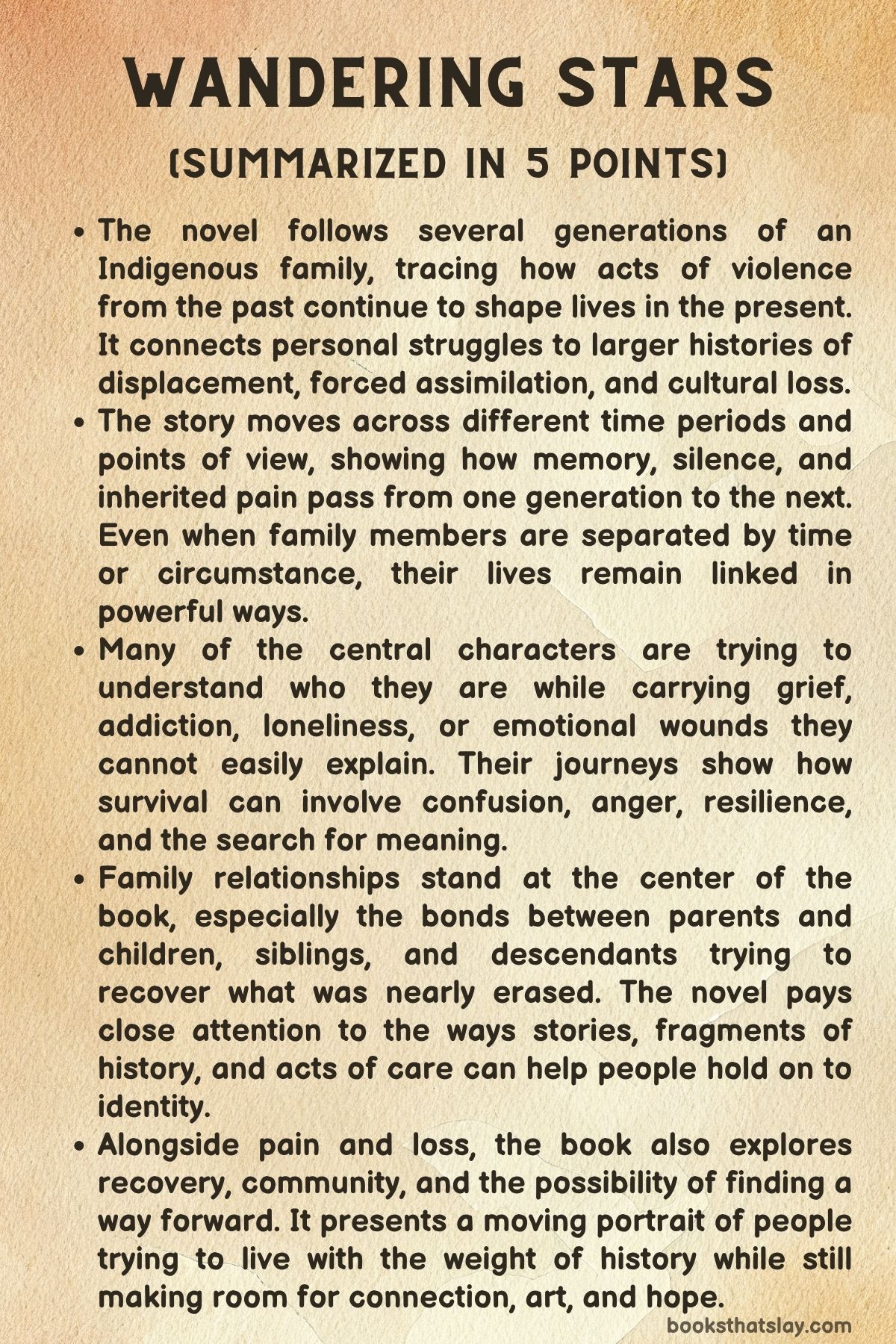
Wandering Stars by Tommy Orange is a multigenerational novel about how historical violence continues to shape Indigenous lives across time. The book moves from the Sand Creek Massacre and the era of forced assimilation into the lives of later descendants living in Oakland after the events of There There.
Orange shows how trauma can pass through families not only in stories and memory, but also in silence, addiction, shame, and survival. At the same time, the novel is about endurance, kinship, and the search for identity. It follows several generations as they struggle with grief, inheritance, and the difficult work of staying alive and finding a way back to one another.
Summary
The novel begins by placing Indigenous suffering within a long history of colonial violence in the United States. It recalls the Sand Creek Massacre, the destruction of Native communities, forced relocation, the killing of buffalo, imprisonment, and the boarding school system designed to erase Indigenous identity.
Fort Marion and Carlisle become symbols of this project, turning human beings into captives and then into targets of cultural reprogramming. This history is not treated as background alone.
It is the force that shapes the generations that follow.
Jude Star survives Sand Creek as a boy. He escapes through a landscape filled with death, carrying memories that remain with him for the rest of his life.
Along the way, he loses family, witnesses horror, and lives through hunger and cold. After being taken to Fort Marion, he endures the rule of Richard Henry Pratt, who treats Indigenous prisoners as subjects in an experiment of assimilation.
Jude is forced into performance, punishment, renaming, and religious instruction. Even when he finds meaning in the Bible, his reading is filtered through the pain of what has been done to his people.
He comes to see that being given a new name is not renewal but another kind of loss.
Later, in Oklahoma, Jude tries to build a life. He reads, writes, works, and marries Hannah.
He struggles with alcohol and uses drink as a way to recover speech from a silence that has overtaken him. His search for relief leads him toward ceremony, prayer, and the hope of family.
He eventually becomes a father to Charles. For a time, his life seems steady.
Yet the world around him remains hostile to Indigenous survival. Even as he tries to preserve stories for his son, he is placed in the cruel position of helping enforce laws against Native religious practice.
When he realizes Bear Shield’s family is about to be targeted during a ceremony, he helps them escape, knowing that the choice will cut him off from his own home and safety.
The novel then turns toward Richard Henry Pratt in old age. He reflects on his career without fully facing its brutality.
He continues to justify what he did, even while signs of doubt break through. His self-defense stands in contrast to the suffering of the people whose lives he helped damage.
One of those lives is Charles Star, Jude’s son, who bears the marks of trauma from Carlisle. Charles lives in Oakland, haunted by memory, dependent on laudanum, and unable to separate dreams, pain, and reality.
He wants to write and feels that writing could help him reach something true inside himself, but addiction keeps pulling him away from that possibility.
Charles plans a robbery and is shot while carrying it out. He dies alone, surrounded by blood, unfinished pages, and stolen money.
Pratt later finds his body, but even then he refuses full accountability, clinging to the idea that his methods were necessary. Charles’s death becomes another broken link in a family line already marked by displacement and violence.
Opal Bear Shield, who loved Charles and is pregnant with his child, discovers his body. She takes his papers, the money, and his body with her as she flees.
In hiding, she speaks to the child she carries, trying to pass on what she knows of Charles, of Carlisle, and of Cheyenne custom. Her memories are incomplete, but she still tries to honor the dead and preserve what can be saved.
She gives birth to their daughter, Victoria, and dies, leaving the child to be raised away from the full truth of her origins.
Victoria grows up with little connection to her heritage and in a home marked by alcohol misuse and emotional neglect. She eventually learns that she is Indigenous and receives a box of her father Charles’s things.
That box becomes one of the few material links to her past. She has daughters, Jacquie and Opal, but her own life is shaped by exhaustion, distance, and inherited damage.
Before she dies, she places Charles’s writings in the Friendship Center in Oakland so her daughters might one day recover something of where they come from.
The later part of the novel follows descendants living after the Big Oakland Powwow shooting. Orvil Red Feather is physically recovering from being shot and emotionally trapped in the aftereffects of terror.
He becomes increasingly dependent on pain medication, finding in it not just relief from injury but escape from nightmares, fear, and shame. Music becomes another language for him, one that gives shape to emotions he cannot otherwise express.
Yet the same sensitivity that opens him to music also leaves him vulnerable to addiction.
Sean Price, also recovering from injury, feels alienated within his adoptive white family and within the racial identity assigned to him by others. He develops his own drug habit, and he and Orvil connect online through shared pain and access to pills.
Their friendship grows around loneliness, confusion, and substance use. Sean offers Orvil stronger homemade drugs, and the two drift further from school, structure, and family.
Around them, the rest of the family is also struggling. Opal, the older matriarch, is trying to hold everything together while facing illness and the fear that she cannot protect the boys from what history has already done to them.
Jacquie is working to stay sober and rebuild trust after years of addiction. Loother is trying to make sense of himself through language, poetry, and young love.
Lony, the youngest, becomes fixated on blood, power, and ritual, searching for a version of Indigeneity that feels strong enough to answer his fear and helplessness. His imagination is intense and often alarming, but it grows from a real hunger for connection, meaning, and inherited knowledge.
A family trip to Alcatraz brings many of these tensions into the open. The island, a place of Indigenous political meaning as well as personal pain, becomes the setting for confrontation and memory.
Lony climbs a water tower, wanting to fly, wanting proof that belief can become power. Orvil climbs up after him, and the moment exposes both Lony’s desperation and Orvil’s own unraveling.
Each of them is trying to survive, but neither knows how to say what they need.
Orvil’s addiction worsens. He spends more time with Sean, takes increasingly dangerous pills, drops out of school, and slips away from his family.
After a car accident, he steals a bag of drugs and disappears further into dependency. Sean eventually gets clean, but Orvil spirals toward isolation and despair.
Lony, in his own crisis, runs away repeatedly, drawn toward the freedom of the road and the ocean. Eventually Orvil overdoses, collapsing while his family calls out to him.
This near-death experience becomes a turning point. Orvil enters treatment in the Sierra foothills and remains there for years.
Recovery is slow and imperfect, but he begins to build a life through work, running, music, and research. He thinks more deeply about land, ancestry, and the people whose names are too often forgotten.
Back in Oakland, he joins a band and continues trying to live clean, carrying his past without letting it entirely define him.
The final movement of the novel centers on Lony’s absence and return. After graduating, he leaves with friends and does not come back.
Years later, he writes to his family. In the letter, he explains that he left because he felt abandoned and because he needed to understand life outside the family’s wounded orbit.
Living outdoors and apart has changed his view of family and healing. He believes they all tried to recover alone when they needed one another.
He writes with honesty and forgiveness, asking whether it is too late to come home.
By ending with Lony’s letter, the novel closes not with full resolution but with the possibility of return. Across generations, the family has carried massacre, captivity, erasure, addiction, abuse, and grief.
Yet they have also carried stories, music, memory, and the wish to reconnect. The book argues that survival is not simple endurance.
It is the effort to gather what has been scattered, to name what was buried, and to come back to one another despite everything that tried to make that impossible.
Characters
Jude Star
Jude Star stands near the emotional and historical foundation of Wandering Stars because his life shows how mass violence does not end when the killing stops. He survives Sand Creek, but survival does not return him to the life he had before.
The boy who escapes the massacre carries memory as a wound that shapes his entire way of being in the world. Jude is marked by silence, displacement, and the feeling that the world he belonged to has been destroyed beyond repair.
What makes him such a powerful character is that he is not only a victim of history. He is also someone trying to build meaning after near-total devastation.
His relationship to language, religion, music, and ceremony reveals a person searching for a form of life that can still hold him.
His silence is one of the most striking aspects of his character. He does not simply become quiet by temperament.
His muteness suggests a mind and spirit so deeply affected by violence that ordinary expression no longer feels possible. Alcohol gives him temporary speech, which makes his drinking more than a habit.
It becomes tied to access, release, and damaged selfhood. At the same time, Jude is thoughtful, observant, and inwardly rich.
His reading of the Bible shows his ability to interpret one tradition through the lens of another, connecting Christian stories to Cheyenne knowledge rather than accepting colonial religion in the narrow form in which it is given to him. This makes him a figure of intellectual and spiritual complexity rather than passive assimilation.
Jude’s role as a father deepens his importance. He wants to pass stories to Charles, to give his son some continuity with the world that was nearly erased.
Those scenes reveal his tenderness and his longing to create a different future. Yet he is also caught in impossible moral conditions, especially when state power forces him into conflict with Indigenous ceremonies.
His decision to protect Bear Shield’s family shows courage, loyalty, and the refusal to allow authority to fully determine who he is. Jude’s character carries grief, conscience, love, and fracture all at once.
Through him, the novel shows how a person can be shaped by catastrophe and still struggle toward responsibility, care, and memory.
Charles Star
Charles Star represents inherited trauma in one of its most painful forms. He grows up in the shadow of his father’s suffering and then endures his own experiences of abuse and institutional harm.
He lives with a mind that cannot keep memory, dream, fear, and present reality neatly separated. This makes him a character defined by instability, but not by emptiness.
Charles is full of thought, sensitivity, and unrealized ability. He wants to write, and that desire matters because it suggests an effort to turn private damage into language.
Writing offers him the possibility of coherence, self-recognition, and authorship over a life that has mostly been shaped by outside force.
His addiction to laudanum is central to his character, but the novel never treats this as a simple moral failing. His dependency is connected to the abuse he suffered and the psychic overload he cannot contain.
He is haunted, and substances become one way of dulling what otherwise feels unbearable. Yet Charles is not reduced to a portrait of decline.
He remains a person with imagination and longing. His inner life has beauty in it, especially in the way he thinks about stories, loneliness, and what it means to be meant for something more than mere survival.
He senses that he might become a writer if he could only get close enough to himself.
His relationship with Opal also reveals a gentler and more hopeful side. Through her, he is seen not just as broken, but as someone worthy of love and memory.
This matters because his life could easily be read only through the lens of damage. Instead, he becomes a tragic figure whose lost possibilities are deeply felt.
His death during the robbery is devastating not only because he dies young, but because he dies on the edge of expression, with pages nearby and the sense that something in him remained unfinished. Charles embodies the cost of institutional violence across generations.
He also stands for the creative lives that colonial history distorts, interrupts, or destroys before they can fully emerge.
Opal Bear Shield
Opal Bear Shield is one of the novel’s strongest figures of endurance, practical intelligence, and emotional force. Her character carries both love and motion.
She acts when others hesitate, protects what she can, and keeps going even when there is almost no guidance available to her. After Charles dies, her actions reveal extraordinary resolve.
She is pregnant, grieving, vulnerable, and alone, yet she takes responsibility for his body, his writings, and the child she carries. She tries to honor traditions she only partly knows, which makes her deeply moving as a character.
She is not someone with complete inherited knowledge or stable cultural certainty. She is someone trying to preserve fragments in the middle of rupture.
That quality defines much of her significance. Opal represents the struggle to maintain continuity when history has broken the usual channels through which culture, ceremony, and belonging are passed down.
She remembers only pieces, but she values those pieces enough to carry them forward. Her speech to the unborn child is one of the clearest signs of that effort.
In those moments, she becomes a bridge between generations, even while her own life is under threat. She wants her child to know where she came from, who Charles was, and what should not be forgotten.
This makes Opal a character shaped not only by survival but by transmission.
She also has a fierce inner independence. She does not wait for permission to act, and she does not let fear erase her will.
At the same time, the character is not romanticized. She is operating within systems that have already constrained and damaged her future.
Her courage exists alongside vulnerability, uncertainty, and material precarity. That balance keeps her human and believable.
Opal becomes a symbol of maternal care, historical memory, and resistance without losing the immediacy of a young woman improvising her way through grief. Her life is brief, but her presence echoes far beyond it because her choices shape the line that continues after her.
Victoria
Victoria is one of the clearest examples of a person growing up downstream from buried history. She inherits a past that has been concealed, fragmented, and only partially preserved.
Raised without real access to her heritage, she lives with a disconnection she cannot fully name at first. That absence shapes her identity.
She senses that something has been withheld from her, and when she finally learns more about where she comes from, that knowledge arrives not as comfort but as a painful correction. Victoria’s character is defined by delayed recognition.
She has to understand herself through scraps, through objects, through disclosures that come too late and in damaged form.
Her life also shows how trauma can become ordinary within family structures. She grows up in a home marked by alcohol misuse and neglect, and this environment narrows her emotional and practical horizons.
She works hard, carries heavy responsibility, and becomes largely absent from her own daughters’ lives because survival takes up so much of her energy. That absence is not presented as indifference.
It is one more expression of how historical violence becomes domestic strain, exhaustion, and emotional distance. Victoria loves, but she cannot fully provide what she herself never received.
This makes her a tragic but deeply sympathetic figure.
The box of Charles’s writings is crucial to her character because it gives her one of the only direct connections to family history. Her attempt to preserve that archive for her daughters is an act of care that exceeds what she herself was given.
Even though she cannot repair the past, she tries to ensure that the next generation has access to something real and lasting. That gesture reveals her importance in the family line.
Victoria is not the keeper of perfect memory, but she is a custodian of what remains. Through her, the novel examines how identity can be both hidden and stubbornly present, and how preservation itself can become an act of love.
Jacquie Red Feather
Jacquie is one of the most layered characters because she embodies damage, appetite, shame, humor, endurance, and recovery all at once. She carries deep wounds from the past, including sexual violence, family instability, and addiction, yet she refuses to disappear into a single role.
She is not only a survivor, not only an addict in recovery, and not only a damaged elder returning to family life. She is someone trying to remain present inside her own history without being crushed by it.
That effort gives her character emotional depth and moral force.
Her sobriety is one of the central features of her later life, but the novel treats recovery as an ongoing, contested condition rather than a final achievement. Jacquie has urges, disappointments, habits of self-protection, and moments of loneliness that make sobriety difficult.
Even when she is doing well, the possibility of relapse remains near. This makes her struggle feel real.
She is learning how to live without numbing herself, which means she must confront memories and emotions directly. Her commitment to meetings and family obligations shows discipline, but the character remains alive because she is never reduced to a model of healing.
She is still funny, skeptical, irritated, observant, and vulnerable.
Her relationship with Opal is especially important. Their bond contains old hurt, uncertainty, and mutual care.
They cannot easily speak plainly about everything between them, yet their shared history creates a deep emotional current. Jacquie’s willingness to return, stay sober, and re-enter family life marks a significant act of courage.
She is trying to become available again, especially for the younger generation. That does not erase the past, but it changes the moral shape of the present.
Jacquie becomes a character through whom the novel explores whether repair is possible after years of absence and self-destruction. Her answer is not neat optimism.
It is persistence, honesty, and the difficult labor of staying.
Older Opal
Older Opal serves as one of the book’s central anchors of care, authority, and exhausted determination. She has spent years trying to create safety for a family that keeps getting pulled toward danger, grief, and inherited pain.
What defines her is not control but responsibility. She does not have the power to prevent trauma from touching the people she loves, yet she continues acting as though her effort matters.
That gives her character a quiet heroism. She signs papers, walks with children, handles crises, makes arrangements, keeps routines going, and tries to hold together a household that is constantly threatened by collapse.
Her strength, however, is never shown as invulnerability. She is tired, worried, and often aware that her care may not be enough.
The shooting has changed Orvil, Lony is unraveling in ways she cannot fully interpret, Jacquie’s sobriety feels fragile, and illness enters her own body. Her cancer deepens her character because it forces her into a different relationship with hope.
She wants healing, including culturally grounded healing, but she also confronts the limits of what she knows and where she can turn. Her fatigue is emotional as much as physical.
She has spent a lifetime managing aftermath.
At the same time, she is not merely a figure of burden. She carries memory and moral clarity.
She understands that family history matters, even when younger people do not yet know how to hold it. When she receives the preserved box of family writings, that inheritance changes something in her.
She begins to see survival not simply as making it through but as becoming remade through what one learns and carries forward. Older Opal becomes a character who joins endurance to reflection.
She is a guardian, but she is also a witness to what guardianship costs. Through her, Wandering Stars presents care as a demanding, imperfect, and sacred form of labor.
Orvil Red Feather
Orvil is one of the most searching and emotionally exposed characters in the novel. After surviving the shooting, he lives in a space where physical pain, psychic shock, shame, and confusion blur together.
He cannot simply return to ordinary adolescence because his body and mind have been permanently marked by what happened. He becomes a character defined by aftermath.
He searches online for other survivors, watches testimony, and tries to find an account of trauma that sounds like his own. What he finds is not clarity but recognition of confusion itself.
That is central to who he is: a young person trying to understand what survival means when survival feels ugly, frightening, and incomplete.
Music becomes one of his main forms of expression. He may not fully understand himself in language, but he begins to understand himself in sound, rhythm, and performance.
This gives him a path toward feeling and a way of shaping what otherwise seems chaotic. Yet the same openness that allows him to connect to music also leaves him vulnerable to dependence on medication and later on more dangerous drugs.
His addiction grows from several sources at once: relief from pain, relief from nightmares, access to confidence, escape from guilt, and the seductive sense of entering a more vivid reality through substances. His decline is painful because he recognizes what is happening and still cannot stop it.
Orvil’s character is also defined by the tension between isolation and return. He withdraws from family, school, and responsibility, but he never entirely loses the capacity for remorse or connection.
Even in his worst periods, he feels guilt about abandoning the people who love him. That guilt does not save him immediately, but it proves that he has not gone emotionally numb.
His overdose and later recovery do not erase what came before. Instead, they make visible his endurance, discipline, and capacity for transformation.
As an adult in recovery, still running, working, and making music, he becomes a figure of hard-won continuance. He does not represent easy healing.
He represents the long, uneven work of choosing life again and again.
Sean Price
Sean Price brings a different but connected form of dislocation into the novel. He is adopted into a white family and grows up feeling both included and fundamentally out of place.
His racial and cultural uncertainty is not abstract to him. It affects how he understands belonging, how others perceive him, and how he interprets power within his own home and community.
Sean is sensitive to hypocrisy and false equivalence, especially around race, identity, and bloodline. His discomfort with simplistic ideas about ancestry makes him intellectually alert, even when his life becomes chaotic.
He sees how whiteness protects itself through easy comparisons and evasions, and he resists that, though not always successfully.
His addiction story runs parallel to Orvil’s but has its own shape. Sean’s dependence begins through injury and medication, then deepens through access, family dysfunction, and the chemistry experiments happening in his father’s basement.
The fact that his father becomes a source of supply gives Sean’s situation a disturbing intimacy. The household itself becomes part of the machinery of his decline.
Selling drugs at school and sharing them with Orvil are not merely reckless acts. They emerge from a world where boundaries, care, and authority have already been compromised.
Sean knows he is in danger, but the structure around him normalizes that danger.
What makes Sean compelling is that he is not written as a simple corrupting influence on Orvil. He is lonely, wounded, searching, and often desperate for recognition.
His conversations with Orvil carry real affinity because both young men are trying to survive pain through altered states and mutual understanding. Sean’s later recovery adds another dimension to his character.
He does get clean, but he remains haunted by Orvil’s disappearance. That lingering uncertainty suggests moral growth.
He can no longer hide from the consequences of what happened between them. Sean becomes a portrait of someone shaped by racial confusion, family distortion, and addiction, but also capable of reflection, accountability, and lasting remorse.
Lony Red Feather
Lony is one of the most unpredictable and revealing characters because he expresses pain through imagination, ritual invention, and acts that others find alarming. He feels disconnected from stable knowledge about who he is and where he comes from, and that gap fills him with restless energy.
Rather than respond with passivity, he creates meanings. He studies blood, invents theories of Indigenous power, imagines superhuman abilities, and tries to transform helplessness into significance.
This does not make him merely eccentric. It makes him a child responding to inherited rupture by constructing his own symbolic world.
His self-harm is especially important because it combines pain, belief, and the need to do something active in a situation that otherwise leaves him powerless. He buries his blood as though it might produce change, strength, or connection.
This behavior is frightening, but it is also tragically understandable. Lony feels that ordinary adult responses are inadequate.
Therapy, caution, and reassurance do not reach the depth of what he is feeling. He wants evidence that being Indigenous means more than carrying damage.
He wants force, myth, and visible possibility. That desire drives both his rituals and his dangerous fantasies about flying.
At the same time, Lony is not only a symbol of crisis. He is perceptive, imaginative, and often startlingly philosophical.
He sees connections between time, history, belief, and identity that adults around him struggle to articulate. His idea that Indigenous people are treated as though they belong to the past is a sharp insight, not childish confusion.
His eventual disappearance and later letter show that his imagination matures into self-knowledge. Time away allows him to think differently about family, abandonment, selfishness, and forgiveness.
When he writes home, he does so with emotional clarity and surprising wisdom. Lony becomes a character whose early instability develops into moral vision.
He understands that healing cannot remain solitary, and that recognition makes his return deeply meaningful.
Loother Red Feather
Loother is quieter than some of the other major characters, but he is crucial because he represents a different response to family trauma. He is observant, verbal, inward, and resistant to false social expectations.
He does not need to fit in, and he does not especially want to. That independence gives him dignity, though it also isolates him.
Loother thinks carefully about language and how people interpret him. He knows that his directness can be mistaken for anger, and he understands that much of this misunderstanding is racialized and social rather than personal.
He lives with a calm awareness of the world’s distortions.
Language is his chosen medium for selfhood. He loves words, experiments with rap and poetry, and uses writing to move toward feeling and connection.
This creative practice distinguishes him from some of the family’s other forms of coping. Where substances offer escape and ritualized self-harm offers dramatic action, language offers Loother reflection and form.
His poem for Vee and his awkward, sincere movement toward young love show a softer side of his character. He is capable of tenderness, restraint, and genuine attention.
These qualities matter because they place him within the family as someone trying to make meaning without disappearing into self-destruction.
Still, Loother is not untouched by the family’s pain. His frustration with Lony and his sense that nothing about his family is normal reveal the pressure he lives under.
He has to watch addiction, crisis, and emotional instability unfold around him while trying to maintain his own interior balance. That quiet endurance is part of what makes him valuable.
He does not dominate the plot, but he helps show that trauma affects not only the visibly broken but also the siblings who keep functioning while absorbing everything around them. Loother’s steadiness, creativity, and emotional discipline make him one of the clearest embodiments of survival without spectacle.
Richard Henry Pratt
Richard Henry Pratt is one of the novel’s most unsettling characters because he is not presented as a cartoon villain. He is shown as a man deeply committed to an ideology of assimilation who remains capable of self-justification even in old age.
This complexity makes him more disturbing, not less. He believes he has acted in the service of improvement and civilization, and he measures himself against others in ways that let him feel comparatively humane.
Yet his thoughts reveal vanity, denial, and an inability to reckon honestly with the damage he caused. He turns conquest into policy and erasure into moral mission.
His significance lies in the way he represents institutional violence that can speak in the language of reform. Pratt does not need to hate Indigenous people in simple terms to destroy their worlds.
He can believe in his own benevolence while overseeing a system that strips people of language, names, kinship, and cultural life. That contradiction is central to his character.
He is terrifying because he is so convinced of his reasonableness. Even when he senses failure or regret, he redirects that feeling into resentment at being misunderstood or insufficiently praised.
His connection to Charles’s death deepens the novel’s moral architecture. Finding Charles dead does not lead him to a transformative recognition.
Instead, he continues trying to persuade himself that his method was the best possible one. This refusal makes him a figure of historical impunity.
He can approach death without giving up the story that protects him. Through Pratt, the novel examines how systems of domination reproduce themselves through conviction, bureaucracy, and moral distortion rather than through open brutality alone.
He stands as the face of a national logic that harms, renames, confines, and then calls that process help.
Themes
Historical Violence as a Living Force
The novel treats history not as a closed period behind the characters but as an active presence shaping bodies, families, language, and emotional life across generations. The early massacres, imprisonments, and boarding schools are not included simply to explain where the family came from.
They continue to exist in the present through silence, addiction, shame, fractured memory, and the interruption of cultural transmission. This is what gives the novel its moral and emotional structure.
It refuses the comforting belief that atrocity belongs to the past while the present stands separate from it. Instead, the present is shown as carrying the unfinished consequences of what was done.
This theme becomes especially powerful through the way inherited damage appears in forms that are not always immediately recognizable as historical. A person struggling with substances, a child who feels detached from identity, a family that cannot easily talk to one another, a household built around crisis management rather than ease: all of these are connected to older structures of violence.
The novel insists on this connection without reducing characters to case studies. It shows that historical violence survives by becoming intimate.
It enters homes, relationships, habits, and even self-perception. People can inherit wounds they do not have words for, and those wounds still shape how they move through the world.
The importance of this theme also lies in its rejection of simplified recovery narratives. Historical harm cannot be solved by individual resilience alone because it is collective, structural, and cumulative.
Yet the novel does not turn this insight into despair. Instead, it argues that naming these connections matters.
To see addiction, grief, and dislocation in historical context is not to excuse harm, but to understand it more truthfully. That truth allows for a different kind of moral attention, one rooted in memory rather than denial.
In Wandering Stars, history remains alive not because the characters are trapped in the past, but because the past was never allowed to end cleanly. Its effects continue, demanding recognition.
Survival, Return, and the Meaning of Continuance
Survival in this novel is never presented as a simple matter of staying alive. Many characters survive events that should have destroyed them, but survival by itself does not bring peace, clarity, or wholeness.
Instead, the book asks what kind of life is possible after catastrophe and whether return is possible after alienation, addiction, disappearance, or family rupture. This makes continuance a far more demanding idea than endurance.
To continue living is one thing. To return to oneself, to one’s people, or to a livable future is something more complex.
This theme appears across generations. Jude survives massacre but loses a world.
Charles survives abuse but cannot convert survival into stability. Opal survives loss and manages to carry memory forward.
Orvil survives the shooting, addiction, and overdose, then has to learn how to live beyond mere emergency. Lony survives through movement, estrangement, and distance before reaching a point where he can imagine coming home.
These arcs show that return is rarely literal or complete. A person does not simply go back to who they were.
The self has already been altered. What matters is whether a new relation to life can be built from what remains.
The novel’s treatment of return is especially moving because it refuses sentimentality. Families do not heal through one conversation.
Addiction does not vanish through insight. Trauma does not dissolve because someone wants it to.
Yet the possibility of coming back still matters profoundly. It appears in letters, in recovery, in shared meals, in preserved archives, in music, in ceremony, and in the ongoing effort to stay connected.
Continuance becomes meaningful when it includes recognition, accountability, and renewed relation. The novel suggests that survival becomes fuller when people are able to return not to innocence, which is impossible, but to one another with greater honesty.
That is why the ending carries such weight. It offers not a perfect reunion but an opening, and that opening is enough to make continuance feel morally significant rather than merely accidental.
Addiction, Pain, and the Search for Relief
Substance use in the novel is tied to physical pain, trauma, memory, shame, longing, and the desire for access to feeling. The characters do not turn to alcohol or drugs in a social vacuum.
They use because something in ordinary life has become intolerable, unreachable, or numb. The novel handles this with unusual care.
It does not sentimentalize addiction, but it also refuses the lazy moral framework that would treat substance use as proof of weakness. Instead, it shows how addiction can begin as relief, medication, speech, sleep, confidence, or escape, then slowly reorganize a person’s life around need and absence.
What makes this theme so strong is the variation in how it appears. For Jude, alcohol becomes connected to voice and expression after a life marked by trauma-induced silence.
For Charles, laudanum blurs memory and reality in a mind already damaged by abuse. For Jacquie, alcohol becomes one of the ways she manages pain and dislocation until recovery demands that she face herself without it.
For Orvil and Sean, pain medication opens into a broader chemical world of experimentation, dependency, and self-loss. The novel therefore treats addiction not as one experience repeated across characters, but as a pattern shaped differently by each person’s wound.
At the same time, the theme is not only about destruction. It is also about what substances reveal that characters are missing.
Relief is not trivial. Sleep, confidence, speech, numbness, and temporary freedom all answer real needs.
The tragedy is that the answer becomes its own prison. The novel shows this especially clearly in Orvil, whose use is tied to both terror and artistic awakening.
He feels more alive, more expressive, and less afraid, which makes the pull of addiction emotionally credible. Recovery, then, cannot simply mean stopping use.
It must involve building a life that can hold pain without annihilation. That is why work, music, movement, family, and honesty matter so much later on.
They do not erase the original need, but they offer forms of structure and meaning that drugs had falsely promised to provide. In Wandering Stars, addiction is a response to suffering, but recovery becomes a way of redefining what relief can mean.
Family, Memory, and Incomplete Inheritance
Family in the novel is not a stable source of comfort handed down through secure tradition. It is a broken, interrupted, and often painful structure through which memory travels imperfectly.
Characters inherit stories in fragments, objects in boxes, gestures without context, names without explanation, and emotional burdens without clear origin. This incomplete inheritance is one of the novel’s central concerns.
The question is not whether the past gets passed down, but how it does so when formal lines of transmission have been damaged by death, displacement, assimilation, secrecy, and addiction. The answer is that memory survives unevenly, and people must work to interpret what they receive.
This gives family a dual role. It is both the site where damage continues and the site where repair might begin.
Parents fail children, not always through cruelty, but through exhaustion, absence, or inherited incapacity. Siblings misunderstand one another even as they remain bound by love.
Elders carry knowledge but may not know how to speak it fully. Younger generations feel anger at what they were not taught, but they also hunger for connection to those same damaged lines.
The family is therefore not idealized. It is a tense, burdened, often unstable formation.
Yet it remains the place where preservation happens, however partially. A box of letters, a remembered story, a walk, a recipe, a conversation, a return letter years later: these become acts of inheritance.
The theme is especially rich because the novel does not suggest that complete recovery of the past is possible. Many things are permanently lost.
Languages, rituals, names, and relationships have been broken or erased. But incomplete inheritance is still inheritance.
Fragments still matter. A person can build identity not from total knowledge, but from what has survived and from the effort to treat what survives seriously.
This is why archives, storytelling, music, and family testimony carry such importance. They allow descendants to assemble meaning from remnants.
The emotional power of the novel comes in part from this recognition: that love may appear not as full transmission, but as the determination to leave something behind that another person can use to find their way. Family memory is damaged, but not gone, and that distinction shapes the entire moral world of the book.