Wanting Daisy Dead Summary, Characters and Themes
Wanting Daisy Dead by Sue Watson is a psychological thriller that revolves around the mysterious death of Daisy Harrington, a second-year student at Exeter University. After Daisy’s tragic death, her housemates, who all had complicated relationships with her, continue to be haunted by their past.
Two decades later, they are brought back together for a weekend event organized by a true crime podcast that aims to uncover the truth about Daisy’s death. As the housemates confront their darkest secrets, the investigation into Daisy’s murder uncovers hidden guilt, betrayal, and unresolved emotions, leading to a shocking confession that alters the course of their lives forever.
Summary
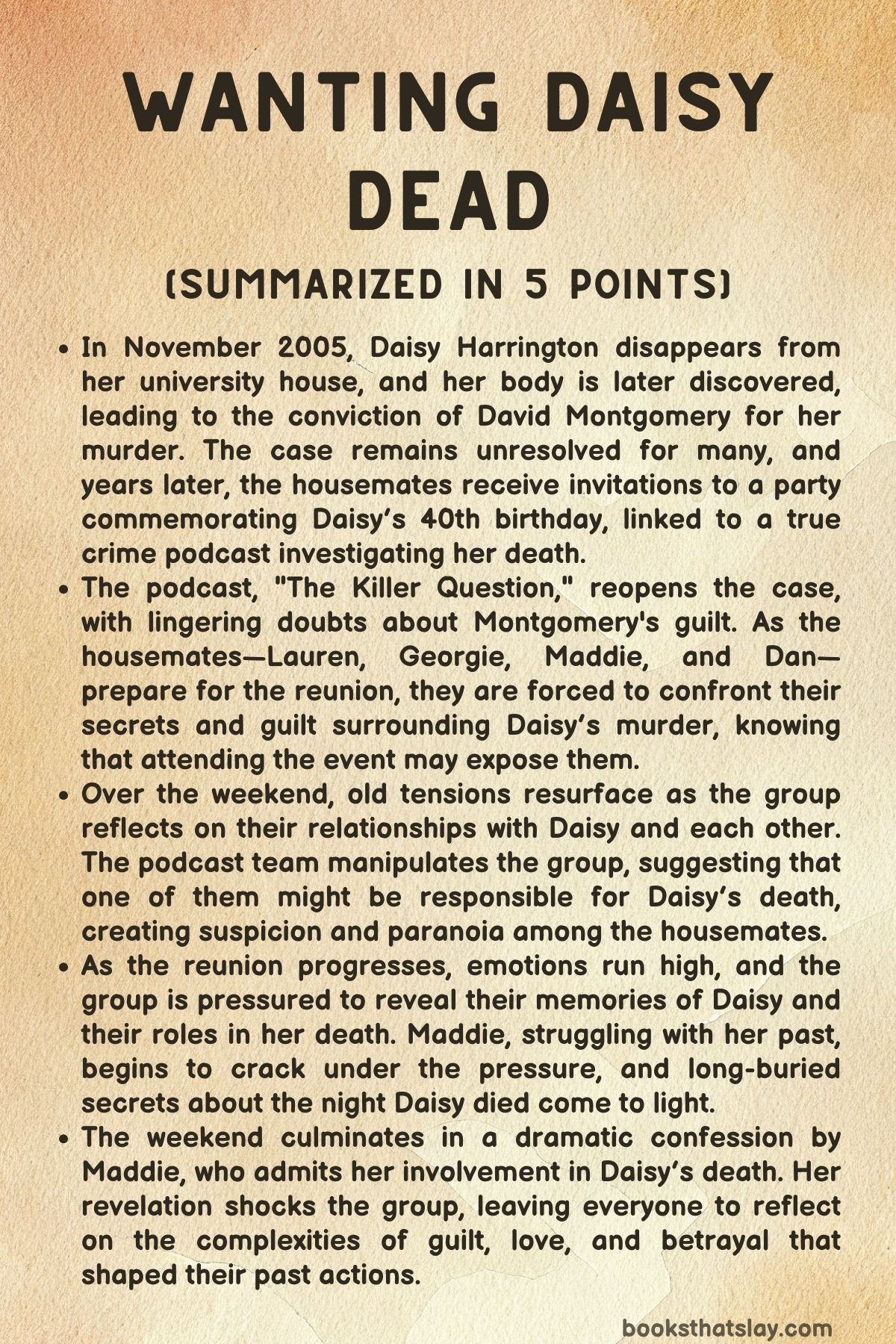
In November 2005, Daisy Harrington, a second-year student at Exeter University, goes missing after leaving her house to meet a friend. Her housemates initially assume she stayed over at a friend’s place, but when she doesn’t return the next day, they report her disappearance to the police.
Despite a media frenzy and multiple pleas for her return, Daisy’s body is eventually discovered on Exmouth Beach. The police arrest and convict David Montgomery, a professor, for her murder, but there’s lingering doubt about whether he was truly the killer.
Twenty years later, Daisy’s housemates—Lauren, Georgie, Maddie, and Dan—are still haunted by her death. Although they’ve moved on with their lives, the trauma of what happened remains.
They each receive an invitation to a birthday party being held in Daisy’s honor, commemorating what would have been her 40th birthday. The invitation carries a chilling message: “We know why you wanted Daisy dead – and if you aren’t at her party, everyone else will know too.” The invitations are connected to a popular true crime podcast, “The Killer Question,” which seeks to uncover the real story behind Daisy’s death, especially since David Montgomery, who was convicted of the crime, recently took his own life in prison.
The housemates, once close friends, now find themselves grappling with the guilt and secrets surrounding Daisy’s murder. Lauren, who became a successful author after writing a semi-fictionalized account of Daisy’s life, struggles with writer’s block and the pressure to produce another book.
The podcast’s reopening of the case brings her fears to the surface. Georgie, now married with children, feels the weight of the podcast potentially revealing her involvement in Daisy’s death.
Maddie, who fled the country after Daisy’s death, is also unnerved by the invitation. Dan, who had an affair with Daisy and was a suspect during the investigation, continues to wrestle with guilt and shame.
The invitation forces the housemates to confront their shared history, knowing that the truth about Daisy’s death might be exposed. Each character is affected by their past actions, and their responses to the invitation are shaped by their fear of what might come to light.
The weekend gathering at the university is meant to be a celebration, but it quickly becomes a tense and suspenseful event as the past resurfaces.
As the group reunites, they are subjected to being recorded for the podcast, which manipulates their conversations to draw out confessions and memories of Daisy. The podcast hosts suggest that David Montgomery’s conviction might have been a mistake, and they work to pry out the truth from the housemates.
Tensions flare, and old secrets begin to resurface. Each of the housemates had a reason to be angry with Daisy, and all of them are under suspicion.
Dan’s complicated relationships with both Georgie and Daisy come to the forefront. He had an affair with Daisy while still involved with Georgie, a betrayal Georgie is unaware of.
Their volatile relationship is strained further during the weekend, especially as they engage in passive-aggressive exchanges. Georgie, feeling the pressure of the past, begins to unravel.
She suspects Lauren might have had a motive for Daisy’s death, especially after learning that Daisy had been pregnant with Dan’s child at the time of her death. As the weekend progresses, each character’s past actions come under scrutiny, and the tension grows.
The podcast’s hosts continue to manipulate the group, raising the possibility that someone in the group might be responsible for Daisy’s death. As the characters discuss their memories of that night, suspicions shift, and they are all forced to confront their darkest secrets.
A voice note from the podcast hosts suggests that the group is being watched, and their answers to difficult questions will either clear or condemn them. The fear of exposure mounts, and by the time dinner arrives, the group is on edge.
During the final dinner, the group is asked to anonymously write down who they think the real killer is, if not David Montgomery. Their responses only deepen the suspicion, and the atmosphere becomes increasingly tense.
The line between guilt and innocence blurs as accusations are made, and the group begins to unravel emotionally. The weekend culminates in a dramatic moment when the podcast hosts reveal that they are, in fact, David Montgomery’s daughters, adding a new layer of complexity to the case.
As the weekend ends, the housemates are left uncertain of their fates. The podcast’s investigation has forced them to confront their pasts and the unresolved emotions they’ve carried for years.
Maddie, struggling with the weight of her actions, is ultimately revealed to have played a central role in Daisy’s death. She confesses to having killed Daisy in a fit of rage, driven by her deep feelings of love and rejection.
Maddie’s confession changes everything, as the truth about Daisy’s murder is finally revealed.
In the aftermath, Georgie writes a book about the events surrounding Daisy’s death, while Maddie serves time in prison, grappling with the consequences of her actions. The relationships among the housemates are forever altered, and they are left to reflect on how their past actions shaped their present lives.
The podcast, “The Killer Question,” ultimately exposes the complexities of guilt, betrayal, and redemption, leaving the housemates to reckon with their roles in the tragedy that changed their lives forever.
Characters
Lauren
Lauren, once a close friend of Daisy, has become a successful author after writing a semi-fictionalized account of Daisy’s life. However, the success that came from her first book has not come without its toll.
Lauren is grappling with writer’s block and a lingering sense of guilt. Her past with Daisy was marked by tension and unresolved issues, making the re-opening of the case deeply unsettling for her.
Lauren’s involvement in Daisy’s death is complicated; while she did not kill Daisy, her actions—particularly her plagiarism of Daisy’s manuscript—create a deep sense of guilt that haunts her throughout the story. As the investigation progresses, Lauren’s unease grows, especially as the podcast, “The Killer Question,” digs deeper into the truth of Daisy’s death.
Her interactions with the others reveal her internal struggles, particularly her complicated relationship with Georgie, who accuses her of having a motive to kill Daisy. Despite the pressure, Lauren remains enigmatic, with her true emotions often masked under the guise of control.
However, her emotional vulnerability becomes more apparent, especially as her past actions come to light, adding complexity to her character.
Georgie
Georgie is a woman of contradictions—cold, controlling, and harboring deep resentments, especially when it comes to her relationship with Daisy and Dan. As Dan’s wife, Georgie has long been aware of the affair between him and Daisy, a betrayal that has shaped her into a resentful and defensive character.
She is suspicious of everyone around her, particularly Lauren, whom she accuses of having a motive to kill Daisy. Georgie’s cold demeanor and defensive nature mask her inner turmoil and the weight of her own guilt.
During the investigation into Daisy’s death, Georgie becomes a focal point, with her past actions becoming central to the mystery. Her admission of sending the cruel letter to David Montgomery’s wife is a pivotal moment, revealing her jealousy and insecurities.
Georgie’s marriage to Dan, fraught with emotional neglect and betrayal, reaches a breaking point as she decides to leave him, marking a major turning point in her character arc. Throughout the story, Georgie struggles with reconciling her past actions with the present, but ultimately, she finds some sense of freedom from her toxic relationship with Dan.
Maddie
Maddie, who had once been Daisy’s closest friend, is the character most affected by the haunting memories of Daisy’s death. After fleeing the country following Daisy’s murder, Maddie is left emotionally fragile and struggling with guilt.
Her unrequited love for Daisy and the complicated feelings surrounding Daisy’s choices lead to a tragic moment where Maddie confesses to having killed Daisy in a fit of rage. Maddie’s deep love for Daisy, mixed with feelings of rejection and inadequacy, caused her to lash out in a way that would change her life forever.
Maddie’s confession reveals the depths of her emotional turmoil, her inability to cope with the rejection she felt from Daisy, and the overwhelming jealousy she harbored over Daisy’s relationships with Dan and others. After her confession, Maddie serves time in prison, where she continues to grapple with her past actions.
Her emotional dependency on her therapist, Cara, reflects her inability to let go of the past and her need to control the people around her. Maddie’s character is one of tragic complexity, shaped by deep love, guilt, and an overwhelming sense of inadequacy.
Dan
Dan, the married man caught in a love triangle with Daisy and Georgie, is a man consumed by guilt and shame. His affair with Daisy, coupled with his emotional neglect of Georgie, has left him in a state of constant conflict.
He is unable to escape his past, as the investigation into Daisy’s death brings his actions back to the surface. Dan is desperate to protect himself from being implicated in Daisy’s death and works hard to deflect suspicion onto others.
His relationship with Georgie is filled with tension, and the weekend reunion forces him to confront the brokenness of his marriage. While Dan tries to appear calm and in control, his emotions are often simmering just beneath the surface.
His interactions with the other characters reveal a man haunted by guilt and unable to truly make peace with his past. Throughout the weekend, Dan’s motivations become clearer, and his role in the events surrounding Daisy’s death becomes increasingly suspect.
He is a man trying to maintain control over a situation that is rapidly spiraling out of his grasp.
Alex
Alex is a character who initially seems like an outsider, but his involvement in the investigation brings him into the heart of the story. A former university friend, Alex had been to prison for dealing drugs in his youth but has since turned his life around.
His return to the university for the reunion stirs old feelings, particularly jealousy in Dan, who sees Alex as a rival for Maddie’s attention. Alex’s role in the investigation is revealed slowly, as it becomes clear that he has been secretly involved in the podcast and is gathering information from the former housemates.
Despite his charming demeanor, Alex is a character with a complicated past, and his presence adds a layer of tension to the already fraught dynamics within the group. His role as an informant in the investigation complicates the relationships within the group, as his actions stir suspicions and force the others to reflect on their own roles in Daisy’s death.
Themes
Guilt and Redemption
The theme of guilt plays a significant role throughout Wanting Daisy Dead, as each character confronts their own actions and the consequences they left behind. The traumatic events surrounding Daisy’s death are not only a catalyst for the investigation into her murder but also a profound source of guilt for the characters who were involved in her life.
For Lauren, Georgie, Dan, Maddie, and others, their responses to the past are shaped by a heavy burden of unresolved emotions. Lauren, who went on to have a successful writing career, grapples with guilt stemming from a deep-seated fear that her work—specifically the theft of Daisy’s manuscript—may have played a part in Daisy’s demise.
Despite her public success, Lauren feels the weight of her actions, unable to completely separate herself from her past mistakes. Georgie, on the other hand, experiences guilt regarding her involvement with Daisy’s tragic death, particularly after her passive-aggressive behavior, which included sending the cruel letter to David Montgomery’s wife.
As Georgie’s past actions are brought into the light, she is forced to confront the consequences of her jealousy and bitterness, emotions that ultimately contributed to her strained relationships with both Daisy and Dan.
Maddie’s guilt is perhaps the most complex and raw. Initially, Maddie’s love for Daisy is shown to have been deeply unrequited, and her feelings of rejection and emotional neglect spiral into dangerous territory.
Maddie’s internal conflict culminates in the violent act of striking Daisy, a confession that ultimately exposes the true complexity of her feelings. Her violent outburst stems from a combination of love, jealousy, and an overwhelming need for control over her relationship with Daisy.
As she finally admits her guilt, the complexity of her emotions and actions becomes evident, marking her attempt at redemption. For Maddie, confession becomes an essential moment for her healing process, although the consequences of her actions remain with her as she spends time in prison.
Redemption, as explored in this story, is not an easily attainable goal. It is not only a matter of confession but also of coming to terms with one’s past and attempting to make amends.
Characters such as Georgie and Lauren wrestle with whether redemption is even possible, given the gravity of their actions. For some, like Maddie, the journey toward redemption is a lifelong struggle, marked by a constant battle between guilt and the desire for peace.
Secrets and Betrayal
Betrayal is a powerful undercurrent in Wanting Daisy Dead, as each of the characters faces the reality of their actions and the secrets they’ve tried to keep hidden. The most significant secret, of course, is Daisy’s death, with each character potentially holding knowledge or playing a role in the events that led to her tragic end.
This theme is amplified by the re-opening of the case, thanks to the podcast “The Killer Question,” which forces the characters to confront their own lies and omissions. The re-emergence of the case brings out deep-rooted tensions, as everyone has something to hide.
At the heart of the betrayal is the group dynamic that once seemed so close-knit but was built on fragile foundations. Lauren’s secret about plagiarizing Daisy’s work is one such instance of betrayal, one that not only affects Daisy but also serves as a reminder of Lauren’s own moral transgressions.
This betrayal extends to the emotional level as well, as Lauren’s actions are driven by a desperate need for success and recognition, leaving Daisy’s legacy and memory in jeopardy.
Georgie’s betrayal of Daisy’s trust is even more personal, rooted in a history of rivalry and jealousy. Daisy’s affair with Dan, which Georgie was unaware of for a time, marks a deep betrayal that strains their already fragile friendship.
Georgie’s feelings of anger and bitterness toward Daisy are compounded when she is forced to confront her own role in Daisy’s death. The betrayal here is not just one of actions but also of emotions, as Georgie’s deep insecurities lead her to lash out in ways that she later regrets.
Maddie’s betrayal of Daisy is the most devastating, for it is not just an emotional betrayal but a violent one. The revelation that Maddie killed Daisy in a fit of rage turns the entire narrative on its head.
Maddie’s betrayal is rooted in an intense love that bordered on obsession, and when Daisy’s feelings didn’t mirror hers, Maddie’s emotional instability caused her to take a life. This act of violence marks the ultimate betrayal, as Maddie, in a moment of overwhelming emotion, took away the person she had wanted to be close to, all because of the emotional wounds left by Daisy’s rejection.
This betrayal haunts Maddie, as she can no longer escape the consequences of her actions, regardless of the internal struggles she faces.
Identity and Self-Perception
The search for identity and self-perception is a central theme that shapes the characters’ experiences in Wanting Daisy Dead. Each of the main characters has, at some point, struggled with defining themselves beyond the shadow of Daisy’s death.
Lauren, for instance, is a successful writer, but her fame is overshadowed by the secret she carries regarding the plagiarism of Daisy’s manuscript. Her identity is tainted by this unresolved issue, and the ongoing investigation into Daisy’s murder only intensifies her self-doubt.
Despite her outward success, Lauren feels trapped between the persona she’s built for herself and the guilt she cannot shed. The weight of this internal conflict affects her interactions with others and makes her increasingly isolated, as she becomes more consumed by the fear of being exposed.
Georgie’s sense of self is similarly affected by her relationship with Daisy. As a mother and wife, she is expected to maintain a certain facade of stability, but the truth about her own emotional neglect and feelings of betrayal create a growing sense of self-loathing.
Her bitterness toward Daisy and the subsequent unraveling of her marriage with Dan forces Georgie to reassess who she is beyond her role as a wife and mother. The slow breakdown of her marriage further complicates her search for identity, as she struggles to redefine herself outside the toxic relationship she has had with Dan.
Maddie’s journey toward understanding her identity is the most tragic. She once saw herself as Daisy’s closest friend and confidante, but the rejection she felt from Daisy, combined with her inability to express her emotions, led to a violent rupture.
Maddie’s violent act not only ended Daisy’s life but also marked a break from the image she had of herself as someone who could be loved and accepted. After the murder, Maddie struggles with reconciling her violent actions with the person she once believed herself to be.
The guilt she feels as she faces the consequences of her actions challenges her self-image and makes her question whether redemption is possible for someone like her. Her relationship with her therapist, Cara, highlights the ongoing struggle Maddie faces to reconcile the different parts of her identity—the loving person she wishes to be and the one who allowed her emotions to spiral out of control.
The Impact of the Past
The past, in Wanting Daisy Dead, is not something that can be easily outrun. The characters’ relationships with their past actions and the death of Daisy permeate every aspect of their present lives.
For each of the housemates, the trauma they experienced twenty years ago continues to haunt them, shaping how they view themselves and their interactions with others. The weekend reunion, organized by the podcast, serves as a confrontation with the past, forcing the characters to relive their darkest moments.
The past impacts Lauren’s success, Georgie’s marriage, and Maddie’s emotional well-being. No one is untouched by the events of the past, and each person’s attempt to move forward is hindered by the unresolved guilt and pain that they carry.
The podcast’s re-opening of Daisy’s case is not just a professional investigation but a psychological one for the characters. It brings back old memories, reigniting their fears and insecurities.
The relentless reminder of Daisy’s death and the possibility that one of them may be responsible forces them to reckon with their past actions in a way that they have been trying to avoid for years. This resurfacing of old emotions makes it impossible for any of the characters to escape the reality of what happened.
The past, with all its complexities and unresolved issues, is not something that can be buried, and it eventually demands attention, forcing the characters to face the uncomfortable truths about themselves and their relationships with one another.