We Fell Apart Summary, Characters and Themes | E. Lockhart
We Fell Apart by E. Lockhart is a novel that explores themes of family, identity, and the search for connection. The story revolves around Matilda Avalon Klein, a young woman who embarks on a journey to meet her estranged father, Kingsley Cello, a renowned artist she has never known.
Invited to his remote estate, Hidden Beach, Matilda arrives expecting to find a father with whom she can build a relationship, but instead, she discovers a family filled with secrets, emotional turmoil, and unanswered questions. As Matilda navigates this chaotic and unpredictable environment, she grapples with her feelings of abandonment and her search for belonging. It’s the 3rd book in the We Were Liars series.
Summary
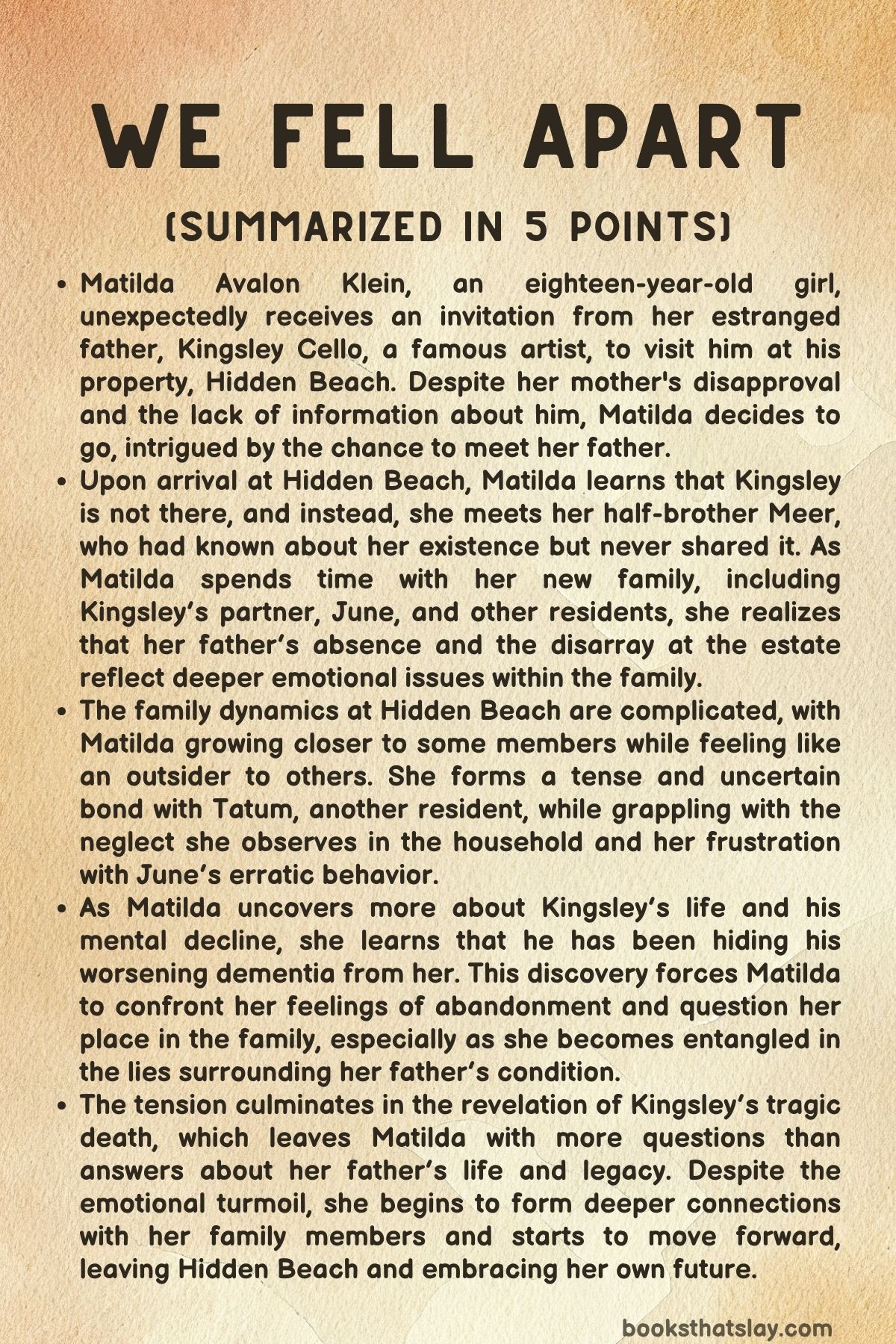
Matilda Avalon Klein, an eighteen-year-old girl, has lived most of her life with her mother, Isadora, a former artist’s muse who raised her alone after being abandoned by Matilda’s father, Kingsley Cello, an enigmatic and controversial artist. Matilda receives an unexpected email from Kingsley, inviting her to Hidden Beach, his remote estate on Martha’s Vineyard, where he offers to give her a painting.
Intrigued by this sudden gesture and with a mix of curiosity and unresolved emotions, Matilda decides to visit him, despite her mother’s disapproval and lack of information about Kingsley.
Growing up, Matilda had little contact with her father, and her mother, Isadora, rarely spoke of him, though she often hinted at their tumultuous past. Isadora’s relationship with Kingsley had been brief; after he painted her portrait, their romance ended abruptly when she became pregnant with Matilda.
Kingsley disappeared from Isadora’s life before Matilda was born, leaving Isadora to raise her on her own. Over the years, Isadora moved from one unstable relationship to another, and Matilda never knew a permanent home or the stability of a true family unit.
Upon learning more about Kingsley, Matilda discovers that he is famous for his neoclassical paintings that combine classical mythology with modern, often violent interpretations. He is wealthy and his works sell for millions, but Isadora never profited from her own portrait.
Matilda is left conflicted by her mother’s silence about Kingsley and her growing desire to meet him. Isadora confesses that she had lived with Kingsley for a short time in New York, but when Isadora became pregnant, Kingsley left without support.
In the aftermath of her breakup with Luca, her boyfriend, Matilda receives another email from Kingsley, detailing cryptic instructions on how to get to his estate. She feels lost, isolated, and unsure of where her life is heading.
Still, she decides to make the journey to Hidden Beach, hoping to finally meet her father and perhaps understand him better.
Arriving at Martha’s Vineyard, Matilda meets two young women, Holland and Winnie, who take her in for a while. Despite their warm hospitality, Matilda remains focused on her upcoming meeting with Kingsley.
She is tired, disoriented, and emotional, but she pushes forward, following the instructions she has received to reach Hidden Beach. When she finally arrives, she is greeted not by her father, but by Meer, her half-brother, who had been aware of her existence for years.
Kingsley, however, is not there—he is off on an unexpected trip.
Meer takes Matilda around the estate and explains that Kingsley, a free-spirited artist, comes and goes as he pleases, and the household is chaotic. Matilda begins to learn more about her father’s unconventional family.
She is introduced to Brock, a troubled young man, and June, Kingsley’s partner, who is an artist and herbalist. The relationships in the household are strained, with much of the emotional baggage left unspoken.
Matilda begins to feel like an outsider in this world, especially with Tatum, a brooding and distant young man who seems to resent her presence.
The group visits the ruins of an old mansion on Beechwood Island, the site of a recent fire that claimed several lives. Tatum is deeply affected by the visit, as it reminds him of his own tragic past.
Back at Hidden Beach, Matilda struggles with her feelings of displacement. She is still hoping to meet her father, but his absence, combined with the underlying tension in the household, leaves her feeling increasingly uncertain.
Matilda becomes more involved in the everyday life at Hidden Beach, even helping June with her indigo dyeing. She begins to bond with Meer, but the household dynamics remain uncomfortable.
June’s erratic behavior, her neglect of her family’s needs, and the declining upkeep of the property highlight the neglect that pervades the family’s life. Matilda confronts June, accusing her of not taking care of the people around her, but June remains distant and unaware of the turmoil she has caused.
Meer, searching for purpose, takes up raising poultry, but disaster strikes when the family dog attacks the birds. This event, though tragic, brings Tatum and Matilda closer, and they share a moment of emotional vulnerability.
However, the tension remains as Tatum, struggling with his own discontent, seems unsure about his feelings for Matilda.
As Kingsley’s whereabouts remain unknown, Matilda discovers more about her father’s past. She finds his artwork and sketches, which suggest a darker side to Kingsley’s personality.
His fame as an artist is tainted by his refusal to face his emotional issues, and Matilda’s vision of him begins to crumble. When Kingsley’s condition takes a turn for the worse, Matilda uncovers the truth about his deteriorating health.
Kingsley, suffering from dementia, has been hiding away in the tower, his behavior becoming more erratic and dangerous. The family has been concealing his illness from Matilda, and she is devastated by the deception.
In the final stages of the story, Matilda confronts her father, only to be rejected and accused of being part of a conspiracy. She realizes that her idealized vision of Kingsley is unachievable, and the family’s dysfunction is beyond repair.
The situation culminates in tragedy when Kingsley is found dead, his death leaving Matilda with more questions than answers. June insists on keeping the details of his death private, which only deepens the sense of mystery and unresolved feelings.
Matilda, now filled with grief and confusion, comes to terms with the complexities of her relationship with Kingsley and the people at Hidden Beach. She decides to leave the island, accepting that her father’s legacy is not hers to claim.
As she heads to college with Tatum, she begins to look forward to a future that is no longer defined by her past, choosing to move on from the turbulence and uncertainty of Hidden Beach.
Characters
Matilda Avalon Klein
Matilda Avalon Klein is the protagonist of We Fell Apart, a young woman struggling with feelings of abandonment and emotional turmoil. Her complex relationship with her estranged father, Kingsley Cello, is the central thread that ties her journey together.
Throughout the story, Matilda is portrayed as curious, sensitive, and introspective. Raised by her mother, Isadora, Matilda has never known her father, and her understanding of Kingsley is shaped by conflicting emotions: her mother’s disdain for him, the fame he achieved as an artist, and the mystery surrounding his absence.
Matilda’s journey to Hidden Beach, in search of connection with a father she never knew, represents her longing for identity and belonging.
Despite her yearning for answers, Matilda is often conflicted, especially as she uncovers more about Kingsley’s erratic behavior, the dysfunction of her father’s family, and her own place within it. She struggles with her sense of isolation and her sense of self-worth, particularly after a breakup with her boyfriend Luca.
At Hidden Beach, Matilda finds herself navigating complicated dynamics with her newfound family members—her half-brother Meer, his chaotic mother June, and Tatum, a brooding young man with whom she forms an intense and complex relationship. Through her experiences with these people and her father’s decline, Matilda learns to grapple with her emotions, her identity, and her role in the fractured world around her.
Kingsley Cello
Kingsley Cello, Matilda’s father, is a celebrated yet controversial artist known for his neoclassical paintings that mix classical mythology and fairy tales. Throughout We Fell Apart, Kingsley is portrayed not only as a genius but also as an elusive and distant figure, whose absence looms large in Matilda’s life.
As a man of considerable fame and wealth, he seems to embody the contradictions between artistic brilliance and personal failure. His relationship with Matilda’s mother, Isadora, ended when she became pregnant, and he vanished soon after, leaving her to raise Matilda alone.
Kingsley’s neglect of Matilda and his mysterious abandonment of the family define much of her emotional struggles.
When Matilda finally visits Hidden Beach, Kingsley’s decline due to dementia becomes a shocking revelation. He is not the vibrant, idealized father she had imagined, but a man imprisoned by his illness, paranoia, and violent outbursts.
His refusal to acknowledge his illness and his estrangement from those who care for him, including June, reveal the darker side of his personality. Kingsley’s enigmatic and troubled past, intertwined with his tumultuous relationships and his artistic legacy, complicates Matilda’s search for closure and understanding.
His death, shrouded in mystery and surrounded by secrecy, forces Matilda to confront the painful reality of who he was and what he left behind.
Isadora
Isadora, Matilda’s mother, is a complicated figure in We Fell Apart. A former muse to various artists, she has always been Matilda’s sole family and source of emotional stability.
Isadora’s past with Kingsley defines much of her character and her relationship with her daughter. She was abandoned by Kingsley when she became pregnant, and though she never speaks ill of him, her actions and words suggest a deep, unresolved pain from this betrayal.
Isadora’s relationships with a series of transient men after her split from Kingsley further reinforce her detachment from stable commitments, leading Matilda to grow up in a somewhat unstable environment, moving from one place to the next.
Despite her apparent emotional distance, Isadora is protective of Matilda, keeping the secrets of their past and Kingsley’s identity from her. Her reluctance to reveal more about Kingsley may be her way of shielding Matilda from the emotional complexity of her father’s legacy.
However, Isadora’s failure to offer clear answers about Matilda’s father ultimately contributes to the confusion and emotional isolation Matilda feels. Her own struggles with abandonment and identity resonate with Matilda, shaping how she views her mother’s choices, her upbringing, and her own sense of self.
Meer
Meer is Matilda’s half-brother, a young man raised in the unconventional and often chaotic environment of Hidden Beach. While he is initially a stranger to Matilda, their relationship becomes an essential part of the story as she uncovers the truths about her father’s family.
Meer’s upbringing at the castle-like estate is marked by isolation, unconventional schooling, and a family dynamic that is both nurturing and dysfunctional. Despite his oddities and the chaotic nature of his home, Meer is an important figure in Matilda’s search for her place within the family.
Though he is friendly and eager to connect with Matilda, Meer is often seen as detached and somewhat aimless. His deep emotional struggles are revealed through his relationships with his family members, especially June, his mother.
Meer’s fascination with raising poultry as a form of solace demonstrates his longing for control and stability in a life that feels out of control. His actions, though seemingly trivial, reflect the undercurrents of grief, guilt, and longing that shape his existence.
In many ways, Meer serves as both a guide and a reminder to Matilda of the disjointed family she is now part of, one that both embraces her and alienates her at the same time.
Tatum
Tatum is a brooding and emotionally complex character who plays a significant role in We Fell Apart. As a member of the Hidden Beach household, Tatum embodies the internal conflict that pervades the estate.
His relationship with Matilda begins with tension and reluctance, as he initially sees her as an intruder in the already fractured dynamics of the house. Tatum’s own emotional wounds, stemming from his past and his family’s tragic losses, inform his difficult behavior and his often cold exterior.
As the story progresses, Tatum becomes a key figure in Matilda’s emotional development. Despite their tumultuous interactions, he forms a bond with her, revealing his own struggles with abandonment and isolation.
Tatum’s feelings for Matilda grow, and they share an unexpected kiss, which only complicates their already strained relationship. However, his emotional guardedness and tendency to push people away continue to create friction.
Tatum is also deeply affected by the ongoing mystery of Kingsley’s absence and the emotional strain it places on the household. His eventual confession of love for Matilda and his role in hiding Kingsley’s illness from her represent the complexities of his character, torn between loyalty, guilt, and love.
Tatum’s evolution throughout the story reflects the emotional turbulence and healing that both he and Matilda must undergo as they come to terms with their shared grief and the dysfunctional world around them.
June
June is Kingsley’s partner and the mother of Meer. A talented artist in her own right, June is deeply embedded in the world of Hidden Beach, yet her behavior grows increasingly erratic throughout We Fell Apart.
At first, June appears to be a calm and nurturing figure, a counterbalance to the chaos of the house. She is an artist and herbalist, working with indigo dye and brewing tinctures, but as the story progresses, it becomes clear that her mental state is deteriorating.
June’s neglect of her responsibilities, particularly her failure to care for Meer and Brock properly, highlights her emotional detachment and inability to manage the complexities of her life.
June’s failure to acknowledge her own emotional struggles and her involvement in hiding Kingsley’s declining health further reveal the layers of dysfunction that permeate the family. As the story unfolds, Matilda confronts June about her neglect, and their relationship becomes fraught with tension.
June’s inability to face the truth about Kingsley and her own role in the family’s chaos leaves Matilda feeling even more alienated. Despite her creative talents and moments of nurturing, June’s actions ultimately contribute to the unraveling of the family, making her both a sympathetic and tragic figure in the story.
Themes
Family and Estrangement
The theme of family and estrangement is central to We Fell Apart. Matilda’s journey is deeply influenced by the fractured relationships within her family, particularly with her estranged father, Kingsley Cello.
Matilda has grown up without a father figure, raised instead by her mother, Isadora, who has her own complex history with Kingsley. Despite their past, Kingsley’s invitation to Matilda to visit him creates a glimmer of hope for a connection that has been long absent.
However, this hope is tempered by the realities of Kingsley’s distance and the complications surrounding his life. The estrangement is not only emotional but physical as well, with Kingsley’s absence from his home being a symbol of his disengagement from his own family.
Matilda’s discovery that she has a half-brother, Meer, who has known about her existence for years, but whom she was unaware of, further emphasizes the extent of the family’s disintegration. This sense of estrangement is amplified by the secrets and lies surrounding Kingsley’s condition and his family.
The deeper Matilda delves into her father’s life, the more she realizes how much she has been excluded from the emotional fabric of her family. Her relationship with Tatum also explores themes of abandonment and isolation, adding another layer to her understanding of familial ties and the yearning for connection.
Identity and Self-Discovery
As Matilda grapples with the revelation of her family’s complexities, she embarks on a path of self-discovery. Her identity, shaped by the absence of a father and the emotional distance from her mother, comes into question when she begins to learn more about Kingsley, the man who should have been a part of her life.
Matilda struggles with the idea of who she is—caught between the life she’s built with Saar, a stable figure in her life, and the allure of the chaotic and mysterious world at Hidden Beach. This conflict intensifies as she learns more about her father’s art, which is controversial, violent, and deeply symbolic, echoing themes of isolation and escape.
Her own sense of identity becomes tangled in the questions surrounding Kingsley’s legacy and her place within it. The more Matilda unearths about her family’s past, the more she realizes that her own identity is not only shaped by her relationships but by the secrets that bind her to her family.
In trying to understand her father’s world, she also begins to understand herself better. The theme of self-discovery is not just about finding her place in the family, but about finding her own purpose and path moving forward.
Legacy and Artistic Expression
Legacy plays a pivotal role in We Fell Apart, particularly through the lens of Kingsley’s art. As an artist, Kingsley’s fame is tied to his controversial neoclassical paintings, which are infused with themes of violence, mythology, and fairy tales.
For Matilda, her father’s legacy is one that she must contend with, not only because of the emotional distance but also because of the overwhelming presence of his artwork. Her discovery of his paintings, along with the intricate details of his life, forces her to confront the legacy of a man who, despite his artistic brilliance, was emotionally distant and neglectful.
Kingsley’s art is also deeply tied to his personal history, his isolation, and his strained relationships with those around him. As Matilda examines his paintings, she begins to understand the undercurrents of his life, filled with both beauty and darkness.
The concept of legacy is not just about the physical inheritance Matilda stands to gain from her father, but also the emotional baggage that comes with it. Her understanding of Kingsley’s art evolves as she tries to reconcile her image of the artist with the reality of his deteriorating health and the fractured state of his family.
Ultimately, Matilda must decide how she wants to carry forward her own legacy, knowing that her father’s legacy will never fully be hers to claim.
Mental Illness and Its Impact on Relationships
Kingsley’s declining health due to dementia introduces the theme of mental illness and its profound effect on relationships. As Matilda uncovers the extent of her father’s illness, she is confronted with the reality that the man she imagined meeting is no longer the person she anticipated.
Kingsley’s dementia has led to paranoia, forgetfulness, and violent outbursts, and the secrecy surrounding his condition deepens the emotional divide between him and his family. June, his partner, has taken on the burden of caring for him, but her emotional exhaustion and erratic behavior reveal the strain that mental illness places on family dynamics.
Matilda’s confrontation with her father’s illness forces her to come to terms with her own feelings of abandonment, as she realizes that her father’s absence wasn’t just physical but mental as well. She is caught in a cycle of wanting to understand her father and to help him, but struggling with the overwhelming sense that it may be too late.
The emotional toll of caring for someone with dementia is evident in the way the family members, including Tatum, Meer, and June, cope with Kingsley’s deterioration. The theme of mental illness adds complexity to Matilda’s journey, as she must navigate her relationship with her father and her understanding of the emotional scars he has left on her and the rest of the family.
It highlights the challenges of reconciling the idealized image of a loved one with the reality of their illness and the lasting impact it has on family bonds.
The Search for Belonging
At its core, We Fell Apart is a story of belonging and the search for connection. Matilda, raised without a father and by a mother who had her own struggles, has always felt disconnected from those around her.
Her life with Saar provided stability, but it was never the family she longed for. Her journey to Hidden Beach, where she hopes to finally meet her father, represents her desire for a sense of belonging, for finding a place where she can fit in.
However, her arrival at the island forces her to confront the truth that belonging is not as simple as being with family. The dynamics at Hidden Beach are complicated and filled with tension, from her strained relationship with Tatum to the chaotic environment of the household.
Despite moments of connection with Meer and even with Tatum, Matilda still feels like an outsider, not just in her father’s world but in her own family. As the story unfolds, Matilda learns that true belonging does not come from being surrounded by people, but from understanding oneself and making peace with the complexities of family and identity.
Her search for belonging is not just about finding a place within the family, but about creating her own sense of home, both within herself and in her relationships with others.