We Who Will Die Summary, Characters and Themes
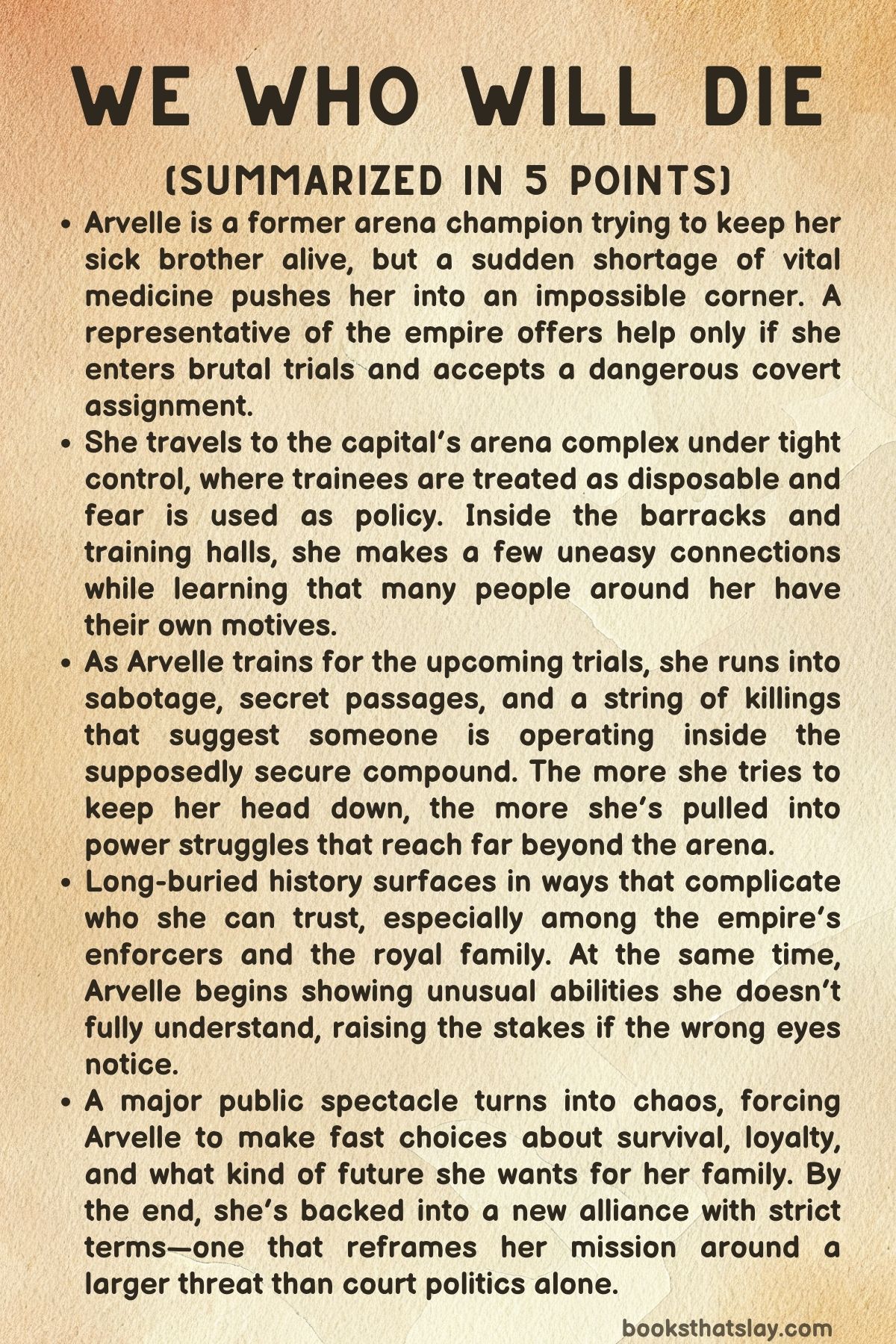
We Who Will Die by Stacia Stark is a dark fantasy centered on Arvelle, a hardened young woman who’s survived poverty, loss, and the brutal arena culture of her empire. When her brother Evren’s lung illness worsens and all medicine vanishes from the city, Arvelle is cornered by a vampire envoy with an impossible offer: enter the emperor’s deadly trials and earn a place near the throne—then use that access to kill the emperor.
Forced into the capital’s underground fighting world, Arvelle faces political schemes, old ghosts, and powers awakening inside her, while trying to keep her family alive.
Summary
Arvelle spends her nights working security in Yorick’s tavern, where rules forbid displays of power. She keeps her employer’s gambler, Gaius, safe while he drinks and bets with his friend Magnus.
Trouble arrives when Orson Norcross, a silver-crowned noble, storms in furious over Gaius’s affair with Orson’s wife. Arvelle holds her ground and reminds Orson of the tavern’s rule.
Orson retreats, promising punishment later. When Arvelle’s shift ends at 4 a.m., she rushes into the Fog’s Edge district to buy lung tonic for her brother Evren, whose coughing fits are so severe they can stop his breathing.
The apothecary is sold out, and so are the others. Arvelle realizes someone is buying up every vial in the city, and panic hits—Evren cannot last long without it.
At dawn she returns home and finds an elegant vampire waiting outside. He calls himself Bran and claims to serve the emperor.
He produces two vials of lung tonic and shows he knows far too much about Arvelle: that she once won the Sands, an arena contest that marks her as a lethal fighter. Bran proposes a bargain.
Arvelle must enter the Sundering—three arena trials that lead to recruitment into the Praesidium Guard. If she succeeds, Evren will be kept alive with steady medicine and sent to elite healers in Nesonias.
Arvelle refuses. Bran then reveals the real demand: once she’s close enough, she must kill Vallius Corvus, the emperor.
Arvelle still refuses, until Bran gives her an ultimatum and a deadline of midnight.
Before she can decide, Evren suffers another attack. Arvelle uses the last of her tonic alongside salves, crystals, and chants to pull him back from the edge.
Evren’s twin, Gerith, rages about how their uncle stole Arvelle’s Sands winnings years ago, stealing their chance to leave and find real care. Arvelle plans to travel to another city to search for tonic, but life interrupts—Gerith has invited a hungry teenage girl, Sarai, to breakfast.
Arvelle feeds her anyway, then sends Sarai off with the twins to their tutor.
Arvelle checks on Fallon, a young fighter she coaches, and runs into Carrick, a man close to her who wants a future together. He warns her about murders in the Thorn—bodies found with their hearts missing.
Carrick presses her to leave the past behind and offers marriage and escape for her and the twins. Arvelle refuses.
Their argument is cut short when Gerith arrives in tears: something is wrong with Evren.
Arvelle races home to find Evren collapsed outside, gasping for air, while Bran stands nearby holding the medicine. Bran refuses to help unless Arvelle accepts the deal immediately.
Carrick tries to intervene; Bran shatters one vial on purpose to prove his control. With Evren fading, Arvelle agrees.
Bran forces Evren to drink vampire blood to repair the immediate damage and stabilize him, then threatens to kill both brothers if Arvelle runs. Arvelle turns to Leon, her former trainer and the father of Kassia—Arvelle’s best friend who died in the Sands.
Leon blames Arvelle for Kassia’s death and warns the Sundering will kill her too, but he reluctantly agrees to accompany her.
Bran locks the agreement in place brutally: he bites Arvelle, breaks her wrist, then makes her drink his blood so the injury heals. Arvelle packs fast, gives her brothers whispering mirrors for daily contact, and forces them to promise they’ll flee if threatened.
Bran sends the twins away under the guard of a vampire woman named Elva, who claims she will keep them alive and take them to healers. Arvelle watches them depart toward Nesonias, knowing their safety depends on her obedience.
Bran, Leon, and Arvelle travel to the capital’s arena city and enter the underground training complex where gladians live like stock penned for entertainment. Bran gives Arvelle a false background as his sponsored fighter.
In the barracks she meets Maeva, a friendly half-bronze gladian, and is threatened by Baldric and his sister Hester, who recognize her from past arena days and swear to kill her. Arvelle refuses to back down.
Maeva points out the imperius—a table where vampires and sigilmarked elites sit together—and identifies the massive armored vampire watching Arvelle as the Primus, the emperor’s top enforcer. That means Arvelle’s mission is far worse than she imagined.
Arvelle’s memories cut back to her childhood refuge: an oak tree overlooking the Thorn, where she once stole a noble boy’s jacket to sell for food and aether stones. The boy returns later, calling himself Ti, intrigued rather than furious.
Their uneasy connection is framed by Arvelle’s need to survive and her instinct not to trust.
In the present, danger in the training complex escalates. Maeva warns that gladians are already being found dead outside the arena.
The emperor’s eldest son, Prince Rorrik, demonstrates what happens to suspected spies by casually killing a bound sigilmarked in front of everyone. Leon trains Arvelle harshly, reminding her that fights only end when someone yields and begs the emperor for mercy—or dies—and even mercy depends on the emperor’s mood.
Arvelle struggles with a heavy scutum shield, and Leon shifts her to a lighter parma to match her speed. The armored Primus watches, tells her to go home, and promises to force the issue if she doesn’t.
Arvelle discovers strange carved symbols that make her nauseated, and the Primus forces her to sit with the imperius at meals to keep her under scrutiny. Hester sabotages Arvelle during rope training by slicking the rope with magic; Arvelle tears her hands and nearly falls, saved only by Leon’s wind magic.
The Sundering is announced to begin soon, and a sponsor event brings the emperor himself into the complex. He forces everyone to kneel with raw power, then allows sponsors to evaluate fighters.
During the event, a corpse missing its heart is dumped in the hall, confirming the heart-theft killings have reached the capital’s underground.
Training intensifies. Arvelle is pushed into sparring in the arena and is overwhelmed by memories of Kassia dying there.
After a poor showing, the Primus orders her to train directly with the imperius. At dawn he drills her until she breaks, then removes his helmet and reveals his identity: Tiernon—Ti—now a vampire and the Primus.
Arvelle is stunned and furious, certain her past has been used to trap her. Tiernon demands to know why she is here; Arvelle admits Kassia died while she waited for him to return, and she refuses to forgive him.
Tiernon insists she must stay alive while he investigates the truth behind her presence.
Arvelle survives her first formal arena fight against Maximus. He taunts her about Kassia, but she fights through panic, takes a wound, and uses a feigned weakness to control the match.
She chooses mercy and appeals to the emperor, who grants a thumbs-up, sparing Maximus. In the aftermath, Rorrik corners Arvelle and threatens her, calling her easy to break.
Soon after, the emperor stages daylight “games,” forcing chained criminals to kill each other and then unveiling captured centaurs being executed for sport. Maeva is shaken, and Arvelle responds by training harder, convinced she could be next.
As another trial approaches, Bran pressures Arvelle through their bond and demands information about Tiernon and Rorrik. Then Rorrik lures Arvelle into the palace, hides her beneath the emperor’s quarters, and gives her a pendant to silence her steps.
When Arvelle acts, she believes she kills the emperor by slashing his throat and driving a silver dagger into his heart. She escapes in chaos and meets Leon, who smuggles her back to the ludus.
Leon delivers the horrifying truth: the emperor is alive. Arvelle realizes she was manipulated—vampire power can alter perception—and she may have killed the wrong person.
Tiernon later confirms it. The man dead in the palace is Sigilkeeper Tiberius Cotta, a figure Arvelle met at the sponsor event and who came from the Thorn.
The emperor publicly announces Tiberius’s death and punishes a guard with “turning,” a drawn-out execution. Arvelle is crushed by guilt, and Rorrik admits he used his power to make Tiberius look like the emperor, mocking Arvelle for trusting him.
Worse, Arvelle’s whispering mirror is smashed, cutting her off from her brothers.
Determined to protect herself, Arvelle and Leon plan to get her chosen for the imperius, since that access might put her near the emperor again. At a high-stakes card game, Arvelle plays weak until she can strike.
She defeats Rorrik and uses his blood-written favor to demand a novice spot in the imperius, taking a place many assumed would go to Maeva. The price is immediate tension and jealousy, but Arvelle needs proximity more than comfort.
Violence spills into the streets during chariot races when citizens protest taxes and wardens burn crowds alive. Arvelle and Maeva manage to save two small children while their parents die.
Soon after, a rebel vampire attempts to use an aether grenade under the stands. The blast triggers Arvelle’s sudden, instinctive power: a shimmering shield described as griffon warding.
Tiernon urgently tells her to drop it before others notice.
The emperor’s fury turns inward. To punish failure and tighten control, he orders an execution by his sons.
Rorrik kills Lucius by ripping out his heart, and Neris warns Arvelle that the emperor uses punishments to turn allies against each other. Arvelle follows Tiernon and forces him to explain his disappearance years ago.
Tiernon admits he left to protect her: the emperor threatened to have Arvelle turned and make Tiernon watch. He also reveals the emperor’s obsession with bloodlines and the danger of children born of mixed vampire and sigilmarked blood, hinting at why Tiernon hides his identity.
When Albion attacks Arvelle in the library, blaming her for ruining his plans, Arvelle fights to protect Jorah, a worker who has helped her navigate secret corridors. Albion poisons Arvelle and drags her toward a painted sigil, chanting dark words.
Jorah returns and stabs Albion, buying Arvelle a moment. She slashes Albion’s throat and kills him, and an ancient voice—Mortuus—speaks in her mind, implying Albion’s death has fed a larger pattern of sacrifice.
Tiernon arrives, shaken, and Arvelle survives after treatment for gorgon poison. Her brothers are brought to her, and Evren reveals he has studied forbidden lore: a sect has tried to free Mortuus for decades.
At the novice presentation, the emperor forces chained prisoners from enemy kingdoms to slaughter each other—until explosions rip through the arena. Rebel vampires strike from towers with crossbows and aether bombs, collapsing stands and killing thousands.
In the panic, Arvelle and Maeva choose to free the maginari imprisoned beneath the arena. They force a vow not to harm innocents, open the cages, and guide people toward escape.
With chaos as cover, Arvelle decides to take one more shot at the emperor and returns to the devastated arena with a captured crossbow built to launch aether bombs. She lines up the emperor but hesitates when she sees Neris beside him—she will not kill her friend.
The emperor escapes in smoke.
Bran then reveals the full scheme through their bond: he engineered the attack, planned to claim succession as an unacknowledged bastard son, and intended to frame Arvelle and Calena for the massacre before killing Arvelle to free himself of their bond. As Bran tries to finish her, an enormous unseen wyvern appears with Rorrik riding it.
Rorrik kills Bran by tearing out his heart, and Arvelle feels the bond’s pain snap into relief. When a rebel rushes Rorrik, Arvelle steps in and kills the attacker, accidentally ruining Rorrik’s plan to capture that rebel alive.
Rorrik tests Arvelle with Bran’s red book written in strange script. To her shock, the letters reshape into meaning in her mind, and she reads aloud while bleeding tears.
Rorrik claims her as a tool: she will translate the book for him. Tiernon arrives furious, and Rorrik proposes a new bargain—Arvelle works with him on the book and on stopping Mortuus from breaking free, and Rorrik will help train Arvelle’s stolen or awakened powers.
Arvelle agrees only on strict terms: keep Mortuus caged, then she, Tiernon, and her brothers leave the empire and are left alone. Rorrik accepts, setting a fragile alliance against a larger threat that is already spreading across the empire through hidden sacrifices.
Characters
Arvelle
Arvelle is the emotional and moral center of We Who Will Die, defined by fierce competence and an almost stubborn refusal to surrender her agency even when she is cornered. Her driving force is love mixed with responsibility: every choice she makes is filtered through Evren’s survival and Gerith’s safety, which is exactly why she is so exploitable by predators like Bran and Rorrik.
What makes her compelling is the way she weaponizes control in a world designed to strip it from her—whether that means enforcing a tavern’s “no power” rule against an elite threat, bargaining with an emperor’s thumb instead of killing a defeated opponent, or deliberately losing at cards to manipulate expectations. She carries deep survivor’s guilt from Kassia’s death and the Sands, and that guilt becomes a pressure point her enemies keep stabbing, yet it also sharpens her empathy: Arvelle repeatedly chooses restraint when cruelty would be simpler.
As her latent power manifests into the griffon ward and her connection to Mortuus grows louder, her story shifts from pure survival to identity—she is no longer only someone trying not to die poor, but someone whose existence has become politically, magically, and mythically dangerous.
Evren
Evren embodies the story’s stakes in human form: fragile, brilliant, and constantly at risk of being extinguished by forces far larger than him. His illness is not just a plot engine; it shapes the household’s emotional weather, turning every shortage into panic and every cough into a countdown.
Evren’s intellect gives him a different kind of courage than Arvelle’s—he studies forbidden lore, names Mortuus without flinching, and recognizes the long game being played around them even when he cannot fight it physically. There is also quiet steel in him: he endures being used as leverage, being forced to drink vampire blood, and being shuffled between protectors, yet he continues reaching for understanding rather than collapsing into fear.
When he begins discussing sects and decades-long attempts to free Mortuus, Evren becomes a lens for the wider myth arc, suggesting that his “weakness” has always been paired with the kind of knowledge empires fear.
Gerith
Gerith is the story’s most volatile pulse—protective, furious, and quick to ignite when he senses injustice. His anger is rooted in love and helplessness: he cannot cure Evren, cannot undo their uncle’s theft, and cannot shield Arvelle from the brutal bargains she must make, so his rage becomes a way to keep feeling powerful in a life that keeps proving him powerless.
Yet Gerith is not only temper; he is also loyalty and growth. His emerging sigil ability hints that he is not destined to remain the “ordinary” twin, and the fact that his power surfaces in small, domestic moments underscores how the supernatural bleeds into even the most private corners of their lives.
He functions as a constant reminder that Arvelle’s sacrifices have witnesses—and that even good sacrifices leave scars in the people left behind.
Bran
Bran enters as salvation wearing elegance: polite, controlled, and terrifyingly sure of his entitlement to Arvelle’s life. He is a classic architect of coercion—offering “help” that is actually a shackle, structuring rewards so they are always conditional, and ensuring dependence by refusing to heal Evren fully.
His cruelty is deliberate rather than emotional: shattering a vial to prove dominance, threatening the brothers to eliminate escape routes, and sealing the bargain with violence disguised as ritual. Bran’s most revealing trait is his ambition’s cold patience; he has stalked Arvelle’s history, understands her weak points, and treats her as a shaped tool rather than a person.
In the end, he is exposed as not merely a servant of the emperor but a would-be usurper, and that twist reframes all his “duty” as self-serving strategy—his greatest power was never strength, but narrative control, the ability to make Arvelle’s only apparent choices lead back to him.
Tiernon
Tiernon is the story’s most emotionally complex power figure because he is both threat and shelter, both the Primus who can ruin Arvelle and the boy from the Thorn who once brought small lifelines to her family. As the masked enforcer, he embodies the empire’s terrifying order—discipline, surveillance, and the quiet certainty that he can break someone if he must.
As Ti, he is the wound that never healed: the absence that shaped Arvelle’s expectations of abandonment, and the silence that turned Kassia’s death into something that felt personal and preventable. His motivations are tangled between duty, fear, and love; he hides his identity, obeys a father who tortures him, and still tries to keep Arvelle alive even when she becomes a suspected infiltrator.
Tiernon’s tragedy is that his protection is indistinguishable from control—he forces her into the imperius orbit “for her safety,” insists on proximity, and tries to manage what she feels, because vulnerability in the emperor’s court is lethal. When he finally admits he left to protect her from being turned and describes what the emperor did to him, Tiernon becomes a portrait of someone molded by atrocity who is still trying, imperfectly, to choose tenderness.
Rorrik
Rorrik is charm sharpened into a weapon: playful, theatrical, and deeply sadistic in the specific way of someone who knows they can rewrite reality and enjoys watching people doubt themselves. He treats cruelty as entertainment—disemboweling a bound prisoner with casual ease, calling Arvelle pet names while threatening everything she loves, and manipulating her into killing an innocent with a kind of gleeful psychological intimacy.
His power is not only physical; it is narrative distortion, the ability to make Arvelle’s senses betray her so she becomes complicit in horror. Yet Rorrik is not a simple villain because his goals widen beyond personal amusement: he is patient about plans, obsessed with rare knowledge, and prepared to kill allies to secure a long-term advantage.
The book frames him as both monster and strategist, and his final leverage over Arvelle—her ability to translate the gods’ script and the looming threat of Mortuus—positions him as someone who will gladly “partner” if partnership is the most efficient form of ownership.
Vallius Corvus
Vallius Corvus represents imperial cruelty elevated into law: a ruler who uses spectacle to normalize slaughter and fear to keep the powerful loyal and the powerless broken. He governs through public degradation—forcing kneeling with power bursts, turning executions into lessons, and turning arenas into instruments of policy rather than mere sport.
Vallius is also an engine of family corrosion: he pits sons and brothers against each other, weaponizes punishment to test devotion, and maintains control by making love dangerous. Even when the plot briefly suggests vulnerability through the possibility of assassination, the broader truth remains that he is insulated not just by guards but by a culture he has trained to accept brutality as order.
His presence is less a character you “know” intimately and more a constant atmospheric pressure that bends everyone else’s choices.
Leon
Leon is a hard-edged embodiment of grief turned into discipline. He begins as a man who cannot forgive Arvelle because blaming her is easier than living with Kassia’s death, and that bitterness makes him initially reluctant to help even when Arvelle is being coerced.
As a trainer and guardant, he is ruthless because he believes ruthlessness is the only honest preparation for the arena’s indifference; he does not coddle, he conditions. Yet Leon’s morality is not dead—he chooses, repeatedly, to protect the vulnerable when it costs him, whether that means helping children after the Circus massacre or shifting from skepticism to strategic alliance when Arvelle confesses the assassination plot.
His faith, his hidden blessings, and his refusal to register them show a man who understands power systems intimately and resists them in the only ways he can: secrecy, stubbornness, and selective mercy.
Maeva
Maeva is warmth surviving in a place designed to freeze it out. She offers Arvelle orientation, food, friendship, and a sense that solidarity is still possible among people forced to compete for survival.
Underneath that kindness is quiet strength and political complexity: she is half-bronze, tied to the Sigilmarked Syndicate through her father, and constantly navigating how much of herself can be known without being used. Maeva’s tears at the centaur execution, her decisive actions freeing the maginari, and her willingness to risk her own standing for strangers reveal a moral clarity that contrasts sharply with the empire’s normalization of atrocity.
Her most painful function in the story is as collateral: when Arvelle takes the novice spot, Maeva becomes a symbol of how even desperate choices can wound the innocent, and the friendship is tested by the system’s design to make scarcity and resentment inevitable.
Carrick
Carrick represents the life Arvelle might have chosen if survival had not already cost her so much. His proposal is not framed as villainy; it is a genuine attempt to offer stability, family, and escape from violence.
But he also embodies a kind of pressure that Arvelle cannot accept—an expectation that love should heal what trauma has calcified, and that she should be “ready” to move on simply because a good man asks. Carrick’s role becomes tragic rather than romantic: he wants to save her, but Arvelle’s reality is one where “being saved” is usually just another form of being claimed.
His promise to watch over the twins if she dies shows that his affection is real, but the story uses him to underline that goodness alone cannot compete with systems built on coercion.
Kassia
Kassia is the ghost that structures Arvelle’s inner life. Even in absence, she defines Arvelle’s guilt, her refusal to trust easy promises, and her rage at the arena’s indifference.
Kassia’s death is not treated as a simple tragedy; it is an origin wound that the empire keeps reopening, especially through opponents’ taunts and the ritualized violence of the Sands. She also ties Arvelle to Leon in a bond of shared loss that begins as blame and slowly transforms into something closer to mutual understanding.
Kassia matters because she represents what the arena steals that healing magic cannot return: time, futures, and the unbroken version of a person.
Elva
Elva functions as a measured counterpoint to Bran’s cruelty: another vampire, but one who at least performs protection without immediate sadism. She takes custody of the twins, swearing to keep them alive and bring them to healers, and her presence complicates the idea that “vampire” automatically means “monster.” Elva is still part of the same power structure—she is the kind of caretaker empires use to make exploitation look civilized—but in a world of constant predation, her competence and apparent honor become meaningful.
She symbolizes the uneasy reality Arvelle must accept: sometimes safety arrives wearing the uniform of the enemy.
Jorah
Jorah is the story’s quiet hinge character: a shy worker whose access matters more than any sword. He begins as someone Arvelle can pressure and manipulate, but he becomes his own moral actor—showing her corridors, mourning Tiberius, and ultimately returning to save Arvelle in the library despite the risk.
His loyalty is not transactional in the way the empire trains people to be; it is rooted in personal bonds and outrage at injustice. Jorah’s bravery is especially striking because he is not a trained fighter—his heroism is choice, not capacity—and his survival matters because it keeps alive the idea that ordinary people can still resist a regime built to make them feel powerless.
Neris
Neris is one of the most important internal checks on Arvelle’s impulsiveness because she understands the politics of survival from the inside. She warns Arvelle how punishments are used to fracture loyalty, how affection can be leveraged as evidence, and how power must sometimes be hidden for self-preservation.
Neris’s care is pragmatic rather than tender: she loosens magical pressure, gives instructions, and draws boundaries that keep people alive. Her presence also forces Arvelle into moral hesitation at critical moments, like the failed assassination shot, highlighting that Arvelle’s refusal to become indiscriminate is both her strength and her vulnerability.
Lucius
Lucius embodies the lethal cost of loyalty in the emperor’s court. He takes blame to protect Tiernon, demonstrating how devotion can become a sacrifice demanded by hierarchy rather than chosen freely.
His death—instant, public, and made into theater—shows how quickly status evaporates when it conflicts with royal cruelty. Lucius is less developed as a person than as a warning: the empire does not reward goodness or competence; it rewards usefulness, and usefulness ends the moment it is inconvenient.
Micah
Micah functions as part of the imperius ecosystem: a figure who moves within elite violence with practiced readiness. He participates in searches, confrontations, and power displays, and his presence reinforces that Arvelle is now operating inside a brotherhood of sanctioned brutality where even the “good” outcomes are soaked in blood.
Micah’s role is important because it normalizes how the imperius work—fast, coordinated, and conditioned to prioritize the emperor’s security over civilians—making Arvelle’s moral friction with them sharper.
Calena
Calena is a covert disruptor whose power becomes visible only in its effects, especially when she undermines Praesidium wards during the arena chaos. She represents the dangerous kind of resistance that operates inside imperial mechanisms rather than outside them, using small, precise breaks to create openings.
Calena also becomes part of Bran’s intended scapegoat narrative, which signals how rebels, conspirators, and unwilling tools can be flattened into the same category by those pursuing power. Her significance lies in how she reveals the empire’s paranoia: anyone with leverage is either leashed or destroyed.
Albion
Albion is grief corroded into extremism. He blames vampires for his losses and converts that pain into a justification for murder and ritual sacrifice, convincing himself that cruelty is devotion to love rather than betrayal of it.
His manipulation of Arvelle—offering reunion, peace, and spared suffering—shows how he weaponizes hope as bait, mirroring the vampires’ coercion in a human register. Albion’s attempted sacrifice and the appearance of Mortuus’s voice through the act frames him as a conduit for older darkness: he is not just broken, he is dangerous because he has decided that ends sanctify methods, even when those methods annihilate the innocent.
Mortuus
Mortuus is less a character in the conventional sense and more a predatory intelligence pressing against the story’s edges. The voice in Arvelle’s head after Albion’s death implies a godlike entity that feeds on sacrifice and treats human suffering as amusement.
Mortuus’s significance is thematic as much as plot-based: it represents the ultimate scale of exploitation, where even death is not release but a mechanism of imprisonment, and where power bargains are cosmic rather than political. The growing sense that Mortuus is “breaking free” expands the stakes beyond overthrowing an emperor, reframing the empire’s blood rituals and sacrifices as part of a much older and more terrifying economy.
Baldric
Baldric is a blunt instrument of intimidation whose primary function is to show how the Sands create long memories and long grudges. He recognizes Arvelle from past victories and turns that recognition into a death threat, using the social permission of arena culture to treat murder as inevitable.
His cruelty toward Maeva, especially through slurs and classed insults, reveals him as someone who polices hierarchy even among the oppressed. Baldric matters because he demonstrates that the arena does not only pit fighters against each other physically; it trains them to reproduce the empire’s contempt horizontally.
Hester
Hester is malice expressed through sabotage rather than direct confrontation. By slicking the rope with magic, she tries to injure Arvelle without taking responsibility, which mirrors the broader imperial habit of outsourcing violence through “rules” and plausible deniability.
Hester’s alliance with Baldric shows sibling loyalty twisted into shared hostility, and her willingness to break norms reveals the desperation and cruelty that flourish where survival is scarce. She functions as a reminder that not all threats are grand conspiracies; some are petty, personal, and just as deadly.
Nyrant
Nyrant is institutional authority given a face: the voice that announces timelines, controls access, and frames the Sundering as opportunity rather than slaughter. He embodies the arena’s administrative cruelty, the way bureaucracy can make death feel procedural.
By managing gladians as assets and entertainment until they are formally admitted, Nyrant reinforces the story’s central critique: in this empire, personhood is conditional and can be revoked by schedule.
Axia
Axia offers a glimpse of care inside brutality. As a healer, she treats Arvelle’s wounds and speaks honestly about what would truly fix her body, even when Arvelle refuses.
Axia’s presence underscores the cruel irony of the arena: it allows healing only to preserve the spectacle, not to restore dignity. She also highlights Arvelle’s self-denial; Arvelle will endure pain permanently if it means not losing time, control, or leverage.
Tiberius Cotta
Tiberius Cotta is the story’s sharpest example of collateral damage. He is presented as a Sigilkeeper with roots in the Thorn, someone who recognizes Arvelle’s origins and thereby creates a brief, rare moment of being seen without contempt.
His murder—especially because Arvelle is tricked into committing it—turns him into a moral turning point: her mission stops being abstract “kill the emperor” resistance and becomes an intimate stain she must carry. Tiberius matters because his death proves how easily the powerful can turn the oppressed into weapons against their own.
Alaric Virnia
Alaric Virnia, primarily through Maeva’s connection to him, represents inherited power within the sigilmarked hierarchy. His existence shows that not all non-vampire authority is liberatory; some of it is simply another tier of the same empire.
By making Maeva both “friend” and “daughter of a Sigilkeeper,” the narrative uses Alaric to complicate trust, suggesting that lineage can protect you and isolate you at the same time.
Cargyn
Cargyn appears briefly but is unforgettable because of what is done to him. As a bound sigilmarked accused of spying, he becomes a disposable lesson, a body used to instruct gladians that they are not people, only entertainment.
His death clarifies the stakes for Arvelle’s secrecy: the empire does not interrogate; it performs annihilation.
Magnus and Gaius
Magnus and Gaius introduce the Thorn’s day-to-day desperation: gambling, survival jobs, and the fragile sanctuary of rules like “no power” that keep the elite from casually killing the poor. Gaius’s entanglement with Orson’s wife triggers the first clear example of elite vengeance, while Magnus functions as part of the environment Arvelle navigates—men who survive by risk, vice, and whatever small leverage they can find.
They are less central as individuals than as proof of how precarious ordinary life is under supernatural aristocracy.
Orson Norcross
Orson Norcross embodies entitlement backed by supernatural threat. His silver crown and the way he expects to punish Gaius outside the tavern’s rule show a man who experiences boundaries as temporary inconveniences rather than real constraints.
He is important because he illustrates the social order Arvelle is resisting even before she enters the emperor’s world: power assumes it can always collect its debt later.
Perrin
Perrin, the apothecary, is the messenger of scarcity. He does not cause the crisis, but his inability to provide tonic and his knowledge that supplies are being bought out reveal how the poor are strangled indirectly—through markets, hoarding, and manufactured shortages.
Perrin’s role highlights that violence in this world is not only fangs and blades; it is also logistics used as a weapon.
Sarai
Sarai introduces the theme of hunger as identity. As a teenage girl invited to breakfast without warning, she reflects the precarious networks of the poor—people who survive through small kindnesses, awkward generosity, and the grace of households already stretched thin.
Sarai also emphasizes Arvelle’s instinctive caretaking: even under crushing pressure, she feeds a stranger, which reinforces that Arvelle’s humanity persists even when the empire tries to grind it away.
Fallon
Fallon functions as a glimpse of Arvelle’s life before the Sundering: she is a coach and protector, someone who gives younger fighters a chance to survive systems that chew up the talented. Fallon’s presence suggests that Arvelle’s identity has never been solely “fighter”; she has also been mentor, stabilizer, and substitute guardian—roles that deepen the cost of forcing her into assassination.
Ti
Ti is Tiernon before the armor, and his importance lies in the emotional contract he forms with Arvelle in the Thorn. He is curious, entitled at first, then strangely persistent, moving from confrontation to exchange, from stolen jacket to negotiated company.
Ti’s buttons and promises reveal a boy trying to bridge worlds, yet his eventual disappearance becomes a formative abandonment that Arvelle carries into adulthood. Ti matters because he shows that the Primus was not born a weapon; he was made one, and the remnants of who he was still haunt both of them.
Leira
Leira’s death is a blunt demonstration of the arena’s cruelty: even submission and mercy can be ignored. She exists to shatter any illusion that rules protect the weak, and her end hardens Arvelle’s understanding that survival in this system requires strategy, not faith.
Titus
Titus, as Leira’s killer, personifies the kind of fighter the arena rewards: someone willing to finish what others think should be stopped. He represents the moral erosion the Sands cultivate, where victory becomes less about skill and more about the willingness to become an instrument of the empire’s appetite.
Maximus
Maximus is the opponent engineered to break Arvelle psychologically. By taunting her about Kassia, he fights inside her head, testing whether her trauma will override her technique.
Arvelle sparing him by appealing to the emperor reframes Maximus’s role: he becomes a measure of her control, proving she can win without surrendering her moral boundary completely, even in the arena that traumatized her.
Sochal
Sochal’s death functions as a signal flare that something is wrong inside the ludus beyond the public brutality. The repeated discovery of bodies suggests hidden access, secret actors, and a second game running beneath the Sundering—one where murder is not sport but message.
Pholus
Pholus represents the maginari’s capacity for order amid chaos. When Arvelle demands vows not to harm innocents, Pholus answers pragmatically on behalf of his people, showing leadership that contrasts with the empire’s manufactured savagery.
He matters because he complicates “monstrous prisoner” narratives: the caged are capable of restraint, while the crowned revel in slaughter.
Themes
Coercion, Consent, and the Price of Survival
Arvelle’s choices in We Who Will Die are shaped less by desire and more by pressure applied at the exact point where her life is already weakest: her brother’s failing lungs. The bargain Bran offers is not presented as a simple transaction; it is built as a trap that turns caretaking into leverage.
Even when Arvelle resists, the terms keep narrowing until refusal becomes the same as watching Evren die. That dynamic keeps repeating in different forms: the arena’s rules that force fighters to beg for mercy, the way sponsors treat gladians as assets, and the emperor’s practice of turning punishment into spectacle.
Consent exists on paper, but the environment is designed so that “agreeing” often means “choosing the least horrific outcome.” The effect is psychological as much as physical. Arvelle learns to measure every decision by what it costs the people she loves, which turns devotion into a vulnerability that others can target.
The narrative also exposes how coercion can dress itself up as protection. Bran claims he is saving Evren, Tiernon claims he is trying to keep Arvelle alive, Rorrik claims he is offering a hiding place—yet each “rescue” contains a hook that limits her agency afterward.
By showing coercion operating through medicine, law, romance, and political power, We Who Will Die argues that control does not need chains to work; it only needs a dependable way to manufacture urgency and remove options. Arvelle’s struggle, then, is not only to survive fights, but to reclaim the right to say yes or no without a blade held to her family.
Power as Performance and the Machinery of Fear
Public violence in We Who Will Die is not merely punishment; it is messaging. The emperor’s court treats cruelty as a language everyone is forced to understand, from Rorrik’s casual disembowelment of an accused spy to daylight “games” where chained criminals, captured centaurs, and enemy peoples are pushed into staged slaughter.
These scenes are framed as entertainment, but their true function is social control: the crowd is trained to accept atrocities as normal, and the ruling class is trained to treat lives as disposable. Fear becomes efficient when it is predictable.
People kneel because they know what happens when they do not, and the empire reinforces that lesson through repeated demonstrations rather than policy debates. The arena itself becomes a political institution, turning combat into a public ritual that reinforces hierarchy.
Victory is conditional on the emperor’s thumb, so even triumph belongs to him. That detail matters because it makes power feel omnipresent—fighters cannot claim ownership over their own skill, and spectators are taught that mercy is a privilege granted from above, not a right.
The Praesidium system then extends that logic: gladians are told they are “only entertainment” until admitted, which encourages desperate competition and internal distrust. Even rebellion is absorbed into this theater.
The arena bombing is a political shock meant to reshape loyalty and succession, and Bran’s confession reveals how easily mass death can be used as a stepping stone for ambition. In this world, politics does not hide behind speeches; it announces itself through bodies.
We Who Will Die shows fear not as an accidental byproduct of tyranny, but as a carefully maintained resource—harvested through spectacle, refreshed through rumor, and protected by making everyone complicit as witness.
Identity, Bloodlines, and Being Claimed by Systems
Arvelle’s body becomes a battleground for competing definitions of who she is: fighter, caretaker, tool, threat, potential asset. We Who Will Die repeatedly shows institutions trying to rename people so they can be owned.
Bran recasts Arvelle’s past Sands victory as a résumé for imperial violence. The ludus assigns her a fabricated background as a sponsored gladian.
The imperius treat novices as political tokens. The emperor’s obsession with bloodlines turns identity into a breeding concern, where love across categories becomes “dangerous” because it produces children who cannot be neatly classified.
That fear of mixed blood is not abstract; it drives Tiernon’s trauma and shapes his choices, making identity a matter of survival rather than self-expression. The emergence of Arvelle’s griffon ward intensifies this theme: power appears in her without permission, then immediately becomes something others want to control, hide, exploit, or punish.
Neris warns her to conceal it, which reveals an irony—strength is not automatically liberating when the system punishes any power it does not own. Arvelle also faces identity fractures caused by manipulation.
When Rorrik makes her see Tiberius as the emperor, she experiences the terrifying idea that even perception can be rewritten, meaning the self that “decides” might be acting on false reality. Her guilt afterward is identity-shaking: she is forced to carry the label of killer in a context where the target was manufactured.
The story deepens this by connecting identity to language and translation. Arvelle’s ability to read the strange script marks her as uniquely valuable, and Rorrik’s immediate response is not curiosity but possession: she “will work for him.” In We Who Will Die, identity is constantly being claimed by systems—empire, arena, bloodline politics, divine forces—and Arvelle’s fight is as much about defining herself as it is about surviving combat.
Betrayal, Manipulation, and the Limits of Trust
Trust in We Who Will Die is dangerous not because people are always cruel, but because power makes deception effortless and accountability rare. The story builds a pattern where apparent allies offer help that is later revealed as strategy.
Bran’s “medicine” comes with a leash. Rorrik’s “hiding place” is a setup designed to produce a murder that benefits him.
Even Tiernon’s protection has sharp edges, because his status as Primus ties him to the emperor’s machinery whether he wants it or not. What makes betrayal especially brutal here is that it often relies on accurate emotional knowledge.
Bran stalks Arvelle’s history, understanding exactly which fears will move her. Rorrik reads vulnerability as an instruction manual, then mocks her for trusting him, making betrayal not just loss but humiliation.
The narrative also shows how betrayal can be structural rather than personal. The arena’s “mercy” is presented as a rule, then violated when a fighter is killed after bowing, teaching everyone that promises exist only when convenient for rulers.
Sponsors and enforcers operate within that same logic, where the appearance of order is maintained while outcomes remain arbitrary. Arvelle learns to build a smaller, more careful trust network: Maeva’s loyalty, Jorah’s courage, Leon’s reluctant commitment, Neris’s warnings.
Yet even these bonds are stressed by scarcity and politics; Arvelle taking Maeva’s novice opportunity shows how survival decisions can crack friendships without anyone intending harm. The theme reaches a peak with perception manipulation—if a vampire can change what a face looks like, then certainty itself becomes fragile.
Arvelle’s horror after killing Tiberius is not only grief; it is the realization that her agency can be redirected through illusions. That forces a new model of trust: she cannot simply decide who is good, she has to decide what evidence can be relied upon, and what motives might exist behind every gesture.
We Who Will Die portrays trust as a resource that must be rationed, tested, and sometimes rebuilt after devastation, because in a court built on fear, sincerity is both rare and strategically valuable.
Resistance, Revolution, and the Ethics of Collateral Damage
The empire in We Who Will Die produces resistance as naturally as it produces terror, but the story refuses to romanticize rebellion as automatically pure. The arena bombing, meant to strike at imperial power, kills thousands in an instant and triggers chaos that endangers the imprisoned maginari as the structure threatens collapse.
That catastrophe forces an ethical question that the book keeps returning to: what does liberation mean if the method treats ordinary lives as acceptable losses? Arvelle’s response is telling—she helps orchestrate an escape, demands vows not to harm innocents, and still chooses to pursue assassination because she believes removing the emperor could prevent future mass cruelty.
Her choices highlight a central tension: direct action can be necessary, but the line between strike and massacre is easy to cross when power is uneven and desperation is high. The rebels’ use of aether bombs and crossbows mirrors the empire’s own reliance on spectacle and fear, suggesting that tactics can inherit the moral shape of the enemy.
Bran’s confession adds another layer by showing how “revolutionary” violence can be hijacked by personal ambition. His plan is not freedom; it is succession and self-coronation, using rebels, Arvelle, and civilians as expendable pieces.
Rorrik complicates matters further. He kills Bran, disrupts rebel plans, and positions himself as a potential ally against Mortuus, yet he also enjoys control and mocks vulnerability.
This blurs easy categories of oppressor and liberator, pushing the theme toward realism: political change often arrives through flawed actors with mixed motives. The story’s strongest ethical stance appears in Arvelle’s refusal to kill Neris during her assassination attempt.
Even under extreme stakes, she rejects a logic that reduces people to obstacles, distinguishing her from the empire and from those who treat bodies as currency. We Who Will Die frames resistance as necessary but morally hazardous, insisting that the question is not only “who should fall,” but “what kind of world is being built in the process, and who pays for it.”