West of Wicked Summary, Characters and Themes
West of Wicked (The Great and Terrible Land #1) by Nikki St. Crowe reimagines Dorothy Gale’s familiar journey through Oz as a darker, more dangerous story of lost origins, cursed lands, hidden magic, and betrayal. Dorothy begins as a woman caught between gratitude for the Kansas family who raised her and a deep longing to understand where she truly came from.
When a cyclone tears her away from Kansas and drops her into Oz, she is forced into a world where witches rule, magic has a cost, and every promise carries a threat. The story turns Dorothy’s search for home into a brutal quest for truth.
Summary
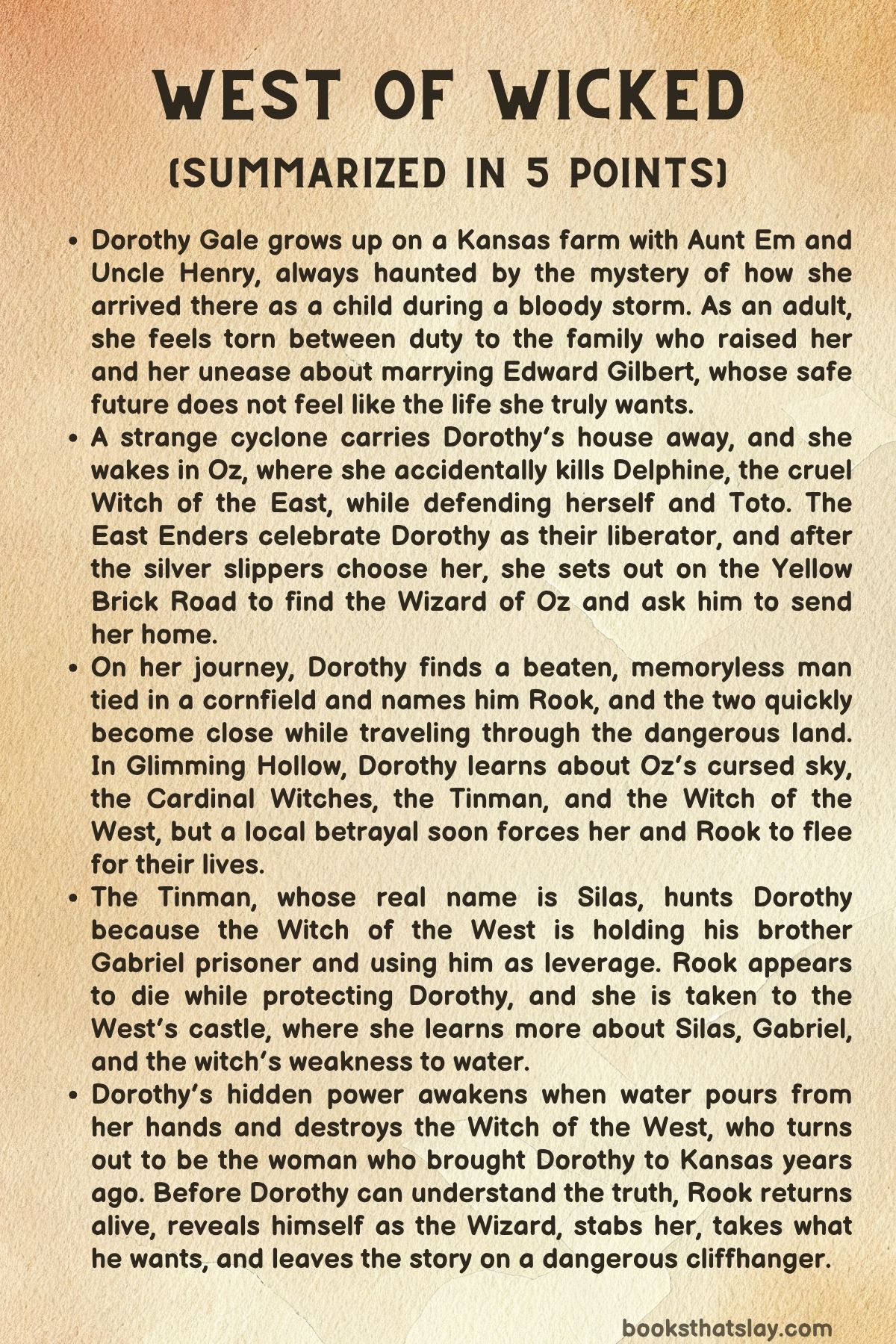
Dorothy Gale grows up on a Kansas farm under the care of Aunt Em and Uncle Henry, the only parents she has ever really known. She was brought to their doorstep as a small child during a violent summer storm, carried by a desperate woman whose face Dorothy can barely remember.
What remains with her is a blur of blood, wind, panic, and the repeated need to go home. Em and Henry take her in and raise her with warmth, but Dorothy never fully escapes the fear that love and safety can disappear without warning.
As she gets older, Dorothy becomes increasingly responsible for the farm and for her aging aunt and uncle. Em’s hands begin to tremble, and Henry’s body shows the damage of years spent working the land.
Dorothy loves them deeply, but her gratitude also traps her. She feels obligated to remain where she is, even when a part of her longs for answers about her past and a life beyond Kansas.
Toto, her fiercely loyal little dog, is one of her few constant sources of comfort.
Dorothy’s life is also complicated by Edward Gilbert, her neighbor and childhood companion. Edward loves her and wants to marry her, offering a future built on stability, family, children, and a shared home.
Dorothy knows he is good, steady, and sincere, but the idea of marrying him fills her with unease rather than joy. She avoids giving him a clear answer, partly because she does not want to hurt him and partly because she does not want to admit the truth to herself.
Aunt Em gently encourages her to stop hiding behind duty and decide what she truly wants.
Dorothy begins to understand that the thought of Edward marrying someone else brings her more relief than sorrow. Before she can fully confront that realization, a storm approaches the farm.
Henry goes out to secure the barn, and Em urges Dorothy to get into the cellar. Toto runs outside, and Dorothy follows him into the violent weather.
She sees a strange glittering tornado moving toward the farm, unlike anything she has ever seen. Em manages to pull Dorothy back inside, but before they can reach safety, the house is lifted from the ground and carried away by the cyclone.
When Dorothy wakes, she is hurt and surrounded by wreckage. Toto has survived, but Em and Henry are missing.
Dorothy tries to open the cellar door, expecting to find Em, but instead a wild red-haired woman bursts out and attacks her. The woman calls herself Delphine, the Witch of the East, and accuses Dorothy of being sent by the West.
Dorothy is confused and terrified, but Delphine gives her no chance to explain. The witch uses magic against her and traps Toto in a chest, forcing Dorothy to fight for both their lives.
Dorothy eventually grabs a kitchen knife and stabs Delphine in the neck. The witch dies outside the farmhouse, and soon a crowd gathers.
Instead of treating Dorothy as a murderer, the people celebrate her. They are East Enders, and Delphine had ruled them with cruelty.
Cleo, Delphine’s former servant, explains that Dorothy has freed them from a tyrant. Dorothy learns that she is no longer in Kansas but in Oz, a land marked by a cursed dark sky after the Great and Terrible War.
She also learns that Delphine’s silver slippers are powerful magical objects.
The Good Witch of the North, Lacosta, appears and attempts to take the slippers for herself, but they vanish and later reappear inside Dorothy’s house. Since the slippers seem to choose Dorothy, Lacosta tells her that the Great and Powerful Wizard of Oz may be the only one capable of sending her home.
Dorothy changes into her blue-and-white dress, gathers food, puts on the slippers, and starts along the Yellow Brick Road with Toto. At the same time, Cleo leaves Delphine’s castle for the first time as a free woman, uncertain of what freedom will mean for her.
Far away, the Witch of the West watches these events unfold. She sends Faos and the winged monkeys to summon the Tin Woodman, a feared mercenary.
The Tinman serves her because his brother Gabriel is imprisoned in her dungeon, giving the witch power over him. He is violent, relentless, and useful to her, but his obedience is rooted in desperation rather than loyalty.
On the Yellow Brick Road, Dorothy finds a badly beaten man tied to a pole in a cornfield. He has no memory of his name or past, so she names him Rook.
He joins her, and they quickly form a strong bond. Rook is protective, clever, and dangerous when threatened, but his lack of memory makes him seem vulnerable.
Dorothy, still shaken by everything she has lost, finds comfort in his presence. The two travel together to Glimming Hollow, where the East Enders greet Dorothy as a hero.
In Glimming Hollow, Dorothy is welcomed by Provost Ana, Remy the innkeeper, and others who are grateful for Delphine’s death. They feed her, shelter her, and tell her more about Oz.
Dorothy learns that Delphine’s magic consumed living things and that she sacrificed East Enders to strengthen herself. She also hears about the Cardinal Witches, vanished gods, the cursed sky, the Wizard, the Witch of the West, and the Tinman.
A fortune teller warns Dorothy that the Tinman is close and that her search is not only about getting home, but about a soul.
Rook becomes suspicious of councilman Fink and secretly follows him. He discovers that Fink is working with the West’s forces and plans to hand Dorothy over to the Tinman.
During a celebration in Dorothy’s honor, she and Rook grow closer, but the night turns violent when guards seize her. Rook fights to save her, and Remy helps them escape through a hidden tunnel beneath the inn.
The Tinman arrives with the winged monkeys and nearly captures them, but Rook wounds him and gets Dorothy away.
Cleo crosses paths with the Tinman and becomes unwillingly involved in the pursuit. Though she had spent years under Delphine’s control, her new freedom does not immediately bring safety.
She is pushed and used by stronger forces, yet she begins to question the people around her and the stories she has been told. Her journey starts shifting from survival under one master to the difficult task of deciding who she wants to become.
Dorothy and Rook hide in the tunnel and become intimate, their connection deepening under the pressure of danger. But their escape does not last.
In the forest, the Tinman and the winged monkeys catch up with them. Rook fights fiercely and kills several monkeys, but the Tinman throws his axe into Rook’s back.
Rook appears to die, and Dorothy is captured. She is taken to the Witch of the West’s castle, devastated by the loss and powerless against the forces closing around her.
Cleo is left with Rook’s body, but when she checks on him, the body has vanished. Realizing that something is deeply wrong, she runs to warn the others.
On the way, she meets Glinda, the Witch of the South, who offers to tell her the truth about her past. This encounter suggests that Cleo’s life may have been shaped by secrets larger than Delphine’s rule.
At the West’s castle, Dorothy is imprisoned in a dungeon across from Gabriel, the Tinman’s brother. Gabriel explains that the Tinman’s real name is Silas and that everything he has done has been to free him.
The Witch of the West orders Silas to take Dorothy’s silver slippers, but the slippers refuse to leave Dorothy for long. During a panic attack, water begins to appear in the dungeon.
Silas realizes Dorothy may have created it herself. Because water is fatal to the Witch of the West, he and Dorothy gather it in his canteen and form a plan.
They go upstairs pretending Dorothy is ready to surrender the slippers. But when she tries to use the water, the canteen contains only ash.
The plan fails, and the witch attacks Silas through magic. Dorothy’s terror and desperation awaken something powerful inside her.
Water pours from her hands when she grabs the witch, destroying her. As the witch dies, Dorothy recognizes her as the woman who brought her to Kansas years earlier.
The truth is devastating: the person Dorothy thought was simply an enemy was tied to the mystery of her origin.
The Witch of the West leaves behind a note explaining that she foresaw this moment. She tells Dorothy to take the golden mask, protect the winged monkeys, find the truth, and never trust the Wizard of Oz.
Before Dorothy can fully understand the message, Rook appears alive. Dorothy runs to him in relief, believing she has recovered someone she thought she had lost.
Instead, he reveals the truth: he is the Wizard himself. He stabs her, betraying the trust and intimacy they had built.
In the aftermath, Silas realizes that Rook was also his other brother and that the Wizard had used Dorothy to obtain the golden mask and Gabriel. Dorothy’s journey to find her way home has been manipulated by someone who knew far more than he admitted.
As Silas drifts in and out of consciousness, the Wizard takes what he came for and leaves. Dorothy lies bleeding, the West is dead, the mask is gone, and the distant roar of a lion rises in the darkness, ending the story on a note of danger, revelation, and unfinished truth.
Characters
Dorothy Gale
Dorothy is the emotional center of the book, shaped by abandonment, gratitude, fear, and an urgent desire to understand where she belongs. Her life in Kansas is not unhappy, but it is incomplete.
Aunt Em and Uncle Henry give her love and stability, yet the circumstances of her arrival leave a wound that never closes. Dorothy’s hesitation with Edward shows that she cannot accept a safe future simply because it is offered to her.
She wants honesty from herself, even when that honesty is painful. Once she reaches Oz, her ordinary life is stripped away, and she is forced to act before she understands the rules of the world around her.
Killing Delphine is not an act of conquest for Dorothy; it is an act of survival. Still, Oz immediately turns that survival into legend, naming her a hero and sorceress before she knows what power she carries.
Her journey in West of Wicked is marked by loss after loss: Kansas, Em and Henry, her sense of certainty, Rook’s supposed death, and finally her trust in him. Her magic emerges through fear and desperation, especially in the confrontation with the Witch of the West.
Dorothy is not simply searching for home; she is searching for truth, and by the end, that truth proves far crueler than ignorance.
Rook / The Wizard of Oz
Rook begins as a wounded stranger with no memory, which makes him appear vulnerable despite his obvious strength and skill. Dorothy’s decision to name him creates an immediate sense of intimacy, as if she is helping him become someone new.
He is protective, sharp, physically capable, and emotionally persuasive, making it easy for Dorothy to trust him. His bond with her grows quickly because both of them seem displaced and incomplete.
Yet the ending reshapes every earlier moment with suspicion. When Rook reveals himself as the Wizard, his tenderness becomes part of a larger manipulation.
His lost memory may be a lie, a mask, or a controlled performance designed to get close to Dorothy. His betrayal is especially brutal because it weaponizes Dorothy’s loneliness and need for connection.
He does not merely deceive her politically; he enters her heart, lets her grieve him, then returns only to harm her. His connection to Silas and Gabriel also makes him part of a broken brotherhood, suggesting that the Wizard’s power is tied to betrayal not only of strangers but of family.
As a character, he represents the danger of charm without honesty and the horror of discovering that comfort was part of the trap.
Silas / The Tinman
Silas is introduced through fear before he is understood as a person. Known as the Tinman, he has a reputation for brutality, violence, and unstoppable pursuit.
He serves the Witch of the West and hunts Dorothy with terrifying efficiency, but the story later reveals that his cruelty is tied to coercion. His brother Gabriel is imprisoned, and Silas obeys the witch because he sees no other way to save him.
This does not erase the harm he causes, but it complicates him. He is not a simple villain; he is a man whose love for his brother has been used as a chain.
His fight with Rook shows his physical danger, while his later alliance with Dorothy shows his capacity for strategic trust. When he realizes Dorothy can create water, he quickly understands how that power might defeat the witch.
Silas’s emotional core lies in loyalty, but that loyalty has been twisted by captivity and desperation. By the end of the book, he is also a victim of the Wizard’s schemes, especially when he realizes that Rook is his other brother.
Silas stands as one of the story’s most morally strained figures, caught between violence, devotion, and the painful truth that saving one person can make him a weapon against many others.
Gabriel
Gabriel appears mainly through imprisonment, but his role is central to Silas’s motivation. Locked in the Witch of the West’s dungeon, he becomes the living leverage that keeps Silas obedient.
His captivity explains why the Tinman continues serving a witch he does not truly support. Gabriel’s presence also gives Dorothy important context once she is imprisoned.
Through him, she learns Silas’s real name and begins to understand that her hunter is not simply a monster. Gabriel’s weakness in captivity contrasts with the power others are willing to use in his name.
He does not drive much of the visible action, but the story turns around what he represents: family, obligation, and the terrible cost of love under the control of tyrants. His connection to both Silas and Rook deepens the final betrayal.
The Wizard is not only using Dorothy; he is also using his own brothers. Gabriel’s rescue or possession becomes part of the Wizard’s larger plan, showing how people in Oz are often treated as pieces in someone else’s game.
The Witch of the West
The Witch of the West is first presented as a distant threat, watching Dorothy and sending others to act on her behalf. Her castle, her control over Silas, and her command of fear make her seem like one of Oz’s great enemies.
Yet the end of the book changes her meaning. She is revealed to be the woman who brought Dorothy to Kansas long ago, linking her not just to Oz’s politics but to Dorothy’s deepest personal mystery.
Her death by Dorothy’s awakened water magic is violent, but her final note shows that she expected it and had prepared Dorothy for a larger truth. She warns Dorothy not to trust the Wizard, tells her to protect the winged monkeys, and directs her toward the golden mask.
This makes her a character of contradiction: dangerous and manipulative, but also possibly protective in ways Dorothy cannot yet understand. She harms and imprisons, yet she may also have saved Dorothy as a child.
In the book, she becomes less a traditional villain and more a guardian of secrets whose methods are severe, morally damaged, and difficult to forgive.
Delphine / The Witch of the East
Delphine is the first direct magical threat Dorothy faces in Oz. She emerges from the cellar like a nightmare, immediately attacking Dorothy and accusing her of being aligned with the West.
Her violence is personal and frantic, but the East Enders’ reaction to her death reveals the larger truth of her rule. Delphine was a tyrant whose magic fed on living things, and she sacrificed her own people for power.
Her silver slippers mark her as powerful, but they also become part of Dorothy’s destiny when they refuse to remain with anyone else. Delphine’s brief appearance has a major effect on the story because her death transforms Dorothy from lost outsider into public symbol.
The people of the East do not know her, but they need her to mean freedom. Delphine’s cruelty also establishes the moral landscape of Oz, where magic is not harmless wonder but a force that can drain, consume, and destroy.
She is less developed than the West, but her impact is immediate and lasting.
Cleo
Cleo is one of the most important witnesses to the cost of tyranny in West of Wicked. As Delphine’s former servant, she begins the story in the shadow of another woman’s power.
Delphine’s death gives her freedom, but freedom does not instantly make her secure or confident. Cleo must leave the only structure she has known, even though that structure was abusive.
Her path shows the confusion that can follow liberation, especially when stronger forces continue trying to use her. Her interactions with the Tinman pull her into Dorothy’s pursuit, but she gradually starts questioning the motives of the people around her.
The disappearance of Rook’s body is a major turning point for her because she recognizes that the situation is not what it appears to be. Her meeting with Glinda suggests that her own past contains hidden truths, making her more than a former servant or side character.
Cleo’s arc is about awakening: first to freedom, then to suspicion, then to the possibility that her life has been shaped by secrets she has not yet been allowed to know.
Aunt Em
Aunt Em represents the closest thing Dorothy has to a mother in Kansas. She is loving, practical, and emotionally perceptive.
Though age and illness are beginning to affect her body, her mind remains clear enough to see Dorothy’s avoidance around Edward. Em does not force Dorothy into marriage, but she does push her to stop using family duty as an excuse.
This makes her care more honest than sentimental. She wants Dorothy to live truthfully, even if that means choosing a path other than the one others expect.
Her disappearance during the cyclone becomes one of Dorothy’s deepest wounds, because Em is tied to home, safety, and belonging. The uncertainty of her fate intensifies Dorothy’s fear that every home can be taken away.
Em’s role is brief but emotionally powerful because she anchors Dorothy before Oz tears that life apart.
Uncle Henry
Uncle Henry is a quieter figure, but he carries the weight of the farm and the years that shaped Dorothy’s Kansas life. His body has been worn down by labor, and his instinct during the storm is to go outside and secure the barn, showing his practical courage and sense of responsibility.
He is part of the home Dorothy feels obligated to protect, and his aging body contributes to her reluctance to leave. Henry’s importance lies less in dialogue and more in what he represents: stability, work, duty, and the fragile human world Dorothy knows before magic enters her life.
His disappearance alongside Em makes the cyclone not just a physical relocation but an emotional severing. Dorothy’s journey begins with the fear that she has lost the people who chose her when no one else could.
Edward Gilbert
Edward is not cruel or unworthy; that is what makes Dorothy’s conflict with him more complex. He offers her a life that should seem safe and desirable: marriage, home, children, and a future rooted in familiarity.
His love appears sincere, but it is built around a version of Dorothy who may not truly exist. He imagines stability as the answer to her uncertainty, while Dorothy feels trapped by the very future he offers.
Edward functions as a symbol of the life Dorothy might have accepted if she had chosen comfort over truth. Her realization that his marriage to someone else would bring relief rather than heartbreak is a crucial moment of self-knowledge.
He is not a villain in the story; he is the wrong answer to a question Dorothy has not yet fully asked herself.
Toto
Toto is Dorothy’s loyal companion and one of the few beings who remains with her across worlds. His dash into the storm helps trigger Dorothy’s presence in the house when the cyclone lifts it away, but this does not make him a cause of blame.
Instead, it shows Dorothy’s instinctive devotion. She follows him because she loves him and because he is part of her home.
In Oz, Toto’s survival gives Dorothy a living link to Kansas. Delphine trapping him in a chest immediately raises the stakes of Dorothy’s first fight, turning fear into action.
Toto’s role may be simple compared with the witches and rulers of Oz, but his loyalty is emotionally vital. In a world where nearly everyone has hidden motives, Toto remains honest, immediate, and constant.
Lacosta / The Good Witch of the North
Lacosta presents herself as helpful, but her attempt to take the silver slippers suggests that goodness in Oz may be political, limited, or self-serving. She gives Dorothy important direction by telling her to seek the Wizard in the Emerald City, yet she also wants control of the magical objects Dorothy has inherited.
Her role complicates the idea of a “good” witch. She is not openly cruel like Delphine, but she is not purely generous either.
Lacosta understands more about Oz than Dorothy does and uses that knowledge to guide the situation toward her own preferred outcome. Her presence teaches Dorothy an early lesson: titles in Oz cannot be trusted at face value.
A person may be called good and still be driven by power.
Glinda / The Witch of the South
Glinda enters the story later, but her appearance signals another layer of hidden truth. She meets Cleo and offers to reveal the truth about Cleo’s past, positioning herself as someone with knowledge others lack.
Unlike Lacosta, whose help comes with immediate suspicion, Glinda’s role is quieter and more mysterious. She seems to understand that Cleo is important beyond her service to Delphine.
Her offer suggests that Oz’s history is not only written through witches, wars, and rulers, but also through erased identities and withheld memories. Glinda’s importance lies in what she may reveal rather than what she has already done.
She represents knowledge, timing, and the possibility that some truths have been waiting for the right person to ask the right question.
Remy
Remy, the innkeeper of Glimming Hollow, gives Dorothy practical kindness at a time when public praise alone cannot protect her. He helps welcome her, but more importantly, he acts when danger arrives.
During the chaos caused by Fink’s betrayal and the Tinman’s approach, Remy guides Dorothy and Rook toward a hidden tunnel. His courage is not grand or magical; it is rooted in local knowledge, loyalty, and the willingness to risk himself for someone who freed his people.
Remy represents the ordinary citizens of Oz who have suffered under magical rulers but still retain decency and bravery. His help proves that Dorothy’s survival depends not only on witches, slippers, or hidden powers, but also on people who choose to do the right thing in a dangerous moment.
Provost Ana
Provost Ana stands as one of the leading voices of Glimming Hollow after Delphine’s fall. She helps frame Dorothy as a liberator in the eyes of the East Enders and participates in the community’s attempt to honor her.
Ana’s role shows how quickly a frightened society can attach hope to a stranger. Her welcome is genuine, but it also places pressure on Dorothy, who barely understands what she has done or what Oz expects from her.
Ana represents civic order trying to return after tyranny. Through her, the book shows the difficult moment after a ruler falls, when people are grateful but still vulnerable to betrayal, fear, and political manipulation.
Fink
Fink is a clear example of betrayal within a liberated community. While Glimming Hollow celebrates Dorothy, he secretly works with the West’s forces to deliver her to the Tinman.
His actions reveal that Delphine’s death does not remove all danger from the East. Power leaves behind collaborators, opportunists, and frightened people willing to trade others for security.
Fink’s betrayal is especially dangerous because it comes from inside a place where Dorothy has been welcomed. He turns celebration into trap and reminds the story that public praise can hide private treachery.
His role may be smaller than that of the witches or the Wizard, but he sharpens the book’s atmosphere of mistrust.
Faos and the Winged Monkeys
Faos and the winged monkeys are first presented as agents of the Witch of the West, sent to summon the Tinman and carry out her commands. They seem threatening because they arrive as a force rather than as individuals.
Yet the West’s final note asks Dorothy to protect the winged monkeys, changing the way their role must be understood. They are not simply monsters or soldiers; they may be another controlled or endangered group within Oz’s power struggles.
The golden mask appears tied to their fate, and the Wizard’s desire for it suggests that control over them has major consequences. Their violence during the pursuit of Dorothy is real, but the story hints that they too may be bound by forces larger than themselves.
Themes
The Search for Home and the Fear of Losing It
Dorothy’s idea of home is unstable from the beginning. Kansas gives her shelter, love, and family, but it does not answer the question of where she came from or why she was brought there in blood and terror.
Aunt Em and Uncle Henry are her home in the emotional sense, yet Dorothy also feels trapped by the duties that come with loving them. Her uncertainty about Edward shows that a house, marriage, and predictable future are not enough if they require her to silence her own instincts.
When the cyclone takes her to Oz, the physical home is destroyed, and the people who gave it meaning vanish. From that point forward, Dorothy’s wish to return home becomes more complicated.
She is not only trying to go back to Kansas; she is trying to recover safety, identity, and the missing truth of her childhood. West of Wicked treats home as something both desired and dangerous, because every version of it can be lost, questioned, or revealed as incomplete.
Power, Control, and the Cost of Magic
Magic in the story is not presented as harmless beauty or simple wonder. Delphine’s power feeds on living things, and her rule over the East Enders is built on sacrifice and fear.
The Witch of the West controls Silas by imprisoning Gabriel, proving that power does not always need chains around the person being used; sometimes it only needs control over someone they love. The silver slippers choose Dorothy, but even that gift brings danger because others want to possess or exploit them.
The golden mask carries similar weight, especially because it appears connected to the winged monkeys and the Wizard’s plans. Dorothy’s own water magic emerges under extreme fear, suggesting that power can be tied to survival rather than ambition.
The novel repeatedly shows that magic has political consequences. Whoever controls magical objects, curses, or creatures controls the direction of Oz.
Power is never neutral here; it always asks who benefits, who suffers, and who is being forced to pay the price.
Trust, Betrayal, and Hidden Motives
Nearly every relationship Dorothy forms in Oz is shaped by incomplete truth. The East Enders call her a hero before they understand her.
Lacosta guides her but tries to take the slippers. Fink smiles within a grateful community while secretly arranging her capture.
The Witch of the West appears to be only an enemy until Dorothy learns she is tied to her childhood. Most devastatingly, Rook gives Dorothy companionship, protection, and intimacy before revealing himself as the Wizard and stabbing her.
This betrayal hurts because it rewrites the emotional meaning of their journey. What seemed like comfort becomes strategy, and what seemed like vulnerability becomes performance.
The book uses betrayal not only as a twist but as a way to show how dangerous loneliness can be. Dorothy wants someone to stand beside her, and Rook understands that need well enough to use it.
Trust becomes one of the riskiest acts in Oz, yet without it, Dorothy would have no allies, no protection, and no chance of understanding the truth.
Identity, Memory, and the Truth Behind the Self
Dorothy’s identity is uncertain long before she reaches Oz. She knows herself as a Kansas farm girl, but her earliest memory tells her that this is not the whole story.
The woman who carried her through the storm, the blood, and the desperate need to go home all point to a hidden origin. Rook’s supposed memory loss mirrors Dorothy’s own missing past, which helps create their bond.
Both seem like people searching for who they are, but the ending exposes a sharp difference: Dorothy’s uncertainty is real, while Rook’s may be part of his deception. Cleo’s meeting with Glinda also expands this theme, suggesting that she too has a past shaped by secrets.
Silas’s identity is split between the feared Tinman and the brother trying to save Gabriel. Even the Witch of the West changes in Dorothy’s eyes, shifting from enemy to the woman who once brought her to Kansas.
Identity in the story is never fixed by names alone. It is hidden in memory, loyalty, fear, and the truths powerful people try to bury.