Westward Women Summary, Characters and Themes
Westward Women by Alice Martin is a speculative literary novel about a mysterious illness that sends young women across America toward the west. Set in 1973, the story follows Aimee, Eve, Ginny, and Teenie as their lives are pulled into the path of this strange infection and the dangers waiting along the road.
The novel uses its eerie premise to explore freedom, fear, female restlessness, and the cost of being unheard. It is also a story about survival: the kind that happens in public, on highways and buses, and the quieter kind that happens when women rebuild themselves after loss.
Summary
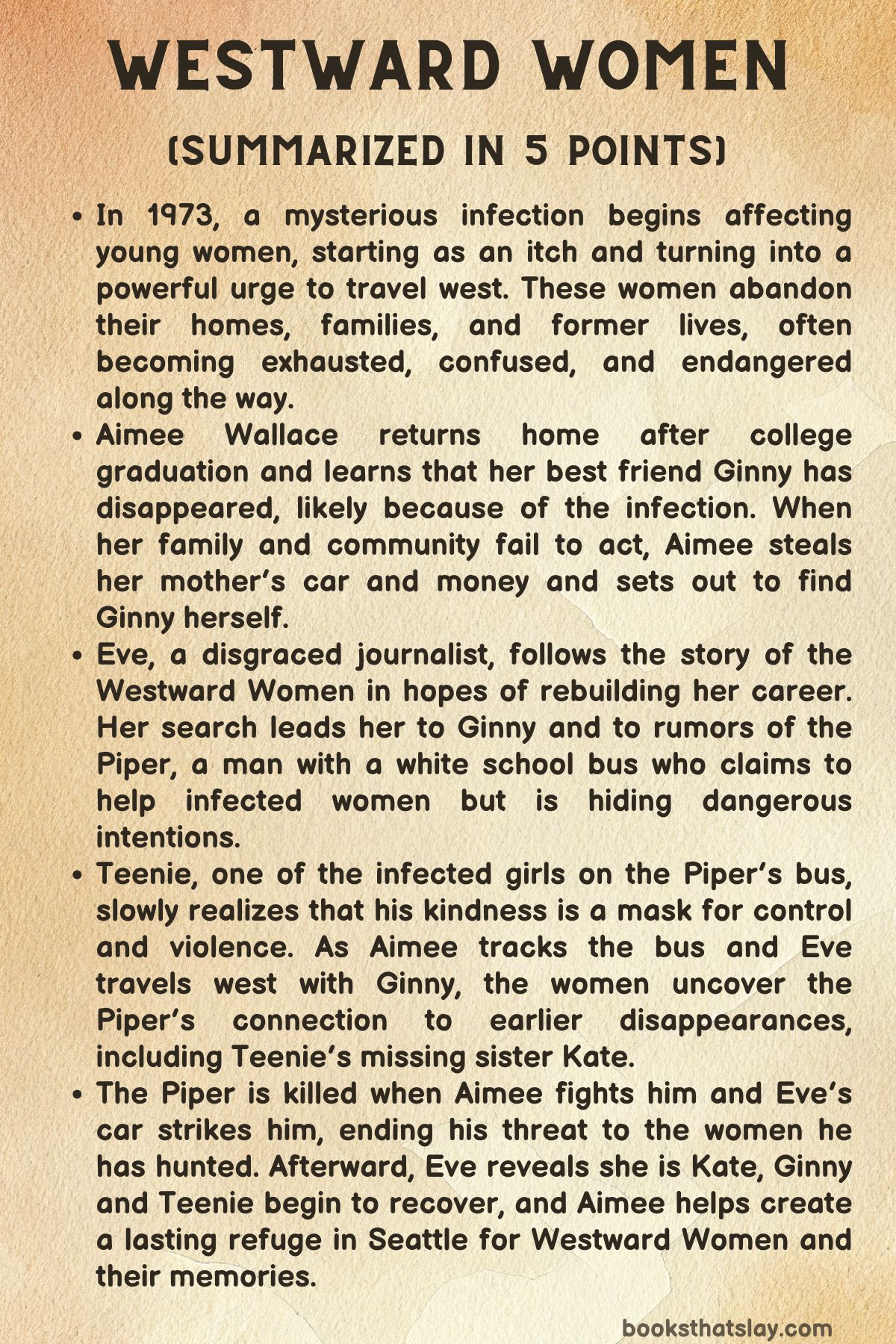
Westward Women begins in a world unsettled by a strange infection that affects young women. It starts as an itch, small enough to ignore at first, but soon becomes something stronger and harder to resist.
The infected women feel an urgent need to travel west. They leave homes, partners, parents, work, school, and familiar identities behind.
No one fully understands the illness. It does not seem to kill the women directly, but it makes them vulnerable.
On the road, many grow exhausted, forgetful, impulsive, and confused. Some disappear.
Some are found dead. Others are never accounted for at all.
The story first shows the infection from inside one woman’s body and memory. After a miscarriage, she remembers the itch and recognizes the pull to leave.
Her life with her boyfriend no longer feels like something she can remain inside. The infection becomes linked not only to movement, but also to release: the possibility of leaving behind a life that has become unbearable.
Aimee Wallace enters the story at the moment she should be celebrating. She graduates from the University of Maryland, but her family is not there to see it.
Her mother, Betty, is busy caring for infected girls, while her father, Gerald, stays at home. When Aimee calls home after graduation, she learns that her best friend, Ginny, has vanished and is believed to be infected.
Aimee returns to Gibsonia, Pennsylvania, expecting fear, urgency, and a search effort. Instead, she finds hesitation.
People talk about Ginny’s disappearance as if it is sad but not surprising. Even Aimee’s parents seem more resigned than alarmed.
Aimee is frustrated by this quiet acceptance. She also feels trapped by the future others have begun arranging for her.
Ginny’s disappearance becomes a breaking point. Aimee refuses to stay home and wait while her friend is reduced to another story about a lost infected woman.
She steals her mother’s car and money and leaves at night, determined to find Ginny herself.
At the same time, Eve is trying to rescue her own ruined life. A journalist in Asheville, she has lost credibility and is desperate for a story that will repair her reputation.
The Westward Women seem like the subject that could bring her back. After interviewing an infected girl, Eve hears rumors about a man called the Piper.
He drives a white school bus and gathers infected women, presenting himself as someone who can help them travel west safely. The image is both strange and tempting: a man offering order in the chaos of the infection.
Eve leaves her boyfriend, William, and goes after the Piper. Her motives are not pure.
She wants the story, the byline, and the professional recovery she believes it might give her. But as she follows the trail of infected women, the story becomes harder to keep at a distance.
In Detroit, she meets Ginny, who has been traveling with the Piper but has separated from him. Eve brings Ginny along.
At first, Ginny is a source, a living link to the story Eve wants to write. Over time, however, Eve becomes emotionally attached to her.
Their connection grows complicated by desire, dependence, sickness, and Eve’s ambition.
Another part of the story follows Teenie, an infected teenage girl riding on the Piper’s bus. Through her, the reader sees the strange community of women the Piper has collected.
The bus appears to offer protection. The women are fed, transported, and kept together.
For girls who are sick, disoriented, and traveling through unsafe places, this seems like mercy. But the Piper’s kindness has a controlling edge.
He questions every woman. He takes their money.
He decides where the bus goes and when anyone may leave. He watches them too closely.
At night, he scratches outside their sleeping quarters, turning safety into fear.
Teenie’s memories of her older sister Kate deepen the danger around the Piper. Years earlier, Kate disappeared while Teenie slept beside her in the backyard.
Teenie has carried that loss ever since. As her infection worsens, old memories begin to connect with new fears.
She starts to suspect that the Piper may have known Kate, may have been involved in her disappearance, and may have returned for Teenie. The bus, once a refuge, begins to feel like a trap.
Aimee’s search for Ginny takes her across highways, ferries, and unfamiliar towns. Along the way, she meets infected women and hears fragments of their stories.
Her journey is not just practical; it becomes increasingly strange. Aimee begins experiencing vivid, memory-like visions of women who are missing or dead.
These visions are often triggered by scents, and they seem to give her access to pieces of the women’s final experiences. Through them, Aimee learns that the Piper’s history is darker than it first appears.
He has harmed women before, and the pattern surrounding him is not accidental.
Aimee eventually catches up with the Piper and boards his bus under false pretenses. There she meets Teenie and realizes she is close to finding Ginny.
The closer Aimee gets, the more dangerous the situation becomes. The Piper’s calm manner hides violence, and his control over the women depends on their sickness, exhaustion, and isolation.
Aimee understands that finding Ginny is no longer her only purpose. She must also help the women still trapped with him.
Meanwhile, Eve and Ginny continue west. Eve’s own symptoms grow worse, making her less able to pretend she is only an observer.
The infection begins to claim her body and judgment. Ginny, who has already been changed by the illness, begins to move between weakness and recovery.
Their relationship develops in the middle of this uncertainty. Eve wants Ginny, but she also wants to complete her story.
She struggles to choose between care and career, intimacy and distance, truth and exploitation.
Their route carries them toward Denver and then farther west, in the direction of Seattle. As Eve weakens, her pursuit of the story becomes more desperate.
She has spent much of her life trying to escape shame by turning pain into material, but the infection forces her into the same vulnerability she once hoped to document from the outside.
The central confrontation comes when Aimee and Teenie face the truth about the Piper. His threat can no longer be explained away as oddness or misguided protection.
When he attacks, Aimee acts quickly. She pushes Teenie aside and throws the Piper into the road.
At that exact moment, Eve’s car arrives. Eve hits him and kills him.
The death ends his immediate danger, but it does not undo the damage he caused or restore the lost women he used, watched, or harmed.
After the Piper’s death, another truth is revealed. Eve tells Teenie that she is actually Kate, Teenie’s missing sister.
She survived what happened years earlier by remaking herself into someone else. Her name, career, and adult life have all been part of an identity built after trauma.
Teenie, newly shaken and seemingly freed from the infection, cannot fully accept this at first. The sister she lost and the woman standing before her do not easily become the same person in her mind.
Teenie chooses to leave and return home.
Ginny also begins to recover. Aimee and Ginny finally reach Seattle, where they settle in a house that becomes a sheltering place for women affected by the infection.
The house offers something different from the Piper’s bus. It is not built on control, secrecy, or possession.
It becomes a place of gathering, rest, and witness. Ginny eventually agrees to return Aimee’s stolen car and maintain contact, suggesting that their friendship has survived, though it has changed.
Eve, still pulled by the illness, reaches the Pacific Ocean. The westward urge has carried her as far as land allows.
She walks into the water, seemingly ready to surrender to the force that has been driving her. But Teenie returns and saves her.
This act does not erase Teenie’s pain or confusion, but it creates the possibility of a renewed bond between the sisters. Eve, who once survived by becoming someone else, is pulled back into life by the person who remembers who she used to be.
Years later, the Seattle house becomes a kind of historic site connected to the Westward Women. Aimee reflects on the women who passed through it, the stories they left behind, and the traces that remain.
The infection becomes part of history, but not in a neat or finished way. The women’s journeys were shaped by sickness, danger, longing, and the failures of the people who should have protected them.
Yet the story also leaves room for chosen community, memory, and survival. By the end, Westward Women is not only about women being driven west by a mysterious force.
It is about what they flee, what they seek, who harms them along the way, and how some of them find each other before they are lost.
Characters
Aimee Wallace
Aimee Wallace is one of the central figures in Westward Women, and her character is shaped by restlessness, loyalty, anger, and a growing desire to define her own life. At the beginning of the book, she feels emotionally abandoned by her family, especially when neither of her parents comes to support her graduation.
This absence reveals how easily Aimee is overlooked, and it also explains why Ginny’s disappearance affects her so strongly. Aimee is not content to accept the silence and passivity around her; when others treat Ginny’s disappearance as something inevitable or unchangeable, Aimee responds with action.
Her decision to steal her mother’s car and money is reckless, but it also shows her refusal to remain trapped in the life that others have arranged for her. She becomes a character who moves not because she is infected, but because she chooses to pursue truth, friendship, and freedom.
As the story develops, Aimee becomes increasingly connected to the suffering of the infected women. Her visions of dead or missing women make her search feel larger than a personal mission to find Ginny.
She begins to carry the memories of women who have been erased, ignored, or harmed, which makes her both a witness and a protector. Aimee’s courage is not presented as simple fearlessness; she is often uncertain, frightened, and overwhelmed, but she continues forward anyway.
Her confrontation with the Piper shows the fullest expression of her bravery. By pushing Teenie aside and fighting back, Aimee acts decisively in a moment when another young woman’s life is in danger.
By the end of the book, Aimee has changed from a young woman reacting against her family’s neglect into someone who helps create a new kind of refuge. Her presence in Seattle suggests that survival is not only about escaping danger, but also about building a place where women’s stories can remain alive.
Ginny
Ginny is Aimee’s best friend and one of the most important emotional forces in the book, even when she is absent. Her disappearance gives Aimee a reason to leave home, but Ginny is more than a motivation for another character’s journey.
She represents the terrifying vulnerability of the infected women, who are pulled away from their homes, identities, and relationships by a force they cannot fully understand or control. When Ginny separates from the Piper and meets Eve, she appears fragile, disoriented, and dependent, but she is not empty or passive.
Her continued movement westward shows how deeply the infection has altered her will, yet her bond with Eve and later with Aimee shows that parts of her former self are still present beneath the illness.
Ginny’s character also explores the painful tension between care and possession. Both Aimee and Eve want to help her, but Ginny cannot simply be rescued in an easy or immediate way.
She must recover gradually, and her healing depends on safety, patience, and connection rather than control. Her relationship with Eve becomes emotionally significant because it gives Ginny tenderness during a time when she is deeply vulnerable.
Her reunion with Aimee also restores the friendship that began the search, but it does not return everything to the way it was before. Ginny’s eventual recovery and her willingness to return the stolen car show that she is regaining agency.
She is a character marked by loss and disorientation, but she also becomes a sign that the pull westward can be survived.
Eve
Eve is one of the most complex characters in the book because she begins her journey with ambition, guilt, and emotional detachment, but gradually becomes tied to the very story she hoped to use for professional redemption. As a disgraced journalist, she is initially motivated by the possibility of restoring her reputation.
Her interest in the infected women is partly sincere, but it is also shaped by career desperation. This makes her morally complicated: she wants to expose the truth, but she also treats the suffering of others as material for a story.
Her decision to leave William behind shows that she is already dissatisfied with her life, even before her infection intensifies. Like many characters in the novel, Eve is pulled westward both by external forces and by buried personal wounds.
Eve’s relationship with Ginny softens and unsettles her. Ginny begins as a source, but Eve’s attachment to her becomes emotional and intimate.
Through Ginny, Eve is forced to confront the limits of observation. She can no longer remain only a journalist watching from the outside, because she becomes part of the crisis herself.
Her infection makes this transformation even more powerful, as she experiences the same loss of control that she once tried to document in others. The revelation that Eve is actually Kate, Teenie’s missing sister, adds tragic depth to her character.
Her reinvention as Eve is not merely a change of name; it is an attempt to survive trauma by burying the person she used to be. When she walks into the ocean near the end, her action reflects exhaustion, surrender, and the continuing power of the infection.
Teenie’s return to save her gives Eve a second chance, but not a simple resolution. She remains a character defined by survival, reinvention, guilt, longing, and the painful hope of being recognized.
Teenie
Teenie is one of the most vulnerable and emotionally revealing characters in the story. As an infected teenage girl on the Piper’s bus, she gives the reader a view into the world of the women who have already been gathered and controlled.
Her youth makes her especially exposed to danger, but Teenie is also observant and emotionally intelligent. She notices the strange behavior of the Piper, the atmosphere among the women, and the gradual worsening of her own condition.
Her narration captures the confusion of infection: the body wants movement, the mind becomes unstable, and memory begins to loosen. Through Teenie, the book shows how frightening it is to lose control of oneself while still sensing that something is wrong.
Teenie’s memories of her sister Kate are central to her character. Kate’s disappearance has shaped Teenie’s life long before she understands the Piper’s possible connection to it.
Her infection therefore becomes linked not only to the larger phenomenon affecting young women, but also to a personal family wound that has never healed. When Teenie realizes that the Piper may have returned for her after taking Kate years earlier, her story becomes one of repeated danger and inherited trauma.
Her inability to fully accept Eve as Kate after the revelation is heartbreaking because it shows how much time, fear, and illness have damaged her sense of recognition. Yet Teenie’s final return to save Eve is one of the most powerful acts in the book.
Even when memory and certainty fail her, some emotional bond remains. Teenie represents innocence under threat, but also the instinct to protect, remember, and return.
The Piper
The Piper is the book’s most openly threatening figure, though much of his danger comes from the way he hides cruelty beneath gentleness. At first, he appears to be helping infected women by giving them transportation and a shared place to travel west.
This appearance of care makes him especially disturbing, because he uses the women’s vulnerability to gain access to them. He asks questions, takes their money, controls the bus, watches them, and creates an environment where dependence replaces safety.
His white school bus becomes a false shelter, a space that looks protective but is actually controlled by a predator.
The Piper’s character represents exploitation disguised as rescue. The infected women are already losing their homes, memories, and stability, and he takes advantage of that condition.
His connection to earlier disappearances, including Kate’s, suggests that he is not simply a man caught up in the crisis but someone who has repeatedly used the crisis for violence and control. He is frightening because he understands how easily society dismisses these women once they begin moving west.
Their disappearances can be explained away by the infection, which gives him cover. His death comes through the combined force of Aimee’s resistance and Eve’s arrival, making his defeat the result of women interrupting the pattern of harm he has depended on.
He is not only an individual villain, but also a symbol of how vulnerable people can be preyed upon when the world stops looking for them.
Betty Wallace
Betty Wallace, Aimee’s mother, is a complicated parental figure because she is caring in a public sense but emotionally absent from her own daughter. Her work nursing infected girls suggests compassion and dedication, yet her absence from Aimee’s graduation reveals a painful imbalance in her priorities.
Betty is close to the crisis of the infected women, but she does not fully recognize the crisis unfolding inside her own family. This makes her a quietly important character, because she reflects the way adults in the book often respond to disaster through routine, duty, or resignation rather than direct emotional engagement.
Betty’s passivity after Ginny’s disappearance deepens Aimee’s frustration. From Aimee’s point of view, her mother’s failure to act feels like betrayal.
Betty may not be cruel, but her inability to respond with urgency helps push Aimee into taking matters into her own hands. Her stolen car and money become symbols of Aimee breaking away from parental control.
Betty’s role in the book is not that of a villain, but of a mother whose care is misdirected or insufficient. She shows how neglect can exist even in people who believe they are doing good.
Gerald Wallace
Gerald Wallace, Aimee’s father, represents the ordinary domestic stillness that Aimee feels compelled to escape. Like Betty, he does not attend Aimee’s graduation, and his absence contributes to her sense that her achievements and desires are not truly seen.
Gerald’s staying home while Betty nurses infected girls gives him an air of passivity. He is part of the family structure that expects Aimee to return, fit in, and accept a life already imagined for her.
His importance lies less in dramatic action and more in what he represents: the quiet pressure of home, convention, and emotional distance.
Gerald’s lack of urgency about Ginny’s disappearance also reflects a broader failure in the adult world. The young women who vanish are not pursued with enough seriousness, and Gerald becomes part of that atmosphere of acceptance.
For Aimee, this is unbearable. His character helps explain why Aimee’s journey is not only a search for Ginny but also an escape from a family environment that has made her feel powerless.
Gerald is therefore significant as a symbol of the ordinary world that cannot or will not respond adequately to extraordinary female suffering.
William
William, Eve’s boyfriend, is a secondary character, but he plays an important role in showing what Eve is trying to leave behind. He represents the life that Eve has before she commits herself fully to the story of the infected women and to her own westward pull.
Her decision to leave him suggests emotional dissatisfaction and a refusal to remain in a relationship that cannot contain who she is becoming. William is not presented as the central cause of Eve’s pain, but his presence marks the boundary between her old life and the dangerous journey that follows.
Through William, the book shows Eve’s difficulty with attachment. She can leave him because part of her is already detached, already searching for reinvention or escape.
His role also highlights Eve’s self-interest at the beginning of her journey. She is willing to abandon personal ties in pursuit of a story that might restore her reputation.
Yet as Eve becomes infected and emotionally involved with Ginny, her departure from William begins to look like part of a much deeper pattern. She is not simply leaving a boyfriend; she is moving away from a version of herself that no longer feels possible.
Kate
Kate exists first as a missing sister, a memory, and a wound in Teenie’s life before she is revealed to be Eve. As Kate, she represents the long-term consequences of disappearance.
Her vanishing years earlier leaves Teenie with confusion, grief, and unanswered questions. The fact that Teenie slept beside her before she disappeared makes the loss especially haunting, because it turns an ordinary childhood memory into a scene of lasting trauma.
Kate’s absence shapes Teenie’s fear before Teenie fully understands what happened.
When Kate is revealed to have survived by becoming Eve, her character becomes a powerful study of reinvention after trauma. She has not simply escaped; she has buried her former identity in order to continue living.
This survival strategy is both understandable and tragic. By becoming Eve, Kate gains distance from what happened to her, but she also loses her connection to Teenie and to her own past.
Her reunion with Teenie is painful because recognition does not immediately heal the years between them. Kate’s character shows that survival can be fragmented, and that escaping physical danger does not mean escaping memory, guilt, or grief.
Themes
Restlessness as a Form of Escape
In Westward Women, the pull toward the west becomes more than a symptom of illness; it becomes a physical expression of dissatisfaction, grief, fear, and the desire to escape lives that feel already decided. The infected women abandon homes, families, relationships, and even names, suggesting that the movement is tied to a deeper need to break away from roles imposed on them.
The itch begins in the body, but it reveals emotional unrest that many characters have been unable to voice. For some, leaving is terrifying and dangerous, yet staying seems equally unbearable.
Aimee’s journey mirrors this same restlessness even though she is not infected in the usual way. She leaves because no one around her is willing to act, and because her future in Gibsonia feels narrow and controlled.
The west therefore becomes both a destination and an idea: freedom, disappearance, reinvention, and danger all at once.
Female Vulnerability and Predatory Power
The infected women become vulnerable because their desire to move makes them physically exhausted, confused, forgetful, and dependent on strangers. This vulnerability creates the conditions for men like the Piper to present themselves as rescuers while actually taking control.
His white school bus appears to offer safety, order, and direction, but it slowly becomes a space of surveillance, manipulation, and fear. He collects women, asks questions, takes their money, controls where they go, and uses their weakened state against them.
The theme becomes especially disturbing because society already treats the Westward Women as lost causes rather than people worth protecting. Ginny disappears and her community barely searches for her, showing how easily women can be dismissed once their behavior becomes inconvenient or hard to explain.
The danger is not only the infection, but the way others respond to it. The women are harmed most when their suffering is ignored, misunderstood, or exploited.
Memory, Identity, and Reinvention
Memory in the story is unstable, painful, and closely connected to identity. The infection causes women to forget parts of themselves, but forgetting is not always simple loss; it can also become a means of survival.
Eve’s hidden identity as Kate shows how reinvention can protect a person from trauma, but also separate her from the people who still need the truth. Her transformation into Eve allows her to continue living, yet it also leaves Teenie trapped in the wound of Kate’s disappearance.
Aimee’s scent-triggered visions of dead or missing women create another kind of memory, one that reaches beyond personal experience and forces buried violence into the present. These visions suggest that forgotten women still leave traces behind, even when official searches fail or families stop asking questions.
The story treats memory as both fragile and necessary: painful memories can break people open, but they can also expose truth, restore connection, and prevent disappearance from becoming permanent silence.
Sisterhood, Rescue, and Chosen Community
The strongest form of resistance in the story comes from women finding, protecting, and remembering one another. Aimee begins her journey because Ginny’s disappearance matters to her when almost everyone else accepts it too easily.
Teenie survives because Aimee intervenes at the moment of danger, and Eve survives because Teenie returns to pull her from the ocean. These acts of rescue are not neat or sentimental; they are often strained by confusion, fear, illness, and betrayal.
Still, they show that care can interrupt cycles of abandonment. The Seattle house later becomes a symbol of chosen community, a place where women gather after movement, loss, and recovery.
It stands against the loneliness of the road and against a world that allowed many Westward Women to vanish. Sisterhood here is not limited to blood ties, though Kate and Teenie’s reunion gives that bond special weight.
It is built through pursuit, witness, shelter, and the refusal to let women disappear unnoticed.