What Boys Learn Summary, Characters and Themes
What Boys Learn by Andromeda Romano-Lax is a tense, character-driven thriller about a mother who realizes her teenage son may be closer to a pair of shocking deaths than anyone suspects. Abby, a high school counselor already stretched thin by grief and school politics, finds unsettling evidence in her son Benjamin’s room just as two students—Sidney Mayfield and Isabella “Izzy” Scarlatti—are found dead.
As rumors harden into accusations and authorities scramble for explanations, Abby’s private fears collide with public tragedy. The story follows her as she tries to protect Benjamin while also facing the possibility that protection and truth might not align.
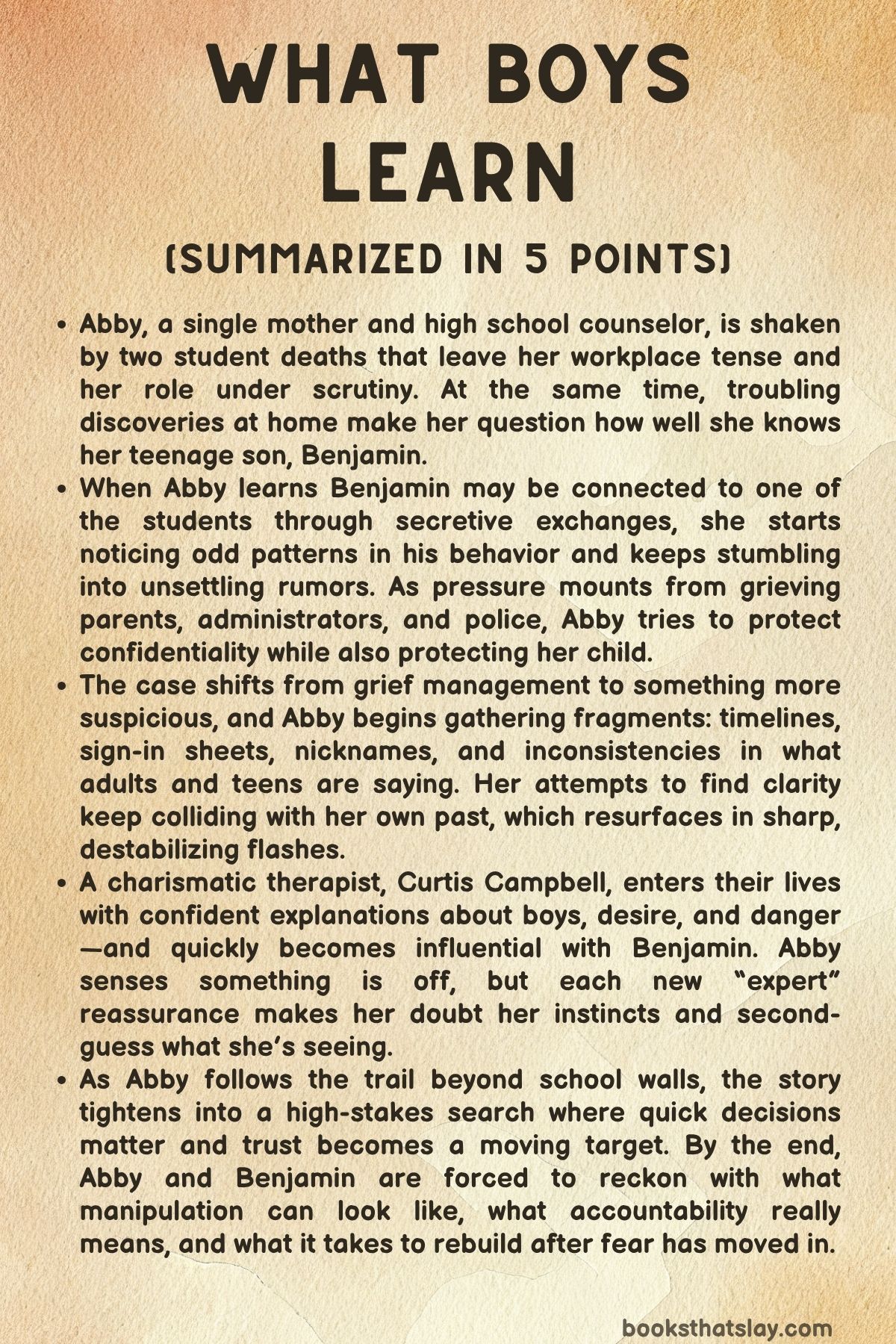
Summary
Abby, a single mother and school counselor at Summit High, is in the middle of packing up her apartment when she finds something that stops her cold: a piece of satiny women’s underwear hidden among her teenage son Benjamin’s clothes. It looks worn, possibly unclean, and the discovery sends Abby spiraling into dread.
She shuts herself away and opens a shoebox of old keepsakes from her past—objects tied to trauma she has never fully named. Even before she has time to confront Benjamin, life at school demands her attention.
Summit High is reeling from the death of a student, Sidney Mayfield. Abby expects to help coordinate a response for grieving students, but instead she’s blindsided by administrative maneuvering.
The dean, Kimberly Duplass, tells Abby to take a “mental health break” and informs her that an outside psychiatrist, Dr. Shields, will soon be sharing Abby’s office. Abby hears the subtext: she’s being edged out.
In the same breath, the school is trying to control the narrative and protect itself, and Abby’s role as a trusted counselor now looks inconvenient.
Sidney’s father, Jack Mayfield, storms into the dean’s office and demands Abby’s counseling notes. He insists the school failed his daughter and wants access to anything that might explain her death, including details about Sidney’s mother and prescription drug use.
He pushes further, asking for other students’ records—especially Isabella “Izzy” Scarlatti—arguing that someone must have influenced Sidney and that destructive behavior can spread. Abby refuses to violate confidentiality, and Mayfield leaves furious, calling her incompetent and blaming her for what happened.
The confrontation doesn’t end there. In the parking lot, Mayfield corners Abby again, shouting and pounding on her car.
Abby manages to escape and flags down a police cruiser—only to recognize the officer as Robert, her ex-boyfriend. Robert calms Mayfield, but Abby’s nerves are shredded.
She can’t stop thinking about Benjamin, the hidden underwear, and the feeling that something dangerous is forming around her family.
Then Abby gets a call that changes everything: Duplass tells her that Izzy has been found dead near Wadsworth, close to the Wisconsin border. Even more disturbing, Duplass says Izzy died a day before Sidney.
A note has been found suggesting a suicide pact. Duplass also tells Abby not to come to school—calling it a “soft suspension”—and promises a final paycheck, as if Abby is a problem to be managed rather than a professional grieving alongside her students.
At home, Abby tries to talk to Benjamin about the deaths and about her sudden removal from school, but he stays distant and pragmatic, more focused on logistics like tuition and schedules. Abby notices him searching through drawers in his room, and her fear sharpens.
She leaves briefly to pick up pizza and, while out, hears rumors from a student: Izzy’s reputation was complicated, and there had been a photo circulating that involved boys. Driving home, Abby sees a distressed barefoot girl by the road and gives her shoes, taking a secret photo before leaving.
The encounter lingers, strange and unresolved.
When Abby returns, she finds Robert inside the apartment with Benjamin. Robert explains why: he saw Benjamin running from the Scarlattis’ house.
Benjamin had gone inside through an unlocked door and taken Izzy’s diary. Robert chose not to arrest him and instead slipped the diary back through the family’s mail slot.
He hints that the case may not be straightforward, leaving Abby to face a new question: why would her son risk breaking into a dead girl’s home for a diary?
Abby confronts Benjamin. He claims he didn’t “break in” and says Izzy wasn’t his friend, though they interacted at the private pool where he lifeguards and trains.
He describes secret handwritten notes—Izzy didn’t want her boyfriend monitoring her phone. He frames Izzy as someone who played games, used him, laughed at him with Sidney.
Abby presses him about the diary, and he insists he didn’t have time to read it. His answers feel practiced, and Abby can’t tell where embarrassment ends and deception begins.
Then Abby brings up the underwear. Benjamin says Izzy gave it to him in public, stepping out of it beneath her skirt.
The explanation makes Abby’s skin crawl—not just because of the sexual charge, but because it suggests coercion, performance, or a test. Soon after, Abby gets word that Detective Hernández wants to speak with her again.
As the pressure builds, Abby’s mind keeps flashing back to her own adolescence: a night in a car with her brother Ewan and a boy named Grant, drinking, heading toward a party, and losing control of her body and memory. The recollection arrives in fragments—vomiting, humiliation, Ewan’s cruelty, a moment when Abby is left alone on a trail with police lights nearby.
She remembers Ewan taunting Grant, and she remembers signs that another girl had been involved—underwear, shoes, a sense of violence she can’t fully place. The night ends in a horrific crash that kills Grant.
Abby survived, but whatever happened that night has haunted her since.
In the present, rumors spread that Sidney and Izzy may have been murdered. Abby learns details that don’t fit a simple suicide story: a figure seen near Sidney’s house, a security system turned off, a suicide note that Izzy’s parents say isn’t in her handwriting, and an allergic reaction triggered by a drug.
Abby visits the pool and sees a sign-in sheet showing Izzy and Benjamin leaving at the exact same time on the day in question. Benjamin reacts with anger and sarcasm when Abby asks about it, mentioning a motel in a way that makes Abby’s stomach drop—because Izzy’s body was found far from home, and no one has clearly explained where she died.
Abby reaches out to Curtis Campbell, a former professor turned therapist whose public persona looks polished and reassuring. He agrees to meet Benjamin, and he proposes hypnosis for Abby first, framing it as a way to build trust.
Abby goes through with it, but afterward something feels wrong. Curtis provides a transcript that claims Abby said far more than she remembers—confessions and details that don’t match her sense of the session.
Abby begins to suspect she was impaired. Curtis also becomes strangely invested in Benjamin, repeatedly pushing for time alone with him.
A dramatic development seems to close the case: police announce that a suspect, Christopher Weber, died in a car crash, and items in the vehicle—zip ties, blindfolds, photos, pills—suggest he was responsible. Curtis reinforces this narrative, labeling Weber as a predator and then pivoting to Benjamin, claiming tests suggest “psychopathic traits,” even pointing to old brain scans.
Abby is stunned and frightened, unsure whether Curtis is offering insight or planting a story.
When a missing young woman, Veronica Lovell, is found alive after being held captive, the supposed certainty cracks. Veronica describes being drugged, waking in a controlled room, and being released only because “the plan changed.” Her account raises the possibility of an accomplice or a different perpetrator altogether.
Abby’s instincts flare back to Curtis. She breaks into his office and finds evidence that confirms her suspicions: a recording from her hypnosis session that is mostly silence, contradicting the detailed transcript Curtis gave her.
Abby realizes Curtis likely drugged her and fabricated the document to manipulate her.
Outside, Abby finds Curtis’s SUV hidden under a tarp—damaged and consistent with a hit-and-run linked to Weber’s death. Abby and Robert race to find Benjamin, discovering his phone hidden at home, suggesting Curtis removed it to prevent tracking.
Desperate, they confront Abby’s imprisoned brother Ewan, who hints that Curtis “coaches” young men and moves around to find new targets. A lead from Curtis’s father points them toward a marina and a sailboat.
The final chase converges on a vessel named Paradox, where Curtis has taken Benjamin and a teenage girl, Lenora. Curtis pressures Benjamin toward cruelty, trying to shape him into the kind of boy who obeys without empathy.
Benjamin resists in secret, trying to protect Lenora, pocketing a knife for defense, and attempting to get help. Lenora drinks something Curtis prepared and becomes sick and disoriented.
Events spill into the lake, and in freezing water Benjamin fights to keep Lenora afloat, holding her up as rescue boats arrive. Curtis attempts to manipulate the rescue response, but Abby and Robert are close enough now to see through him.
Benjamin and Lenora are pulled from the water alive, and Curtis is arrested before he can disappear. Investigators begin tying Curtis to a broader pattern of harm, including Weber’s death and other suspicious incidents in Curtis’s past.
In the aftermath, Benjamin refuses to be treated like a hero in public, but he starts the slow work of processing what Curtis tried to make of him—and what he chose instead.
Months later, Abby and Benjamin relocate and rebuild their lives with cautious intention. Abby shifts her work toward helping families caught in the juvenile system, using what she learned about fear, institutions, and the stories adults tell to explain boys’ behavior.
Curtis remains entangled in the legal process, facing multiple murder charges. Abby and Robert keep an uneven connection, neither fully healed nor fully apart, while Abby’s central focus stays the same: keeping Benjamin safe, and making sure the truth—about power, consent, and the ways boys are taught to see others—doesn’t get buried under convenient conclusions.
Characters
Abby
Abby is the novel’s moral center and its most psychologically layered consciousness, a school counselor whose professional identity is built on containment—of students’ crises, institutional optics, and her own history. Her discovery of women’s underwear hidden among Benjamin’s clothes detonates a private panic that quickly fuses with public catastrophe at Summit High, where two student deaths push her from competent helper into a woman fighting to stay credible inside a system eager to sideline her.
What makes Abby compelling is how her care becomes indistinguishable from control: she is constantly scanning for patterns, threats, and hidden meanings, not only because she is trained to notice risk, but because her adolescence—marked by intimidation, humiliation, and violence—taught her that danger often arrives wrapped in normalcy. That past, preserved in her shoebox of “unforgettable items,” keeps bleeding into the present through fragmented memories and somatic alarms, which makes her both unusually perceptive and unusually vulnerable to manipulation.
When Curtis offers hypnosis and an authoritative framework for Benjamin’s behavior, Abby is drawn to the promise of clarity, yet the same longing makes her easier to gaslight; the falsified transcript and the eerie silence on the tape expose how readily her need for answers can be weaponized. Across the story, Abby evolves from a counselor trying to follow rules into a mother willing to break them—sneaking into offices, photographing a distressed girl, building amateur databases of disappearances—because the institutions around her keep choosing convenience over truth.
Her arc is ultimately about reclaiming agency: not by becoming fearless, but by acting despite fear, learning that protecting a child in a predatory world may require distrusting “experts,” believing her own perceptions, and accepting that certainty is rarely available when the stakes are highest.
Benjamin
Benjamin sits at the story’s most volatile intersection: he is both a teenage boy trying to assemble an identity and a suspected node in a chain of violence that adults cannot yet map. He reads initially as emotionally sealed—practical, distant, oddly indifferent to deaths that horrify his mother—yet that flatness functions less as cruelty than as a shield built from adolescence, masculinity scripts, and his mother’s anxious scrutiny.
His connection to Izzy is steeped in secrecy, humiliation, and transactional intimacy: handwritten notes to evade a jealous boyfriend, the exchange involving underwear that collapses boundaries and consent into spectacle, and the diary theft that signals both obsession and desperation to possess a narrative that otherwise made him feel used. Benjamin’s character is defined by oscillation between passivity and eruption: he appears compliant and rehearsed when questioned, then explodes in domestic violence-adjacent rage, shattering a plate and asserting privacy with frightening intensity.
Those swings make him legible to authority figures as “a problem,” which is precisely what Curtis exploits—reframing adolescent confusion and anger as pathology, dangling a diagnosis and a deterministic story about “traits” as if it were destiny. The sailboat sequence reveals Benjamin’s deeper core: when isolated with Curtis and Lenora, he becomes observant, strategic, and morally resistant, quietly pocketing a knife, attempting to signal for help, and ultimately risking himself to keep Lenora alive in freezing water.
That choice reorients him from suspected threat to coerced near-victim and reluctant hero, while still refusing the simplified redemption narrative offered by the community. Benjamin’s ongoing struggle is not just recovering from Curtis’s grooming; it is learning how to live with the knowledge that adult systems can misread boys, weaponize shame, and turn male socialization into a funnel toward harm—ideas that sit at the thematic heart of What Boys Learn.
Isabella “Izzy” Scarlatti
Izzy is constructed through absence, rumor, artifacts, and other people’s needs, which makes her both vividly present and perpetually contested. In school gossip she is not the uncomplicated victim the town wants; Chandra’s comments suggest Izzy could be cruel to boys and socially powerful enough to leave damage, while Abby’s notes show her as a girl navigating coercive dynamics with Manny and a possibly predatory “older man,” using decoys and misdirection as survival tactics.
That duality matters because it prevents Izzy from becoming a moral lesson; she is instead a teenager improvising power in a world that constantly polices female sexuality and punishes it. The alleged pact note, the disputed handwriting, and the allergic-reaction drug death position her as a target whose story is immediately seized by adults—by the Scarlattis demanding answers, by school administrators protecting the institution, by law enforcement shaping a coherent case narrative.
Izzy’s relationship with Benjamin is especially ambiguous and thematically sharp: it blends flirtation, manipulation, performance, and possible coercion in ways that highlight how adolescent consent can be warped by status games and fear. Even after death, Izzy functions as a catalyst: her diary becomes a contested object of truth, her memorialized locker becomes a symbol of sanctified tragedy, and her image becomes something Abby thinks she sees on the roadside, reflecting how trauma makes the mind search the world for the missing.
In the end, Izzy’s character is less about solving a mystery than about exposing how quickly communities flatten complicated girls into either saints or villains—and how that flattening enables predators to keep operating in the shadows.
Sidney Mayfield
Sidney’s death is the spark that ignites institutional panic, parental rage, and Abby’s professional unraveling, yet Sidney herself remains largely knowable only through the contours of what she leaves behind and what others project onto her. In Abby’s counseling records, Sidney appears ordinary—college interests, general well-being—suggesting either that warning signs were absent or that the structures available to teenagers make honesty too risky.
Her significance in the narrative lies in how her death becomes a battleground: Jack Mayfield weaponizes it to demand access, assign blame, and search for a contaminating influence, while school leadership treats it as a reputational hazard requiring controlled messaging and a convenient reshuffling of staff. Sidney is also tied to the social ecology of Summit High, where her proximity to Izzy and their shared aura of troubled glamour become easy explanations for adults who want a simple cause-and-effect story.
The later shift from “suicide” to “murder” reframes Sidney not as self-destructive but as hunted, which retroactively indicts the complacency of every earlier assumption and underscores how girls’ deaths are often misfiled as private despair rather than public violence. Sidney’s character, in that sense, is a haunting negative space: she is the girl everyone claims to want to understand only after she is gone, and her absence exposes how little the adults truly knew about the world their children were moving through.
Jack Mayfield
Jack Mayfield embodies grief that mutates into aggression, control, and suspicion, turning him into both a sympathetic parent and an antagonistic force. His first instinct is not to mourn quietly but to litigate reality: he storms into the school, demands Abby’s notes, tries to pierce confidentiality, and insists that someone else must have caused his daughter’s death.
That insistence on contagion—on the idea that “another kid” must have influenced Sidney—reveals a refusal to accept ambiguity or internal complexity, because ambiguity offers no one to punish and no mechanism to restore order. Jack’s anger also exposes the fragile position of caregivers like Abby: his insults and parking-lot confrontation demonstrate how institutions often leave front-line staff to absorb parental violence, then judge them as liabilities when the backlash arrives.
His focus on Geneva’s prescription drug use and his desire for other students’ records show how easily grief recruits stigma as an explanatory tool, especially when the social class and reputation of families are at stake. Jack is important not because he holds the truth, but because his desperation pressures the story into motion, forcing Abby to choose between procedural ethics and personal survival.
Kimberly Duplass
Kimberly Duplass represents the school’s managerial conscience—the kind that speaks the language of care while executing the logic of risk containment. Her “mental health break” for Abby is framed as benevolence but functions as displacement, a way to remove a potentially inconvenient counselor from the center of an unfolding scandal.
By introducing Dr. Shields and later issuing a “soft suspension,” Duplass signals that the institution’s priority is not student healing but institutional insulation, especially in the eyes of the board and wealthy stakeholders. She is adept at plausible deniability: she delivers devastating news and administrative decisions in the same calm register, turning professional compassion into a tool that makes coercion feel polite.
Yet Duplass is not depicted as a cartoon villain; she is a product of bureaucratic incentives where tragedy becomes a brand threat, and the person who asks too many questions becomes the hazard to manage. Her character clarifies one of the book’s sharper critiques: systems often respond to adolescent death by protecting adults’ reputations first, which is exactly the environment predators exploit.
Robert
Robert functions as both a stabilizing presence and a reminder that protection is imperfect, because even well-intentioned law enforcement operates within limits that can feel morally intolerable. As Abby’s ex-boyfriend and a police officer, he straddles intimacy and authority, creating a complicated trust dynamic: he can enter Abby’s home to help, but his badge also symbolizes the same system that too often misclassifies violence or shrugs at missing persons statistics.
Robert’s decision not to arrest Benjamin after the diary incident reveals his protective instincts and lingering affection for Abby, but it also shows the ethical murkiness of selective enforcement, especially when a case is volatile and evidence is fragile. His realism about unsolved homicides and missing people is grim but grounding, countering Abby’s spirals with institutional knowledge while still enabling her pursuit through shared files and pattern recognition.
As the plot darkens around Curtis, Robert becomes a partner in Abby’s improvised investigation, yet his prior secret visit to Ewan suggests he, too, is capable of withholding information “for the right reasons,” mirroring Abby’s own secrecy. Robert’s role in the rescue sequence reinforces him as an action-oriented ally, but the relationship remains “complicated, intermittent,” underscoring that safety and love are not synonymous.
Curtis Campbell
Curtis Campbell is the novel’s most chilling figure because his menace is built on credibility, charm, and professional rhetoric rather than overt brutality. He arrives as an idealized solution—slim, successful, a former professor, a therapist with polished insight—then gradually reveals himself as someone who understands how to convert psychological language into dominance.
His methods are predatory in their sophistication: he presses Abby to relinquish control of Benjamin under the guise of mentorship, pushes hypnosis as “help” while likely drugging her, and fabricates a transcript that frames her as confessing to guilt and possibly complicity, turning her own memory fractures into leverage. With Benjamin, Curtis uses diagnosis as a leash, introducing “psychopathic traits” not to treat but to shape identity, offering a cold, consequence-based worldview that strips empathy and reframes harm as intelligence.
The sailboat coaching and the staged endangerment of Lenora show his preference for orchestration: he does not merely hurt people; he trains others to become instruments, which makes him a plausible engine behind a larger pattern of crimes. His connection to the damaged SUV, the suspected hit-and-run, and the earlier suspicious drowning of his wife and daughter positions him as a long-term predator skilled at wearing respectability like camouflage.
Curtis is also thematically central because he embodies the book’s warning about how “education” and “therapy” can be corrupted into grooming pipelines—how the lessons boys absorb can be deliberately engineered by adults who want violence to reproduce itself. In What Boys Learn, Curtis is not just a murderer; he is a teacher of contempt.
Dr. Shields
Dr. Shields appears briefly but carries symbolic weight as the institution-approved replacement—an outsider installed through board connections, marketed as mental health support while functioning as an administrative override of Abby’s relational work. His arrival, timed after student deaths, highlights how schools often respond to crisis by importing credentialed authority rather than strengthening trusted relationships already in place.
Even in absence, Dr. Shields represents the politics of mental health services: who gets access, who gets displaced, and how professional expertise can be used to signal responsibility without actually meeting students’ immediate needs.
Detective Hernández
Detective Hernández represents the formal investigative apparatus that Abby cannot fully access but cannot ignore, a figure who circles the narrative as pressure rather than comfort. His attempts to speak with Abby—and the sense that he “wants to speak again”—indicate that her proximity to the students and to Benjamin has made her relevant to the case, whether she wants that spotlight or not.
Hernández’s role also underscores a key tension: Abby’s counselor instincts urge confidentiality and careful listening, while the detective’s world demands disclosure, timelines, and usable facts. He is less a fully individualized character than a reminder that once violence enters a community, private life becomes evidence, a transition that intensifies Abby’s paranoia and accelerates her willingness to investigate on her own terms.
Chandra
Chandra serves as a sharp corrective to the community’s impulse to simplify Izzy into a pure victim, offering Abby a version of teenage social reality that adults often miss. Her gratitude to Abby suggests Abby’s counseling mattered in tangible ways, while her comments about rumors, cruelty, and a circulating photo expose how reputation economies work among adolescents—how power, sex, and humiliation are traded, archived, and weaponized.
Chandra’s presence is brief but important because she shows that “helped” students still carry complicated truths, and that teen communities often know more than institutions admit.
Willa
Willa functions as Abby’s tether to an earlier, steadier world, someone connected to Abby’s late mother and therefore to a version of care not mediated by institutions. Abby’s call to Willa—without disclosing the deaths—shows how Abby uses Willa as emotional refuge while still keeping her most frightening realities sealed, a pattern that mirrors the broader secrecy in Abby’s life.
Willa’s later phone call about the crashed MG and the supposed dead killer becomes a pivotal plot trigger, but it also reveals her role as a conduit of community intelligence, the way older networks circulate news and meaning. Willa represents continuity and witness; she is a reminder that Abby is not entirely alone, even when she behaves as if she must be.
Ewan
Ewan is Abby’s embodied past—violent, manipulative, and still reaching into her present from prison through letters that are both threats and hooks. His presence explains much of Abby’s hypervigilance: he is proof that harm can be intimate, familial, and persistent, and that escape is not the same as safety.
The revelation that Ewan has their new address signals betrayal by someone in Abby’s orbit and reintroduces the old terror that Abby has tried to quarantine for Benjamin’s sake. During the monitored video call, Ewan’s taunting refusal to provide clear help without leverage shows his enduring need for control, as if information itself were another weapon.
He also complicates the moral landscape because he possesses insights about Curtis and youth facilities, implying that predation and “coaching” can thrive inside systems meant to rehabilitate. Ewan is not simply a villain; he is the origin point of Abby’s fractured memory and the reminder that boys learn violence early when they are raised around it.
Grant
Grant exists primarily through Abby’s traumatic recollection, but his role is consequential because he anchors the night that still shapes Abby’s sense of guilt, fear, and responsibility. He is the boy in the car, the one who dies in the crash, and therefore a symbol of how adolescent recklessness can turn fatal and how survivors can be trapped in incomplete narratives about what really happened.
Grant’s relationship to Ewan and Abby’s memory of underwear and shoes stashed by Ewan suggest that Grant may have been both participant and collateral, though Abby’s fragmented recall refuses certainty. In character terms, Grant is less a personality than a hinge: his death is one of the original fractures in Abby’s life, the moment after which “normal” becomes impossible, and that fracture makes Abby especially susceptible to Curtis’s later manipulation.
Manny
Manny appears as Izzy’s jealous boyfriend, a figure whose controlling presence shapes Izzy’s secrecy and the covert note-passing with Benjamin. He represents the adolescent version of surveillance and possessiveness, where intimacy becomes monitoring and privacy becomes betrayal.
Even at the level of rumor and Abby’s notes, Manny’s jealousy illustrates how quickly teenage relationships can become coercive ecosystems, creating the conditions in which girls look for decoys, boys become instruments, and predators like Curtis find chaos to exploit.
Rita
Rita functions as Abby’s workplace sounding board and an informal intelligence source, the colleague who calls with rumor, shifting investigative status, and the kind of hallway truth that never appears in official memos. Her revelations—murders instead of suicides, security systems off, reprocessing prints—are the practical sparks that push Abby deeper into fear and action.
Rita’s character underscores how institutions leak information through people long before they acknowledge it publicly, and how women in care roles often end up assembling reality from scraps while administrators manage narratives. Even briefly, she adds realism to the school’s ecosystem.
David
David, the downstairs neighbor, is a small but unsettling presence because he symbolizes Abby’s central fear: that she does not truly know where Benjamin goes or who has access to him. His casual mention that Benjamin has visited him multiple times punctures Abby’s illusion of oversight and amplifies her sense that their move has placed Benjamin inside a social web she cannot see.
David’s character is not developed as overtly dangerous, which is exactly why he matters; he represents the ordinary adult proximity that can be benign, predatory, or simply unknown, and that uncertainty keeps Abby on edge.
Lenora
Lenora appears late but becomes a decisive mirror for Benjamin and a litmus test for Curtis’s intent. She is a teenage girl drawn into Curtis’s orbit and then impaired by the lemonade he prepares, her increasing illness making her both physically vulnerable and narratively urgent.
What distinguishes Lenora’s role is that she is not merely a victim to be rescued; she is the person whose presence forces Benjamin to choose what kind of boy he will be when an adult pressures him toward harm. Lenora’s rescue, and Benjamin’s effort to keep her alive in the water, transforms the story from suspicion to exposure, revealing Curtis’s grooming tactics and confirming that Benjamin’s earlier secrecy was entangled with manipulation rather than straightforward malice.
Lenora therefore functions as both endangered individual and thematic pivot: her survival interrupts the cycle Curtis is trying to teach, which is one of the most consequential “lessons” contested in the novel.
Veronica Lovell
Veronica is the living counterpoint to the dead girls, a missing young woman whose return destabilizes the community’s desire for closure. Her account—falling sick, missing an Uber, waking blindfolded in a plastic-covered room, being released because “the plan changed”—expands the threat landscape beyond Summit High and suggests method, planning, and possibly an evolving offender narrative.
Veronica’s survival introduces the terrifying possibility of partners, shifting motives, and incomplete investigations, while also reminding Abby that not all victims become statistics; some return with testimony that can be doubted, sensationalized, or instrumentalized. As a character, Veronica functions as evidence made human, turning rumor into lived experience and intensifying Abby’s belief that the official story is too neat to be true.
Sheriff Bruckner
Sheriff Bruckner appears as the practical authority who grants Abby and Robert access to the search on the water, representing the local power capable of acting quickly when persuaded. His willingness to take them out underscores how much the investigation depends on relationships, urgency, and who is considered credible in the moment.
In the climactic sequence, Bruckner’s presence also contrasts with Curtis’s manipulation of rescue signals, highlighting the thin margin between effective response and orchestrated misdirection. He is a functional character, but one who embodies the community-level decision-making that can determine whether someone lives or dies.
Martha
Martha, Abby’s stepmother, is part of the emotional architecture of Abby’s backstory, associated with humiliation and abuse that helped shape Abby’s internalized shame and mistrust. Even when she is not present in the immediate plot, her influence appears in Abby’s reflexive self-doubt and in the way Abby anticipates blame before it is spoken.
Martha matters because she represents the domestic training ground where Abby learned to endure and to appease, patterns Curtis later exploits by presenting himself as an authoritative interpreter of Abby’s own mind. Her character underscores that the dangers Abby faces as an adult do not begin with the murders; they begin with the earlier lessons about power inside family life.
Themes
Mothers, sons, and the limits of protection
Abby is constantly trying to do two jobs at once: be a steady parent at home and a stable counselor for other people’s kids at school. The story keeps pressing on the gap between those roles and what either one can actually accomplish.
In her apartment, she is literally packing Benjamin’s life into boxes while realizing she doesn’t know what’s going on inside his head, and the discovery of the hidden underwear becomes a private alarm she can’t share without risking the trust she still has with him. At work, she is asked to manage grief and panic after student deaths, yet the institution treats her as replaceable, even risky, the moment powerful adults feel threatened.
That combination forces Abby into a kind of hypervigilant mothering that isn’t warm or soothing; it’s procedural, investigative, and often lonely. She checks locks, searches drawers, studies sign-in sheets, and starts building spreadsheets of disappearances because traditional reassurance no longer works for her.
Even when she is acting out of love, the methods look like surveillance, and Benjamin experiences them that way. The resulting fights aren’t only about teenage privacy; they’re about Abby’s fear that the world is teaching her son lessons she can’t see, name, or interrupt in time.
What makes the theme hit hard is that Abby’s instincts are often correct, but correctness doesn’t equal control. She is right to suspect the official narrative around the deaths is incomplete.
She is right to question whether Benjamin is being manipulated. She is right to feel that adult men who appear “helpful” can be dangerous.
Still, the steps she can take are limited by legal boundaries, social norms, and the emotional cost of accusing people without proof. The story shows protection as a shrinking zone: Abby can’t access records, can’t force cooperation from administrators, can’t compel police urgency, can’t keep her son within arm’s reach, and can’t erase the ways her own trauma shapes how she interprets every new clue.
By the end, her best form of protection isn’t perfect prevention; it’s learning how to respond when the worst pressures arrive—staying engaged, acting quickly when evidence appears, and refusing to let institutions silence her. What Boys Learn frames motherhood not as all-knowing intuition, but as a repeated confrontation with uncertainty where love has to coexist with the possibility of being wrong, being doubted, and still moving.
Institutions that manage risk instead of caring for people
The school’s response to tragedy reveals an institutional mindset that treats human suffering as a liability problem. Abby expects to coordinate support for students after a death, but the administration’s first move is to remove her from the center of action—sending her home for a “mental health break,” crowding her space with an outsider psychiatrist, and later pushing her into a “soft suspension.” The language is polite, but the intent is clear: control the narrative, limit exposure, and keep decision-making away from the person whose job is actually student trust.
When Sidney’s father demands counseling notes and hints that Abby is hiding something, the institution doesn’t protect her role or clarify boundaries; it allows her to stand alone against his rage, then treats the conflict as evidence she is “out of her depth.” This is not just office politics. It is a system announcing what it values: reputational safety over relational care, procedural compliance over ethical nuance, and influential adults over vulnerable teenagers.
The theme expands beyond the school to policing and public storytelling. Early assumptions about suicide shape how adults interpret evidence, and once a conclusion is socially convenient, it becomes sticky even when facts contradict it.
The conversation about missing people and unsolved homicides underlines how normal it is for cases to drift into neglect, not because everyone is cruel, but because systems are overloaded and incentives are misaligned. Abby senses this drift and tries to compensate with her own research, but that response is also a sign of institutional failure: citizens shouldn’t have to create private databases to feel that reality is being taken seriously.
Even the arrival of a charismatic expert figure who offers certainty—diagnoses, scans, neat explanations—mirrors the institutional desire for tidy categories. A label like “psychopathic traits” functions as a shortcut: it promises predictability, shifts attention away from context, and gives adults a script for fear.
The story suggests that when institutions are anxious, they favor categories that protect them from complexity, even if those categories harm the people inside them.
The most frightening part of institutional behavior is how reasonable it can appear from the outside. Administrators can say they are “supporting staff.” Police can say they are “following leads.” Clinicians can say they are “using evidence-based assessment.” The damage happens when those phrases become shields against responsibility.
The result is an environment where teenagers, especially those in crisis, become case files and talking points, and where accountability can be redirected toward the easiest target—the counselor who refuses to violate confidentiality, the mother who asks too many questions, the boy whose anger is loud rather than hidden. The narrative keeps returning to the idea that systems don’t need to be openly evil to be dangerous; they only need to be designed to protect themselves first.
Sexual power, consent, and the social training of boys
Sex and intimacy appear in the story less as romance and more as a field where power is negotiated, performed, and sometimes weaponized. Benjamin’s connection with Izzy is defined by secrecy, exchange, and humiliation—handwritten notes so a boyfriend can’t monitor messages, flirtation that may also be manipulation, and the underwear as a provocative “gift” that instantly turns into evidence with multiple possible meanings.
For Abby, it triggers fear not only because it suggests sexual activity, but because it suggests a situation where someone’s boundaries may have been violated, someone may have been coerced, and the truth may be hidden behind shame. The book repeatedly shows how quickly adults and teens assign stories to sexual situations: boys are assumed to be predators, girls are assumed to be victims, and sometimes the reverse appears as rumor.
What matters is not picking a simplistic side but seeing how the social environment teaches everyone to treat sex as status and leverage instead of mutual care.
The line about consent being a relatively recent cultural expectation becomes a quiet warning that progress is fragile. Abby feels things “sliding backward,” and the events support that fear: drugs used to incapacitate, blindfolds and restraints, images collected as trophies, and the casualness with which some people treat these as sensational details rather than moral emergencies.
The men at the center of danger understand social scripts and exploit them. They present themselves as professionals, mentors, or rescuers, and they rely on the fact that many people still struggle to recognize coercion when it wears a respectable face.
Benjamin, meanwhile, is at the age where masculinity is being tested and graded by peers, porn culture, and adult authority figures. His anger, his secrecy, and his attraction to transgressive situations can be read as adolescence, but the story insists that adolescence is exactly when “training” happens—when a boy learns whether women are full people or props, whether empathy is strength or weakness, and whether consequences are real or negotiable.
The theme becomes especially sharp in how the story contrasts two versions of male learning. One version is built on contempt and control: coaching a boy to think coldly, to treat others as objects, to value dominance and secrecy, and to see vulnerability as an opportunity.
The other version is built on responsibility: Benjamin choosing to protect Lenora, trying to get help, refusing the easy path of self-preservation, and later resisting public hero narratives that would turn the experience into a trophy. The novel suggests that the question is not whether boys will be influenced, but who gets to influence them and what incentives shape that influence.
It also shows how mothers like Abby are forced to become translators of danger—trying to explain patterns of coercion without turning their sons into permanent suspects. The tension between educating a boy about harm and not teaching him that he is inevitably harmful is one of the story’s most painful, persistent pressures.
Memory, trauma, and the struggle over what is true
Abby’s past does not sit quietly behind the present; it actively changes what the present feels like, what it means, and what she believes she is allowed to remember. The narrative uses her earlier experiences with Ewan, Grant, and the crash to show how trauma fractures memory into sensory pieces—nausea, fear, humiliation, a trail at night, a choking grip—rather than coherent timelines.
This fragmentation isn’t just a stylistic choice; it becomes a major problem in Abby’s life because her authority as a narrator of her own experience is repeatedly challenged. She doubts herself, and other people take advantage of that doubt.
A threatening letter arriving at her new address demonstrates how the past can physically locate you, not just emotionally haunt you. It also makes clear that trauma doesn’t end when you leave the original scene; it ends only when you regain safety, credibility, and control over your own story.
The hypnosis sequence and its aftermath turn this theme into an ethical crisis. Abby seeks relief and clarity, but instead she is placed in a situation where her suggestibility becomes a tool for someone else’s agenda.
The existence of a transcript that claims she said things the recording does not support becomes a chilling metaphor for what abusers do: they replace your account with theirs and then act as if their version is the official record. The recording’s silence—her drugged voice fading, time passing without her consent—captures the terror of losing not only control but also evidence.
Abby’s demand for a transcript is a demand for ownership of her own experience, and the discovery that it was falsified forces her to accept that the danger is not only physical; it’s epistemic. Someone is trying to control what counts as truth.
This theme also shapes Abby’s relationship with Benjamin. Her fear makes her interpret his actions through a trauma-informed lens that sometimes resembles suspicion.
At the same time, the story refuses to paint trauma as merely distortion; it can also be pattern recognition. Abby sees connections others ignore, notices inconsistencies, and refuses to accept easy explanations because she has lived through how easy explanations protect perpetrators.
The novel presents healing not as remembering everything perfectly, but as rebuilding the ability to test reality: comparing accounts, verifying evidence, trusting instincts while seeking confirmation, and refusing to surrender to stories that erase harm. By the end, Abby’s movement into work supporting families in the juvenile system suggests a hard-earned transformation.
The past still exists, but it no longer owns the entire frame. The struggle over truth remains, yet Abby becomes someone who can hold uncertainty without collapsing and can act without waiting for perfect memory to grant her permission.