What Happened Next Summary, Characters and Themes
What Happened Next by Edwin Hill is a mystery-thriller about a man returning to the place where his life was permanently split in two. Hill builds the story around Charlie Kilgore, who was a baby when his family’s Memorial Day weekend ended in murder, fire, fear, and silence.
Years later, Charlie comes back to Hero, New Hampshire, hoping to turn the old case into a true-crime podcast, but the past refuses to stay in the shape everyone gave it. The novel is about family loyalty, buried guilt, money, obsession, and the painful difference between knowing a story and owning the truth.
Summary
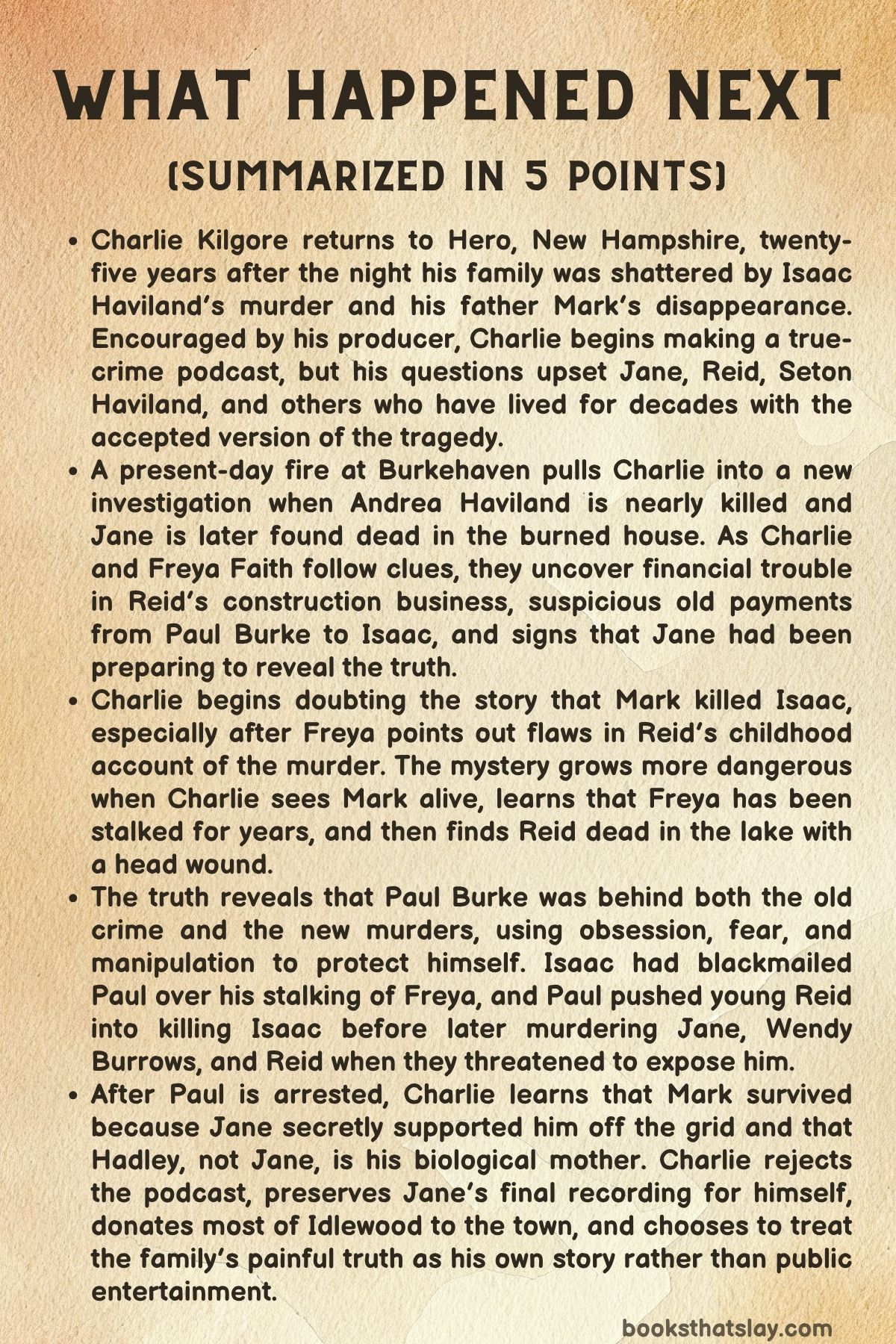
Charlie Kilgore returns to Hero, New Hampshire, twenty-five years after the night that ruined his family. The accepted version of events is simple but terrible: his father, Mark Kilgore, murdered Isaac Haviland, who had been having an affair with Charlie’s mother, Jane.
Mark then attacked Jane and tried to come after Charlie and his older brother Reid. Reid, only twelve at the time, escaped in a rowboat with baby Charlie and survived to tell the story.
Mark disappeared into the White Mountains afterward and was presumed dead, although no body was ever found.
As an adult, Charlie works at a Boston radio station. Encouraged by his producer, Julian, he decides to make a true-crime podcast about the murder that shaped his life before he was old enough to remember it.
His first step is to speak with Lisa Lawson, the widow of Wendy Burrows, the detective who led the original investigation. Wendy died in a suspicious car crash into the lake, but Lisa rejects any theory that her wife was murdered because of the case.
Charlie is not convinced. The missing body, the detective’s death, and the gaps in the story all leave him uneasy.
When Charlie reaches Hero, he reconnects with Seton Haviland, Isaac’s daughter and the acting police chief. Seton has her own family history tied to the tragedy, and she does not welcome Charlie’s questions.
She warns him that digging into the past will hurt people who have already suffered enough. Charlie continues anyway.
At the same time, he becomes aware of a new town dispute. Paul Burke is developing Burkehaven, his old family property, with Reid Construction.
Seton’s mother, Andrea Haviland, strongly opposes the project because she wants the shoreline protected.
Charlie returns to Idlewood, the family property, and reunites with Jane, Reid, his aunt Hadley, and Paul. The family carries out familiar Memorial Day rituals: lanterns over the lake, Bolognese for dinner, card games on the porch, and quiet attention to traditions that have outlived the people who first gave them meaning.
Charlie’s questions quickly disturb the family peace. Jane and Reid are uncomfortable with his interest in Mark, and when they learn about the podcast, Jane feels betrayed.
To her, Charlie is turning their private pain into public entertainment.
Jane later softens and agrees to let Charlie record her. She tells him he deserves to understand his own history.
She admits that her marriage to Mark was unhappy and that Mark may also have had an affair. She hints that there is something more important she wants to tell Charlie, but she says they should speak the next day.
Before that conversation can happen, Charlie goes for a run and sees smoke rising from Burkehaven. He runs toward the burning construction site, calls 911 from the nearby bungalow, and reaches the fire just as someone collapses near the house.
Before he can help, he is struck unconscious.
When Charlie wakes, Seton is there. They find that Andrea Haviland is the person who escaped the fire, and together they drag her to safety.
The fire is ruled arson. Because Andrea had been fighting the Burkehaven development, she becomes the obvious suspect.
Detective Duncan Gilcrest takes over the investigation. The fire also makes Charlie realize that the present is beginning to echo the past.
Once again, Burkehaven, the Kilgores, and the Havilands are linked through violence.
Charlie soon meets Freya Faith, a former television star and one of Paul’s longtime clients, at Andrea’s café. Freya once acted in crime shows, and she becomes interested in Charlie’s investigation.
She has sharp instincts and starts helping him question the official account of the old murder. She notices details that do not hold together, including Reid’s claim that he heard Isaac call Jane “my love” from a distance that seems impossible.
Charlie begins to understand that the story he grew up with may not simply be incomplete; it may have been shaped by someone who wanted everyone to believe a particular version.
Charlie’s doubts increase when he sees a man at a bar who looks like Mark. The possibility that his father is alive unsettles everything.
If Mark survived, then his disappearance may not have meant guilt in the way everyone assumed. Meanwhile, Gilcrest grows suspicious of Charlie and also shows possessive behavior toward Freya, with whom he is romantically involved.
Charlie finds himself caught between two investigations: the old murder and the current arson.
The case turns darker when Jane’s body is found in the burned Burkehaven house. Her car is discovered abandoned, and Charlie fears his questions may have pushed events into motion.
Jane had been ready to tell him something, and now she is dead. Two weeks later, after Jane’s memorial, Charlie and Freya continue following leads.
Vance Moodey, a lumber supplier, reveals that he and Jane had been quietly dating. He also tells Charlie that he had given Reid money.
This raises new questions about Reid’s finances and the future of the family business.
Andrea gives Charlie another important piece of the puzzle. She tells him Jane had called her to meet at Burkehaven the morning of the fire.
She also reveals that years earlier, she discovered suspicious payments from Paul to Isaac in the Landing’s books. At the time, she thought they were loans.
Now, in light of everything happening, the payments look more serious. Charlie starts to see a possible financial connection between Isaac, Paul, and the original murder.
Charlie learns that Reid Construction is in trouble. Reid has been juggling debts and hiding how bad things have become.
Andrea reviews the books and finds serious problems. Charlie confronts Reid about the money, the payments from Vance, the future of Idlewood, and Jane’s possible plan to put the property into conservation instead of allowing Reid to use or sell it.
He also presses Reid about the old murder, especially the claim about Isaac’s final words. Reid becomes angry and defensive.
He insists that he loved Jane and accuses Charlie of inventing drama for his podcast.
Freya’s past then becomes part of the danger. She tells Charlie about a stalker who began targeting her when she was a young actress.
A threatening message, “Welcome Home,” is smeared on her truck using nail polish from her own condo. Suspicion briefly turns toward Reid because he had access to her building and had once kept pictures of Freya in his room.
Seton later reveals that Reid was caught on hidden camera entering Freya’s apartment, making him look even more suspicious.
Soon afterward, Charlie sees Mark near Idlewood. His father is alive, wet, frightened, and clearly in distress.
Before Charlie can fully process that discovery, he finds Reid dead in the lake with a head wound. Gilcrest begins to suspect Charlie, arguing that Jane and Reid’s deaths leave him with Idlewood and half of the construction firm.
Hadley steps in to protect Charlie and insists that he needs a lawyer. Charlie, however, starts to believe the truth points past Andrea, past Reid alone, and toward Paul.
After learning that Mark had appeared near the Landing looking for an old friend, Charlie goes to Burkehaven Farm. There he finds Mark badly wounded in Freya’s truck.
Mark manages to say Paul’s name. Charlie follows Ginger’s howls into the hills and finds Freya tied up in an old cabin.
Gilcrest is also there, wounded by a gunshot. The hidden truth finally breaks open.
Paul Burke is revealed as the person behind both the old crime and the new murders. As a teenager, he became obsessed with Freya, stole from her, and began stalking her.
Years later, he used his role as her manager to keep power over her life. Isaac discovered the truth and blackmailed Paul, using the money to support the Landing.
When Isaac became involved with Jane, Paul saw a chance to protect himself. He manipulated young Reid by convincing him that Isaac had to be removed to save the family.
Reid killed Isaac with the chef’s knife. Jane returned, found Reid with the body, and was stabbed while trying to stop him.
Mark arrived later, found Jane injured, and chose to run so Reid would not be blamed.
Years later, Jane realized Paul had influenced Reid after Charlie repeated Paul’s phrase about cutting out evil before it takes root. She met Paul at Burkehaven and told him she intended to go to the police.
Paul killed her with a board, moved her car, set the fire, attacked Charlie, and allowed Andrea to nearly die in the flames. He also admits that he drowned Reid after Reid threatened to expose him.
He had killed Detective Wendy Burrows years earlier when she came too close to the truth. Charlie nearly shoots Paul, but Seton arrives and stops him from crossing that line.
After Paul’s arrest, Charlie’s life is rebuilt on painful new knowledge. Mark is alive because Jane secretly helped him survive off the grid for decades, taking money from the firm to support him.
Charlie begins cautiously reconnecting with him. DNA results reveal another hidden truth: Hadley, not Jane, is Charlie’s biological mother.
She and Mark had one drunken night together, and Jane raised Charlie as her own. Freya agrees to buy only one Burkehaven lot if the rest is conserved.
Charlie decides to donate most of Idlewood to the town while keeping a dock and some land. He refuses Julian’s plans for the podcast, quits the radio station, and saves only his final recording with Jane.
In the end, Charlie chooses not to turn his family’s pain into content. The story is his, and he decides to keep it that way.
Characters
Charlie Kilgore
Charlie Kilgore stands at the emotional center of the book as a man trying to reclaim a past that everyone else has already explained for him. He begins with the outward purpose of making a true-crime podcast, but his real need is more personal: he wants to know what happened to his family, why his father vanished, and why his own childhood has always been framed by someone else’s memory.
Charlie is curious, restless, and sometimes reckless, especially when his questions hurt Jane and Reid. Yet his mistakes come from a deep wound rather than simple ambition.
In What Happened Next, Charlie’s investigation forces him to face the difference between public curiosity and private grief. By the end, he changes because he understands that truth is not always something to package for an audience.
His refusal to continue the podcast is one of his most important choices, showing that he has moved from chasing a story to protecting what remains of his family’s humanity.
Jane Kilgore
Jane Kilgore is one of the book’s most sorrowful and guarded figures. For decades, she lives with the consequences of one terrible night, carrying secrets that affect every member of her family.
She is not simply a victim of violence; she is also a mother who made impossible choices under extreme pressure. Her decision to protect Reid, help Mark disappear, and raise Charlie as her own child reveals a woman who chose family preservation over legal truth.
That choice damages everyone, but the novel does not present her as cold or calculating. Jane is tired, loving, fearful, and burdened by the cost of silence.
Her willingness to speak with Charlie before her death suggests that she has reached a point where secrecy has become unbearable. Her murder is especially tragic because she dies just as she is ready to correct the false history that has shaped Charlie’s life.
Reid Kilgore
Reid Kilgore is a deeply damaged character whose childhood trauma never truly ended. As a boy, he was manipulated by Paul into believing that Isaac was a threat who had to be removed.
His killing of Isaac is horrifying, but it is also tied to his age, confusion, fear, and loyalty to the family. As an adult, Reid becomes defensive, angry, and financially desperate.
His construction business is failing, and his need to preserve status and control makes him look increasingly suspicious. Reid’s love for Jane appears genuine, but it is tangled with guilt and dependence.
He cannot bear Charlie’s questions because they threaten the version of events that allowed him to survive. His death in the lake completes a life shaped by another person’s manipulation.
Reid is guilty of violence, yet he is also one of Paul’s earliest victims, a child turned into a weapon and then abandoned to live with the consequences.
Mark Kilgore
Mark Kilgore is first presented through absence, rumor, and accusation. For most of the story, he exists as the presumed murderer who vanished into the mountains, allowing everyone else to build their lives around his supposed guilt.
When he is revealed to be alive, the book changes the meaning of his disappearance. Mark did not run because he had killed Isaac; he ran because he believed that staying would expose Reid.
His choice is morally complicated. By disappearing, he protects his son, but he also leaves Charlie without a father and allows a false story to harden into accepted history.
Mark’s survival off the grid, secretly supported by Jane, turns him into a living ghost. He is both present and absent, innocent of the central murder yet responsible for abandoning one child to protect another.
His cautious reconnection with Charlie at the end suggests the possibility of healing, though not an easy or complete one.
Seton Haviland
Seton Haviland is both a figure of law and a person shaped by family loss. As Isaac’s daughter and Hero’s acting police chief, she has personal reasons to resist Charlie’s investigation.
His search threatens to reopen her own family’s grief, and she initially sees him as someone disturbing old pain for a podcast. However, Seton is not closed-minded.
As new crimes occur, she follows evidence and eventually becomes essential to stopping Charlie from killing Paul. Her role is important because she represents a more disciplined relationship to truth than Charlie has at the beginning.
She cares about justice, but she also understands the human cost of exposure. Her connection with Charlie develops through conflict, shared danger, and a growing recognition that both of their families were harmed by the same hidden forces.
Freya Faith
Freya Faith brings glamour, intelligence, and private fear into the story. As a former television star known for crime shows, she understands performance, suspicion, and narrative shape, which makes her a useful partner for Charlie.
She quickly sees weaknesses in the accepted account of Isaac’s murder and helps Charlie think beyond the obvious suspects. Beneath her confidence, however, Freya has lived for years under the shadow of a stalker.
The revelation that Paul controlled and threatened her life for decades makes her more than a side character in Charlie’s investigation. She is central to Paul’s history of obsession and control.
Freya’s decision near the end to purchase only one Burkehaven lot while preserving the rest shows her movement away from dependence and toward agency. She survives not because she is untouched by fear, but because she keeps fighting for control over her own life.
Paul Burke
Paul Burke is the true architect of the book’s violence, and his danger lies in how ordinary and trusted he appears for so long. He is connected to the Kilgores, the Burkes, Freya, the development project, and the old payments to Isaac, yet he hides behind charm, money, and familiarity.
His obsession with Freya begins when he is young and grows into theft, stalking, manipulation, and long-term control. When Isaac discovers the truth, Paul protects himself by turning Reid’s fear and loyalty into a tool.
This is what makes him so destructive in What Happened Next: he rarely needs to act openly at first because he knows how to push damaged people toward choices that serve him. Years later, when Jane and Reid threaten exposure, he kills again.
Paul’s crimes are not sudden eruptions but the result of entitlement, obsession, and a lifelong belief that other people exist to protect his desires.
Hadley
Hadley is a quiet but significant figure whose importance becomes clearer as the story progresses. At first, she appears mainly as Charlie’s aunt and a protective presence within the damaged Kilgore family.
She watches the old wounds reopen and tries to protect Charlie when Gilcrest begins treating him as a suspect. The later revelation that she is Charlie’s biological mother changes her entire role in the story.
Hadley’s past with Mark and Jane’s decision to raise Charlie as her own show how layered the family’s secrets are. Hadley is not presented as someone trying to claim what Jane gave her life to protect.
Instead, she remains steady, loving, and careful. Her presence complicates Charlie’s idea of motherhood without erasing Jane’s place in his life.
Through Hadley, the book shows that biological truth can matter deeply while still not replacing the emotional truth of who raised and loved a child.
Andrea Haviland
Andrea Haviland is a strong moral presence in the town’s present-day conflict. Her opposition to Burkehaven is rooted in preservation, memory, and respect for the shoreline.
Because of that opposition, she becomes an easy suspect when the fire is ruled arson. Yet Andrea’s role is not that of a villain but of someone who has been close to the truth without fully understanding it.
Her discovery of Paul’s suspicious payments to Isaac years earlier becomes a key piece of the larger mystery. She also helps Charlie understand that Jane had been preparing to act before her death.
Andrea is practical, principled, and emotionally tied to both Isaac’s memory and the future of Hero. Her near-death in the fire shows Paul’s willingness to sacrifice anyone who might be useful as a scapegoat.
Isaac Haviland
Isaac Haviland is dead before the main events unfold, but his choices shape nearly everything that follows. He is remembered as Jane’s lover and Mark’s supposed victim, but the truth reveals a more complicated position.
Isaac discovered Paul’s crimes against Freya and chose to blackmail him rather than immediately expose him. That decision gave Paul a motive and created the chain of manipulation that led to Isaac’s death.
Isaac’s affair with Jane also destabilized the Kilgore family and made it easier for Paul to convince young Reid that Isaac was a threat. Isaac is neither a simple victim nor a villain.
He is a flawed man whose actions placed him at the center of several dangerous tensions: desire, money, secrecy, and revenge.
Detective Wendy Burrows
Detective Wendy Burrows represents the original investigation’s lost chance at justice. She was the detective who came closest to uncovering the truth behind Isaac’s murder, and her death in a car crash was long treated as unfortunate but not necessarily criminal.
The later revelation that Paul killed her confirms that she had been following the right path. Wendy’s role in the novel is brief but important because her death shows how far Paul was willing to go even decades earlier.
She also stands as a contrast to the false story that survived. The truth was not impossible to find; it was actively buried.
Wendy’s fate proves that the old case did not remain unsolved because no one cared, but because the person responsible was willing to remove anyone who threatened him.
Duncan Gilcrest
Duncan Gilcrest is a flawed investigator whose suspicion of Charlie is partly understandable and partly shaped by jealousy and insecurity. As the detective handling the Burkehaven arson and later deaths, he focuses on Charlie because the inheritance and timing make him look suspicious.
However, Gilcrest’s romantic involvement with Freya clouds his judgment. His possessiveness toward her makes him less reliable, even when he is not the true villain.
He is not presented as corrupt in the same way Paul is, but he is compromised by emotion and ego. His presence adds pressure to Charlie’s investigation because Charlie is not only searching for answers but also defending himself from a law officer who may be looking in the wrong direction.
Vance Moodey
Vance Moodey serves as one of the story’s quieter but useful witnesses. His relationship with Jane reveals that her life before her death was not frozen in the past; she had begun forming new emotional ties.
His admission that he gave Reid money helps expose the financial instability behind Reid Construction and deepens Charlie’s suspicion that money, property, and debt are tied to the murders. Vance is not central in the way Charlie, Jane, Reid, Paul, or Freya are, but his information helps shift the investigation away from the old accepted story and toward the hidden pressures affecting the family in the present.
Julian
Julian is important because he represents the outside world’s appetite for Charlie’s tragedy. As Charlie’s producer, he encourages the podcast and sees the old murder as material that can become compelling audio.
He is not malicious, but his role highlights the ethical tension at the center of Charlie’s journey. To Julian, the Kilgore case has structure, mystery, and audience appeal.
To Charlie, it begins that way too, but it becomes something far more personal and painful. By rejecting Julian’s podcast plans at the end, Charlie rejects the idea that every family wound must become content.
Julian’s presence helps define Charlie’s transformation from storyteller to guardian of his own history.
Themes
The Burden of Inherited Stories
Charlie grows up inside a story he did not choose and cannot remember. Everyone around him has already decided what happened: Mark killed Isaac, attacked Jane, and vanished after Reid saved Charlie.
That version gives the family a structure for grief, but it also traps Charlie inside a history built from fear, silence, and manipulation. What Happened Next examines how inherited stories can become almost as powerful as facts, especially when they are repeated by family members, police records, and town memory.
Charlie’s podcast begins as an attempt to retell the story publicly, but his deeper need is to separate truth from performance. As he learns more, he discovers that the accepted account protected some people, punished others, and erased the real source of danger.
The book shows that family stories are not harmless when they are built around lies. They shape identity, loyalty, blame, and even love.
Charlie can only move forward once he stops accepting the version handed to him and decides what the truth means for his own life.
Silence, Protection, and Moral Compromise
The Kilgore family survives by keeping secrets, but survival comes at a terrible cost. Jane protects Reid by allowing Mark to take the blame.
Mark protects Reid by disappearing. Hadley lives with the hidden truth of Charlie’s birth.
Each act of silence begins as a form of protection, yet each one also creates new damage. Reid grows into adulthood without real accountability, Mark loses his place as a father, Charlie grows up with a false understanding of his family, and Jane carries a private burden until it finally gets her killed.
The story does not treat truth as simple or painless. Telling the truth would have destroyed a child’s life, but hiding it destroys lives in slower ways.
This theme is powerful because the characters’ choices are emotionally understandable even when they are morally troubling. The book asks whether love can excuse silence when silence allows harm to continue.
Jane’s final decision to speak suggests that protection based on lies eventually becomes another kind of danger.
Obsession and Control
Paul’s crimes come from a long pattern of obsession disguised as care, management, friendship, and family loyalty. His fixation on Freya begins in youth and becomes the root of theft, stalking, manipulation, blackmail, and murder.
He does not simply desire Freya; he wants control over her choices, her safety, her career, and her fear. That same need for control appears in the way he manipulates Reid, pays Isaac, kills Wendy, murders Jane, and drowns Reid.
Paul’s violence is not random. It grows from entitlement and the belief that other people can be moved, silenced, or removed when they threaten his private world.
Freya’s storyline shows the long-term effect of being watched and managed by someone who claims importance in her life. Reid’s storyline shows how obsession can destroy people beyond the original target.
Paul’s power comes from patience, social trust, and his ability to seem useful. The book presents obsession not as passion but as possession, and it shows how dangerous that possession becomes when protected by money and reputation.
Ownership of Pain and the Ethics of True Crime
Charlie begins with a familiar true-crime impulse: there is an old case, unanswered questions, and a potential audience. The podcast offers him a way to investigate his family’s past, but it also risks turning real suffering into a product.
Jane’s early sense of betrayal is important because she understands that the story is not just a mystery; it is the worst experience of her life. As Charlie investigates, people die, old wounds reopen, and the line between personal truth and public entertainment becomes harder to ignore.
By the end, Charlie has enough material for a sensational podcast, but he no longer wants to give it away. His choice to save only Jane’s final recording and resign from the station shows his growth.
He understands that truth does not always need an audience to matter. Some stories belong first to the people who survived them.
The theme challenges the hunger for crime narratives by asking who benefits when pain becomes content and who is harmed when private grief is made public.