What Happens This Christmas Summary, Characters and Themes
What Happens This Christmas by Dani Ryan is a poignant exploration of love, disillusionment, and the complexities of relationships set against the backdrop of the holiday season. The story centers on Candy, a woman caught in the throes of a failing marriage to Nick, a bartender at an Irish pub.
As their relationship deteriorates amidst their glamorous lifestyle in Manhattan, they both struggle with the realization that their connection is no longer what it once was. Amidst lavish dinners, parties, and shopping, they find themselves confronted with the cold reality of emotional distance. As they navigate family dynamics, personal desires, and the impending divorce, both Candy and Nick must come to terms with their past and decide if there’s hope for their future together.
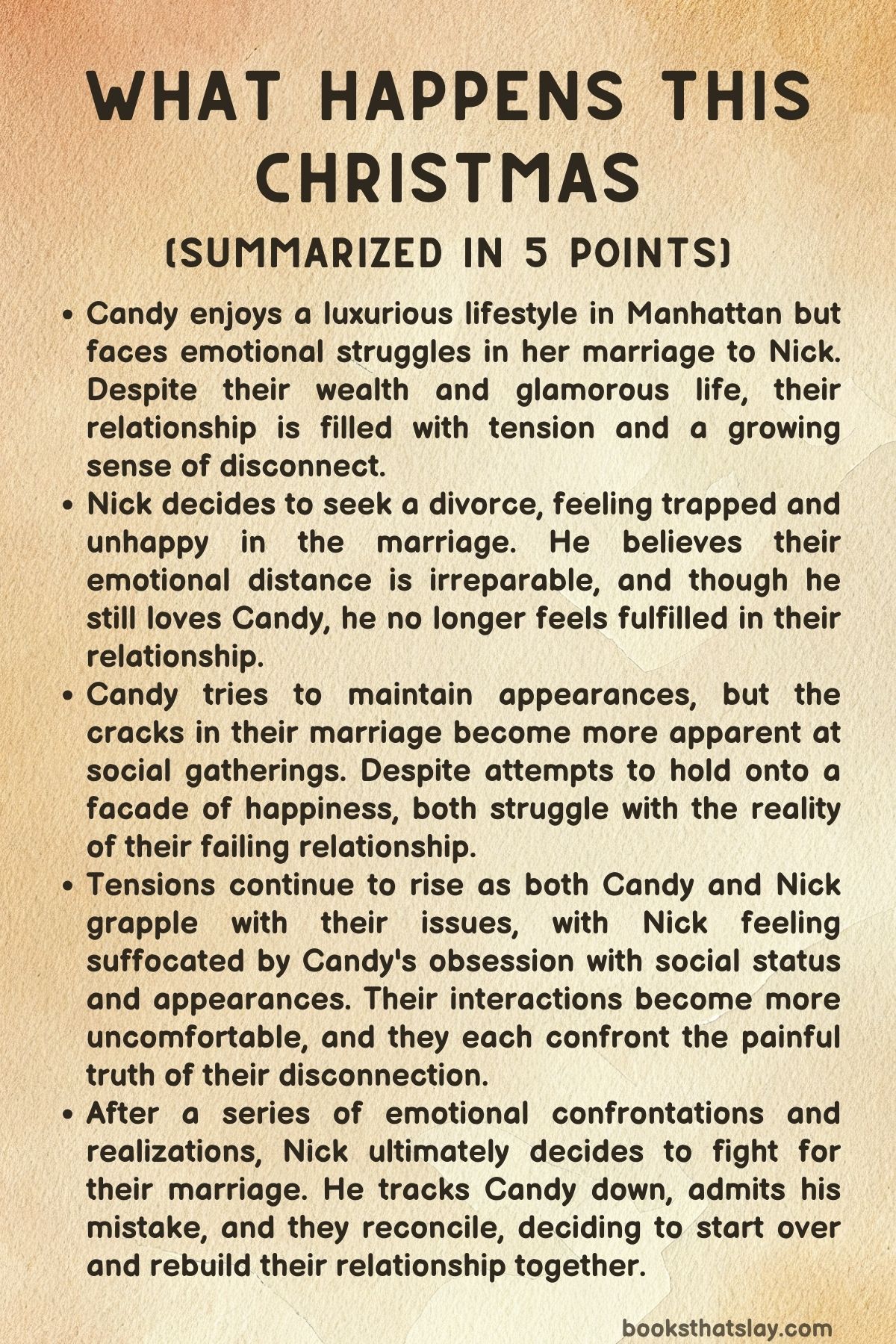
Summary
The story begins with Candy, a woman who lives a life of luxury in Manhattan. A savvy shopper, she enjoys the thrill of purchasing high-end items like a black wool coat from a renowned designer and a watch for her husband, Nick.
However, as she prepares for a dinner at home with him, a sense of unease begins to settle. When she gives him the watch, Nick drops a bombshell—he wants a divorce.
Candy, shocked and confused, struggles to comprehend the weight of his words. Despite their wealth and comfortable lifestyle, their marriage is empty, marked by tension and emotional disconnection.
Nick’s perspective reveals his frustration. He has been feeling trapped in the relationship for a long time.
Although he still cares for Candy, the spark that once existed has faded. Their emotional distance is too great to ignore.
The love between them has withered, and the marriage has become suffocating. As Nick contemplates the end of their relationship, he wrestles with the realization that, despite their outward appearances, they are living separate lives.
The couple attends a holiday party, but their strained interactions only deepen their sense of alienation. Nick feels increasingly uncomfortable in social settings, and Candy, who still clings to the idea of a perfect life, attempts to maintain appearances.
However, the cracks in their marriage are evident to both of them. The emotional distance is undeniable, and Nick’s frustration grows.
He can no longer pretend that everything is fine. The facade of a happy marriage begins to crumble.
Candy, meanwhile, is consumed by feelings of emptiness. Surrounded by material wealth, she realizes that she is emotionally bankrupt.
Her marriage, once a source of happiness, now feels like a prison. She struggles to hold on to the ideal of a perfect marriage, but her attempts are futile.
As she reflects on their relationship, she questions whether the superficiality of their life is worth preserving. The lavishness of their home and the parties they attend seem meaningless in the face of their growing emotional disconnect.
Nick’s dissatisfaction with their life together becomes more evident. His frustration with Candy’s obsession with appearances and social events escalates.
Their visit to a fancy restaurant serves as a reminder of how far apart they’ve grown. Even the simplest activities feel forced, as neither of them can truly connect with the other.
Their dynamic is increasingly strained, and Nick realizes that they are no longer living in harmony. Even the act of enjoying a meal together becomes an ordeal.
As the holiday season progresses, the couple’s interactions become more uncomfortable. Nick’s attempts to reconnect with Candy at the pub are met with resistance, and their conversations are laced with passive-aggressive remarks.
Despite the festive atmosphere, they both feel the weight of their fractured relationship. The façade of a perfect marriage is crumbling, and the truth is becoming harder to ignore.
In an effort to escape the tension, Nick and Candy spend time at their house on Long Island, but their emotional disconnect only grows. Candy’s decision to make plans with their friends instead of spending quality time with Nick intensifies his frustration.
He begins to accept that their marriage is beyond repair. Despite their wealth, their relationship is emotionally bankrupt.
Nick’s internal conflict deepens as he grapples with the reality of their situation.
A trip to a Christmas tree farm highlights the tension between them. Although Nick insists on selecting a real tree, Candy reluctantly participates, expressing her frustration with the situation.
Their conversation is filled with sarcastic remarks, reflecting the growing bitterness in their marriage. Candy continues to hold onto the illusion of a perfect life, but deep down, she knows that their relationship is nearing its end.
As the story progresses, Candy is further distanced from Nick, especially after a visit from her carefree sister, Eloise. Eloise’s spontaneous and unrefined behavior clashes with Candy’s more controlled demeanor, highlighting the superficiality of their relationships.
Candy tries to escape her troubles by immersing herself in shopping, but even these activities fail to bring her any real comfort.
Nick, on the other hand, continues to struggle with the reality of their failing marriage. He meets with his lawyer to discuss divorce proceedings, offering to let Candy keep their penthouse.
Though he still has feelings for her, he realizes that their relationship is irreparably broken. Meanwhile, Candy tries to salvage their marriage with a grand piano as a gift for Nick, but the gesture is met with mixed emotions.
Both of them are trapped in a cycle of pretense, unable to address the deeper issues in their relationship.
The tension between them escalates further when they take part in a forced photo session for their Christmas card. The photographer’s attempts to capture a moment of affection between them only serve to highlight the emotional distance that now defines their marriage.
Their physical attraction remains, but it is overshadowed by the unresolved issues that have plagued their relationship.
The complexity of their emotions becomes more evident as they engage in a physical encounter that is simultaneously passionate and fraught with anger. This moment symbolizes the clash between their lingering desires and the deep emotional disconnect that has taken root.
Their marriage, once full of love and passion, now feels like a hollow shell.
In the final chapters, the strain of their relationship reaches its breaking point. Candy spends time with Eloise, trying to find solace in the distractions of shopping and social events.
However, the growing tension between her and Nick continues to weigh heavily on her. Candy’s attempts to maintain appearances only serve to exacerbate the emotional isolation she feels.
At a party hosted by Irina, Candy confronts the gossip and rumors about her marriage. The tension between Candy and Nick is palpable as they navigate the complex dynamics of their relationship.
Their interactions are filled with unspoken resentment, but there are also moments of vulnerability. Despite their differences, they still care for each other, though they are unsure if they can repair what has been broken.
Nick’s emotional breakdown leads to a dramatic reconciliation. He realizes the mistakes he made in asking for a divorce and decides to fight for their marriage.
After an emotional confrontation, Nick proposes that they start fresh, leaving behind the pain of the past. Candy, though hesitant, begins to believe that there may still be hope for their future together.
The story ends on a hopeful note, as they embrace the possibility of rebuilding their relationship amidst the backdrop of Christmas.
Characters
Candy
Candy is a complex character who is initially presented as someone living a life of luxury and superficiality. She enjoys the finer things in life, such as designer shopping, extravagant dinners, and a high-end apartment in Manhattan.
Yet, beneath the surface, she is deeply dissatisfied with her marriage to Nick. Despite her outward appearance of control and grace, Candy is struggling with an overwhelming sense of emotional emptiness.
She clings to the image of a perfect marriage, even though it is crumbling around her. Her materialistic lifestyle and obsession with maintaining appearances serve as a distraction from the growing emotional distance between her and Nick.
Throughout the story, Candy is conflicted between her desire to hold onto the life she has built with Nick and the realization that their marriage has become irreparably broken. Her internal struggle is most apparent in moments where she attempts to salvage their relationship, such as her purchase of an extravagant grand piano for Nick.
Yet, these gestures, no matter how lavish, are met with indifference from him, symbolizing the futility of her efforts. In the end, Candy’s emotional journey leads her to confront her inner turmoil and the possibility of starting over, as she realizes that she cannot continue living a life dictated by societal expectations and material possessions.
Nick
Nick, on the other hand, is portrayed as a man trapped in a marriage that no longer brings him happiness. Despite his love for Candy, he feels emotionally suffocated by her obsession with appearances and their hollow existence.
Nick works as a bartender at The Black Sheep, a job that contrasts sharply with Candy’s world of luxury and wealth. He is disillusioned with the facade they have built together and is painfully aware of the growing distance between them.
His decision to ask for a divorce stems from a culmination of months of frustration, during which he has come to terms with the reality that their marriage is no longer fulfilling. Nick is a man struggling to balance his love for Candy with the realization that their emotional disconnect has become too great to ignore.
While he still harbors feelings for her, he understands that the relationship cannot be saved without change. His internal journey is highlighted by his interactions with others, including his lawyer, Mel, and his mother, Virginia, who adds further strain to his already fragile marriage.
Nick’s decision to fight for their relationship towards the end reflects his desire for redemption, as he recognizes that he still has the capacity to love Candy and is willing to make the effort to rebuild their bond.
Eloise
Eloise, Candy’s younger sister, serves as a stark contrast to Candy’s more controlled and composed demeanor. Eloise is carefree, spontaneous, and unrefined, often causing friction in Candy’s carefully curated life.
While Candy’s focus is on maintaining appearances and upholding social status, Eloise’s unfiltered personality and lack of concern for societal expectations highlight the differences between the two sisters. Eloise’s presence in the story is both a source of frustration for Candy and a catalyst for reflection.
While Candy struggles with her emotions and the dissolution of her marriage, Eloise remains a symbol of freedom and impulsiveness, unburdened by the constraints that Candy feels. Their interactions often underscore the superficiality of Candy’s relationships and the emotional isolation she experiences.
Despite the tension between them, Eloise provides moments of levity and insight into the way Candy views the world around her.
Irina
Irina, a character who briefly appears at the party hosted by her, represents the judgmental and hypocritical social circle that Candy is part of. Irina’s gossip about Nick and the couple’s financial situation fuels Candy’s anger and frustration, leading to a confrontation that reveals Candy’s willingness to stand up for herself.
Despite the tension between them, Irina’s character plays a pivotal role in Candy’s emotional journey, as the confrontation with her marks a turning point in Candy’s development. Through this moment, Candy begins to reclaim some of her power and assert her agency, symbolizing a shift in her perspective as she confronts the external pressures that have long influenced her decisions.
Irina, while a relatively minor character, highlights the toxic dynamics of the social circles that Candy tries to navigate, and her actions ultimately prompt Candy to reconsider her role in that world.
Vito Deluca
Vito Deluca’s brief appearance in the story adds an element of danger and complexity to the narrative. Vito is a man with a ruthless reputation, and his interest in involving Nick in business dealings adds an undercurrent of tension to the already strained relationship between Candy and Nick.
While Vito’s presence is more of a catalyst for Nick’s eventual decision to fight for his marriage, it also serves to highlight the contrast between Nick’s desire for simplicity and the complications of his world. Vito’s character represents the external pressures and temptations that threaten to pull Nick further away from his marriage to Candy, as well as the darker side of the world they inhabit.
His interactions with the couple further emphasize the emotional and psychological strain that defines their relationship.
Virginia
Virginia, Nick’s mother, plays a significant role in adding to the tension within Nick and Candy’s marriage. As a force that advocates for the divorce, Virginia represents the external familial pressures that contribute to the couple’s already fragile relationship.
Her presence in the story serves as a reminder of the difficulties Nick faces in navigating his loyalty to his mother while also attempting to repair his marriage. Virginia’s constant interference and her attempts to set Nick up with Sibley further exacerbate the strain between the couple.
She embodies the emotional manipulation and the sense of entrapment that Nick feels, as he is forced to choose between his family and his wife. Her arrival at the house and the subsequent hostile interactions with Candy further reveal the deep rift between Nick and his mother, adding yet another layer of complexity to his emotional turmoil.
Sibley
Sibley, a woman from Nick’s childhood, briefly appears as a potential romantic distraction. Her attempt to rekindle something with Nick adds to the emotional complexity of his relationship with Candy.
Sibley’s flirtation with Nick serves as a reminder of the allure of past relationships and the temptation of escape from the emotional weight of his marriage. While Nick brushes off her advances, Sibley represents the unresolved desires and regrets that linger in his mind.
Her character briefly highlights Nick’s internal conflict and the ways in which he is tempted by the possibility of a simpler, less complicated relationship, even though he ultimately chooses to remain committed to his marriage.
Themes
Materialism and Superficiality
In What Happens This Christmas, materialism and the pursuit of status are central to the characters’ lives, particularly Candy’s. From the very beginning, Candy’s lifestyle is characterized by luxury, high-end shopping, and a desire to maintain a polished appearance in society.
She is constantly surrounded by material possessions, from her designer coats to lavish apartments and expensive gifts. These possessions, however, serve as a façade for deeper emotional emptiness.
The more material wealth Candy accumulates, the more disconnected she feels from her marriage and herself. Nick, in contrast, becomes increasingly disillusioned by the shallow nature of their life together.
His frustration grows not only with the superficiality of their social world but also with Candy’s obsession with appearances and social expectations. Their strained relationship reflects the hollowness of a life centered solely on material success, where the deeper emotional needs of the couple are neglected.
Despite all the wealth and luxury that surrounds them, the couple’s inability to connect emotionally underscores the emptiness that materialism can breed. The narrative suggests that, while material possessions may offer temporary comfort, they cannot replace genuine human connection and emotional fulfillment.
Emotional Distance and the Breakdown of Relationships
The emotional distance between Candy and Nick is a pervasive theme in What Happens This Christmas. As their marriage unravels, it becomes clear that both have drifted apart emotionally, even though they continue to maintain outward appearances.
Candy, despite her lavish lifestyle, feels increasingly isolated and disconnected from Nick. She tries to hold onto the image of a perfect marriage, but the reality is far different.
Nick, on the other hand, feels trapped in a marriage that no longer brings him happiness. He loves Candy but is no longer emotionally fulfilled, leading him to the decision of divorce.
Their interactions are increasingly characterized by tension, silence, and passive-aggressive behavior, highlighting how the emotional distance between them has become insurmountable. Even when they attempt to salvage their relationship, their efforts feel forced and disconnected.
This theme of emotional distance is further emphasized by the coldness and lack of intimacy in their interactions. It’s not just a physical separation that divides them but an emotional chasm that neither knows how to bridge.
The dissolution of their marriage is not a sudden event but a slow and painful realization that their emotional needs have not been met for a long time, leading to an inevitable breakdown.
The Illusion of Perfection
The theme of maintaining an illusion of perfection runs throughout What Happens This Christmas, particularly in the lives of Candy and Nick. Both characters are trapped in a world of appearances, where outward perfection is prioritized over genuine emotional connections.
Candy, for example, is obsessed with curating a flawless life, spending her days shopping for luxury items and hosting social events. Yet, despite this outward show of success, she is deeply unhappy and dissatisfied with her marriage.
The couple’s attempts to maintain a façade of marital bliss during social events, like the holiday party or their photo session for Christmas cards, only highlight the growing disconnect between them. Their efforts to convince others—and themselves—that everything is fine are futile as the cracks in their relationship become more apparent.
Candy’s struggle with this illusion is further exemplified by her need to hold onto the image of a perfect marriage even when she knows it is no longer real. The theme emphasizes the pressure to maintain a picture-perfect life, which often leads to neglecting the more important aspects of personal happiness and emotional health.
Identity and Self-Realization
As the story progresses, both Candy and Nick are forced to confront their personal identities and the disillusionment that comes with their current lives. For Candy, her identity has been built around her social status and material wealth.
She defines herself by the high-end brands she wears, the luxurious apartment she lives in, and the events she attends. However, as her marriage to Nick deteriorates, she begins to question who she really is beyond these material markers.
The internal conflict she experiences revolves around her realization that her wealth and social standing are not enough to fill the emotional void in her life. Nick, too, grapples with his own identity as he wrestles with his feelings for Candy and his dissatisfaction with their marriage.
He realizes that he has been living in a way that no longer aligns with his true self and begins to understand that he needs to make a change for his own emotional well-being. The theme of identity is explored through the couple’s journey of self-discovery, as they both come to terms with the fact that their lives are not fulfilling in the ways they had hoped.
This theme resonates with the notion that true fulfillment and happiness come from within, and not from external circumstances or material possessions.
Love and Its Complexities
The complexities of love are at the heart of What Happens This Christmas, as both Candy and Nick navigate the conflicting emotions that arise from their failing marriage. Despite the emotional distance and dissatisfaction they experience, there is still a deep love between them.
This love is tangled with resentment, frustration, and longing, making it difficult for them to find a resolution. For Candy, love is entangled with her need for control and her obsession with appearances.
She struggles to reconcile her feelings of love for Nick with the reality of their disconnection. Nick, on the other hand, is torn between his love for Candy and his desire for freedom from a relationship that no longer brings him joy.
Their physical intimacy, as seen in their passionate yet angry encounters, further complicates their emotions. The love they share is not simple or straightforward; it is marked by anger, hurt, and regret.
The novel portrays love as something multifaceted, where feelings of attachment, longing, and anger can coexist, creating a complex emotional landscape. This theme explores the challenges of love in a relationship that has deteriorated, where the love remains, but it is clouded by unresolved conflicts and unmet needs.