What Have You Done by Shari Lapena Summary, Characters and Themes
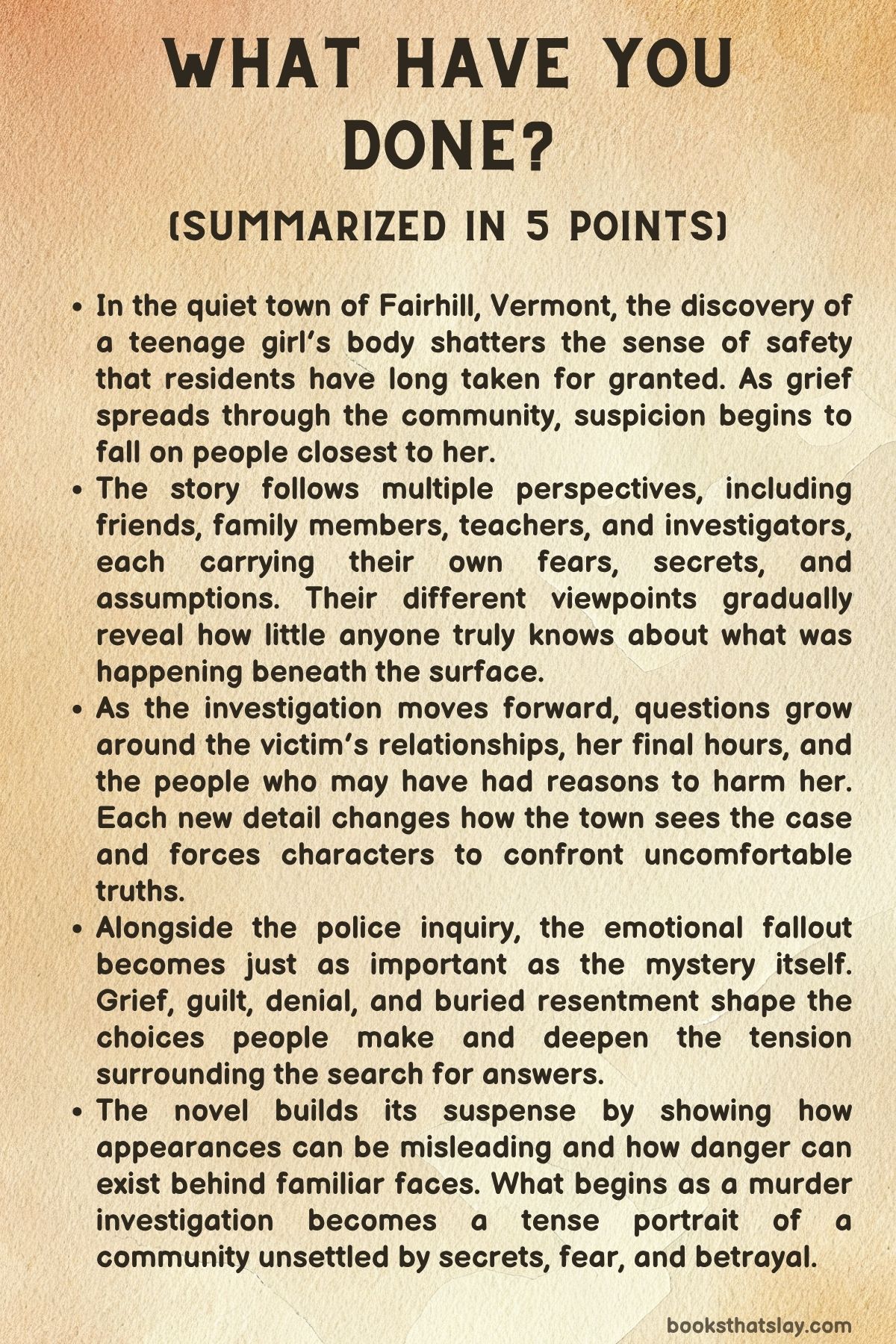
What Have You Done by Shari Lapena is a small-town suspense novel set in Fairhill, Vermont, where a teenage girl’s murder shakes a community that assumes it knows its own secrets. The story begins with the discovery of Diana Brewer’s body and follows the grief, suspicion, and fear that spread through her family, friends, teachers, and neighbors.
Lapena builds the novel through shifting points of view, including Diana’s own presence after death, which gives the story an eerie edge. What looks at first like a straightforward case keeps changing as hidden misconduct, damaged loyalties, and false assumptions come to light.
Summary
In Fairhill, Vermont, life moves at a familiar pace until farmer Roy Ressler finds the body of 17-year-old Diana Brewer in one of his fields. The sight is horrifying: Diana has been strangled, her body moved, and key evidence is missing, including her clothes and phone.
News of her death tears through the town, leaving her mother, Brenda, broken with grief and forcing everyone who knew Diana to look at the last hours of her life.
Diana’s boyfriend, Cameron Farrell, becomes an immediate focus for police attention. He was with her the night she died, and at first he tells officers that he dropped her off around 11:00 pm.
But his story quickly begins to fall apart. His mother knows he came home much later, and Cameron later admits that after an argument with Diana, he returned to her house and waited outside.
Diana had wanted space from him and had been considering a future that did not include staying tied to him. She even broke up with him that night after he reacted badly to her wish to attend a different college.
His lies, jealousy, and controlling behavior make him look dangerous, and both the police and Diana’s friends begin to wonder if grief is hiding guilt.
Diana’s closest friends, Riley Mead and Evan Carr, are also struggling to make sense of what happened. Riley remembers Diana telling her that Cameron had become too possessive.
Evan, quieter and more inward-looking, writes in his journal about Diana as the person who understood him best. He presents himself as the sensitive outsider of the group, someone overwhelmed by loss and disturbed by the way suspicion is circling around people he knows.
Riley and Evan cling to each other as the town grows more tense, but even within their friendship, uncertainty spreads.
Other suspects emerge. A creepy customer from Diana’s workplace, Joe Prior, had made her uncomfortable, always choosing her checkout line and trying to talk to her.
Police trace him, question him, and discover he lied about his whereabouts. He is clearly a predator, a man who stalks girls and fantasizes about entering their homes.
His behavior is deeply alarming, and later it is revealed that he did murder another teenage girl in New York. For a long time, he seems capable of being Diana’s killer too.
Yet although he is dangerous, the investigation eventually shows that his crimes belong to a different track of violence, not Diana’s murder.
At school, another troubling line of suspicion appears around Brad Turner, Diana’s gym teacher and running coach. Diana had complained that Brad made her uncomfortable by watching her and touching her in ways that crossed clear boundaries.
Principal Kelly handled the complaint badly, minimizing it and trying to protect Brad’s reputation rather than taking strong action. As pressure builds, more information comes out.
Another girl reports inappropriate conduct, and even Paula Acosta’s daughter, Taylor, later reveals that Brad looked at her in ways that made her feel exposed and unsafe. Brad is not just careless or misunderstood; he is a man who abuses his position and counts on the silence of girls and the weakness of adults around him.
Because Diana had spoken up about Brad shortly before her death, the police begin to suspect that he might have killed her to stop her from reporting him. This theory gains strength when it becomes clear that there had been a second, more serious incident involving Diana and Brad, one that Kelly had also failed to handle properly.
The town starts turning toward Brad as the answer. His fiancée Ellen, Roy’s daughter, is devastated as she learns more and more about who he really is.
Brad is arrested, and for a time it appears that the case is solved.
Running beside the police investigation is Diana’s own perspective after death. She watches her mother’s grief, Riley’s panic, Cameron’s fear, and the mistakes of the adults around her.
At first, Diana cannot fully remember what happened. Her final night exists in fragments.
She recalls the fight with Cameron, her fear, and flashes of danger, but not the complete truth. Her presence gives the story a strange emotional layer because she is both central to the crime and separated from the living world, unable to make herself heard.
Brenda, Diana’s mother, feels Diana near her in the house and begins speaking to her as if she is still there. Riley, shaken by the murder and by a threatening text sent from Diana’s missing phone, becomes increasingly convinced that Diana’s spirit has not moved on.
The phone message, sent after Diana’s death, suggests that the killer still has her phone and is willing to frighten those closest to her. Fear deepens, and suspicion spreads again when Cameron admits he drove near the field where Diana’s body was found.
His parents become desperate enough to consider hiding evidence if it would save their son.
Yet the case keeps slipping away from every neat explanation. Joe is guilty of terrible crimes, but not this one.
Brad is an abuser and a threat, but he is not Diana’s murderer either. The town is full of men capable of harm, full of adults who excuse warning signs, and full of people who only partly know one another.
That is what makes the truth so hard to see.
The final turn comes after Diana’s funeral. Riley goes to Evan’s house, exhausted and grieving, and while he is out of the room she discovers Diana’s missing phone hidden under his bed.
In that instant, everything changes. Riley calls 911, realizing she is in the house with Diana’s killer.
When Evan returns, he understands what has happened. The calm, wounded friend mask drops, and the violence beneath it becomes visible.
Diana’s recovered memory reveals the truth. After Diana came home the night of her breakup with Cameron, Evan came by to borrow a book.
She let him in because she trusted him. He confessed that he loved her.
Diana, overwhelmed by everything she had already been dealing with, laughed at the worst possible moment, not out of cruelty alone but from stress and emotional overload. Evan snapped.
In a burst of rage, he attacked her, knocked her down, and strangled her with her jump rope. He then moved her body, hid her phone, and created a false version of himself through his journal and his behavior, pretending to be the grieving friend while steering attention toward others.
Evan’s arrest exposes the novel’s central idea: the most dangerous person was not the one the town feared most, but the one people thought they understood. He is not sorry in any full moral sense.
In custody, he thinks about shaping the story into a book, already trying to control the narrative and turn murder into material. He blames Diana for his violence, revealing how deeply self-serving and warped he is.
By the end, justice arrives, but it does not bring comfort in any simple way. Brad still stands exposed as a predator.
Joe still represents another kind of evil. Kelly must face the consequences of his cowardice.
Ellen leaves behind her future with Brad. Brenda must live on with her loss.
Riley and Cameron are left with grief that cannot be undone. Diana, finally understanding what happened, lets go of revenge as she sees that Evan will face punishment.
The novel closes on the bitter truth that a community can survive a crime, but it cannot return to innocence once the people inside it are seen clearly.
Characters
Diana Brewer
Diana Brewer is the still center of the novel, the person around whom everyone else’s fear, grief, guilt, and self-deception begin to turn. Even after her death, she remains an active consciousness in the story, which makes her more than a victim and gives her a moral presence that many of the living characters lack.
At first, Diana’s posthumous perspective is marked by confusion. She sees her own body with disbelief, watches the people around her react, and struggles to recover the memory of what happened.
That fractured awareness reflects how violence erases control from its victim, but it also allows the story to show her mind working back toward truth. She is not written as a symbol of innocence alone.
She is intelligent, socially central, emotionally burdened, and increasingly aware of how unsafe the world around her has become.
Her relationships reveal how much pressure she is carrying before her murder. Cameron’s possessiveness is beginning to suffocate her, and she is trying to claim a future that belongs to her rather than to the expectations of a boyfriend who assumes continued access to her body, time, and choices.
At the same time, she is dealing with Brad Turner’s predatory behavior and the failure of authority figures to protect her properly when she speaks up. That combination matters because it shows that Diana is not destroyed by a single threat appearing out of nowhere.
She is surrounded by men who feel entitled to her in different ways, and by adults who minimize what she experiences. Her death is therefore shocking, but the atmosphere around her has already been marked by control, fear, and secrecy.
What makes Diana especially compelling is the gap between how others see her and what the reader gradually understands about her. To her mother she is a beloved daughter on the edge of adulthood.
To her friends she is the emotional center of their world. To Cameron she becomes someone he wants to keep.
To Brad she is a student he objectifies. But from her own perspective, she is a person trying to keep moving despite layers of pressure closing in around her.
Once her memory returns, the truth of her murder is almost more devastating because it comes not from the most obvious external threat but from someone she trusted. That final revelation gives Diana’s arc tragic force.
She is surrounded by danger, but the fatal act comes from intimacy betrayed. In What Have You Done, Diana represents not only a lost life but also the terrible cost of being disbelieved, watched, desired, and misread by nearly everyone around her.
Riley Mead
Riley Mead serves as one of the clearest emotional lenses in the story because her grief is immediate, raw, and restless. She cannot accept easy explanations, and that refusal is one of the reasons she becomes so important.
From the beginning, Riley is shown as deeply attached to Diana, first through ordinary teenage communication and then through the sudden horror of silence when Diana stops answering messages. After the murder, Riley’s pain does not make her passive.
It makes her alert. She feels responsible for what Diana told her, especially the concerns about Cameron’s behavior, and she carries the burden of deciding what to reveal to the police.
That sense of loyalty mixed with fear defines much of her role. She wants to honor her friend, but she also understands that speaking honestly may harm people she knows.
Riley’s character is shaped by the way grief unsettles certainty. She swings between trust and suspicion, especially in relation to Cameron, and her doubt feels credible because it grows from both evidence and fear rather than from melodrama.
She keeps testing what she believes against what she observes, and that makes her one of the few characters actively trying to move toward truth instead of protecting a preferred version of events. Her instincts are often better than those of the adults around her.
She sees what is changing in Cameron before his parents fully admit it, and she remains disturbed by details the police and school administration seem too slow to confront. Even when she makes impulsive decisions, such as pursuing leads with Evan, those choices grow out of emotional honesty rather than vanity or self-importance.
Riley also represents how grief can open a person to both insight and vulnerability. She becomes intensely concerned with Diana’s continued presence, the missing phone, and the possibility that the dead are not fully gone.
Those responses are not just supernatural ornament. They show how badly Riley needs meaning, contact, and reassurance in a world that has become unstable.
She is searching not only for a killer but also for a way to keep Diana from disappearing completely. That need makes her fragile, but it also makes her brave.
Her final discovery of the phone under Evan’s bed confirms the value of her persistence. She survives because she can read danger fast enough when it finally stands directly in front of her.
Riley emerges as a portrait of friendship under extreme strain: loyal, frightened, stubborn, emotionally exposed, and yet more capable than many adults of facing the truth when it arrives.
Evan Carr
Evan Carr is the most disturbing character in the novel because he is built around concealment. He initially appears to be the sensitive outsider, the thoughtful boy whose inner life is richer than what his surroundings allow.
He writes in a journal, loves books, feels misunderstood at home, and presents himself as someone whose attachment to Diana was based on intellectual and emotional closeness. Much of his danger comes from the plausibility of that image.
He fits a familiar role: the grieving friend who seems more reflective than threatening. His narration and behavior encourage sympathy, which is exactly why the final revelation is so effective.
The story shows how easily self-presentation can become a mask, especially when it is supported by language that sounds vulnerable and humane.
Evan’s love for Diana is not love in any mature sense. It is possessive longing filtered through fantasy and self-dramatization.
He imagines himself as the one who truly understood her, but his supposed depth is inseparable from entitlement. When he confesses his feelings and she does not respond in the way he wants, his emotional self-image collapses into rage.
The speed of that transformation matters. It reveals that his gentleness was conditional.
He could imagine Diana as a person as long as she existed within a story that centered his feelings. The moment she laughed, he experienced it not as a painful misunderstanding but as an injury to his identity.
His violence comes from a belief that humiliation authorizes retaliation, and that belief makes him terrifyingly ordinary in psychological terms.
What deepens his characterization is that he continues to narrate himself after the murder as though he were still the sensitive observer of events. His journal becomes a tool of self-fictionalization.
He is not simply hiding facts; he is creating an alternate self who can exist beside the murderer he has become. Even after arrest, he thinks about the case as material for a future book and imagines controlling the story through writing.
That impulse shows the full ugliness of his narcissism. Diana’s death is, in his mind, something that can still feed his ambitions.
He does not arrive at remorse. He arrives at interpretation.
That distinction is central to understanding him. In What Have You Done, Evan is not the obvious monster standing outside the community.
He is the inward, observant boy who has already learned how to turn language into camouflage.
Cameron Farrell
Cameron Farrell is built as the most immediate suspect, and the novel uses that position to explore how controlling behavior, adolescent masculinity, and fear can make guilt look visible even when murder is not the crime involved. Cameron is Diana’s boyfriend, and by the time of her death their relationship is already under strain.
He wants closeness on his terms, expects their futures to align, and reacts badly when Diana expresses independence. His possessiveness is not subtle.
Friends notice it, Riley hears Diana’s complaints, and even his mother slowly begins to recognize how much she has ignored. Cameron’s character matters because he is both harmful and not the killer.
The story refuses to let that distinction become an excuse. He may be innocent of murder, but he still embodies a form of pressure that narrows Diana’s freedom.
His repeated lies to the police are central to his characterization. Cameron lies first to avoid looking bad, then to hide the emotional reality of the breakup, and later because every correction makes him appear guiltier.
He becomes trapped inside his own dishonesty. That pattern shows how immaturity and panic can mimic the behavior of a murderer.
He is ashamed, frightened, and deeply concerned with how others see him, especially his father and the police. The novel uses his shifting account of the night to build suspense, but it also shows how boys are often trained to protect their pride before they protect the truth.
Cameron cannot bear to present himself as rejected, desperate, or out of control, so he edits reality until the editing itself becomes suspicious.
At the same time, the novel gives Cameron real emotional pain. He is grieving Diana, and his grief is complicated by the fact that he knows others suspect him.
He is not emotionally generous, but he is not empty. His crying at the funeral, his agitation after police questioning, and his fixation on the end of the relationship all show a boy who feels loss intensely but lacks the maturity to respond to it honestly.
His parents’ readiness to protect him at almost any cost also shapes him. Their instinct to hide, minimize, or even consider destroying evidence reveals the family system that supports his evasions.
Cameron therefore becomes more than a false suspect. He is an example of how a young man can be dangerous without being a murderer, and how a community that excuses possessiveness can fail to recognize harm until it is too late.
Brenda Brewer
Brenda Brewer is the novel’s clearest portrait of maternal grief, and her character carries much of its emotional devastation. She begins as a hardworking single mother who is tired after long nursing shifts but proud of the daughter she has raised.
Her private thoughts before the tragedy show a woman who wants Diana to have a wider life than the one Fairhill offers and who worries that early commitment to Cameron may limit her future. That instinct becomes painful in retrospect, because Brenda senses something narrowing around her daughter before she has any reason to imagine how final the danger will become.
After Diana’s death, Brenda’s world contracts almost completely into absence, memory, and the need to remain connected to her child somehow.
What is striking about Brenda is that grief does not flatten her into a single note of suffering. She is shattered, but she is also observant, angry, guilty, and searching.
She must answer police questions, revisit details of Diana’s relationships, and confront the possibility that she did not know everything happening in her daughter’s life. That realization wounds her deeply, especially when she learns about Brad.
It adds another dimension to her loss: not only has Diana been taken from her, but there were forms of pain and danger she could not protect her from because they remained hidden or were mishandled by others. Brenda is therefore not simply mourning a death.
She is mourning the unknowable parts of her daughter’s final weeks and the failure of the adult world around her.
Her growing sense that Diana is still present in the house gives her character a haunted but moving quality. Whether those moments are read psychologically or spiritually, they reveal Brenda’s refusal to let maternal connection be reduced to memory alone.
She speaks to Diana, senses her nearby, and worries about whether holding on too tightly is selfish. That internal conflict shows emotional depth.
She wants comfort, but she also wants peace for her daughter. Unlike many of the adults in the story, Brenda does not spend her energy protecting institutions, reputations, or appearances.
She remains anchored to love and loss. In What Have You Done, Brenda becomes a study of what grief does to time, perception, and identity.
She survives, but survival for her is not recovery. It is the painful work of continuing in a world that has been permanently emptied.
Paula Acosta
Paula Acosta functions as one of the novel’s moral witnesses, someone positioned close enough to the school system to see its failures and close enough to motherhood to feel their consequences personally. As an English teacher and the mother of Taylor, Paula lives in a double state of concern from the beginning.
She is alert to the emotional lives of students, but she is also worried about her own daughter’s isolation, phone use, and adjustment to adolescence. Diana’s death intensifies every one of those concerns.
Paula immediately understands that the murder is not just a tragedy for one family. It is a shock wave moving through the school, exposing everything fragile, hidden, or neglected in the lives of young people.
Paula’s significance grows because she refuses to look away once she learns about Diana’s complaint against Brad. Where Principal Kelly thinks first about reputation and damage control, Paula thinks about responsibility.
She pushes for action when Kelly hesitates, and her instinct is shown to be morally correct. She understands that even uncertainty is not a reason for silence when a student has said she feels unsafe.
That makes Paula one of the few adults in the story who acts with clarity rather than self-protection. Her role is not dramatic in the same way as Riley’s or Brenda’s, but it is essential because she embodies the adult conscience that institutions often fail to produce on their own.
Her relationship with Taylor gives her character additional depth. Paula is not idealized.
She worries, misreads some things, and struggles to know how much to press when her daughter withdraws. But those uncertainties make her more believable.
When Taylor finally reveals both the bullying she has endured and Brad’s behavior toward her, Paula’s fear becomes sharply personal. The danger was not only abstract or historical; it was close to home.
This revelation confirms Paula’s earlier instincts and turns her from concerned observer into directly implicated mother. Her anger is then no longer only ethical but visceral.
She sees how institutional cowardice creates the conditions in which predatory men continue operating. Paula stands for the kind of adult attention that young people desperately need: imperfect, anxious, but willing to act once the truth becomes visible.
Brad Turner
Brad Turner is one of the novel’s clearest embodiments of abuse hidden behind ordinary social respectability. As a teacher and coach, he occupies a position that gives him easy access to girls, authority over them, and an appearance of trustworthiness.
He initially tries to frame Diana’s complaint as a misunderstanding, using the familiar language of minimization that predatory men often rely on. He wants his behavior interpreted as harmless touch, accidental discomfort, or teenage overreaction.
Yet the more the story exposes him, the more obvious it becomes that his conduct is deliberate. He watches girls sexually, engineers moments of proximity, and depends on silence, shame, and institutional weakness to protect him.
Brad’s fear after Diana’s death is revealing because it is not the fear of a falsely accused innocent person. It is the fear of a man who knows there is truth behind the allegations and who understands that exposure could destroy the life he has built.
He is obsessed with reputation, with what Ellen knows, with what Kelly has told police, and with whether the public version of the complaint will remain mild enough to manage. Even when he is frightened, he remains self-centered.
His concern is not the damage done to Diana or the students he has harmed. It is what happens to him if they speak too clearly.
That quality makes him morally repellent even before the full details of his behavior emerge.
The novel also uses Brad to show that a person can be deeply dangerous without being guilty of the central murder. For much of the story, suspicion turns toward him for understandable reasons.
He had motive, he had predatory habits, and he had already crossed serious boundaries with Diana. When the police arrest him, it seems plausible that his abusive conduct has escalated into murder.
The later revelation that he is not the killer does not lessen his significance. Instead, it sharpens the book’s broader argument that communities often contain multiple forms of male violence operating at once.
Brad is not the final answer to the crime, but he is still one of the darkest presences in the story because he represents systemic harm: the kind that thrives through denial, paperwork, euphemism, and adult cowardice.
Principal Graham Kelly
Principal Kelly is one of the most revealing adult characters because his failures are not driven by sadism but by weakness, vanity, and fear. He is not the one committing direct violence, yet his choices help create the conditions in which harm continues.
When Diana reports Brad’s conduct, Kelly does not respond with the seriousness the situation demands. He chooses containment over accountability, records a softened version of events, and persuades himself that he is being reasonable.
That self-persuasion is central to his character. He wants to think of himself as practical and balanced, but in reality he is protecting the institution, the male colleague, and his own comfort at the expense of the student who came to him for help.
Kelly’s moral cowardice extends beyond the school complaint. His private life is also marked by avoidance, including an affair he is desperate to keep hidden.
That detail is important not because it equals his professional misconduct, but because it reveals a larger pattern. He avoids conflict until avoidance becomes impossible, and then he responds too late.
He is deeply uncomfortable with decisive action when it threatens his image or stability. As a result, he becomes the kind of administrator who can speak the language of concern while failing in the substance of care.
He is tormented as the case develops, but his suffering does not erase his responsibility. He helped create a system in which Diana had reason to believe she might not be protected.
To the novel’s credit, Kelly is not drawn as purely monstrous. He is weak, not theatrical.
He drinks, lies, worries, and gradually understands the extent of his failure. When he finally tells the full truth, the moment has weight because it is both necessary and humiliating.
He recognizes that his inaction has consequences beyond reputation loss; it may have contributed to a girl’s isolation at a crucial moment. That realization gives him some moral dimension, but not redemption in any simple sense.
He becomes a study in how damage is often enabled by people who do not see themselves as villains at all. Their weakness, when joined to institutional authority, can be catastrophic.
Ellen Ressler
Ellen Ressler occupies one of the most painful positions in the novel because she is forced to watch the man she planned to marry turn into a stranger. At first, Ellen appears within the domestic frame of her family’s life on the farm, with a wedding ahead of her and a future that seems stable.
Brad’s role in that future is already marked by a slight emotional distance, a sense that he keeps parts of himself sealed off, but Ellen explains that away as damage from his difficult upbringing. Her willingness to interpret secrecy as vulnerability shows her capacity for empathy, but it also reveals how easily women are trained to make excuses for men who withhold, evade, and control information.
As the accusations against Brad grow, Ellen becomes a character defined by conflict between loyalty and perception. She wants to believe him because belief preserves not only the relationship but the future she has already imagined.
Yet every new disclosure destabilizes that hope. The story handles her uncertainty well.
She is not foolish for hesitating; she is someone trying to reconcile love with evidence. That process is emotionally exhausting because each new fact requires her to revise not just her opinion of Brad but her understanding of her own judgment.
If he is guilty, then she has failed to see something essential. That is one of the hidden injuries of proximity to abusive men: they damage not only trust but a person’s faith in her own ability to read character.
Ellen’s eventual decision to leave Brad and start over elsewhere shows real strength, though it arrives through devastation rather than triumph. By the time she learns the fuller truth, the relationship is not merely broken; it has become morally impossible.
Her emptiness after Brad’s arrest captures the collapse of a planned life. She loses not only a partner but also a narrative about who she thought she was and where she was going.
Ellen therefore stands as an important counterpoint to the teenage girls in the story. She is an adult woman, yet she too is vulnerable to manipulation, self-doubt, and the slow revelation that a man she trusted built intimacy on concealment.
Her arc shows the afterlife of abuse on those standing near it, even when they are not its direct target.
Roy Ressler
Roy Ressler enters the story through the terrible act of discovery, and that role gives him a quiet but important function throughout the novel. As the farmer who finds Diana’s body, he becomes one of the first witnesses to the rupture that changes the town.
His horror is immediate and physical. He notices details he wishes he could avoid, thinks of his own daughter, and tries to hold himself together while waiting for the police.
That early reaction establishes him as a character whose emotional life is grounded in decency. He is not a flashy presence, but he gives the story one of its clearest images of ordinary goodness confronting extraordinary violence.
Roy’s significance deepens because he is also Ellen’s father. Once Brad becomes a suspect, the distance between public crime and private family collapses.
Roy must process Diana’s murder not only as a citizen and witness, but as a father whose daughter is engaged to a man now linked to abuse and possibly worse. His instincts remain protective, yet he does not respond through denial or bullying certainty.
He asks questions, worries, and tries to understand. That measured concern contrasts with the Farrell family’s defensive loyalty around Cameron.
Roy’s fatherhood is not perfect, but it is rooted in care rather than control.
He also represents the small-town consciousness the novel examines so closely. His farm, the place where Diana’s body is found, becomes a literal site onto which the town’s hidden corruption is cast.
The land that seemed ordinary now holds evidence of brutality. Roy has to live with that knowledge, with police activity in his fields, with media attention, and with the unsettling realization that violence has entered the spaces his family thought were safe.
He is not central to solving the case, but he helps embody the community’s shock. Through him, the novel shows how murder contaminates not only relationships but places, routines, and the ordinary trust by which people move through the world.
Susan Ressler
Susan Ressler is not as prominent as some other figures, but she helps define the moral and emotional atmosphere of the Ressler family. Her responses to Diana’s death and later to the revelations about Brad are marked by a seriousness that cuts through comforting explanations.
When comments suggest that Diana may have been targeted because of her attractiveness, Susan is disturbed by the implication because she immediately hears the cruelty hidden inside that logic. She understands that such statements shift blame toward the victim, and her discomfort shows a sharper ethical intelligence than some of the louder characters around her.
As Ellen’s mother, Susan also helps frame the emotional consequences of Brad’s exposure. She is part of the family structure that must absorb the collapse of Ellen’s engagement and the shame attached to public scandal.
Unlike characters who fixate on appearances first, Susan’s reactions feel grounded in protection and judgment. She is concerned not only with what happened but with what it means for her daughter’s future and emotional safety.
Her steadier presence gives the family scenes weight and realism.
Susan’s quieter role should not be mistaken for insignificance. In a novel crowded with suspicion, noise, and self-justifying men, she represents a form of ethical clarity that does not need performance.
She notices the implications of what others say, senses danger in Brad’s worldview, and stands within a family that, despite pain and confusion, remains more open to truth than many others in the town. Her presence helps keep the Resslers emotionally credible and morally grounded.
Shelby Farrell
Shelby Farrell is one of the most psychologically revealing parents in the story because she lives at the intersection of love, denial, and dawning recognition. From early on, she knows Cameron has lied about when he came home, and that knowledge unsettles her deeply.
She wants to protect him, yet she also seems to understand before her husband does that something in her son’s behavior is troubling. Her instinct is not to confront the truth directly but to avoid knowing too much.
That hesitation is painful because it feels so believable. Shelby senses that once certain truths are spoken aloud, her role as mother will become almost unbearable.
Her character develops through a slow shift from defensive reassurance to fear. As more comes out about Cameron’s possessiveness toward Diana, Shelby begins to reflect on the relationship with new eyes.
She starts to see patterns she previously minimized. That process is not heroic; it is deeply uncomfortable and emotionally messy.
She is forced to realize that maternal love has helped her overlook warning signs. Yet even then, her protectiveness remains extreme.
She admits she would help destroy evidence if her son were guilty. This is one of the novel’s most chilling admissions because it shows how love can collapse into moral surrender when mixed with fear.
Shelby is compelling because she is neither blind nor brave enough to resolve the contradiction at her center. She knows more than she wants to know, and she wants less truth than the situation requires.
Her anxiety, evasiveness, and flashes of honesty make her one of the more layered adult characters. She is not a villain, but she illustrates how families can become engines of concealment when confronted with the possibility that someone they love may be dangerous.
Edward Farrell
Edward Farrell represents a harder and more deliberate form of familial protection than Shelby. Where she recoils from knowledge, he moves toward strategy.
Once he understands that Cameron lied and may continue lying, Edward begins thinking in practical terms about what must be hidden, what must be said, and how far he is willing to go to protect his son. That makes him one of the clearest portraits of patriarchal loyalty in the novel.
His concern is real, but it is tied to authority, control, and an almost immediate readiness to obstruct justice if necessary.
His interactions with Cameron show a father who measures truth according to usefulness. He does not urge full honesty for moral reasons; he calculates what the police might already know and advises his son accordingly.
This creates a grim feedback loop in which adult guidance reinforces teenage deception. Edward is not simply standing by his child during a crisis.
He is helping shape the crisis into a more dangerous form by teaching Cameron that survival matters more than truth. That attitude also suggests a larger family dynamic in which male behavior is managed, defended, and explained away instead of confronted.
Yet Edward is not immune to fear. When he learns Cameron drove near the field, even he begins to imagine the possibility that his son may actually be a killer.
That moment matters because it reveals the limit of his control. Beneath his certainty and aggression is panic.
Still, even panic does not make him more ethical. It makes him more willing to act covertly, even to search for hidden evidence himself.
Edward shows how paternal love, when fused with pride and dominance, can become an accomplice to moral collapse.
Joe Prior
Joe Prior is one of the novel’s most unsettling figures because he is both a red herring and a genuine predator. He first enters the story as the creepy customer who made Diana uncomfortable at work, and from there he becomes an obvious object of police interest.
The novel uses him to sustain suspense, but it also refuses to reduce him to a mere distraction. Joe is in fact a violent man.
He stalks girls, studies them, fantasizes about invading their homes, and has already committed murder elsewhere. That truth gives his scenes a disturbing weight.
Even when he turns out not to have killed Diana, he remains a reminder that the danger surrounding girls is not hypothetical or singular.
What makes Joe especially effective as a character is that his violence is rooted in long habits of dehumanization. He watches girls as objects for fantasy and control, and he frames the fantasy of entering their private spaces as part of a thrill.
There is no emotional complexity in the way he sees them. They are targets, surfaces, projections.
His background of childhood abuse does not excuse his actions, but it helps explain the psychic damage through which terror and domination have become normal to him. The novel is careful not to sentimentalize this.
Trauma may be part of his history, but he has chosen to become a predator.
Joe also plays an important structural role in the story’s treatment of suspicion. Because he is genuinely capable of murder, he sharpens the reader’s sense that the town is not dealing with one neat problem.
Multiple threats coexist. His arrest for another girl’s murder confirms that instinct.
The community’s focus on Diana’s case almost accidentally uncovers a different chain of violence. Joe therefore broadens the novel’s moral landscape.
He shows that while Diana’s killer comes from within her trusted circle, predatory men also move through the margins of everyday life, often half seen, often dismissed until they have already done irreversible harm.
Taylor Acosta
Taylor Acosta begins as a quieter presence in the story, but her character grows in importance because she represents the forms of suffering that often remain hidden behind a school’s ordinary surface. Paula worries about Taylor’s solitude, her phone use, and her difficulty fitting in, but those worries initially seem like familiar parental concerns rather than signs of something serious.
As the novel develops, however, Taylor becomes a key example of how adolescents often carry fear and humiliation in silence, especially when they believe adults may not protect them effectively.
Her revelation that Sadie Kelly has been bullying her adds one layer to this silence. The threat that a principal’s daughter can use her father’s influence to intimidate another student shows how power works informally as well as officially in the school environment.
Taylor has learned that speaking may bring more trouble rather than relief. That lesson becomes even more damaging when paired with her later confession about Brad staring at her chest and smiling when caught.
Her discomfort has been real, recurring, and difficult to name aloud. The fact that she only tells her mother after Diana’s death and after other accusations emerge shows how much external permission young people often need before they feel safe enough to describe harassment.
Taylor’s role is therefore morally significant even if she is not central to the murder investigation. She becomes one of the voices that confirms the broader pattern of adult failure around Brad.
She also deepens Paula’s storyline by turning abstract professional concern into maternal urgency. Taylor stands for those students who are not at the center of public attention but are still being shaped by the same climate of intimidation, dismissal, and fear.
Her quietness is not emptiness. It is survival.
Lee Brewer
Lee Brewer, Diana’s father, is defined largely through absence, and that is exactly what makes him meaningful. He is part of Diana’s life, but not at its center.
Brenda’s thoughts about him reveal a man who moved on into another domestic life and allowed distance to grow between himself and his daughter. His presence after Diana’s death is therefore marked by guilt, discomfort, and a partial outsider status.
He grieves, but he does so from a position shaped by prior disengagement. That tension gives his character emotional realism.
Lee’s importance lies in what he reveals about fractured family structures. He is not monstrous or cruel, but he is not fully dependable either.
Diana’s life has been formed primarily by Brenda’s labor, attention, and sacrifice, while Lee has remained more peripheral. In the aftermath of the murder, that imbalance becomes impossible to ignore.
The grief of a less-present parent carries its own shame because mourning cannot erase history. He cannot return to the center simply because tragedy has occurred.
Through Lee, the novel also shows that loss redistributes old resentments rather than canceling them. Brenda must deal not only with her own grief but with the presence of a former husband whose claim to shared mourning is emotionally complicated.
That complexity helps keep the family dynamics honest. Death does not turn everyone into equal sufferers.
It exposes the unevenness that was already there.
Sadie Kelly
Sadie Kelly has a relatively smaller role, but she matters because she reflects how the adult failures in the story echo downward into adolescent behavior. As the principal’s daughter, she benefits from a sense of inherited protection, and Taylor’s fear of being harmed through Sadie’s influence suggests how school hierarchy extends beyond official structures into social life.
Sadie’s bullying is not simply teenage cruelty in isolation. It takes place within an environment where power is already being misused and where young people have reason to believe that truth may be ignored if the wrong person controls the response.
Her connection to Riley and Diana through the Ouija board memory also places her near the novel’s concerns with memory, belief, and denial. When Riley later tries to revisit that experience, Sadie minimizes it and distances herself from it.
This may be ordinary skepticism, but it also fits a broader pattern in which people retreat from uncomfortable truths once they threaten stability. In that sense, Sadie subtly mirrors her father.
Both prefer a manageable version of events.
Though she is not one of the novel’s deeply developed figures, Sadie contributes to its picture of a social world in which intimidation, dismissal, and self-protective silence are learned early. She helps show that institutions do not fail only in offices and police interviews.
Their failures shape the daily lives and behavior of the young people moving through them.
Martin Acosta
Martin Acosta provides a quieter adult perspective and serves mainly as a stabilizing figure within Paula’s home life. He listens to Paula’s worries, offers measured responses, and helps frame the family conversations about Taylor.
His role is not dramatic, but it is useful because it shows a more ordinary form of parenthood beside the crisis-driven behavior of other adults. He does not dominate, deflect, or manipulate.
Instead, he occupies the space of the concerned but somewhat uncertain parent who knows something is wrong without yet knowing how to solve it.
His significance becomes clearer when contrasted with men like Kelly, Brad, or Edward. Martin is not a savior figure, but he is not organized around entitlement or self-protection either.
He participates in concern rather than commanding it. That lower-key presence helps the domestic scenes feel grounded and makes Paula’s mounting alarm more credible.
She is not alone in her household, though she is more perceptive than he is about the gendered dimensions of what is unfolding.
Martin’s restraint also underscores one of the book’s subtler truths: not every decent person knows what to do when faced with hidden harm. Sometimes the divide is not between evil and goodness, but between those who act and those who hesitate.
Martin is decent, but Paula becomes the one who sees more quickly that silence is dangerous.
Themes
The failure of institutions to protect the vulnerable
The novel presents a world in which formal authority exists everywhere and moral protection exists almost nowhere. Police officers investigate, teachers supervise, principals maintain records, parents watch over children, and yet the young women in the story continue to move through danger with inadequate support.
This theme is especially powerful because the threat does not come only from one hidden criminal. It comes from the inability or unwillingness of institutions to respond clearly when harm first announces itself.
Diana reports Brad’s behavior, and the school does not meet that act of courage with decisive action. Instead, her complaint is softened, managed, and reduced to something administratively survivable.
The language of procedure becomes a shield for adult discomfort rather than a path to justice.
What makes this theme especially strong is that institutional failure is shown as cumulative. A principal’s weak response does not exist in isolation.
It shapes what students think is worth reporting, what parents realize too late, and what predators believe they can keep doing. Taylor’s silence about Brad is directly connected to a climate in which girls learn that speaking may not lead to safety.
Even Riley and Evan, in their own ways, are left to chase theories and pursue clues because the adults around them are too slow, too partial, or too compromised. The police, though more active than the school administration, also struggle to interpret the chaos because the community has already been damaged by silence and misleading appearances.
The story also suggests that institutional failure is rarely dramatic at first. It often looks like delay, minimization, record-keeping, selective wording, or reputation management.
People tell themselves they are being practical. They convince themselves that certainty is needed before action, even when uncertainty is exactly what makes early action important.
This is why the theme carries so much force. Harm is not enabled only by evil people; it is enabled by structures that prefer calm surfaces to uncomfortable truth.
The result is a moral landscape in which young people are asked to navigate danger without reliable adult protection. By the time institutions fully respond, the damage has already spread far beyond what a timely act of courage might have prevented.
Male entitlement and the many forms of violence against girls
The novel repeatedly shows that violence against girls is not a single event with a single face. It exists on a spectrum that includes control, harassment, stalking, coercion, voyeurism, emotional pressure, and murder.
This theme becomes powerful precisely because the story refuses to isolate Diana’s death from the broader atmosphere around her. Before she is killed, she is already dealing with Cameron’s possessiveness, Brad’s predatory attention, and Joe Prior’s stalking behavior.
These men are different in age, role, and intensity, but they share a basic assumption: that Diana is available to be watched, claimed, directed, or used. The murder is therefore not presented as an isolated eruption into an otherwise safe world.
It is the most extreme point on a continuum of entitlement.
Cameron’s behavior shows how possessiveness can hide behind the language of young love. He expects alignment, access, and emotional compliance.
He reacts badly to independence because he has quietly built Diana into his own future plan. Brad represents institutionalized predation, the adult man who uses status and normality to excuse increasingly invasive conduct.
Joe represents predation in a more openly threatening form, the stalker who turns surveillance into fantasy. Then the final revelation about Evan adds the most painful variation of all: the boy who sees himself as emotionally deeper than the others but still responds to rejection with deadly rage.
The novel’s insight is that these are not unrelated figures. They are variations of a cultural pattern in which female subjectivity is continually overridden by male desire, insecurity, or resentment.
What gives this theme its depth is the way the story also tracks the consequences of these forms of violence on women and girls. Diana edits herself, fears not being believed, and has to calculate how different men might react to her choices.
Riley becomes hyperalert. Taylor remains silent out of embarrassment and fear.
Brenda is forced to discover, after the fact, how much her daughter had been carrying. Even Ellen’s storyline reflects the same logic from another angle: she must confront the fact that the man she trusted treated girls as objects and assumed he could keep doing so.
The novel is not only about one murder investigation. It is about the social conditions that make girls continually manage male entitlement long before any crime can be named in its final form.
Grief as a force that distorts, reveals, and reshapes reality
Grief in this novel is not treated as a private feeling that unfolds neatly inside the bereaved. It becomes a force that changes perception, memory, judgment, and even the sense of reality itself.
Brenda experiences Diana as still present in the house. Riley becomes preoccupied with signs, ghosts, and the possibility of contact across death.
Diana herself remains in the narrative as a consciousness unable at first to access the truth of her own end. These elements give grief an almost physical dimension.
It lingers in rooms, moves through conversations, rearranges suspicion, and makes ordinary life feel thin and unstable. The town does not simply mourn Diana; it becomes a place altered by the fact of her absence.
What is especially compelling is the way grief produces both distortion and insight. People misread each other under its pressure.
Riley’s fear intensifies her suspicion. Brenda’s closeness to Diana’s memory edges toward instability.
Cameron’s grief is entangled with guilt, pride, and defensiveness, making him hard to read even to himself. Yet grief also strips away superficial habits.
It reveals who is protecting appearances, who is capable of moral courage, and who cannot bear the truth. Paula’s concern sharpens under the force of Diana’s death until she can no longer tolerate the school’s evasions.
Ellen’s emotional crisis around Brad deepens because grief has made false comfort impossible. Even Kelly’s eventual confession is shaped by the pressure of what Diana’s death has forced him to confront about his own cowardice.
The theme also works through the way grief changes time. Characters keep circling back to the last messages, the last conversation, the last night, the last chance to do something differently.
The past becomes active, unfinished, almost more powerful than the present. Diana’s recovering memory literalizes this structure, but all the mourners experience a version of it.
They cannot move forward because the unanswered past keeps demanding revision. In that sense, grief becomes investigative.
It drives the living to keep asking what they missed and what the dead were trying to carry alone. The novel suggests that grief is not only sorrow for what is gone.
It is a painful reorganization of knowledge. Once someone dies violently, everyone who loved that person has to rebuild reality around new and often unbearable truths.
The danger of false narratives and the human urge to control the story
Again and again, the novel shows characters trying to survive by shaping events into narratives that protect them. These narratives may be lies, half-truths, omissions, fantasies, or carefully managed public versions, but they all serve the same purpose: to keep reality bearable or useful.
Cameron lies about the timeline because the truth makes him look desperate and controlling. Kelly edits Diana’s complaint because the full version threatens his position and his self-image.
Brad calls predation a misunderstanding. Edward tries to manage what his son should say depending on what police already know.
Even Ellen, for a time, keeps searching for a version of Brad she can still believe in because abandoning that story means losing the future she had imagined. The town is therefore full of competing narratives, and each one is an act of self-protection.
This theme reaches its darkest form through Evan. More than any other character, he understands narrative as power.
His journal is not merely private reflection; it is the construction of an alternate self. He writes himself as the grieving, sensitive friend while hiding the violent, resentful person underneath.
After his arrest, he still thinks about the murder as material for writing, as though authorship could transform atrocity into significance. That is the clearest expression of the book’s suspicion toward storytelling itself: language can illuminate truth, but it can also become camouflage.
Evan does not simply lie to others. He aestheticizes his lies.
He turns them into personality.
What makes this theme especially rich is that it is not confined to criminals. Ordinary people also cling to narrative because reality is too painful without it.
Brenda wants to feel Diana near her because the finality of loss is almost impossible to endure. Riley seeks signs because randomness and silence are intolerable.
These responses are human and sympathetic, but they still show the mind reaching for forms that can hold what fact alone cannot. The novel does not condemn this impulse entirely.
Instead, it asks what happens when the need for a manageable story becomes stronger than the need for truth. In that gap, danger grows.
Predators keep operating, institutions keep failing, and grief gets redirected into illusion. The story’s ultimate shock comes from how thoroughly people misread Evan, but the groundwork for that misreading exists everywhere.
Nearly everyone is living inside some version of a preferred story, and reality only breaks through after irreparable damage has been done.