What Lies Beyond the Veil Summary, Characters and Themes
What Lies Beyond the Veil by Harper L. Woods is the first book in The Of Flesh and Bone series, an adult fantasy romance steeped in betrayal, forbidden love, and the collision of human and fae worlds. The story follows Estrella Barlowe, a young woman forced into servitude under cruel lords and suffocating religious traditions, while haunted by her father’s sacrificial death to the Veil—a magical barrier separating mortals from the fae.
When the Veil shatters and Estrella becomes marked with forbidden power, she is thrust into a dangerous journey of survival, love, and self-discovery. The novel blends romance, dark magic, and rebellion, creating a tale of fate and desire.
Summary
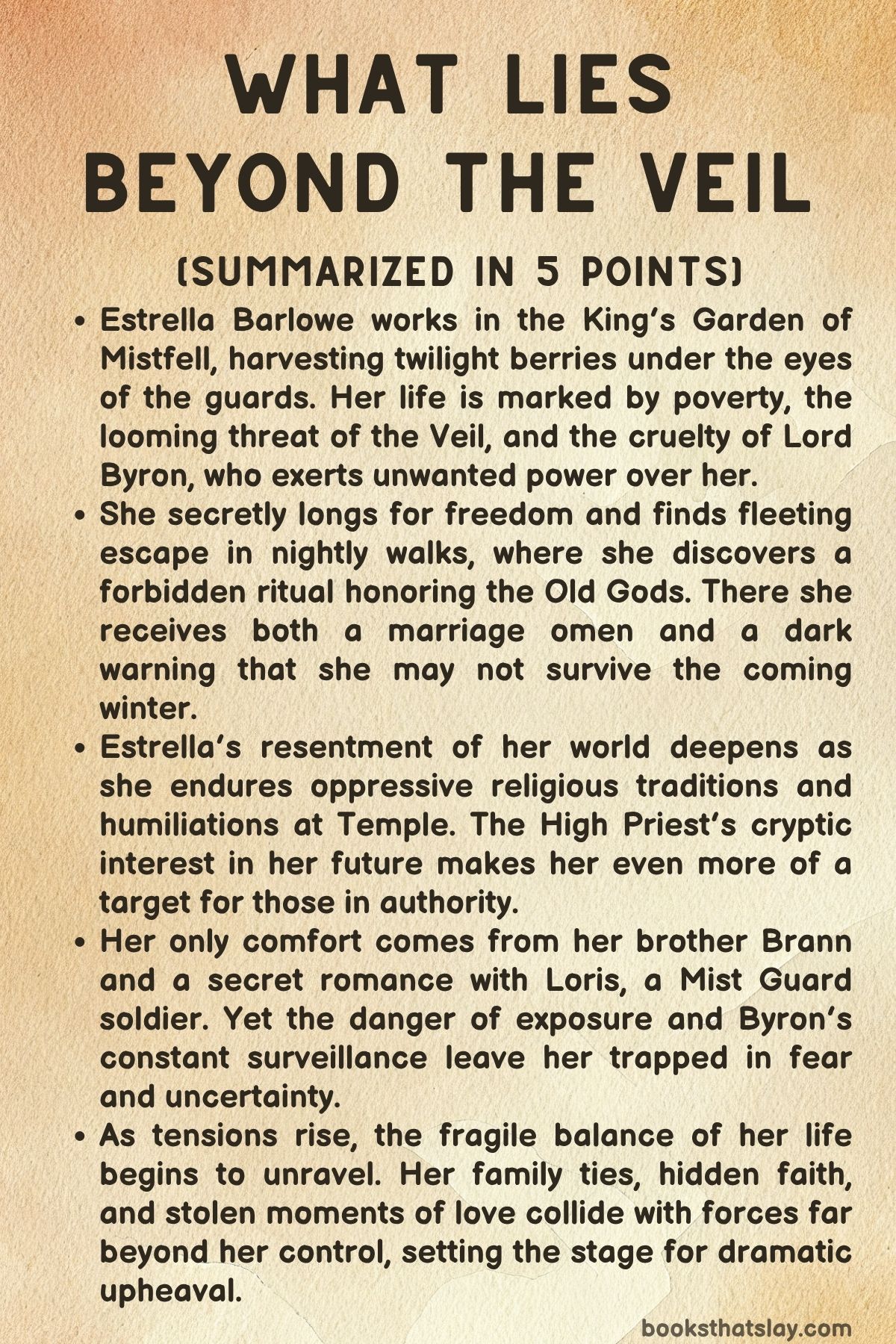
Estrella Barlowe spends her days laboring in the King’s Garden of Mistfell, harvesting twilight berries under the control of the Royal Guard. Her family relies on her work, but the job is dangerous, taking her close to the Veil—the magical wall that separates humans from the fae.
Estrella’s life is made worse by Lord Byron, who abuses his power by tormenting her with unwanted attention. Though married, Byron uses his position to humiliate her, leaving Estrella trapped in a cycle of fear and degradation.
Haunted by memories of her father’s sacrifice to the Veil, Estrella often wanders into the woods at night. On one of these walks, she discovers a hidden group worshiping the forbidden Old Gods.
A woman named Adelphia invites her into their ritual, where Estrella draws omens from their fortune-telling cake: a ring symbolizing marriage and a candle that falls, warning of her death before winter ends.
At Temple the next day, Estrella is forced to participate in worship of the New Gods, The Father and The Mother. The ceremony reveals another sacrifice will soon be demanded at the Veil, a grim reminder of her father’s fate.
When suitors take interest in Estrella, the High Priest interferes, declaring that the gods have other plans for her. Byron seizes the moment to assert dominance, humiliating her publicly and ordering her to his library later.
Before meeting him, Estrella shares a stolen moment with her secret lover, Loris, a Mist Guard soldier. Their relationship, however, is already known to Byron.
When she meets the lord, he reveals his plan: he has poisoned his wife Jaclen and intends to marry Estrella. Outraged, she refuses him, but he warns her that defiance will bring death.
Soon after, Jaclen dies, confirming Byron’s ruthless ambition.
With her fate tied to Byron’s schemes, Estrella is brought to the festival where sacrifices are made to the Veil. Instead of submitting to Byron, she chooses to give herself to the ritual.
But when the priest raises the dagger, the Veil shatters, unleashing chaos. Estrella instinctively touches it, absorbing fae magic into her body and collapsing under its force.
As the world unravels, Estrella and her brother Brann flee. When Mist Guards pursue them, Estrella discovers her newfound powers by draining the life from her attackers—Loris among them.
Horrified by her abilities, she hides the truth, but Brann and their mother realize she has been marked by the fae. Their mother urges Brann to protect her, even if it means leaving everything behind.
On the run, Estrella and Brann face pursuit by guards and the terrifying Wild Hunt, spectral riders who hunt the fae-marked. Brann insists Estrella carry a dagger to end her life if capture becomes inevitable.
Exhaustion and hunger force them into a nearby village, where they try to survive in hiding.
Estrella eventually finds herself traveling with Caelum, a mysterious man who promises protection. Together they face brutal winters, injuries, and starvation.
Despite her distrust, Estrella begins to rely on Caelum, who confesses his bond to her through their shared Mark. His stories of gods, primordials, and fae mates weave an unsettling picture of destiny, and Estrella starts to question her growing feelings for him.
Their journey leads them to a group of rebels known as the Resistance, led by a woman named Melian. Though Caelum mistrusts them, Estrella persuades him to stay among their underground refuge.
She asserts her independence, insisting she cannot be caged, even as Caelum’s protective nature threatens to overwhelm her freedom.
Within the Resistance, Estrella learns disturbing truths from forbidden texts about the origins of the Veil and how witches cursed the fae to tether their souls to humans. The Resistance soon organizes a mission to rescue others who are fae-marked.
Estrella insists on joining, despite Caelum’s reluctance. Their journey is fraught with danger, including attacks by Mist Guards and betrayals.
Melian warns Estrella not to trust Caelum, whose evasive past casts doubt on his loyalty.
As battles intensify, Caelum demonstrates unnatural skill and brutality in combat. The group suffers losses, including Melian’s death, leaving Estrella shaken.
In the ruins of Calfalls, Caelum unleashes terrifying power, revealing his true identity. He is not merely a fae-marked man, but Caldris, the God of the Dead.
Before Estrella’s horrified eyes, he raises an army of the dead, slaughtering their enemies and chaining her to him.
Caldris explains that Estrella is his mate, bound to him across lifetimes. The Veil’s destruction was his doing, a rebellion against a false history that painted him as a villain.
He insists that her soul has always been tied to his, that he has felt her lives and deaths for centuries, and now that he has her, he will never let her go.
Estrella struggles with betrayal and longing. Though she has grown to love Caelum, discovering his true identity leaves her torn between fear and desire.
Bound by blood and fate, she cannot escape his claim. The Resistance lies broken, their mission failed, and Estrella is left in the grasp of the God of the Dead—forever tied to a love that is as consuming as it is dangerous.
Characters
Estrella Barlowe
At the heart of What Lies Beyond the Veil, Estrella is a young woman caught between oppression, faith, and destiny. She begins as a poor worker in the King’s Garden, tethered to Mistfell’s rigid social and religious structures, where her father’s sacrifice and her mother’s frailty weigh heavily on her shoulders.
Her character is defined by resilience and yearning; she resents the forced piety of the Temple and Lord Byron’s abuse, yet she still seeks moments of freedom in her nightly walks and secret rebellion. As the Veil shatters, she transforms from a victim of circumstance into a figure of power, marked by Faerie magic and feared by her own people.
Her evolution is complex—haunted by love, betrayal, and prophecy—culminating in her struggle to reconcile her humanity with the monstrous strength within her. Estrella’s journey is both physical and emotional, moving from survival to reluctant acceptance of her bond with Caldris, the God of the Dead, which entangles her in a love that is equal parts devotion and dread.
Brann Barlowe
Brann, Estrella’s brother, provides both companionship and protection in a collapsing world. Reckless yet fiercely loyal, he shoulders responsibilities beyond his years, especially after their father’s death.
His devotion to Estrella is unwavering, even when the burden of her secret threatens his safety. He represents the unbreakable bonds of family, contrasting the cruelty of figures like Byron and the coldness of the Temple.
Brann’s character arc emphasizes sacrifice; he arms Estrella with both weapons and hard truths, urging her to take her own life rather than fall into enemy hands. His defiance against the Mist Guards and his determination to shield Estrella reveal both his bravery and his tragic recognition that their lives are no longer their own.
Brann embodies the human cost of power struggles, his fate interwoven with his sister’s survival.
Lord Byron
Lord Byron is a figure of dominance, cruelty, and obsession, emblematic of the corruption at Mistfell’s core. His interactions with Estrella are steeped in psychological and physical abuse, from mocking her with twilight berries to threatening her under the guise of divine will.
His pursuit of her, culminating in the poisoning of his wife Jaclen to clear a path for marriage, reflects not love but ownership—he seeks to control Estrella as he controls Mistfell. Byron’s significance lies not only in his personal tyranny but also in how he embodies the hypocrisy of power cloaked in religious justification.
His manipulation of both the Temple and Estrella underscores the novel’s critique of institutions that weaponize faith for control. He is both villain and catalyst, pushing Estrella toward her eventual rebellion and transformation.
Loris
Loris, the Mist Guard and Estrella’s secret lover, represents fleeting rebellion against the rigid laws of Mistfell. His relationship with her is built on risk and secrecy, offering Estrella moments of tenderness in a world dominated by fear.
However, his inability to protect her from Byron’s influence and his eventual role in trying to kill her after her transformation reveal the fragility of their bond. Loris is not inherently cruel, but he is a product of the system, unable to defy it fully.
His character serves as a foil to Caelum—where Loris’s love is hesitant and human, Caelum’s devotion is consuming and immortal. Loris embodies the tragedy of ordinary men crushed by extraordinary circumstances, his love insufficient against the weight of destiny and power.
Caelum / Caldris, the God of the Dead
Caelum enters Estrella’s life as a protector and companion, slowly entwining himself with her through trust, care, and growing intimacy. His presence is at once comforting and possessive, and as their bond deepens, he reveals vulnerability in his loneliness and affection for her.
Yet the revelation of his true identity as Caldris, the God of the Dead, shatters Estrella’s fragile sense of safety. His duality—both tender and terrifying—defines his character.
He claims her as his mate across lifetimes, binding her with blood, power, and passion, blurring the line between love and domination. Caldris represents inevitability: the force that both dooms and saves Estrella, embodying the consuming nature of devotion when it transcends mortality.
His relationship with her challenges ideas of autonomy, destiny, and love, making him one of the most complex and unsettling figures in the narrative.
Melian
Melian, the scarred warrior and leader within the Resistance, brings a different form of strength to the story. Her skepticism of Caelum and her determination to protect the Marked cast her as both ally and truth-teller in Estrella’s journey.
Unlike Estrella, Melian has accepted the harsh realities of their world, wielding pragmatism and suspicion as weapons. She represents defiance against both human tyranny and Fae domination, embodying the possibility of resistance even when hope is slim.
Her death in Calfalls marks a turning point, stripping Estrella of guidance and revealing the cost of standing against overwhelming forces. Melian’s character underscores the novel’s theme of sacrifice and the brutal fragility of rebellion.
Estrella’s Mother
Though physically weakened and confined to a wheeled chair, Estrella’s mother remains an emotional anchor for her children. She carries the grief of her husband’s sacrifice and channels it into caution, warning Estrella against recklessness and impropriety.
Her love is fierce but expressed through fear, highlighting the generational trauma inflicted by Mistfell’s rituals and religious tyranny. Despite her frailty, her decision to send Estrella away with Brann demonstrates courage and clarity, prioritizing her daughter’s survival even at the cost of family unity.
She represents the quieter forms of resilience—the strength to endure, to counsel, and to let go when necessary.
Themes
Oppression and Power
The world of What Lies Beyond the Veil is structured around dominance and submission, where authority figures wield their influence with cruelty. Estrella’s life is governed by men like Lord Byron, who represents the abusive use of social rank to strip women of dignity and agency.
His desire to control her body and fate is less about love and more about ownership, highlighting how those in power see others as expendable possessions. The High Priest and High Priestess reinforce this dynamic through religion, weaponizing faith to justify sacrifice and suffering in the name of divine will.
The guards, too, serve as instruments of oppression, maintaining order through violence and fear. Estrella’s lack of autonomy mirrors the plight of her community, who are constantly reminded that their lives may be demanded as tribute to the Veil.
The book illustrates how power thrives not only through brute force but through manipulation, ritual, and the calculated crushing of resistance. This pervasive atmosphere of dominance leaves Estrella struggling against structures designed to keep her voiceless, forcing her into rebellion even when survival demands compliance.
Religion and Sacrifice
Religion operates as both a tool of unification and a mechanism of control. The worship of the New Gods legitimizes a cycle of sacrifice, presenting it as a sacred duty while erasing any questioning of its morality.
Estrella’s father’s death at the Veil looms large, shaping her resentment toward a faith that demands blood for protection. Her encounters with the Old Gods, however, introduce an alternate path—one that is forbidden yet resonant, offering community, ritual, and a sense of choice.
The Samhain gathering and the dire omen of her candle show how prophecy and ritual intertwine with personal destiny, trapping individuals between hope and fear. Sacrifice, whether voluntary or coerced, is framed as the ultimate act of devotion, yet its arbitrariness exposes the cruelty embedded in belief systems.
This theme explores the clash between tradition and survival, questioning whether the gods are guardians or tyrants, and whether faith sustains society or slowly consumes it.
Fate and Free Will
The shadow of prophecy hangs over Estrella from the moment her candle falls at the Samhain ritual. Omens, divine declarations, and supernatural markings push her toward a destiny she cannot escape.
Her life becomes a constant struggle to assert her will against forces that insist her path is predetermined. Byron’s insistence that their union is ordained, the High Priest’s cryptic words about her purpose, and Caelum’s claim that she is his eternal mate all strip away her freedom, replacing it with inevitability.
Yet Estrella resists, time and again, choosing to defy Byron, risk forbidden love, and embrace danger rather than quietly submit. The destruction of the Veil amplifies this conflict, as her mark ties her to Faerie and positions her at the center of a cosmic struggle.
Even as Caldris claims her fate has been sealed across lifetimes, Estrella’s rebellion embodies the question at the heart of the narrative: whether identity and choice can withstand destiny. The tension between predestination and autonomy makes every decision heavier, shaping her into someone who must constantly prove she is more than the sum of others’ expectations.
Love and Obsession
Love is rarely gentle or uncomplicated. Estrella’s secret relationship with Loris offers a fleeting escape but is ultimately unsustainable in a world ruled by surveillance and punishment.
Byron’s pursuit of her masquerades as devotion but is in truth rooted in obsession, a hunger for control that desecrates the meaning of affection. With Caelum, later revealed as Caldris, love becomes even more complicated.
Their bond is marked by passion, protection, and intimacy, but it is entangled with lies, power imbalances, and the suffocating claim of destiny. His insistence that she has belonged to him across countless lives blurs the line between eternal devotion and consuming obsession, leaving Estrella trapped in a paradox of desire and fear.
Love becomes a battlefield where trust, autonomy, and survival are constantly negotiated, reflecting how attraction can be both a lifeline and a cage.
Identity and Transformation
Estrella’s journey is defined by her transformation from a powerless harvester of berries into a marked figure whose very existence threatens the order of her world. The moment she touches the Veil and absorbs its magic, her identity shifts irrevocably.
She becomes a fugitive, a wielder of power she does not understand, and a symbol of both fear and hope. Her mark isolates her, yet it also binds her to a destiny larger than herself.
The discovery that the history she was taught may be false forces her to reassess who she is, not just in relation to her family or community, but in relation to gods, Fae, and ancient power. Every confrontation—with Byron, with the Veil, with Caldris—reshapes her sense of self.
Transformation is not only physical but psychological, as she learns to resist domination, embrace her strength, and forge an identity that transcends the roles others impose. Her arc emphasizes how survival requires reinvention, and how power comes at the cost of innocence.
Resistance and Rebellion
Survival in What Lies Beyond the Veil is inseparable from rebellion. Estrella’s nightly walks, her defiance of Byron, her embrace of forbidden rituals, and her refusal to submit to her predetermined role all mark small but vital acts of resistance.
The Resistance itself embodies this theme, existing as a fragile hope against overwhelming power. Yet even within its ranks, Estrella learns that rebellion is fraught with mistrust, sacrifice, and betrayal.
True resistance often means walking a path of uncertainty, where alliances shift and survival is not guaranteed. For Estrella, rebellion is less about overthrowing systems and more about preserving her humanity in a world that constantly seeks to erase it.
Her resilience, even when everything is stripped from her, positions her not only as a survivor but as a defier of inevitability, showing how rebellion becomes an act of self-preservation as much as defiance against tyranny.