What Lies In The Woods Summary, Characters and Themes
What Lies in the Woods by Kate Alice Marshall is a psychological thriller that explores friendship, secrets, and survival. It follows Naomi, Cassidy, and Olivia, three childhood friends whose lives were forever altered when a violent attack in the woods scarred them physically and emotionally.
Their testimony put a man, Alan Michael Stahl, behind bars as the so-called “Quinault Killer.” But as adults, they are forced to confront long-buried truths when Stahl dies in prison and disturbing revelations resurface. The novel examines the fragility of memory, the burden of loyalty, and the devastating consequences of lies that were meant to protect.
Summary
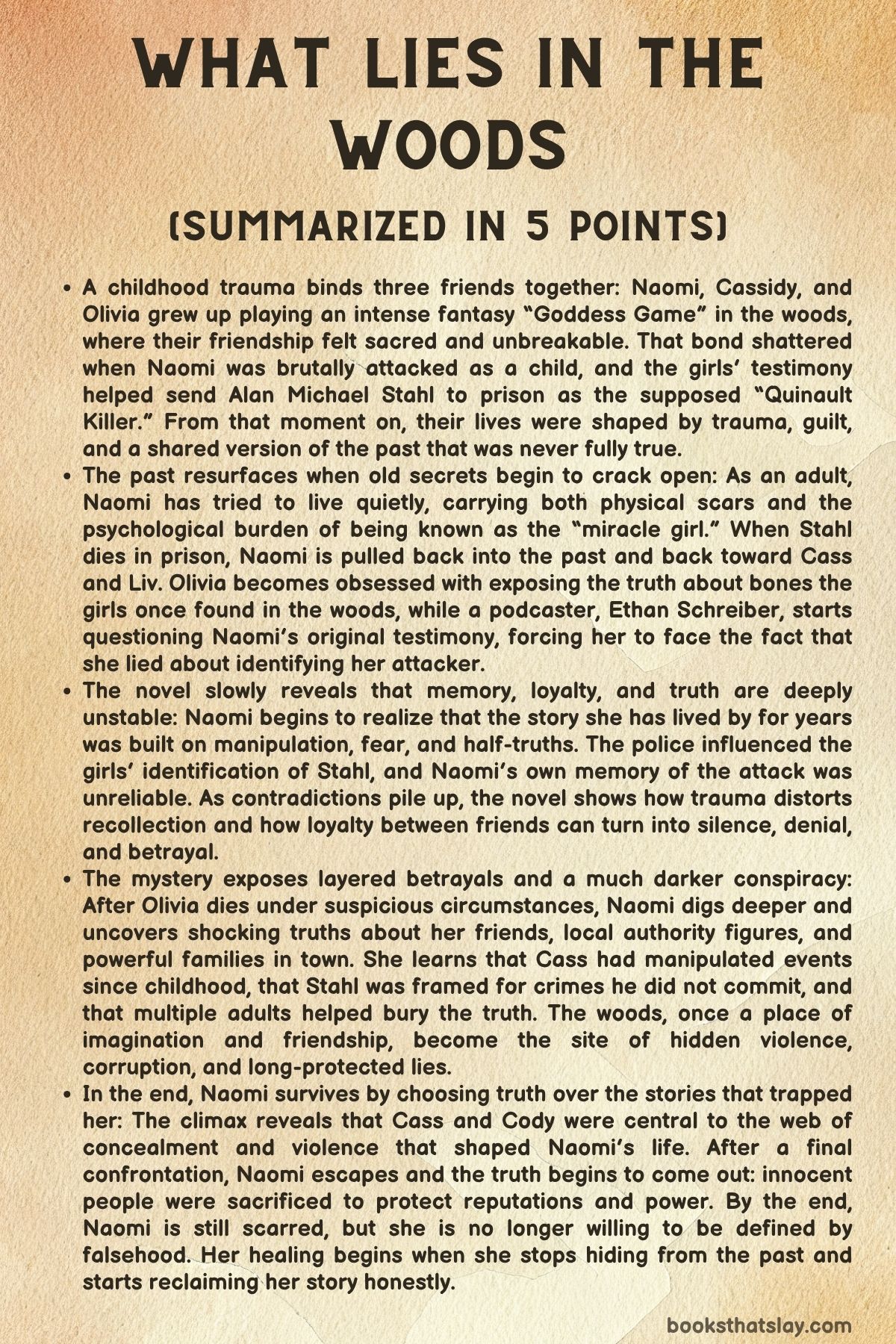
Naomi, Cassidy, and Olivia grew up bound by a secret world in the woods where they played elaborate games as goddesses and warriors. Their childhood pact of loyalty was broken one summer when Naomi was brutally attacked and nearly killed.
Her survival and testimony identified Alan Michael Stahl as the culprit, branding him as the infamous “Quinault Killer.” For the town, the case was closed, but for the girls, the scars ran much deeper.
As an adult, Naomi has built a quiet life as a wedding photographer. Her body carries the physical reminders of her trauma, and she lives under the weight of being the “miracle girl.” Her carefully managed existence is shaken when she receives a call informing her that Stahl has died in prison.
The news pulls her back into contact with Cassidy, who has grown into a polished businesswoman running a lodge, and Olivia, whose obsession with the past never let her move on. Olivia reveals she has uncovered information about “Persephone,” the set of bones the girls secretly found in the woods as children but hid from everyone.
Believing Persephone was a real missing girl, Olivia insists the truth must come out. Cassidy resists to protect her reputation, while Naomi wavers, torn between fear and duty.
Naomi also reconnects with Cody Benham, the man who found her after the attack decades earlier and who is now a state legislator. Their meeting reopens old memories of his kindness and her dependence on him.
At the same time, Naomi encounters Ethan Schreiber, a podcaster investigating Stahl’s crimes. Ethan presses Naomi with questions, casting doubt on her testimony and hinting that her account was never reliable.
Secretly, Naomi admits to herself that she lied at trial: she never actually saw Stahl’s face during the attack. Her deception sent him to prison, and the guilt weighs heavily.
Olivia’s obsession with Persephone escalates, and Naomi discovers disturbing evidence that Olivia had been secretly revisiting the bones. Before Naomi can intervene, Olivia disappears.
Naomi and Cassidy follow clues into the woods, eventually finding Olivia dead in the pond where they once played their games. Police rule it a suicide, but Naomi refuses to believe it.
Her grief is compounded by the unraveling of her certainty about the past, her friendship with Cassidy, and her role in Stahl’s conviction.
As Naomi digs deeper, she discovers contradictions in the case. Cassidy admits their childhood identification of Stahl was guided by police, casting doubt on whether he was ever guilty of attacking Naomi.
A threatening letter from Stahl’s son AJ intensifies Naomi’s fear, but she continues to search for answers. Naomi recalls the cruel harassment she endured from Oscar Green, Cassidy’s relative, and begins to suspect he could have been her true attacker.
Meanwhile, her investigation reveals layers of deception involving police, her friends, and the town itself.
Ethan reveals himself as Stahl’s son, confessing he pursued Naomi for answers about his father’s downfall. While he admits his obsession, Naomi realizes he has not harmed anyone.
Their uneasy alliance grows as Naomi faces new threats, including an attack in her motel room and surveillance tied to powerful local families. She learns her father received secret payments connected to Cassidy’s family, pointing to a cover-up that reached far beyond childhood mistakes.
The truth emerges when Naomi uncovers a knife hidden near Persephone’s bones, marked with Kimiko Barnes’s initials. Confronting the Barneses, Naomi learns that Olivia, in a psychotic episode fed by their goddess game, stabbed her believing a sacrifice was needed.
Cassidy manipulated the situation, encouraging Olivia’s breakdown and then finishing the attack herself out of jealousy. To protect their daughter and to shield the town, the adults framed Stahl, allowing an innocent man to be condemned.
Naomi realizes that her entire life has been shaped by lies—both her own and those of others. Her confrontation with Cody brings another devastating revelation: he was responsible for the death of Jessi Walker, a missing woman whose body became the bones they called Persephone.
Cass had blackmailed Cody with evidence, ensuring his silence and binding him to her schemes. When Naomi refuses to be silenced, Cass proposes killing her to maintain control, but Cody ultimately turns on Cass, killing her before trying to eliminate Naomi.
In a desperate fight, Naomi escapes, though badly injured, and is finally rescued by Officer Bishop.
In the aftermath, Cody is arrested and Cass’s manipulations are exposed. Jessi’s family receives her remains, and Naomi begins the slow process of healing.
Unable to return to photographing weddings, she creates an art series documenting her scars and the landscapes of her trauma, which gains recognition. Ethan returns, still searching for truth about his father and himself, and he and Naomi agree to continue their uneasy exchange of honesty.
The story closes with Naomi scarred but alive, no longer defined by lies, and willing at last to speak the truth.
Characters
Naomi Cunningham
Naomi is the emotional and psychological anchor of What Lies in the Woods, carrying the scars of both physical and emotional trauma. As a child, she survived a brutal stabbing in the forest, her testimony sending Alan Michael Stahl to prison.
Yet beneath the image of “the miracle girl” lies deep survivor’s guilt and an unspoken truth: she never actually saw her attacker. Her adult life is shaped by this dual burden of being both a symbol and a liar, and her wedding photography career underscores her attempt to capture beauty while hiding her own disfigurements.
Naomi’s fractured relationship with her father adds another layer of abandonment and neglect, compounding her sense of isolation. Her interactions with childhood friends Cass and Liv reveal lingering loyalty, bitterness, and betrayal, as she struggles to reconcile love with resentment.
Naomi’s journey is one of confronting falsehoods, uncovering hidden crimes, and redefining her own story. In the end, she evolves from a passive survivor into an active truth-seeker, using her scars as art and testimony rather than shame.
Olivia (Liv)
Olivia represents fragility, obsession, and devotion to the past. Of the three girls, she is the one most unable to release childhood bonds and the mythology they built around Persephone.
Her fixation on finding the truth behind the bones reflects both her moral drive and her unraveling mental state. Liv’s artistic tendencies, seen in her sketches and her rituals around Persephone’s remains, reveal her deep need for meaning in trauma.
Yet this fixation becomes destructive, pulling her further into the woods—both literally and metaphorically. She is haunted by guilt, truth, and loyalty, and her death, staged as suicide, symbolizes how secrets can consume those who carry them.
Liv embodies both innocence and instability, a reminder that survival does not mean escape, and that loyalty to the past can become fatal.
Cassidy (Cass)
Cass embodies ambition, control, and hidden malice. Outwardly, she reinvents herself as a polished lodge owner, mother, and respected figure in town.
Beneath this exterior, however, lies jealousy and ruthlessness. As children, she manipulated the Goddess Game, channeling Liv’s instability and Naomi’s vulnerability.
Her envy of Naomi and Liv’s closeness festers into cruelty, culminating in her role in Naomi’s stabbing and the cover-up. As an adult, Cass continues her pattern of manipulation, using blackmail and deceit to maintain her status and wealth.
Her duality—nurturing mother on the surface, calculating survivor underneath—highlights how trauma can manifest as ambition warped into selfishness. Cass is both protector and destroyer, a friend whose loyalty masks betrayal, and her unraveling in the climax exposes the darkness that long lurked behind her composed exterior.
Ethan Schreiber (AJ Stahl)
Ethan, or AJ, is both an inheritor and rejecter of legacy. As the son of Alan Michael Stahl, he is marked by the sins of his father, yet desperate to distance himself from them.
His journalism and podcasting career initially appear as an effort to document truth, but they are also a veiled attempt to grapple with his own identity. Ethan’s interactions with Naomi oscillate between antagonistic probing and intimate vulnerability.
His confession of compulsions to “test” himself reflects his fear of inherited violence, though he insists he has never harmed anyone. His relationship with Naomi is complicated, charged with shared guilt and attraction, creating a bond forged in mutual recognition of trauma.
Ethan represents the blurred line between truth-seeker and manipulator, and between victim and perpetrator by association.
Cody Benham
Cody is a study in contradiction: once Naomi’s savior and steadfast protector, he ultimately emerges as complicit in covering up truths and perpetuating violence. As a child, he discovered Naomi bleeding in the woods, and as an adult, he is a state legislator and family man.
Yet his façade hides a history of silence and cowardice—particularly around the death of Jessi Walker, which he concealed. Cody’s protective instinct toward Naomi transforms into dangerous control, culminating in his betrayal during the climax.
His dual roles as rescuer and aggressor make him one of the most unsettling figures in the story, showing how the same person can embody safety and threat. Cody’s downfall is tied to his inability to live with guilt, and his willingness to sacrifice others to preserve his own life.
Alan Michael Stahl
Though dead at the novel’s beginning, Stahl haunts the narrative as both scapegoat and shadow. Convicted as the “Quinault Killer” largely due to Naomi’s testimony, his role is ambiguous, with much of the evidence against him being circumstantial.
His looming presence represents society’s need for a monster, someone onto whom collective fear and trauma can be projected. For Naomi, Stahl becomes the embodiment of guilt—not just for what he did or did not do, but for the lie she told that cemented his conviction.
Even in death, his influence remains through his son Ethan, through the doubts about justice, and through the way his name shaped the survivors’ lives.
Themes
Trauma and Memory
In What Lies in the Woods, the scars of childhood trauma shape the lives of Naomi, Cass, and Olivia long after their shared ordeal. Naomi’s physical scars act as a constant reminder of the night she was attacked, but the deeper wounds lie in her memory and the way she interprets her own survival.
The narrative shows how memory is not a fixed record but something that can be corrupted by fear, suggestion, and self-preservation. Naomi’s false testimony against Stahl, though meant to protect herself and others, becomes both a survival strategy and a burden that twists her sense of truth.
Cass and Olivia, too, are locked in patterns of remembering and forgetting, clinging to versions of events that protect them from unbearable guilt. Memory in this novel is not simply about recalling the past; it becomes an active force that manipulates present choices, shaping relationships and identities.
Trauma fractures memory, making it unreliable, and the book powerfully illustrates how victims and survivors struggle not just with what happened, but with how they remember and tell it.
Secrets and Lies
The secrecy surrounding Persephone’s bones, Naomi’s testimony, and the truth of what happened in the woods underscores the novel’s exploration of lies as both destructive and protective forces. The girls’ decision to hide Persephone’s remains creates a shared secret that ties them together yet isolates them from one another as they age.
Lies become a form of currency in their world, a way to protect reputations, families, and even entire communities. Naomi’s perjury as a child is framed as necessary to secure justice, yet it erodes her trust in herself and her relationships.
Cass weaponizes secrets for her own survival, manipulating both Naomi and Cody to preserve her carefully built life. The story demonstrates how lies spread outward like ripples, entangling more people over time, until truth itself becomes nearly impossible to discern.
The novel suggests that secrets may shield individuals from immediate pain but often corrode the foundations of trust, leaving devastation in their wake.
Female Friendship and Betrayal
The bond between Naomi, Cass, and Olivia drives the emotional core of What Lies in the Woods. Their childhood alliance, expressed through their Goddess Game, initially symbolizes loyalty, unity, and the power of imagination.
Yet as adults, the bond is marked by betrayal, silence, and resentment. The narrative captures the complexities of female friendship, where intimacy and vulnerability can foster both deep loyalty and profound harm.
Olivia’s determination to honor Persephone’s truth reveals her idealism and moral compass, but it also exposes the fractures between the friends. Cass’s ambition and jealousy lead her to orchestrate manipulation and violence, betraying the very trust that once defined their childhood vows.
Naomi is caught between them, torn by love, guilt, and the knowledge that her friends’ choices shaped the course of her life as much as her own did. The novel portrays friendship as both a sanctuary and a battlefield, showing how its strength can endure trauma but also how it can collapse under the weight of betrayal.
Guilt and Survival
Survival in the novel is depicted not as triumph but as a complicated state riddled with guilt and self-doubt. Naomi embodies this theme most strongly: she is alive while others are dead, and this survival is framed by the media and prosecutors as miraculous heroism.
Yet for Naomi, survival feels less like bravery and more like a heavy inheritance, something that never allows her to move forward. Her guilt stems from her testimony, her silence about the true attacker, and her inability to save Olivia in adulthood.
This guilt also expands beyond her own actions, encompassing the broader consequences of survival—how her testimony ruined Stahl’s family and how her silence prolonged injustices. Survival becomes a double-edged sword: it is life itself, but it carries obligations and burdens that Naomi cannot escape.
The theme underscores that survival is not just about enduring violence but about learning to live with the consequences, a process that can be as haunting as the trauma itself.
Corruption and Power
Authority figures in the novel—police officers, parents, and even friends—are often complicit in distorting the truth for their own protection. From the tainted identification of Stahl to the concealment of Liv’s violence by adults, the narrative demonstrates how power is used to manipulate justice.
Cass and her family embody this corruption most clearly, leveraging influence, money, and manipulation to bury crimes and protect reputations. The town itself seems steeped in complicity, where protecting appearances often matters more than justice.
Even Ethan, though framed as both confidant and threat, embodies the murkiness of power when he manipulates Naomi for his own needs, despite his claims of honesty. The theme highlights how individuals and institutions can twist narratives to maintain order and stability, even at the cost of truth.
In this way, the book becomes not only a story of personal betrayal but also a commentary on systemic failures of justice and the ease with which power silences the vulnerable.