What The River Knows Summary, Characters and Themes
What the River Knows by Isabel Ibañez is a lush historical fantasy that takes readers to late 19th-century Egypt, where mystery, magic, and betrayal intertwine. At its heart is Inez, a spirited young woman from Buenos Aires, who has long yearned to be part of her parents’ archaeological adventures.
When she learns of their deaths under suspicious circumstances, her grief transforms into determination. Traveling across the ocean to Egypt, she sets out to uncover the truth, only to encounter dangerous secrets, forbidden magic, and a complex web of alliances. Through Inez’s journey, the novel explores themes of family, loyalty, power, and the cost of ambition.
Summary
In 1884, Inez lives under her aunt’s care in Buenos Aires, yearning for a letter from her parents, explorers stationed in Egypt. She treasures a golden ring from her father, a keepsake imbued with ancient magic.
When the long-awaited correspondence arrives, it brings devastating news: her parents are dead. Refusing to accept her uncle Ricardo’s distant assurances, Inez defies her family and sails alone for Egypt to search for the truth.
Her arrival in Alexandria is far from welcoming. Instead of her uncle, she is met by Whit Hayes, Ricardo’s gruff British associate, who tries to send her home immediately.
Determined to resist, Inez escapes into the bustling streets and boards a train to Cairo. Along the way, Basil Sterling, an antiquities officer, takes interest in her ring and ultimately steals it, claiming it belongs in a museum.
With her father’s final gift lost, Inez’s grief deepens.
In Cairo, she lodges at Shepheard’s Hotel, where her parents had once stayed, and discovers her mother’s unfinished letter along with belongings that hint at a life of secrets. Whit soon reappears, revealing fragments of knowledge about her parents’ dangerous archaeological work.
That evening, at a dinner among officials and scholars, Inez finally confronts Ricardo. Their reunion is strained, marked by his insistence that she return to Argentina.
When she refuses, tensions rise, especially as Ricardo and other men debate Egypt’s heritage being stripped by foreigners.
Ricardo eventually reveals that the ring held significant magical power tied to Cleopatra’s tomb, the site her parents had pursued. Furious that Inez lost it, he tries to force her back home under Whit’s watch.
Instead, Inez manages escapes and ventures with Whit to Cairo’s Khan el-Khalili bazaar. There she purchases a mysterious trinket pulsing with magic, another clue in the puzzle.
Despite their clashes, Inez and Whit develop a fragile partnership.
At Groppi’s café, she spots Sterling wearing her stolen ring, confirming her fears. Back at the hotel, Ricardo plans to leave for an excavation, and Inez discovers her mother had secretly written to Maspero, expressing suspicion of Ricardo’s dealings.
This deepens her mistrust and spurs her onward.
During travels to temples, Inez and Whit grow closer, their connection marked by unspoken attraction. At Trajan’s Kiosk, she experiences magical visions tied to Cleopatra.
Her sketching leads to the discovery of a hidden tunnel, revealing Ricardo’s long-standing search for the tomb. As she and Whit explore the labyrinth, Inez realizes her parents were deeply involved and that Ricardo is closer than ever to finding Cleopatra’s resting place.
Late one night, Inez encounters her mother, Lourdes, alive and in hiding. Lourdes warns her that Ricardo is smuggling antiquities and is dangerous, urging her to feign loyalty for survival.
This revelation shakes Inez further, leaving her caught between loyalty, suspicion, and her quest for answers.
Soon after, Inez and Whit uncover a chamber filled with treasures, suggesting they are at the threshold of Cleopatra’s tomb. Ricardo intercepts them, making it clear he has been watching closely.
Torn between truth and survival, Inez conceals her mother’s warnings and pretends compliance.
Events escalate when Ricardo sends Whit on a dangerous mission and Inez attends a lavish New Year’s Eve ball. Whit reemerges under his true identity as Lord Whitford Hayes, and though their feelings surface during a dance, chaos soon intrudes.
Elvira, Inez’s cousin, is mistaken for her and abducted. Despite her mother’s schemes to protect her, Inez cannot accept Elvira’s fate.
She and Whit attempt a rescue but are captured. Imprisoned together, they confess their fears and share a kiss, believing death is near.
Ricardo rescues them, but during an ambush by American smuggler Burton, Elvira is brutally executed as punishment for Lourdes’s betrayal. The loss devastates Inez, who carries guilt for her cousin’s fate.
In the aftermath, Ricardo reveals painful truths: Lourdes was entangled with a shadowy organization known as The Company, dealing in forbidden knowledge and artifacts. Inez’s father may have uncovered Cleopatra’s tomb, and his gift of the ring was a final act of protection before Lourdes betrayed him and vanished.
Cayo’s fate remains uncertain.
Ricardo insists Inez must return to Argentina, binding her future to her inheritance and marriage. She refuses, determined to uncover her father’s fate and confront her mother’s betrayal.
Meanwhile, Whit struggles with his growing love for Inez and the weight of his own disgraced past. Eventually, he proposes marriage, offering her a choice that could bind them together.
The book closes with a chilling twist: in an epilogue, a man named Porter reads a telegram aboard a ship—“INEZ FELL FOR IT”—suggesting Whit may be entangled in hidden schemes, leaving Inez’s trust and future uncertain.
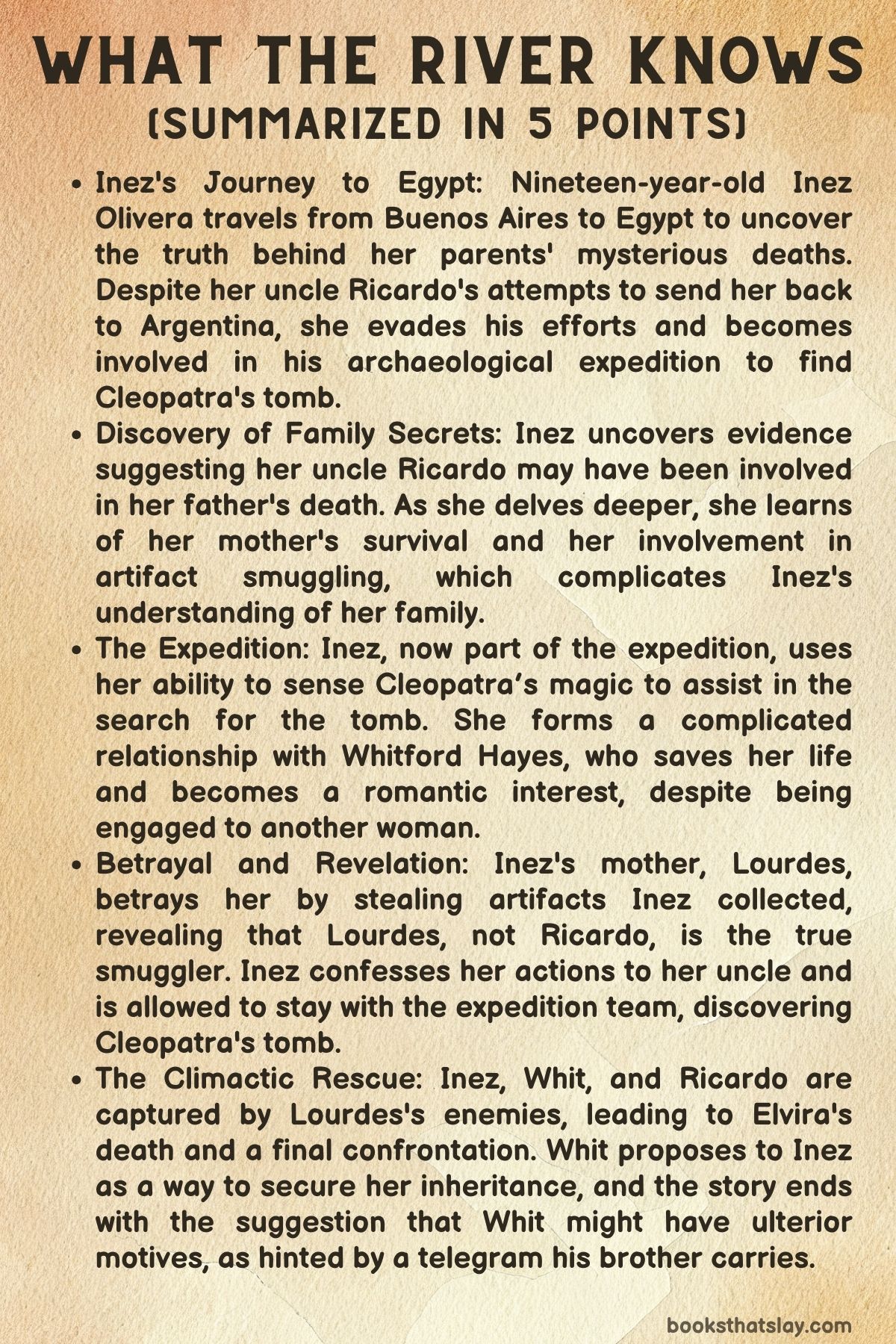
Characters
Inez
Inez stands at the heart of What the River Knows, evolving from a sheltered young woman into a determined truth-seeker. Her grief over her parents’ deaths fuels her defiance, compelling her to sail alone to Egypt despite her family’s disapproval.
She is marked by a deep yearning for belonging, made more poignant by the emotional distance her parents always maintained while pursuing their archaeological passions. The golden ring her father gave her symbolizes both her connection to them and her latent ability to sense magic.
Over time, her character hardens as she navigates betrayal, danger, and loss—especially with the tragic death of her cousin Elvira. Yet even in the face of grief and manipulation, Inez’s resolve only strengthens, making her both courageous and vulnerable.
Her growing independence, sharp wit, and unwillingness to be dismissed by men in power illustrate her transformation into a woman who will no longer accept being sidelined.
Whit Hayes (Lord Whitford Hayes)
Whit is introduced as brusque and antagonistic, initially tasked with sending Inez back to Argentina. Beneath his gruff exterior, however, lies a conflicted man shaped by disgrace and guilt from his military past.
His loyalty to Ricardo, who once saved his life, binds him to morally gray duties, even as his personal integrity resists the corruption surrounding him. His identity as Lord Whitford Hayes, revealed later, deepens his complexity, exposing a tension between duty, societal expectations, and personal longing.
His dynamic with Inez moves from hostility to reluctant alliance and finally to romance, culminating in a relationship marked by both tenderness and betrayal. Whit’s internal struggle—between his sense of honor and his entanglement in dangerous schemes—makes him a man caught between worlds, both protector and potential betrayer.
Ricardo
Ricardo is both enigmatic and imposing, serving as Inez’s uncle and her legal guardian. He embodies authority, secrecy, and ambition, driven by his pursuit of Cleopatra’s tomb and the immense power it represents.
While he occasionally demonstrates concern for Inez, his actions are often manipulative and self-serving. His involvement in smuggling antiquities, his connections with disreputable allies, and his demand for Inez’s obedience reveal a man compromised by greed and ambition.
Yet, his layered morality prevents him from being purely villainous. He is protective when it suits him, ruthless when crossed, and consistently pragmatic.
For Inez, he becomes both a source of potential answers and a looming threat, complicating her quest for truth.
Lourdes
Lourdes, Inez’s mother, embodies secrecy, manipulation, and survival. Believed dead for much of the novel, she reemerges with shocking revelations: she is alive and deeply entangled in illicit dealings with The Company and the Curators.
Unlike the romanticized figure Inez longed for, Lourdes is revealed as cunning and potentially treacherous, willing to betray family ties for power. Her duplicity—framing Ricardo, betraying her husband Cayo, and manipulating her daughter—casts her as one of the most unpredictable forces in the story.
For Inez, her mother’s survival brings both relief and devastation, shattering her illusions of maternal devotion and forcing her to confront the darker legacies of her family.
Cayo
Though largely absent from the narrative, Cayo’s presence is felt through memories, artifacts, and the golden ring he entrusted to Inez. Unlike Lourdes, he represents a figure of quiet strength and integrity, though still distant as a father.
His possible discovery of Cleopatra’s tomb and his decision to send Inez the magical ring suggest he foresaw danger and trusted his daughter more than he ever expressed in life. His fate—uncertain, possibly dead or captive—serves as a central mystery that propels Inez forward.
He remains an anchor of hope for her, contrasting starkly with her mother’s betrayal.
Elvira
Elvira begins as one of Inez’s frivolous cousins, embodying vanity and social ambition. However, her trajectory takes a tragic turn as she is mistaken for Inez and abducted, only to be executed by Burton.
Her death becomes a pivotal moment of grief and guilt for Inez, who blames herself for Elvira’s sacrifice. Despite her flaws, Elvira’s fate humanizes her, transforming her from a peripheral figure into a symbol of the high cost of Inez’s defiance and the dangers surrounding their family.
Basil Sterling
Basil Sterling represents colonial greed and corruption. An antiquities officer, he initially appears scholarly, identifying the ring’s hieroglyphs, but quickly reveals himself as unscrupulous by stealing it.
His obsession with Cleopatra’s tomb is fueled not only by ambition but also by desperation—his illness driving him to seek supernatural healing from Cleopatra’s remains. Sterling personifies the exploitative side of European presence in Egypt, using authority to plunder cultural treasures under the guise of preservation.
He serves as a foil to Inez, embodying everything she resists: exploitation, arrogance, and entitlement.
Abdullah
Abdullah, Ricardo’s brother-in-law, serves as both comic relief and a reminder of the novel’s magical undercurrents. His playful tricks with magic, such as producing boiling water, highlight his unique connection to enchantment, setting him apart from the more dangerous ways magic is pursued elsewhere in the story.
His loyalty to Ricardo and his family ties complicate his position, but his role underscores the blending of everyday life with magic that runs throughout the book.
Burton
Burton emerges as one of the most ruthless antagonists. Initially disguised as an ally, he reveals himself to be manipulative, violent, and utterly self-interested.
His execution of Elvira in cold blood underscores his brutality, cementing him as a figure of horror in Inez’s journey. His death at Whit’s hands provides a measure of justice, but his role leaves a lasting scar on Inez and reinforces the perilous stakes of her quest.
Themes
Grief and Loss
The narrative of What the River Knows begins with a devastating moment for Inez—learning of her parents’ death through a letter. This loss is not simply an event but a force that propels her across continents, shaping her every decision and emotional state.
The theme of grief operates on multiple layers. On one hand, Inez must contend with the personal void of losing the parents she barely knew, having spent much of her life longing for their presence.
Their absence leaves her with memories that are fragmented, incomplete, and tinged with yearning. On the other hand, her grief transforms into determination, a refusal to accept the neat, dismissive explanation of their deaths offered by others.
This grief is not passive; it becomes a restless energy, demanding action. As she navigates Egypt, each discovery about her parents—letters, rooms left untouched, or whispered suspicions—keeps the wound raw and prevents closure.
Yet it also deepens her maturity, forcing her to face betrayal, danger, and the cruelty of truth. Loss, in this sense, is not only about mourning the dead but also about grieving the illusions she carried: her belief in her parents’ invulnerability, in her uncle’s trustworthiness, and even in her mother’s loyalty.
The narrative portrays grief as both destructive and generative—it shatters the world Inez thought she knew, but also pushes her toward the resilience and clarity she needs to survive.
Power and Exploitation
Throughout What the River Knows, the question of power is tied directly to the historical and cultural context of late 19th-century Egypt. European officials, archaeologists, and collectors treat the land as a resource to plunder, arguing over rights to artifacts while ignoring the voices of Egyptians themselves.
This exploitation is not limited to politics or economics; it extends to the very heritage of Egypt, commodifying its sacred past. Within this setting, personal relationships mirror broader systems of control.
Ricardo wields his authority over Inez as her guardian, attempting to dictate her actions and even her financial future by tying her inheritance to marriage. Similarly, the obsession with Cleopatra’s tomb becomes a metaphor for how history and culture are manipulated for power—whether Sterling’s desire to consume her remains for healing, or Ricardo’s schemes to profit from the discovery.
Power is also exercised through secrecy and manipulation, as allies betray one another and loyalties shift depending on who holds leverage. For Inez, resisting exploitation means carving out agency in a world determined to silence her.
Her defiance in refusing to leave Egypt, her pursuit of magical artifacts, and her refusal to hand over what is hers all become acts of rebellion. The novel underscores that power is rarely neutral; it is often maintained through suppression, greed, and the subjugation of others, and true strength requires recognizing and challenging those structures.
Identity and Independence
At the heart of What the River Knows is Inez’s struggle to define herself beyond the roles others assign her. From her childhood, her parents kept her on the periphery of their world, treating her as someone to be protected but not trusted with their work.
When she arrives in Egypt, Ricardo continues this pattern, insisting she return home and framing her as a burden or liability. Even Whit, in his protective instincts, initially views her as a responsibility rather than a partner.
Against this backdrop, Inez’s insistence on making her own choices takes on heightened significance. She does not simply want answers about her parents—she wants to prove her capacity to exist in the dangerous, magical, and contested world they inhabited.
Each escape, each confrontation, each refusal to accept the limits imposed on her represents a step toward independence. Her identity is also complicated by the revelations about her mother’s betrayal, which force her to reconsider her own inheritance—not just material but moral.
In claiming agency, Inez must confront painful truths about family, loyalty, and trust, and still choose who she will become. Her independence is not gifted to her; it is fought for in the face of dismissals, betrayals, and systemic barriers.
The narrative positions her journey as one of self-definition, where independence is inseparable from survival.
Betrayal and Trust
The theme of betrayal permeates the story, shaping its tension and emotional stakes. At the center lies Lourdes, Inez’s mother, whose duplicity reframes everything Inez believed about her family.
To learn that her mother aligned with corrupt organizations, manipulated allegiances, and may have sacrificed loved ones for gain is a profound wound. Ricardo too embodies betrayal, as he presents himself at times as a protector yet is implicated in smuggling and dangerous dealings.
Whit’s relationship with Inez is also clouded by the looming possibility of betrayal, especially with the epilogue’s revelation that he may have fulfilled a hidden bargain against her interests. Trust becomes precarious in such a world, where alliances shift, motives remain hidden, and even love carries the risk of deception.
For Inez, betrayal forces vigilance, compelling her to question what people say and to rely on her instincts. Yet betrayal is not only destructive; it heightens the value of the few bonds that prove genuine.
Her tentative trust in Whit, her growing alliance with Isadora, and her own reliance on her inner resolve highlight the fragility and preciousness of loyalty. The novel suggests that in a world rife with greed and ambition, betrayal is almost inevitable, and the challenge lies in deciding when to risk trust and when to guard against it.
Love and Desire
Amidst the danger and intrigue of What the River Knows, the evolving relationship between Inez and Whit provides a deeply human counterpoint. Their attraction develops in stolen glances, heated arguments, and reluctant partnerships, revealing desire as both intoxicating and perilous.
Their connection is complicated by Whit’s guarded past, his engagement to another, and the heavy weight of secrets between them. Yet the vulnerability they share, particularly when trapped together in life-threatening circumstances, strips away pretense and brings raw emotion to the surface.
Love, in this context, is never simple—it is interwoven with mistrust, fear of loss, and the shadow of betrayal. Still, it offers Inez moments of respite from her grief and isolation, reminding her of the possibility of intimacy even in a world defined by danger.
Desire is also framed as an assertion of life in the face of death; their kiss in the tomb, believing they might die, becomes an act of defiance against despair. Ultimately, love in this story is not a neatly resolved romance but a complex force—one that binds, complicates, and sometimes betrays.
It underscores the tension between personal longing and the harsh realities of survival, making it as fraught and uncertain as the search for Cleopatra’s tomb itself.