Where the Sea Lavender Grows Summary, Characters and Themes
Where the Sea Lavender Grows by Kitty Johnson is a dual-timeline historical novel about grief, hidden parentage, wartime sacrifice and the lasting presence of those we have loved.
Set between the Second World War and the early twenty-first century, the story follows Elise Jenkins, a bereaved artist restoring the murals of Marsh House, and Lilias Carter-Brown, the woman who painted them decades earlier. As Elise investigates an evacuee who resembles her dead son, the house begins revealing memories that have been buried for generations. The novel considers how family secrets shape identity and how sorrow can slowly become a source of connection rather than isolation.
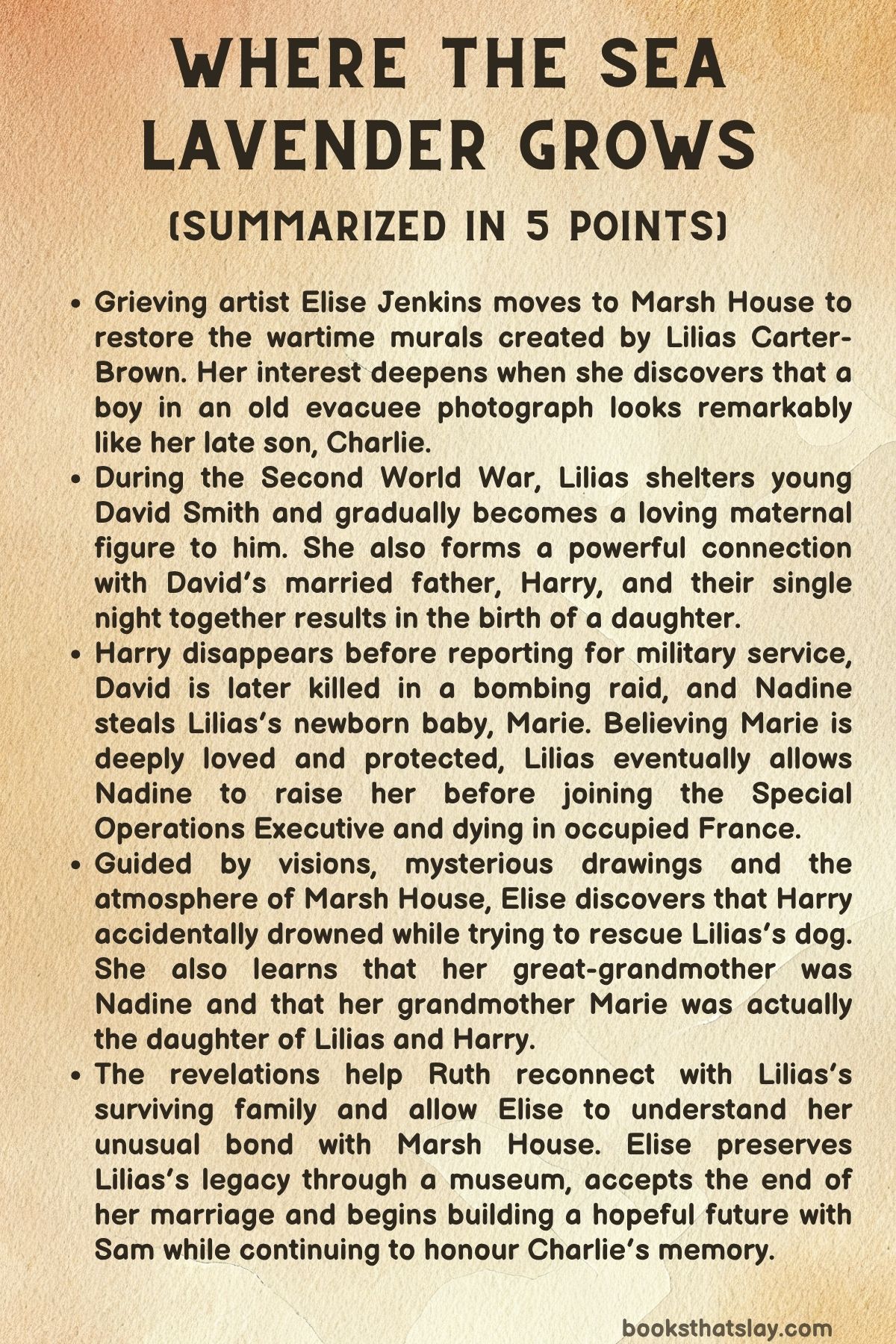
Summary
In 2006, elderly Ruth Carter-Brown lives at Rose Lodge Care Home, surrounded by memories that frequently carry her back to Marsh House and her beloved sister, Lilias. Music reminds her of happier days, but it also awakens grief connected to the disappearance of the house, the loss of Lilias and a child whose fate has haunted her for decades.
Six months after the death of her ten-year-old son, Charlie, artist and conservator Elise Jenkins accepts a commission to restore Marsh House on the North Norfolk coast. Its former owner, Lilias Carter-Brown, decorated walls, shutters and doors with paintings that have remained largely untouched since the Second World War.
Elise hopes the work will help her recover her artistic confidence, but she has another reason for going. During a previous visit to Selkey-on-Sea, she saw a wartime photograph of an evacuee boy whose appearance strongly resembled Charlie.
Her husband, Robbie, considers the similarity meaningless, yet Elise feels compelled to discover the boy’s identity. At Marsh House, she meets joiner Sam Gibson and immediately senses a warmth and ease between them that has been absent from her marriage.
In September 1939, Lilias helps receive London evacuees at the village hall. She chooses five-year-old David Smith and his pregnant mother, Nadine, after a small red ball rolls towards her and creates an immediate sense of connection.
Nadine dislikes the isolated house, the marshes and Lilias’s unconventional habits, while David quickly becomes attached to Lilias, her paintings and her dog, Compass. Lilias’s younger sister, Ruth, also returns home after the failure of her marriage to Ralph.
Nadine eventually decides to return to London without David. Although she tells herself that he will be safer in Norfolk, she also hopes that his absence will allow her to rebuild her troubled relationship with her husband, Harry.
David is devastated when his mother leaves, and Lilias gradually becomes his surrogate parent. She comforts him, encourages his curiosity and gives him the affection and security he desperately needs.
Harry visits Marsh House to inspect David’s living conditions and immediately recognises that his son is happy. He is drawn to Lilias’s intelligence, independence and understanding of the emotional damage left by the First World War.
Lilias and Harry share stories about lost ambitions and wartime memories. Their attraction remains unspoken, but their appreciation of the marshes, their love for David and their awareness of life’s uncertainty create a powerful bond.
In the present, Elise begins experiencing strange incidents. She feels sudden cold, dreams vividly about the wartime household and produces drawings of people she has never consciously seen.
On Charlie’s eleventh birthday, she sees a vision of Marsh House covered in snow and senses Lilias’s happiness in caring for David. Later, Sam discovers a hidden mural showing Lilias, David and an unknown dark-haired man who exactly matches one of Elise’s unexplained sketches.
Elise’s relationship with Robbie continues to weaken. Their greatest source of conflict is the final stage of Charlie’s illness, when Charlie wanted to visit Iceland to see the Northern Lights but Robbie supported further chemotherapy.
Elise cannot forgive herself for allowing the treatment to continue or Robbie for dismissing Charlie’s final wish. When Robbie brings Charlie’s pug, Lulu, to Marsh House, the dog’s presence is painful but also allows Elise to reconnect with loving memories of her son.
As war continues, Lilias and Ruth build a family life around David. They survive a severe winter, resist the threats of the cruel Percy Cook and care for a rescued house martin that David names Frank.
The household also faces sorrow. Nadine gives birth prematurely to a stillborn daughter, and Lilias must explain the death to David after Harry admits that he cannot find the right words.
Lilias’s feelings for Harry deepen through his visits and letters. Harry is married, however, and Lilias understands that acting on their attraction could hurt Nadine and destroy David’s sense of security.
Ruth reveals that her friendship with Gloria is a romantic relationship. She married Ralph in the hope that conventional marriage would change her, but living dishonestly caused misery for both of them.
Lilias accepts Ruth without hesitation. Their conversation strengthens their bond, although Ruth and Gloria’s happiness is soon destroyed when Percy Cook threatens to expose them after his son sees them kissing.
Terrified of her family’s reaction, Gloria flees to London and is killed in an air raid before Ruth can find her. Ruth’s grief leaves her emotionally shattered, while Lilias becomes even more aware of how quickly war can take away love.
Shortly before reporting for military service, Harry visits Marsh House. During a dance at a nearby air base, he and Lilias can no longer conceal their feelings.
After helping the grieving Ruth, they spend the night together at Lavender Cottage. Harry tells Lilias that she is one of the reasons he wants to survive, and their brief union gives them a sense of belonging that neither expects to experience again.
The following morning, Harry and Compass disappear. Harry never reaches his military unit, causing the authorities to suspect that he has deserted.
Lilias refuses to believe that he abandoned his duty, his son or her. Nadine demands that David return to London, leaving Lilias powerless to prevent the separation.
Soon afterwards, Lilias discovers that she is pregnant with Harry’s child. She leaves Marsh House, hides in Yorkshire and invents a respectable explanation for her absence.
While living alone, she learns that David’s neighbourhood has been bombed. She travels to London and discovers that David was killed when a building believed to be safe received a direct hit.
The shock sends Lilias into premature labour inside Nadine’s house. With the help of a neighbour, she gives birth to a daughter who clearly possesses Harry’s features.
Nadine immediately realises the truth. Claiming that she will carry the baby to an air-raid shelter, she leaves the house with the newborn and disappears.
Lilias searches for her daughter and learns that Nadine has named the child Marie. Witnesses describe Nadine as completely devoted to the baby, treating her as the reason she must continue living after losing David and Harry.
Lilias remains torn between reclaiming her daughter and allowing Marie to remain with the only mother she knows. She eventually locates Nadine and watches her comforting the baby with genuine tenderness.
Understanding that taking Marie away would create another devastating separation, Lilias leaves without revealing herself. Once she knows that her daughter is loved and protected, she commits herself to dangerous work for the Special Operations Executive.
In the present, Elise’s personal life collapses when a woman named Kate reveals that she has been having an affair with Robbie. Elise learns that Robbie was with Kate during Charlie’s final hours and returned to the hospital only moments before their son died.
Robbie claims that the affair was an escape from fear and grief, but Elise cannot accept his absence when Charlie needed him. She ends the marriage and returns to Marsh House, which now feels more like home than London.
Elise eventually meets Ruth after discovering that the elderly woman is still alive. Ruth recognises Elise’s drawings as accurate portraits of Lilias, Harry and herself, even though Elise had never seen their photographs.
Ruth explains that David died in the bombing and that Lilias later served in occupied France, helping the Resistance before being captured and executed. Lilias received the George Cross after her death for the lives she helped save.
One mystery remains: Harry’s disappearance. Elise wakes one morning to discover that she has unknowingly painted a lake over one of the restored murals.
At Selkey Mere, she experiences a vision of Harry following Compass into the water. He steps into a sudden drop, becomes trapped in thick waterweed and drowns while thinking of Lilias.
Divers recover human remains from the lake, finally proving that Harry never deserted. He had intended to return to Lilias and David after walking Compass but died while trying to save the dog.
As Ruth’s health fails, Elise’s great-grandmother, known to the family as Nonna, insists on visiting her. Nonna reveals that she is Nadine Smith, and Elise’s grandmother is Marie, the baby taken from Lilias.
Nadine confesses that she stole the child because she believed Lilias had taken Harry from her. Although her act was cruel and unlawful, she insists that she loved Marie completely and raised her as her own daughter.
The revelation means that Elise is Lilias’s biological great-granddaughter. Her ability to sense Lilias, reproduce forgotten images and connect with Marsh House is therefore rooted in a family relationship hidden for generations.
Ruth spends her final weeks getting to know Marie before dying. Nadine also dies shortly after confessing, leaving the surviving family to absorb the complicated truth about love, theft, loss and identity.
Elise also reaches a quieter understanding with Robbie. She recognises that his affair cannot be excused, but she sees that his insistence on further treatment came from terror and a desperate wish to keep Charlie alive.
She assures Robbie that Charlie knew his father loved him. Their marriage remains over, yet forgiveness allows them to separate without continuing to punish one another.
Elise chooses a future with Sam, who has supported her without dismissing her experiences. She also begins building a relationship with Sam’s daughter, Jasmine, learning that loving another child does not diminish her bond with Charlie.
In 2007, Marsh House opens as the Lilias Carter-Brown Museum. The restored rooms, paintings, journals, photographs and wartime records honour Lilias as both an artist and a courageous resistance worker.
Elise remains there as artist in residence. Her portrait of Lilias includes Harry, David, Compass, Marie and the people saved by Lilias’s wartime service.
She also paints Charlie beside David, imagining the two boys together beyond the suffering that ended their lives. Lulu’s playful response to an unseen presence and the rainbows filling Elise’s studio suggest that Charlie remains close.
Elise’s sorrow has not disappeared, but it no longer controls every part of her existence. Through art, truth, family and renewed love, she learns to carry Charlie’s memory while allowing herself to live.
Characters
Elise Jenkins
Elise is the emotional centre of Where the Sea Lavender Grows, and her journey examines what happens when motherhood continues after a child’s death. Six months after losing Charlie, she feels separated from her profession, her marriage and the future she once imagined.
Her grief is intensified by guilt because she allowed doctors and Robbie to continue Charlie’s treatment instead of honouring his wish to see the Northern Lights. She interprets this decision as a failure to protect him, even though it was made under unbearable pressure.
The resemblance between Charlie and the evacuee David gives Elise a purpose when she has almost stopped believing that purpose is possible. Her investigation initially appears to be an attempt to find meaning in coincidence, but it becomes a route into her own family history.
Elise’s artistic sensitivity allows her to receive images and emotions connected to Marsh House. Whether these experiences are understood as supernatural communication, inherited memory or an unusual form of intuition, they require her to trust herself after months of doubting every decision.
Her relationship with Robbie reveals that mourning can separate people who experienced the same loss. Elise cannot accept that he escaped into an affair during Charlie’s illness, particularly because he was absent during their son’s final moments.
Her connection with Sam develops more carefully. He listens when she speaks about Charlie, believes her accounts of the house and does not demand that she recover according to anyone else’s schedule.
By the end, Elise does not overcome grief in the sense of leaving it behind. She learns that sorrow can exist beside love, creative work, family connection and hope.
Lilias Carter-Brown
Lilias is the historical and moral heart of Where the Sea Lavender Grows. She is an independent artist whose compassion repeatedly places her in situations where loving someone means accepting responsibility for their safety.
Her decision to shelter David and Nadine begins as a wartime duty but becomes a profound maternal relationship. Lilias gives David stability, imagination and affection, and she comes to regard him as the child she once hoped to have with Geoffrey.
Her attraction to Harry creates a serious moral conflict. She respects the fact that he is married and understands Nadine’s insecurity, yet she also recognises that her bond with him is based on shared experience, emotional honesty and mutual love.
The single night she spends with Harry brings happiness but also changes every remaining part of her life. His disappearance, David’s removal, her pregnancy and the later theft of Marie force her to endure multiple losses without the support of those closest to her.
Lilias’s decision not to reclaim Marie is one of her most painful choices. She sees that Nadine genuinely loves the baby and concludes that removing Marie would repeat the pattern of separation that has already damaged so many lives.
Her wartime service is not simply an escape from private sorrow. She chooses to fight because occupation, starvation and persecution have destroyed members of her French family and countless people she will never know.
Lilias dies before learning the full truth about Harry, yet her paintings and her influence remain active. Her life is ultimately defined not by what was taken from her but by the beauty, protection and courage she offered others.
Ruth Carter-Brown
Ruth begins as Lilias’s younger sister but gradually becomes the guardian of the family’s memories. Her sharp manner in old age protects decades of grief that she has never been able to express fully.
Her marriage to Ralph reflects the pressure to conform to social expectations. Ruth hopes marriage and motherhood will suppress her attraction to women, but the attempt leaves her isolated and ashamed.
Her relationship with Gloria allows her to experience honest love for the first time. Lilias’s immediate acceptance gives Ruth emotional security, although the hostility of Percy Cook demonstrates how dangerous openness can be in their society.
Gloria’s death leaves Ruth with grief that cannot be publicly acknowledged. She loses not only the woman she loves but also the right to mourn her openly.
Ruth later survives Lilias, David, Harry and many other people connected to Marsh House. Covering the mural is not an act of rejection but an attempt to survive memories that have become physically unbearable.
Her decision to donate photographs anonymously shows that part of her still wants the past to be preserved. Meeting Elise allows her to speak about Lilias without reducing her sister to either a tragic victim or a celebrated war hero.
The discovery that Marie survived offers Ruth a form of late restoration. Although she cannot recover Lilias, she can know her sister’s daughter and die understanding that the family line continued.
Nadine Smith
Nadine is one of the novel’s most difficult and psychologically complex figures. Her abandonment of David at Marsh House, hostility towards Lilias and eventual theft of Marie make her responsible for severe emotional harm.
At the same time, her behaviour develops from repeated loss, insecurity and fear. She has experienced miscarriages, a stillbirth, the disappearance of her husband and the bombing death of her son.
Nadine’s marriage to Harry is shaped by imbalance. She adores him but never feels secure in his love, particularly because his strongest emotional bond appears to be with David.
Leaving David in Norfolk is partly selfish, since she wants uninterrupted time with Harry. It is also shaped by the genuine belief that her son will be safer away from London.
Her jealousy of Lilias becomes destructive because Lilias possesses qualities Nadine fears she lacks. Lilias understands Harry’s wartime trauma, appreciates the landscape he loves and forms a natural relationship with David.
When Nadine sees Harry’s face in Lilias’s newborn daughter, she interprets the child as both proof of betrayal and compensation for everything she has lost. Her decision to take Marie is therefore an act of revenge, desperation and possessive maternal longing.
Nadine’s love for Marie is genuine, but genuine love does not erase the crime that created their relationship. Her confession forces the family to accept that a person can provide lifelong care while also building that life upon an unforgivable act.
Harry Smith
Harry is intelligent, affectionate and emotionally marked by the First World War. His bond with David shows him as a loving father who values his son’s curiosity and emotional openness.
His marriage to Nadine contains tenderness but also instability. He recognises her suffering, yet he often fails to understand the depth of her fear that she will be abandoned.
Harry’s connection with Lilias grows because she understands experiences he cannot easily explain. They share memories of wartime loss, interrupted ambitions and the strange guilt of surviving when others did not.
His decision to sleep with Lilias is morally complicated. He betrays Nadine, but the narrative presents the night as the result of genuine love and the belief that military service may make it their only chance for happiness.
Harry’s disappearance shapes the lives of everyone who loved him. Nadine feels publicly humiliated, David loses his father, and Lilias spends the rest of her life wondering whether he deserted, regretted their night or died.
The truth is far less intentional. Harry dies while trying to rescue Compass, still planning to return to Lilias and unaware that their daughter will be born.
His accidental death is especially tragic because it allows misunderstanding to replace reality for decades. Recovering his remains restores his honour and proves that he did not willingly abandon his family.
David Smith
David represents the children whose lives were transformed by evacuation and war. At five years old, he is frightened by separation but remains curious, affectionate and capable of adapting to unfamiliar surroundings.
His relationship with Lilias gives her a chance to experience motherhood, while her care provides him with security that Nadine struggles to offer. Their love develops through ordinary routines involving animals, food, games, gardening and art.
David’s affection for Compass and Frank reflects his sensitivity towards vulnerable creatures. Saving the injured bird allows him to believe that damaged lives can recover through patience and care.
He also experiences confusion and anger. His fight with Toby Cook follows cruel remarks about Ruth and Gloria, showing that he reacts strongly when people he loves are threatened.
David’s return to London occurs because Nadine has legal authority, not because Marsh House has ceased to be his home. Lilias’s inability to protect him from removal becomes one of her deepest sources of guilt.
His death in a supposed place of safety captures the cruelty and randomness of civilian bombing. There is no meaningful reason for his death, which makes the loss harder for Lilias and Elise to accept.
Through Elise’s final painting, David is symbolically united with Charlie. The two boys become connected across generations through their resemblance, their early deaths and the mothers who continue loving them.
Sam Gibson
Sam provides emotional steadiness in Elise’s present-day life. He is practical and skilled, but he is also willing to accept experiences that cannot be explained through ordinary evidence.
His response to Elise’s grief differs sharply from Robbie’s. Instead of avoiding Charlie’s name, Sam asks Elise to describe him, allowing her to remember her son as a complete person rather than only as a tragedy.
Sam believes Elise when she reports visions, unexplained drawings and lost periods of memory. His support helps her investigate without making her feel irrational or unstable.
His history with Rachel shows that he is not presented as perfect. Their marriage followed an unplanned pregnancy and was damaged by the loss of that child, resentment and miscommunication.
Sam’s relationship with Jasmine also complicates his romance with Elise. He must balance his daughter’s security with his desire for a new life, while Elise must decide whether she can risk caring for another child.
His willingness to move slowly allows love to develop without demanding that Elise replace her former family. He represents companionship based on patience, trust and respect.
Robbie Jenkins
Robbie is both a grieving father and an unfaithful husband. His affair with Kate during Charlie’s illness is a serious betrayal, especially because it leaves Elise alone during some of the most frightening moments of their son’s decline.
He presents the affair as an escape from fear and helplessness. This explanation does not excuse his actions, but it reveals a man who cannot endure emotional pain directly and therefore seeks distance from it.
Robbie’s insistence on further chemotherapy comes from hope mixed with denial. He cannot accept Charlie’s approaching death and treats continued medical intervention as proof that he is still fighting for his son.
His decision conflicts with Charlie’s wish to spend his remaining time differently. The resulting guilt remains with both parents, although Robbie initially protects himself by accusing Elise of being emotionally absent.
Later, he becomes honest enough to admit that further treatment caused Charlie unnecessary suffering. His fear that Charlie blamed him reveals how deeply he has punished himself.
Elise’s forgiveness does not restore the marriage. It allows them to recognise each other as damaged parents who made terrible mistakes while loving the same child.
Charlie Jenkins
Charlie never appears alive in the present action, yet his personality remains vivid through Elise’s memories. He was intelligent, creative, confident and deeply interested in animals and the natural world.
His wish to visit Iceland reveals that he understood the limited time available to him. He wanted wonder, experience and beauty rather than another uncertain medical procedure.
Charlie’s death shapes Elise’s marriage, career and sense of identity. She fears that enjoying life, loving Sam or caring for Jasmine might suggest that she is leaving him behind.
The resemblance between Charlie and David creates the initial mystery. Elise’s need to learn about David is partly an attempt to understand why another lost child seems to be calling her towards Marsh House.
Charlie’s continuing presence is represented gently rather than fearfully. Lulu’s behaviour, the final rainbows and Elise’s sense of joy in the studio suggest that love has altered form rather than disappeared.
Marie
Marie is the biological daughter of Lilias and Harry, although she grows up believing that Nadine is her mother. Her entire identity is therefore shaped by a secret created before she was old enough to understand it.
As a baby, she becomes the focus of two competing forms of maternal love. Lilias gives her up after seeing that she is securely attached to Nadine, while Nadine builds her future around raising the child she stole.
Marie’s adult discovery is destabilising because it changes her understanding of ancestry, parenthood and childhood. The woman she trusted as her mother remains the person who raised her, but she is also responsible for separating her from Lilias.
Her meeting with Ruth allows her to gain access to the biological family denied to her. She cannot know Lilias personally, yet she inherits her history, artistic legacy and George Cross.
Marie represents both the lasting consequences of secrecy and the possibility of connection after truth is revealed. Her survival means that Lilias’s family continues despite war, execution and silence.
Jasmine Gibson
Jasmine is Sam’s daughter and initially represents a source of anxiety for Elise. Being responsible for another child feels dangerous because Elise believes she failed to save Charlie.
Jasmine’s questions about Sam and Elise reveal her uncertainty about changing family relationships. She worries about being replaced and repeats negative claims made by Rachel.
The incident in which she runs into the road causes Elise to relive the terror of helplessness. Elise responds by withdrawing, convinced that caring for Jasmine exposes both of them to emotional danger.
Over time, Jasmine becomes part of Elise’s recovery. Their relationship proves that loving a new child does not replace the one who died.
Esther Marshall
Esther is one of the first people to offer Elise friendship in Norfolk. Her warmth gives Elise a social connection beyond the restoration project and the emotional tension of her marriage.
She does not treat Elise’s grief as an uncomfortable subject. Although her initial sympathy makes Elise defensive, Esther’s openness eventually encourages her to speak honestly.
Esther also assists the investigation by sharing local knowledge and introducing Elise to people connected with Marsh House. Her presence prevents Elise’s search from becoming entirely solitary.
Percy Cook
Percy Cook represents cruelty supported by fear, silence and local authority. He bullies his family, mistreats animals and exploits wartime shortages for personal profit.
His hostility towards Lilias grows because she refuses to submit to him. She challenges his treatment of Irene, rejects his firewood and protects David and Compass from his threats.
Percy’s reaction to Ruth and Gloria exposes his prejudice and enjoyment of power. He threatens to reveal their relationship because he understands that society will punish them even though they have harmed no one.
His daughter Belle later describes his death as a release. Her account shows that his violence was not limited to public conflicts but shaped the lives of those inside his household.
Gloria
Gloria gives Ruth the courage to live honestly. Their relationship offers affection, companionship and the possibility of a future beyond Ruth’s failed marriage.
Her fear after Percy’s threats shows how social prejudice turns private love into a source of danger. Gloria cannot trust her family to accept her and therefore disappears rather than face exposure.
Her death in an air raid denies Ruth even the chance to say goodbye. Because their relationship could not be publicly recognised, Ruth’s mourning becomes lonely and largely invisible.
Compass
Compass is more than Lilias’s pet. The dog provides comfort to David, companionship to Lilias and a sense of continuity within Marsh House.
His disappearance with Harry creates a false connection between Harry’s absence and possible desertion. When Compass later returns alone, his survival deepens rather than solves the mystery.
Harry’s attempt to rescue him causes the drowning at Selkey Mere. Compass therefore becomes an innocent link between love, accident and the misunderstandings that follow.
Themes
Grief, Memory and Continuing Love
Grief in Where the Sea Lavender Grows is not presented as a condition that ends once enough time has passed. Elise, Ruth, Lilias, Nadine and Robbie each continue living in relationships with people who are no longer physically present.
Elise initially experiences memory as punishment. Charlie’s belongings, Lulu’s smell and the thought of Iceland remind her of decisions she cannot change, making love feel inseparable from guilt.
Her work at Marsh House gradually alters that experience. Restoring paintings allows her to preserve rather than escape the past, and learning about David shows that another mother’s grief can exist beside her own without diminishing it.
Ruth survives by hiding painful images and refusing to discuss certain events. Her silence protects her temporarily but also prevents the family from understanding Lilias’s life and Marie’s identity.
Nadine reacts differently by taking Marie and building a new reality around her. Her grief becomes possessive because she attempts to replace what has been lost rather than accept the loss.
The novel ultimately suggests that continuing love is healthier when memory is acknowledged rather than controlled. Elise does not stop mourning Charlie, but she reaches a point where remembering him includes creativity, gratitude and imagined companionship instead of only regret.
Motherhood, Protection and Moral Conflict
Motherhood appears in several forms, none of which is simple or idealised. Biological relationship, daily care, sacrifice, guilt and possession all influence who considers herself a mother.
Lilias becomes David’s mother through protection, routine and emotional presence. Nadine remains his biological mother, but her decision to leave him and later remove him from safety creates painful questions about parental authority.
Marie’s birth intensifies the conflict. Nadine commits an abduction, yet she also gives Marie lifelong care and genuine affection.
Lilias has the strongest legal and biological claim, but she decides that reclaiming her daughter may harm the child. Her sacrifice challenges the idea that maternal love must always express itself through possession.
Elise faces a different form of maternal guilt. Charlie’s death convinces her that she failed in the basic duty of protection, even though no parent could guarantee his survival.
Her fear of responsibility for Jasmine shows how grief can make love feel dangerous. Forming a bond with the girl later demonstrates that motherhood can expand without replacing the child who died.
The story does not provide a single definition of a good mother. Instead, it examines how love can inspire protection, courage, selfishness, deception and painful acts of release.
Secrets, Identity and Inherited History
The characters live inside identities shaped by information they do not possess. Marie believes Nadine is her biological mother, Elise thinks Nadine is her great-grandmother, and Ruth assumes that Lilias’s child disappeared forever.
These secrets begin as attempts to manage shame or prevent pain. Lilias hides her pregnancy to protect herself and her child from social judgement, while Ruth covers the mural because she cannot bear its emotional weight.
Nadine’s secrecy is more destructive because it protects an identity created through theft. Her silence allows Marie to grow securely, but that security depends upon denying Lilias’s existence.
Elise’s unexplained connection to Marsh House suggests that concealed history continues influencing later generations. She produces images and follows emotional clues before understanding that she belongs to Lilias’s family.
The final confession changes legal, biological and emotional relationships at once. Marie must reconsider the meaning of motherhood, while Elise discovers that her professional and spiritual attachment to the house has a familial foundation.
Truth does not repair every injury. It cannot return Lilias to her daughter or give Marie the childhood she might have had.
However, truth restores names, connections and moral responsibility. By revealing what happened, the surviving characters gain the ability to remember their family honestly rather than remain trapped inside an incomplete version of the past.
War, Sacrifice and Lost Possibilities
War affects the characters not only through death but also through interrupted futures. Evacuation separates children from parents, bombing destroys supposed places of safety, military duty divides lovers and prejudice becomes more dangerous under social pressure.
Lilias loses Geoffrey in the First World War and later loses Harry, David and members of her French family during the second conflict. Each loss narrows the life she might have lived as an artist, traveller, wife and mother.
Ruth loses Gloria before their relationship can become secure. Harry never sees Marie, David never returns to Marsh House and Nadine’s suffering becomes one factor in her decision to steal a child.
Lilias’s choice to join the Special Operations Executive transforms private grief into public resistance. She does not act because death no longer matters to her, but because the occupation has shown her what happens when cruelty is allowed to continue unopposed.
Her final jump into occupied France represents both courage and renunciation. She chooses service after deciding that Marie should remain with Nadine, sacrificing the possibility of reclaiming her private life.
The museum eventually preserves both sides of Lilias’s identity. She is remembered as a courageous operative, but also as an artist, sister, lover and mother whose personal sacrifices gave emotional meaning to her public heroism.