Where the Wildflowers Grow Summary, Characters and Themes
Where the Wildflowers Grow by Terah Shelton Harris is a story about survival, guilt, love, and the difficult work of learning to live after great loss. The novel follows Leandra Wilde, a woman shaped by isolation, family violence, and a wrongful conviction, as she escapes after a prison transport crash and finds temporary refuge on a flower farm in Alabama.
Under a new name, she begins building a life with people who offer trust without demanding quick answers. The book is about the difference between staying alive and choosing to belong, even when the past keeps calling.
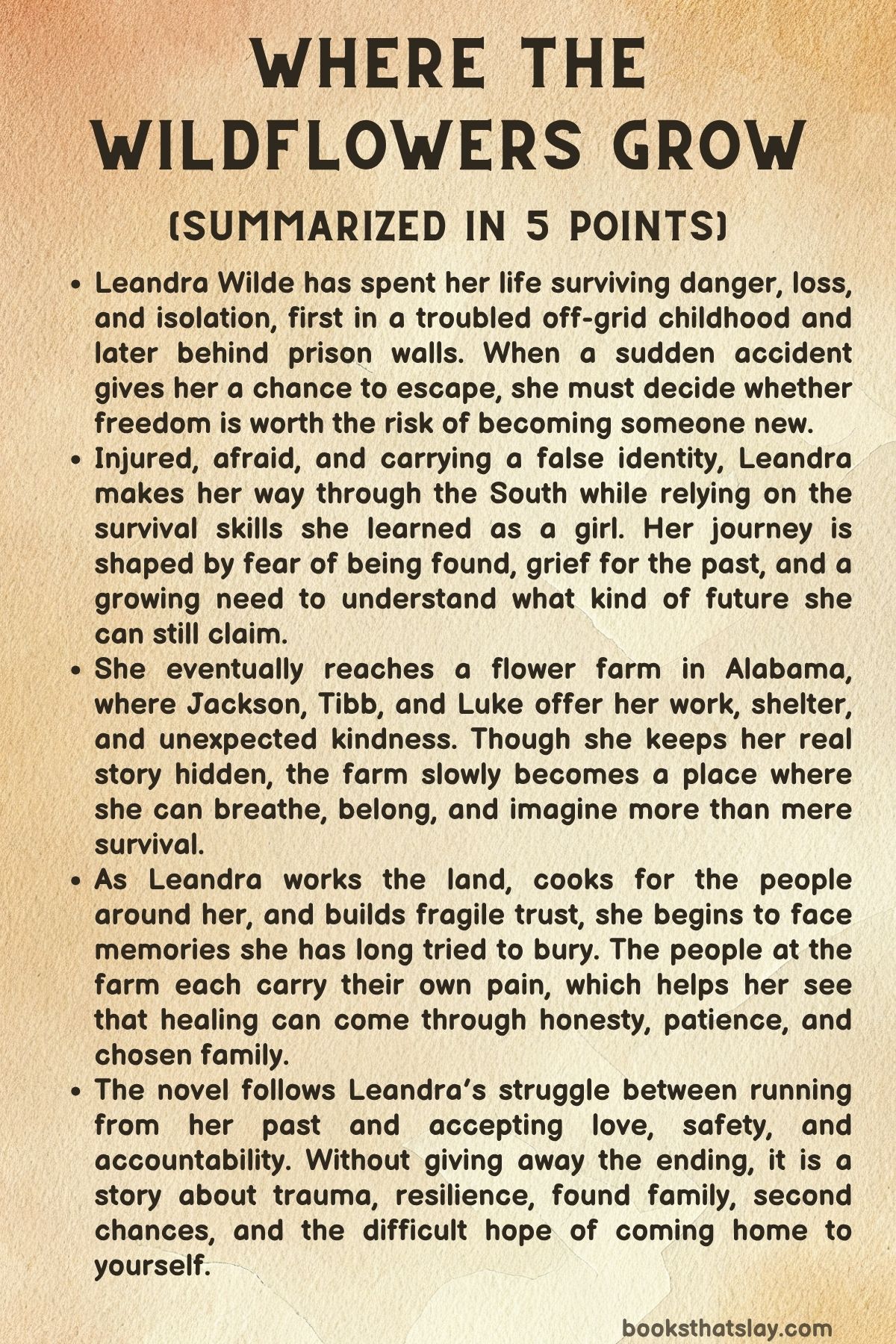
Summary
Leandra Wilde sees her life as divided into separate parts. There was the life before everything broke, the strange and painful space that followed, and then the second life that began after a prison transport bus crashed into a ravine.
She was born into the last branch of the Wilde family and grew up in an isolated trailer in South Carolina with her sister Lila, her mother, and her father. Her childhood was marked by fear, hunger, secrecy, and survival.
Her father was unstable and believed he heard the voices of ancestors. He distrusted the government, kept his family off the grid, and made sure his daughters existed outside normal records.
Leandra and Lila did not have ordinary identities, ordinary schooling, or ordinary safety. They learned how to live from the land because they had to.
Their mother tried to hold the family together, but she also made excuses for their father’s cruelty. She used her beauty and her relationships with men to get food and favors, especially from Deacon Ridley, a powerful and dangerous man.
Ridley’s attention becomes one of the great threats in Leandra’s life. At first he appears as someone who can provide, but his gifts carry control, and his interest in the Wilde family becomes more frightening with time.
In the present, Leandra is a convicted felon being transported with another prisoner, Loretta, and several guards. One of the guards, Officer Madison, has shown Leandra rare kindness during her years in prison.
During the trip, Officer Manziel takes a detour to avoid traffic. A deer appears in the road, and the bus crashes, rolling into a ravine and sinking into the river.
Loretta and two officers drown quickly. Officer Madison is trapped beneath wreckage.
Leandra tries to save her, but the damage is too severe. Instead of abandoning her immediately, Leandra stays with Madison until she dies.
For a moment, she nearly lets herself die too, but some part of her still wants to live. She forces herself to swim to the surface.
When Leandra reaches shore, she is injured, exhausted, and alone. The crash site is hidden by water and debris, so no one knows where the bus is.
Rescue will not come soon. Leandra understands that this moment could become an escape.
She washes herself, burns parts of her prison uniform, makes a fire, catches and cooks a fish, and gathers enough strength to think clearly. She returns to the submerged bus and takes money from the dead officers.
She also finds Officer Madison’s purse and driver’s license. Because Madison resembles her enough to be useful, Leandra sees a possible cover identity.
Leaving the ravine means becoming a fugitive, but staying means returning to prison. She chooses to run.
She reaches Ninety Six, South Carolina, buys clothes and basic supplies, and rents a motel room using Officer Madison’s name. On the news, she learns that authorities are searching for the prison bus in the wrong place.
This gives her a small window of time. The next day, she researches bus routes at the library and buys a Greyhound ticket under the name Leigh Smith, using a version of the nickname her sister Lila once gave her.
As she moves through towns and toward the bus, memories of Lila follow her. Lila was the person Leandra loved most, the person she tried to protect, and the person she believes she failed.
Leandra manages to leave South Carolina by pretending her abusive boyfriend has taken her identification. Her bus later breaks down near Camden, Alabama.
With almost no money and nowhere to go, she sleeps outside at a campground. Walt, the owner, finds her and assumes she is running from an abusive man.
When his regular cleaner is unavailable, Leandra offers to clean cabins. Walt gives her work, food, and a place to sleep.
His kindness is simple and practical, and it helps her survive another day.
In Camden, Leandra meets Jackson, a flower farmer, at a farmers market. His kindness unsettles her because she has learned to distrust gifts, especially from men.
Flowers remind her of Deacon Ridley’s false generosity, so she runs from Jackson at first. Later, when her work with Walt ends and she needs another place to go, she becomes curious about Jackson’s Flower Farm.
She visits the farm and meets Luke and Tibb, two men who work with Jackson and carry their own painful histories. Jackson is trying to expand the farm into a cooperative that can create jobs for Wilcox County.
Leandra, still using the name Leigh, accepts his offer to work there.
At the farm, Leigh lives in a small cabin and works hard preparing land, learning about flowers, and helping with daily tasks. She is guarded and anxious, but the farm gives her a rhythm.
Jackson notices that she is carrying a heavy past, but he does not force her to explain. He invites her on nightly walks and tells her she does not have to speak.
Tibb introduces her to yoga, which helps her feel connected to her body again instead of treating it only as something that must endure pain. Luke brings humor and warmth.
Slowly, the men begin to feel like a found family.
Leigh also begins to care for them through food. She cooks biscuits, sausage, grits, eggs, butter, fried chicken, and pie.
The meals become a language she can manage when words are too hard. Through cooking, she apologizes for being distant and shows gratitude.
Bit by bit, she reveals parts of her past. She tells them that she grew up off the grid, that her parents neglected their children, that she had a sister named Lila, and that Deacon Ridley became a terrible danger to them.
As Leigh’s bond with Jackson grows, so does the pressure of her hidden identity. Luke is badly beaten after confronting his sister Heather’s abusive boyfriend, and Leigh stays beside him through the night.
His pain brings back memories of Lila and of her own helplessness. Later, during a community gathering called Bonfire, Luke reveals his gift for singing.
Jackson gives Leigh a birthday candle and tells her she is light. The group surprises her with cake, offering her a kind of celebration she never truly had.
But Carly, Jackson’s former love, is jealous and suspicious. She warns Leigh not to become a distraction and later begins looking into Tibb’s criminal history, showing that the farm’s peace is fragile.
Jackson’s feelings for Leigh deepen. He gives her one of his family’s cherished Gee’s Bend quilts, a meaningful gift that shows how much she matters to him.
Leigh wants to accept the life being offered, but fear keeps pulling her back. She knows she is living under a false name.
She knows the law could find her. She also believes she does not deserve happiness because she failed to save her family.
At the farm’s wood-chopping area, called the Outlet, Leigh realizes that much of her anger is directed at herself. Jackson admits he knows she sleepwalks and has been watching over her at night to keep her safe.
His confession finally helps her trust him with more of the truth. She tells him that Deacon Ridley came for Lila, trying to force her into marriage to settle their father’s gambling debts.
When the family resisted, Ridley’s men locked them inside their trailer and set it on fire. Leigh escaped, but Lila, her mother, and her father died.
Jackson tells her that she could not have saved them. He repeats it until she begins to hear him.
For the first time, she breaks down in his arms instead of holding the pain alone.
After this, Leigh and Jackson become lovers. Winter passes into spring, and the farm’s expansion moves forward.
The grand opening becomes a success, bringing a large crowd and hope for the future. Jackson tells Leigh he loves her, and she admits she loves him too.
Still, her fugitive life hangs over everything. When disaster threatens the farm and Jackson faces financial ruin, Leigh chooses to sacrifice herself.
She goes to Carly, reveals that her real name is Leandra Wilde, and admits she is an escaped felon. She turns herself in so the reward money can be used to save Jackson’s Flower Farm.
In custody, Leandra reveals the rest of what happened after the fire. Ms. Byrd tried to help her, but Deacon Ridley shot her.
Leandra later watched Ridley die instead of helping him. She buried the bodies, survived in the woods, and was eventually convicted of manslaughter because no one believed her account.
Jackson visits before she is taken away, but she tells him to use the money to rebuild the farm and let her go.
As Leandra is transported back to prison, Jackson fills the road with white lily petals, a final promise of love and remembrance. Sixteen years pass.
When Leandra is finally released, Jackson is waiting for her. He has not forgotten her or stopped loving her.
He brings her home to the Flower Farm, where the life she once thought impossible is waiting, along with their daughter. The story ends with Leandra returning not just to a place, but to the family, love, and future she once believed she had lost forever.
Characters
Leandra “Leigh” Wildes
Leandra “Leigh” Wildes is the central character of Where the wildflowers grow, and her journey is shaped by survival, guilt, secrecy, love, and the painful desire to belong somewhere. At the beginning of the story, she is presented as someone whose life has been broken into separate parts: the life before tragedy, the uncertain in-between, and the second life that begins after the prison bus crash.
This structure immediately shows that Leandra does not experience her life as whole or simple. She is a woman who has endured violence, loss, imprisonment, and disbelief, and every part of her personality is marked by the need to keep moving, stay hidden, and expect danger.
Her childhood off the grid teaches her practical survival skills, but it also deprives her of safety, legal identity, emotional security, and trust in the world. Because of this, Leandra is highly observant, cautious, and self-reliant, yet she is also deeply wounded by the fact that she could not protect the people she loved.
After the crash, Leandra’s actions reveal both her toughness and her humanity. She escapes death through intelligence and endurance, but she does not simply abandon Officer Madison.
She stays with Madison until the guard dies, even though leaving sooner might have helped her own chances. This moment is important because it shows that Leandra is not defined only by her status as a fugitive or convicted felon.
She carries moral weight, compassion, and a strong sense of responsibility, even when the world has refused to see her clearly. Her decision to take Madison’s belongings and use another identity is morally complicated, but it comes from desperation rather than cruelty.
Leandra’s survival is often messy because her circumstances have forced her into impossible choices.
At Jackson’s Flower Farm, Leandra begins to change from someone who merely survives into someone who slowly allows herself to live. Her new name, Leigh, represents both concealment and rebirth.
She is hiding from the law, but she is also discovering parts of herself that prison, trauma, and grief had buried. Her cooking becomes one of her first ways of communicating affection and gratitude.
She does not easily explain her feelings, but she feeds the people around her, and through those meals she begins to create family again. Her work with flowers also mirrors her emotional transformation.
Flowers require care, patience, and belief in growth, and Leigh gradually learns to apply those same ideas to herself.
Leigh’s deepest conflict is her guilt over Lila, Mama, Daddy, Ms. Byrd, and even the deaths connected to Deacon Ridley. She believes she failed because she survived when others did not.
This survivor’s guilt makes her afraid of happiness, as if loving Jackson or becoming part of the farm means betraying the dead. Her relationship with Jackson is therefore not just romantic; it is a confrontation with her belief that she is undeserving of peace.
When she finally tells him the truth about the fire and Ridley, she allows herself to be seen not as a criminal, but as a traumatized survivor. Her final decision to turn herself in so the reward money can save the farm shows both her self-sacrificing love and her continued tendency to pay for happiness with her own freedom.
By the end of the book, her release and return to Jackson suggest that healing does not erase suffering, but it can give suffering a place to rest.
Jackson
Jackson is one of the emotional anchors of the story, a man whose gentleness is not weakness but strength. As a flower farmer, he represents patience, restoration, and the belief that beauty can be cultivated even in difficult soil.
His farm is not only a workplace; it is a vision for renewal, both for himself and for the wider community. His plan to turn the flower farm into a cooperative shows that he is not motivated only by personal success.
He wants to create jobs, hope, and dignity in Wilcox County. This makes Jackson a character connected to growth in a practical, emotional, and social sense.
His relationship with Leigh develops slowly because he understands that she is carrying pain she cannot immediately name. Instead of forcing her to confess, he offers presence.
His nightly walks with her are important because they show his patience and emotional intelligence. He gives her room to be silent, but he also makes it clear that she does not have to carry everything alone.
Jackson’s kindness is different from the manipulative kindness Leigh has known before, especially from Deacon Ridley. He gives without demanding control, and this distinction allows Leigh to slowly trust him.
Jackson is also marked by his own wounds. The book suggests that he, Luke, and Tibb all carry painful histories, which makes the farm a place where damaged people are not fixed instantly but are allowed to continue living with dignity.
Jackson’s love for Leigh is steady and protective without being possessive. When he gives her one of his family’s Gee’s Bend quilts, the gesture carries emotional weight because it connects her to heritage, home, and belonging.
He is not merely attracted to her; he is inviting her into the sacred parts of his life.
By the end of Where the wildflowers grow, Jackson’s faithfulness becomes one of his defining qualities. Even when Leigh turns herself in and tells him to let her go, he does not stop loving her.
The image of him filling the road with white lily petals is a powerful expression of devotion, grief, and promise. Sixteen years later, his waiting proves that his love was not temporary passion but a long commitment.
Jackson’s character represents the kind of love that does not deny the past, but chooses to remain present anyway.
Lila
Lila is Leandra’s beloved sister and one of the most important emotional presences in the book, even though much of her role exists through memory. She represents innocence, family, and the life Leandra could not save.
Growing up in the isolated Wilde household, Lila shares Leandra’s strange and dangerous childhood: the off-grid existence, the unstable father, the mother’s compromises, and the constant threat posed by men like Deacon Ridley. Because the sisters lack ordinary protection from society, their bond becomes one of the few reliable sources of love in Leandra’s early life.
Lila’s importance lies not only in who she is, but in what she means to Leandra. She gives Leandra the nickname that later becomes part of her fugitive identity, showing how deeply Leandra carries her sister within her.
Even when Leandra is trying to disappear, she chooses a name connected to Lila. This suggests that Lila remains a moral and emotional compass for her.
Leandra may be hiding from the law, but she is not trying to erase her sister. Instead, her new identity preserves Lila’s memory in a quiet, painful way.
Lila is also central to the story’s violence because Deacon Ridley’s desire to claim her exposes the full horror of the world around the Wilde family. His attempt to force her into marriage to settle gambling debts shows how vulnerable she is in a society where powerful men can treat poor, isolated women as property.
Lila’s death in the fire becomes the wound that Leandra cannot forgive herself for surviving. In Leandra’s mind, Lila is not just a lost sister; she is proof of Leandra’s failure, even though Jackson later helps her see that she could not have saved everyone.
As a character, Lila functions as the heart of Leandra’s grief. Her memory pushes Leandra toward both despair and tenderness.
When Leigh watches over Luke after his beating, she remembers her helplessness with Lila, showing that Lila’s death continues to shape how Leigh responds to suffering. Lila may not be physically present for most of the story, but her influence is constant.
She is the lost loved one whose absence drives Leandra’s guilt, choices, and eventual longing for redemption.
Deacon Ridley
Deacon Ridley is the main figure of menace in the story, and he represents predatory power disguised as help. At first, his relationship with Leandra’s mother is connected to survival, because he provides food and support to a family living in poverty and isolation.
However, his generosity is never innocent. Like the flowers he gives, his gifts carry manipulation beneath their beauty.
This is why Jackson’s kindness initially unsettles Leandra; Ridley has taught her that gifts can be traps.
Ridley’s danger grows because he understands the Wilde family’s vulnerability. They are isolated, legally invisible, poor, and controlled by a father whose instability leaves them exposed.
Ridley uses this weakness to gain influence over the household. His attempt to take Lila as payment for gambling debts reveals his cruelty and his belief that people, especially women, can be owned.
He is not only personally violent; he is part of a larger pattern of male control, intimidation, and exploitation.
The fire that kills Leandra’s family shows Ridley’s evil most clearly. When his men lock the Wildes inside the trailer and set it burning, Ridley becomes responsible for destroying Leandra’s entire first life.
His later death, which Leandra watches without helping, is morally complex. The act becomes the basis for her conviction, but within the story it is also tied to trauma, fear, rage, and the knowledge that Ridley has already taken almost everything from her.
Leandra’s failure to save him cannot be separated from the fact that he created the nightmare in which she was trapped.
Ridley’s role is important because he shapes Leandra’s distrust long after he is gone. His manipulation makes her suspicious of Jackson’s flowers.
His violence makes her believe safety is temporary. His treatment of Lila and her mother leaves Leandra with a deep fear of men who offer protection while secretly seeking control.
Ridley is therefore not just an antagonist in the past; he is a shadow over Leandra’s present, influencing how she interprets kindness, desire, and danger.
Leandra’s Father
Leandra’s father is a disturbing and tragic figure whose instability shapes the Wilde family’s isolation. He hears voices he calls “ancestors,” distrusts the government, and keeps his family off the grid.
His beliefs may come from fear, paranoia, or mental illness, but regardless of the cause, they create a dangerous environment for his wife and daughters. By refusing ordinary systems of identity and protection, he leaves Leandra and Lila legally invisible and socially vulnerable.
The survival skills he teaches them are useful, but they come at a terrible cost.
His character is complicated because he is not presented only as useless or monstrous. He does pass down knowledge that later helps Leandra survive after the bus crash.
She knows how to build fires, catch food, endure discomfort, and move through the natural world because of the strange upbringing he imposed on her. However, the same upbringing also deprives her of normal safety.
His survivalism prepares her for crisis while also helping create the crisis of her life.
As a father, he fails because he cannot protect his family from his own violence, delusions, or debts. His gambling debts are especially important because they directly contribute to Ridley’s attempt to claim Lila.
This shows that his failures are not only emotional but practical and moral. He may distrust outside power, but he exposes his family to a more immediate and deadly power in Ridley.
His inability to face reality traps the family in danger.
Leandra’s father represents the damage caused when fear becomes a household law. His paranoia teaches his daughters how to survive outside society, but it also cuts them off from help when they need it most.
In the book, he is part of the tragedy of Leandra’s first life: a man who may believe he is protecting his family, yet whose choices help destroy them.
Leandra’s Mother
Leandra’s mother is a painful character because she is both victim and participant in the family’s harm. She lives under the control and violence of Leandra’s father, but she also excuses him and tries to keep the household functioning under impossible circumstances.
Her beauty and relationships with men, especially Deacon Ridley, become survival tools. She uses what power she has to keep her daughters fed, but that power is limited and dangerous because it depends on men who can exploit her.
Her relationship with Ridley shows the desperate choices available to her. She does not appear to have real independence, money, or social support.
In that situation, accepting Ridley’s help may seem necessary, but it also brings a predator closer to her daughters. This makes her morally complicated.
She is not simply careless, because she is trying to survive, but she is also unable to fully protect Lila and Leandra from the danger she allows into their lives.
As a mother, she is marked by endurance. She tolerates violence and instability, perhaps because she sees no clear escape.
However, her endurance does not become liberation. Instead, it becomes part of the prison in which the family lives.
Leandra’s memories of her mother are therefore likely filled with mixed emotions: love, pity, anger, and sorrow. Her mother is someone Leandra loses, but also someone whose choices Leandra must struggle to understand.
In the larger story, Leandra’s mother represents the way poverty and abuse can trap a person into compromises that harm the next generation. She is not the villain, but she is not able to be the protector Leandra and Lila need.
Her death in the fire deepens Leandra’s grief because it ends any possibility of understanding, forgiveness, or repair between mother and daughter.
Officer Madison
Officer Madison is a significant character because she brings humanity into a place where Leandra expects none. As a prison guard, she belongs to the system that confines Leandra, yet she treats her with unusual kindness.
This makes Madison stand out in Leandra’s prison life. She is not merely an officer; she is one of the few people who sees Leandra as human before the crash.
Her death in the bus wreck becomes one of the first major moral tests in the story. Leandra could abandon her immediately and focus only on escape, but she stays with Madison while trying to free her.
When she cannot save her, she remains with her until death. This scene reveals Madison’s importance less through what she does and more through what she awakens in Leandra.
Madison’s kindness has mattered enough that Leandra cannot treat her as disposable.
Madison also becomes part of Leandra’s escape because Leandra takes her purse and driver’s license, using their resemblance as cover. This creates a morally uneasy connection between them.
Leandra honors Madison by staying with her, but she also uses Madison’s identity to survive. The contradiction fits the book’s larger moral world, where survival often forces choices that are neither clean nor simple.
As a character, Madison represents compassion inside an unforgiving system. Her presence reminds the reader that individual kindness can exist even within institutions that have harmed Leandra.
Her death also marks the beginning of Leandra’s fugitive life. In a symbolic sense, Madison becomes part of the bridge between Leandra’s prison identity and Leigh’s uncertain new life.
Loretta
Loretta is another prisoner on the transport bus, and though her role is brief, she helps establish the danger and randomness of the crash. Her death shows how quickly life can vanish in the story’s world.
Unlike Leandra, Loretta does not get a second chance after the bus sinks. This contrast emphasizes the strange burden of Leandra’s survival.
Leandra lives not because she is innocent of suffering, but because she fights, endures, and is lucky in a moment when others are not.
Loretta’s presence also reminds the reader that Leandra is part of a larger population of imprisoned women whose stories may never be fully known. The book focuses on Leandra, but Loretta’s death hints at other lives interrupted by the same system and the same accident.
She is not developed in the same depth as Leigh or Jackson, but her loss contributes to the grim atmosphere of the crash.
In Leandra’s journey, Loretta becomes one of the dead left behind in the river. Her death adds to the moral and emotional weight of Leandra’s escape, because Leandra’s freedom begins in a scene of mass death.
This makes the beginning of her second life feel haunted rather than triumphant. Loretta’s character, though minor, helps show that survival in the story is never simple victory.
Officer Manziel
Officer Manziel is important because his decision to detour the prison transport bus sets the crash in motion. He is not developed as deeply as the central characters, but his action becomes one of the story’s turning points.
The detour, meant to avoid traffic, leads the bus toward disaster when the deer appears and the vehicle crashes into the ravine. In this way, Manziel represents the role of chance and human decision in Leandra’s fate.
His character also shows how institutions can be shaped by ordinary choices that have extraordinary consequences. A route change, a moment of driving, and a sudden animal in the road become the circumstances that open the possibility of Leandra’s escape.
The crash is not planned by Leandra, which matters because her fugitive life begins not with a calculated breakout but with a catastrophe.
Manziel’s role is mostly functional, but it is still meaningful. He belongs to the system transporting Leandra away, yet his decision accidentally creates the conditions for her second life.
The story uses him to show how fate can arrive through small, practical choices that no one fully understands until it is too late.
Walt
Walt is the campground owner who gives Leigh one of her first chances after she flees. His kindness is practical rather than dramatic.
He finds her when she is stranded and vulnerable, and instead of turning her away, he offers her food, work, and shelter. Like several good characters in the book, Walt assumes she is fleeing an abusive man, and that assumption shapes his willingness to help.
Even though he does not know the full truth, his compassion gives Leigh time to recover and decide what to do next.
Walt’s importance lies in the fact that he becomes a temporary safe harbor. Leigh is broke, injured, and uncertain when she reaches Camden, and Walt’s campground allows her to pause without immediately being consumed by fear.
He does not become her permanent family, but he makes the next stage of her life possible. Without his help, she might not have remained in the area long enough to find Jackson’s Flower Farm.
His character represents ordinary decency. He is not shown as someone trying to rescue Leigh in a grand way.
Instead, he gives her work and treats her like a person capable of earning her place. This matters deeply for Leigh, who has been treated by the law as a criminal and by her past as a victim.
Walt’s simple trust becomes one of the first steps in restoring her sense of usefulness.
Jackson’s Flower Farm
Although the farm is not a person, it functions almost like a character in the novel because it gathers wounded people and gives them a place to grow. It is where Leigh, Jackson, Luke, and Tibb form a found family, and it becomes the physical expression of Jackson’s hope.
The farm is built around flowers, labor, cooperation, and community, all of which contrast sharply with Leandra’s childhood of isolation, violence, and secrecy.
For Leigh, the farm becomes the first place where she experiences belonging without blood ties. She works, cooks, learns, rests, and slowly becomes known there.
Its cabins, fields, meals, and nighttime walks give her a rhythm of life that prison and survival never allowed. The farm’s beauty does not erase her trauma, but it gives her a new environment in which healing becomes possible.
The farm also raises the stakes of Leigh’s love. When disaster threatens it, she chooses to turn herself in so the reward money can save it.
This shows that the farm has become more than Jackson’s dream; it has become Leigh’s proof that something good can come from broken lives. In that sense, the farm is one of the emotional centers of Where the wildflowers grow.
Luke
Luke brings warmth, humor, music, and vulnerability into the found family at the farm. At first, he helps Leigh feel accepted through his easygoing nature.
His humor softens the atmosphere and gives her a way to belong without having to immediately explain herself. Because Leigh is guarded and afraid of being known, Luke’s friendliness matters.
He makes the farm feel less like a place where she is being watched and more like a place where she might be welcomed.
However, Luke is not merely comic relief. His own pain becomes visible through his relationship with his sister Heather and his anger toward her abusive boyfriend.
When he gets drunk and is badly beaten after confronting the man, the story reveals his helplessness and rage. He wants to protect Heather, but like Leigh with Lila, he cannot fully control the danger faced by someone he loves.
This parallel deepens Leigh’s connection to him, because his suffering reflects one of her own deepest wounds.
Luke’s singing at Bonfire reveals another side of him. His gift as a singer suggests that he carries beauty inside him despite his pain.
This makes him similar to the farm itself: damaged, imperfect, but capable of producing something moving and alive. His music gives the group a moment of shared feeling, and it helps Leigh see that each person at the farm has hidden depths.
As a character, Luke represents the mixture of joy and grief that defines the found family. He is funny, loving, reckless, talented, and wounded.
His presence helps Leigh learn that broken people can still laugh, sing, and care for each other. He also helps show that protection is not always successful, but love still matters even when it cannot prevent harm.
Tibb
Tibb is one of the steady presences at Jackson’s Flower Farm, and his role in Leigh’s healing is quiet but important. He introduces her to yoga, which helps her reconnect with her body after years of trauma, imprisonment, and survival.
For Leigh, the body has often been something to push, hide, punish, or force through danger. Through Tibb’s influence, she begins to experience her body as something that can breathe, stretch, settle, and belong to her again.
Tibb’s own past is also marked by pain and judgment. Carly later digs into his criminal history, showing that he, like Leigh, carries a record that can be used against him.
This makes Tibb an important mirror for Leigh. He is proof that a person’s past does not have to be the only truth about them.
At the farm, he is not reduced to his mistakes or history. He is part of the household, part of the work, and part of the emotional life of the group.
His character contributes to the book’s larger theme of found family. Tibb does not need to dominate scenes to matter.
His steadiness, care, and acceptance help create the atmosphere that allows Leigh to soften. He is one of the people who makes the farm feel safe not through speeches, but through repeated acts of presence.
Tibb also challenges the reader’s assumptions about guilt and redemption. If Carly sees his past as a weapon, the farm sees him as a whole person.
This contrast is central to the story’s moral vision. Tibb’s character helps argue that people who have been marked by the justice system, trauma, or shame still deserve community, dignity, and a chance to grow.
Carly
Carly is Jackson’s former love and one of the main sources of tension in Leigh’s new life at the farm. Her jealousy and suspicion make her an obstacle to Leigh’s fragile sense of belonging.
Unlike Jackson, Luke, and Tibb, Carly does not simply accept Leigh’s presence. She sees Leigh as a threat, both romantically and perhaps socially, because Leigh’s arrival disrupts the life Carly understands and the connection she may still want with Jackson.
Carly’s suspicion is not entirely baseless, since Leigh is indeed hiding a serious truth. This makes Carly more complex than a simple jealous rival.
She senses that something about Leigh does not add up, but her response is controlling and invasive rather than compassionate. Her warning to Leigh not to become a distraction shows that she views Jackson’s dream as something Leigh might damage.
Later, her decision to dig into Tibb’s criminal past reveals how willing she is to use people’s histories against them.
Her role becomes especially important when Leigh chooses to reveal the truth to her. Leigh goes to Carly, admits that she is Leandra Wildes, and turns herself in so the reward money can save the farm.
This moment transforms Carly from a suspicious outsider into the person through whom Leigh’s sacrifice becomes possible. Carly may not be emotionally generous, but she becomes part of the mechanism that saves Jackson’s dream.
As a character, Carly represents judgment, possessiveness, and the social danger of being exposed. She reminds Leigh that the life she has built at the farm is fragile because secrets can be uncovered and pasts can be weaponized.
At the same time, Carly’s presence forces Leigh to confront the truth that love built on concealment cannot remain untouched forever.
Heather
Heather is Luke’s sister, and her situation echoes the abuse and helplessness that define much of Leigh’s past. She is trapped in a relationship with an abusive boyfriend, and Luke’s attempt to protect her leads to his beating.
Although Heather is not developed as deeply as Leigh or Lila, her role is emotionally significant because she reflects the recurring pattern of women endangered by violent men.
Through Heather, the story shows that the kind of violence Leandra experienced is not isolated in the past. It continues in other lives and other families.
Luke’s desperation to defend Heather parallels Leandra’s grief over Lila. Both characters love someone who is threatened, and both are forced to confront the painful truth that love alone cannot always rescue another person from danger.
Heather’s presence also helps reveal Luke’s character. His humor and warmth are balanced by anger, fear, and protectiveness when it comes to his sister.
Because of Heather, readers see the depth of Luke’s loyalty and the limits of his control. Her situation adds another layer to the book’s exploration of abuse, survival, and the emotional cost of trying to save someone.
Ms. Byrd
Ms. Byrd is a crucial figure because she is one of the people who tries to help after the fire. Her attempt to assist Leandra shows that kindness does exist outside the immediate circle of the Wilde family, but her death also reinforces the danger of Ridley’s violence.
When Ridley shoots her, the story makes clear that anyone who stands between him and control can become a target.
Ms. Byrd’s role is brief but morally important. She represents intervention, compassion, and the possibility that Leandra might have been believed or protected.
Her death destroys that possibility and leaves Leandra even more alone. This helps explain why Leandra later survives in the woods, buries the bodies, and becomes trapped in a legal story no one believes.
Ms. Byrd might have been a witness or helper, but Ridley’s violence silences her.
For Leandra, Ms. Byrd’s death adds another layer of guilt and trauma. She is not only grieving her family; she is also carrying the memory of someone who tried to help and was killed.
This deepens the injustice of Leandra’s conviction because the truth of what happened becomes buried with the dead. Ms. Byrd stands as a reminder of how close Leandra came to rescue, and how brutally that rescue was taken away.
Themes
Survival as a Way of Life
Leandra’s survival is not presented as a single dramatic act but as a habit shaped by years of fear, poverty, isolation, and violence. Long before the crash, she learns how to live without safety, without records, without reliable adults, and without the protection most children expect.
Her father’s extreme beliefs and her mother’s helpless compromises force her to understand the world as dangerous. After the prison bus accident, those old lessons become the reason she lives.
She makes fire, finds food, hides her identity, reads people carefully, and keeps moving even when her body is injured and exhausted. Yet Where the wildflowers grow also shows that survival can become its own prison.
Leandra knows how to escape danger, but she does not know how to trust peace. At Jackson’s farm, survival slowly changes meaning.
It is no longer only about hiding, running, or staying alive. It becomes learning to eat with others, accept care, work toward a future, and believe that life can hold more than fear.
Guilt, Trauma, and the Burden of the Past
Leandra carries guilt as if it were proof of her failure, even when the events of her past show how powerless she truly was. The deaths of Lila, her parents, Ms. Byrd, and Ridley leave her trapped in a painful belief that she should have done more.
This guilt shapes her silence. She hides not only because she is a fugitive, but because telling the truth would mean facing the parts of herself she has judged for years.
Her sleepwalking, fear, anger, and emotional distance show trauma working through the body before it can be spoken aloud. Jackson’s patience matters because he does not demand confession as payment for kindness.
He gives her room to speak when she is ready. When she finally tells him what happened, the act does not erase her pain, but it breaks her isolation.
The novel suggests that healing begins when a person stops carrying blame alone and allows another person to witness the truth with compassion.
Found Family and the Possibility of Belonging
Leandra’s biological family is marked by love, danger, neglect, and helplessness, so belonging is never simple for her. She loved Lila deeply, but her childhood taught her that family could also mean hunger, secrecy, fear, and being failed by the people meant to protect her.
At Jackson’s Flower Farm, she enters a different kind of household, one built through choice rather than blood. Jackson, Tibb, and Luke do not immediately fix her life, but they make space for her.
Their acceptance is shown through ordinary acts: meals shared at a table, work done side by side, walks in silence, jokes, birthday cake, and quiet protection. Leandra begins to contribute through cooking and labor, which allows her to belong without first having to explain everything.
This found family gives her a new model of love, one where care is not used to control or trap her. By the end, home becomes something she can return to, not something she must escape.
Love, Sacrifice, and Redemption
Love in Where the wildflowers grow is deeply tied to sacrifice, but the novel separates real love from possession and manipulation. Ridley’s gifts and attention are dangerous because they come with control, debt, and violence.
Jackson’s love is different because it is patient, steady, and respectful of Leandra’s fear. He offers presence rather than pressure.
Their relationship gives Leandra a reason to imagine a future, yet it also forces her to confront the harm her hidden identity could bring to the farm and the people who have protected her. Her decision to turn herself in is painful because it costs her the freedom she has fought to keep.
Still, it is also an act of agency. She chooses to save the farm and protect the people she loves, rather than keep running.
Redemption here does not mean avoiding punishment or pretending the past never happened. It means accepting truth, taking responsibility, and trusting that love can endure separation, time, and suffering.